Friday, December 12, 2008

Three More Speeches from Julius Caesar in The Cosby Show

“Shakespeare.” By Matt Robinson. Perf. Bill Cosby, Phylicia Rashad, Malcolm-Jamal Warner, Roscoe Lee Brown, Christopher Plummer, and Carl Anthony Payne, II. Dir. Jay Sandrich. The Cosby Show. Season 4, episode 5. NBC. 22 October 1987. DVD. Urban Works, 2007.

On a more serious note, The Cosby Show brought us three speeches from Julius Caesar, one of which is delivered by Rosco Lee Brown, who played Polonius in the Campbell Scott Hamlet. Another is delivered by Christopher Plummer—the Christopher Plummer.

As the family members gather after dinner, each of them conveniently facing the audience, we get these three speeches (well, two speeches, really, divided among three main speakers):
  1. Cassius' "Why, man, he doth bestride the narrow world / Like a Colossus" (I.ii.135-50).

  2. Cassius' speech continued:  "Age, thou art sham'd / Rome, thou has lost the breed of noble bloods" (I.ii.150-61).

  3. Caesar's "Let me have men about me who are fat" (I.ii.192-212)
Is this an education in cultural literacy?  Is it the indoctrination of our youth in the language of Shakespeare?  Or is it merely a convenient and typical sit-com device?


Links: The Show at IMDB.

Click below to purchase
every single season of The Cosby Show
from amazon.com
(and to support Bardfilm as you do so).

Thursday, December 11, 2008

The Cosby Show Raps Julius Caesar

“Shakespeare.” By Matt Robinson. Perf. Bill Cosby, Phylicia Rashad, Malcolm-Jamal Warner, Roscoe Lee Brown, Christopher Plummer, and Carl Anthony Payne, II. Dir. Jay Sandrich. The Cosby Show. Season 4, episode 5. NBC. 22 October 1987. DVD. Urban Works, 2007.

The Cosby Show moved from Macbeth in its second season to Julius Caesar in its fourth. After spending some time complaining about how boring Shakespeare is, the two young scholars (Theo and Cockroach) begin to realize that it makes sense after all. As a culmination of this epiphany, they perform a rap version of Mark Anthony's "Friends, Romans, Countrymen" speech.

It's not difficult to find rap versions of Shakespeare plays—and not many of those rise to the top. This one seems fairly straightforward—pretty route—at first.  But listen to the lyrics (and read them—they're printed below). There are some genuinely interesting and inventive devices here.

For example, Anthony's "And Brutus is an honourable man" is transmuted into "Brutus is cool." In itself, that's nothing. But it's placed in a half line with no rhyming line to accompany it, and the effect is (as it is in Shakespeare) to call our attention to the line and to invite us to question its truthfulness.

Additionaly, there's a majesty and magic in the rhythm, cadence, and alliteration of "Caesar was about to run Rome to ruin" and "Caesar said, 'No, baby,' and turned the crown down." Marvelous, that. Really.


Lyrics to the The Cosby Show's "Julius Caesar Rap" (a.k.a. "Mark Anthony's Rap"):
Theo:
I say, friends!

Cockroach:
Uh, let me hold your ear.

Theo:
And Romans!

Cockroach:
Uh, let me hold your ears.

Theo:
I say, countrymen!

Cockroach:
Uh, let me hold your ears.

Theo:
Now, I’m Marcus Antonius, but they call me Mark
I didn’t come to bite, you see, I came to bark.
About the holes that the brothers put in Julius C—
As far as I’m concerned, it was cool with me.
You see, Brutus and the boys must have know what they were doin’;
Caesar was about to run Rome to ruin.
’Cause Brutus is cool . . . [Breakdown.]

Cockroach:
All Caesar did was to Romanize the world
And put some bronze in the palm of every boy and girl
But the man’s so chill that when they handed him the crown,
Caesar said . . .

Theo:
“No, Baby.”

Cockroach:
. . . and turned the crown down.
But Brutus, he said, he said he’s into greed,
Which is how he justified the Ides of March deed.
But Brutus is cool . . . [Breakdown.]

Theo:
I say, Chill, homeboy, my heart’s with Dr. J.

Cockroach:
So let’s get busy ’til he comes this way.

Theo:
Doctor was taken to the bridge!

[Said bridge occurs.]

Theo:
Now the last little Caesar scene before homeboy blew

Cockroach:
Was to drop some old gold on each one of you

Theo:
J.C. was your father.

Cockroach:
J.C. was your brother.

Theo:
And what I want to know . . .

Cockroach:
When comes such another?

Both:
Great Caesar’s ghost! Great Caesar’s ghost!

Cockroach:
He’s chilling most . . .

Theo:
From coast to coast!

Both:
Great Caesar’s ghost! Great Caesar’s ghost!
He’s chilling most from coast to coast!

Links: The Show at IMDB. Brief Previous Post on the Subject.

Click below to purchase
every conceivable season of The Cosby Show
from amazon.com
(and to support Bardfilm as you do so).

Wednesday, December 10, 2008

The Cosby Show Presents . . . Macbeth

“Theo and Cockroach.” By Thad Mumford. Perf. Bill Cosby, Phylicia Rashad, Malcolm-Jamal Warner, and Carl Anthony Payne, II. Dir. Jay Sandrich. The Cosby Show. Season 2, episode 15. NBC. 30 January 1986. DVD. Urban Works, 2007.

The Cosby Show, a smart and funny (and sometimes sophisticated) family comedy, integrates Shakespeare into its plots twice.  In the second season, Theo and Cockroach try to listen to an LP of Macbeth instead of reading the play.  In the fourth season, they perform a rap version of Mark Anthony's "Friends, Romans, Countrymen" speech—more on that anon.

The clip below shows the expressions on their faces as they try to make sense out of the lines as they hear them.  I've see that expression!  I've worn that expression, come to think of it!  But hearing the plays aloud can be enormously helpful to understanding them.

Of course, here at Bardfilm, we generally advocate the integration of Shakespeare and film—not Shakespeare and the delightfully-retro LP format.  That makes the following clip delightfully-meta-theatrical:  the medium of film is being used to show a completely aural version of what is often staged—or turned into the medium of film itself.


Links: The Show at IMDB.  Brief Previous Post on the Subject.

Click below to purchase
every available season of The Cosby Show
from amazon.com
(and to support Bardfilm as you do so).

Tuesday, December 9, 2008

Do You Glory in your Wealth?

 Great River Shakespeare Festival. Winona, Minnesota.
If you glory in your wealth, then here's a worthy cause to help you spread it around a bit! The Great River Shakespeare Festival has kindly asked for whatever support you may be able to offer. Their appeal can be found here.

I've written about the festival before.  It's marvelous.  It's wonderful.  And it needs support.  As you consider your end-of-year giving, consider the GRSF.  It's a marvelous company offering marvelous Shakespeare to the many-headed of Minnesota and the surrounding area.
Sonnet 91 (edited somewhat)

Some glory in their birth, some in their skill,
Some in their wealth, some in their bodies' force,
Some in their garments, though new-fangled ill,
Some in their hawks and hounds, some in their horse.
All of them donate to the Great River Shakespeare Festival.

Star Trek's Midsummer Night's Dream

“Time’s Arrow, Part 2.” By Jeri Taylor. Perf. Patrick Stewart, Jonathan Frakes, LeVar Burton, Michael Dorn, Gates McFadden, and Brent Spiner. Dir. Les Landau. Star Trek: The Next Generation. Season 6, episode 1. Syndicated television. 21 September 1992. DVD. Paramount, 2002.

Shakespeare can be used as an excuse or a distraction. In this clip, it's both. It serves as an excuse to explain the odd behavior of the crew of the Enterprise, who have travelled back in time to Mark Twain's San Franscisco. Ah, they're actors! Putting on a Shakespeare play! What could be more natural? It also serves as a distraction to the comic-relief-providing landlady, who keeps popping in at inopportune moments to demand the rent.

Many of the actors in the Star Trek franchise have performed in Shakespeare elsewhere (Patrick Stewart being the most noted example). I wonder what Data would be like as Puck in a more complete production of the play. Hmmmmm. Well, until that happens, we have his "Wither wander you?" to contemplate:


For more connections between Star Trek and Shakespeare, head to Shakespeare and Star Trek Complete.

Click below to purchase the DVDs from amazon.com
(and to support Bardfilm as you do so).

Monday, December 8, 2008

Shakespeare i' th' News: Recent Activity

Many an article and various.
An alert reader (thanks again, Dad!) has provided me with a number of links to Shakespeare news.

First, an article on the RSC's decision to stop using the real skull they have been using in the David Tennant / Patrick Stewart Hamlet.

Those familiar with Slings and Arrows will wonder whether life is imitating art or art life.  Or both.  

Next, an article theorizing that the reason Shakespeare retired to Stratford and stopped writing plays was Miltonic in the extreme: He was going blind from years of trying to read his own handwriting.  

I have often thought that the reason his signatures (all from near the end of his life) were so cramped was because of some Jacobean strain of carpel tunnel syndrome—not because the man from Stratford was barely literate, as many anti-Stratfordians claim.  But I hadn't considered that his eyesight might have been failing as well.  

Finally, an article on David Tennant, including information about his decision to give up playing the Doctor and his thoughts about the RSC production moving to London for the remainder of its run.

A Disgruntled Patrick Stewart Complains about 
all the Attention that David Tennent is Getting.

Links: Previous entry about David Tennant as Hamlet.

Countdown to the End of Shakespeare and Star Trek Week

“In a Mirror, Darkly, Part II.” By Mike Sussman. Perf. Scott Bakula, Jolene Blalock, and John Billingsley. Dir. James L. Conway. Star Trek: Enterprise. Season 4, episode 19. United Paramount Network. 29 April 2005. DVD. Paramount Home Video, 2005.

As the Star Trek franchise grew and expanded, it took Shakespeare with it. However, it seems to have confined him to an alternate universe.

I've mentioned this episode before, but I did not provide, at that point, a video clip of the scene.

In this episode, we're placed in an alternate universe, and a ship from the regular Star Trek universe has found its way there as well. The universe of the episode is harsh and unrelenting—and it doesn't care for Shakespeare! I suppose that's one way to tell the difference between the good guys and the bad guys: Tell me what you do with Shakespeare and I will tell you what you are (to paraphrase Brilliat-Savarin).

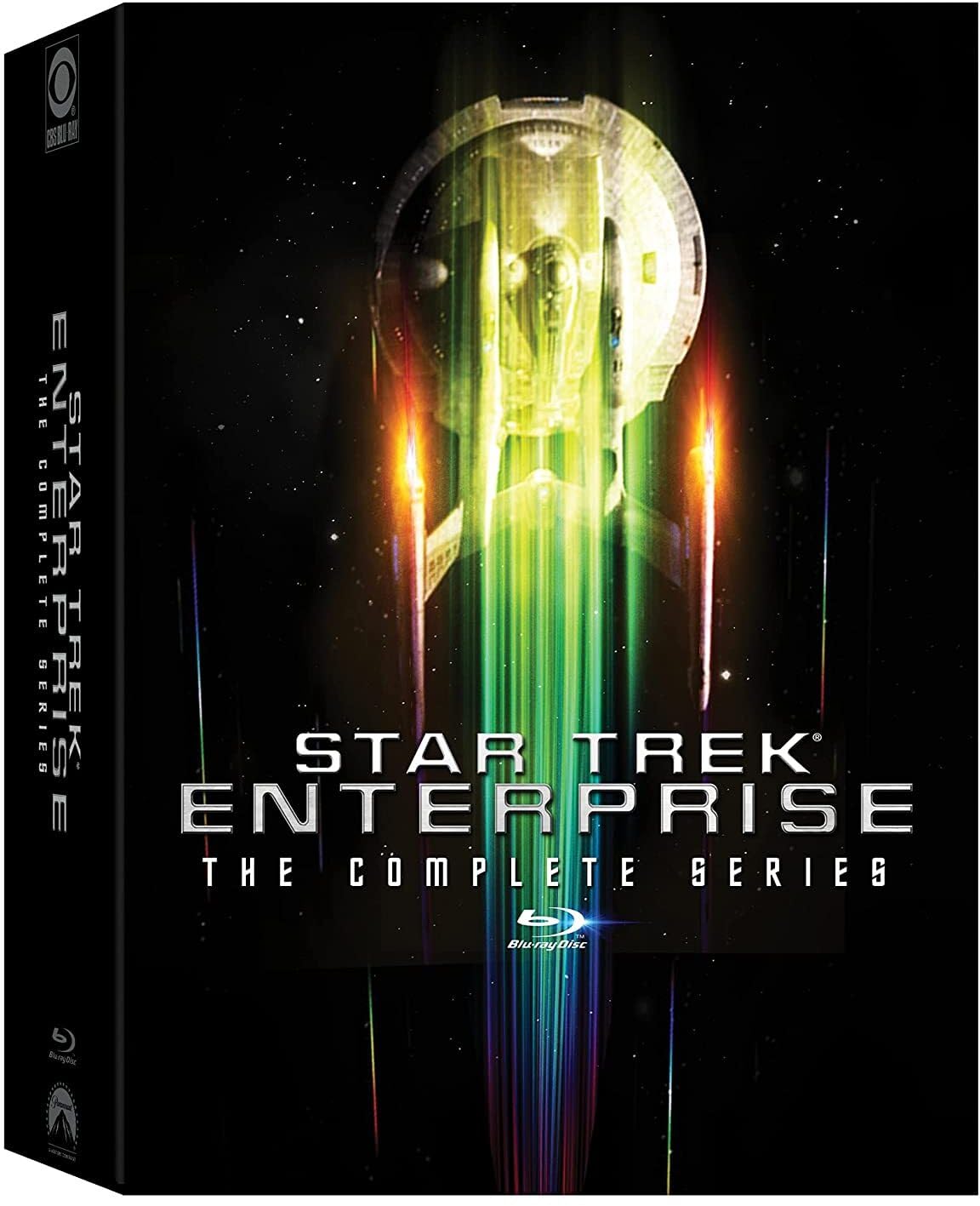
But the fact that this is the only reference to Shakespeare in the entire Star Trek: Enterprise series (a prequel to The Original Series) isn't enough to redeem the series. The only way I managed to choke my way through it was by watching it at three times the speed with the subtitles on. At that speed, it's actually not a bad show!

This is the last known reference to Shakespeare in the Star Trek universe—but I couldn't bear to end with it.  I plan two posts to wrap up this subject—look for them soon at a blog near you! Actually, this blog.

I wanted to compare our major works with their counterparts in the other universe. . . . The stories were similar in some respects, but their characters were weak and compassionate. With the exception of Shakespeare, of course. From what I could tell, his plays were equally grim in both universes.

For more connections between Star Trek and Shakespeare, head to Shakespeare and Star Trek Complete.

Click below to purchase the DVDs from amazon.com
(and to support Bardfilm as you do so).

Saturday, December 6, 2008

What to Buy the Shakespeare Scholar on your List for Christmas

Hamlet 2. Dir. Andrew Fleming. Screenplay by Pam Brady and Andrew Fleming. Perf. Steve Coogan, Catherine Keener, David Arquette, and Elisabeth Shue. 2008.  DVD.  Universal Studios, 2008.

Although I wasn't able to see it in theatres, I'm looking forward to seeing Hamlet 2 on video.  I've written as much before.

And If
I'm looking forward to it, I know that the Shakespearean you know best is also looking forward to it. Fortunately, it's being released in time for Christmas (the release date is December 21)!  And if enough of you buy it for your SSS (Special Shakespearean Someone), it will enable me to buy it for myself! We all win!  Click below to put it in your cart right away (so you don't forget):


Links: Trailer. Official site. Previous Post One. Previous Post Two. Previous Post Three. The Film at IMDB.

Click below to purchase the film from amazon.com
(and to support Bardfilm as you do so).

To the Victor Belong the Spoils. And Second Place isn't Bad, Either!

Jones, Keith. "Prince Hamlet's Haiku."
You may recall that I entered a Haiku Competition.  Most marvelously, I was awarded second place!

I couldn't be more thrilled!

[Well, actually, I could be a little more thrilled—first place was a MacAir, and that would please me no end!  But the first place haiku was certainly deserving.]

For your convenience, I'm reprinting my haiku below. And I'll let you all know when the big book deal comes through—the complete works of Shakespeare in forty haiku (I'll include all the plays, the major poems, and the sonnets). Look for it.
Prince Hamlet's Haiku

A wandering ghost—
My dead father cries “Uncle!”
I must have revenge.

For more Shakespearean haiku, see The Complete Works of William Shakespeare in Haiku.

Friday, December 5, 2008

It was a television show. Take it for all in all, we shall not look upon its like again.

“The Most Toys.” By Shari Goodhartz. Perf. Patrick Stewart, Jonathan Frakes, LeVar Burton, Michael Dorn, Gates McFadden, and Brent Spiner. Dir. Tim Bond. Star Trek: The Next Generation. Season 3, episode 22. Syndicated television. 5 May 1990. DVD. Paramount, 2002.

We return to Shakespeare and Star Trek with a moment that most of the commentators have missed.

In this episode, Data is stolen away by an enormously devoted Trekkie, but the other members of the crew think he has blown up. Captain Picard, glancing at a copy of Shakespeare he had previously given Data, finds a bookmark on the page where Horatio questions Hamlet about Hamlet's father. It becomes a statement on the humanity of Data:


For more connections between Star Trek and Shakespeare, head to Shakespeare and Star Trek Complete.

Click below to purchase the DVDs from amazon.com
(and to support Bardfilm as you do so).

A Brief Foray Back to Shakespeare in Monty Python Before Returning to Shakespeare and Star Trek Week

“Hospital for Overactors.” “Spam.” By Monty Python et al. Perf. Terry Gilliam, John Cleese, Graham Chapman, Terry Jones, Michael Palin, and Eric Idle. Monty Python’s Flying Circus. Episode 25. BBC. 15 December 1970. DVD. New Video, 1999.

This clip speaks for itself, but we could note that overacting and underacting Shakespeare are equally poor versions of Shakespeare. I'm fond of the Olivier-inspired Richards the III (Richard the IIIs?) in the Richard the III ward:


Links: Monty Python's Official Site.

Click below to purchase the complete Flying Circus from amazon.com
(and to support Bardfilm as you do so).

Thursday, December 4, 2008

Post-Colonial Shakespeare—Exciting, Intriguing, and Unexpected!

Doctor Dolittle. Dir. Richard Fleischer. Perf. Rex Harrison, Samantha Eggar, Anthony Newley, Richard Attenborough, and William Dix. 1967. DVD. 20th Century Fox, 2000.

As promised, here is a much more interesting, much more delightful, still quite thoughtful video contemplation of post-colonial Shakespeare.

I was delighted to watch Doctor Dolittle (the 1967 version with Rex Harrison) recently. It's delightful—it's weird—and it had some Shakespearean allusions, too! Perfect!

In this scene, the Doctor and his companions have been captured by the indigenous people of an immense floating island on which they have been shipwrecked. They've been taken to a sort of holding cell and—well, see for yourself (I'll add some commentary later):


There are so many interesting things about that clip that I don't know quite where to begin.

First, there's interest in the humor of the presentation. When William Shakespeare the Tenth says, "What a funny accent!" it's funny because it's unexpected. Naturally, it shouldn't be unexpected that someone looking very different from Doctor Dolittle should speak English, but we're set up to find it unexpected. Still, when we laugh, it's troubling because of the way we've been deceived.

Second, we're presented with this idyllic picture of a culture with its own sophistication, it's own deeply-considered ways of doing things, and its own heritage. But those things—that culture—isn't exactly indigenous! One of their favorite authors is William Shakespeare! Is this just a legacy of a colonial period now faded?

Third, we're on an island. A floating island! (And not the desert—for which, q.v.). That's great because most post-colonial criticism of Shakespeare is devoted to The Tempest, which takes place on an island, too.

There are other points of interest—that white men who have previously come to the island committed the shocking faux pas of killing people before being introduced!

A reader encouraged me to take another look at Shakespeare Wallah before dismissing it so summarily, so I will do so. But, for now, I found much more to think about—and much more all-around enjoyment!—in Doctor Dolittle.

Links: The Film at IMDB.

Click below to purchase the film from amazon.com
(and to support Bardfilm as you do so).

Post-Colonial Shakespeare—Very Dull Version

Shakespeare Wallah. Dir. James Ivory. Perf. Shashi Kapoor and Felicity Kendal. 1965. DVD. Merchant Ivory, 2004.

I apologize for this post, and I will back up my apology with a considerably-more-exciting post in just a few minutes.

One of the dullest Shakespeare-related films out there (and I'll admit that there are many) is an early Merchant / Ivory production (N.B.:  It's an Early, early Merchant / Ivory production) called Shakespeare Wallah.  

Perhaps I'm bitter about it because it really has such promise!  The plot revolves around a troupe of actors who preform Shakespeare around post-colonial India.  That idea is exciting and intriguing and fraught with interest!  Wow!

But this film is dull, dull, dull.  This is especially true if you compare it to Branagh's A Midwinter's Tale (for which, q.v.), which is much more exciting and interesting in every way!

Links: The Film at IMDB.

Click below to purchase the film from amazon.com
(and to support Bardfilm as you do so).

Shakespeare and Jesse James

The Assassination of Jesse James by the Coward Robert Ford. Dir. Andrew Dominik. Perf. Sam Shepard, Mary-Louise Parker, Casey Affleck, and Brad Pitt. 2007. DVD. Warner Home Video, 2008.

Some time ago, I heard a rumor that there was some Shakespeare-related matter in the latest Jesse James flick. It turns out to be true! I prepared a short clip of the scene in question (the sound was terrible, so I put the text over the images). As they're waiting to rob the train, one of the bandits quotes the first four lines of Sonnet 62 (you can just barely hear it, I'm afraid) in a delightful backwoods Missouri accent:
Sin of self-love possesseth all mine eye
And all my soul and all my every part;
And for this sin there is no remedy,
It is so grounded inward in my heart.

Links: The Film at IMDB.

Click below to purchase the film from amazon.com
(and to support Bardfilm as you do so).

Wednesday, December 3, 2008

Screen Shot Shakespeare: Star Trek Title References to Shakespeare

“Dagger of the Mind.” By S. Bar-David (Pseudonym) [Shimon Wincelberg]. Perf. William Shatner, Leonard Nimoy, DeForest Kelley, and Nichelle Nichols. Dir. Vincent McEveety. Star Trek. Season 1, episode 9. NBC. 3 November 1966. DVD. Paramount, 2007.
Fairly frequently, the connection between Shakespeare and Star Trek is merely titular. [All right, junior high readers—you can stop laughing now.] The titles are drawn from Shakespeare, in other words, but the plots have only the most superficial connection—if that—to their titles. 

Unlike “By Any Other Name” and “Conscience of the King” (for which, q.v. and q.v. respectively), episodes that (more or less—and sometimes less than more, I'll admit) connect their Shakespearean titles with Shakespearean matter in their plots, these episodes, called "titularly parasitical" by a scholar in the field (for which, q.v.), have a title that alludes to Shakespeare but don't do much beyond that. [Junior high readers may need a bit of time here to repeat the phrase "titularly parasitical" a few times amidst giggles. Now we can go on.]

For your convenience, I've provided screen shots of the title cards of these episodes, together with citations (in proper MLA form) for each and (where it seems appropriate) some commentary.

The first connection between Shakespeare and Star Trek is listed and pictured above: “Dagger of the Mind.” The allusion is to Macbeth, naturally, but the plot doesn't take us too far along those lines. It's about a prisoner who escapes from the Tantalus Penal Colony. [Hello? Junior high readers? Can we come back to the subject for a minute? Please? All right. Quiet down now. Quiet! That's better. Thanks.] Anyway, he's from this penal colony [Oh, come on!] where they make the prisoners see what they want them to see. That's all. Except here's a screen shot of the pharmaceutical delivery that begins the episode:


“All our Yesterdays.” By Jean Lisette Aroeste. Perf. William Shatner, Leonard Nimoy, DeForest Kelley, and James Doohan. Dir. Marvin Chomsky. Star Trek. Season 3, episode 23. NBC. 14 March 1969. DVD. Paramount, 2008.

In "All our Yesterdays," time travel saves people at the end of their civilization.  The Shakespearean title gives it a tone that "People Jump Backward in Time Before their Planet Explodes" didn't really have.  The allusion in the title is to Macbeth's "Tomorrow and tomorrow and tomorrow" speech.  I suppose something could be made of the way the civilization stands at its "last syllable of recorded time"—but I'm not going to do it.

Star Trek V: The Final Frontier. Dir. William Shatner. Perf. William Shatner, Leonard Nimoy, DeForest Kelley, Nichelle Nichols, James Doohan, Walter Koenig, and George Takei. 1989. DVD. Paramount, 2005.

I suppose the allusion in the title here might be considered more illusionary.  In my mind, I connect the "final frontier" with the border "from whose bourn / No traveller returns" of Hamlet's "To be or not to be" soliloquy.  But I could be convinced that they have very little in common.  This is not true of the next title, however.

Star Trek VI: The Undiscovered Country. Dir. Nicholas Meyer. Perf. William Shatner, Leonard Nimoy, DeForest Kelley, Nichelle Nichols, James Doohan, Walter Koenig, and George Takei. 1991. DVD. Paramount, 2003.

Clearly, the reference here is to the "Undiscovered country from whose bourn / No traveller returns," although one of the Klingon commanders defines it as "the future" (for which, q.v.). In this film, Bones and Kirk think that they will never return when are sentenced to life imprisonment on a penal asteroid. [That's enough, junior high readers!  Oh, I give up.]


“Remember Me.” By Lee Sheldon. Perf. Patrick Stewart, Jonathan Frakes, LeVar Burton, Michael Dorn, Denise Crosby, Gates McFadden, Marina Sirtis, Brent Spiner, and Wil Wheaton. Dir. Cliff Bole. Star Trek: The Next Generation. Season 4, episode 5. Syndicated television. 22 October 1990. DVD. Paramount, 2002.

Hamlet's father's ghost gets the credit for this allusion.


“Devil’s Due.” By Philip Lazebnik and William Douglas Lansford. Perf. Patrick Stewart, Jonathan Frakes, LeVar Burton, Michael Dorn, Gates McFadden, and Brent Spiner. Dir. Tom Benko. Star Trek: The Next Generation. Season 4, episode 13. Syndicated television. 4 February 1991. DVD. Paramount, 2002.

All right—this one is very tentative.  Shakespeare uses the phrase "to give the devil his due" twice (in 1 Henry IV and in Henry V).


“The Mind’s Eye.” By René Echevarria and Ken Schaefer. Perf. Patrick Stewart, Jonathan Frakes, LeVar Burton, Michael Dorn, Gates McFadden, and Brent Spiner. Dir. David Livingstone. Star Trek: The Next Generation. Season 4, episode 24. Syndicated television. 27 May 1991. DVD. Paramount, 2002.

Once again, Hamlet is mined for a title.


“Thine Own Self.” By Ronald D. Moore and Christopher Hatton. Perf. Patrick Stewart, Jonathan Frakes, LeVar Burton, Michael Dorn, Gates McFadden, and Brent Spiner. Dir. Winrich Kolbe. Star Trek: The Next Generation. Season 7, episode 16. Syndicated television. 14 February 1994. DVD. Paramount, 2002.

And again with the Hamlet reference in the title!

I'll try to return to deeper integrations of Shakespeare in Star Trek next time.

For more connections between Star Trek and Shakespeare, head to Shakespeare and Star Trek Complete.

Click below to purchase the DVDs from amazon.com
(and to support Bardfilm as you do so).
Bardfilm is normally written as one word, though it can also be found under a search for "Bard Film Blog." Bardfilm is a Shakespeare blog (admittedly, one of many Shakespeare blogs), and it is dedicated to commentary on films (Shakespeare movies, The Shakespeare Movie, Shakespeare on television, Shakespeare at the cinema), plays, and other matter related to Shakespeare (allusions to Shakespeare in pop culture, quotes from Shakespeare in popular culture, quotations that come from Shakespeare, et cetera).

Unless otherwise indicated, quotations from Shakespeare's works are from the following edition:
Shakespeare, William. The Riverside Shakespeare. 2nd ed. Gen. ed. G. Blakemore Evans. Boston: Houghton Mifflin, 1997.
All material original to this blog is copyrighted: Copyright 2008-2039 (and into perpetuity thereafter) by Keith Jones.

The very instant that I saw you did / My heart fly to your service; there resides, / To make me slave to it; and, for your sake, / Am I this patient [b]log-man.

—The Tempest