Monday, June 25, 2012

Richard III in Jesus of Montreal

Jesus of Montreal. Dir. Denys Arcand. Perf. Lothaire Bluteau, Catherine Wilkening, and Johanne-Marie Tremblay. 1989. DVD. Koch Lorber Films, 2004.

This quotation from Richard III may be more than just incidental—it certainly seems so—but I'm not familiar enough with the film to dig deeply into its significance.

But I can point out the connections between religion and theatre that the scene evokes. The film is about a theatre director who is hired to put on scenes from Christ's passion for a church pilgrimage of sorts. The unorthodox theology behind his presentation makes a number of people nervous and angry.

In the scene below, a character contemplates his own history. He presents theatre and religion as something of a dichotomy. He loved the theatre, but he felt that he had to pursue religion instead:


The rest of the film may, in part, be contemplating whether religion and theatre are irreconcilable entities. Perhaps it is even taking us back to the origins of the theatre in English—to the medieval mystery plays themselves.

Links: The Film at IMDB.

Click below to purchase the film from amazon.com
(and to support Bardfilm as you do so).

Friday, June 22, 2012

Richard III in The Wars of the Roses

King Richard III. Dir. Michael Bogdanov. Perf. Andrew Jarvis, Michael Pennington, Anne Penfold, June Watson, and Susanna Best. Wars of the Roses. 1990. DVD. Films for the Humanities & Sciences, 2005.

And now, in the category of terrific films that no reasonable person can reasonably afford, we have the series The Wars of the Roses, the English Shakespeare Company's astonishing production of both tetralogies. Yes, they filmed their series of plays that includes the plots of Richard II; Henry IV, Part One; Henry IV, Part II; Henry V; Henry VI, Part One; Henry VI, Part Two; Henry VI, Part Three; and Richard III. Amazing is too mild a word for it.

But it's also around $700 for the series, which is why you should have your library buy it for you (as I did).

Their Richard III opens with this excellent and humor-filled introduction to the cast. In under four minutes, they set the stage for the play, obliterating any confusion students, scholars, and general readers might face in encountering the play:


Links: The Series at IMDB.

Click to purchase
(or to have your library purchase)
the films from Films for the Humanities and Sciences.

Thursday, June 21, 2012

Richard III in Magnum, P. I.

“Case of the Red Faced Thespian.” By Donald P. Bellisario and Glen A. Larson. Perf. Tom Selleck, John Hillerman, and Roger E. Mosley. Dir. Ivan Dixon. Magnum, P. I. Season 4, episode 12. CBS. 19 January 1984. DVD. Universal Studios, 2006.

While Runaway Train lies nearer to the sublime on the continuum, this episode of Magnum, P. I. moves along the scale toward the ridiculous.

I know very little about the conventions of the show, but this episode centers on a character named Higgins who is struck on the head by a croquet ball just before a 1920s Theme Party begins. He imagines himself to be the great (albeit fictional) Shakespearean actor Sir Fearing Pangborn. [As a side note, does anyone know whether that name is parodying any actor in particular? Sir Herbert Beerbohm Tree? John Barrymore?] [Additional Note: See the comments below for the solid suggestion that the character actor Franklin Pangborn is the object of the mild parody.] Another character (T.C., for those in the know) is dressed as Paul Robeson—but he claims he's playing Paul Robeson playing Brutus Jones, so there's no additional Robeson-as-Othello material in this episode.

Here's a brief sample. Warning: It's quite silly, and impressional people should not be allowed to assume that Magnum's shirt-and-shorts combo is appropriate attire in the twenty-first century.


Links: The Episode at IMDB.

Click below to purchase the complete series from amazon.com
(and to support Bardfilm as you do so).

Wednesday, June 20, 2012

Richard III in Runaway Train

Runaway Train. Dir. Andrey Konchalovskiy. Perf. Jon Voight, Eric Roberts, and Rebecca De Mornay. 1985. DVD. MGM, 1998.

Although the use of Richard III in popular culture can sometimes be nothing more than incidental, it occasionally is used to alter the entire tenor of a work.

Such is the case with the 1985 Action / Adventure film Runaway Train. The film's plot centers on two escaped convicts—one of whom is recalcitrant and unrepentant while the other is mostly just along for the ride. They end up on board a string of four locomotive engines connected together along with a female railway worker; the engineer has a heart attack and dies, leaving the throttle on full—and the emergency brakes locked on. That gives everyone some respite, but the eventual effect is for the breaks to burn out entirely, leaving the three on board a train that is racing faster and faster with no hope of stopping. If they could get to the foremost locomotive, they could potentially turn off the throttle, but for various reasons they seem unable to get there.

Note: In the next few paragraphs, spoilers will abound. Should you wish to let this film's plot unfold for yourself, stop here, watch the film, and come back to add your commentary to this post. Thank you.

By the end of the film, the warden, who is the main prisoner's arch nemesis, has made it on to the train by means of a helicopter. He and the prisoner fight, and the prisoner handcuffs him to the first locomotive. The prisoner then uncouples the other locomotives from the first, climbs to the top of the engine, and awaits his certain doom—and the simultaneous doom of his arch nemesis. The screen whites out, and this quote appears:


The quote doesn't supply the names of the characters, but the quotation marks indicate that it is an exchange between characters rather than a quote from one character alone. In fact, it is part of the scene in which Richard woos Lady Anne:
Lady Anne: No beast so fierce but knows some touch of pity.

Richard: But I know none, and therefore am no beast. (I.ii.71-72)
The clever argument—technically, it's a syllogism—embedded in the exchange runs something like this: Beasts have pity. Richard doesn't have pity. Therefore, Richard is not a beast.

Richard makes the argument to try to subvert Anne's accusations. Eventually, his attempt pays off—Anne does agree to marry him.

But what does that mean for Runaway Train? Are we to draw the conclusion that this prisoner is, like Richard, both devoid of pity and also the more human because of it? Is that brought into question because the prisoner has shown pity to the others on the train by uncoupling their locomotives from his? Is this prisoner no more than a beast—whatever the logic of the syllogism might suggest? Does the quotation point toward the warden rather than the prisoner, suggesting that he has brought about his own end as well as that of the prisoner by being devoid of pity?

The quotation, by opening these questions, gives the film far more layers than it would otherwise have.

Here are the final moments of the film:


Links: The Film at IMDB.

Click below to purchase the film from amazon.com
(and to support Bardfilm as you do so).
Monday, June 18, 2012

Richard III in Law and Order

“Aria.” By Dick Wolf. Perf. Paul Sorvino, Chris Noth and Dann Florek. Dir. Don Scardino. Law and Order. Season two, episode 3. NBC. 1 October 1991. DVD. National Broadcasting Company, 2004.

Sometimes the inclusion of Shakespeare is purely incidental.

Such is the case with this Richard III interjection at the beginning of an episode of Law and Order. The rest of the episode has to do with actors, and these two actors, who are fooling about with props and quoting a line from Richard III, merely set the scene. I watched the episode—admittedly, it was a few years ago—hoping for deeper tie-ins to the play, but there wasn't much there.

All the same, it's another way Richard III is frequently used in popular culture: As shorthand for "Theatre."


Links: The Episode at IMDB.

Click below to purchase the complete series from amazon.com
(and to support Bardfilm as you do so).

Thursday, June 14, 2012

Richard III in Fame

Fame. Dir. Alan Parker. Perf. Eddie Barth, Irene Cara and Lee Curreri. 1980. DVD. Warner Home Video, 2010.

In the film Fame, several students use Shakespeare in their auditions. One student gives us a bit of Richard III's opening monologue (interesting in that it's not the portion of that speech typically used); another gives us a portion of Touchstone's comic bit near the end of As You Like It; the last reads something from Romeo and Juliet.

The auditions aren't quite as over the top as those in A Midwinter's Tale (for which, q.v.), but they are still pretty marvelous. Take a look!


Links: The Film at IMDB.

Click below to purchase the film from amazon.com
(and to support Bardfilm as you do so).

Wednesday, June 13, 2012

An In-Depth Exploration of Richard III, Act I, Scene ii

Looking for Anne. Dir. Gérard Dallez. 2005. DVD. Equipe de Recherche sur les Aires Culturelles, 2005.

Included in the volume Shakespeare on Screen: Richard III (ed. Sarah Hatchuel and Nathalie Vienne-Guerrin, Ruon: Publications de l’UniversitĂ© de Rouen, 2005) is a short film entitled Looking for Anne. When I requested the book through my stalwart Inter-Library Loan connections, I was under the assumption that it was a complete film that told the plot of Shakespeare's Richard III from Lady Anne's point of view. Even though that turned out not to be the case—causing some inevitable collateral disappointment—the film itself provides a good deal of commentary on and discussion of Act I, scene ii of the play: The scene in which Lady Anne accepts Richards proposal of marriage.

There's considerable discussion—in French (with English subtitles)—about the scene, and one participant seems to have a cockatoo on her shoulder for no readily-apparant reason. And then comes the fun part. The actors attempt to put all they've been discussing into the scene itself.

The discussion here typifies the threefold conversation that frequently happens in my classroom about this scene:
  1. Why does Anne accept Richard?

  2. Why doesn't Anne kill Richard?

  3. How is it possible to enact whatever conclusions we reach about those two questions?
Here's a brief clip to give you a taste of the film, which is something like a discussion, something like a documentary, and something like an actor's workshop:


Click below to purchase the book
(and the film that should come with it) from amazon.com
(and to support Bardfilm as you do so).

Tuesday, June 5, 2012

Richard III and Felix the Cat at the Top of the Foshay Tower

Felix in Hollywood. Dir. Otto Messmer. 1923. DVD. Sling Shot Entertainment, 1999.

Although this one was not mentioned by the article, it fits in Richard III week well under the category "No Escape from Shakespeare."

I wasn't really searching for Shakespeare when I went to the small museum kept at the top of the Foshay Tower in downtown Minneapolis (along with a marvelous observation platform), but there he was, embedded in a cartoon from 1923.

The Foshay Tower was built during the Roaring Twenties, and the museum directors decided to give their visitors something of a taste of that time in American history. Felix the Cat must have sprung to mind, and the cartoon short Felix Goes to Hollywood can be played from one of the museum's kiosks.

In the film, there's a brief parody of one of Richard's best-known lines:


Links: The Film at IMDB. The Foshay Tower at Wikipedia.

Click below to purchase the film from amazon.com
(and to support Bardfilm as you do so).

Monday, June 4, 2012

Richard III Week at Bardfilm Begins with Richard III in Alfred Hitchcock Presents

Burnett, Mark Thornton. “Parodying with Richard.” Shakespeare on Screen: Richard III. Ed. Sarah Hatchuel and Nathalie Vienne-Guerrin. Ruon: Publications de l’UniversitĂ© de Rouen, 2005. 91-112.

Tempera, Mariangela. “Winters and Horses: References to Richard III on Film and Television.” Shakespeare on Screen: Richard III. Ed. Sarah Hatchuel and Nathalie Vienne-Guerrin. Ruon: Publications de l’UniversitĂ© de Rouen, 2005. 65-89.

I've mentioned the two articles listed above before (for which, q.v.). They provided me with a vast range of unexplored territory, Richard IIIwise, and I've been collecting them, pondering whether they would build up any coherent picture of the way popular culture has appropriated the conventional image and overarching relevance of Richard III in particular.

I'm not sure they've done so, but I am sure that you, gentle readers, will find them interesting and valuable. And I hope to post them with minimal commentary over the next week or two.

"Silent Witness." By Robert C. Dennis and Jeanne Barry. Perf. Alfred Hitchcock, Don Taylor, and Dolores Hart. Dir. Paul Henreid. Alfred Hitchcock Presents. Season 3, episode 5. CBS. 3 November 1957. DVD. Universal Studios, 2007.

The first one is from the television series Alfred Hitchcock Presents. In it, an English professor has been carrying on an affair with a student. When he tries to break it off, she threatens to expose him. He does away with her—but the baby she was babysitting at the time witnessed the event. The rest of the episode plays with the themes of Richard III as the professor contemplates doing away with the child to cover his crime. Here's the episode's opening:


The professor is reading from Richard's monologue near the end of the play—the one in which he comes closest to repenting of his crimes:
My conscience hath a thousand several tongues,
And every tongue brings in a several tale,
And every tale condemns me for a villain.
Perjury, perjury, in the high'st degree
Murder, stem murder, in the direst degree;
All several sins, all used in each degree,
Throng to the bar, crying all, Guilty! guilty!
I shall despair. There is no creature loves me;
And if I die, no soul shall pity me:
Nay, wherefore should they, since that I myself
Find in myself no pity to myself? (V.iii.195-205)
The full episode is quite intriguing—full of plot twits and with a surprising conclusion. Give it a try!

Links: The Episode at IMDB.

Click below to purchase the season from amazon.com
(and to support Bardfilm as you do so).

Tuesday, May 29, 2012

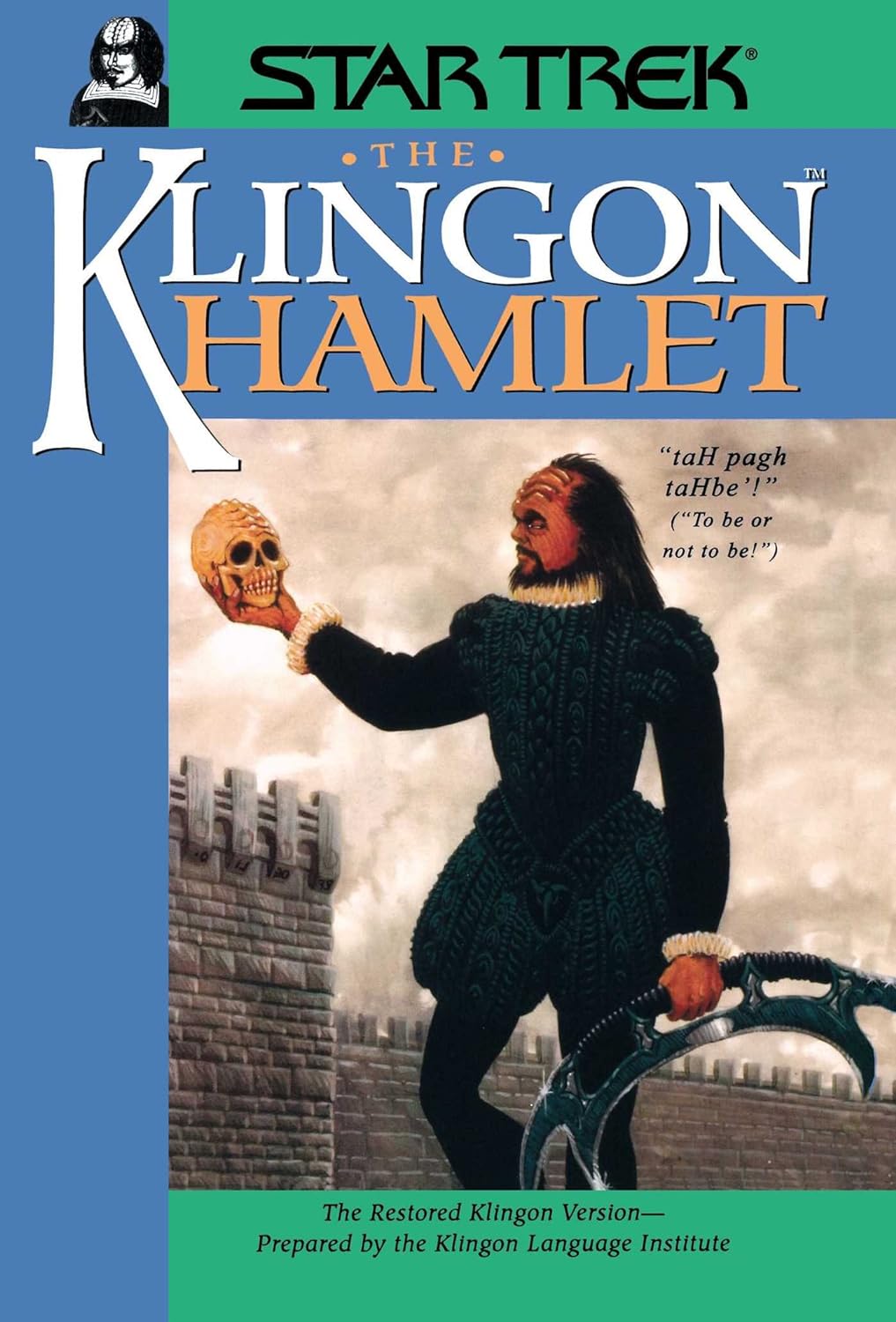
Klingon Hamlet Revisited

Shakespeare, William. The Klingon Hamlet. Trans. Nick Nicholas, Andrew Strader, and the Klingon Language Institute. New York: Simon & Schuster [Pocket Books], 2000.

The performance of selections of Hamlet and Much Ado About Nothing in Klingon by the Washington Shakespeare Company received a fair amount of attention. One review quotes Christopher Henley, the Artistic Director, who said, "It seems a way to say that we're not as reverent as other companies in town."

All right. Fair enough. And I imagine it would be interesting to see such a production, even if you don't happen to be deeply engaged in Star Trek. What would it be like to watch a Hamlet without knowing the language in which it's being performed? What elements of Klingon culture would be brought to bear in the production? How would those elements be made comprehensible to what I imagine was a majority non-Klingon audience.

But I'd like to talk about the book for a minute. In addition to what I'd like to call "The Droes'hQuapleth Engraving" pictured above, the book has some magnificently funny material. As a parody of English Language Studies and Shakespeare studies, the footnotes are priceless.

Some of my favorites come from the nunnery scene:
nunnery: lit. squadron of the celebate. (The closest Klingon equivalent of a monastic order, these were bands of warriors—of either gender—who dedicated their lives to fighting, to the point of refusing to mate.)

O heavenly powers! lit. Power of Kahless.

like sweet bells jangled: lit. like a bagpipe clumsily squeezed.

to England: lit. To Earth. There is no documented instance where Terra paid tribute or ransom to the Klingon Empire; this is probably not a historical reference, although it has endeared the play to many young Klingons. (201)
But I also genuinely appreciate these notes from Hamlet's advice to the players:
I has as lief the town crier spoke my lines: lit. I would prefer my words to be shot from a Federation battleship.

It out-herods Herod: lit. He [who does so] is more deserving to resemble Molor than Molor himself. (201)
And, finally, this note on Hamlet's most famous soliloquy (from page 200—click on the image to enlarge it):


It's really quite remarkable stuff—even down to the parody of some conspiratorial elements—including some of the Nazi propaganda insisting that Shakespeare was actually a German author.

Links: Official Site of The Klingon Hamlet.

Click below to purchase Hamlet in the original Klingon
from amazon.com
(and to support Bardfilm as you do so).

Monday, May 28, 2012

Shakespeare in Huckleberry Finn (The Novel and the 1955 Film)

Twain, Mark. Huckleberry Finn. New York: Charles L. Webster and Company, 1885.

Huckleberry Finn. Dir. Herbert B. Swope, Jr. Perf. Denise Alexander, John Carradine, and Walter Catlett. 1955. DVD. Synergy Entertainment, 2007.

Do you remember the great Shakespearean actors from Mark Twain's Huckleberry Finn? They come along in Chapter Nineteen, eventually revealing their "true" identities to be aristocratic: one is a Duke, and the other is the long-lost Louis XVII of France.

I've been hoping mightily that one or another of the film versions of the novel would contain some part of their Shakespeare performances. But I've tried three so far, and this is the only one that gives us a bit of a Shakespearean connection—and that isn't much.

But Twain does some remarkable things with those characters and their knowledge of Shakespeare. Here's the scene where the Duke and the King plan a night of Shakespeare for the next town they visit—concluding with a marvelous interpretation of Hamlet's soliloquy:
"I'll answer by doing the Highland fling or the sailor's hornpipe; and you—well, let me see—oh, I've got it—you can do Hamlet's soliloquy."

"Hamlet's which?"

"Hamlet's soliloquy, you know; the most celebrated thing in Shakespeare. Ah, it's sublime, sublime! Always fetches the house. I haven't got it in the book—I've only got one volume—but I reckon I can piece it out from memory. I'll just walk up and down a minute, and see if I can call it back from recollection's vaults."

So he went to marching up and down, thinking, and frowning horrible every now and then; then he would hoist up his eyebrows; next he would squeeze his hand on his forehead and stagger back and kind of moan; next he would sigh, and next he'd let on to drop a tear. It was beautiful to see him. By and by he got it. He told us to give attention. Then he strikes a most noble attitude, with one leg shoved forwards, and his arms stretched away up, and his head tilted back, looking up at the sky; and then he begins to rip and rave and grit his teeth; and after that, all through his speech, he howled, and spread around, and swelled up his chest, and just knocked the spots out of any acting ever I see before. This is the speech—I learned it, easy enough, while he was learning it to the king:
To be, or not to be; that is the bare bodkin
That makes calamity of so long life;
For who would fardels bear, till Birnam Wood do come to Dunsinane,
But that the fear of something after death
Murders the innocent sleep,
Great nature's second course,
And makes us rather sling the arrows of outrageous fortune
Than fly to others that we know not of.
There's the respect must give us pause:
Wake Duncan with thy knocking! I would thou couldst;
For who would bear the whips and scorns of time,
The oppressor's wrong, the proud man's contumely,
The law's delay, and the quietus which his pangs might take,
In the dead waste and middle of the night, when churchyards yawn
In customary suits of solemn black,
But that the undiscovered country from whose bourne no traveler returns,
Breathes forth contagion on the world,
And thus the native hue of resolution, like the poor cat i' the adage,
Is sicklied o'er with care,
And all the clouds that lowered o'er our housetops,
With this regard their currents turn awry,
And lose the name of action.
'Tis a consummation devoutly to be wished.
But soft you, the fair Ophelia:
Ope not thy ponderous and marble jaws,
But get thee to a nunnery—go! (181-82)
The film listed above doesn't give us that (I'm still searching for one that does), but it does give us a fragment of Shakespeare embedded in the two connivers' conversation:


Yes, I'll keep searching and hoping!

Links: The Film at IMDB.

Click below to purchase the film and the book from amazon.com
(and to support Bardfilm as you do so).


Thursday, May 24, 2012

The Great River Shakespeare Festival 2012

King Lear. Two Gentlemen of Verona. The Complete Works of William Shakespeare (Abridged). Great River Shakespeare Festival. Winona, Minnesota. 20 June to 5 August 2012.
I've said it before, and I'll go on saying it until . . . well, I'm not sure when or if I'll stop saying it: The Great River Shakespeare Festival provides an astonishing experience every year. These actors, directors, costumers, apprentices, designers, staff, et cetera are at the very top of their game.

Past years of the Great River Shakespeare Festival have delivered brilliant productions of the plays. Witness their Taming of the Shrew, their Love's Labour's Lost, their Comedy of Errors, or their Othello. I anticipate that this year's productions will be even better.

Witness this video that provides some fascinating insight into the company:


Tickets are on sale now. Buy some.
Links: The Great River Shakespeare Festival.

The Atlantic Ocean, Simon Winchester, and the Seven Ages of Man

Winchester, Simon. Atlantic: Great Sea Battles, Heroic Discoveries, Titanic Storms, and A Vast Ocean of a Million Stories. New York: Harper, 2010.

I'm trying to write about things as I encounter them instead of putting them on the back burner.

That's why I'm briefly mentioning a book I'm listening to and its Shakespeare connection. Ever since I read The Meaning of Everything: The Story of the Oxford English Dictionary, I've tried to read everything that Simon Winchester has written. The man is an astonishing writer. He can make geology—a subject about which I would not generally be bubbling over with interest to investigate—completely fascinating. He is one of the modern masters of non-fiction. I've read his Krakatoa: The Day the World Exploded, his A Crack in the Edge of the World: America and the Great California Earthquake of 1906, his The Man Who Loved China (which was a bit of a dud, but a dud by Winchester is still worth reading), his Pacific Rising: The Emergence of a New World Culture (which was also on the less-than-thrilling side, but which might be seen as a companion to the book I'm currently reading), and his The River at the Center of the World: A Journey Up the Yangtze, and Back in Chinese Time. I'm currently listing to the audiobook version of his Atlantic: Great Sea Battles, Heroic Discoveries, Titanic Storms, and A Vast Ocean of a Million Stories (read—and marvelously read, too—by the author).

As Grandmother Jones used to say, I told you that to tell you this. The organizational structure of Atlantic is based on Jaques' "Seven Ages of Man" speech from As You Like It. Winchester attempts to trace the history and culture of the Atlantic Ocean in these seven categories:
. . . . . . . . . . . . . . . . . . . All the world’s a stage,
And all the men and women merely players:
They have their exits and their entrances;
And one man in his time plays many parts,
His acts being seven ages. At first the infant,
Mewling and puking in the nurse’s arms.
And then the whining school-boy, with his satchel
And shining morning face, creeping like snail
Unwillingly to school. And then the lover,
Sighing like furnace, with a woeful ballad
Made to his mistress’ eyebrow. Then a soldier,
Full of strange oaths and bearded like the pard,
Jealous in honour, sudden and quick in quarrel,
Seeking the bubble reputation
Even in the cannon’s mouth. And then the justice,
In fair round belly with good capon lined,
With eyes severe and beard of formal cut,
Full of wise saws and modern instances;
And so he plays his part. The sixth age shifts
Into the lean and slipper’d pantaloon,
With spectacles on nose and pouch on side,
His youthful hose, well saved, a world too wide
For his shrunk shank; and his big manly voice,
Turning again toward childish treble, pipes
And whistles in his sound. Last scene of all,
That ends this strange eventful history,
Is second childishness and mere oblivion,
Sans teeth, sans eyes, sans taste, sans everything. (II.vii.139-66)
In another author's hands, it might be really, really cheesy. But Winchester is (thus far—I've only read into the second age) able to pull it off. And it demonstrates that Shakespeare is never confined to the study or the stage. He contains oceans.

Click below to purchase one or two books from amazon.com
(and to support Bardfilm as you do so).


Wednesday, May 23, 2012

"It is the bloody business": Lady Macbeth's Complicity

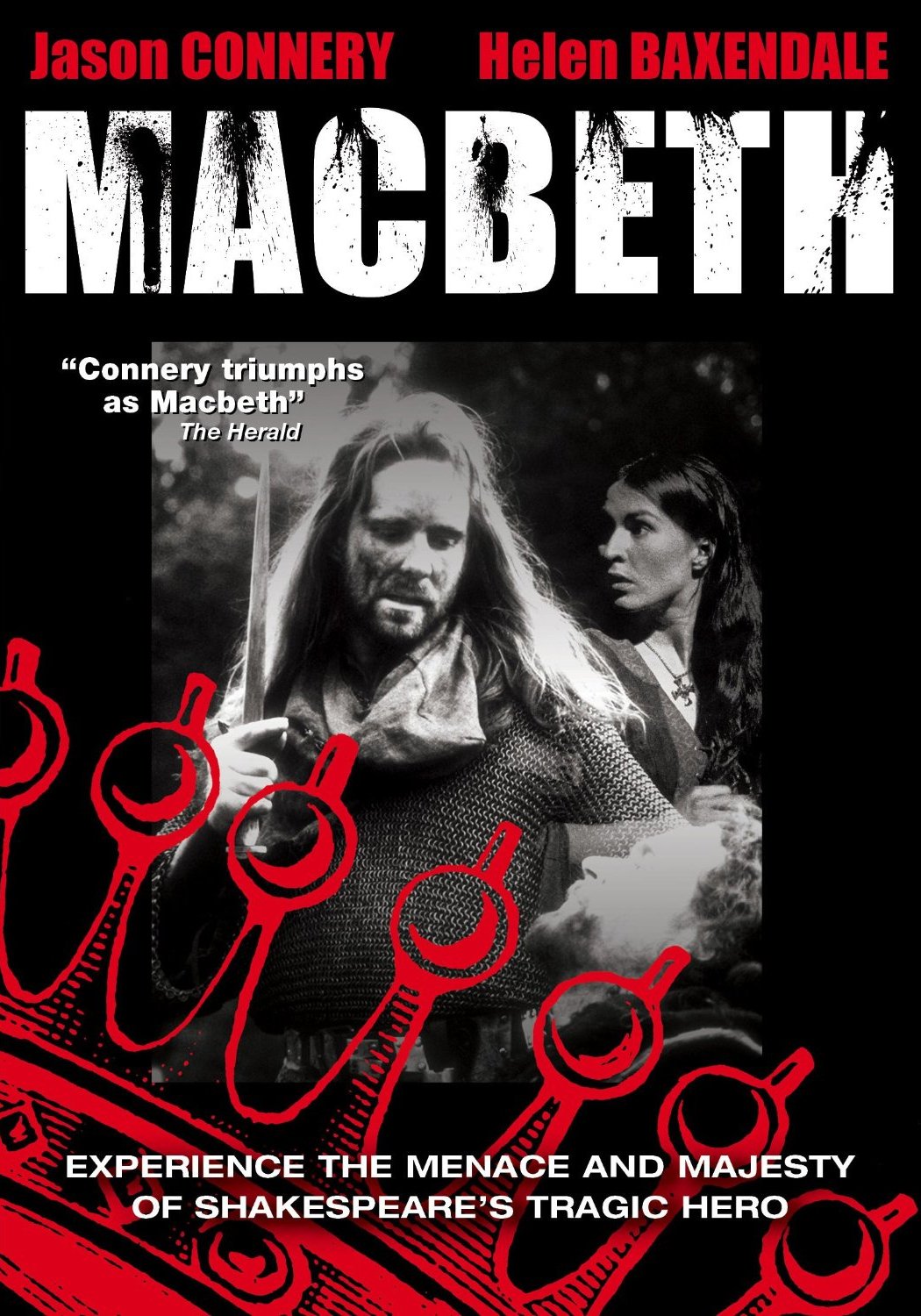
Macbeth. Dir. Jeremy Freeston. Perf. Jason Connery, Helen Baxendale, and Graham McTavish. 1997. DVD. Hurricane Int'l, 2007.

I wrote a brief post on this film version of Macbeth some time ago (for which, q.v.), but, whether it was out of laziness or lack of technology, I did not include a film clip at that time.

Here's the clip and a question. In this version, the director has given Lady Macbeth some stage business that opens the question of her complicity in the murder of Duncan. Is she partly responsible? Is she entirely responsible, leading the innocent Macbeth down the garden path to murder? Is she entirely innocent of the deed herself?

Warning: The clip below is violent and bloody.


What do you think about that? Is that a fair portrayal of her character? Why or why not?

Links: The Film at IMDB.

Click below to purchase the film from amazon.com
(and to support Bardfilm as you do so).

Tuesday, May 22, 2012

The Bardfilm iPhone App?

Bardfilm. The Bardfilm iPhone App. 22 May 2012.

Has Bardfilm been spending its copious free time writing code for a new App for the iPhone?

Well, no. But I have thought of a workaround that will essentially do the same thing. The end result will be a button on your iPhone's home screen that will take you directly to Bardfilm's latest post.

First, head to Bardfilm's home page. The main page will be the best choice; that way, you will always be heading to the latest Bardfilm has to offer. If you are on a specific post instead of the main page, you'll always go to that post instead of to the latest post. Of course, if you have a particular favorite—Bardfilm's discovery of a previously-misattributed poem (for which, q.v.), for example you can use this same technique to get to that post.

But I digress.

Once Bardfilm's home page loads up, press the center icon at the bottom of the screen—it looks like a rectangle with an arrow jumping out of it and pointing to the right. That will bring up a list of options—you can mail a link to the page, send a tweet about the page, print the page, or add the page to your home screen. Choose the option that says "Add to Home Screen."

The next screen gives you a chance to name the button you're creating.  Just click "Add" and you're done.

And there you are! Bardfilm at your fingertips! Your home page will now have a button you can press to head straight to the latest post. And it's absolutely free! That just one of the ways we happen to roll.


Bardfilm is normally written as one word, though it can also be found under a search for "Bard Film Blog." Bardfilm is a Shakespeare blog (admittedly, one of many Shakespeare blogs), and it is dedicated to commentary on films (Shakespeare movies, The Shakespeare Movie, Shakespeare on television, Shakespeare at the cinema), plays, and other matter related to Shakespeare (allusions to Shakespeare in pop culture, quotes from Shakespeare in popular culture, quotations that come from Shakespeare, et cetera).

Unless otherwise indicated, quotations from Shakespeare's works are from the following edition:
Shakespeare, William. The Riverside Shakespeare. 2nd ed. Gen. ed. G. Blakemore Evans. Boston: Houghton Mifflin, 1997.
All material original to this blog is copyrighted: Copyright 2008-2039 (and into perpetuity thereafter) by Keith Jones.

The very instant that I saw you did / My heart fly to your service; there resides, / To make me slave to it; and, for your sake, / Am I this patient [b]log-man.

—The Tempest