Uderzo, Albert. Asterix and the Great Divide [Les Grand Fossee]. Trans. Anthea Bell and Derek Hockridge. London: Orion Books, 2001.
I have fifteen quick minutes before I need to depart for class.
That may be just enough time to mention the spin Asterix takes on Romeo and Juliet.
I found this while doing a search for something else entirely in my local library. Serendipity is often quite welcome.
The plot of the Asterix stories is always generally the same. There is, in the books, one village in Gaul that has never been conquered by the Romans. The stories are filled with bad puns and battles agains the Romans. I started reading them in French (that's where I learned my bad French puns), but I turned to English when availability of the French editions started to diminish.
In this book, a different village is divided (you can see the trench that runs through the village in the sample below). But—are you surprised?—a boy from one side of the village is in love with a girl from the other side.
The image below is where most of the Shakespeare makes its way in to the story. Click on it to enlarge it, and enjoy this re-creation of the balcony scene.
Links: The Official Web Site for Asterix.
Thursday, March 27, 2014
Friday, March 14, 2014
Book Note: Tower of the Five Orders
Hicks, Deron R. Tower of the Five Orders . Boston: Houghton Mifflin Harcourt, 2013.
I just finished reading the second book in the Shakespeare Mysteries series. For Secrets of Shakespeare's Grave, the first book in the series, click here.
I enjoyed the book very much—though I did spend a considerable portion of the middle of the book chanting "Please don't be a Marlovian Conspiracy Theory book. Please don't be a Marlovian Conspiracy Theory book."
It turns out that it isn't. At least, it isn't yet. Another cliffhanger at the end makes us wonder where the next book will take us, but it does seem that Shakespeare's authorship of his own works is fully secured by the end of the novel.
As with the previous novel, I really can't tell you much about the story without spoiling it. But I will just say that it's a terrific adventure story, complete with life-threating suspense and a few truly villainous villains. Read it.
Links: The Series' Official Website.
I just finished reading the second book in the Shakespeare Mysteries series. For Secrets of Shakespeare's Grave, the first book in the series, click here.
I enjoyed the book very much—though I did spend a considerable portion of the middle of the book chanting "Please don't be a Marlovian Conspiracy Theory book. Please don't be a Marlovian Conspiracy Theory book."
It turns out that it isn't. At least, it isn't yet. Another cliffhanger at the end makes us wonder where the next book will take us, but it does seem that Shakespeare's authorship of his own works is fully secured by the end of the novel.
As with the previous novel, I really can't tell you much about the story without spoiling it. But I will just say that it's a terrific adventure story, complete with life-threating suspense and a few truly villainous villains. Read it.
Links: The Series' Official Website.
Thursday, March 13, 2014
Benedict Cumberbatch as Rosencrantz in Rosencrantz and Guildenstern are Dead
Rosencrantz and Guildenstern are Dead. Perf. Kobna Holdbrook-Smith and Benedict Cumberbatch. Selection from National Theatre: 50 Years on Stage. Dir. Nicholas Hytner. Olivier Theatre. 2 November 2013.
The National Theatre recently celebrated its fifty years of existence with a stage performance and documentary that's currently available for streaming in full at PBS's website.
The section that is likely to catch everyone's eye is Benedict Cumberbatch. He who plays Sherlock in the new BBC Sherlock series and Khan in Star Trek: Into Darkness plays Rosencrantz in the "dead in a box" sequence from the middle of Act II of Rosencrantz and Guildenstern are Dead, Tom Stoppard's first play on the stage of the National Theatre. Here's the scene in question:
That is, of course, great—and Kobna Holdbrook-Smith does a magnificent job as Guildenstern. But the entire show has some fascinating clips from the archives that I can't wait to enjoy.
The National Theatre recently celebrated its fifty years of existence with a stage performance and documentary that's currently available for streaming in full at PBS's website.
The section that is likely to catch everyone's eye is Benedict Cumberbatch. He who plays Sherlock in the new BBC Sherlock series and Khan in Star Trek: Into Darkness plays Rosencrantz in the "dead in a box" sequence from the middle of Act II of Rosencrantz and Guildenstern are Dead, Tom Stoppard's first play on the stage of the National Theatre. Here's the scene in question:
That is, of course, great—and Kobna Holdbrook-Smith does a magnificent job as Guildenstern. But the entire show has some fascinating clips from the archives that I can't wait to enjoy.
Book Note: The Truth About William Shakespeare: Fact, Fiction, and Modern Biographies
Ellis, David. The Truth About William Shakespeare: Fact, Fiction, and Modern Biographies. Edinburgh: Edinburgh University Press, 2012.
David Ellis' The Truth About William Shakespeare: Fact, Fiction, and Modern Biographies is a thoroughly enjoyable and certainly necessary critique of the modern biography of Shakespeare. In a careful and scholarly way, Ellis comments on the persistent drift from the certain to the speculative—and then to the speculative-but-expressed-as-certainy—that characterizes the modern Shakespeare biography. It's a tendency I noted in a post on the documentary In Search of Shakespeare, and it became most evident to me in Stephen Greenblatt's Will in the World (mentioned in the same post).
Ellis is meticulous in analyzing the anecdotes and assumptions that have made their way into every aspect of biographies of the bard in chapters that take us chronologically through Shakespeare's life. His chapter "How to make bricks without straw" comments on the ways biographies of Shakespeare—if they are to be written at all—must depend largely on speculation. Subsequent chapters then detail the speculation in different categories: "Forebears," "The female line and Catholicism," "Boyhood and youth," "Marriage," "The theatre," et cetera.
Let me give you an example of Ellis' modus operandi. First quoting from Katherine Duncan-Jones, who says, "as a member of Leicester's Men for some time between 1584 and 1586, Shakespeare would have quickly shown his versatility both in writing and performing. He would have been a natural choice to supply one of the gaps left by Knell's death in June 1587" (61, Ellis' emphasis), Ellis goes on to critique the disappearance of the conditional.
David Ellis' The Truth About William Shakespeare: Fact, Fiction, and Modern Biographies is a thoroughly enjoyable and certainly necessary critique of the modern biography of Shakespeare. In a careful and scholarly way, Ellis comments on the persistent drift from the certain to the speculative—and then to the speculative-but-expressed-as-certainy—that characterizes the modern Shakespeare biography. It's a tendency I noted in a post on the documentary In Search of Shakespeare, and it became most evident to me in Stephen Greenblatt's Will in the World (mentioned in the same post).
Ellis is meticulous in analyzing the anecdotes and assumptions that have made their way into every aspect of biographies of the bard in chapters that take us chronologically through Shakespeare's life. His chapter "How to make bricks without straw" comments on the ways biographies of Shakespeare—if they are to be written at all—must depend largely on speculation. Subsequent chapters then detail the speculation in different categories: "Forebears," "The female line and Catholicism," "Boyhood and youth," "Marriage," "The theatre," et cetera.
Let me give you an example of Ellis' modus operandi. First quoting from Katherine Duncan-Jones, who says, "as a member of Leicester's Men for some time between 1584 and 1586, Shakespeare would have quickly shown his versatility both in writing and performing. He would have been a natural choice to supply one of the gaps left by Knell's death in June 1587" (61, Ellis' emphasis), Ellis goes on to critique the disappearance of the conditional.
What is so effective here is again that "would have" has the mere appearance of the conditional; bu that is more interesting from the point of view of biographical method is how, when Duncan-Jones later reverts to the question of Shakespeare and the Queen's Men, any hint of that conditional (previously event in all the words I have italicised) has disappeared. Only a little later, for example, she speculates about the work Shakespeare would have done for the Queen's Men "while he was a full-time member of the company in the later 1580s." Her treatment of the issue is only one example among hundreds, in her work and those of the other biographers, of how what might have been is gradually converted into what was. (60)
Ellis primarily considers Duncan-Jones' Ungentle Shakespeare, Stephen Greenblatt's Will in the World, Peter Ackroyd's Shakespeare: The Biography, Jonathan Bate's The Genius of Shakespeare and Soul of the Age, René Weis' Shakespeare Revealed, and James Shapiro's 1599, but he comments on dozens of others.
The book is great, offering a welcome bit of common sense and a much-needed reminder to exercise sound scholarship when making claims about the life of the Bard.
Wednesday, March 12, 2014
Book Note: Grace Tiffany's Will: A Novel
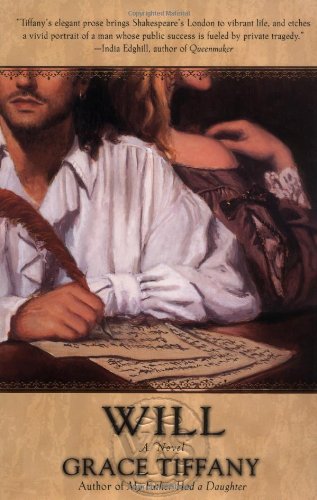
Tiffany, Grace. Will: A Novel. New York: Berkley, 2004.
No real surprises await in Grace Tiffany's Will: A Novel, but it's a pleasant read nonetheless. Indeed, without Grace Tiffany's old use of language, the book would fall rather flat.
The novel is a fictional biography of Shakespeare, filling in all the missing pieces—not the least of which is Shakespeare's point of view on things like his wife, his son's death, and his desire to act and write for the London stage. And, since Grace Tiffany is a well-respected Shakespeare scholar in her own right, the novel has (with a few exceptions) a good sense of the contemporary history.
One of the exceptions is having one of Shakespeare's daughters end up disguising herself as a boy and coming to London to try to take her place on the stage. I can't quite place where I've encountered that idea before, but I know another fictional piece or two has toyed with the idea. It's not quite as common as having Elizabeth I attend a performance at the Globe, but it carries the same weight of impossibility—mixed with the interest of the impossible becoming possible.
There's also a wonderfully unlikely scene where Will Shakespeare and Ben Jonson steal a skull from London bridge—the skull of Edward Arden, as it turns out—to play the role of Yorick.
Better than those moments are the points where Shakespeare reflects on his art. In the section below, Shakespeare separates himself and his own views from his characters and their views:
No real surprises await in Grace Tiffany's Will: A Novel, but it's a pleasant read nonetheless. Indeed, without Grace Tiffany's old use of language, the book would fall rather flat.
The novel is a fictional biography of Shakespeare, filling in all the missing pieces—not the least of which is Shakespeare's point of view on things like his wife, his son's death, and his desire to act and write for the London stage. And, since Grace Tiffany is a well-respected Shakespeare scholar in her own right, the novel has (with a few exceptions) a good sense of the contemporary history.
One of the exceptions is having one of Shakespeare's daughters end up disguising herself as a boy and coming to London to try to take her place on the stage. I can't quite place where I've encountered that idea before, but I know another fictional piece or two has toyed with the idea. It's not quite as common as having Elizabeth I attend a performance at the Globe, but it carries the same weight of impossibility—mixed with the interest of the impossible becoming possible.
There's also a wonderfully unlikely scene where Will Shakespeare and Ben Jonson steal a skull from London bridge—the skull of Edward Arden, as it turns out—to play the role of Yorick.
Better than those moments are the points where Shakespeare reflects on his art. In the section below, Shakespeare separates himself and his own views from his characters and their views:
Although we have license to be skeptical of the ways Tiffany fills in the gaps of Shakespeare's biography, this novel is compelling.Mayhap I think the thing the rebel says. Mayhap I do not. He says it, not I. And they hang him. Do I think it right that they hang him? Who may guess? It is not I who speaks, but the play, and the play is poetry, and poetry is many sided. . . . I say only that there is safety in poetry's doubleness. (179-80)
Monday, March 10, 2014
Book Note: Goodnight Desdemona (Good Morning Juliet)
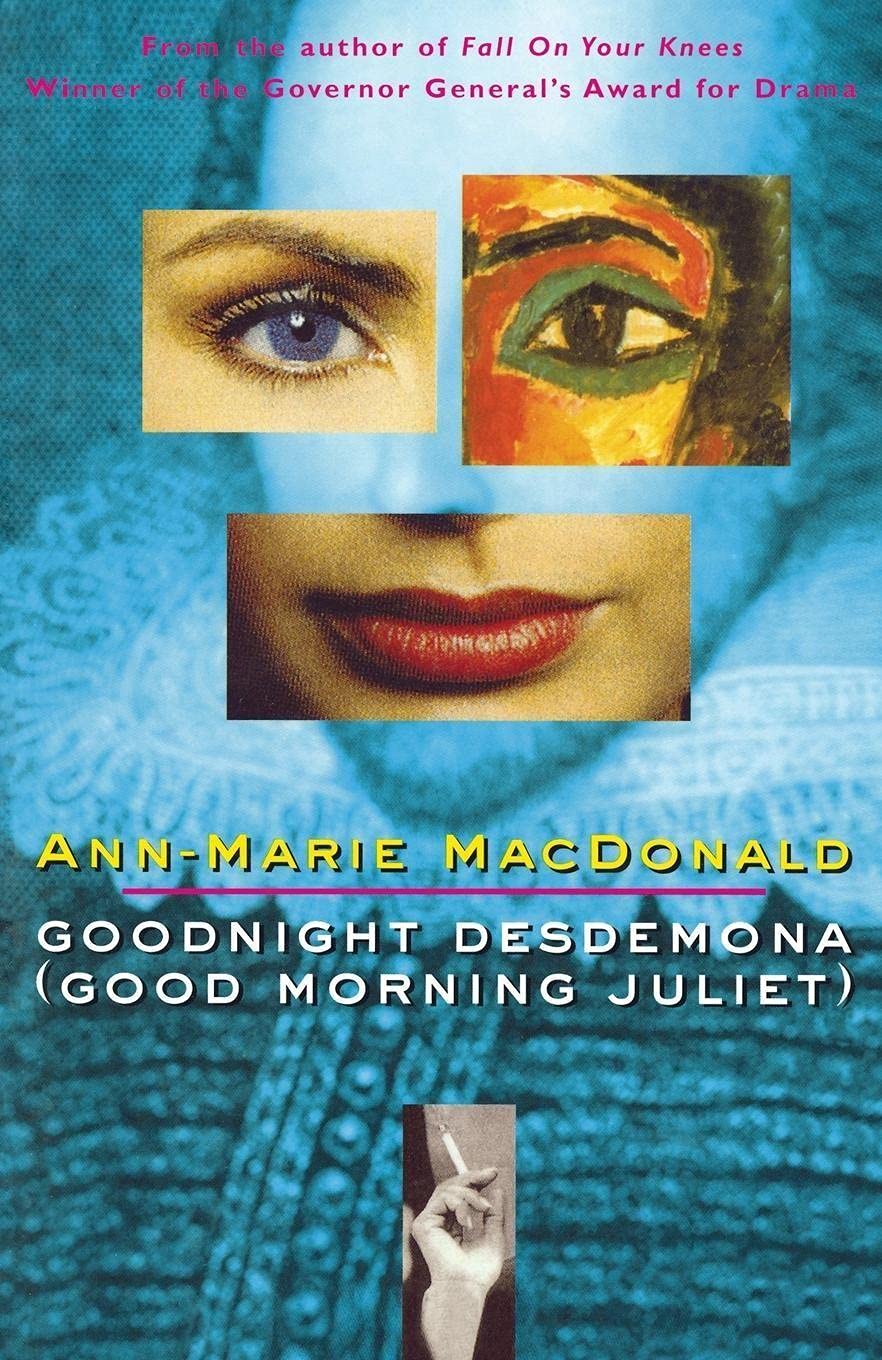
MacDonald, Ann-Marie. Goodnight Desdemona (Good Morning Juliet). New York: Grove, 1990.
Careful readers may have noticed that I'm catching up on reading and posting about Shakespeare-related books. I have a few more to do, but then I'll put the film back in Bardfilm.
Goodnight Desdemona (Good Morning Juliet) is clever, amusing, and thoughtful. Although I Hate Hamlet (for which, q.v.) is still my favorite modern Shakespeare-related play—well, I should remember that Rosencrantz and Guildenstern are Dead is also my favorite—this one is right up there.
The plot involves a junior professor of Shakespeare at a university. While working on her project, she falls into her wastepaper basket and ends up in the plot of Othello, just as Iago is convincing Othello of Desdemona's perfidy. Without thinking, she tells Othello and Iago is a liar and pulls the handkerchief from Iago's back pocket to prove it. Othello is overjoyed, but Iago is demoted and starts to plot a new revenge—this time, on this scholar from the future who has spoiled his plot.
The professor then ends up in Romeo and Juliet, dressed as a boy. A whole host of Shakesperaean mistaken identity / falling-in-love-with-the-wrong-person activity takes place—and that's where to describe more of the plot would be to spoil it.
Careful readers may have noticed that I'm catching up on reading and posting about Shakespeare-related books. I have a few more to do, but then I'll put the film back in Bardfilm.
Goodnight Desdemona (Good Morning Juliet) is clever, amusing, and thoughtful. Although I Hate Hamlet (for which, q.v.) is still my favorite modern Shakespeare-related play—well, I should remember that Rosencrantz and Guildenstern are Dead is also my favorite—this one is right up there.
The plot involves a junior professor of Shakespeare at a university. While working on her project, she falls into her wastepaper basket and ends up in the plot of Othello, just as Iago is convincing Othello of Desdemona's perfidy. Without thinking, she tells Othello and Iago is a liar and pulls the handkerchief from Iago's back pocket to prove it. Othello is overjoyed, but Iago is demoted and starts to plot a new revenge—this time, on this scholar from the future who has spoiled his plot.
The professor then ends up in Romeo and Juliet, dressed as a boy. A whole host of Shakesperaean mistaken identity / falling-in-love-with-the-wrong-person activity takes place—and that's where to describe more of the plot would be to spoil it.
Friday, March 7, 2014
Book Note: Interred with their Bones
Carrell, Jennifer Lee. Interred with their Bones. [a.k.a. The Shakespeare Secret.] New York: Plume, 2008.
This is an action-adventure novel involving a search for the manuscript of Shakespeare's lost play Cardenio. And it's not too bad. The story is, for the most part, compelling, and the characters are enjoyable. There are places where the novel becomes tedious or even derivative (in some ways, it seems like a Shakespearean Da Vinci Code), but I struggled through them to find out what was going to happen next.
The pattern of the novel was one somewhat tedious element of the novel. Sections of rushing off to a new place in a maniacal worldwide treasure hunt alternate with long stretches of exposition. Oh, and the occasional murder—always in the manner of a death from a Shakespeare play.
Elements of the authorship of Shakespeare's works form a part of this novel, but, unlike Chasing Shakespeares (for which, q.v.), Interred with their Bones doesn't become propagandistic, and that keeps those sections from becoming too tedious. The author says that she is agnostic on the authorship issue (the novel itself raises the interesting question of why religious terms like "heretic" or "orthodox" are employed by debaters of the notion), but she tends to lean toward William Stanley, sixth earl of Derby.
The novel is clever in its presentation of the authorship camps. For much of the book, we're not sure if the attacks on the protagonist are being put together by a consortium of Stratfordians who are worried that the discovery of Cardenio will prove that Shakespeare did not write the plays attributed to him or by a cabal of Oxfordians or the like who are worried that it will prove that Shakespeare did. The plans of the opposition are so carefully-laid that, as I read the book, I thought that it couldn't be the Stratfordians—we can't even agree on whether Q2 or F of Hamlet has greater authority!
In short, the novel is not bad. It even has a passage alluding to the exploded notion that Shakespeare had a hand in translating Psalm 46.
Links: The Author's Web Site.
This is an action-adventure novel involving a search for the manuscript of Shakespeare's lost play Cardenio. And it's not too bad. The story is, for the most part, compelling, and the characters are enjoyable. There are places where the novel becomes tedious or even derivative (in some ways, it seems like a Shakespearean Da Vinci Code), but I struggled through them to find out what was going to happen next.
The pattern of the novel was one somewhat tedious element of the novel. Sections of rushing off to a new place in a maniacal worldwide treasure hunt alternate with long stretches of exposition. Oh, and the occasional murder—always in the manner of a death from a Shakespeare play.
Elements of the authorship of Shakespeare's works form a part of this novel, but, unlike Chasing Shakespeares (for which, q.v.), Interred with their Bones doesn't become propagandistic, and that keeps those sections from becoming too tedious. The author says that she is agnostic on the authorship issue (the novel itself raises the interesting question of why religious terms like "heretic" or "orthodox" are employed by debaters of the notion), but she tends to lean toward William Stanley, sixth earl of Derby.
The novel is clever in its presentation of the authorship camps. For much of the book, we're not sure if the attacks on the protagonist are being put together by a consortium of Stratfordians who are worried that the discovery of Cardenio will prove that Shakespeare did not write the plays attributed to him or by a cabal of Oxfordians or the like who are worried that it will prove that Shakespeare did. The plans of the opposition are so carefully-laid that, as I read the book, I thought that it couldn't be the Stratfordians—we can't even agree on whether Q2 or F of Hamlet has greater authority!
In short, the novel is not bad. It even has a passage alluding to the exploded notion that Shakespeare had a hand in translating Psalm 46.
Links: The Author's Web Site.
Thursday, March 6, 2014
Book Note: Essential Shakespeare: The Arden Guide to Text and Interpretation
Bickley, Pamela, and Jenny Stevens. Essential Shakespeare: The Arden Guide to Text and Interpretation. London: Bloomsbury, 2013.
This book would be a most excellent text and one that I might consider using in my upper-level Shakespeare course if it had been copyedited—or at least proofread.
The content of the book is quite marvelous, but the presentation leaves a great deal to be desired. The numerous typographical errors are incredibly distracting, particularly when the text of a Shakespeare play is being quoted. Please note that these aren't variant texts or variant spellings—they're typos, plain and simple. Many of them are the type of typo that results from using an OCR scan of a text without carefully proofreading it. But there are errors in the text of the book as well as in the material quoted in the text. I expect far more from a volume bearing the name of The Arden Shakespeare.
If you can get past the typographical errors, the book has much to recommend it. Fourteen plays are addressed, and each section provides an admirable sampling of food for thought. The section on Measure for Measure, for example, offers a wide range of ideas on the play, some of which I may be able to incorporate into my class the next time I teach the play.
Although written for students studying Shakespeare for the first time on a college level (and, therefore, both comprehensible and light-hearted), the volume does not condescend to its readers. Rather, it takes them a fair way on the road to greater depth of thought about Shakespeare's plays. For that, it's quite valuable (though I hope a second edition—one free from typos—will be forthcoming).
This book would be a most excellent text and one that I might consider using in my upper-level Shakespeare course if it had been copyedited—or at least proofread.
The content of the book is quite marvelous, but the presentation leaves a great deal to be desired. The numerous typographical errors are incredibly distracting, particularly when the text of a Shakespeare play is being quoted. Please note that these aren't variant texts or variant spellings—they're typos, plain and simple. Many of them are the type of typo that results from using an OCR scan of a text without carefully proofreading it. But there are errors in the text of the book as well as in the material quoted in the text. I expect far more from a volume bearing the name of The Arden Shakespeare.
If you can get past the typographical errors, the book has much to recommend it. Fourteen plays are addressed, and each section provides an admirable sampling of food for thought. The section on Measure for Measure, for example, offers a wide range of ideas on the play, some of which I may be able to incorporate into my class the next time I teach the play.
Although written for students studying Shakespeare for the first time on a college level (and, therefore, both comprehensible and light-hearted), the volume does not condescend to its readers. Rather, it takes them a fair way on the road to greater depth of thought about Shakespeare's plays. For that, it's quite valuable (though I hope a second edition—one free from typos—will be forthcoming).
Wednesday, March 5, 2014
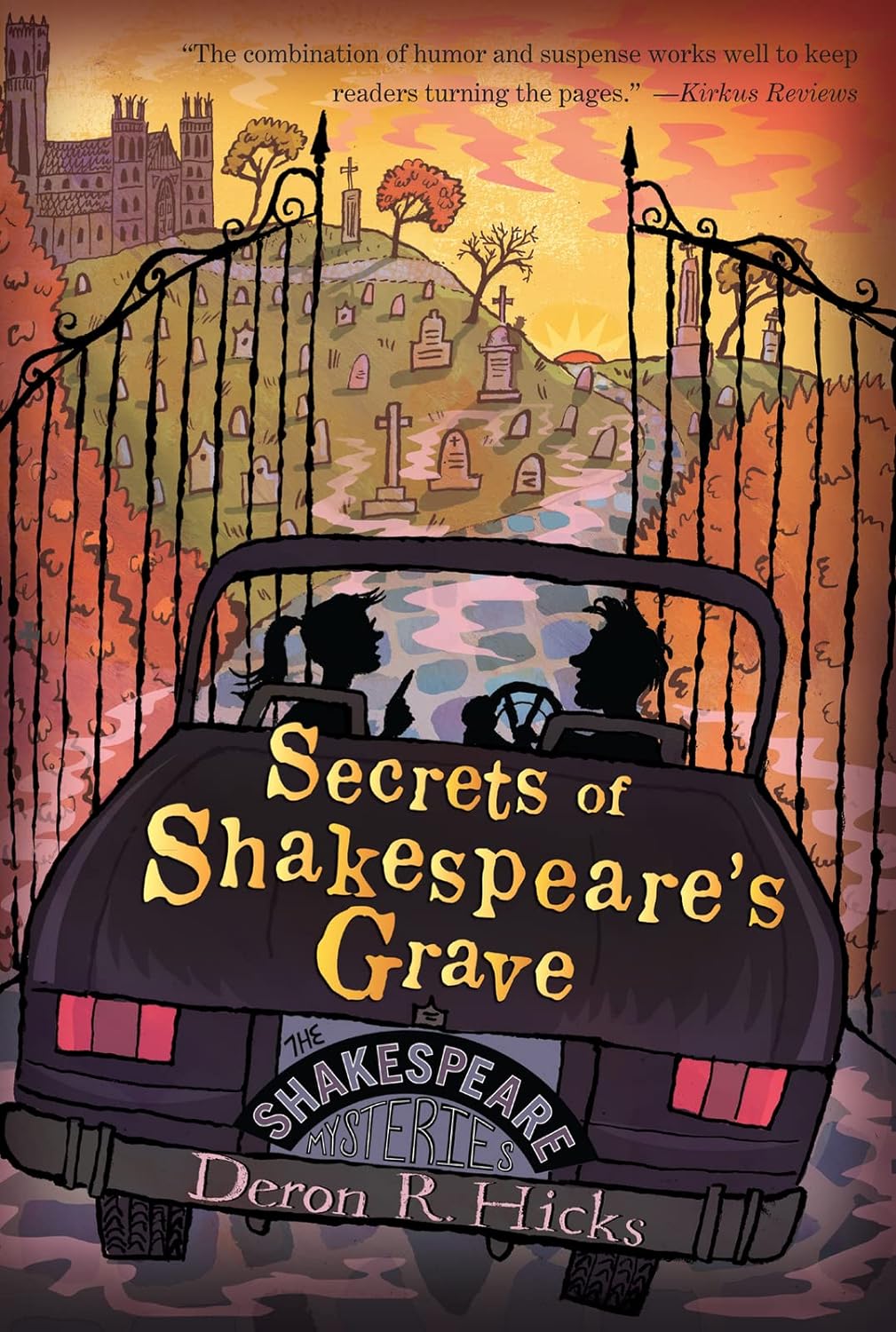
Book Note: Secrets of Shakespeare's Grave
Hicks, Deron R. Secrets of Shakespeare's Grave. New York: Houghton Mifflin Harcourt Books for Young Readers, 2012.
When I first spotted this book in the bookstore, I thought it might be another young adult book debunking Shakespeare's authorship of the works attributed to Shakespeare.
So far (I've only read the first of the books in a series of at least two books), it's been exactly the opposite, though I don't want to tell you too much for fear of spoiling it for you.
The plot involves a brother and a sister who need to do what they can to save the family publishing business from being taken over by a disreputable relative.
More than that I'm not at liberty to reveal. But I will tell you that I enjoyed the book very much. It is filled with adventure—and not of the corny, tacky variety. It also involves intriguing trips to New York, London, and Stratford-upon-Avon to track down clues to the family treasure. Read it and enjoy!
Note: The book's plot involves what I take to be a misreading of the poem on Shakespeare's Monument in Stratford. The line in question reads ". . . Si[t]h all that he hath writt / Leaves living art, but page, to serve his witt." The book considers the word "page" here to mean a piece of paper. Given the context, however, I take "page" to mean a servant. It's a minor point, but I thought I should mention it.
Additional Note: For the second book in the series, click here.
When I first spotted this book in the bookstore, I thought it might be another young adult book debunking Shakespeare's authorship of the works attributed to Shakespeare.
So far (I've only read the first of the books in a series of at least two books), it's been exactly the opposite, though I don't want to tell you too much for fear of spoiling it for you.
The plot involves a brother and a sister who need to do what they can to save the family publishing business from being taken over by a disreputable relative.
More than that I'm not at liberty to reveal. But I will tell you that I enjoyed the book very much. It is filled with adventure—and not of the corny, tacky variety. It also involves intriguing trips to New York, London, and Stratford-upon-Avon to track down clues to the family treasure. Read it and enjoy!
Note: The book's plot involves what I take to be a misreading of the poem on Shakespeare's Monument in Stratford. The line in question reads ". . . Si[t]h all that he hath writt / Leaves living art, but page, to serve his witt." The book considers the word "page" here to mean a piece of paper. Given the context, however, I take "page" to mean a servant. It's a minor point, but I thought I should mention it.
Additional Note: For the second book in the series, click here.
Tuesday, March 4, 2014
Book Note: Stage Fright on a Summer Night
Osborne, Mary Pope. Stage Fright on a Summer Night. Illus. Sal Murdocca. New York: Random House, 2002.
They always want to put Queen Elizabeth I in the Globe Theatre, nearly every single time.
I've read a few books in the Magic Tree House series from time to time. This one is, I'm afraid, not the very best of the genre. There's not much of a plot or much of a conflict to overcome. The structure of the series becomes a thinly-veiled pretense for journeying to Elizabethan England. But it only took about fifteen minutes to read, so I don't feel that put out.
Once there, our two protagonists are exposed to the usual seamier side of the era—the stench, the bear baiting, et cetera—before they meet a man named Will who is putting on a play called A Midsummer Night's Dream. He needs two actors to play fairies, and he snatches up the protagonists for the roles. They like this guy named Will all right, and they play their parts well.
They journey back to their own place and time, and they find this note. I'm including the full spread that includes their discovery, as it may be the most interesting part:
It's at that point that they realize that the Will they met was the William Shakespeare they they've heard of somewhere before. Not only that, but they have his signature—and a line of writing in his own hand! Naturally, they decide to leave it in the treehouse.
Since the book itself doesn't allow for much interesting speculation, I'm providing just a smidgen of my own. Perhaps Morgan has sent these uninformed children back in time to get a document worth billions of dollars, probably to fund her malicious plot to take over the world.
They always want to put Queen Elizabeth I in the Globe Theatre, nearly every single time.
I've read a few books in the Magic Tree House series from time to time. This one is, I'm afraid, not the very best of the genre. There's not much of a plot or much of a conflict to overcome. The structure of the series becomes a thinly-veiled pretense for journeying to Elizabethan England. But it only took about fifteen minutes to read, so I don't feel that put out.
Once there, our two protagonists are exposed to the usual seamier side of the era—the stench, the bear baiting, et cetera—before they meet a man named Will who is putting on a play called A Midsummer Night's Dream. He needs two actors to play fairies, and he snatches up the protagonists for the roles. They like this guy named Will all right, and they play their parts well.
They journey back to their own place and time, and they find this note. I'm including the full spread that includes their discovery, as it may be the most interesting part:
It's at that point that they realize that the Will they met was the William Shakespeare they they've heard of somewhere before. Not only that, but they have his signature—and a line of writing in his own hand! Naturally, they decide to leave it in the treehouse.
Since the book itself doesn't allow for much interesting speculation, I'm providing just a smidgen of my own. Perhaps Morgan has sent these uninformed children back in time to get a document worth billions of dollars, probably to fund her malicious plot to take over the world.
Monday, March 3, 2014
Book Note: Much Ado About Jessie Kaplan
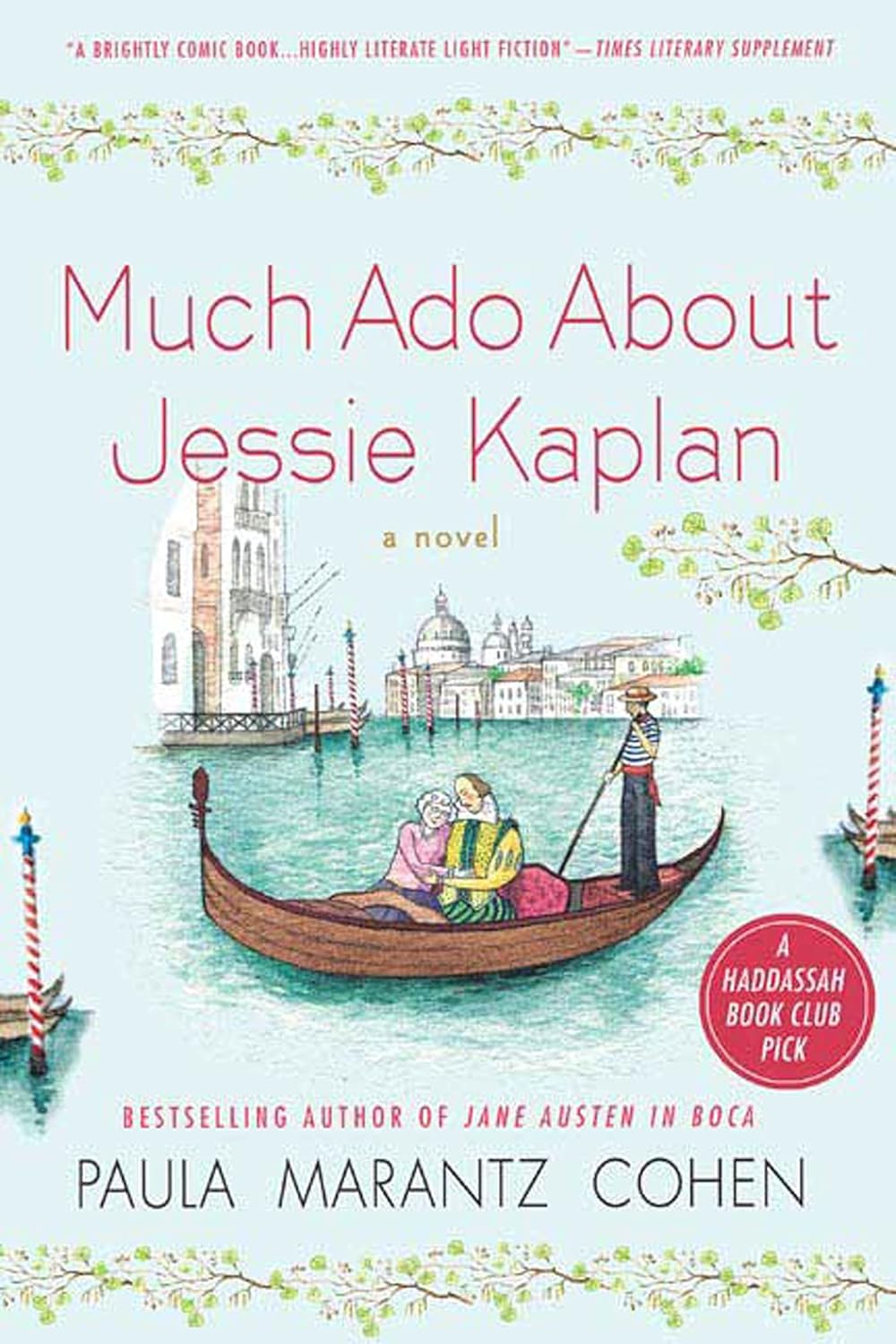
Cohen, Paula Marantz. Much Ado About Jessie Kaplan. New York: St. Martin's Griffin, 2005.
I finished reading this light and delightful little novel backstage at the production of Midsummer Night's Dream that I was recently in. There's not as much Shakespeare qua Shakespeare as I'd like, but the characters are very appealing and very funny, and the plot is quite compelling.
While the family fusses over the preparation for the elder child's bat mitzvah, a new problem arises. The grandmother starts quoting odd snatches of old poetry and singing Elizabethan songs. At first, this goes relatively unremarked upon, but it increases and starts to become problematic.
The grandmother (the eponymous Jessie Kaplan) has become convinced that she is the reincarnation of the Dark Lady of Shakespeare's sonnets. She believes that she was a Jew living in Venice when Shakespeare visited the city. They fell in love, and he wrote her many sonnets—not only the mean ones recorded in the published sonnets, but many happy ones as well. Somehow, they fell out of love, and, in revenge he wrote not only the mean sonnets but also modeled the character of Jessica and Shylock in The Merchant of Venice after her and her father. She never forgave him.
Eventually, Jessie interests the daughter's high school English teacher in her story—particularly when she says she remembers where she hid those extra sonnets.
I'll stop there to avoid spoilers. But do read the book. It's pretty light, but it does have some good things to say about interpretation and about Shakespeare.
I finished reading this light and delightful little novel backstage at the production of Midsummer Night's Dream that I was recently in. There's not as much Shakespeare qua Shakespeare as I'd like, but the characters are very appealing and very funny, and the plot is quite compelling.
While the family fusses over the preparation for the elder child's bat mitzvah, a new problem arises. The grandmother starts quoting odd snatches of old poetry and singing Elizabethan songs. At first, this goes relatively unremarked upon, but it increases and starts to become problematic.
The grandmother (the eponymous Jessie Kaplan) has become convinced that she is the reincarnation of the Dark Lady of Shakespeare's sonnets. She believes that she was a Jew living in Venice when Shakespeare visited the city. They fell in love, and he wrote her many sonnets—not only the mean ones recorded in the published sonnets, but many happy ones as well. Somehow, they fell out of love, and, in revenge he wrote not only the mean sonnets but also modeled the character of Jessica and Shylock in The Merchant of Venice after her and her father. She never forgave him.
Eventually, Jessie interests the daughter's high school English teacher in her story—particularly when she says she remembers where she hid those extra sonnets.
I'll stop there to avoid spoilers. But do read the book. It's pretty light, but it does have some good things to say about interpretation and about Shakespeare.
Monday, February 24, 2014
Book Note: The Tragedy of Arthur
Philips, Arthur. The Tragedy of Arthur: A Novel. New York: Random House, 2012.
I recently finished listening to the audio book version of The Tragedy of Arthur. I was impressed by its wit and its complexity.
The protagonist of the novel, Arthur Philips, a relatively-successful novel writer himself, finds himself in possession of a unique book: the 1597 quarto of The Tragedy of Arthur by William Shakespeare. The novel takes the form of Arthur fulfilling his contractual obligations by writing the introduction to the first modern edition of this newly-discovered Shakespeare play.
The problem is that Arthur has become convinced that the play is a forgery. His father, who passed the book along to him, has served many jail terms for forgery, and Arthur thinks this is just one more forgery.
The novel successfully blurs all sorts of lines: between novel and memoir; between fiction and scholarship (in many ways, it reminded me of Nabokov's Pale Fire); between Shakespeare and his imitators. In his hints and suggestions that the play is a forgery, the narrator almost seems to protest too much. The more he hints that it's fake, the more the reader is inclined to consider its authenticity.
And the story he tells of growing up with a father who is part artist, part forger, and part confidence trickster is both very moving and very entertaining. Elements of the relationships within the family are reflected in the play. Is that coincidence, which would imply that the play is authentic? Or are they autobiographical reflections, which would make the play a fake? The questions continue the blurring of fiction and memoir.
A similar echo is in the exchange in the image above—not in the dialogue itself but in the speech headings. In the repeated "Arthur . . . Philip . . . Arthur . . . Philip" along the left-hand margin, the narrator finds another connection—one between the text and his own name—that's too hard to explain away.
The novel itself purports to be the introduction to a scholarly edition of the play. At the novel's end, the play begins. Arthur Philips (the novelist of the novel rather than the novelist within the novel) has written a five-act play in the style of Shakespeare. In terms of its plot and language, I found it to be a bit tedious—yet the introduction has set it up so cleverly that I couldn't help but think about how I would make the case for its being Shakespeare's or prove it not to be. The novel itself, as it turns out, leaves the question of its authenticity up in the air. The narrator is convinced it isn't—but many Shakespeare scholars and experts in printed texts of the 1500s come out in favor of it.
All in all, it was a fabulous and fascinating read. I enjoyed it immensely, and I highly recommend it.
Note: For another review--one with a few more details, try the one Shakespeare Geek provides.
I recently finished listening to the audio book version of The Tragedy of Arthur. I was impressed by its wit and its complexity.
The protagonist of the novel, Arthur Philips, a relatively-successful novel writer himself, finds himself in possession of a unique book: the 1597 quarto of The Tragedy of Arthur by William Shakespeare. The novel takes the form of Arthur fulfilling his contractual obligations by writing the introduction to the first modern edition of this newly-discovered Shakespeare play.
The problem is that Arthur has become convinced that the play is a forgery. His father, who passed the book along to him, has served many jail terms for forgery, and Arthur thinks this is just one more forgery.
The novel successfully blurs all sorts of lines: between novel and memoir; between fiction and scholarship (in many ways, it reminded me of Nabokov's Pale Fire); between Shakespeare and his imitators. In his hints and suggestions that the play is a forgery, the narrator almost seems to protest too much. The more he hints that it's fake, the more the reader is inclined to consider its authenticity.
And the story he tells of growing up with a father who is part artist, part forger, and part confidence trickster is both very moving and very entertaining. Elements of the relationships within the family are reflected in the play. Is that coincidence, which would imply that the play is authentic? Or are they autobiographical reflections, which would make the play a fake? The questions continue the blurring of fiction and memoir.
A similar echo is in the exchange in the image above—not in the dialogue itself but in the speech headings. In the repeated "Arthur . . . Philip . . . Arthur . . . Philip" along the left-hand margin, the narrator finds another connection—one between the text and his own name—that's too hard to explain away.
The novel itself purports to be the introduction to a scholarly edition of the play. At the novel's end, the play begins. Arthur Philips (the novelist of the novel rather than the novelist within the novel) has written a five-act play in the style of Shakespeare. In terms of its plot and language, I found it to be a bit tedious—yet the introduction has set it up so cleverly that I couldn't help but think about how I would make the case for its being Shakespeare's or prove it not to be. The novel itself, as it turns out, leaves the question of its authenticity up in the air. The narrator is convinced it isn't—but many Shakespeare scholars and experts in printed texts of the 1500s come out in favor of it.
All in all, it was a fabulous and fascinating read. I enjoyed it immensely, and I highly recommend it.
Note: For another review--one with a few more details, try the one Shakespeare Geek provides.
Thursday, February 13, 2014
J. R. R. Tolkien on "the folly of reading Shakespeare"
Tolkien, J. R. R. The Letters of J. R. R. Tolkien. Ed. Humphrey Carpenter. Boson: Houghton Mifflin, 1981.The general impression is that J. R. R. Tolkien, author of The Hobbit and miscellaneous other works set in the world of The Hobbit, did not like Shakespeare.
The reason for this impression springs partly from Tolkien's account of his imaginative creation of the Ents, which are something like walking, talking trees. The Ents are inspired by Shakespeare, but they sprang forth not from what Shakespeare did but from what he didn't do. Shakespeare Geek has an account of how Tolkein's disappointment with "the shabby use made in Shakespeare of the coming of 'Great Birnam wood to high Dunsinane hill'" (212) led him to imagine how walking trees might really march to war.
What might be more surprising is an account of Tolkein actually enjoying Shakespeare. In Letter 76, dated 28 July 1944 and written to Christopher Tolkien, J. R. R. Tolkien describes seeing a production of Hamlet. Tolkien argues that it's foolish to read Shakespeare . . . except in conjunction with seeing performances of the plays:
I wonder if Tolkien would say the same about his own books today. Is there folly in annotating Tolkien—unless you see the films?Plain news is on the airgraph; but the only event worth of talk was the performance of Hamlet which I had been to just before I wrote last. I was full of it then, but the cares of the world have soon wiped away the impression. But it emphasised more strongly than anything I have ever seen the folly of reading Shakespeare (and annotating him in the study), except as a concomitant of seeing his plays acted. It was a very good performance, with a young rather fierce Hamlet; it was played fast without cuts; and came out as a very exciting play. Could one only have seen it without ever having read it or knowing the plot, it would have been terrific. It was well produced except for a bit of bungling over the killing of Polonius. But to my surprise the part that came out as the most moving, almost intolerably so, was the one that in reading I always found a bore: the scene of mad Ophelia singing her snatches. (88)
As a side note, he does object to Shakespeare's use of elves. We find that in Letter 151, written to Hugh Brogan on 18 September 1954:
If he's objecting to the elves in Midsummer Night's Dream, I'll have to argue with him; however, if he means the elves in Merry Wives of Windsor, I'm entirely on his side.I now deeply regret having used Elves, though this is a word in ancestry and original meaning suitable enough. But the disastrous debasement of this word, in which Shakespeare played an unforgiveable part, has really overloaded it with regrettable tones, which are too much to overcome. (185)
Wednesday, February 5, 2014
Book Notes: William Shakespeare: Very Interesting People and Coffee with Shakespeare
Holland, Paul. William Shakespeare: Very Interesting People. Oxford: Oxford University Press, 2007.
Wells, Stanley. [Co-written with Paul Edmondson.] Coffee with Shakespeare. New York: Sterling, 2008.
I've just finished reading two very concise books that focus on Shakespeare's biography. One was a great deal of fun, compressing impressively the most important information about Shakespeare's life and times into a very slim volume; the other was, quite frankly, very disappointing.
Paul Holland's William Shakespeare, one of the Very Interesting People series of books, is exquisite. It's a reprint of Holland's Oxford Dictionary of National Biography entry, and it adroitly covers Shakespeare's life. But it goes beyond that to be one of the best, most concise accounts of how Shakespeare attained his current position. It's going to be my go-to resource for students asking how popular Shakespeare was in his own day and in the century following his death. It also has a good (though necessarily cursory) overview of stage history, literary derivatives of Shakespeare, and filmed versions of Shakespeare plays. All in all, it was a thoroughly enjoyable, enlightening read.
Stanley Wells' Coffee with Shakespeare was a let down—especially considering Wells' great scholarship and keen writing ability. But perhaps it was just thrown together for the gift shop at the Shakespeare Birthplace. Whatever the case may be, it's an imaginary conversation with Shakespeare over coffee about his life and times. It's a pretty good idea—but it doesn't play out very well. It becomes over-sentemtalized at points; at others, it takes a quick and easy stance on matters that are really quite complicated and nuanced (e.g., the order of the sonnets). I include a few images from the book below to illustrate:
Wells, Stanley. [Co-written with Paul Edmondson.] Coffee with Shakespeare. New York: Sterling, 2008.
I've just finished reading two very concise books that focus on Shakespeare's biography. One was a great deal of fun, compressing impressively the most important information about Shakespeare's life and times into a very slim volume; the other was, quite frankly, very disappointing.
Paul Holland's William Shakespeare, one of the Very Interesting People series of books, is exquisite. It's a reprint of Holland's Oxford Dictionary of National Biography entry, and it adroitly covers Shakespeare's life. But it goes beyond that to be one of the best, most concise accounts of how Shakespeare attained his current position. It's going to be my go-to resource for students asking how popular Shakespeare was in his own day and in the century following his death. It also has a good (though necessarily cursory) overview of stage history, literary derivatives of Shakespeare, and filmed versions of Shakespeare plays. All in all, it was a thoroughly enjoyable, enlightening read.
Stanley Wells' Coffee with Shakespeare was a let down—especially considering Wells' great scholarship and keen writing ability. But perhaps it was just thrown together for the gift shop at the Shakespeare Birthplace. Whatever the case may be, it's an imaginary conversation with Shakespeare over coffee about his life and times. It's a pretty good idea—but it doesn't play out very well. It becomes over-sentemtalized at points; at others, it takes a quick and easy stance on matters that are really quite complicated and nuanced (e.g., the order of the sonnets). I include a few images from the book below to illustrate:
Near the beginning of the book (Shakespeare's contributions are in brown; the questioner's are in green):
The middle of a conversation about the sonnets:
Thoughts about living away from Stratford:
Grab a copy of Holland's William Shakespeare—it's great. But try Wells' Shakespeare & Co. instead of Coffee with Shakespeare.
Click below to purchase the books from amazon.com
(and to support Bardfilm as you do so).
Tuesday, February 4, 2014
A Quick Review of Anonymous
Anonymous. Dir. Edward D. Wood, Jr. Perf. David Hasselhoff, Sarah Jessica Parker, Mark Wahlberg, Lindsay Lohan, and Willem Dafoe. 2011. DVD. Sony Pictures Home Entertainment, 2012.
After several years and many attempts, I finally found enough time and a hearty-enough constitution to watch Anonymous. In the interest of accuracy (unlike the film itself), I'll reveal that I watched it in several sections over about a week's time, occasionally watching it at three times the speed with the subtitles on, frequently grading papers as I did so.
The film is awful in all sorts of ways. For the ways in which the plot is ludicrous—both historically and logically—I point you toward Holger Syme's take on the film. In addition to that, the acting is bad, the writing is worse, and the editing frequently makes very little sense.
I don't imagine it comes as a surprise to any of Bardfilm's readers, but I was utterly appalled by the film. Here are a few of the more notable things this film asks us to believe:
There are innumerable blurbs for Anonymous scattered around the Internet. By way of conclusion, I've collated a few of the more notable ones here:
Cole, Mary Hill. The Portable Queen: Elizabeth I and the Politics of Ceremony. Amherst: University of Massachusetts Press, 1999.
Links: The Film at IMDB.
After several years and many attempts, I finally found enough time and a hearty-enough constitution to watch Anonymous. In the interest of accuracy (unlike the film itself), I'll reveal that I watched it in several sections over about a week's time, occasionally watching it at three times the speed with the subtitles on, frequently grading papers as I did so.
The film is awful in all sorts of ways. For the ways in which the plot is ludicrous—both historically and logically—I point you toward Holger Syme's take on the film. In addition to that, the acting is bad, the writing is worse, and the editing frequently makes very little sense.
I don't imagine it comes as a surprise to any of Bardfilm's readers, but I was utterly appalled by the film. Here are a few of the more notable things this film asks us to believe:
- Elizabeth I goes on progress in order to give birth to illegitimate children (one of whom is fathered by a former illegitimate child of Elizabeth's). Every time the Virgin Queen gets pregnant, they have to go on progress, have the baby, and then shuffle off the little mortal coil to some noble willing to raise it. According to Mary Cole's The Portable Queen, Elizabeth went on twenty-three progresses during her reign. The math suggests that Elizabeth was certainly doing her part to increase the stock of heirs to the throne of England by at least (there could have been twins!) twenty-three. Note: Thanks to @commish24 and @historyadjunct for their help in suggesting this source and passing along its information.
- The Earl of Oxford has a stockpile of a dozen or so plays that he suddenly decides to release to the world. It's always good to be prepared with a Brilliant Drama Slush Fund.
- William Shakespeare is too idiotic to be taken seriously as an actor, but everyone swallows the idea that he's a playwright—make that the playwright—without any question. He's also completely ignorant—except when it comes to extorsion and theatre business, which he manages quite nicely.
- Elizabethans hate hunchbacks. Therefore, they hate Robert Cecil. The Earl of Oxford decided to give the Richard III of his eponymous play a hunch in order to mock Robert Cecil. That was the first time anyone ever said anything about Richard III having a hunch.
- Christopher Marlowe was murdered by William Shakespeare because he suspected that Shakespeare might not be the author of the plays.
- Writing anything in iambic pentameter is inordinately impressive to everyone—even other playwrights.
"Remember when Regan and Cornwall gouged my eyes out? This was worse."
—Gloucester
"This is the silliest stuff that ever I heard."
—Hippolyta
"Eww, that's disgusting. She's old enough to be his mother! Oh, that's right. She is his mother."
—Antiochus
"I had never seen this film before, nor shall ever again, for it is the most insipid ridiculous film that ever I saw in my life."
—Samuel Pepys
"Well, I'll admit it. As slurs on my character go, this tops Ben Jonson's 'Not Without Mustard' joke!"
—William Shakespeare
"Never, never, never, never, never."
—King Lear
"O horrible! O horrible! Most horrible!"
—Hamlet
"I rather liked it."
—Iago
Works Cited
Cole, Mary Hill. The Portable Queen: Elizabeth I and the Politics of Ceremony. Amherst: University of Massachusetts Press, 1999.
Links: The Film at IMDB.
Subscribe to:
Posts (Atom)
Bardfilm is normally written as one word, though it can also be found under a search for "Bard Film Blog." Bardfilm is a Shakespeare blog (admittedly, one of many Shakespeare blogs), and it is dedicated to commentary on films (Shakespeare movies, The Shakespeare Movie, Shakespeare on television, Shakespeare at the cinema), plays, and other matter related to Shakespeare (allusions to Shakespeare in pop culture, quotes from Shakespeare in popular culture, quotations that come from Shakespeare, et cetera).
Unless otherwise indicated, quotations from Shakespeare's works are from the following edition:
Shakespeare, William. The Riverside Shakespeare. 2nd ed. Gen. ed. G. Blakemore Evans. Boston: Houghton Mifflin, 1997.
All material original to this blog is copyrighted: Copyright 2008-2039 (and into perpetuity thereafter) by Keith Jones.
—The Tempest


.Cover.jpg)