Saturday, November 14, 2009

More Shakespeare on Sesame Street

Sesame Street. 1969-present. [The number of seasons and episodes and the paucity of information about them makes more precise citation, I'm afraid, impracticably difficult.]

When I posted a link to Patrick Stewart's appearance on Sesame Street, I suspected that I had only scratched the surface. But I didn't realize how deep below the surface of the show Shakespeare runs until I read Mad Shakespeare's paean on the subject.

I'm undoubtedly indebted to them for pointing out the following clip, which seems inspired by the Weird Sisters:


But I'm even more stunned by this Monsterpiece Theatre episode (I never knew this existed), with its marvelous riff on Hamlet:


And, yes, that is Mel Gibson.

By the way, a Muppet Show episode (let's leave off the great Sesame Street v. Muppet Show debate for another time, shall we?) has Christopher Reeve doing something similar with Hamlet, Kermit, and the gang (I've been holding off on writing about it until the DVD of that season is officially released).

The good people of Mad Shakespeare don't mention "Omelet, Prince of Dinner" (for which, follow this link) but that may be because it isn't that good. They do mention "The Taming of the Shoe," which also isn't very good, so perhaps that hypothesis won't hold water. The "Taming" segment is mainly a title reference (even though there is—as you'd expect—an unruly shoe).

Finally, they mention the Monsterpiece Theatre segment entitled "Monsters of Venice." The sketch in general gets a little sketchy (by which I mean it becomes too dull too quickly), but there is one stupendous moment when Grover, spokesmonster for the Monsters of Venice (who feel marginalized because they have not been invited to the party), delivers a portion of the "If you prick us, do we not bleed" speech (III.i.64ff):


Note: I thought it best to give the scene in abbreviated form here. The notorious "pound of fur" scene doesn't really carry much weight.

Friday, November 13, 2009

Shakespeare, Catullus, and Jesse James

The Assassination of Jesse James by the Coward Robert Ford. Dir. Andrew Dominik. Perf. Sam Shepard, Mary-Louise Parker, Casey Affleck, and Brad Pitt. 2007. DVD. Warner Home Video, 2008.

Catullus. Catullus: The Complete Poems for American Readers. Trans. Reney Myers and Robert J. Ormsby. New York: E. P. Dutton, 1970.

The purpose of this post is to clarify a persistent misattribution. The Assassination of Jesse James by the Coward Robert Ford does contain a quotation from Shakespeare; however, it also contains a quotation from Catullus.

At one point in the film, one of the bandits quotes from Poem LXX by Catullus:
My love says she would marry only me,
And Jove himself could never make her care.
What women say to lovers, you'll agree,
One writes on running water or on air.
The Latin for this poem reads as follows:
Nulli se dicit mulier mea nubere malle
quam mihi, non si se Iuppiter ipse petat.
dicit: sed mulier cupido quod dicit amanti,
in uento et rapida scribere oportet aqua.
A bit later in the film, another bandit quotes from Sonnet 62 (though you can only just make out the words):
Sin of self-love possesseth all mine eye
And all my soul and all my every part;
And for this sin there is no remedy,
It is so grounded inward in my heart.
Here's a clip that contains both quotations:


Again, the main point is to give due credit where it is due. Shakespeare wrote "And for this sin there is no remedy, / It is so grounded inward in my heart"; Catullus wrote "What women say to lovers, you'll agree, / One writes on running water or on air." Thank you for the clarification.


Links: The Film at IMDB.

Click below to purchase the film and the poems from amazon.com
(and to support Bardfilm as you do so).


Thursday, November 12, 2009

A Midsummer Night's Dream: Get Over It (Part Two)

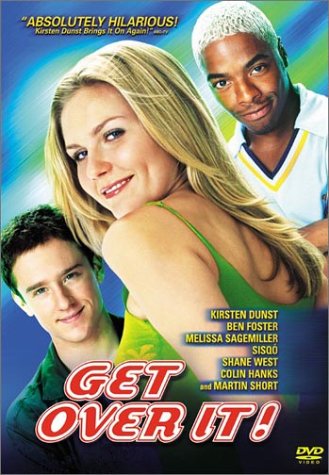
Get over it. Dir. Tommy O’Haver. Perf. Kirsten Dunst, Ben Foster, Melissa Sagemiller, and Sisqó. 2001. DVD. Miramax, 2001.

Get Over It fits Kenneth S. Rothwell's "Mirror Movie" devision of Shakespeare Derivatives, but it might also fit the "Musicals, ballets, and operas" section. Not only are the high school students putting on A Midsummer Night's Dream, it's a musical version of the play!

The songs are amusing, but not terribly exciting. More interesting is the way the lives of the students are affected by the plot of the play—and how the plot of the play is then significantly altered by the alterations in the lives of the students.

The only reason the character playing Lysander tried out for the play at all is because he had broken up with the character playing Hermia, and he thought they would get back together (like Hermia and Lysander do at the end of A Midsummer Night's Dream). But the character playing Helena falls for the character playing Lysander, and he starts to fall for her. The question then becomes whether Lysander should pair up with Helena, changing the ending of Shakespeare's play.

You might have thought that love alters not when it alteration finds—but that doesn't hold true in this film!

Caution: The clip below contains spoilers.


Please note that the film has a fair amount of obscene language (edited out in the clip above). Bardfilm recommends previewing before showing clips to your classes, your children, your aged parents, or people with heart conditions.

This just in: Lyrics for the songs from Get Over It quoted above, together with the text of Lysander's speech:
Opening (Did you Ever Read a Shakespeare Play?)

Did you ever read a Shakespeare play
And never understand a word they say?
Well, tonight we're gonna make things clear
’Cause Shakespeare’s dead . . .
but we’re all here!

William Shakespeare wrote a play
A long, long time ago
About this chick named Hermia
And the two guys who loved her so.
They said, “Hermia, please be my girl,”
But she only wanted one (she wanted one).
In the night the fairies came to play,
So tonight we have our fun.

’Cause I love him
And I love her
(If only her best friend he’d prefer).
And so the fairies all hatched a scheme
In this (boom-shacka-lacka-lacka)
Midsummer Night’s Dream.


Hermia (I’ll make you love me)

Whoo-ohh-ohh.
Why won’t you love me?
Whoo-ooh-ooh,
Whoo-ooh-ooh-ooh.
There’s a girl
Who says she don’t love me,
So that’s the girl
That I got to have.

I’ll tell you why:
She’s everything a girl ought to be
And that is why
I can’t understand
Why she don’t love me.
No!

Hermia—
I’ll make you love me.
Hermia—
I’ll make you care.
Never before has a girl
Hurt me more
I’m begging—
Hermia—
Please love me!
Why won’t you love me?
Please love me!


Lysander’s Speech

My lord, I shall reply amazedly.
Half sleep, half waking . . .
. . . . . . . . . . . . . . . . . . . . . . . . . . . .
I came with Hermia hither: our intent
Was to be gone from Athens [so] we might,
Without the peril of . . . Athenian law[, be wed]. (IV.i.146-47; 151-53, with alterations)
[From here on out, not from Shakespeare]
However—
My lord, we slept and slept, as well you know.
Things did change as love did grow.
Although in ways fair Hermia’s soul and mine
Shall forever intertwine,
Alas, we must forever part,
For, lo, to another belongs this heart.

Links: The Film at IMDB.

Click below to purchase the film from amazon.com
(and to support Bardfilm as you do so).


Wednesday, November 11, 2009

A Midsummer Night's Dream: Get Over It (Part One)

Get over it. Dir. Tommy O’Haver. Perf. Kirsten Dunst, Ben Foster, Melissa Sagemiller, and Sisqó. 2001. DVD. Miramax, 2001.

Get Over It does not use Shakespeare brilliantly, but it has some wonderful moments. The high school drama teacher / director is played to absolute perfection by Martin Short, for example.

The film fits Kenneth S. Rothwell's "Mirror Movie" devision of Shakespeare Derivatives. The students at the high school are putting on A Midsummer Night's Dream, and the plot of the play and the plots of their lives intersect and interact in interesting ways.

I'm intrigued by the "dream sequence" devices this section of the film uses. The cover of the play becomes the setting of a daydream version of dream. It does degenerate (be warned—"the stale of horses," as Octavius puts it (Anthony and Cleopatra I.iv.62) will make an appearance) into slapstick, but the world of the cover is interestingly maintained.


I have to note that, despite Demetrius' claim, there is swordfighting in the play. Well, to be fair, there is threatened swordfighting in III.ii when Demetrius and Lysander pursue each other through the wood with swords drawn.

I should also note that the film has a fair amount of obscene language (edited out in the clip above). Bardfilm recommends previewing before showing clips to your classes.

Bonus Clip: Desmond Forrest-Oates is the One-Man Hamlet.


Links: The Film at IMDB.

Click below to purchase the film from amazon.com
(and to support Bardfilm as you do so).


Tuesday, November 10, 2009

The Beatles and Shakespeare: The Scholarly Conclusion

The Beatles Anthology. San Francisco: Chronicle Books, 2000. Print.

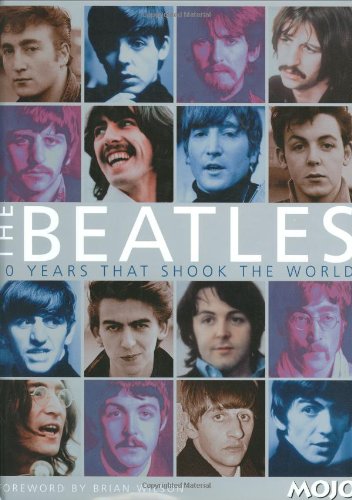
Black, Johnny. “The Eggman Cometh.” The Beatles: Ten Year That Shook the World. Ed. Paul Trynka. London: Dorling Kindersley, 2004. 276. Print.

I've found some scholarly weight to put behind my post on The Beatles "I am the Walrus" (for which, q.v.). And, in following that trail, I discovered some other odd and interesting tidbits.

First, though, the scholarly citations. Johnny Black helps pinpoint the date of the broadcast in the section of The Beatles: Ten Year That Shook the World that deals with the song:
One final surreal touch came on September 29, when random lines from a BBC Third Programme radio production of King Lear were added—the radio being tuned by Ringo, while John worked the mixing desk. (276)
The date of the broadcast was 29 September 1967; recording work on the song commenced on 5 September 1967.

In 1974, John Lennon, according to The Beatles Anthology, said this:
There was even some live BBC radio. They were reciting Shakespeare or something and I just fed whatever lines were on the radio right into the song. . . . I never knew it was King Lear until, years later, somebody told me—because I could hardly make out what he was saying. (273)
He also said this, which shouldn't lesson my admiration for him—even though it nonetheless does:
I hate Shakespeare; I don’t care whether you should like him or not. I don’t know if it’s because of school or because it doesn’t mean anything to me. (176)
In the same book, Ringo paints a somewhat surreal and fascinating portrait of his life as an actor. Of particular interest is what he amused himself by doing while hanging out with Richard Burton and Elizabeth Taylor. It seems that Ringo really enjoyed pretending to be dismissive of Shakespeare in Burton's presence:
Richard [Burton] and Elizabeth [Taylor] turned out to be really good friends. One fabulous thing he did was to read “I am the Walrus” off the album sleeve in that voice of his. It was just amazing. We’d go and stay with them on their boat, and that drove Richard crazy. Because I used to play games with his head. I would say, “. . . the English language, what a load of crap!” and he would explode. And I’d say, “Shakespeare—give us a break.” It was just a little game I would play with him, and he’d always fall for it and get angry and send me off his boat: “Get off my boat, you little whippersnapper.” (278)
Ah, Ringo—you kid, you!

But wouldn't it be marvelous to have Richard Burton declaiming "I am the Eggman. They are the Eggmen. I am the Walrus. Goo, goo, ga-joob"? I can just hear it, can't you?


Shakespeare is the Eggman!

Click below to purchase the books from amazon.com
(and to support Bardfilm as you do so).


Monday, November 9, 2009

What Shakespeare Didn't Say

Pearce, Joseph. The Quest for Shakespeare[: The Bard of Avon and the Church of Rome]. San Francisco: Ignatius Press, 2008. Print.

I don't particularly like to offer really negative reviews, especially when Books & Culture has done such a fine job of that already, but I feel compelled to make one comment about Joseph Pearce's recent work on Shakespeare's religion.

The question of Shakespeare's religion (whether he had any, and, if he did, whether it was protestant or Catholic) is an enormously vibrant topic in modern Shakespeare studies. And prominent scholars have come down on both sides of the issue.

My main objection to much of the argumentation involves its use of evidence from the plays. All too often, a character is quoted as evidence that Shakespeare thought one thing or the other. At its most extreme, it can become stunningly misleading. Pearce, for example, makes the following argument:
Shakespeare did not merely condemn each of the seven deadly sins; he ordered them in conformity to the teaching of the Catholic Church . . . . he describes lust or "unchastity" as the least grievous: "Of the deadly seven it is the least." (22)
The problem is that Shakespeare, however much his plays may condemn each of the seven deadly sins, did not describe lust as the least of the seven deadly sins. Claudio, desperate for his life in Measure for Measure and wanting to justify his imminent request that his sister sleep with Angelo to save his life, describes it that way. Indeed, Claudio even says, "Sure it is no sin" (III.i.109) before adding "Or of the deadly seven it is the least" (III.i.110).

Let's have clarity of argument. It may be that Shakespeare orders the seven deadly sins in a Catholic way. But let's make the argument from what his characters say or how they tend to behave instead of from an amorphous "Shakespeare says" position.

By the way, the portrait on the cover is cited as "Nicholas Hilliard, Man Holding a Hand from a Cloud (miniature)—possibly William Shakespeare, 1588." Its title is usually given as Portrait of an Unknown Man Clasping a Hand from a Cloud, and the connection to Shakespeare was made in the 1977 book Shakespeare by Hilliard by Leslie Hotson. The belief that this is a portrait of Shakespeare is not widely held. But here's a larger image of the miniature:


Links: The article at Books & Culture.

Click below to purchase the book from amazon.com
(and to support Bardfilm as you do so).

Sunday, November 8, 2009

Sesame Street 40, Hamlet 408

"Soliloquy on B." Perf. Patrick Stewart. Sesame Street. [Details about the specific episode are sketchy at present, but I will be attempting to gather them soon. Bardfilm likes to give full bibliographic details whenever possible.]
Sesame Street turned forty this week; Hamlet was written 408 years ago (though not necessarily this week). In honor of the one or the other, Bardfilm is providing Patrick Stewart's riff on Hamlet's soliloquy. If only Alistair Cookie had introduced it for Monsterpiece Theatre!

To celebrate these important historic moments, here's Patrick Stewart contemplating the letter B.


Saturday, November 7, 2009

Baby Shakespeare may be even more Lost than Perdita

Baby Shakespeare. N.d. Perf. Aspen Clark and Sierra Clark. 2002. DVD. Disney, 2002.

I've always loathed the Baby Einstein series on principle. Real life and real interaction seem so much more three-dimensional and interesting than videos of spinning toys. The reason for this is primarily because they are!

It seems that the people behind the videos are acknowledging that they made claims that were too extravagant, and, as this article explains, they're offering refunds to parents who are willing to admit that their children are dimwitted. Or that they didn't turn into geniuses from watching videos. I suppose marketing the DVD under the name Baby Couch Potato didn't seem like a good idea, but the "genius" claim has gotten them in some trouble.

I grabbed the video from our library and watched it—well, mostly listened to it while grading papers—and there's very little Shakespeare there. At one point, the camera pans over some flowers, and we hear one of Oberon's most lyrical speeches:
I know a bank where the wild thyme blows,
Where oxlips and the nodding violet grows,
Quite over-canopied with luscious woodbine,
With sweet musk-roses and with eglantine:
There sleeps Titania sometime of the night,
Lull'd in these flowers with dances and delight. (II.i.249-54)

Out of all this, we can at least say that we're virtually certain that Shakespeare did not obtain his genius by being plunked down as a baby to watch videos of spinning toys. We here at Bardfilm shudder to think of it.

Oh, there's one more thing—you can buy the onesie pictured above if you so desire! (The shop is not affiliated with Bardfilm.)

I also should mention that I couldn't resist an allusion to a lost baby in the title of this post. The reference is to The Winter's Tale.

Links: The Film at IMDB.

Click below to purchase the film from amazon.com
(and to support Bardfilm as you do so).

Friday, November 6, 2009

The Phantom of 42nd Street; or, "Where was Shakespeare in 1945?"

The Phantom of 42nd Street. Dir. Albert Herman. Perf. Dave O'Brien, Kay Aldridge, Alan Mowbray, Frank Jenks, and Vera Marshe. 1945. DVD. Alpha Video, 2004.

One of the most thrilling categories of Shakespearean derivatives is the "Mirror Movie" mentioned in Kenneth S. Rothwell's classification system. In that type of derivative, characters in a film are putting on a Shakespeare play—and, most frequently, the events of their lives reflect or are reflected in the play.

The Phantom of 42nd Street isn't, on the whole, remarkable. It's a more-or-less typical B movie in the slightly-hardboiled detective / slightly-film noir vein. But some of the bit parts steal the show.

The cabbie, for example, is named "Romeo," but we don't know why until he accurately cites a quotation from Hamlet (and smug he looks about it, too!) and tells us that he was brought up on Shakespeare. The female bit player finally lands a line (not one actually in Shakespeare) to everyone's great amusement.

For the most part, though, the play settles down to a plot involving putting on a production of Julius Caesar to catch a murderer.


In the scene, we get a bit of the beginning of Act II, scene ii of Julius Caesar, including the "Cowards die" speech alluded to in The Music Man:
Cowards die many times before their deaths;
The valiant never taste of death but once.
Of all the wonders that I yet have heard.
It seems to me most strange that men should fear;
Seeing that death, a necessary end,
Will come when it will come. (II.ii.32-37)
You may notice that the actors playing the detective / reporter and the cabbie play amateur actors well. The detective, as Decius, needs to project, and he prompts the cabbie (who is playing Casca) with what amounts to a nonce-line: "Speak of hands for me" instead of "Speak, hands, for me" (III.i.76). The line that should follow, the most famous in the play, is cut. We hear no "Et tu, Brute?" (III.i.77)—but that may be part of the exigencies of the mystery plot.

In short, Shakespeare was alive and kicking (in B movies, at least) in 1945. He may have been kicking to get out of them, but he was kicking all the same.

Links: The Film at IMDB.

Click below to purchase the film from amazon.com
(and to support Bardfilm as you do so).

Thursday, November 5, 2009

The Beatles and Shakespeare, Take Three

The Music of Lennon and McCartney. Dir. Philip Casson. Perf. John Lennon, Paul McCartney, and Peter Sellers. 1965.
I just remembered one more connection between the Beatles and Shakespeare—and Peter Sellers. In a strange moment, John and Paul point out Peter, who is dressed as Richard III (à la Olivier), and he delivers a speech. Here you go:

Wednesday, November 4, 2009

Noël Coward: The Shakespeare of Comic Lyricists

Coward, Noël. “Why Must the Show Go On?” The Lyrics of Noël Coward. London: Heinemann, 1965. 355-57.

A Midwinter’s Tale [a.k.a. In the Bleak Midwinter]. Dir. Kenneth Branagh. Perf. Richard Briers, Hetta Charnley, Joan Collins, Nicholas Farrell, Mark Hadfield, Gerard Horan, Celia Imrie, Michael Maloney, Jennifer Saunders, Julia Sawalha, and John Sessions. 1995. Videocassette. Turner, 1999.

Branagh’s A Midwinter’s Tale (for which q.v.) is brilliant beyond bearing, but we shouldn't overlook Noël Coward's contribution. The opening sequence of the film uses one of his songs, and that song has been running through my head. Coward is a brilliant lyricist—something of a cross between P. G. Wodehouse and Lennon / McCartney and Gilbert & Sullivan. This song (see the lyrics below) is particularly amazing. It strikes me as something a Fool in a modernized King Lear would sing:

Why must the show go on?

The world for some years
Has been soddden with tears
On behalf of the Acting profession,
Each star playing a part
Seems to expect the ‘Purple Heart’,
It’s unorthodox
To be born in a box
But it needn’t become an obsession,
Let’s hope we have no worse to plague us
Than two shows a night at Las Vegas.
When I think of physicians
And mathematicians
Who don’t earn a quarter the dough,
When I look at the faces
Of people in Macey’s
There’s one thing I’m burning to know:

Why must the show go on?
It can’t be all that indispensable,
To me it really isn’t sensible
On the whole
To play a leading role
While fighting those tears you can’t control,
Why kick up your legs
When draining the dregs
Of sorrow’s bitter cup?
Because you have read
Some idiot has said,
‘The Curtain must go up’!
I’d like to know why a star takes bows
Having just returned from burying her spouse.
Brave boop-a-doopers,
Go home and dry your tears,
Gallant old troupers,
You’ve bored us all for years
And when you’re so blue,
Wet through
And thoroughly woe-begone,
Why must the show go on?
Oh Mammy!
Why must the show go on?

We’re asked to console
With each tremulous soul
Who steps out to be loudly applauded,
Stars on opening nights
Sob when they see their names in lights,
Though people who act
As a matter of fact
Are financially amply rewarded,
It seems, while pursuing their calling,
Their suffering’s simply appalling!
But butchers and bakers
And candlestick makers
Get little applause for their pains
And when I think of miners
And waiters in ‘Diners’
One query for ever remains:

Why must the show go on?
The rule is surely not immutable,
It might be wiser and more suitable
Just to close
If you are in the throes
Of personal grief and private woes.
Why stifle a sob
While doing your job
When, if you use your head,
You’d go out and grab
A comfortable cab
And go right home to bed?
Because you’re not giving us much fun,
This ‘Laugh Clown Laugh’ routine’s been overdone,
Hats off to Show Folks
For smiling when they’re blue
But more comme-il-faut folks
Are sick of smiling through,
And if you’re out cold,
Too old
And most of your teeth have gone,
Why must the show go on?
I sometimes wonder
Why must the show go on?

Why must the show go on?
Why not announce the closing night of it?
The public seem to hate the sight of it,
Dear, and so
Why you should undergo
This terrible strain we’ll never know.
We know that you’re sad,
We know that you’ve had
A lot of storm and strife
But is it quite fair
To ask us to share
Your dreary private life?
We know you['re] trapped in a gilded cage
But for Heaven’s sake relax and be your age,
Stop being gallant
And don’t be such a bore,
Pull up your talent,
There’s always Plenty more
And if you lose hope
Take dope
And lock yourself in the John,
Why must the show go on?
I’m merely asking
Why must the show go on?
Coward also wrote the lyrics for a musical called Sigh No More—but I only just learned that, so I have nothing more to say on that subject . . . yet.

Links: Previous Post on the Subject. Previous Previous Post on the Subject.

Click below to purchase the film—or the shooting script!—or the book of Noël Coward lyrics!—from amazon.com
(and to support Bardfilm as you do so).


Tuesday, November 3, 2009

The Beatles and Shakespeare, Take Two

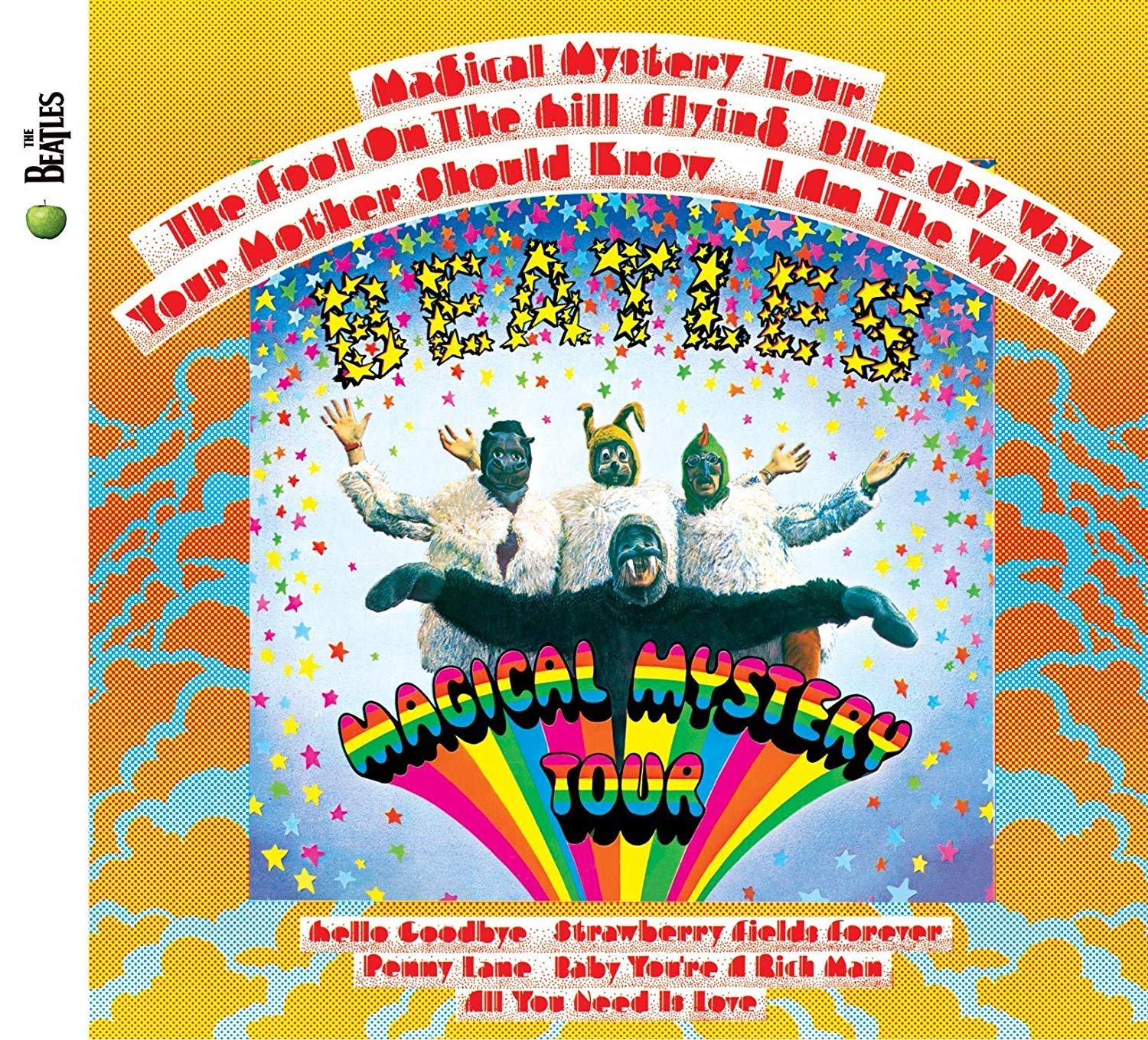
The Beatles. "I am the Walrus." By John Lennon and Paul McCartney. Magical Mystery Tour. 1967. EMI, 2009. CD.

The Beatles played a scene from Midsummer Night's Dream, but they also—however unwittingly—incorporated portions of King Lear into one of their songs.

"I am the Walrus" contains, among much else, a radio spinning between stations—mostly static-filled ones—one of which was broadcasting an audio production of King Lear. I will be trying to track down a more scholarly source than my own memory, and I'll update this post when I get that material. In the meantime, I re-listened to the track from an earlier CD release than the most current, and, just after the two minute mark, some indistingishable (to me) words come in (it sounds like "What light," but there's nothing with those sounds anywhere near the rest of the words from Lear). Then, right after the "Sitting in an English garden, waiting for the sun. / If the sun don't come, you get a tan from standing in the English rain" pair of lines, the lines "Now, good sir" and "poor man, made tame to fortune's . . . good pity." The lines are part of an exchange between Gloucester and Edgar at a point where Gloucester has been blinded and met the mad King (sorry if any of these are spoilers) and while Edgar is still disguised. Here's the more complete exchange:
Gloucester: Now, good sir, what are you?

Edgar; A most poor man, made tame to fortune's blows,
Who, by the art of known and feeling sorrows,
Am pregnant to good pitty. (IV.vi.220-23)
The broadcast seems to progress at the right speed for the scene to pick up at 3:51 in the song with Oswald's lines after Edgar has fought and overcome him:
Oswald: Slave, thou hast slain me. Villain, take my purse:
If ever thou wilt thrive, bury my body,
And give the letters which thou find'st about me
To Edmund earl of Gloucester; seek him out
Upon the British party: O, untimely death!
Death!

Edgar: I know thee well; a serviceable villain,
As duteous to the vices of thy mistress
As badness would desire.

Gloucester: What, is he dead?

EDGAR Sit you down, father; rest you. . . . (IV.vi.246-55)
The Wikipedia entry points out that these lines formed part of the "Paul is dead" theory. Note, however, that no direct answer is given in the song, even though Edgar says, "He's dead" just two lines later. I don't know if anyone ever considered Paul's line "Now am I dead" from the Midsummer Night's Dream scene, but it could be used as evidence: those who are able to say "I am dead" are seldom (if ever) actually dead.

Links: The Wikipedia entry on the song.

Click below to purchase the album from amazon.com
(and to support Bardfilm as you do so).

Monday, November 2, 2009

A Midsummer [Hard Day's] Night's Dream

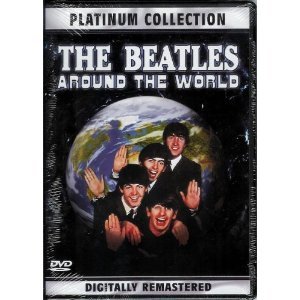
The Beatles: Around the World. [a.k.a. Around the Beatles]. Perf. John Lennon, Paul McCartney, George Harrison, Ringo Starr, and Trevor Peacock. 1964. DVD. Video Music, 2003.

A long time ago, I tracked down this rare clip of the Beatles performing Shakespeare, started considering all the clever ways Beatles songs could be worked into productions of Shakespeare, and promptly forgot about the clip itself.

But it's back. The Fab Four here portray the rude mechanicals from A Midsummer Night's Dream as they put on their version of Pyramus and Thisbe:


This clip mainly has the effect of filling its viewer with wonder and awe that anyone was ever able to hear the Beatles well enough to judge their musical quality—early fans of the Beatles were apparently seldom if ever able to hear the Beatles perform (at least at any live venue) over the screams of the fans next to them. But even if it's hard to hear, it's fascinating to see John, Paul, George, and Ringo (and Trevor Peacock, for good measure) in these roles. The audience seems to eat it up. But they'd probably be screaming with joy if they were performing Moose Murders or gargling with low-quality ginger ale.

Links: The Film at IMDB.

Click below to purchase the film from amazon.com
(and to support Bardfilm as you do so).


Sunday, November 1, 2009

The Music Man and Shakespeare

The Music Man. Dir. Morton DaCosta. Perf. Robert Preston, Shirley Jones, and Buddy Hackett. 1961. DVD. Warner Brothers, 1999.

A few small allusions to Shakespeare in The Music Man recently caught my attention. The first is from Mayor Shin's daughter; the second is provide by Harold Hill himself. Interestingly, neither is a direct quotation:


Of course, the poet actually said (though Caesar, which is an important qualification) this:
Cowards die many times before their deaths;
The valiant never taste of death but once. (Julius Caesar, II.ii.32-33)
I'm curious as to whether this misquotation is part of Harold Hill's character (surely Marion would recognize a misquotation on this scale if so) or if it's meant to be taken as a direct line from the bard. In any case, it's interesting to think how Caesar's line got to be put down in eight and six and then attributed to "the poet."

Links: The Film at IMDB.

Click below to purchase the film from amazon.com
(and to support Bardfilm as you do so).

Friday, September 18, 2009

Revisiting Shakespeare in the Bush

Bohannan, Laura. “Shakespeare in the Bush.” Natural History August-September 1966: 28-33.
Rpt. in Pen America: A Journal for Writers and Readers 1.2 (2001): 66-76.

Some considerable time ago, I wrote on the notion that a production of Hamlet was like a game of chess. The analogy I proposed was designed to enable contemplation of the way meaning and form relate. I suppose (to put it in [perhaps] needlessly-Saussurian terms) the rules of chess are la langue while a specific game of chess is une parole. In other words, the rules of chess are its grammar while a game of chess is a text—a manifestation of those rules.

The question, when taken from linguistic theory through chess to Hamlet, becomes complicated. Is the text of Hamlet the equivalent of la langue and a given performance of the play une parole? Or is the text of Hamlet itself une parole—one that points toward a meaning that lies beyond itself? If it is the latter, then there may be different forms that draw upon the same meaning presented in Hamlet. If it is the former (disregarding the question of which text of the play is the text of the play), then any specific performance can either be described in terms of its adherence to the rules or be used as a way of determining what the rules of Hamlet are.

Hamlet delivers meaning in a highly-specific form. Another form may deliver similar (or identical?) meaning. The issue becomes whether such a form would be Hamlet or just be like Hamlet.

At this point, I need to repeat the sentence that my grandmother often said: “I told you that to tell you this.”

In 1966, the article "Shakespeare in the Bush" by Laura Bohannan was first published. It has been reprinted in numerous places since, and it’s available on the web in an authoritative version here.

The narrative itself is extremely interesting, even though its presentation leaves a great deal to be desired. Indeed, the title itself may be considered offensive: the word “bush” here is a charged term that conveys a sense of superiority and condescension that is genuinely intolerant, intolerable, and imperialist (cf. the OED’s example quotation, written by J. S. Huxley in 1942: “Over most of Africa . . . not 10 per cent of the schools are anything but the most primitive sub-elementary bush-schools.”

The condescension in the title carries over into the narrative. Bohannan is an anthropologist who has travelled to a remote section of Nigeria to study the Tiv, one of the people groups that live there. Because she isn’t able to witness the ceremonies that she went there to study, she becomes morose and withdrawn. Eventually, she is asked to tell one of the stories of her country. She tells the plot of Hamlet. The members of the Tiv raise objections. The conclusion is that Hamlet cannot be transplanted or translated or transmigrated into the Tiv culture.

I think I’m ready to concede if the play were translated word for word and plot point for plot point into the Tiv language that it wouldn’t be a very good play. If a culture doesn’t believe in (or cannot suspend its disbelief in) ghosts, and if a major portion of the plot hinges on the nature of ghosts, the play becomes less comprehensible. It would be as if a play where a man from Mars appears to the protagonist and tells her what she ought to do was presented to playgoers who cannot suspend their disbelief in extraterrestrial beings. It would make a certain amount of sense, but the general reaction could be summed up in the phrase “Yeah, right!” and it wouldn’t be taken seriously.

But the extraterrestrial plot could be modified so that it would make better sense to a non-extraterrestrial-believing audience. The man from Mars could be presented as a CIA agent who has disguised himself as a man from Mars. Or the man could be presented as a man from Mars, Pennsylvania.

Likewise, it seems like a careful consideration of Tiv beliefs (which an anthropologist working among them would have) could make the transmission of a comprehensible Hamlet relatively easy and poignant. The objection to the ghost of Hamlet’s father could be overcome by presenting that character as either “an omen sent by a witch” (29) or “a dead body the witches had animated to sacrifice and eat” (30)—in other words, a Zombi—suggestions made by members of the Tiv during the course of the conversation. Claudius could also be held responsible for Hamlet’s madness because of witchcraft, and Laertes could have “killed his sister by witchcraft, drowning her so he could secretly sell her body to the witches” (33).

Maddeningly, Laura Bohannan did not immediately bring in a film crew, a screenplay writer, and an anthropological consultant to produce a Tiv Hamlet with a Zombi Hamlet, Sr.; a witchcraft-practicing Laertes; a Gertrude who, according to local mores, was entirely right to marry Claudius; and a Hamlet who was bewitched into actual madness instead of merely pretending to be mad. What a show that would be! What a production! What a story! What a play! Using Tiv culture to tell the story of Hamlet instead of smashing the story of Hamlet into Tiv culture is both a brilliant and attainable idea!

But would it still be Hamlet?

It’s clearly like Hamlet, even if the original language is abandoned and some major plot points are altered significantly. A play like the Tiv Hamlet here imagined would still be recognizable as Hamlet. And it might be the only Hamlet comprehensible in that culture.

A game of chess played entirely without pawns or a game in which players make two moves per turn would be recognizable as forms of chess. Acknowledging that this parole is a departure from the absolute norms of la langue while still being indebted to them may be a reasonable qualification, but it shouldn’t detract from the interest in studying the differences it makes.

In “Shakespeare in the Bush,” the old man says, “We believe you when you say your marriage customs are different, or your clothes and weapons. But people are the same everywhere” (33). People, like Hamlets, are not identical everywhere, but there are enormous similarities. Recognizing and studying the similarities and differences will make for better understanding among people everywhere—not to mention better Hamlets for everyone!


Bardfilm is normally written as one word, though it can also be found under a search for "Bard Film Blog." Bardfilm is a Shakespeare blog (admittedly, one of many Shakespeare blogs), and it is dedicated to commentary on films (Shakespeare movies, The Shakespeare Movie, Shakespeare on television, Shakespeare at the cinema), plays, and other matter related to Shakespeare (allusions to Shakespeare in pop culture, quotes from Shakespeare in popular culture, quotations that come from Shakespeare, et cetera).

Unless otherwise indicated, quotations from Shakespeare's works are from the following edition:
Shakespeare, William. The Riverside Shakespeare. 2nd ed. Gen. ed. G. Blakemore Evans. Boston: Houghton Mifflin, 1997.
All material original to this blog is copyrighted: Copyright 2008-2039 (and into perpetuity thereafter) by Keith Jones.

The very instant that I saw you did / My heart fly to your service; there resides, / To make me slave to it; and, for your sake, / Am I this patient [b]log-man.

—The Tempest