Bickley, Pamela, and Jenny Stevens. Essential Shakespeare: The Arden Guide to Text and Interpretation. London: Bloomsbury, 2013.
This book would be a most excellent text and one that I might consider using in my upper-level Shakespeare course if it had been copyedited—or at least proofread.
The content of the book is quite marvelous, but the presentation leaves a great deal to be desired. The numerous typographical errors are incredibly distracting, particularly when the text of a Shakespeare play is being quoted. Please note that these aren't variant texts or variant spellings—they're typos, plain and simple. Many of them are the type of typo that results from using an OCR scan of a text without carefully proofreading it. But there are errors in the text of the book as well as in the material quoted in the text. I expect far more from a volume bearing the name of The Arden Shakespeare.
If you can get past the typographical errors, the book has much to recommend it. Fourteen plays are addressed, and each section provides an admirable sampling of food for thought. The section on Measure for Measure, for example, offers a wide range of ideas on the play, some of which I may be able to incorporate into my class the next time I teach the play.
Although written for students studying Shakespeare for the first time on a college level (and, therefore, both comprehensible and light-hearted), the volume does not condescend to its readers. Rather, it takes them a fair way on the road to greater depth of thought about Shakespeare's plays. For that, it's quite valuable (though I hope a second edition—one free from typos—will be forthcoming).
Thursday, March 6, 2014
Wednesday, March 5, 2014
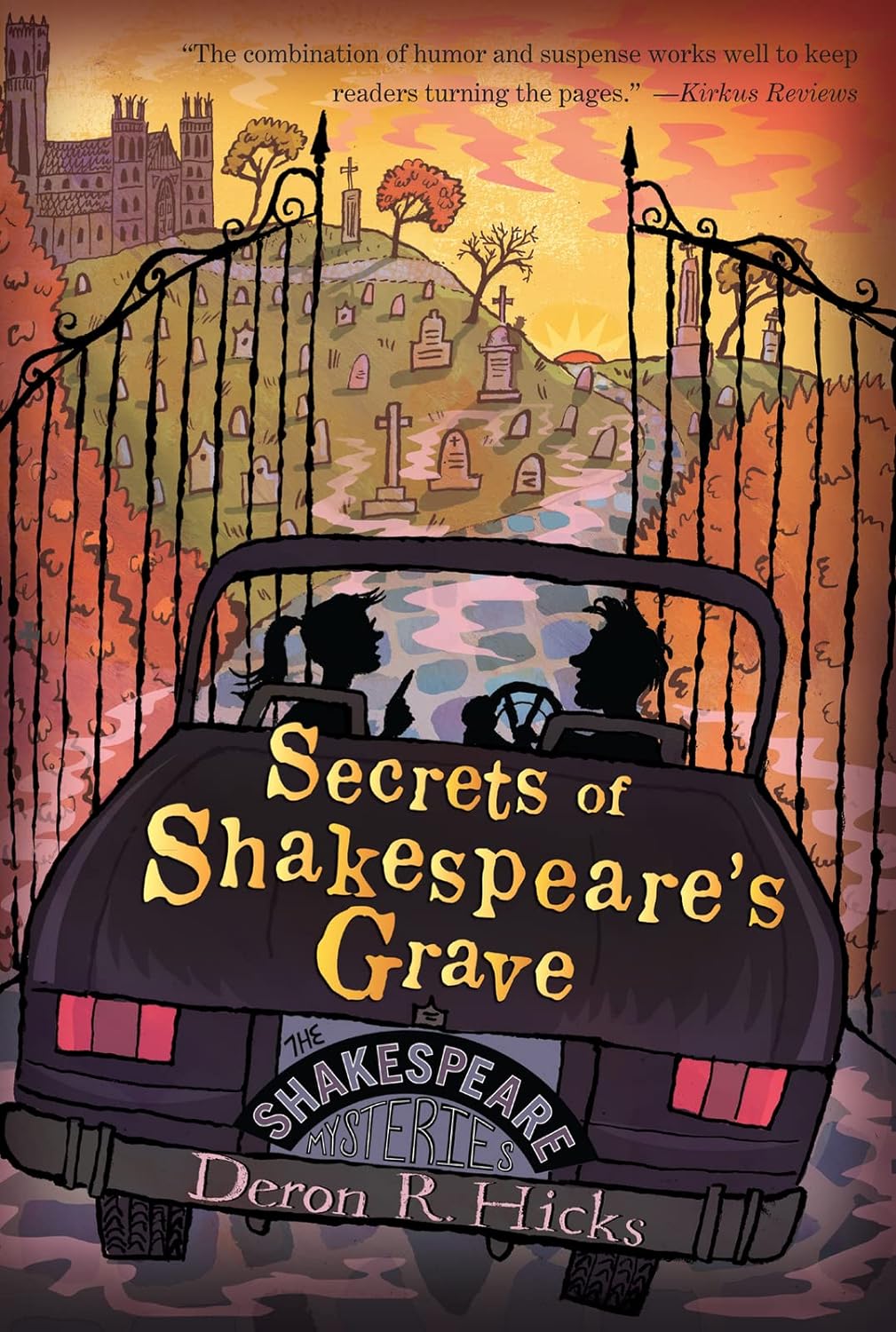
Book Note: Secrets of Shakespeare's Grave
Hicks, Deron R. Secrets of Shakespeare's Grave. New York: Houghton Mifflin Harcourt Books for Young Readers, 2012.
When I first spotted this book in the bookstore, I thought it might be another young adult book debunking Shakespeare's authorship of the works attributed to Shakespeare.
So far (I've only read the first of the books in a series of at least two books), it's been exactly the opposite, though I don't want to tell you too much for fear of spoiling it for you.
The plot involves a brother and a sister who need to do what they can to save the family publishing business from being taken over by a disreputable relative.
More than that I'm not at liberty to reveal. But I will tell you that I enjoyed the book very much. It is filled with adventure—and not of the corny, tacky variety. It also involves intriguing trips to New York, London, and Stratford-upon-Avon to track down clues to the family treasure. Read it and enjoy!
Note: The book's plot involves what I take to be a misreading of the poem on Shakespeare's Monument in Stratford. The line in question reads ". . . Si[t]h all that he hath writt / Leaves living art, but page, to serve his witt." The book considers the word "page" here to mean a piece of paper. Given the context, however, I take "page" to mean a servant. It's a minor point, but I thought I should mention it.
Additional Note: For the second book in the series, click here.
When I first spotted this book in the bookstore, I thought it might be another young adult book debunking Shakespeare's authorship of the works attributed to Shakespeare.
So far (I've only read the first of the books in a series of at least two books), it's been exactly the opposite, though I don't want to tell you too much for fear of spoiling it for you.
The plot involves a brother and a sister who need to do what they can to save the family publishing business from being taken over by a disreputable relative.
More than that I'm not at liberty to reveal. But I will tell you that I enjoyed the book very much. It is filled with adventure—and not of the corny, tacky variety. It also involves intriguing trips to New York, London, and Stratford-upon-Avon to track down clues to the family treasure. Read it and enjoy!
Note: The book's plot involves what I take to be a misreading of the poem on Shakespeare's Monument in Stratford. The line in question reads ". . . Si[t]h all that he hath writt / Leaves living art, but page, to serve his witt." The book considers the word "page" here to mean a piece of paper. Given the context, however, I take "page" to mean a servant. It's a minor point, but I thought I should mention it.
Additional Note: For the second book in the series, click here.
Tuesday, March 4, 2014
Book Note: Stage Fright on a Summer Night
Osborne, Mary Pope. Stage Fright on a Summer Night. Illus. Sal Murdocca. New York: Random House, 2002.
They always want to put Queen Elizabeth I in the Globe Theatre, nearly every single time.
I've read a few books in the Magic Tree House series from time to time. This one is, I'm afraid, not the very best of the genre. There's not much of a plot or much of a conflict to overcome. The structure of the series becomes a thinly-veiled pretense for journeying to Elizabethan England. But it only took about fifteen minutes to read, so I don't feel that put out.
Once there, our two protagonists are exposed to the usual seamier side of the era—the stench, the bear baiting, et cetera—before they meet a man named Will who is putting on a play called A Midsummer Night's Dream. He needs two actors to play fairies, and he snatches up the protagonists for the roles. They like this guy named Will all right, and they play their parts well.
They journey back to their own place and time, and they find this note. I'm including the full spread that includes their discovery, as it may be the most interesting part:
It's at that point that they realize that the Will they met was the William Shakespeare they they've heard of somewhere before. Not only that, but they have his signature—and a line of writing in his own hand! Naturally, they decide to leave it in the treehouse.
Since the book itself doesn't allow for much interesting speculation, I'm providing just a smidgen of my own. Perhaps Morgan has sent these uninformed children back in time to get a document worth billions of dollars, probably to fund her malicious plot to take over the world.
They always want to put Queen Elizabeth I in the Globe Theatre, nearly every single time.
I've read a few books in the Magic Tree House series from time to time. This one is, I'm afraid, not the very best of the genre. There's not much of a plot or much of a conflict to overcome. The structure of the series becomes a thinly-veiled pretense for journeying to Elizabethan England. But it only took about fifteen minutes to read, so I don't feel that put out.
Once there, our two protagonists are exposed to the usual seamier side of the era—the stench, the bear baiting, et cetera—before they meet a man named Will who is putting on a play called A Midsummer Night's Dream. He needs two actors to play fairies, and he snatches up the protagonists for the roles. They like this guy named Will all right, and they play their parts well.
They journey back to their own place and time, and they find this note. I'm including the full spread that includes their discovery, as it may be the most interesting part:
It's at that point that they realize that the Will they met was the William Shakespeare they they've heard of somewhere before. Not only that, but they have his signature—and a line of writing in his own hand! Naturally, they decide to leave it in the treehouse.
Since the book itself doesn't allow for much interesting speculation, I'm providing just a smidgen of my own. Perhaps Morgan has sent these uninformed children back in time to get a document worth billions of dollars, probably to fund her malicious plot to take over the world.
Monday, March 3, 2014
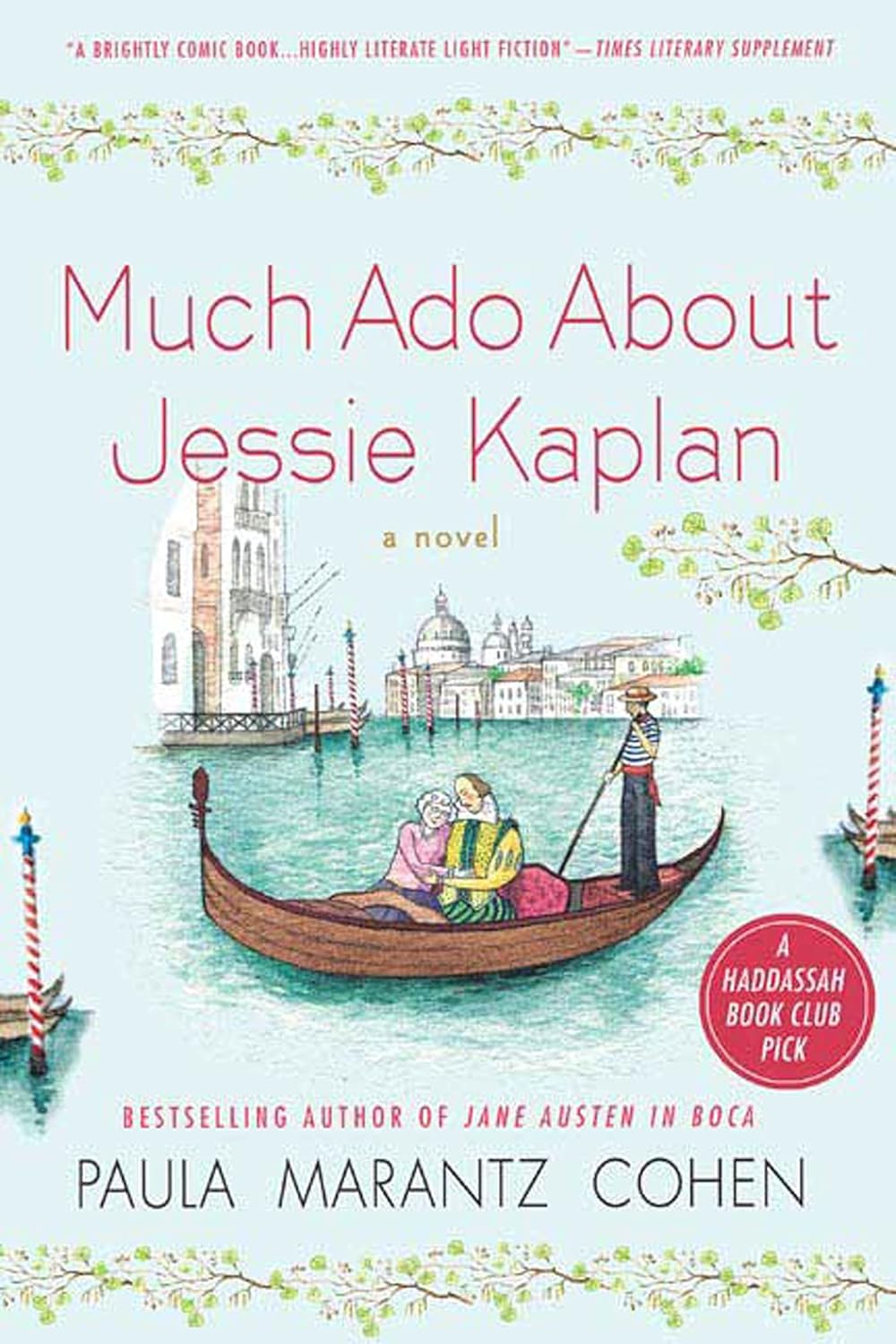
Book Note: Much Ado About Jessie Kaplan
Cohen, Paula Marantz. Much Ado About Jessie Kaplan. New York: St. Martin's Griffin, 2005.
I finished reading this light and delightful little novel backstage at the production of Midsummer Night's Dream that I was recently in. There's not as much Shakespeare qua Shakespeare as I'd like, but the characters are very appealing and very funny, and the plot is quite compelling.
While the family fusses over the preparation for the elder child's bat mitzvah, a new problem arises. The grandmother starts quoting odd snatches of old poetry and singing Elizabethan songs. At first, this goes relatively unremarked upon, but it increases and starts to become problematic.
The grandmother (the eponymous Jessie Kaplan) has become convinced that she is the reincarnation of the Dark Lady of Shakespeare's sonnets. She believes that she was a Jew living in Venice when Shakespeare visited the city. They fell in love, and he wrote her many sonnets—not only the mean ones recorded in the published sonnets, but many happy ones as well. Somehow, they fell out of love, and, in revenge he wrote not only the mean sonnets but also modeled the character of Jessica and Shylock in The Merchant of Venice after her and her father. She never forgave him.
Eventually, Jessie interests the daughter's high school English teacher in her story—particularly when she says she remembers where she hid those extra sonnets.
I'll stop there to avoid spoilers. But do read the book. It's pretty light, but it does have some good things to say about interpretation and about Shakespeare.
I finished reading this light and delightful little novel backstage at the production of Midsummer Night's Dream that I was recently in. There's not as much Shakespeare qua Shakespeare as I'd like, but the characters are very appealing and very funny, and the plot is quite compelling.
While the family fusses over the preparation for the elder child's bat mitzvah, a new problem arises. The grandmother starts quoting odd snatches of old poetry and singing Elizabethan songs. At first, this goes relatively unremarked upon, but it increases and starts to become problematic.
The grandmother (the eponymous Jessie Kaplan) has become convinced that she is the reincarnation of the Dark Lady of Shakespeare's sonnets. She believes that she was a Jew living in Venice when Shakespeare visited the city. They fell in love, and he wrote her many sonnets—not only the mean ones recorded in the published sonnets, but many happy ones as well. Somehow, they fell out of love, and, in revenge he wrote not only the mean sonnets but also modeled the character of Jessica and Shylock in The Merchant of Venice after her and her father. She never forgave him.
Eventually, Jessie interests the daughter's high school English teacher in her story—particularly when she says she remembers where she hid those extra sonnets.
I'll stop there to avoid spoilers. But do read the book. It's pretty light, but it does have some good things to say about interpretation and about Shakespeare.
Monday, February 24, 2014
Book Note: The Tragedy of Arthur
Philips, Arthur. The Tragedy of Arthur: A Novel. New York: Random House, 2012.
I recently finished listening to the audio book version of The Tragedy of Arthur. I was impressed by its wit and its complexity.
The protagonist of the novel, Arthur Philips, a relatively-successful novel writer himself, finds himself in possession of a unique book: the 1597 quarto of The Tragedy of Arthur by William Shakespeare. The novel takes the form of Arthur fulfilling his contractual obligations by writing the introduction to the first modern edition of this newly-discovered Shakespeare play.
The problem is that Arthur has become convinced that the play is a forgery. His father, who passed the book along to him, has served many jail terms for forgery, and Arthur thinks this is just one more forgery.
The novel successfully blurs all sorts of lines: between novel and memoir; between fiction and scholarship (in many ways, it reminded me of Nabokov's Pale Fire); between Shakespeare and his imitators. In his hints and suggestions that the play is a forgery, the narrator almost seems to protest too much. The more he hints that it's fake, the more the reader is inclined to consider its authenticity.
And the story he tells of growing up with a father who is part artist, part forger, and part confidence trickster is both very moving and very entertaining. Elements of the relationships within the family are reflected in the play. Is that coincidence, which would imply that the play is authentic? Or are they autobiographical reflections, which would make the play a fake? The questions continue the blurring of fiction and memoir.
A similar echo is in the exchange in the image above—not in the dialogue itself but in the speech headings. In the repeated "Arthur . . . Philip . . . Arthur . . . Philip" along the left-hand margin, the narrator finds another connection—one between the text and his own name—that's too hard to explain away.
The novel itself purports to be the introduction to a scholarly edition of the play. At the novel's end, the play begins. Arthur Philips (the novelist of the novel rather than the novelist within the novel) has written a five-act play in the style of Shakespeare. In terms of its plot and language, I found it to be a bit tedious—yet the introduction has set it up so cleverly that I couldn't help but think about how I would make the case for its being Shakespeare's or prove it not to be. The novel itself, as it turns out, leaves the question of its authenticity up in the air. The narrator is convinced it isn't—but many Shakespeare scholars and experts in printed texts of the 1500s come out in favor of it.
All in all, it was a fabulous and fascinating read. I enjoyed it immensely, and I highly recommend it.
Note: For another review--one with a few more details, try the one Shakespeare Geek provides.
I recently finished listening to the audio book version of The Tragedy of Arthur. I was impressed by its wit and its complexity.
The protagonist of the novel, Arthur Philips, a relatively-successful novel writer himself, finds himself in possession of a unique book: the 1597 quarto of The Tragedy of Arthur by William Shakespeare. The novel takes the form of Arthur fulfilling his contractual obligations by writing the introduction to the first modern edition of this newly-discovered Shakespeare play.
The problem is that Arthur has become convinced that the play is a forgery. His father, who passed the book along to him, has served many jail terms for forgery, and Arthur thinks this is just one more forgery.
The novel successfully blurs all sorts of lines: between novel and memoir; between fiction and scholarship (in many ways, it reminded me of Nabokov's Pale Fire); between Shakespeare and his imitators. In his hints and suggestions that the play is a forgery, the narrator almost seems to protest too much. The more he hints that it's fake, the more the reader is inclined to consider its authenticity.
And the story he tells of growing up with a father who is part artist, part forger, and part confidence trickster is both very moving and very entertaining. Elements of the relationships within the family are reflected in the play. Is that coincidence, which would imply that the play is authentic? Or are they autobiographical reflections, which would make the play a fake? The questions continue the blurring of fiction and memoir.
A similar echo is in the exchange in the image above—not in the dialogue itself but in the speech headings. In the repeated "Arthur . . . Philip . . . Arthur . . . Philip" along the left-hand margin, the narrator finds another connection—one between the text and his own name—that's too hard to explain away.
The novel itself purports to be the introduction to a scholarly edition of the play. At the novel's end, the play begins. Arthur Philips (the novelist of the novel rather than the novelist within the novel) has written a five-act play in the style of Shakespeare. In terms of its plot and language, I found it to be a bit tedious—yet the introduction has set it up so cleverly that I couldn't help but think about how I would make the case for its being Shakespeare's or prove it not to be. The novel itself, as it turns out, leaves the question of its authenticity up in the air. The narrator is convinced it isn't—but many Shakespeare scholars and experts in printed texts of the 1500s come out in favor of it.
All in all, it was a fabulous and fascinating read. I enjoyed it immensely, and I highly recommend it.
Note: For another review--one with a few more details, try the one Shakespeare Geek provides.
Thursday, February 13, 2014
J. R. R. Tolkien on "the folly of reading Shakespeare"
Tolkien, J. R. R. The Letters of J. R. R. Tolkien. Ed. Humphrey Carpenter. Boson: Houghton Mifflin, 1981.The general impression is that J. R. R. Tolkien, author of The Hobbit and miscellaneous other works set in the world of The Hobbit, did not like Shakespeare.
The reason for this impression springs partly from Tolkien's account of his imaginative creation of the Ents, which are something like walking, talking trees. The Ents are inspired by Shakespeare, but they sprang forth not from what Shakespeare did but from what he didn't do. Shakespeare Geek has an account of how Tolkein's disappointment with "the shabby use made in Shakespeare of the coming of 'Great Birnam wood to high Dunsinane hill'" (212) led him to imagine how walking trees might really march to war.
What might be more surprising is an account of Tolkein actually enjoying Shakespeare. In Letter 76, dated 28 July 1944 and written to Christopher Tolkien, J. R. R. Tolkien describes seeing a production of Hamlet. Tolkien argues that it's foolish to read Shakespeare . . . except in conjunction with seeing performances of the plays:
I wonder if Tolkien would say the same about his own books today. Is there folly in annotating Tolkien—unless you see the films?Plain news is on the airgraph; but the only event worth of talk was the performance of Hamlet which I had been to just before I wrote last. I was full of it then, but the cares of the world have soon wiped away the impression. But it emphasised more strongly than anything I have ever seen the folly of reading Shakespeare (and annotating him in the study), except as a concomitant of seeing his plays acted. It was a very good performance, with a young rather fierce Hamlet; it was played fast without cuts; and came out as a very exciting play. Could one only have seen it without ever having read it or knowing the plot, it would have been terrific. It was well produced except for a bit of bungling over the killing of Polonius. But to my surprise the part that came out as the most moving, almost intolerably so, was the one that in reading I always found a bore: the scene of mad Ophelia singing her snatches. (88)
As a side note, he does object to Shakespeare's use of elves. We find that in Letter 151, written to Hugh Brogan on 18 September 1954:
If he's objecting to the elves in Midsummer Night's Dream, I'll have to argue with him; however, if he means the elves in Merry Wives of Windsor, I'm entirely on his side.I now deeply regret having used Elves, though this is a word in ancestry and original meaning suitable enough. But the disastrous debasement of this word, in which Shakespeare played an unforgiveable part, has really overloaded it with regrettable tones, which are too much to overcome. (185)
Wednesday, February 5, 2014
Book Notes: William Shakespeare: Very Interesting People and Coffee with Shakespeare
Holland, Paul. William Shakespeare: Very Interesting People. Oxford: Oxford University Press, 2007.
Wells, Stanley. [Co-written with Paul Edmondson.] Coffee with Shakespeare. New York: Sterling, 2008.
I've just finished reading two very concise books that focus on Shakespeare's biography. One was a great deal of fun, compressing impressively the most important information about Shakespeare's life and times into a very slim volume; the other was, quite frankly, very disappointing.
Paul Holland's William Shakespeare, one of the Very Interesting People series of books, is exquisite. It's a reprint of Holland's Oxford Dictionary of National Biography entry, and it adroitly covers Shakespeare's life. But it goes beyond that to be one of the best, most concise accounts of how Shakespeare attained his current position. It's going to be my go-to resource for students asking how popular Shakespeare was in his own day and in the century following his death. It also has a good (though necessarily cursory) overview of stage history, literary derivatives of Shakespeare, and filmed versions of Shakespeare plays. All in all, it was a thoroughly enjoyable, enlightening read.
Stanley Wells' Coffee with Shakespeare was a let down—especially considering Wells' great scholarship and keen writing ability. But perhaps it was just thrown together for the gift shop at the Shakespeare Birthplace. Whatever the case may be, it's an imaginary conversation with Shakespeare over coffee about his life and times. It's a pretty good idea—but it doesn't play out very well. It becomes over-sentemtalized at points; at others, it takes a quick and easy stance on matters that are really quite complicated and nuanced (e.g., the order of the sonnets). I include a few images from the book below to illustrate:
Wells, Stanley. [Co-written with Paul Edmondson.] Coffee with Shakespeare. New York: Sterling, 2008.
I've just finished reading two very concise books that focus on Shakespeare's biography. One was a great deal of fun, compressing impressively the most important information about Shakespeare's life and times into a very slim volume; the other was, quite frankly, very disappointing.
Paul Holland's William Shakespeare, one of the Very Interesting People series of books, is exquisite. It's a reprint of Holland's Oxford Dictionary of National Biography entry, and it adroitly covers Shakespeare's life. But it goes beyond that to be one of the best, most concise accounts of how Shakespeare attained his current position. It's going to be my go-to resource for students asking how popular Shakespeare was in his own day and in the century following his death. It also has a good (though necessarily cursory) overview of stage history, literary derivatives of Shakespeare, and filmed versions of Shakespeare plays. All in all, it was a thoroughly enjoyable, enlightening read.
Stanley Wells' Coffee with Shakespeare was a let down—especially considering Wells' great scholarship and keen writing ability. But perhaps it was just thrown together for the gift shop at the Shakespeare Birthplace. Whatever the case may be, it's an imaginary conversation with Shakespeare over coffee about his life and times. It's a pretty good idea—but it doesn't play out very well. It becomes over-sentemtalized at points; at others, it takes a quick and easy stance on matters that are really quite complicated and nuanced (e.g., the order of the sonnets). I include a few images from the book below to illustrate:
Near the beginning of the book (Shakespeare's contributions are in brown; the questioner's are in green):
The middle of a conversation about the sonnets:
Thoughts about living away from Stratford:
Grab a copy of Holland's William Shakespeare—it's great. But try Wells' Shakespeare & Co. instead of Coffee with Shakespeare.
Click below to purchase the books from amazon.com
(and to support Bardfilm as you do so).
Tuesday, February 4, 2014
A Quick Review of Anonymous
Anonymous. Dir. Edward D. Wood, Jr. Perf. David Hasselhoff, Sarah Jessica Parker, Mark Wahlberg, Lindsay Lohan, and Willem Dafoe. 2011. DVD. Sony Pictures Home Entertainment, 2012.
After several years and many attempts, I finally found enough time and a hearty-enough constitution to watch Anonymous. In the interest of accuracy (unlike the film itself), I'll reveal that I watched it in several sections over about a week's time, occasionally watching it at three times the speed with the subtitles on, frequently grading papers as I did so.
The film is awful in all sorts of ways. For the ways in which the plot is ludicrous—both historically and logically—I point you toward Holger Syme's take on the film. In addition to that, the acting is bad, the writing is worse, and the editing frequently makes very little sense.
I don't imagine it comes as a surprise to any of Bardfilm's readers, but I was utterly appalled by the film. Here are a few of the more notable things this film asks us to believe:
There are innumerable blurbs for Anonymous scattered around the Internet. By way of conclusion, I've collated a few of the more notable ones here:
Cole, Mary Hill. The Portable Queen: Elizabeth I and the Politics of Ceremony. Amherst: University of Massachusetts Press, 1999.
Links: The Film at IMDB.
After several years and many attempts, I finally found enough time and a hearty-enough constitution to watch Anonymous. In the interest of accuracy (unlike the film itself), I'll reveal that I watched it in several sections over about a week's time, occasionally watching it at three times the speed with the subtitles on, frequently grading papers as I did so.
The film is awful in all sorts of ways. For the ways in which the plot is ludicrous—both historically and logically—I point you toward Holger Syme's take on the film. In addition to that, the acting is bad, the writing is worse, and the editing frequently makes very little sense.
I don't imagine it comes as a surprise to any of Bardfilm's readers, but I was utterly appalled by the film. Here are a few of the more notable things this film asks us to believe:
- Elizabeth I goes on progress in order to give birth to illegitimate children (one of whom is fathered by a former illegitimate child of Elizabeth's). Every time the Virgin Queen gets pregnant, they have to go on progress, have the baby, and then shuffle off the little mortal coil to some noble willing to raise it. According to Mary Cole's The Portable Queen, Elizabeth went on twenty-three progresses during her reign. The math suggests that Elizabeth was certainly doing her part to increase the stock of heirs to the throne of England by at least (there could have been twins!) twenty-three. Note: Thanks to @commish24 and @historyadjunct for their help in suggesting this source and passing along its information.
- The Earl of Oxford has a stockpile of a dozen or so plays that he suddenly decides to release to the world. It's always good to be prepared with a Brilliant Drama Slush Fund.
- William Shakespeare is too idiotic to be taken seriously as an actor, but everyone swallows the idea that he's a playwright—make that the playwright—without any question. He's also completely ignorant—except when it comes to extorsion and theatre business, which he manages quite nicely.
- Elizabethans hate hunchbacks. Therefore, they hate Robert Cecil. The Earl of Oxford decided to give the Richard III of his eponymous play a hunch in order to mock Robert Cecil. That was the first time anyone ever said anything about Richard III having a hunch.
- Christopher Marlowe was murdered by William Shakespeare because he suspected that Shakespeare might not be the author of the plays.
- Writing anything in iambic pentameter is inordinately impressive to everyone—even other playwrights.
"Remember when Regan and Cornwall gouged my eyes out? This was worse."
—Gloucester
"This is the silliest stuff that ever I heard."
—Hippolyta
"Eww, that's disgusting. She's old enough to be his mother! Oh, that's right. She is his mother."
—Antiochus
"I had never seen this film before, nor shall ever again, for it is the most insipid ridiculous film that ever I saw in my life."
—Samuel Pepys
"Well, I'll admit it. As slurs on my character go, this tops Ben Jonson's 'Not Without Mustard' joke!"
—William Shakespeare
"Never, never, never, never, never."
—King Lear
"O horrible! O horrible! Most horrible!"
—Hamlet
"I rather liked it."
—Iago
Works Cited
Cole, Mary Hill. The Portable Queen: Elizabeth I and the Politics of Ceremony. Amherst: University of Massachusetts Press, 1999.
Links: The Film at IMDB.
Monday, February 3, 2014
Book Note: Brick Shakespeare
McCann, John, Monica Sweeney, and Becky Thomas. Brick Shakespeare: The Tragedies—Hamlet, Macbeth, Romeo and Juliet, and Julius Caesar. New York: Skyhorse Publishing, 2013.
It's sometimes hard to find gifts for Bardfilm. That doesn't mean you shouldn't try, of course, but I often already have copies of books and films that interest me. And, if I don't already own something, I've often heard of it already.
And that's why this Christmas gift was such a delight. I went extremely quickly through these three states in a few brief milliseconds: (1) Realizing that a Lego version of Shakespeare existed; (2) Deeply desiring a Lego version of Shakespeare; and (3) Actually owning a Lego version of Shakespeare.
The volume I have contains four of the tragedies. Essentially, they're edited and reduced versions of the text illustrated with photos of Lego characters in Lego landscapes. The image below (click on it to enlarge it)
It's sometimes hard to find gifts for Bardfilm. That doesn't mean you shouldn't try, of course, but I often already have copies of books and films that interest me. And, if I don't already own something, I've often heard of it already.
And that's why this Christmas gift was such a delight. I went extremely quickly through these three states in a few brief milliseconds: (1) Realizing that a Lego version of Shakespeare existed; (2) Deeply desiring a Lego version of Shakespeare; and (3) Actually owning a Lego version of Shakespeare.
The volume I have contains four of the tragedies. Essentially, they're edited and reduced versions of the text illustrated with photos of Lego characters in Lego landscapes. The image below (click on it to enlarge it)
Wednesday, January 29, 2014
And Now . . . In his Triumphant Return to the Stage . . . Philostrate!
A Midsummer Night's Dream. Dir. Kari Steinbach. Perf. Mason Henderson, Jonathan Horn, Jessica Johnson, Alec Leonard, Austin Lewis, Marisa Jacobus, Lydia Wildes, Matt Groen, Ben Witt, Mitch Geiken, Russell Scharper, Bridget Russell, Sharayah Bunce, Isaac Lind, Allison Preiss, Julia Olsen, Gabriella Abbott, Meghan Sly, Mikaela Kase, Elaina Holmes, Timothy Lawrence, Ian Stuyvenberg, Dawson Del Ehlke, Meghan Sly, and Keith Jones. University of Northwestern Theatre. St. Paul. 26 February—1 March 2014.
I've read Shakespeare extensively for many years. I've taught Shakespeare whenever and wherever I've been able to. I've kept a blog on all sorts of Shakespeare-related material for years. I've even directed four Shakespeare plays for a grade school.
Although I was in three musicals during my high school years, I've never been in a Shakespeare play. Ever.
That changes now.
The director of my university's production of A Midsummer Night's Dream asked me if I would take on the role of Philostrate, and I was thrilled to accept.
Philostrate, for those of you keeping score, is the Master of the Revels to Theseus, the Duke of Athens. He gets to introduce the Pyramus and Thisbe play-within-the-play to the Duke—and he then gets to try to persuade the Duke not to see that play.
I'm excited enough just to be in a Shakespeare play, but this production is already shaping up to be magnificent. The set is extremely interesting in its design, and the overall vision of the play is intriguing. The Athens scenes are generally black and white—with occasional black and white television news reports cutting in—while the scenes in the forest are in high technicolor (as indicated in the poster above).
More bulletins as events warrant. In the meantime, where's my Equity Card?
Links: Ticket Sales.
I've read Shakespeare extensively for many years. I've taught Shakespeare whenever and wherever I've been able to. I've kept a blog on all sorts of Shakespeare-related material for years. I've even directed four Shakespeare plays for a grade school.
Although I was in three musicals during my high school years, I've never been in a Shakespeare play. Ever.
That changes now.
The director of my university's production of A Midsummer Night's Dream asked me if I would take on the role of Philostrate, and I was thrilled to accept.
Philostrate, for those of you keeping score, is the Master of the Revels to Theseus, the Duke of Athens. He gets to introduce the Pyramus and Thisbe play-within-the-play to the Duke—and he then gets to try to persuade the Duke not to see that play.
I'm excited enough just to be in a Shakespeare play, but this production is already shaping up to be magnificent. The set is extremely interesting in its design, and the overall vision of the play is intriguing. The Athens scenes are generally black and white—with occasional black and white television news reports cutting in—while the scenes in the forest are in high technicolor (as indicated in the poster above).
More bulletins as events warrant. In the meantime, where's my Equity Card?
Links: Ticket Sales.
Friday, January 24, 2014
The Quality of Mercy and A-Rod
Weis, Lonnie, dev. and prod. Hidden Shakespeare Trick. Perf. Seattle Mariners, incl. Alex Rodriguez. Circa 1997.A little while ago, Shakespeare Geek alerted his Twitter Followers (SGTFs—if you're not one, why don't you become one?) to a Shakespeare-related commercial put out by the Seattle Mariners.
On one level, the commercial is very clever in a new trick to play on a base runner. Instead of pretending to throw the ball back to the pitcher and waiting for the runner on second to step off the bag to tag him out, Shakespeare is used instead.
With the news of Alexander Rodriguez, a.k.a. A-Rod, being suspended from Major League Baseball for one year, the commercial accretes a new line of thought. In the commercial, A-Rod uses Portia's "Quality of Mercy" speech to distract the runner. Could it have occurred to A-Rod to try the same speech on Bud Selig?
I also find the reaction of the ersatz Red Sox player interesting. He seems both knowledgeable and willing to hear Shakespeare, and he appreciates the speech so much that he becomes lost in a reverie. Even though, as a Cardinals fan, I have a complicated relationship with the Red Sox, I admire this player. Even though he was tagged out, he wasn't tricked by something as simple as the hidden ball trick. He was—as who among us has not?—distracted by the words of Shakespeare.
Ain't Shakespeare great?
Wednesday, January 15, 2014
Book Note: A Mystery of Errors
Hawke, Simon. A Mystery of Errors. Forge: New York, 2000.
I have a few minutes between classes and meetings, and I thought I'd use them to mention a Shakespeare-related book I read over the break.
If you're familiar with A Comedy of Errors, you'll start to think that you're piecing together parts of the plot of this novel—which is part mystery, part comedy, and part historical fiction. But you may not actually be doing so in the right way! But I won't provide any spoilers on that front for those who want to read the book for themselves.
The plot involves a young Will Shakespeare, on his way to London to become an actor—or, perhaps a playwright, if that's what they need and if that's how he can best connect to the theatre. Will isn't our main character, however, and I think that's a very wise choice. Instead, we mainly follow another London-bound traveller named (improbably enough) Symington Smythe.
The interaction between Smythe and Shakespeare is probably the best part of the book. It's not corny or affected. It doesn't have an axe to grind about any biographical details of Shakespeare's life. It doesn't pretend to specific historical accuracy—though it does a good job with the general history of the period. It doesn't present Shakespeare as an untouchable genius. Instead, it paints a compelling portrait of a man who wants to act and his journey to do so.
The book's dust jacked says that A Mystery of Errors is "the first book in the Shakespeare & Smythe series." Unfortunately, it looks like we're still waiting for the second book.
Update: There are two other books in the series, but they're only available from the UK version of Amazon. The titles are The Merchant of Vengeance and The Slaying of the Shrew. Stay tuned as I try to track these titles down.
I have a few minutes between classes and meetings, and I thought I'd use them to mention a Shakespeare-related book I read over the break.
If you're familiar with A Comedy of Errors, you'll start to think that you're piecing together parts of the plot of this novel—which is part mystery, part comedy, and part historical fiction. But you may not actually be doing so in the right way! But I won't provide any spoilers on that front for those who want to read the book for themselves.
The plot involves a young Will Shakespeare, on his way to London to become an actor—or, perhaps a playwright, if that's what they need and if that's how he can best connect to the theatre. Will isn't our main character, however, and I think that's a very wise choice. Instead, we mainly follow another London-bound traveller named (improbably enough) Symington Smythe.
The interaction between Smythe and Shakespeare is probably the best part of the book. It's not corny or affected. It doesn't have an axe to grind about any biographical details of Shakespeare's life. It doesn't pretend to specific historical accuracy—though it does a good job with the general history of the period. It doesn't present Shakespeare as an untouchable genius. Instead, it paints a compelling portrait of a man who wants to act and his journey to do so.
The book's dust jacked says that A Mystery of Errors is "the first book in the Shakespeare & Smythe series." Unfortunately, it looks like we're still waiting for the second book.
Update: There are two other books in the series, but they're only available from the UK version of Amazon. The titles are The Merchant of Vengeance and The Slaying of the Shrew. Stay tuned as I try to track these titles down.
Wednesday, December 18, 2013
Book Note: Juliet: A Novel
Fortier, Anne. Juliet: A Novel. New York: Ballantine Books, 2010.
I just finished listening to this novel. It's large and (at times) unwieldy, it's frustrating and silly, it's sentimental and unbelievable, and it's compelling enough that I really had to listen through to the end.
And, of course, it has Shakespeare. Once things get rolling (and they do take some time to get rolling), the novel contains two stories running in parallel. Our modern-day narrator learns that she is descended from the family from which the real Juliet—the one on whom all the stories (including Shakespeare's) are based—came. Moreover, a dying aunt has given her instructions to return to the city where Juliet's story took place: Siena, Italy. Once there, she embarks on a Da Vinci Code-esque adventure to discover lost treasure, the secret of her mother's death, et cetera, et cetera, et cetera.
The story of the original Juliet and Romeo is told in tandem with the adventure story; it itself is another adventure story altogether.
Eventually, our narrator discovers that she's reliving the story of Romeo and Juliet (after a fashion), and she gets mixed up in a secret cult dedicated to Friar Lorenzo (Shakespeare Friar Lawrence), another secret organization that "makes the Mafia look like the Salvation Army," and a mysterious artist who seems to live beyond time—periodically quoting from Romeo and Juliet.
For a romance / adventure novel (which is not my preferred genre), it wasn't too bad—though I still don't understand the narrator, who is whiney and decisive and indecisive and passionate and cold whenever the plot seems to require her to be one of those things. All the same, I did need to keep reading to figure out what happens—if only to know just how angry to be with the protagonists.
I just finished listening to this novel. It's large and (at times) unwieldy, it's frustrating and silly, it's sentimental and unbelievable, and it's compelling enough that I really had to listen through to the end.
And, of course, it has Shakespeare. Once things get rolling (and they do take some time to get rolling), the novel contains two stories running in parallel. Our modern-day narrator learns that she is descended from the family from which the real Juliet—the one on whom all the stories (including Shakespeare's) are based—came. Moreover, a dying aunt has given her instructions to return to the city where Juliet's story took place: Siena, Italy. Once there, she embarks on a Da Vinci Code-esque adventure to discover lost treasure, the secret of her mother's death, et cetera, et cetera, et cetera.
The story of the original Juliet and Romeo is told in tandem with the adventure story; it itself is another adventure story altogether.
Eventually, our narrator discovers that she's reliving the story of Romeo and Juliet (after a fashion), and she gets mixed up in a secret cult dedicated to Friar Lorenzo (Shakespeare Friar Lawrence), another secret organization that "makes the Mafia look like the Salvation Army," and a mysterious artist who seems to live beyond time—periodically quoting from Romeo and Juliet.
For a romance / adventure novel (which is not my preferred genre), it wasn't too bad—though I still don't understand the narrator, who is whiney and decisive and indecisive and passionate and cold whenever the plot seems to require her to be one of those things. All the same, I did need to keep reading to figure out what happens—if only to know just how angry to be with the protagonists.
Tuesday, December 17, 2013
Fantastic Shakespeare Podcast Number Two: Chop Bard
Ziegler, Ehren. In Your Ear Shakespeare. Chop Bard. 2008-2013. Podcast.
The Chop Bard podcast has been around for years, which is an extreme joy to those (like me) discovering it for the first time now. There are well over a hundred episodes, many of them well over the hour mark.
And they're fascinating. The episodes walk through the plays, pointing out elements of interest and / or controversy as they do so.
I don't agree with everything Ehren Ziegler says, but he says it in an interesting, engaging way that (1) makes me want to keep listening more and (2) makes me want to sit down over a cup of coffee and present my own point of view.
Even if you don't have time to listen to a hundred hours of podcasting, subscribe now. The new series is on Henry V, and it's very enlightening.
Links: The Podcast at iTunes.
The Chop Bard podcast has been around for years, which is an extreme joy to those (like me) discovering it for the first time now. There are well over a hundred episodes, many of them well over the hour mark.
And they're fascinating. The episodes walk through the plays, pointing out elements of interest and / or controversy as they do so.
I don't agree with everything Ehren Ziegler says, but he says it in an interesting, engaging way that (1) makes me want to keep listening more and (2) makes me want to sit down over a cup of coffee and present my own point of view.
Even if you don't have time to listen to a hundred hours of podcasting, subscribe now. The new series is on Henry V, and it's very enlightening.
Links: The Podcast at iTunes.
Friday, December 6, 2013
Shakespeare in The Sound of Music
The Sound of Music. Dir. Robert Wise. Perf. Julie Andrews, Christopher Plummer, Peggy Wood, Anna Lee, Portia Nelson, Marni Nixon, and Evadne Baker. 1965. DVD. 20th Century Fox Home Entertainment, 2010.
With all the pleasant chatter about The Sound of Music, I thought it might be time to comment on the two allusions to King Lear cleverly worked in to the lyrics of two songs. Additionally, each allusion is repeated to underscore its intentional use of Shakespeare.
The first allusion is actually a quotation. The quote comes in the song "How do you Solve a Problem Like Maria?" Of the three words proposed as apt synonyms for or definitions of "Maria," the first is "Flibbertigibbet." Although it's possible that Rogers and Hammerstein got the word directly from Samuel Harsnett's A Declaration of Egregious Popish Impostures (1603), my own scholarly opinion is that it derives directly from Edgar's speech in Act III of King Lear: "This is the foul fiend Flibbertigibbet" (III.iv.115). [Note: The third possible definition of "Maria"—"A clown"—may allude to Twelfth Night's Feste, but I won't press the point.]
The second allusion is to a speech Lear gives in Act I. When Cordelia seems reluctant to speak publicly about her love for her father, he says, "Nothing will come of nothing: speak again" (I.i.90). This finds its way into "Something Good" late in the film. It's been transmuted slightly into the line "Nothing comes of nothing," but the allusion is plain.
I've conflated these allusions into the following file. Ponder their significance:
With all the pleasant chatter about The Sound of Music, I thought it might be time to comment on the two allusions to King Lear cleverly worked in to the lyrics of two songs. Additionally, each allusion is repeated to underscore its intentional use of Shakespeare.
The first allusion is actually a quotation. The quote comes in the song "How do you Solve a Problem Like Maria?" Of the three words proposed as apt synonyms for or definitions of "Maria," the first is "Flibbertigibbet." Although it's possible that Rogers and Hammerstein got the word directly from Samuel Harsnett's A Declaration of Egregious Popish Impostures (1603), my own scholarly opinion is that it derives directly from Edgar's speech in Act III of King Lear: "This is the foul fiend Flibbertigibbet" (III.iv.115). [Note: The third possible definition of "Maria"—"A clown"—may allude to Twelfth Night's Feste, but I won't press the point.]
The second allusion is to a speech Lear gives in Act I. When Cordelia seems reluctant to speak publicly about her love for her father, he says, "Nothing will come of nothing: speak again" (I.i.90). This finds its way into "Something Good" late in the film. It's been transmuted slightly into the line "Nothing comes of nothing," but the allusion is plain.
I've conflated these allusions into the following file. Ponder their significance:
Subscribe to:
Posts (Atom)
Bardfilm is normally written as one word, though it can also be found under a search for "Bard Film Blog." Bardfilm is a Shakespeare blog (admittedly, one of many Shakespeare blogs), and it is dedicated to commentary on films (Shakespeare movies, The Shakespeare Movie, Shakespeare on television, Shakespeare at the cinema), plays, and other matter related to Shakespeare (allusions to Shakespeare in pop culture, quotes from Shakespeare in popular culture, quotations that come from Shakespeare, et cetera).
Unless otherwise indicated, quotations from Shakespeare's works are from the following edition:
Shakespeare, William. The Riverside Shakespeare. 2nd ed. Gen. ed. G. Blakemore Evans. Boston: Houghton Mifflin, 1997.
All material original to this blog is copyrighted: Copyright 2008-2039 (and into perpetuity thereafter) by Keith Jones.
—The Tempest