Wednesday, February 17, 2010

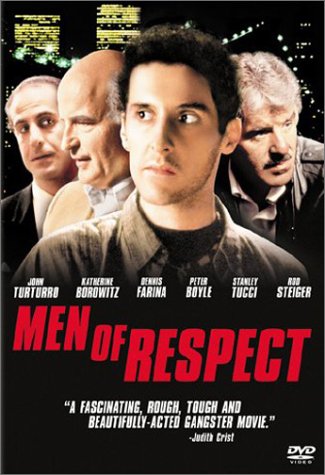
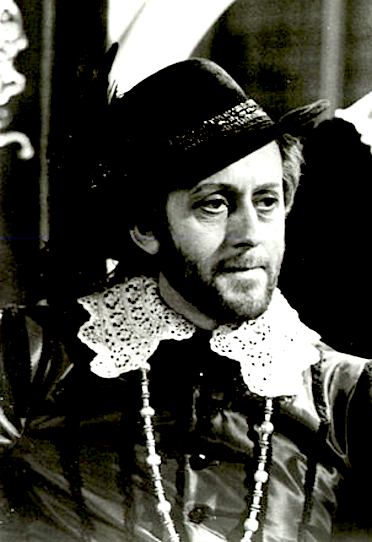
The Dagger Speech from Men of Respect

Men of Respect. Dir. William Reilly. Perf. John Turturro, Katherine Borowitz, and Peter Boyle. 1991. DVD. Sony, 2003.

Men of Respect is a derivative version of Macbeth. My reading of Geoffrey Wright's Macbeth (for which, q.v.) applies to this film just as aptly. Our Macbeth analogue (cleverly (the italics indicate some skepticism about just how clever it is) named Mike Battaglia) is a hit man attempting to become the head of the crime family he serves. Something is lost when we have an ignoble Macbeth fighting for an ignoble position among ignoble peers.

But the dagger speech is presented in an interesting way. The dialogue is entirely internalized, but the vision Mike has of the blood dripping through the ceiling seems like a reasonable substitute. I appreciate the telephone ringing to replace the "I go—the bell invites me" line.

I've added a brief (but telling!) bit of the film from after the murder. It's the derivative version of "Enter Ross with an Old Man." These speeches . . .
Threescore and ten I can remember well:
Within the volume of which time I have seen
Hours dreadful and things strange; but this sore night
Hath trifled former knowings.
. . . . . . . . . . . . . . . . . . . . . . . . . . . . . . . . .
And Duncan's horses—a thing most strange and certain—
Beauteous and swift, the minions of their race,
Turn'd wild in nature, broke their stalls, flung out,
Contending 'gainst obedience, as they would make
War with mankind. (II.iv.1ff)
. . . have been transmuted into news about bad traffic and global warming: "Man, they said it was an earthquake, uh. Earthquakes on the East Coast! I mean, rocks fell on the Thruway. They got cars jammed up all the way to Poughkeepsie. They had a death toll. It's not even a holiday."

Mike gives the only possible response: "It was a rough night."

Here's the clip. Enjoy!


Links: The Film at IMDB.

Click below to purchase the film from amazon.com
(and to support Bardfilm as you do so).
Monday, February 15, 2010

Columbo v. Macbeth

“Dagger of the Mind.” By Jackson Gillis. Perf. Peter Falk, Richard Basehart, John Williams, Honor Blackman, Bernard Fox, Arthur Malet, and Wilfrid Hyde-White. Dir. Richard Quine. Columbo. Season 2, episode 4. NBC. 26 November 1972. DVD. Universal, 2005.

Some time ago, a student mentioned an episode of Columbo that was heavily-indebted to Macbeth. I stored that knowledge away until I could track down the episode, investigate it, and contemplate its relation to Shakespeare. Only recently did I manage to do so.

I had never watched a Columbo episode before watching this one, and this is still the only episode I've ever watched, so I can't do any sort of  comparative analysis to other episodes. But the uses to which Macbeth is put in this play are genuinely intriguing.

The first of these is the meta-theatrical element. Since Columbo tends to present the crime first and then to display Columbo's cunning ability to figure out the complexities that the audience has already seen, this partial summary of the plot isn't exactly a spoiler—it's what you'd learn in the first five minutes of the show. Two actors, neither of whom is terribly morally upright, accidentally kill a third person. They don't plot or intend his death, but he does have secrets that would compromise them if they are connected to his demise. Consequently, they attempt to cover up the murder / accident. The meta-theatrical element comes in when we find out that the two of them are playing Macbeth and Lady Macbeth.

With the weight of an actual crime on their consciences, their acting becomes much more believable and much more powerful. And the speeches they deliver take on a new layer of meaning.

Other connections between the play and their actions underline the mirror plot. Lady Macbeth's "How easy is it, then?" on stage is exactly the attitude she takes toward the off-stage cover-up. In the clip below, you'll see that the on-stage knocking that signals the porter's entrance segues neatly into the off-stage knocking of the maintenance man who is trying to fix the radiator in the Macbeths' dressing room. And when he makes a move to move the trunk, Lady Macbeth sits on it to prevent him from discovering the body—he might otherwise be tempted to shout "Confusion now hath made his masterpiece!" At the end of this clip, the theatre lights are shut off: "Out, out, brief spotlight" is the echo we hear.


All in all, it's an intriguing use of the psychology of Macbeth.

Links: The Episode at IMDB.

Click below to purchase all the Columbo there is from amazon.com
(and to support Bardfilm as you do so).

Sunday, February 14, 2010

Shakespeare's Valentine

Schoenbaum, S. Shakespeare’s Lives. New Edition. Oxford: Oxford University Press, 1993.

Each one of us should dip into Shakespeare’s Lives from time to time. It's a massive—and a massively-delightful—book that tells the fascinating story of what people have done with Shakespeare's biography through the years. One intensely-interesting set of anecdotes revolves around William Henry Ireland. Starting in the late 1800s, Ireland purported to find tons of documents written by and to Shakespeare. He forged every one of them, often not terribly cleverly.

For this Valentine's Day, I thought it would be amusing to see what Shakespeare wrote to Anne Hathaway (as imagined by Ireland). The image above contains the entirety of a letter from Will to Anne; but the letter isn't all. There's a poem, too. Such romantic and affecting poetry has seldom been heard before:
Is there inne heavenne aught more rare
Thanne thou sweete Nymphe of Avon fayre
Is there onne Earthe a Manne more trewe
Thanne Willy Shakespeare is toe you.
Marvelous, that. Magnificent.


Works Cited

Schoenbaum, S. Shakespeare’s Lives. New Edition. Oxford: Oxford University Press, 1993.

Links: Wikipedia's article on William Henry Ireland.

Click below to purchase the book from amazon.com
(and to support Bardfilm as you do so).

Thursday, February 11, 2010

Kit Marlowe in the Old West

Stagecoach. Dir. John Ford. Perf. John Wayne, Claire Trevor, Andy Devine, and Thomas Mitchell. 1939. DVD. Warner Home Video, 1997.

In searching for ways in which My Darling Clementine could be connected to Hamlet (for the beginning of the discussion, q.v.), I chanced upon The Invention of the Western Film: A Cultural History of the Genre's First Half-Century, a book by Scott Simmon that has a chapter devoted to the idea. Part of the book is available through Google Books. The chapter is fascinating, and it does what a MicroBlog on Shakespeare and Film doesn't have time to do: it develops the depth of the connection quite fully.

It also mentions a number of other connections to Shakespeare in western movies. Of these, I explored one that seemed promising: Simon argues that Doc Holliday “sounds like an extension of Doc Boone in Stagecoach, another heavy drinking, Shakespeare-quoting frontier surgeon” (225). I haven't had the time to review the film in question in depth (so please don't take this as pedantic criticism), but the only literary allusion I found in a brief glance through the film was the following drunken misquotation (I believe it's a purposeful and comic misquotation) of two lines from Christopher Marlowe's Doctor Faustus:


The landlady has every right to look on skeptically. Not only does she know herself to be unlike Helen, she doubtless recalls the lines as written by Marlowe:
Was this the face that launched a thousand ships,
And burnt the topless towers of Ilium? (xii.81-82)
I suppose, though, if you follow the conspiracy theory that Kit Marlowe faked his own death, later emerging as the author of the plays attributed to Shakespeare, we might consider Doc Boone's lines to have a connection to Shakespeare. Perhaps Boone possesses the first draft of that play in Shakespeare's own hand—and perhaps that draft does read "Is this the face that wrecked a thousand ships, / And burned the towerless tops of Ilium?" But I remain as skeptical as the landlady pictured above.

Works Cited

Simmon, Scott. The Invention of the Western Film: A Cultural History of the Genre's First Half-Century. Cambridge: Cambridge University Press, 2003.

Links: The Film at IMDB.

Click below to purchase the film or the book from amazon.com
(and to support Bardfilm as you do so).


Wednesday, February 10, 2010

Hamlet: The Soliloquy in Six Syllables

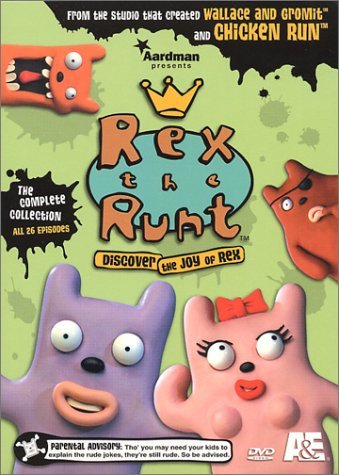
“Wayne the Zebra.” By Ben Caudell, Peter Holmes, Andrew Viner. Perf. Steve Box, Elisabeth Hadley, Andrew Jeffers, Colin Rote, and Bobby Ball. Dir. Richard Goleszowski. Rex the Runt. Season 2, episode 12. BBC. 9 December 2001. DVD. A&E Home Video, 2002.

Aardman Animations, Ltd. is perhaps best known for producing the delightful claymation adventures of Wallace and Gromit. And rightly so.

However, they also are the ones responsible for Rex the Runt. And "responsible" may be the right word—the show tends to be rude and scatological and is probably not geared toward the same age range as is Wallace and Gromit.

But I told you that to tell you this: If you needed any sort of confirmation that Shakespeare was deeply, deeply embedded in western culture, you have only to consider this clip from Rex the Runt. In it, one of the actors up for the audition (for the role of "Beast of Crannock Moor"—long story—watch the episode for more details) gives us just six syllables (since he's a G. I. Joe analogue, his lips are sealed shut from his date of manufacture):


With almost no clues (the bodkin, the word "soliloquy" and the phrase "cultured and all" may count as clues), the auditionee is able to convey Hamlet's "To be or not to be" with only these sounds: "Mmm mmm mm mmmm mmmm mmm."

Shakespeare: Persuasively Pervasive.

Links: The Film at IMDB.

Click below to purchase the film from amazon.com
(and to support Bardfilm as you do so).


You can also get this episode on iTunes!

Thursday, February 4, 2010

Shakespeare in the New(er) West

Tombstone. Dir. George P. Cosmatos. Perf. Kurt Russell and Val Kilmer. 1993. DVD. Walt Disney Video, 1997.

I suppose there's something about Wyatt Earp that makes a Shakespearean presentation in Tombstone inevitable.

In the 1993 film Tombstone, we are taken to the Bird Cage Theatre (the theatre we almost got to in My Darling Clementine— for which, q.v.). But we don't get Hamlet this time. Instead, Henry V is on the bill:


In My Darling Clementine, the soliloquy from and allusions to Hamlet seem to underline deeper considerations. In Tombstone, the scene seems almost obligatory—or, at best, to have a meaning nearer to the surface. Could the shootout at the O.K. Corral be considered Wyatt Earp's Agincourt?

Still, it's Shakespeare, and we're all ready to cry "More Shakespeare!" whenever possible.

Links: The Film at IMDB.

Click below to purchase the film from amazon.com
(and to support Bardfilm as you do so).

Shakespeare in the Old West

My Darling Clementine. Dir. John Ford. Perf. Henry Fonda, Victor Mature, Walter Brennan, and Alan Mowbray. 1946. DVD. Twentieth Century Fox, 2004.

John Ford's classic western about Wyatt Earp, "Doc" Holliday, the Clanton family, and the Shootout at the O.K. Corral contains a bit of Shakespeare, too. Even though "Doc" Holliday says "Shakespeare in Tombstone" in an incredulous tone, I suspect that the connections between Hamlet and the rest of the film are intentional.

Here is a conflation of two scenes: the grand entrance of Granville Thorndyke (played by Alan Mowbray), the actor who has come to town to play Shakespeare; and the Clanton's threatening demands for something other than "them poems." Claiming to have "a very large repertoire," Thorndyke audaciously presents his audience with Hamlet's soliloquy ("them poems" got nothin' on that there poem):


I'm intrigued by Old Man Clanton's concluding line: "When you pull a gun, kill a man." Could it be a paraphrase of Hamlet's Father's Ghost's advice to the Prince?

Links: The Film at IMDB.

Click below to purchase the film from amazon.com
(and to support Bardfilm as you do so).

Wednesday, February 3, 2010

A Splash of Hamlet in The Golden Bowl

The Golden Bowl. Dir. James Ivory. Perf. Kate Beckinsale, James Fox, Anjelica Huston, Nick Nolte, Jeremy Northam, Madeleine Potter, Uma Thurman, and Nicholas Day. 2000. DVD. Trimark, 2001.

Two parts of the 2000 film version of Henry James' Golden Bowl could be said to have a connection to Hamlet.

The first is the opening scene, which presents a dumb show of sorts—one that could be said to foreshadow some of the plot of the film. But it's fairly indirect, and the plot of the dumb show is more akin to Othello than anything else.

The second is more direct—and, potentially, more interesting. The English audience watches a non-western dance that seems to tell a story of treachery and death:


The initial response is intriguing and telling: "It's just like Hamlet," the young man says.

In my post on "Shakespeare in the Bush" (for which, q.v.), I wrote about the account of a non-western response to the plot of Hamlet. The Golden Bowl offers us the inverse: the western response to this non-western construct is to find a western equivalent that will enable comprehension. A large accumulation of dead bodies on the stage must mean something like Hamlet. That's the point of comparison and the place where meaningful discussion between cultures can take place.

Or it may just be that audience members are inclined to say "Thank the Lord that's over" at the end of any dramatic presentation, Shakespearean or otherwise.


Yes. Indeed.

P.S. The Screenplay is by Ruth Prawer Jhabvala, a marvelous author in her own right.

Links: The Film at IMDB.

Click below to purchase the film from amazon.com
(and to support Bardfilm as you do so).

Tuesday, February 2, 2010

Doctor Who (in 1965) Watches Shakespeare (in 1599)

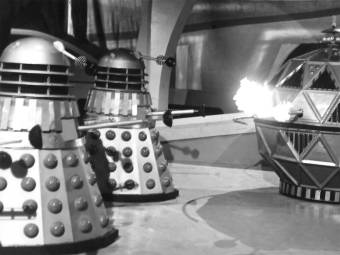
“The Executioners.” “The Chase.” By Terry Nation. Perf. William Hartnell, Jacqueline Hill, William Russell, Maureen O'Brien (Vicki), Peter Purves (Steven Taylor), Robert Marsden (as Abraham Lincoln), Roger Hammond (as Francis Bacon), Vivienne Bennett (as Queen Elizabeth I), Hugh Walters (as William Shakespeare), Richard Coe, Peter Hawkins, and David Graham. Doctor Who. Season 2 (Old Series), Episode 30. BBC. 22 May 1965. Videocassette. Fox Video, 1988.

Bardfilm is overjoyed to present an exceptional rarity: An intersection of Shakespeare and Doctor Who.

Yes, Bardfilm realizes that, especially in the new series, Shakespearean references, allusions, quotations—nay, even the Bard himself—are not rare. But this is a brief but telling moment of Shakespeare in the second season of the original series! For fans, that means William Hartnell (the first doctor) traveling with the first companions.

Intriguingly, the episode doesn't involve a journey through time to the age of William Shakespeare. Instead, the Doctor has rigged up a kind of "Time Television" that enables him to see various events throughout time (for example, Abraham Lincoln delivering the Gettysburg Address or the Beatles playing a pre-1965 concert). Because of this new technology, the TARDIS Travelers (and we along with them) can pinpoint a conversation involving Queen Elizabeth I, William Shakespeare, and Francis Bacon:


That may seems quite flippant and forgettable, but quite a number of interesting inferences are present in this segment:

  1. Shakespeare (a.k.a. "Shaksper, the Man from Stratford") is visualized as the author of the plays attributed to him—indeed, he is placed in juxtaposition to Francis Bacon (one of the contenders for the authorship)—who has an idea for a play based on the story of Hamlet that Shakespeare declines: "It would not be quite in my style," he declares. Since Bacon recognizes Shakespeare as the author of plays, we can fairly assume that he's not using Shakespeare as a front for his own plays. His insulting "Scribbler!" at the end may be class-based or it may be mere jealousy, but it's not consistent with the idea of Shakespeare claiming authorship of plays actually written by Bacon.
  2. The Queen's appreciation of Shakespeare's work is clear—even in the face of opposition from whiny peers of the realm (viz., Sir John Oldcastle). Indeed, her Majesty seems to be testing his Bardship. Once he admits to making fun of Oldcastle, she acknowledges its humor: "We found it very amusing," she says (cf., by way of contrast, Queen Victoria).
  3. The clip offers independent confirmation of the anecdote (first noted in print in 1702—100ish years after the conversation is supposed to have taken place) about Queen Elizabeth's desire for "More Falstaff!" We find out that she, after all, "commanded him to continue in [that admirable character of Falstaff] for one Play more, and to shew him in love" (Rowe, qtd. in Schoenbaum 51).
  4. The Court of Queen Elizabeth was not nearly as crowded as it is usually presented as being!
  5. Will Shakespeare is not above being frightened at the powerful—he does cower a bit, particularly at the beginning. There's a humanizing tendency (as opposed to a tendency toward bardolatry) here.
Overall, the clip takes a relatively conservative position toward Shakespeare, yet it plays with the anecdotal evidence and (possibly) with the authorship question by placing Bacon alongside Shakespeare. And, of course, his initial rejection of the idea of writing a play based on the history of Prince Hamlet—followed by a dawning recognition that he could write something not in his usual style—is intriguing. The move from a kind of posited Ur-Hamlet to Hamlet becomes a turning point in Shakespeare's career. In this imagined version, that turning point is not due to the death of Shakespeare's son Hamnet but to a casual remark from a self-flattering member of the court.

Works Cited

Schoenbaum, S. Shakespeare’s Lives. New Edition. Oxford: Oxford University Press, 1993.

Links: The Episode at IMDB. The Episode on Wikipedia.

Click below to watch the episode at amazon.com
(and to support Bardfilm as you do so).

Monday, February 1, 2010

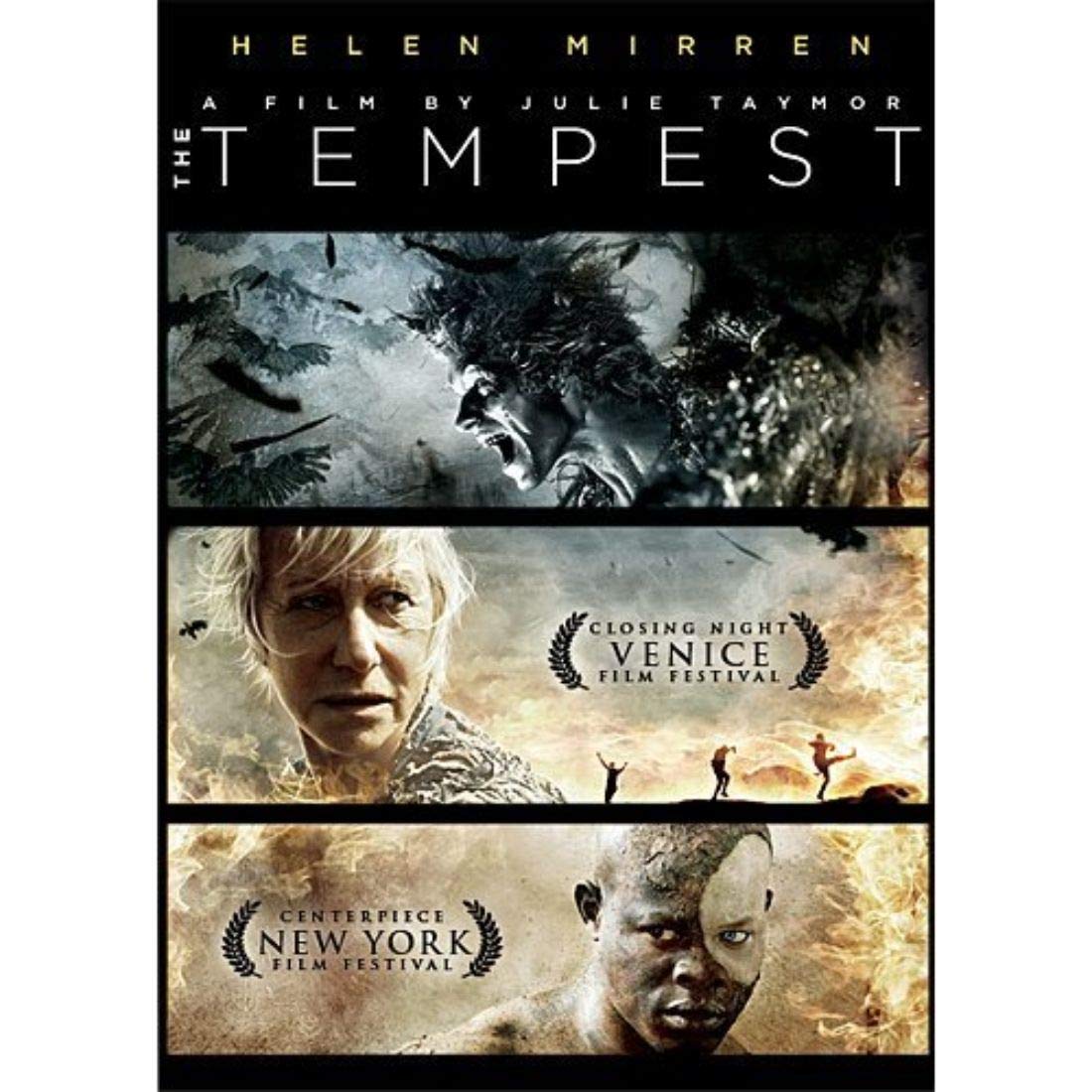
Breaking News: Julie Taymor's Tempest in a Teapot?

Tempest. Dir. Julie Taymor. Perf. Helen Mirren, Djimon Hounsou, Felicity Jones, and Ben Whishaw. Chartoff Productions, 2009.
According to this New York Times' Carpetbagger blog entry, the closed doors at Miramax may mean that Julie Taymor's Tempest "will be shelved, to gather dust, or win a tepid release" (Sharon Waxman, qtd. in the blog entry).

In other words, Tamor's Tempest is a teapot (in a household full of coffee drinkers): potentially dusty, lukewarm, and /or ignored. Shudder.

Bardfilm has been looking forward to the film for nearly a year! Tamor's intensely visual style, Helen Mirren's Prospera, and the intellectual challenges of the play itself are so tantalizing that even a tepid distribution would be agonizing.

We hope that this production will not go under. Please think about the dollars in the film-going public's wallets and purses and recognize that, in Ariel's words, "They cannot budge till your release" (V.i.11). Release the film!

Update: They did!

[N.B.: Comments are encouraged below.]

Links: Taymor's Tempest at IMDB.

Click below to purchase the DVD from amazon.com
(and to support Bardfilm as you do so).

Friday, January 29, 2010

The Guthrie Presents Macbeth!

Macbeth. Dir. Joe Dowling. Perf. Barbara Bryne, Isabell Monk O’Connor, Suzanne Warmanen, Raye Birk, John Skelley, Benjamin Rosenbaum, J.C. Cutler, Bob Davis, James Noah, Peter Christian Hansen, Tyson Forbes, Erik Heger, Michelle O'Neill, Bill McCallum, Robert O. Berdahl, Sun Mee Chomet, Sam Bardwell, Kris L. Nelson, Nicholas Saxton, Graham Zima, Noah Coon, Charlie Lincoln , Elizabeth McCormick, and Nina Moschkau. Guthrie Theatre Company. Minneapolis. 30 January—3 April 2010.
The Guthrie's new production of Macbeth opens tomorrow, and I believe that it will be thrilling in both the older and the newer sense of the word. This production will be the fiftieth Shakespeare production put on by the Guthrie since it staged Hamlet in 1963.

About a month ago, I was privileged to be invited to a "Meet 'n' Greet" event during which Joe Dowling, the director of the production, and Monica Frawley, the set and costume designer, introduced the cast and crew and spoke about their vision of the play.

It sounds fabulous.

The play, as I gathered from Dowling's introductory remarks, will run without intermission—since Macbeth is Shakespeare's shortest tragedy, time won't be much of a problem. The audience will not have the opportunity (other than those the play itself provides) to break away from the unrelenting horrors provided by the play itself.

The play itself will have a contemporary feel—contemporary to this time period, that is, rather than to Shakespeare's England or to Duncan's Scotland, but no specific time is indicated. The general destruction and the effects of warfare will be brought into a universal, platonic realm.

In light of that, the set design is particularly intriguing. The intention is to have the stage scattered with debris—the residue of the conflict with with the play begins—and to have that debris pushed aside, moved around, and added to but not removed. The effect will prevent the audience from forgetting the warfare on which Scottish rule is built. When Macbeth's palace is established, it will simply be placed on top of the debris scattered on the stage. I'm greatly looking forward to seeing how that comes together.

Doubling roles is not at all uncommon—just as it wasn't in Shakespeare's day—and the Guthrie will have the same actor play the roles of Seyton, the Bloody Captain, and the Third Murderer. That combination isn't altogether unusual—I think the Great River Shakespeare Festival combined those roles a few years ago. A more unusual choice is to have the actor playing the Second Weïrd Sister (according to the cast list, it seems that "Weïrd Sister" is the term preferred over "Witch") will also play the Doctor. Doubling those roles may provide a very interesting subtext.

Dowlling also said that he intends to de-emphasizing the supernatural elements of the play, concentrating instead on the psychological realities imbedded in the play. Macbeth and Lady Macbeth are not forced to act according to the prophecies of the Weïrd Sisters—nor do the Weïrd Sisters serve as advisors to Macbeth. The decisions—and, therefore the responsibility—rest with him.

If you're in the Twin Cities, plan to see this play. Here's the calendar where you can choose your performance and order your tickets! I'm convinced that it will be remarkable and that it will give us all—whether we've seen and read the play dozens of times or are coming to it cold—a lot to think about.

When you go to see it, pay attention to the opening lines. The point where the play starts may be astonishingly significant to its interpretation.

The Guthrie recently posted a photo retrospective of the last fifty Shakespeare performances. I'm embedding it here for your convenience and edification!


Thanks, Guthrie Theatre, for providing so many peerless productions! We (I speak for the world here) can't wait to see what the next fifty productions bring.
Links: The Play at the Guthrie Theater.

Thursday, January 7, 2010

Henry V meets Braveheart—in South Park

“Starvin’ Marvin.” By Trey Parker. Perf. Isaac Hayes et al. Dir. Trey Parker. South Park. Season 1, episode 8. Comedy Central. 19 November 1997. DVD. Comedy Central, 2004.

I don't spend a lot of time at South Park, but I needed a quick example of scatological humor for my Literature of Humor class, and I thought of them first. Imagine my shock when I found Shakespeare there! I had to use Babelfish to translate the Turkey Language (I don't suppose it qualifies as "Turkish" or "Turkic") into English, but there it was, as plain as day.

In this episode, mutant Turkeys are taking over the town, and Chef needs to rally the citizens to fight them. His speech is clearly endebted to Braveheart, but the Lead Turkey's response is just as obviously drawn directly from Henry V:


There may also be a subtext of the two orations (by Richard and Richmond) to the opposing armies toward the end of Richard III—but I leave the exploration of that for those of you who are attempting to complete doctoral theses.

Links: The Episode at IMDB.

Click below to purchase the first season from amazon.com
(and to support Bardfilm as you do so).

Monday, December 28, 2009

Woody Allen Plays the Fool. No, Really. The Fool in King Lear.

King Lear. Dir. Jean-Luc Godard. Perf. Woody Allen, Jean-Luc Godard, Norman Mailer, Kate Mailer, Burgess Meredith, Molly Ringwald, and Peter Sellars. 1987. DVD. Lear Media, n.d.
When William Shaksper Junior the Fifth [sic] arrives on a post-Chernobyl apocopyptic beach house filled with strangeness, mafia-esque characters, and Molly Ringwald, audience expectations inevitably run high.

Actually, I suppose that I've exaggerated the inevitably of the height of the expectations. My expectations were fairly meager. I wanted to see Woody Allen as the Fool and to see Peter Sellers clowning it up a bit. I had to wade though almost the entire film before Woody Allen showed up, and I quickly learned that William Shaksper Junior the Fifth was played by Peter Sellars, not Peter Sellers.

The film is an Avant-garde derivative of King Lear, and it's not without its merits. The general idea is that the world has fallen apart, but William Shaksper Junior the Fifth is gathering bits and pieces of King Lear in an attempt to restore it—and, presumably, though it, the art, literature, and humanity of the ages.

With that as a premise (and with Jean-Luc Godard as a director), the play is necessarily fragmented. It wasn't an enjoyable film to watch, but the idea behind it is intriguing. I got the feeling of being T. S. Eliot's Fisher King, constantly hearing the line "These fragments I have shored against my ruins" (The Waste Land 431) running through my head.

That isn't to say that I did not also think "Why then Ile fit you" (The Waste Land 432) from time to time, exasperated at the way the idea was playing itself out and plotting my revenge.

Still, Woody Allen! The Fool! Sort of!

So that you don't have to roll up your cuffs and make your way through the opening hour or so, here's the big payoff:


Links: The Film at IMDB.

Click below to purchase the film from Lear Media.


Monday, December 7, 2009

Something about Margaret: Branagh's Solution in Much Ado about Nothing

Much Ado about Nothing. Dir. Kenneth Branagh. Perf. Kenneth Branagh, Emma Thompson, Denzel Washington, Michael Keaton and Keanu Reeves. 1993. DVD. MGM, 2003.
Branagh's decisions about how to play Much Ado About Nothing's Margaret are, on the whole, objectionable. So is Michael Keaton's Dogberry, but that's another story. Leaving Margaret and Dogberry aside, the film is one of the best modern Shakespeare films available. What does Branagh do with Margaret's character that is so objectionable? And, having done that, does Branagh redeem his decisions in any way?

First, Branagh uses a visually-presented liaison between Borachio and Margaret as ocular proof for Claudio that Hero is unfaithful. In doing so, he deviates from the text. Borachio describes the encounter this way:
I have to-night wooed Margaret, the Lady Hero's gentlewoman, by the name of Hero: she leans me out at her mistress' chamber-window, bids me a thousand times good night . . . . (III.iii.145-48ff)
There's nothing in that account that looks like Branagh's presentation of the encounter. Bardfilm readers will know that I don't usually object to modernizations or to deviations from the text of a given Shakespeare play. Such deviations can be intensely interesting and entertaining, and they can bring different facets of the text to light. But this one goes too far in attempting to justify Claudio's later actions. The play's ending is more significant when Claudio is a bigger idiot. It gives Hero much more credit throughout the rest of the play when her actions are untempered by what might be more reasonable suspicions on Claudio's part.

We also wonder about Margaret more the more she looks blameworthy. Questions about Margaret's silence often occur to readers of the play and (slightly less often) to viewers of productions of the play. Margaret is one of the gentlewomen attending on Hero, and she is presumably around after the news of Claudio's behavior at the wedding gets out. Why doesn't she speak? Surely, she could say a quick "Erm . . . I was the one speaking out of the window that night" and set things right before they get out of hand.

In the text, Margaret doesn't re-enter until V.ii, after the news of Don John's plot has reached the ears of those most concerned in it. In Branagh's version, she's present at the wedding—and would, we might think, be more inclined to interrupt the proceedings. But in having her present, Branagh redeems (somewhat) his decisions about her character, developing some unexpected depths to Margaret as he does so.

During Claudio's accusations, the camera frequently cuts to Margaret to view her reactions (the image above is one such instance). She's perplexed and horrified, but she's not quite ready to speak out—perhaps out of guilt or shame or embarrassment or some combination of all of those. What she is ready to do is to go find Borachio and demand some explanations from him. At least, that's the impression I get as she looks around at the crowd and then dashes out, trying to get ahead of all the other exiting guests.

Had she been able to find Borachio, Margaret might have come back to make a report to Leonato. But (and here's the part that seems most realistically motivated) Borachio has been arrested by this time, and Margaret, unable to find him, can produce neither an explanation nor any proofs for her claim. That really is a convincing reason for her not to speak.

But we do lose something (a good deal, in fact) of the virtue of Margaret in having her so visually complicit in Don John's plot. Borachio's words about her behavior simply don't apply in the Branagh version. When Leonato declares his belief that Margaret "was pack'd in all this wrong, / Hired to it by your brother" (V.i.299-300), Borachio makes this reply:
No, by my soul, she was not,
Nor knew not what she did when she spoke to me,
But always hath been just and virtuous
In any thing that I do know by her. (V.i.300-03)
If that is so, Borachio is not a very keen observer (if the Branagh presentation is foremost in our minds). If we follow the text, Borachio's lines make more sense—though Margaret may still be considered somewhat culpable in allowing herself to be wooed under the name of Hero and for not speaking up as quickly as she might have done.

Links: The Film at IMDB.

Click below to purchase the film from amazon.com
(and to support Bardfilm as you do so).

Friday, December 4, 2009

A Moment of Silence in Measure for Measure

Measure for Measure. Dir. Desmond Davis. Perf. Kate Nelligan and Kenneth Colley. DVD. BBC / Time Life, 2001.

Silence punctuates many of the most important moments in Measure for Measure—and readers (as opposed to those who enact or view a production of the play) are apt to miss time.

One that is often unnoticed comes in the middle of Isabella's first appeal to Angelo:
No ceremony that to great ones ’longs,
Not the king’s crown, nor the deputed sword,
The marshal’s truncheon, nor the judge's robe,
Become them with one half so good a grace
As mercy does.
If he had been as you and you as he,
You would have slipt like him; but he, like you,
Would not have been so stern. (II.ii.59-66)
The silence comes in that empty space after “As mercy does.” There are six more potential beats in that line that simply are not there. It's quite a remarkable pause, and it indicates a shift in Isabella's approach—in addition to letting a cadence fall on all our ears as we contemplate mercy.

Another silence may come late in the play. In this instance, it's not based on the absence of beats in a line but on the absence of a response where we might reasonably expect one. The silence seems to occur immediately after the Duke asks (for the second time in the scene) for Isabella's hand in marriage.

To give you the full effect, I've taken the speech in question and divided it in true cliffhanger style. Here's Duke Vincentio’s proposal:


Does she accept him at this point? Does she reject him? What's going through her mind? Tune in next time . . .

The moment is fraught with possibilities. She may fling herself into his arms and kiss him passionately. She may turn her back on him and walk right off stage. She may even walk up to him and slap him in the face.

We're pretty clear on what she doesn't do. She doesn't utter a speech in which she explains her motives for accepting or denying his proposal.

With all those potentials hanging in the air, we can return to the BBC production to see what choice Kate Nelligan, Isabella, and Desmond Davis (the film's director) make:


Fair enough. That seems to be in line with the genre (in general) of the play. Plenty of marriages adorn the pages of Shakespearean comedy—why not one more?

But Isabella's response at least puts the possibility of an alternate ending into the play. But, of course—and (admit it) you knew this was coming—the rest is silence.

Links: The Film at IMDB.

Click below to purchase the film from amazon.com
(and to support Bardfilm as you do so).

Bardfilm is normally written as one word, though it can also be found under a search for "Bard Film Blog." Bardfilm is a Shakespeare blog (admittedly, one of many Shakespeare blogs), and it is dedicated to commentary on films (Shakespeare movies, The Shakespeare Movie, Shakespeare on television, Shakespeare at the cinema), plays, and other matter related to Shakespeare (allusions to Shakespeare in pop culture, quotes from Shakespeare in popular culture, quotations that come from Shakespeare, et cetera).

Unless otherwise indicated, quotations from Shakespeare's works are from the following edition:
Shakespeare, William. The Riverside Shakespeare. 2nd ed. Gen. ed. G. Blakemore Evans. Boston: Houghton Mifflin, 1997.
All material original to this blog is copyrighted: Copyright 2008-2039 (and into perpetuity thereafter) by Keith Jones.

The very instant that I saw you did / My heart fly to your service; there resides, / To make me slave to it; and, for your sake, / Am I this patient [b]log-man.

—The Tempest