Thursday, August 14, 2008

Shakespeare at the Olympics

Love’s Labour’s Lost. Dir. Kenneth Branagh. Perf. Kenneth Branagh and Alessandro Nivola. 2000. DVD. Miramax, 2000.

Ethel Merman meets Dawn Fraser in this Shakespearean tribute to the Olympics.

Actually, I suppose it's a long way to go, but sweatervestboy's post, coupled with Olympic Fever, reminded me of this scene from Branagh's film adaptation of Love’s Labour’s Lost. The progression from Olympics to Synchronized Swimming to Branagh to Love’s Labour’s Lost to Shakespeare is a long one, but the fact that they're singing Irving Berlin's "No Strings (I'm Fancy Free)" connects us back to Shakespeare because . . . um . . . Shakespeare uses the word "romancy" in his sonnets? Or because Oberon describes the "Imperial votaress" as "fancy-free" in Act II, scene i of A Midsummer Night's Dream? Well, I'm sure there's a reason somewhere. Just enjoy it.


Links: Sweatervestboy's blog.

Click below to purchase the film from amazon.com
(and to support Bardfilm as you do so).

Wednesday, August 13, 2008

Kenneth Branagh's A Midwinter's Tale Trailer

A Midwinter’s Tale [a.k.a. In the Bleak Midwinter]. Dir. Kenneth Branagh. Perf. Richard Briers, Hetta Charnley, Joan Collins, Nicholas Farrell, Mark Hadfield, Gerard Horan, Celia Imrie, Michael Maloney, Jennifer Saunders, Julia Sawalha, and John Sessions. 1995. Videocassette. Turner, 1999.

I've mentioned this brilliant, brilliant film before, but I noticed (as I was doing a periodic check to see if the film had been released on DVD yet—it hasn't, more's the pity) that a trailer was available. I'm only able to show it here in an Adobe Flash, amazon.com-related manner (see below), but it's clearly worth it.

The film involves a down-on-his-luck actor (not played by Branagh, but played by an actor clearly trying to play the part as close to the way Branagh would play it as possible) who wants to put on a production of Hamlet to invigorate his career. At Christmas. In a village called Hope. With a bunch of actors even further down on their luck than he is. It's great.

I'll also post, as a bonus, the audition clip I posted earlier. Perhaps it's time to start a grassroots campaign to get this film out to the viewing, paying public on DVD!  Are you listening, Turner?

The Trailer for the Film:


The clip from the auditions scene:

Click below to purchase the film from amazon.com
(and to support Bardfilm as you do so).

Henry V: Shakespeare as Marketing Device

Playstation 3 Advertisement. June 2008.

An alert reader send me a link to this advertisement. It uses the St. Crispin's Day Speech to create a sense of community among the gamers playing on the Playstation 3 video game console. Whether I condone this use of Shakespeare remains to be seen—however, I do recognize the power of the speech and the attempt to harness it to sell, sell, sell!

As you watch, note the subtle change from "upon St. Crispin's Day" to "upon this day." It makes the appeal much more immediate—"'This day?' did they say? Why . . . today is 'this day!' Let's grab our controllers and play—I don't want to hold my manhood cheap (whatever that means)." The elision of the phrase "in England" serves a similar function.


[Note: At one point, the ad with video was pulled from YouTube; however, I found a version with audio only. If you'd like to see this one, you can close your eyes and imagine that you're being shown images from a video game or you can follow along with the text as it's presented to you.]


For comparison, here's the relevant, unexpurgated portion of the speech:
We few, we happy few, we band of brothers;
For he to-day that sheds his blood with me
Shall be my brother; be he ne'er so vile,
This day shall gentle his condition.
And gentlemen in England now a-bed
Shall think themselves accursed they were not here,
And hold their manhoods cheap whiles any speaks
That fought with us upon Saint Crispin's day. (Henry V, IV.iii.60-67)

Links: The video at YouTube.

Tuesday, August 12, 2008

Another Tempestuous Thought—and a New Poll!

Shakespeare, William. The Tempest. The Riverside Shakespeare. 2nd ed. Gen. ed. G. Blakemore Evans. Boston: Houghton Mifflin, 1997. 1656-88.

The quote used for the tag line in this blog is from The Tempest.   You can see it in the image to the right, and it also appears as the footer to the blog as a whole.

But here is the text—just in case you need it typed up and punctuated:
The very instant that I saw you did
My heart fly to your service, there resides,
To make me slave to it; and, for your sake,
Am I this patient [b]log-man.  (III.i.64-67)
The good people at Bardfilm patiently blog along, trying to keep us all informed of the latest developments in the field of Shakespeare and Film.

You can help!  You may e-mail Bardfilm with suggestions or developments.  Or you may simply participate in the recent poll (to the right of this post), indicating which play you'd like to see Bardfilm spend a week with.

Thank you very much!

Links: E-mail Bardfilm.

Monday, August 11, 2008

A few final showers before the clouds of Tempest week scatter

The Tempest. Silent Shakespeare. Dir. Percy Stow. Perf. Unknown. 1908. DVD. Image Entertainment, 2000.

The Tempest. Dir. Derek Jarman. Perf. Heathcote Williams, Karl Johnson, Jack Birkett, and Toyah Willcox. 1979. Kino Video, 2000.

The Tempest. Shakespeare:  The Animated Tales. Dir. Stanislav Sokolov. Perf. Martin Jarvis, Timothy West, and Alun Armstrong. 1992. DVD. Ambrose Video, 2004.


I just wanted to mention (this is a MicroBlog, after all) three additional productions of The Tempest—and they couldn’t be more different from each other.

First, a 1908 silent version. I don’t have it with me at this moment, but I was surprised at just how advanced the techniques were for that year. It had a more convincing shipwreck than the BBC versions, some nice sudden disappearances of Ariel, and a much longer runtime than I expected. It’s available in a really remarkable DVD with a number of other silent version of Shakespeare plays.

Second, the Jarman Tempest. Whenever I read about Jarman, he seems to be described as the darling of the critics. I’m glad he’s somebody’s darling. I haven’t re-watched his version, but I did glance at it again. It’s a dark, often foul version with a fair amount of nudity (and nudity that is somehow different in quality than Greenaway’s film’s . . . it’s possibly still artistic, but for decidedly different purposes). All in all, it’s too avant-garde for my tastes. Watch this one at your own aesthetic and moral risk.

Finally, there’s a delightful animated version intended for a younger audience. Part of the twelve-play Animated Shakespeare series, this Tempest is bright and airy, with a genuinely funny (albeit quite strange) Caliban.

Click below to purchase the films from amazon.com
(and to support Bardfilm as you do so).


Friday, August 8, 2008

The Granddaddy of Modern Tempests

Prospero's Books. Dir. Peter Greenaway. Perf. Sir John Guelgud, Michael Clark, Isabelle Pasco, and Orpheo. 1991. Videocassette. Media / Video Treasures, 1996.

In 1991, Peter Greenaway released Prospero's Books, a dense, deep, dark derivitive of The Tempest.  It's not for everyone.

Prospero's Books is another film I'm glad to have seen in the theatre—even more so because it (amazingly) hasn't been released on DVD yet.  Sir John Gielgud speaks / reads / recites nearly every line in the play in the film in the audio track in the screenplay in the director's vision.  And if all that layering is confusing, wait until you see the film.  

The film is layered, the screen often split into two or four or more two-dimensional segments and just as many (or more) three-dimensional ones.  

Does anyone remember Myst, the computer game set on an island where mysteries abound?  Watching Prospero's Books is very much like playing that game.  (Note:  The game was released in 1993, so a Greenawayian influence is entirely possible.)

But I don't recall any nudity in the computer game; however, it's very hard to find a scene in the film that doesn't have nudity.  

For that reason alone, the film is not for all viewers.  The nudity is, I suppose, part of an artistic vision rather than an intention to titillate, but it's pervasive. 

Below is the (nudity-free) epilogue to the film.  The splash of water toward the end is part of the rich and strange visual layering. 


Until it comes out on DVD, the film will be something of a rarity.  If your library has a copy, give it a try!

Links: The film at IMDB.

Thursday, August 7, 2008

Straightforward Version of The Tempest

The Tempest. Dir. John Gorrie. Perf. Michael Hordern, Warren Clarke, Pippa Guard, and David Dixon. 1980. DVD. Ambrose Video, 2001.

From a fragment and through a few derivative works, we arrive at a film version of the play itself.  The BBC Tempest is a straitforward production.  There are very few surprises here.  Ariel is a waif-like wisp who tends to disappear in a Kurosawa-esque wipe.  Miranda is Miranda.  The storm is a BBC sound stage storm.

Michael Hordern, who plays Prospero, is one of those English actors who have been around for sixty years or so and has been in tons of things.  He played Baptista in the Zeffirelli Taming of the Shrew, for example.  He's a solid Prospero.

In his version of Prospero's speech at V.i.44-57,  the surprise here is that the speech (unlike Patrick Stewart's fragmentary version) doesn't build to a climax.  Instead, the camera pulls away from Prospero as he starts to disclaim power, and the final line ("And deeper than did ever plummet sound / I'll drown my book") is almost thrown away.  It's a metaphor.  I'm sure of it.  As he distances himself from his So Potent Art, we are distanced from him.

Links: The film at IMDB.

Click below to watch the film at amazon.com
(and to support Bardfilm as you do so).

Wednesday, August 6, 2008

Planet, Island . . . What's the Difference?

Forbidden Planet. Dir. Fred M. Wilcox. Perf. Walter Pidgeon, Anne Francis, and Leslie Nielsen. 1956. Warner Home Video, 2000.

The Plots of The Tempest and Forbidden Planet are said to be amazingly similar in quite a large number of publications.

I suppose the similarities are mainly in characters.  The plot of this science fiction classic (and it really is a classic, influencing many films that followed it and entering pop culture in the same way that things like "Soylent Green" or "Resistance is futile" have) contains a lot more death and destruction and general mayhem than Shakespeare's play.

And it also contains Robby, the Robot!  Hurrah!  I'm sure you've seen this Caliban analogue.  He became the quintessential icon of sci. fi. robots, even making it into The Simpsons on at least two occasions.  I also suspect that Marvin (of The Hitchhiker's Guide to the Galaxy fame) owes a great deal to Robby.

Robby is interesting because he's something of the opposite—or, I suppose, the enlightened or Rousseau-inspired version—of Caliban.  

Anyway, without giving any spoilers, you also have analogues for Prospero and Miranda (they landed on this planet when the Miranda figure was an infant, and everyone died off but them) and a basic analogue for Frederick.  The Miranda figure, having met no human beings other than her father, is much taken with the flock of space travelers who arrive on their island planet.

But the plot . . . well, you should watch this fairly-good, fairly-not-t00-cheesy sci. fi. classic to see how much the writers owe to "The Swan of Altair."

Whoops!  I mean "Avon."  Swan of Avon.  Sorry.

Links: Wikipedia entry on the film.

Click below to purchase the film from amazon.com
(and to support Bardfilm as you do so).

Tuesday, August 5, 2008

Tempest: A Recontextualization of The Tempest

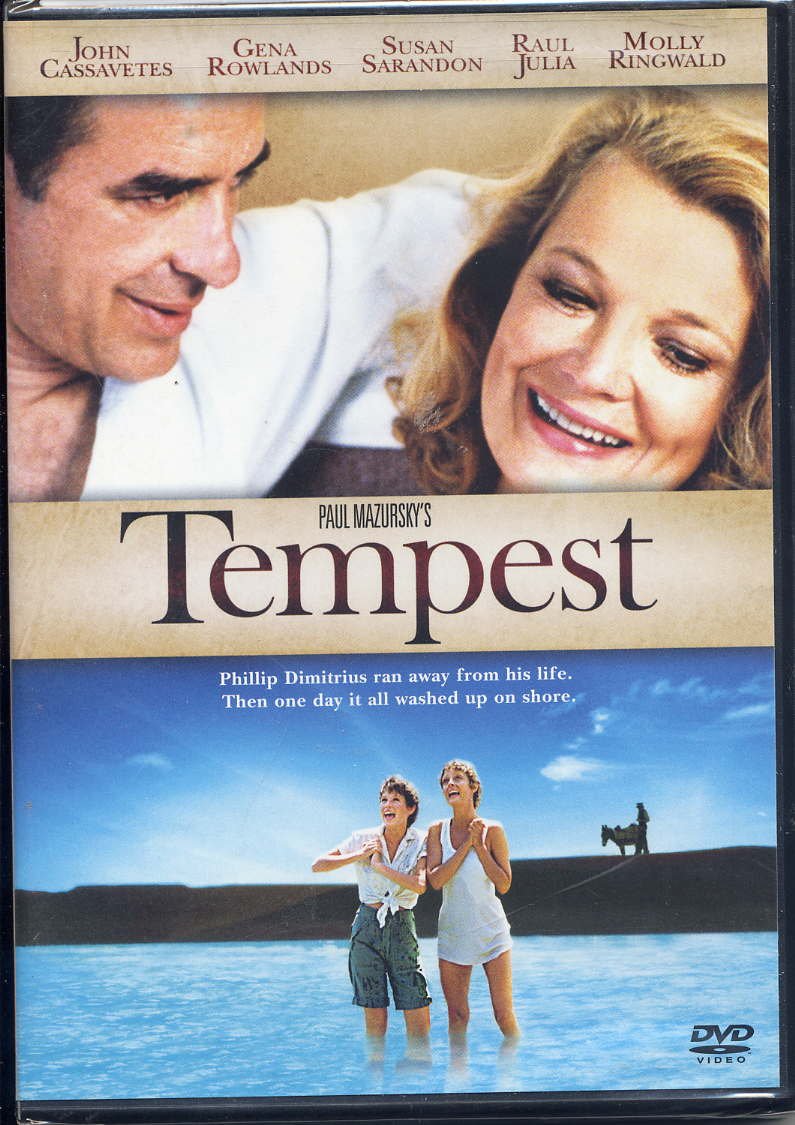
Tempest.  Dir. Paul Mazursky.  Perf. John Cassavetes, Gena Rowlands, Susan Sarandon, Raul Julia, and  Molly Ringwald.  1982.   DVD.  Sony Pictures, 2007.

Tempest (N.B.:  Not The Tempest—just Tempest) is better known than the selection from Extras, but it's still somewhat obscure, partly because it has only recently been released on DVD.

Kenneth S. Rothwell would classify this film as a recontextualization (rather than an adaptation) of a Shakespeare play.  It has a plot roughly like that of the play, but it does some remarkable things with it.

I'm fond of the figure of Caliban in this film (he goes by the name of Kalibanos).  He's one of the great successes in the play—he's funny and winning and sympathetic.  

He's all that in part because of the Prospero analogue (Phillip).  We get a lot of his backstory.  He's an architect who was very controlling and had something of a midlife crisis / breakdown.  He took his daughter to a nearly-uninhabited Greek island with a platonic girlfriend (the Ariel analogue) to recover.

Briefly, I'd like to present one wonderful exchange is between Kalibanos and Philip (the Prospero analogue).  Philip, jealous of the unwanted attention Kalibanos is paying Miranda, throws Kalibanos in the water.  Kalibanos shouts up out of the water:
Kalibanos:  I was boss before you show up.  Me—boss!
Philip:  You were ignorant, you superstitious bastard.  I taught you how to read.  I taught you how to count, fix the pump, read the stars . . . .
Kalibanos counters this with this line:
I show you the olive, and the fig, and the sweet water.
After some additional arguing, Philip knocks Kalibanos senseless with the oar. Then, somewhat reluctantly, he rescues him.

It's hard to tell exactly what Kalibanos says at that point. The subtitles have him say "You are a god, boss," but it sounds more like he's saying "You are God, boss."

In either case, Philip's reply is clear enough:
Philip: I'm no god. I'm a monkey, just like you.
Later, during the tempest itself, Kalibanos shouts to Philip:  "You are God, boss!"  And later still, when Philip seems unable to control the storm he seems to have summoned, Kalibanos has one more speech on the subject:
Kalibanos:  You not God.  Only God, God!
It's a delightful version of the tensions in the exchange betwwen Caliban and Prospero in I.ii, culminating in Caliban's speech:
You taught me language, and my profit on't 
Is . . . I know how to curse.  The red-plague rid you
For learning me your language!  (I.ii.363-65)
The most delightful scene is one in which Kalibanos dances with his goats.  It might be styled with this epigraph:
You taught me language, and my profit on't
Is . . . I know all the lyrics to "New York, New York!" 
Here's that delightful scene:


The film is one I'm glad to have seen in the theatres—on the big screen—even though I didn't like it at the time.  I'm now able to appreciate things about it that were completely mysterious to me at the time.  Yes, like the dancing goats.

Links: The film at IMDB.

Click below to purchase the film from amazon.com
(and to support Bardfilm as you do so).
Monday, August 4, 2008

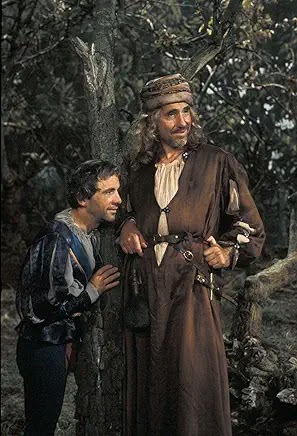
Patrick Stewart as Prospero—A Fragment of The Tempest

“Episode 1.6.”  By Ricky Gervais and Stephen Merchant.  Perf. Ricky Gervais, Stephen Merchant, Ashley Jensen, and Patrick Stewart.  Dir. Ricky Gervais and Stephen Merchant.  Extras.  Season 1, episode 6.  BBC / HBO.  25 August 2005.  DVD.  Universal Pictures Video, 2007.

Welcome to what I've arbitrarily decided will be Tempest Week here at Bardfilm!

We'll kick it off with one that's seldom mentioned in Shakespeare and Film circles. I actually can't quite believe that I forgot this existed! If I hadn't been going through a folder looking for something else, I wouldn't have found this image.

It's from Extras, a show about . . . well, extras . . . on movie sets, and it's written by the team that gave us the BBC Office—so it's absolutely brilliant, though (or, perhaps, because) it does make the viewer exceedingly uncomfortable.

[Side Note: The American version of The Office—though my students love it and insist that I must watch every episode right now right this very second here I'll give you a thumb drive with the latest season on it—seems, for the most part, very dull. But (before I get a bunch of angry e-mails) I'll admit that I've only seen a few episodes of the first season—ones that reproduce (rather amateurishly—whoops! That's another batch of angry e-mails I'll get) specific portions of the BBC Office.]

Anyway, Patrick Stewart does a marvelous Prospero—the image above is taken from his "abjuring my art" speech in V.i.33-57—and then Patrick Stewart does a marvelous Patrick Stewart. The PS PS plays is unlike anything we'd imagine the real PS to be, and it's wonderful. Try it out.


Links: The official site for Extras.

Click below to purchase the show from amazon.com
(and to support Bardfilm as you do so).


Sunday, August 3, 2008

"I'll live by Nym, and Nym shall live by me." —Henry V

Orr, Wendy.   Nim's Island.  Illus. Kerry Millard.  New York:  Alfred A. Knopf, 1999.

Wendy Orr, author of Nim's Island (on which the movie Nim's Island was based) and other works has responded to a question I asked her about Shakespearean influences on her writing.

The reason for the query was some conceivable Tempest analogues in the film (for that entry, q.v.).  

Her response is extremely interesting, and it offers (1) valuable advice for readers of all kinds of literature and (2) further evidence for a "Shakespeare is Everywhere" Weltanschauung (which I have and which I hope you're beginning to share).

The valuable advice applies to Shakespeare, of course, but it also applies to large helpings of other literature:  Read It Aloud.

She mentions studying The Merchant of Venice several times (because she changed schools frequently).  I think that's also enormously valuable.  Occasionally, my students will tell me that they've read Hamlet in high school.  Occaionally, the implication is that they don't need to (or don't intend to) read it again.  But they couldn't be more wrong.  

Shakespeare, like all great literature, can bear multiple readings.  Indeed, readers will get different things out of it at different times in their lives.  As their lives change, their response to Shakespeare also changes.

Thanks, Wendy Orr, for responding to the query!  I look forward to reading more of your work.  Perhaps Shakespeare will make another unintentional (or, even better, intentional) appearance in your future novels!

Links: Wendy Orr's Journal Blog.

Click below to purchase the book from amazon.com
(and to support Bardfilm as you do so).

Saturday, August 2, 2008

Random Saturday Morning Shakespeare Comic

Knight, Kevin. "Untitled."  N.d. N.p.
I don't really know anything about the author of this comic. I just chanced upon it while searching Google images for pictures of Vietnam.  But I find it delightful.

It's something like "Hamlet as computer role-playing game." But, like a study of the play itself, the game lacks the vocabulary necessary to tidy up one of the most complex dramatic works in the history of human civilization!

It's also a very nice distillation of III.iii (the scene that makes its way into Last Action Hero, for which, q.v.).

Links: Original URL.

Friday, August 1, 2008

A New Shakespeare-Related Novel

Winfield, Jess. My Name is Will: A Novel of Sex, Drugs, and Shakespeare. New York:  Twelve, 2008.

The New York Times just reviewed—or, rather, its podcast just interviewed the author of—a new novel related to Shakespeare.

All I know about it I learned from the New York Times Book Review podcast. The author is one of the founding members of the Reduced Shakespeare Company, and the podcast and the review stress the novel's comic elements.

It also appears that a secretly-Catholic and State-persecuted Shakespeare is assumed.  As Shakespeare's Catholicism / Protestantism / Agnosticism / Atheism / Puritanism / et ceteraism has been at the forefront of the scholarly debate in recent years, it will be quite interesting to explore its implications in this novel. 

More when I get a copy and look into it!

Links: The publishing house.  The review.

Click below to purchase the book from amazon.com
(and to support Bardfilm as you do so).

Thursday, July 31, 2008

A Return to Last Action Hero

Last Action Hero. Dir. John McTiernan. Perf. Arnold Schwarzenegger, F. Murray Abraham, Art Carney, and Austin O'Brien. 1993. DVD. Sony, 2007.

While looking through a folder of scholarly articles on Shakespeare, I came across Eric S. Mallin's tremendous and seminal work on Shakespeare and Schwarzenegger.
Mallin, Eric S. “‘You Kilt My Foddah’; or Arnold, Prince of Denmark.” Shakespeare Quarterly 50 (1999): 127-51.
I keep meaning to require it as reading for my Shakespeare and Film class—and I'll certainly do so next time. The way the article reads deeply into the film and into Shakespeare is intriguing.

For example, Mallin points out the interest of the choice the teacher (played by Joan Plowright, Lawrence Olivier's widow) makes in showing a scene from Olivier's Hamlet.

The connection-by-marriage is obviously interesting. But, more interesting that that, is the teacher's decision to show the Claudius-at-prayer scene to support her thesis that Hamlet is "one of the first action heroes." Mallin says that "The weight of the wish in Danny's dream of Shakespeare and the appropriateness of Arnold as a bearer of this weight are of course that Hamlet become an agent of immediate, uncompromising revenge and destruction, not of mediation and equity" (130).

To follow Mallin, Hamlet works because its hero is an inaction hero. We know what action heroes might (and will) do, but we wonder constantly what Hamlet will do, how he'll do it, and (to an extent) why he doesn't.

That's an unformed thought, but I have a semester or two to work on it. In the meantime, enjoy the scene below!


Click below to purchase the film from amazon.com
(and to support Bardfilm as you do so).

Wednesday, July 30, 2008

From Shakespeare's Wife to Shakespeare's Landlady

Nicholl, Charles. The Lodger Shakespeare: His Life on Silver Street. New York: Viking, 2007.

[This post has been in the draft stage for nearly a year now. I suppose it's time to post it. First, of course, I need to write it. Hang on a second.]

Charles Nicholl's books is extraordinarily interesting, even though it deals with a very short period in Shakespeare life. Perhaps it's interesting because it deals with such a short period.

There isn't a ton of documentary evidence about Shakespeare—though there is more than most people suspect.  This book focuses on an intriguing period in Shakespeare's life (as if all periods in his life weren't intriguing) when he was called in to testify about an engagement agreement.

Speaking of engaging, this book is.  Engaging, I mean.  Read it.

Links: Post on Shakespeare's Wife.

Click below to purchase the book from amazon.com
(and to support Bardfilm as you do so).

    
Bardfilm is normally written as one word, though it can also be found under a search for "Bard Film Blog." Bardfilm is a Shakespeare blog (admittedly, one of many Shakespeare blogs), and it is dedicated to commentary on films (Shakespeare movies, The Shakespeare Movie, Shakespeare on television, Shakespeare at the cinema), plays, and other matter related to Shakespeare (allusions to Shakespeare in pop culture, quotes from Shakespeare in popular culture, quotations that come from Shakespeare, et cetera).

Unless otherwise indicated, quotations from Shakespeare's works are from the following edition:
Shakespeare, William. The Riverside Shakespeare. 2nd ed. Gen. ed. G. Blakemore Evans. Boston: Houghton Mifflin, 1997.
All material original to this blog is copyrighted: Copyright 2008-2039 (and into perpetuity thereafter) by Keith Jones.

The very instant that I saw you did / My heart fly to your service; there resides, / To make me slave to it; and, for your sake, / Am I this patient [b]log-man.

—The Tempest