Tuesday, March 21, 2017

A Bit More Shakespeare in Pearls Before Swine

Pastis, Stephen. King of the Comics: A Pearls Before Swine Collection. Kansas City: Andrews McMeel, 2015.

We've occasionally seen Pearls Before Swine dip into Shakespeare for comic effect.

We've seen pun-based takes on Hamlet's soliloquy and threats cobbled out of Julius Caesar.

We've had an encounter with difficult verse lines from Romeo and Juliet.

We've even had Shakespeare translated for modern audiences.

And now, in browsing through a book at the bookstore, we find two more connections between Shakespeare and the Pearls cast.

The first one is part of a series that . . . well, Stephen Pastis has thoughtfully provided a panel of context for it:


The second takes us back to Hamlet's soliloquy . . . with a bit of a twist.


The Shakespeare aficionado might say, like Isabella in Measure for Measure, "O, it is excellent / To have a giant's strength; but it is tyrannous / To use it like a giant" (107-09). But that might be gilding the lily.

Click below to purchase the book from amazon.com
(and to support Bardfilm as you do so).

Monday, March 20, 2017

Book Note: Fakespeare in the Park

Soria, Gabe. Fakespeare in the Park. New York?: Cartoon Network Books, 2016.

I'm pretty much utterly nonplussed about this volume. I have no sense of the context for it. Occasionally, people write me and ask if they can send me something Shakespeare-related, and I generally say, "Sure." That's how this came my way.

It's a work of juvenile fiction published by Cartoon Network Books. And it may have something to do with something called The Regular Show.

I've tried to gain some quick context, and I gather that there's a blue jay and a raccoon. They work for the park service, and they're not very good at their jobs.

As near as I can tell, this is not a novelization of an actual event on the show. If it were, it would provide the context more easily and be more accessible to the causal, mildly-interested bystander.

If you know the show and are a fan, you may find this quite amusing.  After a number of false starts and quirky setbacks, the characters are able to put on a play they call The Most Awsome Exploits of MacDeath, a Veteran Constable, and Juliet, his Squire. Here's a quick sample:


There you have it. If you know the show, you may like it; if you don't, you're likely to be nonplussed.

Click below to purchase the film from amazon.com
(and to support Bardfilm as you do so).

Friday, March 17, 2017

Book Note: Shylock is my Name

Jacobson, Howard. Shylock is my Name: William Shakespeare's The Merchant of Venice Retold. London: Hogarth Shakespeare, 2016.

On the whole, I have not been terribly impressed with the Hogarth Shakespeare series. The Winter's Tale one (for which, q.v.) starting off very promising, but tried too hard. The Taming of the Shrew one (for which, q.v.) didn't seem to think that deeply about the play.

But Shlock is my Name was profound in its grappling with Shakespeare's play—while making it its own and inviting us to look back at Merchant of Venice.

It takes a while for everything to build, but we essentially have the story of Simon Strulovitch, whose daughter is running wild and who intends to marry a christian. His story is set in contemporary England (contemporary to us, that is, not to Shakespeare).

He meets Shylock in a graveyard. At first, Shylock seems to be contemporary to Strulovitch, but it becomes clearer and clearer that Shylock's story has been completed and the Strulovitch is echoing it. Shylock then stands as a guide to Strulovitch's experiences—and also as a touchstone for how Christians have treated / are treating Jews. Ambiguity over whether he is to be taken as real or as an emblem for Jewishness fills the novel's pages.

The novel's plot is cleverly woven together, and it leads to Strulovitch demanding that the man with whom his daughter has eloped / run away become circumcised (this becomes the modernization of the "pound of flesh"). When he can't be found, Strulovitch demands that D'Anton, the man's older mentor and friend, take his place.

I leave you to discover the rest on your own . . . except that I want to provide this novel's take on the "Quality of Mercy" speech. Here, it's given to Shylock. It's toward the end of the novel, and Shylock is asking Strulovitch to reconsider his demand for circumcision.  [Note: There is some coarse language here. So watch it.] 


The kinds of things this novel does are the things all the Hogarth Shakespeares ought to do.

Click below to purchase the film from amazon.com
(and to support Bardfilm as you do so).

Tuesday, March 14, 2017

Book Note: Shakespeare was a Computer Programmer

Holmes, Jeffrey. Shakespeare was a Computer Programmer. Fredericton, New Brunswick, Canada: Brunswick Press, 1975.

And sometimes we run across items that are "even more bizarre and inexplicable," to quote Douglas Adams.

Shakespeare was a Computer Programmer is an extremely odd little book. I spotted it scroll by on the Folger Library Twitter Feed and thought I'd track down a copy myself to see what it's all about. I thought it was probably a book to help computer programmers understand Shakespeare or to help Shakespeareans understand computer programmers better.

Instead, I got something of a parody of the authorship debates. Our purported author—Professor ----------, according to Jeffrey Holmes—discovered a number of odd bits of old paper. To his astonishment, they lead him to the conclusion that the plays of Shakespeare were really written by "one Harry Ramsbottom, an illegitimate Yorkshireman, using technique not to be dreamed of until the advent, four hundred years later, of computer programming" (7).

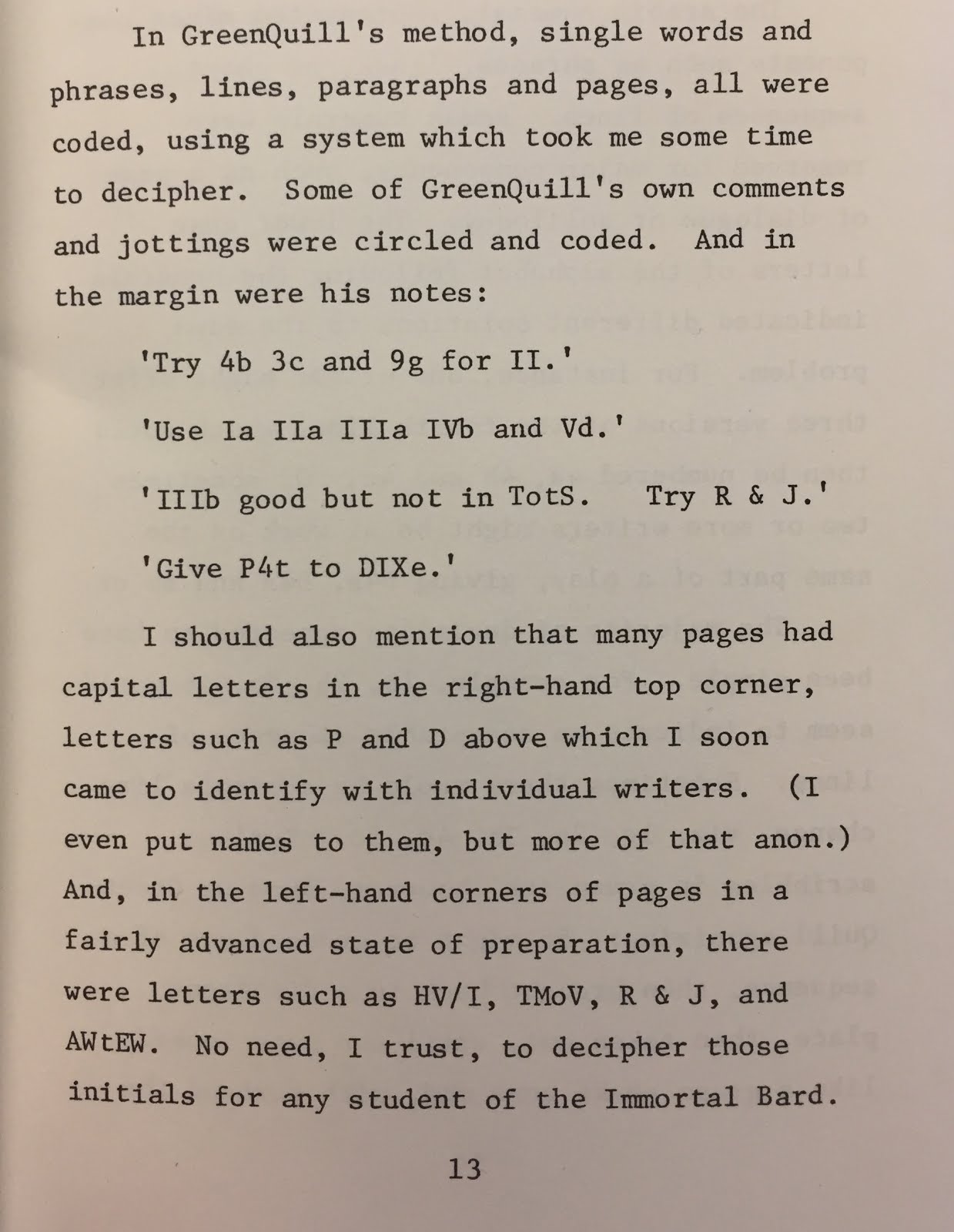
As near as I can figure, the rest of the book imagines that specific words and phrases in Shakespeare were given codes that would make them interchangeable. With a list of intriguing and well-written words and phrases, each given a code, a play could be compiled much as computer code would be.

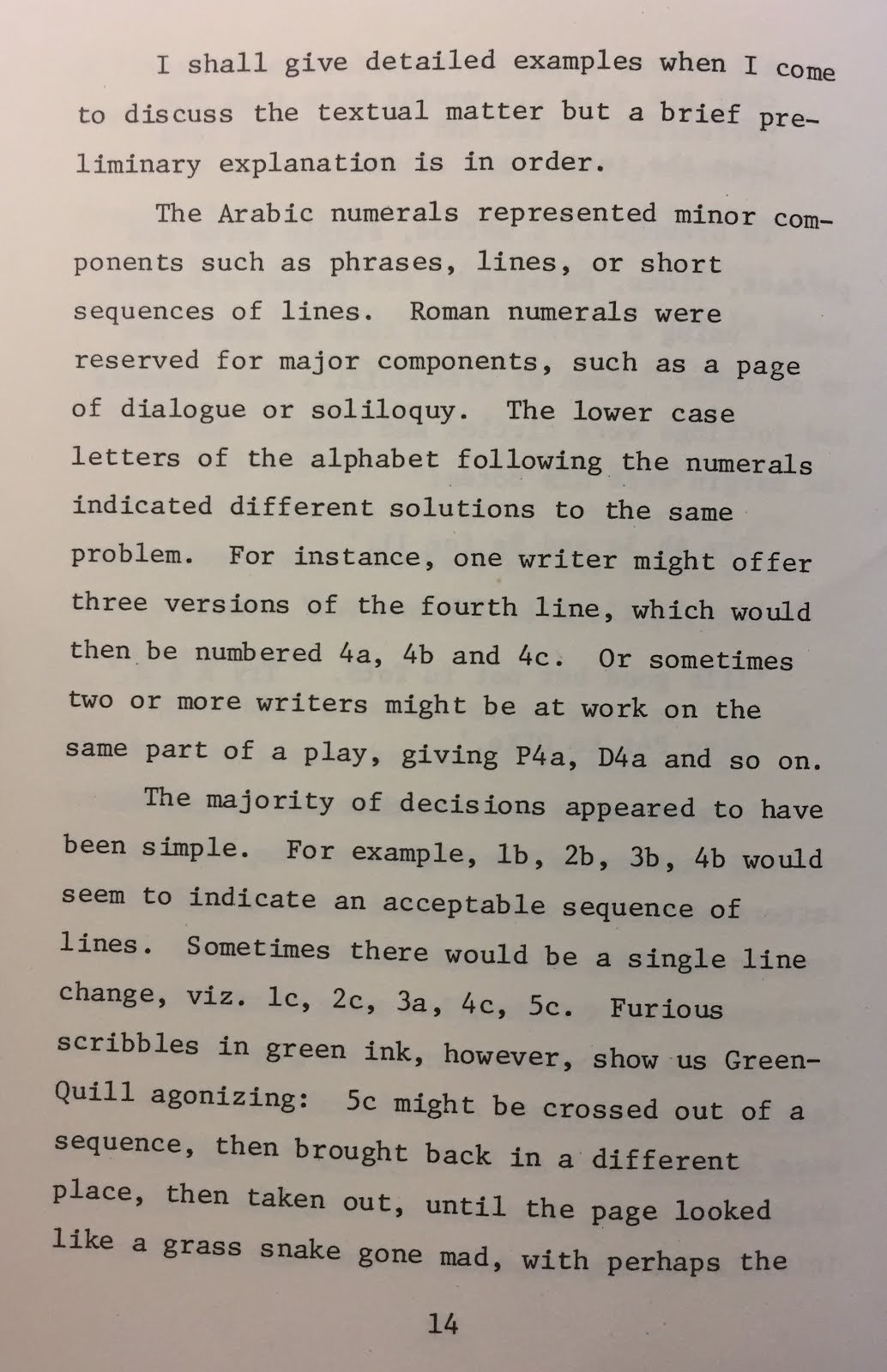
I'll give you pages 13 to 15 as an example:


And it goes on from there, giving examples of lines that could have appeared in one play but actually appeared in another.

There you are. It's odd, but I did read it, and I thought it needed a write-up.

Click below to purchase the book from amazon.com
(and to support Bardfilm as you do so).

Thursday, February 23, 2017

Grade School Macbeth in Slings & Arrows

“Fallow Time.” By Susan Coyne and Bob Martin. Dir. Peter Wellington. Perf. Martha Burns, Paul Gross, Don McKellar, Mark McKinney, Oliver Dennis, Susan Coyne, Stephen Ouimette, Catherine Fitch, and Geraint Wyn Davies. Slings and Arrows. Season 2, episode 2. Movie Central: Canada. 4 July 2005. DVD. Acorn Media, 2006-2007.

I've recently had cause to go back to Slings and Arrows to have a look at the way they staged the Macbeth-within-the-Macbeth-related season of the series.

If you've never seen this show, stop now and go watch it in its entirety and then come back. A remarkable show in its own right, the fun it has with Shakespeare push it into entirely new categories.

If you've never seen the show but you're not obeying the command in the last paragraph, you'll need to know that the series is about a director who takes over as the artistic director of a Shakespeare festival when the previous director dies. That previous director's ghost (or is it just a hallucination?) returns from time to time to help (or to plague?) the new director. In the episode from which this clip is drawn, Jeffrey Tennant (the new director) goes to a local grade school to see its production of Macbeth (the grade school always puts on a version of whatever the festival is doing). As Jeffrey watches the show, he becomes more and more disturbed by the thought of having to direct the play himself—until Oliver, the previous director, shows up. Here's a compilation of all the scenes with the grade school Macbeth:


It's great stuff, particularly in the layering that gives us a director of Macbeth behaving like Macbeth when Macbeth sees the ghost of Banquo.

Links: The Show at IMDB.

Click below to purchase the show from amazon.com
(and to support Bardfilm as you do so).


Book Note: A Midsummer Night's Scream by R. L. Stein

Stein, R. L. A Midsummer Night's Scream. New York: Feiwel and Friends, 2013.

The description from Amazon will give you a pretty good idea of where this book is going:
In R.L. Stine's A Midsummer Night's Scream, the Master of Horror takes on the Master of Theatre!

Oh, what fools these actors be!
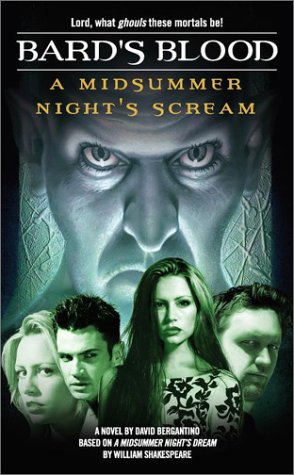
When I wrote on A Midsummer Night's Scream by David Bergantino, I noted that there were other books under that title. The pun must be irresistible for horror writers.

R. L. Stein's is better, but it's still not all that thrilling—and I mean that two ways (that pun must be irresistible for Shakespeare scholars): the horror is more unbelievable than horrific and there's not that much Shakespeare.

The novel does employ some plot elements of Shakespeare at least. There's a character named Mr. Puckerman (can you divine his role?) who has a bunch of different magic potions—love potions, hate potions, aging potions. And the characters in the novel have an awareness of Shakespeare that is gratifying.

That's the part I'll provide as a sample.  Here's our protagonist meeting Mr. Puckerman ("Everyone calls me Puck") for the first time and getting a flavor of his love potion:


Puckerman also has a forgetting potion, and he tries it on Claire, but she's able to remember the events of the meeting fairly completely.

Just like other characters remember Shakespeare fairly completely. Here's a quick reference from later in the book:


And that's about it. The love potions (and hate potions) are used from time to time, but not according to Shakespeare's script.

Still, this is better than the other horror novel—and now I just have two more books with this title to try!

Click below to purchase the book from amazon.com
(and to support Bardfilm as you do so).

Monday, February 20, 2017

Upstart Crow: A Shakespearean Sit-Com

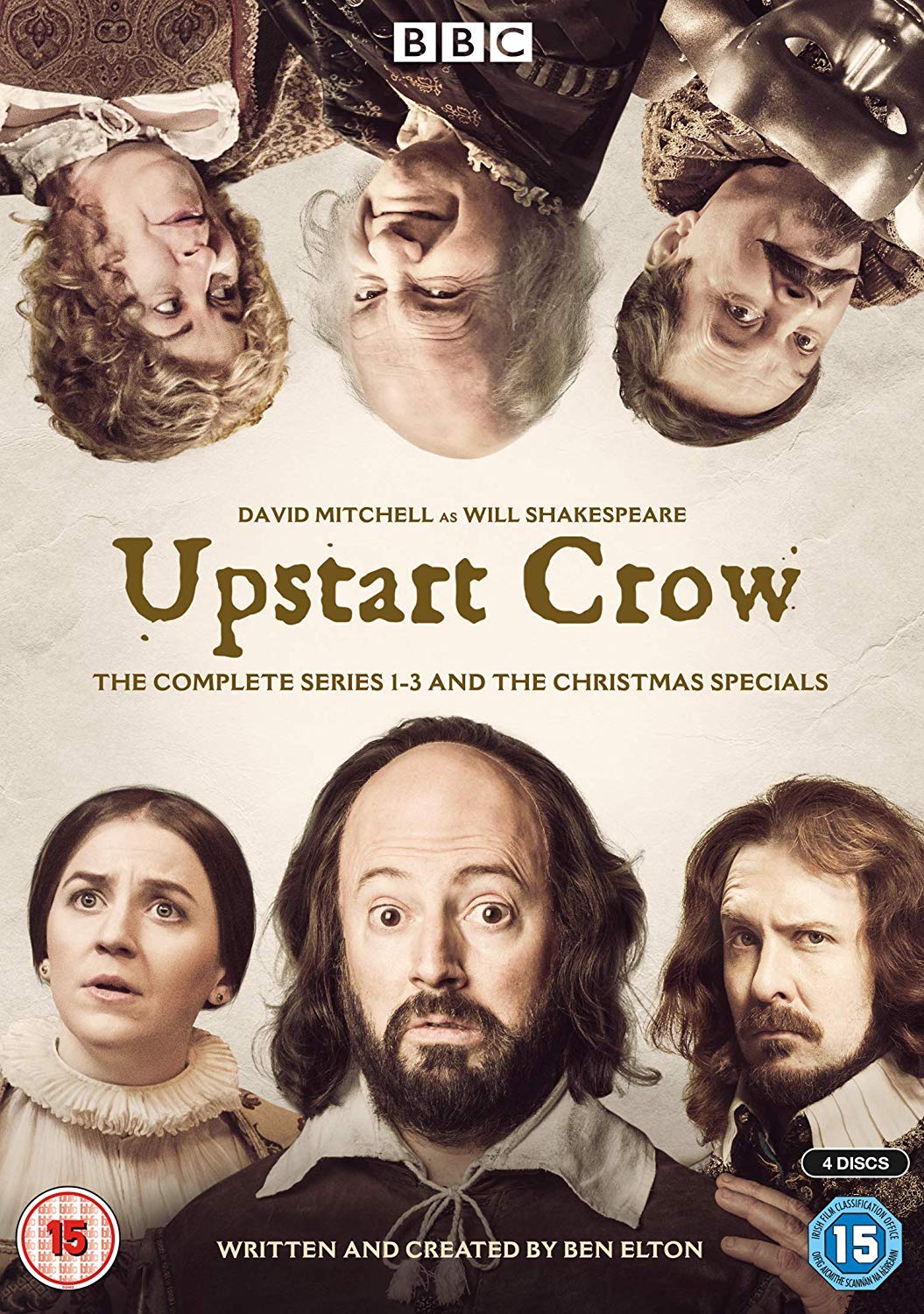
“Star Crossed Lovers.” By Ben Elton. Perf. David Mitchell, Liza Tarbuck, Paula Wilcox, Helen Monks, Harry Enfield, Gemma Whelan, Rob Rouse, Mark Heap, Dominic Coleman, Steve Speirs, and Spencer Jones. Dir. Matt Lipsey. Upstart Crow. Season 1, episode 1. ABC. 9 May 2016. DVD. Paramount, 2007. 

Alert reader and Shakespeare-related novel writer Jean Hegland (for whom, q.v.) pointed me toward Upstart Crow, a sit-com in the old style, complete with either live studio audience or a laugh track.

And it's brilliant.

The show is about Shakespeare trying to make a name for himself as a playwright. We're most often either in his house in Stratford or in his London lodgings. The scheme is for each episode to include a real-life event drawn from Shakespeare's fictional drama. For example, Shakespeare gets into debt to Robert Greene, with whom he's signed a "pound of flesh" agreement. Or he needs a potion to make it appear that someone is dead. Those episodes usually conclude with Anne telling Will that he should put something like that in the play he's working on—but Shakespeare usually discounts the idea, arguing that it would be too unbelievable.

I'm supremely pleased by David Mitchell's Will Shakespeare. He plays the character somewhere between Peter Bowles' Richard DeVere in To the Manor Born and Fawlty Towers' very own Basil Fawlty.

The writer of the show is Ben Elton, who wrote for Balack Adder. Some Shakespeare did make its way into Black Adder (for which, q.v.), but not nearly enough for my tastes. This show rectifies that, providing huge lashings of Shakespeare in every episode.

Other contemporaries of Shakespeare make their way into the show. Robert Greene is always trying to one-up the upstart; Henry Condell and Richard Burbage are constantly complaining about their parts; and Will Kempe is always looking down his nose at everyone else because he understands modern comedy and they don't. He's clearly a sixteenth-century equivalent to Ricky Gervais' David Brent in the BBC Office.

Let me give you a couple quick scenes as a sample. This first scene is the show's opening. Shakespeare is back at home in Stratford, working on Romeo and Juliet—and they work in some good material surrounding the perennial potential "wherefore" confusion. It moves from there to Shakespeare's London lodging, where we get him complaining about his journey in a very modern way. Finally, it cuts to part of the plot (a man in love with the wrong woman has been sent to Shakespeare's lodgings for safekeeping) that provides a callback to the wherefore material:


I'm very fond of the way the show slyly points out that the first name isn't actually the problem preventing Juliet and Romeo from getting married. And the line "If you do your research, my stuff is actually really funny" is genius of the highest order.

This next clip provides a bit of the players from episode five ("What Bloody Man is That?"). It gives us Kempe as David Brent, comedy mastermind:


And I can't resist giving one more in that vein. It's from episode six: "The Quality of Mercy," and it's clearly Kempe as both David Brent and Ricky Gervais when he proposes an entirely new kind of comedy for their proposed new theatre:


The more I dip into the show, the more I like it. It's currently only available in a Region 2 DVD, but I hope a US release is in the works. And I gather that there's a possibility of a second season for the show, so let's keep our eyes peeled for that.

Update: Yes, there was a second season . . . and a third . . . and a couple of specials. But the BBC has announced that they will not be picking up the show for a fourth season. That's a shame, because the third season ends on something of a downer of a cliffhanger. But you can now get all the Upstart Crow there is (see below).

Links: The Wikipedia Entry for the Show.

Click below to purchase the complete run of the series from amazon.com
(and to support Bardfilm as you do so).
Wednesday, February 8, 2017

A Return to Shakespearean Advertisements

More of the Bard on Madison Avenue. A Few Selected Advertisements. Various Years. Various Sources. Various Products.

One of my favorite parts of the Modern Shakespearean Fiction course I developed is the brief presentations students make throughout the course. Each day of class, two or three students present for five minutes on something Shakespearean that they've encountered. Their brief presentations always lead to creative and organic discussion. And I always learn a ton.

Occasionally, students bring in Shakespeare-related advertisements  (for which, q.v.). And they're usually fascinating.

Here are a few a student (a student majoring in marketing, as it happens) brought to the class's attention, supplemented by one of my own.

The first presents Shakespeare (the man) as utterly overly-dramatic:


The tagline "You don't want drama" sums it up. But it's just short for "Unless you are searching for drama, as when, for instance, you are going to see a Shakespeare play, you don't want drama."

I had seen the second advertisement before. Again, we have Shakespeare the man, and he starts with a distancing tone here . . .


. . . but he soon proves his relevance by dishing out hashtags. Intriguingly, this is more of a public service announcement than an advertisement pure and simple.

The third ad the student showed is my favorite of the set:


That one, too, is on the public service side.  With the usual "wherefore for where" substitution aside, we have an intriguing narrative about pickles of two different brands. I do somewhat resent the idea that the out-of-date fridge is called "Globe," but it's still a clever use of the trope of "Shakespeare Means Tragedy."

Finally, we have a return to cell phone ads that play with Romeo and Juliet:


While other ads used Romeo and Juliet as a touchstone for communication (either gone wrong without the right device or enhanced by the right device), this ad focuses on the video-making features. With the right phone, the cardboard sets and mediocre acting that stereotypes a grade school production (with the right director, of course, these stereotypes are broken even without an expensive phone) are turned into beautiful scenery and convincing acting.

I think that means that the new iPhone is capable of lying to us . . . or at least of spinning reality to suit us. 

Links: More Shakespearean Advertisements at Bardfilm.

Tuesday, January 31, 2017

Book Note: Stewart Kenneth Moore's Graphic Novel of Macbeth

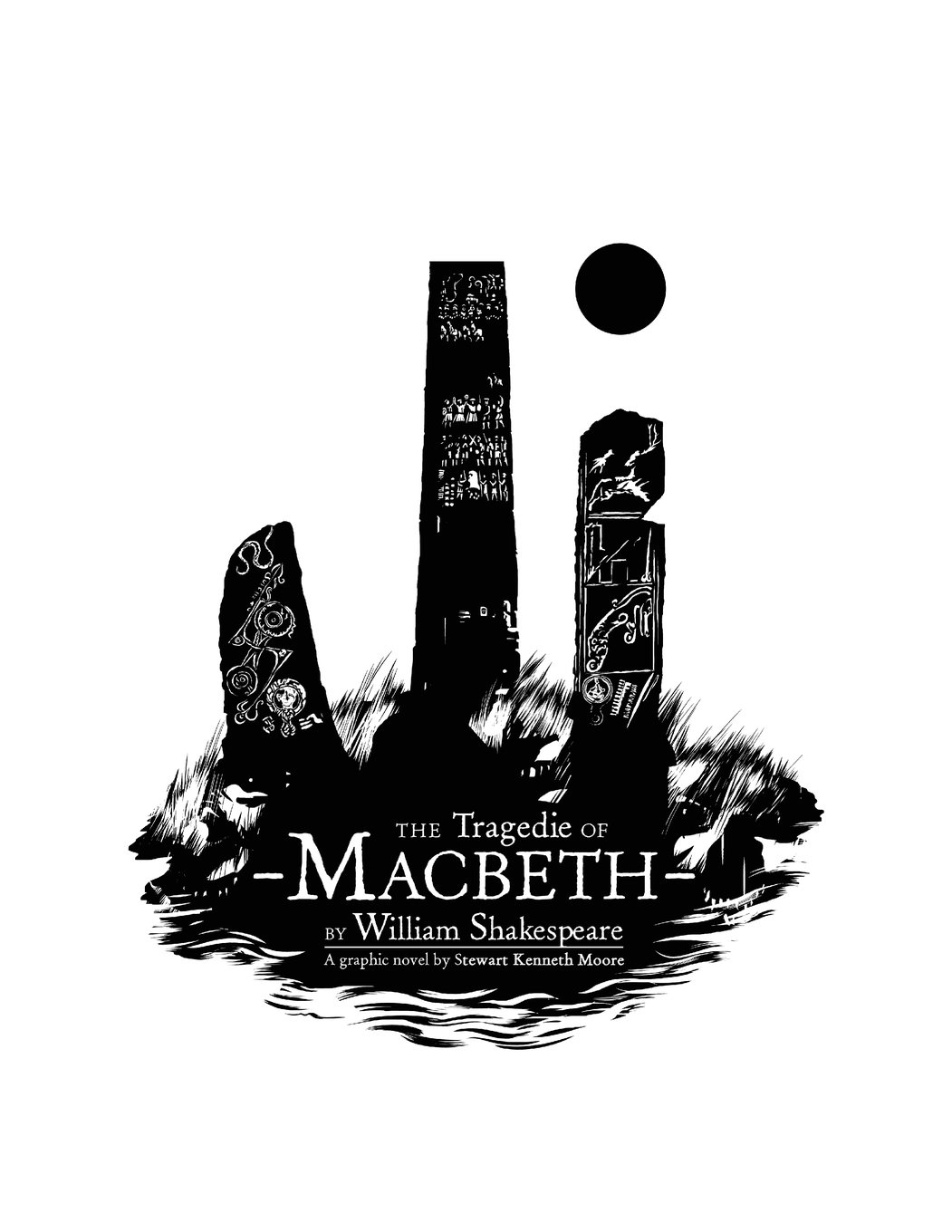
Moore, Stewart Kenneth, illus. The Tragedie of Macbeth by William Shakespeare: A Graphic Novel by Stewart Kenneth Moore based on an abridged version of "The Scottish Play" produced and performed by the Prague Shakespeare Company. N.p.: CreateSpace Independent Publishing Platform, 2016.

I decided to try this out after seeing some recommendations. It’s a graphic novel of a stage production of Macbeth—and I generally do like such layered entities.

Here’s how the author describes the project:
The idea for this project came about in 2015, when Prague Shakespeare Company’s Guy Roberts began planning to commemorate the 400th anniversary of the death of Shakespeare. Guy asked me to participate and so we knocked around some ideas over a beer. I wanted to do something different from the paintings and sketches I’d made of PSC’s productions of Hamlet and Macbeth over the years . . . but what? Drawing the whole play seemed too daunting. 
At this time, Pat Mills pointed me to the work of the Irish artist Louis le Brocquy and his black-and-white Lascaux-like series based on the Celtic epic “The Tain” (The Cattle Raid of Cooley). This ancient poem features a powerful queen and her husband and a war they start with the Irish hero Cú Chulainn. I saw a challenge in trying to tell the whole story of Macbeth in equally start monochromatic hues. I thought about the mysterious symbols on Pictish stones and I saw a way. 
I decided to storyboard PSC’s Macbeth just like a film; essentially a sketchbook of the stage action drawn, start to finish, in just one month. I then realized it would be even more fun to drop the state and cast the players against the half-remembered and half-imagined light of North East Scotland, my childhood home. Its beaches, its standing stones and the rubble-like causeway of Bennachie—all have a role in these pages. I used the hashtag #28DayGraphicNovel on Twitter and tweeted my progress.
The work has a good creation narrative. Beyond that, I didn't find all that much to be excited about. The graphic novel is dominated by black—which is fine, I suppose, for such a dark play, but it becomes relentless.  Side Note: The printing is not incredibly well done. The black smears copiously from the pages to the hands of even the careful reader. In addition, the first copy I received was cropped wrong—about an inch of the top of half the pages was cut off. That doesn't speak to the work itself, but this incarnation of it isn't terrific.

Here's a quick glance at the dagger speech to give you a rough idea of the work:


In many ways, it's just a straightforward account of one production of Macbeth. It's an interesting way to see a production, but it doesn't take us into new territory.

Click below to purchase the film from amazon.com
(and to support Bardfilm as you do so).

Monday, January 30, 2017

Book Note: MacB

Arksey, Neil. MacB. New York: Pearson Longman, 2004.

MacB is a very brief retelling of Shakespeare's Macbeth. This one is set on the football pitch (that's "the soccer field" to readers in the United States).

The opening question is whether Mac and Banksie will make the team. The book provides some good descriptions of the two playing football (soccer) together.

And then they end up at the fortune teller, and she cryptically tells them . . .

Well, you should read that for yourself. Here's the end of that chapter and the beginning of the next (just for some additional local color):


That's our ambiguous prophecy, and it plays out just about how you'd expect it to.

What was a bit unexpected was the end. But don't read on unless you don't mind spoilers.

There aren't any deaths in this story—the team captain is put out of commission by a sabotaged bicycle—so there's not a dramatic death at the end. But Mac does go stark raving mad toward the end. Here's that scene:


It's a quick, somewhat imaginative retelling of Macbeth that may be a good introduction to the plot of the play for younger readers—particularly those fond of football (soccer).

Click below to purchase the book from amazon.com
(and to support Bardfilm as you do so).

Friday, January 27, 2017

Book Note: Hamlet II: Ophelia's Revenge

Bergantino, David. Hamlet II: Ophelia's Revenge. Bard's Blood. New York: Pocket Star Books, 2003.

I recently posted on the other "Bard's Blood" series book I read—A Midsummer Night's Scream—and concluded by wondering whether the first in the series would be better than that one, which was the second.

Well, it is, but not by much.

Our story opens among the football players of Globe University in Stratford, Ohio. They're losing to Fortinbras University's team—the Fighting Generals. But Cameron Dean, the star quarterback, uses the back of Rosenberg or Gyllenhal (I'm afraid I can't keep the two straight) to leap into the end zone.

He's happy enough to forget (almost) that his dad has recently died and that he doesn't much care for his Aunt Claudia.

Then he inherits Elsinore castle and takes the whole football team and their girlfriends there for a vacation.

And that's when Ophelia—the one who died way back when in Denmark—rises from her swamp and starts to kill people. Here's a quick sample of her appearance and her thought process:


That's nearly all I want to tell you, and the main point is that it is better than A Midsummer Night's Scream. There's even a nifty play-within-the-play scene where a musical group called "The Playaz" perform a rap that reveals someone's guilt: "I had a daddy / My mommy was his wife / He also had a sister / Who took his life" (174).

The final image inside the book is also intriguing. This is printed on the inside of the back cover:


At first blush, it's just something like "If you liked these horrible deaths, you're sure to love Hamlet," but it also illustrates my philosophy about modern Shakespearean fiction: Part of what's important is what happens when you return to Shakespeare's play. The play and the modernization can speak to each other in interesting ways.

Usually.

In this case, the first thing you read on the cover is "Something is rotting in the state of Denmark," so there's that to consider.

Click below to purchase the book from amazon.com
(and to support Bardfilm as you do so).

Thursday, January 26, 2017

Book Note: A Midsummer Night's Scream

Bergantino, David. Hamlet II: Ophelia's Revenge. Bard's Blood. New York: Pocket Star Books, 2003.

Note: Blogger has now eaten the original post I made on this book and my half-recreated one. I wouldn't be so frustrated about that if the book I'm trying to write about were any good, but it's not. This time through, you will not get my finely-crafted literary analysis—you'll just get the basics.

I'm afraid this book is not very good, and its lack of goodness is not due to the genre. We have here a horror novel with an extra-terrestrial (or a demon? or a fairy?—can't tell easily and can't be bothered to try to figure it out) who shape-shifts into human form.

Indeed, he takes the form of Professor Ajit Waman, Human Sexuality (Summer Session) teacher at Globe University in Stratford, Ohio.

The new Professor Waman assigns a typical "Pair up—now you're married couples; here's a bag of flour; pretend it's a baby; take care of it or fail the course" assignment.

Hijinks ensue, and a bunch of people are killed in grisly but relatively uninteresting ways at a fly-by-night carnival that rolls into town. Here, for example, is how two of them meet their downfall. Note: Sensitive readers may wish to skip this, whether their sensitivity is to violence or to bad writing.


The carnival has Oberon (the lobster-clawed man in the sideshow) and Titania (the half-woman, half-serpent sideshow attraction).

There you have it. Some Shakespearean plot elements—but not many—and not-very-interesting horror elements.

This is actually the second in the Bard's Blood series—I'll try to summon up the gumption to read the first one to see if it's any better.

Note: In looking for the book, I found that there are at least five other books with the title "Midsummer Night's Scream," including one by R. L. Stein. I'm not sure whether I'm happy to learn that information or not.

Click below to purchase the book from amazon.com
(and to support Bardfilm as you do so).

Wednesday, January 25, 2017

Book Note: Something Wicked

Grantz, Alan. Something Wicked: A Horatio Wilkes Mystery. New York: Dial Books, 2007.

Recently, I wrote a review of Something Rotten: A Horatio Wilkes Mystery (for which, q.v.). I was impressed by the way Alan Grantz presented Hamlet as something of a murder mystery and Horatio as our first-person, point-of-view narrator.

Something Wicked attempts to do the same with Macbeth. However, while Something Rotten is quite successful, Something Wicked isn't. For one thing, Horatio isn't in Macbeth. I got the feeling that the publisher had extended a two-book contract, and this was the contractual obligation novel. Well, it's not as bad as all that, but it's not at all compelling.

There's a Scottish heritage competition on Mount Birnam. Mac is urged on by his girlfriend Beth (who gets him to do whatever she wants by promising or withholding sexual favors) to compete in the competition—if he wins, he'll be declared king of the mountain. That seems pretty light.

But then Horatio finds the body of Duncan—and then the detective work begins. Sheriff Wood investigates, but so does Horatio.

Oh, and there's also a sheepdog named Spot who figures in largely.

The setting is all right, but the characters are neither compelling nor interesting. Most of them aren't even annoying, which would be a reasonable way to garner interest.

Here's a quick sample page from toward the beginning of the novel:


And here's one interesting paragraph from near the end:


That's the sort of thing that's compelling to me—it points back to Macbeth itself and invites us to consider that play in this light.

I bought Horatio as a confidant / guide to Hamlet—but I don't see it working with Macbeth. In short, the first Horatio Wilkes Mystery is pretty good; this one can be given a miss.

Click below to purchase the book from amazon.com
(and to support Bardfilm as you do so).

Bardfilm is normally written as one word, though it can also be found under a search for "Bard Film Blog." Bardfilm is a Shakespeare blog (admittedly, one of many Shakespeare blogs), and it is dedicated to commentary on films (Shakespeare movies, The Shakespeare Movie, Shakespeare on television, Shakespeare at the cinema), plays, and other matter related to Shakespeare (allusions to Shakespeare in pop culture, quotes from Shakespeare in popular culture, quotations that come from Shakespeare, et cetera).

Unless otherwise indicated, quotations from Shakespeare's works are from the following edition:
Shakespeare, William. The Riverside Shakespeare. 2nd ed. Gen. ed. G. Blakemore Evans. Boston: Houghton Mifflin, 1997.
All material original to this blog is copyrighted: Copyright 2008-2039 (and into perpetuity thereafter) by Keith Jones.

The very instant that I saw you did / My heart fly to your service; there resides, / To make me slave to it; and, for your sake, / Am I this patient [b]log-man.

—The Tempest