Wednesday, March 16, 2016

How to Play Humiliation

Lodge, David. Changing Places. New York: Penguin, 1979.

David Lodge's Changing Places doesn't have all that much Shakespeare in it, though it does have a Shakespearean feel to it. An American scholar trades posts with a British scholar to immensely humorous and occasionally slapstick antics.

The most memorable part of the novel to me is a game called "Humiliation" that one of the characters has invented.

The game is an interesting one—and I'd actually be interested in playing it.

But you should all read through all the rest of the excerpts from the book before you decide to play. The end may not be what you expect.

I'll let the book explain the rules, and then I'll trace the way the book uses the game. On page 96, we first learn about the game when Philip Swallow (the British professor teaching at the American institution) tries to teach it to a group of students:


The novel switches to epistolary mode in the middle; from Philip Swallow's perspective (on page 132), we get something about his attempt to introduce the game to his new American colleagues:


Mrs. Zapp is the nearly-filing-for-divorce wife of the American professor who has traded posts with Swallow. Her account of the game is found on pages 135-37:


Beware the game, then, lest you win by admitting not to have read a key work of the canon of literature—but lose by being denied tenure for having failed to do so!

Click below to purchase the book from amazon.com
(and to support Bardfilm as you do so).

Monday, March 14, 2016

Book Note: Prince of Shadows: A Novel of Romeo and Juliet

Caine, Rachel. Prince of Shadows: A Novel of Romeo and JulietNew York: NAL, 2015.

This is another novel I brought along with me on my trip to Vietnam, thinking to abandon it along the way to ease the weight of the return journey.

It was an interesting read, though It's not altogether my cup of tea.

The gimmick is that the story is told from Benvolio's point of view—and Benvolio is [insert drum roll] the Prince of Shadows, a Robin Hood-esque cat burglar who steals from the rich—or those Capulets needing to be brought down a notch or two—and gives to the poor—or keeps it for himself if he has some expensive plan afoot.

In the novel, Mercurio is gay; his paramour's death and his own forced marriage cause him to become reckless—or nearly insane. He does conjure up a curse on both their houses (i.e., Capulet's and Montegue's), and the Prince of Shadows needs to track down all the pieces of the curse in order to lift it.

In the meantime, Romeo is being as annoyingly foolhardy as usual—first about Rosaline (who is a Capulet, so his interest in her causes no end of a stir in the family) and then, when Rosaline has been sent off to the convent, in Juliet.

While that's going on, Benvolio is falling in love with Rosaline; since the novel is from his point of view, this becomes our main romance.

It was a compelling narrative, though it wasn't without its flaws. The interludes between chapters, for example, were fairly uneven. They usually consisted of letters from one character to another, but they sometimes deviate from that. Here's a sample that does--from the diary of Friar Lawrence.


Click below to purchase the book from amazon.com
(and to support Bardfilm as you do so).

Thursday, March 10, 2016

Last Day in Hanoi

Jones, Keith. A Series of Lectures on Shakespeare. Vietnam National University—Hanoi. 7-10 March 2016.

I'm waiting in the hotel lobby for a ride to the airport so that I can spend another twenty-four cumulative hours in flight—this time, to return home.

I had a number of meetings and some wonderful meals with faculty and administrators, and I gave four two-hour lectures on Shakespeare to groups of forty to ninety students.

If you're keeping score, these were the titles of the lectures:
Elizabethan England and the Life and Works of William Shakespeare

A Dream in Hanoi: Shakespeare in Vietnam

Shakespeare: Globe to Globe and Back Again

What Happens in Hamlet when Hamlet Goes to Asia
The students were remarkably astute, and they were interested in Shakespeare and in what I had to say about him. They asked really interesting questions that showed they were thinking keenly about the material. I have yet to go through their answers to the questions I gave them (and to have them translated), but I think this was a remarkably productive beginning to what I hope will be longer-term field research.

I also heard reports of Shakespeare in Hanoi from some of the faculty. There was a Hamlet here not so very long ago--the faculty member reported that it was very good--and some of the students had gained familiarity with some Shakespeare in their Western Literature class. (The irony that I teach a Non-Western Literature class at my institution did not go unnoticed.)

And I also spotted a bit of Shakespeare here and there. For example, there was a blank book with a Shakespeare-related cover:


And there was a volume in a touristy shop for anyone who needed to brush up on Shakespeare quickly:


In the course of answering a question, I imagined a production of Romeo and Juliet as an example. "What if," I said, "the production was set in Hanoi during the war, and Romeo was an American and Juliet was Vietnamese?" The translator was immediately very interested in the idea—and that interest seemed to spread through the rest of the group. I know I would certainly like to see something like that coming out of the Vietnamese film industry!

My hope is that this is just the beginning. I would love to spend my next sabbatical in Hanoi at Vietnam National University, helping organize conferences, plan curriculum, teach Shakespeare, and even encourage productions of Shakespeare.

Stay tuned!

King Lear in Margaret

Margaret. Dir. Kenneth Lonergan. Perf. Anna Paquin, Matt Damon, Matthew Broderick, and Mark Ruffalo. 2011. DVD. Fox Searchlight, 2012.

Margaret is a film about a high school girl named Lisa who distracts a bus driver, contributing to an accident in which a women is killed. It uses King Lear and a possible reference to Macbeth to give greater roundness to some of its themes.

The film itself has some major flaws, but I greatly enjoyed seeing Matthew Broderick playing the English teacher—Ferris Bueller's on the other side of the attendance chart now, eh?

In the first clip below, I've put a brief scene introducing the idea of King Lear to the film, another short clip that I take to be related to Macbeth (be forewarned—it involves blood), and a poem by Gerard Manly Hopkins from which the film gets its name:


In case you need the text of Hopkins' poem with its marked sprung rhythm, here it is:
"Spring and Fall."

to a young child

Márgarét, áre you gríeving
Over Goldengrove unleaving?
Leáves like the things of man, you
With your fresh thoughts care for, can you?
Ah! ás the heart grows older
It will come to such sights colder
By and by, nor spare a sigh
Though worlds of wanwood leafmeal lie;
And yet you wíll weep and know why.
Now no matter, child, the name:
Sórrow’s spríngs áre the same.
Nor mouth had, no nor mind, expressed
What heart heard of, ghost guessed:
It ís the blight man was born for,
It is Margaret you mourn for.
The implication of the poem's place in the film is that Lisa is not as concerned with the death of the woman hit by the bus or by vengeance on the bus driver; instead, she is concerned with her own death and with her own complicity in the woman's.

Later in the film, we are invited to consider possibly the darkest lines in King Lear: the speech Gloucester makes after he has been blinded and cast out of his own house. In the depths of his despair, he cries out, "As flies to wanton boys are we to the gods: / They kill us for their sport." Here's how the teacher elicits responses from his students. (Note: the clip begins with the same brief Lear scene from above—I wanted them conveniently in one file).


The student makes a very valid point that Matthew Broderick is right to support. Broderick says, "That's a valid point. Just because Shakespeare has one of his characters say something, doesn't me he personally agrees with it." The other student also has a idea worth exploring—though I'm not sure it's articulated as clearly as it could be—but there the teacher becomes flummoxed because the point is distracting from the direction he wants the discussion to go.

At such points, I, too, often simply say, "Poor Tom's a-cold" and move on. 

Links: The Film at IMDb.

Click below to purchase the film from amazon.com
(and to support Bardfilm as you do so).

Wednesday, March 9, 2016

Hamlet in Kick-A—

Kick-A—. Dir. Matthew Vaughn. Perf. Aaron Taylor-Johnson, Nicolas Cage, and Chloë Grace Moritz. 2010. DVD. Lions Gate, 2010.

With the last post, the question "But what about Shakespeare in the Superhero genre of movies?" arises. If Shakespeare is present in Action-Adventure (e.g., Last Action Hero) and Horror / Suspense (e.g., The Glass House), surely he must make an appearance in Superhero films.

The answer (apart from a brief reference that I remember in one of the Iron Men films—I know I made a note of it somewhere, but I can't find it right now) is a film whose title I'm reluctant to print in full on this generally family-friendly blog: Kick-A—.

The film is more of a self-reflexive parody than a straightforward Superhero film. Our protagonist is a high school kid who's really into comic books, and he wonders why no one has tried to be a Superhero in real life—so he gives it a try. Mayhem ensures.

The opening (which I've heavily edited . . . see the family-friendly blog reference above) puts our hero in a high school classroom where he is supposed to be studying—can you guess?—Hamlet.

Beyond two brief moments in the classroom—one mentioning Act II, scene ii (the fishmonger scene) and one including a reading of Ophelia's soliloquy in III.i—there's no direct reference to Hamlet, but the film is about those who could act and who stand by doing nothing compared to those who do something about injustice, even if it means their life is in jeopardy. And if that's not Hamlet, I don't know what is!


Links: The Film at IMDb.

Click below to purchase the film from amazon.com
(and to support Bardfilm as you do so).

Tuesday, March 8, 2016

Shakespearean Horror—Or just Horrible Shakespeare?: The Glass House

The Glass House. Dir. Daniel Sackheim. Perf. Diane Lane, Leelee Sobieski, and Stellan Skarsgård. 2001. DVD. Sony Pictures, 2002.

Shakespeare makes his way into most genres. Most of the films in the horror or suspense genre that involve Shakespeare are either intentionally or unintentionally humorous. Theatre of Blood is one example (for which, q.v.).

The Glass House is somewhere in between. I think someone clever enough could write an article about this film equivalent what Eric S. Mallin's “‘You Kilt My Foddah’; or Arnold, Prince of Denmark” (Shakespeare Quarterly 50 (1999): 127-51) did for Last Action Hero (for which, q.v.). There's Hamlet here, but in a way that undermines our expectations.

A teenage girl arrives home past her curfew to find the police in her house. She thinks she's in trouble, but she soon learns that her parents have died in a car crash. At the funeral, she meets this man:


He seems awfully nice and offers to help her in any way that he can. In the Shakespeare-aware viewer, this sets up the Hamlet analogue expectations nicely.

But our expectations are almost immediately thwarted. Some former neighbors of the family who are named Glass and who live in a house with lots of glass walls are their appointed guardians. And they're creepy. That's where the horror comes in—and it's also where Hamlet is brought to the fore.

I've mashed together some clips of the Hamlet material. The girl is studying the play in her high school class, and that makes her think of the possibility that her parents were murdered by her guardians (who are having enormous financial trouble and the kids have an enormous trust fund and blah blah blah).

The creepy guardian offers to help the girl with her homework, and he does, which seems really nice. But he plagiarizes—from Harold Bloom, of all people—and the girl (who has plagiarized before) gets in a lot of trouble. It turns out that the creepy guardian wasn't actually being nice; he was trying to get her caught for plagiarism.

And then there's a lot of horror / suspense stuff, mostly terrible, and the film ends.

It's not a great film, but I'm intrigued by the way it sets up our expectations for a Hamlet-style revenge tragedy and then fails to deliver (sort of—I won't give any spoilers).


The main lesson to take away is that plagiarism is always a bad idea. Always

Links: The Film at IMDb.

Click below to purchase the film from amazon.com
(and to support Bardfilm as you do so).

Monday, March 7, 2016

Kenneth Branagh Plays a Shakespeare-Quoting Laurence Olivier in My Week with Marilyn

My Week with Marilyn. Dir.Simon Curtis. Perf. Michelle Williams, Eddie Redmayne, Kenneth Branagh, Derek Jacobi, and Judi Dench. 2011. DVD. 

I should have expected to find Shakespeare scattered about in a film where Kenneth Branagh plays an actor / director . . . and where that actor / director is Laurence Olivier.

Indeed, the language of Shakespeare is peppered through the film. I've collated the major ones I spotted into a convenient clip for your benefit.

First, Marilyn was intent on using Stanislavsky's (or, technically, Lee Strasberg's) Method Acting Technique to play her role in the light comedy The Prince and the Showgirl. Later in the film (and in the filming), this will drive Olivier insane. Here, Branagh's Olivier makes light of it by saying, with the requisite Hamlet allusion,
We may seem a little strange and, uh, quaint to you at first, but I hope that in time, you may come to find your method in our madness.
He then launches immediately into "My very noble and approved good masters" from Othello.

His next also comes from Othello, and he utters it after a temperamental flight by Marilyn:
                                           O, now, for ever
Farewell the tranquil mind! farewell content!
Farewell the plumed troop, and the big wars,
That make ambition virtue! O, farewell! (III.iii)
At the film's end, we get the final bit of Shakespeare this film has to offer, and it comes, not unexpectedly, from The Tempest:
You do look, my son, in a moved sort,
As if you were dismay'd: be cheerful, sir.
Our revels now are ended.
. . . . . . . . . . . . . . . . . . . . . . . . . . . . . . . .
                                       We are such stuff
As dreams are made on, and our little life
Is rounded with a sleep. (IV.i)
These quotes don't add up to much more than icing on the cake, really—but they're such rich icing on such an interesting cake.


Bonus image for those who read this far and were hoping for an image of Kenneth Branagh looking like Laurence Olivier looking daggers at the camera:


Links: The Film at IMDb.

Click below to purchase the film from amazon.com
(and to support Bardfilm as you do so).

Friday, March 4, 2016

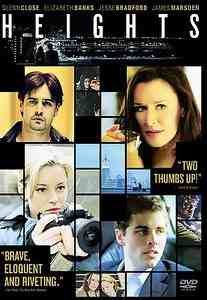
Heights Gives us a Glimpse at Glenn Close's Lady Macbeth

Heights. Dir. Chris Terrio. Perf. Elizabeth Banks, Glenn Close, James Marsden, and Rufus Wainwright.

Heights is a complicated, engrossing, disturbing film about the deterioration of relationships—and the problematic role past relationships can play in those relationships.

Glenn Close (who has her own Shakespeare street cred) plays an actress / teacher (IMDb suggests at Juilliard) / diva named Diana whose husband is having an affair and whose daughter is about to be married to a man who, from the opening few scenes, we think is not to be trusted.

The very opening of the film shows us her character as she critiques the performance two students are giving of "What beast was't then / That made you break this enterprise to me?" Although we're meant to dislike this character from the start, she does make a good point about letting the language work for you:


We are also privy to a bit of how Diana / Glenn Close would play Lady Macbeth (though it's interrupted with divaesque tangents):


Diana also peppers her everyday conversation with a few Shakespeare quotes here and there:


For those of you keeping score, the play in question is actually 1 Henry VI (though the film suggests that there's just one Henry VI, and no one ever reads it). At least she gives us the memorable quote "Shakespeare's worst is still better than anyone else's best." 

As a bonus for those who have read this far, there's a nifty Rime of the Ancient Mariner reference in the background conversation at a party:


The idea of a CGI albatross for a film version of Rime of the Ancient Mariner, but I also like the idea of the animal rights people being on the producer's back like an albatross around the neck of the Ancient Mariner.

To tell you more would be to provide spoilers, but I will mention that the image of Diana as Lady Macbeth pops up at multiple significant places in the film—usually as a bit of an advertisement for the play.  

Links: The Film at IMDB.

Click below to purchase the film from amazon.com
(and to support Bardfilm as you do so).

Book Note: The Secret Life of William Shakespeare

Morgan, Jude. The Secret Life of William Shakespeare. New York: St. Martin's Press, 2014.

This is one of the books I brought with me to pass the time in the various airports I needed to go through to get to Vietnam. But the problem was that this novel made the time hang more heavy on my hands instead. That's one reason I stuck a "Free Book!" note to the cover and abandoned it in the Tokyo airport.

The writing isn't terrible—it's just uninspired. Will wants to obey his father's sanction agains hanging out with players, but he can't help himself.

Later, he wants to obey his vows of fidelity to Anne, and he does for quite a while. And then he can't help himself.

And Anne wants to trust her husband.  And she does for a while.  But then she can't help herself, and she runs off to London.

Sensing a trend?

The novel fills in the gaps in the biographical record, but not very imaginatively.

The plays are also downplayed somewhat. I'd like to have more of the creative side explored.

Here's a page that will give you a sample of the writing. On this page, Shakespeare is still back in Stratford, feeling guilty about going to a play.


All in all, you'd be better off with Grace Tiffany's biographical Shakespeare novel (for which, q.v.).

Click below to purchase the novel from amazon.com
(and to support Bardfilm as you do so).

The First Day in Hanoi

Jones, Keith. A Series of Lectures on Shakespeare. Vietnam National University—Hanoi. 7-10 March 2016.

After too many hours of travel to count, I have arrived in Hanoi. The city is fabulous, the people are delightful, and the food is terrific.

I wandered around Hoàn Kiếm Lake today, soaking in the atmosphere and adjusting to the jet lag. I met an Australian couple and took their photo by the lake. They were amazed that I would travel so far to speak about Shakespeare.

I feel very much like the actor in A Dream in Hanoi who felt like catching up all of Hanoi in a net (for which, q.v.). In that clip, in fact, he's drawing the Turtle Tower in the lake that's just a stone's throw from my hotel.

An English teacher and her students asked if they could practice their English on me as I walked around the lake. When she heard that I was a Shakespeare scholar, she remembered having read Romeo and Juliet some time ago.

The students were interested in telling me the legend of Lê Lợi, the great hero of Vietnamese history. They told of his magic sword, his rallying the people, and his victories to establish independence, bringing Vietnam out of Chinese rule.  You can read more of his story over on Wikipedia.

Just as I started to tell them about Henry V, they said they had to go.

The lectures will start on Monday. Perhaps I'll be able to work in some of the story of Lê Lợi somewhere!


Tuesday, March 1, 2016

Shakespeare Lectures in Vietnam

Jones, Keith. A Series of Lectures on Shakespeare. Vietnam National University—Hanoi. 7-10 March 2016.


Last semester, I was invited by the Vietnam National University to come to Hanoi an lecture on Shakespeare. Thanks to a generous grant from the Faculty Development Committee of the  University of Northwestern—St. Paul, I was able to accept the invitation. In fact, I leave tomorrow morning at two o'clock a.m.

During the lectures, I hope to engage in field research about Vietnamese perspectives on and reactions to Shakespeare. I have prepared a series of questionnaires to distribute after my lectures; I hope to learn much and to start to refine my ideas of Shakespeare around the globe.

One question I have for the students is "Tác giả nào anh chị coi là Shakepspeare của Việt Nam? Tại sao?" For those of us who, like me, don't speak vietnamese, that translates to "Who would you consider the Shakespeare of Vietnam to be and why?" I'm not sure what answers that will elicit (though I think The Tale of Kieu is likely to come up somewhere), and that's fascinating.

I'll also be eliciting responses from the Vietnamese students and faculty members on how they would retell certain plays—Hamlet, for example—in a Vietnamese setting. The image above is of a graphic novel of Hamlet in Vietnamese that I'll use to help convey the narrative.

This will be a whirlwind tour, but I'll try to find time to update you, my alert readers, about what I learn—and I anticipate that it will be a very great deal.

Bonus for those who have read this far: A blurb—in Vietnamese—about Shakespeare!


Thursday, February 18, 2016

The St. Crispin's Day Speech in the Globe Production of Henry V

Henry V: Globe on Screen. Dir. Dominic Dromgoole. Perf. Jamie Parker, Brid Brennan, and Graham Butler. 2012. DVD. Kultur, 2013.

To conclude our brief series on St. Crispin's Day Speeches (should that be "St. Crispins' Day" or even "St. Crispins' Days" by this point?), let us head to the Globe Theatre.

No, not that one. That one burned down in 1613, silly, and I'm no Doctor Who (for whom, q.v.). Let's head to the New Globe Theatre, which has been producing more and more DVDs of its productions, allowing the Globe Theatre to come to those who find it hard to go to the Globe theatre.

As my students instantly recognized, this production pays more attention to the language of the speech than others do. It's still telling, moving speech, but it depends on the speech to do that—not on camera angles or soundtracks.

And it has a brief moment of humor—though I'm not sure it works. When Henry offers to put money in the purses of those who don't wish to fight, one soldier pretends to consider the offer. It gets a laugh, and the soldier clearly indicates that he's not seriously considering the proposition, but it also interrupts the flow of the speech, and the actor has a bit more work to do to get the momentum back again.


Links: The Film at IMDB.

Click below to purchase the film from amazon.com
(and to support Bardfilm as you do so).

Tuesday, February 9, 2016

The St. Crispin's Day Speech in The Wars of the Roses

Henry V. Dir. Michael Bogdanov. Perf. Ben Bazell, Roger Booth, and Philip Bowen. Wars of the Roses. 1991. DVD. Films for the Humanities & Sciences, 2005.

While we were in St. Crispin's Day vein, the students and I tried out the version provided by the War of the Roses series—I suppose you could call it the Hollow Crown of the early 1990s.

This version of the speech provides yet another take on Shakespeare's lines. I think they're still rousing—one of my contentions is that it's very difficult to deliver the lines in a way that lacks all inspiration (which didn't keep Babakitis from managing it in his 2007 version—for which, q.v.).

Rousing though it is, it finds its appeal in a different place. In this version, Westmoreland, who's "O that we now had here / But one ten thousand of those men in England / That do no work to-day! (IV.iii.16-18) initiates Henry's response, is shamed by Henry's overhearing the remark, and the rest of the speech is driven to shame him (and, perhaps, the others on stage) into willingness to fight:


I've never seen this motivation drive the speech . . . which isn't to say that the speech doesn't make me want to grab my longbow (or, in this version, my AK-47) and rush into the fray.

Links: The Series at IMDB.

Click to purchase
(or to have your library purchase)
the films from Films for the Humanities and Sciences.

Monday, February 8, 2016

Say Hello to Hal from The Hollow Crown

Henry V. By William Shakespeare. Perf. Edward Akrout, Tom Hiddleston, and Tom Brooke. Dir. Thea Sharrock. The Hollow Crown. Season 1, episode 4. BBC Two. 21 July 2012. DVD. Universal Studios, 2013.

Technically, I should have been following The Hollow Crown's broadcasts of Shakespeare's second tetralogy rabidly since 2012, but time has conspired to prevent me from doing so.

And, technically, I still haven't watched them. I know it's nearly heretical to say so, but I've dipped into The Hollow Crown's films and haven't been utterly compelled to shove everything else on my plate off onto the floor and devote every waking moment to the series.

But I was interested in exploring different versions of the St. Crispin's Day speech with my Shakespeare and film class, and my class and I both enjoy it when we're all looking at a film for the first or second time (rather than looking at a film I've seen two dozen times and they've never seen), so I determined to try a few I hadn't yet seen, and The Hollow Crown's Henry V was on the list.

I was impressed by the approach here, especially in contrast to Branagh's (for which, q.v.), Olivier's (for which, q.v.), and especially Babakitis—notable for being the absolute worst I've ever encountered (for which, if you can stomach it, q.v.).

Hiddleston's approach is understated but still very effective. His crowd is small, and the camera is nearly on a level with everyone (instead of privileging Henry, as in most versions). And the scene very nearly have no soundtrack—until we reach "band of brothers," at which point they just can't help themselves. Take a look:


My students were very adept at finding all sorts of interesting things to say about the clip, and it has convinced me that I should find the time to watch the films in their entirety.

Links: The Episode at IMDB.

Click below to purchase the film from amazon.com
(and to support Bardfilm as you do so).

Friday, February 5, 2016

Shakespearean Texts, Texted; or, Texting the Text of the Bard

Shakespeare, William, and Courtney Carbone. srsly Hamlet. New York: Random House Books for Young Readers, 2015.

Shakespeare, William, and Brett Wright. YOLO Juliet. New York: Random House Books for Young Readers, 2015.

Shakespeare, William, and Courtney Carbone. Macbeth #killingit. New York: Random House Books for Young Readers, 2016.

Shakespeare, William, and Brett Wright. A Midsummer Night #nofilter. New York: Random House Books for Young Readers, 2016.


I stumbled across a new series from Random House when browsing through my local bookstore the other day. It's called "OMG Shakespeare," and it retells four (so far) of the plays as text exchanges between the characters.

I'm a bit torn about these books. Clearly, I'm not in the center of the demographic for the books. There are also parts of them that are really bad—by which I suppose I mainly mean "uninteresting." But then there are also very clever ways of grappling with the problems that arise when presenting these stories in this medium. And the kids I've shown these to (kids that I've directed in multiple Shakespeare productions—so they know their Shakespeare, and they also know their Snapchats, their emojis, their Facebooks and Twitters, and their other social medias) really, really like them. They show each other certain pages or comments and they laugh hysterically.

I'll give you some examples from srsly Hamlet. At its worst, it becomes nothing more than a rebus—and even the kids who like these books acknowledge that it's inauthentic—they don't actually text that way. Here's Hamlet's "Get thee to a nunnery" speech:


That can be very tedious and annoying. But then the book will play with the form in a genuinely interesting way, bringing other forms of social media into play. Here are two two-page spreads as an example. First, Polonius gives his advice to Laertes. Then Laertes accidentally tells Ophelia in a group text to remember what he said, giving Polonius the opportunity to put his nose in. And don't fail to note the end of the sequence: Ophelia updates her relationship status Facebook-style.


There's some interest and some cleverness in that—and the idea is caught up again after the nunnery scene. Ophelia moves from "In a relationship" to "It's complicated" to . . . this:


The two reactions also show some depth of thought. Horatio is concerned—probably mostly for Hamlet, but also for Ophelia. Rosencrantz is a bit clueless—he just wants to make sure she'll be at the play-within-the-play.

I also very much—far too much, in fact—appreciated what happens to Ophelia when she goes mad:


I'm very likely to use that in future courses when we discuss the line "They aim at it / And botch the words up fit to their own thoughts” (IV.v.9-10). I'll invite students to see if they find any correlation between any of Ophelia's mad speeches / songs and the emojis here.

And it's remarkable how, when Laertes enters, having zipped back from Paris, we get the description "Laertes has checked into Elisnore Castle—with Huge Angry Mob," under which is the delightful message "Huge Angry Mob Likes This."


Finally (for that book), the kids were especially tickled by Fortinbras' entrance at the end of the play:


In YOLO Juliet, the emphasis is placed on the parents' (and other elders') inability to navigate the world of social media—often with humorous results. One prime example is Friar John's use of all caps—which amounts to shouting—is a sign of his incompetence. In the same exchange, you'll notice that Friar Lawrence initials each of his texts as if they were e-mails or memos:


Lady Capulet takes Friar Lawrence's failing one step further. She signs off each text as if it were the end of a letter. In the example below, she also inexplicably "likes" something Capulet is doing:


There are also a few other social media things thrown in with pop cultural references to round things out. Observe what Juliet decides to listen to (and the service she chooses to listen to it with) after the balcony scene:


The narrative ends as I imagine you would expect it to—according to Shakespeare. But if you're worried that it's a downer, think again:


In short, these books demonstrate some intriguing and imaginative uses of social media to tell the stories of Shakespeare—but there's a lot of tedious rebus-esque material there, too. I don't think they would be of much use (or very funny) to those who lack familiarity with the plays. But for those who do (and are in the right demographic), they appear to be a hoot.

Click below to purchase one (or all!) of the books from amazon.com
(and to support Bardfilm as you do so).

   
Bardfilm is normally written as one word, though it can also be found under a search for "Bard Film Blog." Bardfilm is a Shakespeare blog (admittedly, one of many Shakespeare blogs), and it is dedicated to commentary on films (Shakespeare movies, The Shakespeare Movie, Shakespeare on television, Shakespeare at the cinema), plays, and other matter related to Shakespeare (allusions to Shakespeare in pop culture, quotes from Shakespeare in popular culture, quotations that come from Shakespeare, et cetera).

Unless otherwise indicated, quotations from Shakespeare's works are from the following edition:
Shakespeare, William. The Riverside Shakespeare. 2nd ed. Gen. ed. G. Blakemore Evans. Boston: Houghton Mifflin, 1997.
All material original to this blog is copyrighted: Copyright 2008-2039 (and into perpetuity thereafter) by Keith Jones.

The very instant that I saw you did / My heart fly to your service; there resides, / To make me slave to it; and, for your sake, / Am I this patient [b]log-man.

—The Tempest