Thursday, August 18, 2011

Cate Blanchett's Disappointing Elizabeth I

Elizabeth: The Golden Age. Dir. Shekhar Kapur. Perf. Cate Blanchett and Geoffrey Rush. 2007. DVD. Universal Studios, 2008.

Elizabeth: The Golden Age answers the golden, age-old question of what would happen if you took a thrilling narrative, an immense budget, a number of top-notch actors and actresses, a lush soundtrack, and beautiful cinematography and tried to make it as bone-wearyingly boring as you possibly can.

We at Bardfilm try to be as positive as possible in our reviews. But this film is unforgivably dull.

That's particularly the case because it has so much working in its favor! How can the threat of the Spanish Armada possibly be made tedious? The history on which this is based is unbelievably interesting, but this film is dry as dust. And please note that I don't demand absolute historical accuracy in dramatic retellings of historical events—if I did, I wouldn't be able to enjoy any one of Shakespeare's ten history plays. But this film takes the exciting, non-stop drama of this part of Elizabeth's reign and slogs though it at a sloth's pace. It's ridiculously uninspiring.

The clip below shows one way they take the excitement of actual history and empty it of anything even mildly interesting. They take Elizabeth the First's great speech at Tilbury—it's the monarchical equivalent of Shakespeare's Henry V's speech before Agincourt—and re-write it so that it has none of the fire and splendor of the original:


What a mess. The soldiers aren't cheering at what she says; they're simply cheering because they think that she's done talking absolute drivel. Here's what Elizabeth the First actually said, on August 8, 1588, to the troops at Tilbury as they gathered to face the overwhelming force of the invading Spanish fleet:
My loving people . . . I am come amongst you, as you see, at this time, not for my recreation and disport, but being resolved in the midst and heat of the battle, to live or die amongst you all, to lay down for my God and for my kingdom, and for my people, my honour, and my blood, even in the dust. I know I have the body but of a weak and feeble woman, but I have the heart and stomach of a king, and of a King of England, too. (Somerset 464)
For dramatic effect, that has been pared down slightly from the complete speech (which I print in full below)—and I have no doubt that, had Cate Blanchett been allowed to deliver those lines instead of the mindless schlock they gave her to say, the film would have benefited immeasurably.

Let Blanchett speak these lines—or just give her the St. Crispian's Day speech! Either would be inexpressibly superior to the lines they actually gave her.

Here, to provide the complete historical record, is the speech in its entirety:
My loving people. We have been persuaded by some that are careful of our safety, to take heed how we commit ourself to armed multitudes for fear of treachery; but I assure you, I do not desire to live to distrust my faithful and loving people. Let tyrants fear. I have always so behaved my self, that under God, I have placed my chiefest strength and safeguard in the loyal hearts and goodwill of all my subjects, and therefore I am come amongst you, as you see, at this time, not for my recreation and disport, but being resolved in the midst and heat of the battle, to live or die amongst you all, to lay down for my God and for my kingdom, and for my people, my honour, and my blood, even in the dust. I know I have the body but of a weak and feeble woman, but I have the heart and stomach of a king, and of a King of England, too, and think foul scorn that Parma or Spain, or any Prince of Europe should dare to invade the borders of my realm; to which, rather than any dishonour shall grow by me, I myself will take up arms, I myself will be your general, judge and rewarder of every one of your virtues in the field. I know already for your forwardness, you have deserved rewards and crowns; and we do assure you, in the word of a Prince, they shall be duly paid you. (Somerset 464)

Works Cited

Somerset, Anne. Elizabeth I. New York: St. Martin’s Press, 1991.

Links: The Film at IMDB.

Click below to purchase the film and the book from amazon.com
(and to support Bardfilm as you do so).


Tuesday, August 16, 2011

The Private Lives of Elizabeth and Essex—and of Shakespeare

The Private Lives of Elizabeth and Essex. Dir. Michael Curtiz. Perf. Bette Davis, Errol Flynn, Vincent Price, Donald Crisp, Alan Hale, and Olivia de Havilland. 1939. DVD. Warner Home Video, 2005.

I watched this film some time ago, more as a curiosity about how the times of Shakespeare were portrayed in film in the 1930s than anything else. I found it to be wonderful and terrible in equal measure. I chose the three clips below to illustrate that.

Bette Davis plays Queen Elizabeth with power and grandeur. But the Elizabeth she is asked to portray—at least in the romantic, behind-the-scenes scenes with Essex—is sappily and ridiculously (not to mention unhistorically) romantic. Errol Flynn is good as Essex—he's lovely at flying into rages. But the romantic side of him is sentimental rather than swashbuckling.

The Queen's entrance is nicely done: though it's not meticulous about period furnishings, costumes, or attitudes, it provides a sense of grandeur to the royal personage.

The film also provides an interesting twist on the story of Queen Elizabeth's reaction to a performance of Richard II. In 1601, Shakespeare's company was paid to put on a production of Richard II the day before a failed insurrection. The play addresses the successful deposition of an unpopular monarch, and the theory is that the leaders of the insurrection (the Earl of Essex and his crowd) thought that the play would rally the people to their cause—or, at least, give them courage to go through with a dangerous and deadly—and, for Essex and many others, fatal—operation. Afterwards, in extreme pique, Her Majesty purportedly said, "I am Richard—know ye not that?"

In this clip. Her Majesty is much more laid-back about the situation, chiding Lord Burghley, one of her advisors, for censoring "Master Shakespeare and his players without consulting me."


Finally, yes, that is Vincent Price, lurking in the background, playing Sir Walter Raleigh, looking guilty at having intercepted the letters Elizabeth and Essex wrote each other during Essex's Irish campaign. I knew you'd recognize him!

Links: The Film at IMDB.

Click below to purchase the film from amazon.com
(and to support Bardfilm as you do so).

Thursday, August 11, 2011

Inspector Lewis and The Merchant of Venice

“Quality of Mercy.” By Alan Plater. Perf. Kevin Whately, Jo Herbert, Bryan Dick, and Ronan Vibert. Dir. Bille Eltringham. Inspector Lewis. Season 3, episode 2 [also listed as Season 2, episode 6]. BBC. 29 March 2009. DVD. PBS, 2010.

Mysteries invoking Shakespeare are often difficult to write about. Being analytical without giving spoilers is difficult.

Bardfilm circumvents that difficulty by, in this instance at least, being merely informative! An episode of Inspector Lewis is set among a small theatre troupe putting on The Merchant of Venice. Would anyone care to speculate on the murder weapon? In any case, the episode itself is well done (although the themes of the Shakespeare play aren't integrated into the show itself to any great degree). Here's the opening sequence, which shows the director being perhaps a bit too harsh on the actors. Enjoy!


Links: The Episode at IMDB.

Click below to purchase the entire run of the show from amazon.com
(and to support Bardfilm as you do so).

Tuesday, August 9, 2011

Romeo and Juliet: The Rock Opera

Rockin' Romeo and Juliet. Dir. David McGaw. Oto Brezina, Stephen Burr, and Tristan Creeley. 2006. Chockablock Productions, 2006.
A theme of obscure and odd Romeo and Juliet-related material seems to be inadvertently developing. To follow that trend a bit further, I'll draw our collective attention to the trailer for a weird (not "Wëird Sisters" weird—just weird weird) film titled Rockin' Romeo and Juliet.

In it, the rock bank OGGI (or a rock band played by OGGI—it's not made clear) is "Transported through time to rock with Shakespeare."

It looks pretty bad, and the announcer on the trailer below sounds like he's embarrassed by what he's saying—he really doesn't sell the film at all!


Links: The Film at IMDB.

Thursday, August 4, 2011

A Return to the Romeo and Juliet Monkeys

Romeo and Juliet: A Monkey’s Tale. Dir. Karina Holden. Perf. Tim Hopper and Thousands of Monkeys. 2007. DVD. Animal Planet, 2008.

When I first wrote on this film, I was a bit dismissive (for which, q.v.). I'm still pretty dismissive, but now I have a video clip to back up my dismissiveness!

Actually, the film isn't bad. It's an intriguing way of telling us about these amazing monkeys—it draws in the double audience of naturalists and Shakespeareans, and, I suppose, Shakespearean naturalists—though that sounds a bit like a nudist colony headed by King Lear ("Come, unbutton here . . .").

The clip below will give you a sense of what happens when you take the gnomes, the seals, the sparrows and pigeons, and all the other animated entities out of Romeo and Juliet. What remains is the basic story—with monkeys!


Links: The Film at IMDB.

Click below to purchase the film from amazon.com
(and to support Bardfilm as you do so).

Tuesday, August 2, 2011

A Few Thoughts on Rosencrantz & Guildenstern are Undead

Rosencrantz & Guildenstern are Undead. Dir. Jordan Galland. Perf. Jake Hoffman and Devon Aoki. 2009. DVD. C Plus Pictures / Indican, 2010.

My hopes were high for this film. When I first learned about it—back in 2008, no less (for which, q.v.)—I was skeptical, but, as the release date was pushed back and pushed back, I became more and more entranced.

Perhaps because my hopes were so high, watching the film itself was a little bit of a letdown. It's wasn't a big bit of a letdown—just a little bit of one.

The film is bizarre and certainly worth seeing, but I wish its engagement with the text of Hamlet and Tom Stoppard's play was deeper. Still, there are some wonderful things about it.

The story it tells is one of an out-of-work director who is hired to direct a strange derivative version of Hamlet—one with vampires and other oddities. Some of the cast members are also vampires, including something of an evil-twin version of Horatio. Oh, and they're all searching for the Holy Grail. One of the best parts involves the summoning, during opening night, of the actual Hamlet on whom all the stories (Shakespeare's included) have been based—and he's a complete, unloveable ham. The characters playing Rosencrantz and Guildenstern are also wonderfully realized, as you can see in the clip below (which also includes a few other bits and pieces to give you a feel for the entire film):


Clearly, you should all see this film—even if it doesn't provide much fodder for a Shakespeare and Film class or a scholarly essay, it will entertain.

Links: The Film at IMDB.

Click below to purchase the film from amazon.com
(and to support Bardfilm as you do so).

Friday, July 22, 2011

A Time to Love: Romeo and Juliet in China

A Time to Love [Qing ren jie]. Dir. Jianqi Huo. Perf. Wei Zhao and Yi Lu. 2005. DVD. N.p., 2009.

For five brain-packing weeks, the attendees of this year’s Folger Summer Institute studied under the general title “Shakespeare: From the Globe to the Global.” We intensely and deeply explored innumerable aspects of the world in Shakespeare’s day and Shakespeare in today’s world. Of particular interest to my own professional and informal writing was the time we spend on Asian Shakespeares.

A Time for Love was not one of the films we discussed, but the general apparatus we were in the process of developing increased my own understanding of the film and expanded my ability to discuss it.

To call A Time for Love a Chinese version of Romeo and Juliet does both works a disservice, belittling the later by suggesting that it can be easily and uncritically transferred into another time and culture and belittling the former by squeezing it into a box that is far too small to contain it.

The film certainly starts with the general Romeo and Juliet idea. Our Romeo analogue falls for our Juliet analogue; we learn that his mother objects to the match because of something obscure and mysterious that her father did. I’m trying to be careful not to provide spoilers in this post because the film is tremendous, and you should all see it, but the film itself leaves this point unsettled for a considerable period.

While those who are familiar with the play start to recognize elements from it in the film, the protagonists themselves start to find their own story in Romeo and Juliet. Here’s a brief scene in which we watch them watch some of the 1968 Zeffirelli Romeo and Juliet:


These Chinese characters in a Chinese film are trying to find an analogous story for their lives in a classic Western text at the same time as a Western audience is trying to find analogies in the characters' lives to the same classic Western text.

And that’s where I have to stop. The film, from that point forward, critiques the entire idea of the East turning to the West for explanations of its identity—not by discounting it out-of-hand but by questioning the wisdom of such an effort and by contemplating what is wise and what is foolish about such an endeavor.

In watching A Time for Love, I find the reverse happening. The West looks to the East for explanations of Romeo and Juliet and finds both wisdom and folly—but mostly wisdom.

Links: The Film at IMDB.

Thursday, July 21, 2011

Before Gnomeo and Juliet, there was Romeo and Juliet: Sealed with a Kiss

Romeo and Juliet: Sealed with a Kiss. Dir. Phil Nibbelink. Perf. Daniel Trippett, Tricia Trippett, and Chip Albers. 2006. DVD. Indican , 2007.

I'm sure Shakespeare Geek will be among the first to point out that he mentioned this film in 2006. He's always cutting edge, and I'm always limping along behind.

All the same, I often—eventually—get there. This time, when I got there, I found seals performing a musical version of Romeo and Juliet.

Although I want to enjoy and recommend this film unreservedly, it tends to be too sentimentalized. The clip below—the balcony scene—will give some indication of that, though it will also give a slight flavor of the comic relief into which Mercutio and Benvolio have been turned. You will also notice that the usual joke—is it a joke here?—about "wherefore" meaning "where" instead of "why" is brought up twice. Mercutio says "Wherefore art thou Romeo?" while searching for Romeo, but (to give him and the scriptwriter the benefit of the doubt), he isn't necessarily using it to mean "where." He may just be quoting a line or pondering why Romeo is behaving as he is. Later, Juliet's balcony speech is paraphrased, and she says "Where are you, my Romeo?" and Romeo responds with a prompt "I'm right here!" I think I'm right in saying that this strikes right at the nerve of a pet peeve for most Shakespearians. And it's completely unnecessary in this case! If you're paraphrasing anyway, wherefore would you not have Juliet say "Why are you Romeo?"

But that's something of a digression, and the film doesn't stand or fall on that line. Indeed, a number of moments—particularly some of the comic songs—are delightful, and, as a basic introduction to the plot of the play, Romeo and Juliet: Sealed with a Kiss isn't terrible.

As promised, here's the balcony scene. I break the clip off right before the sappy song starts but right after the visual allusion to "star-crossed lovers" lights up the sky.


Links: The Film at IMDB.

Click below to purchase the film from amazon.com
(and to support Bardfilm as you do so).

Tuesday, July 19, 2011

Macbeth: Something Robotic This Way Comes

CGI Macbeth. Dir. Daniel Gallagher. Perf. Kevin McLeod and LibriVox. Bright Red Productions, 2011.
The alternate title for this post is "Do Androids Dream of Daggers that They See Before Them, the Handles Toward Their Hands?" The second alternate is "I, Robot Macbeth."

A new version of Macbeth may be coming, and I owe my knowledge of it to Shakespeare Geek. The twist this time involves an all-robot cast. Shakespeare's text will be retained, though the setting will be altered to "a Cyber Scotland," according to Daniel Gallagher, its creator.

Perhaps I'm particularly interested in this because I recently spent some time on "Foul Whisperings, Strange Matters," a Macbeth-related location in Second Life—and I didn't care for it very much. CGI Macbeth will provide a more interesting, much more complete virtual Macbeth.

But it's also possible that casting the play with robots provides a commentary on the play itself. Does this provide us with a "Six Robots in Search of an Author" scenario? Or does it comment to a greater degree on the way in which the characters are bound to their fates? Although the preliminary trailer (see below) provides us with a glimpse of the witches, the way they're used isn't yet clear. What if they were portrayed as computer programmers?


The project does need funding in order to get off the ground in earnest. If you're feeling particularly philanthropic—or just pro-robotic—head to the Kickstarter.com page for the project. With as little as a ten dollar donation, you can receive a copy of the film once it reaches its completion.
Links: An article on the project. The project's funding page at Kickstarter.com.

Update: The film was made!

Click below to purchase the book from amazon.com
(and to support Bardfilm as you do so).

Thursday, July 14, 2011

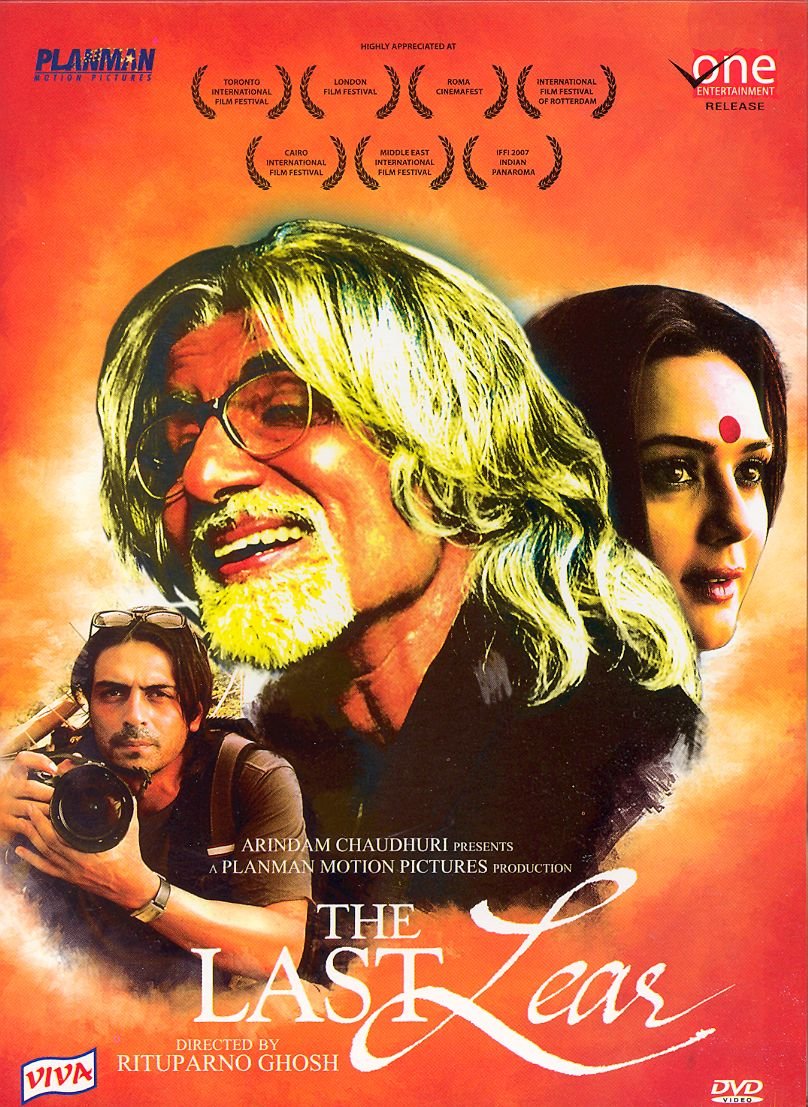
King Lear and The Tempest in The Last Lear

The Last Lear. Dir. Rituparno Ghosh. Perf. Amitabh Bachchan, Preity Zinta, and Arjun Rampal. 2007. DVD. V One, 2008.

And the last Lear post in this brief Lear sequence is The Last Lear. The film is Indian, and it centers on the relationship between an aging actor and an aspiring director.

In the scene below, the director tries to convince the actor to play a role in his latest film:


Beautifully shot, wonderfully acted, and deeply delivered, The Last Lear is a high point of Indian engagement with Shakespeare.

Links: The Film at IMDB.

Click below to purchase the film from amazon.com
(and to support Bardfilm as you do so).

Tuesday, July 12, 2011

House of Strangers as a Derivative of King Lear

House of Strangers. Dir. Joseph L. Mankiewicz. Perf. Edward G. Robinson, Susan Hayward, and Richard Conte. 1949. DVD. Twentieth Century Fox, 2006.

House of Strangers is a derivative of King Lear where three of four sons (instead of two of three daughters) take over their father's kingdom. In this film, the kingdom is a bank, and the king (Gino Monetti, the bank's director) doesn't willingly divide his kingdom. Instead, his kingdom is divided for him when he stands trial for unethical practices.

Here's a scene from early in the film where the father's authority (as well as his questionable business practices) are foregrounded:


Does it seem less horrible to have sons (rather than daughters) reject their father? Does it make a difference to set that rejection in the Italian-American community?

Links: The Film at IMDB.

Click below to purchase the film from amazon.com
(and to support Bardfilm as you do so).


This is a bonus image. The Lear analogue is asking what he should do when he's thrown out of the bank. One of his sons tells him, "You're an old man. Buy peanuts."

Thursday, July 7, 2011

King Lear in The Madness of King George

The Madness of King George. Dir. Nicholas Hytner. Perf. Nigel Hawthorne, Helen Mirren, and Ian Holm. 1994. DVD. MGM, 2001.

I think I've gathered enough material for a few posts on the use of King Lear in films that aren't King Lear.

The first of them comes from a pair of alert readers. They let me know that there's a scene in The Madness of King George in which King Lear plays a prominent role. When films are made about British Kings, Shakespeare has to be there (cf. The King's Speech, for which, q.v.).

This scene is very nicely layered and quite moving. The mad king (recovering a bit from his madness at this point in the film) plays Shakespeare's greatest mad king (also recovering a bit from his madness at this point in the play).


Links: The Film at IMDB.

Click below to purchase the film from amazon.com
(and to support Bardfilm as you do so).

Tuesday, July 5, 2011

A Return to Shakespeare in MST3K

“Hamlet.” By Joel Hodgson and Paul Chaplin. Perf. Kevin Murphy, Michael J. Nelson, Mary Jo Pehl, Bill Corbett, and Patrick Brantseg. Dir. Kevin Murphy. Mystery Science Theater 3000. Season 10, episode 9. Sci-Fi Channel. 27 June 1999. DVD. Rhino Theatrical, 2003.

During the course of my Literature of Humor class, I had cause to mention Mystery Science Theater 3000 and its Hamlet episode. I wasn't terribly impressed (for which, q.v.), but a student urged me to try it again. "It's brilliant," she insisted.

I still won't go that far, but I remember two parts that really are quite brilliant. One comes from the film itself—the closing title card (pictured above), which seems to insist—somewhat desperately—that the film we just saw really was Hamlet. Really!

The second is a one-word comment made by one of the film's viewers to accompany a gesture Hamlet makes. It's actually the funniest moment in the episode, and I'm sorry I didn't include it in my earlier "brilliant gems" clip:

Whatever!

That, at least, is brilliant.

Links: The Film at IMDB.

Click below to purchase the film from amazon.com
(and to support Bardfilm as you do so).

Thursday, June 30, 2011

Shakespeare on The News Hour

The Best of MacNeil / Lehrer: Shakespeare on the News Hour. DVD. MacNeil / Lehrer Productions, 2007.

The connections between Shakespeare and The MacNeil / Lehrer News Hour are not limited to Robert MacNeil's terrific appearance in the Almereyda Hamlet (for which, q.v.). A DVD containing six stories The News Hour did on Shakespeare-related subjects was released in 2007:
  1. "The Heart of My Mystery" (15 January 1996), in which scholars are interviewed on the then-newly-discovered (and since fairly-conclusively debunked) "Funeral Elegy by W. S.," thought at the time, through the miracle of computer analysis, to be by Shakespeare.

  2. "Much Ado" (23 January 1997), in which Charlton Heston, Michael Kahn, and David Kastan are interviewed about the revival of interest in Shakespeare—particularly on film—brought about by the Kenneth Branagh Hamlet.

  3. "The Play's the Thing" (21 June 2001), in which the Denver Public School System's Spring Shakespeare Festival is profiled.

  4. "Brushing Up Their Shakespeare" (26 September 2002), in which The Academy for Classical Acting's approach to teaching how to play Shakespeare is examined.

  5. "An American Falstaff: Kevin Kline" (7 January 2004), in which Kevin Kline is interviewed on that role

  6. "Re-Learning Shakespeare" (27 December 2005), in which Shakespeare's Globe Theatre is covered—Mark Rylance is interviewed.
Of these, the most interesting are the interviews with the actors. Here's a clip from Charlton Heston's interview (he makes the case for Shakespeare and Film):


Kevin
Kline's interview is more significant for the clips it provides of his Falstaff than for his commentary (though his commentary is not to be scorned at all). Here he is, as plump Jack:


All in all, the stories are fascinating, and I'm indebted to my library for buying them for all its patrons to share!

Tuesday, June 28, 2011

Acting Shakespeare; or, Ian McKellen Goes Solo

Acting Shakespeare. Dir. Kirk Browning. Perf. Ian McKellen. 1982. DVD. E1 Entertainment, 2010.

Some years after Playing Shakespeare started, Ian McKellen (Sir Ian to us now) put on a one-man show in which he delivers the greatest hits of Shakespeare along with anecdotes and commentary.

The show is intriguing, more as an avenue of insight into attitudes on Shakespeare in the 1980s than anything else. Sir Ian is charming, but the anecdotes are a bit dated, and he has a tendency to take us very deeply into a character or a speech—and then to release us with an off-hand joke that somewhat deflates the atmosphere rather than relieving the tension.

Still, it's impossible to critique McKellen's acting. It's really quite marvelous.

Here's a place where his instruction and his acting come together best. He explicates Macbeth's "Tomorrow, and tomorrow, and tomorrow":


Links: The Film at IMDB.

Click below to purchase the film from amazon.com
(and to support Bardfilm as you do so).

Bardfilm is normally written as one word, though it can also be found under a search for "Bard Film Blog." Bardfilm is a Shakespeare blog (admittedly, one of many Shakespeare blogs), and it is dedicated to commentary on films (Shakespeare movies, The Shakespeare Movie, Shakespeare on television, Shakespeare at the cinema), plays, and other matter related to Shakespeare (allusions to Shakespeare in pop culture, quotes from Shakespeare in popular culture, quotations that come from Shakespeare, et cetera).

Unless otherwise indicated, quotations from Shakespeare's works are from the following edition:
Shakespeare, William. The Riverside Shakespeare. 2nd ed. Gen. ed. G. Blakemore Evans. Boston: Houghton Mifflin, 1997.
All material original to this blog is copyrighted: Copyright 2008-2039 (and into perpetuity thereafter) by Keith Jones.

The very instant that I saw you did / My heart fly to your service; there resides, / To make me slave to it; and, for your sake, / Am I this patient [b]log-man.

—The Tempest