Tuesday, May 5, 2015

A Shakespeare Poem by Rita Dove

Dove, Rita. "Shakespeare Say." Museum: Poems. Pittsburgh: Carnegie-Mellon University Press, 1983. 33-34.

I've been wanting to continue in the vein of African-American poets writing with Shakespeare in mind, but end-of-the-semester madness has intervened. Still, I'm determined to call our collective attention to a couple poems by Rita Dove, U.S. Poet Laurate from 1993 to 1995.

"Shakespeare Say" was published ten years before Dove became poet laureate. I don't have too much in the way of explication of the poem, but I enjoy the feel of the poem—I feel some Langston Hughes here, though not in the imagery from German—and I'm very fond of these lines: "Shakespeare say / man must be / careful what he kiss / when he drunk" (41-44). The last few lines of the poem are also pretty magnificent.

Without much ado, here's Rita Dove's "Shakespeare Say."
Rita Dove (1952—     )

Shakespeare Say

He drums the piano wood,
crowing.

Champion Jack in love
and in debt,
in a tan walking suit
with a flag on the pocket,
with a red eye
for women, with a
diamond-studded
ear, with sand
in a mouthful of mush—

poor me
poor me
I keep on drifting
like a ship out
on the sea


That afternoon two students
from the Akademie
showed him the town.
Munich was misbehaving,
whipping
his ass to ice
while his shoes
soaked through. His guides
pointed at a clock
in a blue-tiled house.
And tonight

every song he sings
is written by Shakespeare
and his mother-in-law.
I love you, baby,
but it don’t mean
a goddam thing
.
In trouble

with every woman he’s
ever known, all of them
ugly—skinny legs, lie gap
waiting behind the lips
to suck him in.

Going down slow
crooning Shakespeare say
man must be
careful what he kiss
when he drunk
,
going down
for the third set
past the stragglers
at the bar,
the bourbon in his hand
some bitch’s cold
wet heart,
the whole joint

stinking on beer;
in love and winning
now, so even the mistakes
sound like jazz,
poor me, moaning
so no one hears:

my home’s in Louisiana,
my voice is wrong
I’m broke and can’t hold
my piss;
my mother told me
there’d be days like this
.

Click below to purchase Museum: Poems from amazon.com
(and to support Bardfilm as you do so).

Tuesday, April 14, 2015

“Shakespeare was a Black Woman”: Maya Angelou's Statement in Context

Angelou, Maya. "The Role of Art in Life." [Transcript of address given to the National Assembly of Local Arts Agencies Convention in Cedar Rapids, Iowa, 12 June 1985.] Connections Quarterly September 1985: 14+.

On multiple occasions, I've read that Maya Angelou said, “Shakespeare was a Black Woman,” but I was never able to track down the full context of that statement.

Let's hear it for Reference Librarians again! Although this was a bit of a knotty problem to unravel, a reference librarian at my institution was able to find the address in which she made that statement (or at least the largest extraction from that address I've seen).

The context it provides is very interesting. Maya Angelou voluntarily refrained from speaking from age seven to age twelve. A woman of the town took it on herself to read to Angelou:
She knew I loved poetry. I had James Weldon Johnson, County Cullen, Langston Hughes, and Paul Lawrence Dunbar at the tip of my tongue. I loved Shakespeare—I didn't understand that much, I but I loved it. I would record whole scenes and plays, and all the sonnets I could just choke down. (14)
This woman encouraged Angelou to speak by telling her that she would never truly love poetry unless she could speak it out loud. Eventually, Angelou determined to do a "rendition" at a church meeting:
. . . at twelve-and-a-half, I had my voice back, and I decided I would render a rendition. In the CME Church in Stamps, Arkansas, I decided that I would render Portia's speech from The Merchant of Venice. That | would get them. That would knock them right off their pews—I could see myself doing it: "The quality of mercy" (pause) "is not strained. It droppeth" (long pause) "As a gentle rain—" I had it choreographed; it was going to be fantastic. But then, mama asked me, "Sister, what are you planning to render?" So I told her, "A piece from Shakespeare, Mama." Mama asked, "Now sister, who is this very Shakespeare?" I had to tell her that Shakespeare was white. And Mama felt the less we said about whites, the better, and if we didn't mention them at all, maybe they'd just get up and leave. I couldn't lie to her, so I told her, "Mama, it's a piece written by William Shakespeare who is white, but he's dead. And has been dead for centuries." Now, I thought then she would forgive him that little indiosyncracy [sic]. Mama said, "Sister, you will render a piece of Mister Langston Hughes, Mister County Cullen, Mister James Weldon Johnson, or Mister Paul Lawrence Dunbar. Yes ma'am, little mistress, you will."

Well, I did. But years later, when I physically and psychologically left that country, that condition, which is Stamps, Arkansas, a condition I warrant, regrettably, that a number of people in this very room abide today, I found myself, and still find myself, whenever I like stepping back into Shakespeare. Whenever I like, I pull to me. He wrote it for me. "When in disgrace with fortune in [sic] men's eyes / I all alone beweep my outcast state / and trouble deaf heaven with my bootless cries / and look upon myself and curse my fate / wishing me like to one more rich in hope / featured like him, like him with friends possessed / desiring this man's art and that man's scope / with what I most enjoy contented least. . . ." Of course he wrote it for me; that is a condition of the black woman. Of course, he was a black woman. I understand that. Nobody else understands it, but I know that William Shakespeare was a black woman. (28)
It's fascinating to hear Angelou's account of her engagement with Shakespeare—and I dearly wish she had given the Portia speech. Angelou was able to find in Shakespeare her own voice: The voice of a black woman.

I'm including images of the entire article below so that you all can enjoy the full context of Angelou's words. Click on the images to enlarge them.


Thursday, April 2, 2015

The Play Shakespeare in Harlem—Based on Poems by Langston Hughes

Glenn, Robert. Shakespeare in Harlem. Adapted from poems by Langston Hughes. N.p.: N.p., n.d.

In a recent post on a poem entitled "Shakespeare in Harlem" in a volume entitled Shakespeare in Harlem (for which, q.v.), I pondered the question of a play entitled Shakespeare in Harlem.

Let me preface the rest of the post with this statement: Librarians are Amazing.

A careful reader of Bardfilm asked me about a statement in James Shapiro's volume Shakespeare in America (for which, q.v.). The introduction to the poem "Shakespeare in Harlem" concludes by saying,
A short, lyrical play by Hughes, also called "Shakespeare in Harlem," and which also riffs on As You Like It (taking as its frame the famous speech about the Seven Ages of Man but turning it into "a man's blues have seven ages") was staged in New York in 1960. (450)
Having run into dead ends in my own research (which wasn't actually all that shabby), I turned the question over to a reference librarian at my institution. She was able to find out the following information:

Shakespeare in Harlem was a play composed by a white playwright named Robert Glenn. According to Gospel Plays, Operas, and Later Dramatic Works, volume six of The Collected Works of Langston Hughes,
Hughes wrote Mister Jazz as an opener for the Broadway production of Shakespeare in Harlem, a one-act play derived from his poetry by a young white playwright, Robert Glenn. So successful was the August 1959 production of Shakespeare in Harlem in Lucille Lortel's White Barn Theater in Westport, Connecticut, that she brought it to her Theatre de Lys in Greenwich village for one night, October 27, 1959, pairing it with Hughes's Soul Gone Home. The Broadway production, at the 41st Street Theater, was paired with a dramatic rendition of James Weldon Johnson's God's Trombones. It lasted only thirty-two performances despite good reviews. It seems that Mister Jazz has never been performed, Alvin Hayley expressed interest in it as a ballet libretto. (246)
The reference book Off Broadway Musicals, 1910-2007: Casts, Credits, Songs, Critical Reception and Performance Data of More Than 1,800 Shows provides a cast list:

Jay Riley (Narrator), John McCurry (Blues Man, Preacher), Alma Hubbard (Alberta K. Johnson), Ted Butler (Old Man), Calden Marsh (Young Man), Frank Glass (Cat, Killer Boy), Richard Ward (Sick Man, Bartender), Isabel Sanford (Girl in Bar), Royce Wallace (Chippie). (401)

It also interestingly notes that, "On February 3, 1977, the AMAS Repertory Theatre presented the Off Off Broadway production Come Laugh and Cry with Langston Hughes, a new version of Shakespeare in Harlem which was adapted by Rosetta LeNoire and Clyde Williams" (401).

The 13 February 1960 edition of the Daytona Beach Morning Journal has this review:


Interestingly, the "Cat, Killer Boy" of the cast list has become "the cat killer boy of modern juvenile gangs" in the review.

There's a longer review by Brooks Atkinson in the New York Times from 10 February 1960. It includes these paragraphs:
An old man, sitting on a curbstone, ponders the problem of migration to Harlem from the South and the West Indies. A jovial madam recalls the series of worldly misfortunes that have driven her out of respectable businesses. A college student wonders if he can communicate his private hopes and thoughts to a white instructor. A Harlem man whose girlfriend has left him tries to convince himself that he is happier alone.

There are four or five other vignettes in rhyme--all of them small, none of them dazzling. Mr. Hughes seems to be sitting alone, reflecting on the heedless life that pours through the streets, bars and tenements around him. If he were a bitter man, the reflections would be full of passion.
A more detailed account of the play's origin can be found in Lucille Lortel: The Queen of Off-Broadway (New York, Limelight Editions, 2004):
In Dallas [Glenn] had directed the Little Theatre, one of the first African-American theatre groups there. "I couldn't find scripts for them," he recounted, "so I put some of Langston Hughes' poetry, some music and called it Shakespeare in Harlem," a title borrowed from one of Hughes' books of poetry. (156)
The description continues on page 157:


From this we learn that the play was made up of more than poems from Hughes' 1942 volume Shakespeare in Harlem. It contains "Theme from English B," which appeared in the 1951 volume Montage of a Dream Deferred. It also contains (as is stated outright) an ending from that volume. The ending comes from the poem "Good Morning" (pages 426-27 of The Collected Poems of Langston Hughes):


All of that is completely fascinating. But where's the script?

The answer is . . . I don't know—yet.

The New York Public Library wrote back to say that
. . . folder 17, in box 26 does contain an excerpt which was performed at the 20th Anniversary Gala, ANTA Matinee Series, Theatre de Lys (New York, N.Y.) [held on 1 December 1975]. The format appears to be poetry set to characters in play form. Although we have programs and clippings from productions of the piece, that is the only script to be found.
From here, it's a matter of going to the NYPL and asking for Box 26, Folder 17 of the Lortel Papers in the Billy Rose Theatre Division. A list of its contents can be found right here. If any enterprising reader in the New York City area is up to the investigation, I'd welcome a report! Otherwise, it looks like I could obtain a copy of the material for $25 to $35—but I'm out of funds for the year. When the new fiscal year starts (on August 1), I will be able to resume the search and find out, as best I can, the specific contents of Langston Hughes' poetry as adapted by Robert Glenn into Shakespeare in Harlem.

Thanks very much to the Berntsen Library at the University of Northwestern—St. Paul and to one reference librarian in particular. If it weren't for her good, hard work, I wouldn't know any of this.

Update: The Library also has a budget for inter-library loan items like this one! Thanks again, Berntsen Library! Readers, I'll keep you informed about the research progress.

Click below to purchase The Collected Poems of Langston Hughes from amazon.com
(and to support Bardfilm as you do so).

Wednesday, April 1, 2015

More Fools of April in the Renaissance: What do “Bunny Ears” Mean?

Shakespeare, William. As You Like It. [Arden Shakespeare, Second Series.] Ed. Agnes Latham. London: Routledge, 1975.

In Act IV, scene i of As You Like It, Rosalind (disguised as a man going under the name of Ganymede, but pretending to be Rosalind—long story) and Orlando share the following exchange:
Rosalind: Nay, and you be so tardy, come no more in my sight: I had as lief be wooed of a snail.

Orlando: Of a snail?

Rosalind: Ay, of a snail; for though he comes slowly, he carries his house on his head; a better jointure, I think, than you make a woman: besides he brings his destiny with him.

Orlando: What's that?

Rosalind: Why, horns, which such as you are fain to be beholding to your wives for: but he comes armed in his fortune and prevents the slander of his wife.

Orlando: Virtue is no horn-maker; and my Rosalind is virtuous. (IV.i.49-61)
This demonstrates one example (of a hundred thousand) of the "horns of the cuckold" joke. The English Renaissance Stage could not get enough jokes about cuckolds. The idea is that a cuckold (a husband whose wife has been unfaithful to him) had invisible horns. Hilarious.

The following image shows George Lucas giving "bunny ears" to Steven Spielberg:


What's the connection? Well (without intending to cast any aspersions on either the former or the current Mrs. Spielberg), the gesture indicates that he has the horns of a cuckold.

I don't suppose that most people realize they're issuing a pretty severe insult whenever they make "bunny ears" in a photo. And, on April First, I don't suppose you really believe that there's a connection between the two.

Perhaps two paintings (one of which seems to be a reimagining of the former) will serve to convince you. Here, a particular character in the Commedia Dell'Arte is given the horns of the cuckold in a manner very similar to the way Lucas is giving them to Spielberg:


A Scene from the Commedia Dell'Arte, c. 1580


François Bunel,  Actors of the Commedia Dell'Arte (c. 1590s)—Detail

The gesture has remained, though its meaning has largely been lost to the mists of obscurity. But remember it the next time you're tempted to give someone "bunny ears" in a photograph—it has a long and dignified history.  Well, it has a long history, at least.

Click below to purchase the Arden edition of the play from amazon.com
(and to support Bardfilm as you do so).

Renaissance April Fools: The Good Old "We Three" Joke

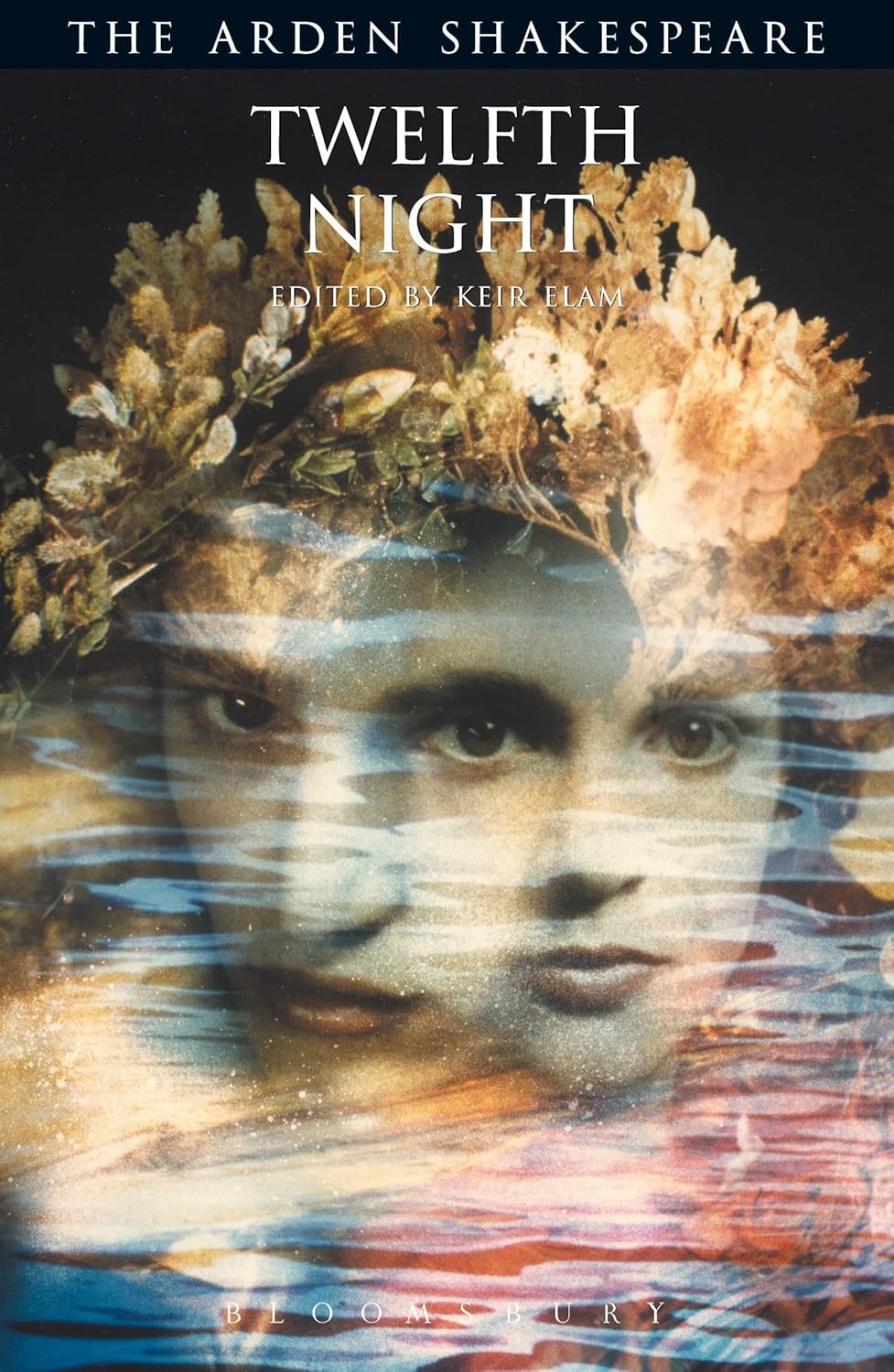
Shakespeare, William. Twelfth Night, or What you Will. [Arden Shakespeare, Third Series.] Ed. Keir Elam. Lodon: Centage Learning, 2008.

When Sir Toby Belch, Sir Andrew Aguecheek, and Feste (the jester) meet up in Act II of Twelfth Night, we get this exchange:
Sir Andrew: Here comes the fool, i'faith.

Feste: How now, my hearts? Did you never see the picture of "we three"?

Sir Toby: Welcome, ass. (II.iii.14-17)
The footnote to the Arden Shakespeare (Third Series) explains this in this way:
. . . alludes to a painting or inn sign representing two asses or loggerheads; the caption "we three" implicated the spectator—here presumably Feste himself—as the third ass or loggerhead (i.e., fool) . . . (212)
The Shakespeare Birthplace Trust has just such an image, dated from 1600-1625:


One fool looks at another fool who, in turn, looks out on the third fool: you, the viewer! April Fool!

The audience participation part of the joke is the best part. The observer needs to be present for the "We Three" to be fulfilled.

There are a number of other related images, including these two signs from a pub in Mold, Whales:


Some images seem to have been created by someone who didn't get the joke and included all three figures in the image itself, leaving out the audience participation:


But additionally interesting is the plethora of postcards around the year 1900 that have combined this Shakespeare-era joke with a Shakespeare quote. They're most often (as in the image that heads this post) an image of two donkeys with the caption "When shall we three meet again?"


Yes, as I said, a plethora. At least one plethora. Perhaps even a multitude of plethora. Again, I like the audience participation aspect of this. The card with two donkeys and the query "When shall we three meet again?" is sent to a person who is absent. At first glance, it seems like the message being conveyed is on the order of "Wish you were here," but the two donkeys turn it into a clever insult—the recipient is the third ass of three.

And remember, if you ever look at an image like this, it means that someone is calling you a donkey: you become the third ass of three.  This April Fools' Day, don't let anyone fool you with a similar joke. 

Oh, wait—I just did. A plethora of times.  April Fool!

Click below to purchase the Arden edition of the play from amazon.com
(and to support Bardfilm as you do so).

Tuesday, March 31, 2015

Spaghetti Shakespeare: Contemporary Review of Johnny Hamlet

"Johnny Hamlet." Review of Johnny Hamlet, dir. Enzo G. Castellari. Variety 10 May 1972: 20+.

As thrilled as I am by the prospect of a Spaghetti Western that retells the story of Hamlet in one way or another (for which, q.v.), not everyone shares my enthusiasm.

Witness the nearly-contemporary review of the film from a 1972 Variety (the film was reeled in 1968):
. . . this "Hamlet" effot is so inept in concept and playing that it is more likely to grow old on the bottom half of an action doublebill. (20)
The review continues . . .
Corman [who plays Johnny Hamlet], with a makeup job that makes him look more like a Q-T suntan ad than a cowboy, is dreadful but Roland [as Horace, the Horatio analogue,] almost makes his ridiculous role dignified. The rest of the cast has been sliced off the same prosciutto as Corman. (34)
I gather than you can't please all the critics all the time. If you'd like to read more of the review, click on the image below to enlarge it—and then take it all with a few grains of finest Italian sea salt.


Links: The Film at IMDB.

Click below to purchase the film from amazon.com
(and to support Bardfilm as you do so).


Monday, March 30, 2015

Book Note: The Dead Fathers Club

Haig, Matt. The Dead Fathers Club. New York: Penguin, 2006.

I finished reading this a little to late for it to form part of the discussion of modern versions of Hamlet in my Modern Shakespearean Fiction class, but it may make its way into future versions of the course—as an option, I think, rather than as a course text for everyone.

The protagonist, Philip, is eleven years old—which is on the young side for derivative versions of the Danish Prince—and that might lead some readers to think that this is young adult fiction. Partly because of the extent and kind of profanity in the book, I would not classify it as such. The novel also grapples intriguingly with issues and ideas of a more advanced kind—though all in the voice of an eleven-year-old boy.

The voice struck me most profoundly. It's well-crafted, captures the tone of an eleven-year-old boy, and has great interest in itself. Here's the opening of the book—in a chapter called "The First Time I Saw Dad After He Died":
I walked down the hall and pushed the door and went into the smoke and all the voices went quiet like I was the ghost.

Carla the Barmaid was wearing her hoop earrings and her tired eyes. She was pouring a pint and she smiled at me and she was going to say something but the beer spilt over the top.

Uncle Alen who is Dads brother was there wearing his suit that was tight with his neck pouring over like the beer over the glass. His big hands still had the black on them from mending cars at the Garage. They were over Mums hands and Mums head was low like it was sad and Uncle Alans head kept going down and he lifted Mums head up with his eyes. He kept talking to Mum and he looked at me for a second and he saw me but he didnt say anything. He just looked back at Mum and kept pouring his words that made her forget about Dad. (1)
Perhaps it's because I'm currently re-reading The Sound and the Fury, but I was impressed by the creation of a voice that can relate everything it sees but lacks the maturity necessary to comprehend or to interpret it.

I also appreciated how the narrative follows Hamlet's—but only to a certain extent. It doesn't make itself into an obvious Hamlet derivative, but it's filled with moments that call our attention to the play. Here are some of my favorites:

  • In the first chapter, some men are smoking Hamlet brand cigars (2)
  • The boy's angelfish is called "Gertie which is short for GERTRUDE which is a funny name" (63)
  • The character called "Dads Ghost" says, about Uncle Alan, "He sits there smiling. That evil villain sits there smiling. Trying to worm his way in like a maggot. Smiling smiling smiling. Look at him Philip. Look at him. Smiling damned villain" (72)
  • In an effort to show how he could bring the pub to profitability, Uncle Alan tells Philip's mom to "Take all those Real Ales." She asks, "What about them?" and we get this line in reply: "Uncle Alan folded his arms still nose whistling and he said Stale flat unprofitable" (77)
  • The Ophelia analogue (whose name is Leah) has an older brother named Dane (84)
  • Number six on a list of "Ways I can kill Uncle Alan" that our protagonist makes is "POISON. You can pour poison into someones ear when they sleep and it kills them. Bu there are no poison shops any more. Weedkiller is poison but I dont know if you can pour it into ears" (126)
  • Philip, who is a bit of a Roman History buff, says, "I know that Romulus was like Uncle Alan because he killed his brother and became the first King of Rome 2800 years ago" (186)
  • In a pub quiz, this question comes up: "Another tricky one. In which play by William Shakespeare do we find the line There is nothing either good or bad but thinking makes it so?" (186)
There are some very intriguing alterations to the plot, but I really can't go into them without causing major spoilers. With an appropriate qualification about the obscenities in mind, The Dead Fathers Club provides an interesting take on Hamlet—one that invites us to return to the play for yet another reading.


Click below to purchase the book from amazon.com
(and to support Bardfilm as you do so).

Sunday, March 29, 2015

Langston Hughes and Shakespeare

Hughes, Langston. "Shakespeare in Harlem." Shakespeare in Harlem. Illus. E. McKnight Kauffer. New York: A. A. Knopf, 1942. 111.

I'm teaching a survey of American Literature for the first time in my long and illustrious career, and I still find myself looking for the Shakespeare angle whenever it seems appropriate.

Langston Hughes wrote a poem called "Shakespeare in Harlem" in a volume called Shakespeare in Harlem. [Apparently, he also wrote  a play called Shakespeare in Harlem, but I haven't yet been able to track it down.] Like many of Hughes' works, it has a deceptively simple façade. I'll provide the text and then an image of the full page spread for the poem:
Hey ninny neigh!
And a hey nonny noe!
Where, oh, where
Did my sweet mama go?

Hey ninny neigh
With a tra-la-la-la!
They say your sweet mama
Went home to her ma. (111)


It may not be Hughes' best poem, but it does the work of turning Shakespearean songs into the blues. 

Click below to purchase the book from amazon.com
(and to support Bardfilm as you do so).

Wednesday, March 25, 2015

A Midsummer Night's Dream at the Guthrie Theatre (2015)

A Midsummer Night’s Dream. Dir. Joe Dowling and David Bolger. Perf. Jay Albright, Darius Barnes, Joe Bigelow, Nicholas Carriere, Eleonore Dendy, Michael Fell, Alex Gibson, Casey Hoekstra, Nike Kadri, Zach Keenan, Emily Kitchens, Tyler Michaels, Kris L. Nelson, Christina Acosta Robinson, Peter Thomson, Angela Timberman, Tony Vierling, and Andrew Weems. Guthrie Theatre Company. Minneapolis. 7 February—29 March 2015.

Right: Tyler Michaels, as Puck, is sent with broom before to sweep the dust behind the door. Production photo by Dan Norman.

Last night, a group of students and faculty went down to the Guthrie Theatre to see their Midsummer Night’s Dream.

If that sentence sounds familiar, it may be because I used it already—back in 2008 (for which, q.v. and the two posts that follow it). This, the 2015 performance, has many of the same qualities and some of the same directorial decisions as the 2008 production, but it's different in a number of ways, not the least of which is that it is Joe Dowling's final production for the Guthrie.

Last time, my organizational principle included four categories: "overall impressions, things that worked, things that didn’t work, and things that might work for some but won’t work for others." This time, I have a list of things that are striking about the production.

The play's opening line.

I had heard that the production was going to be a longer one than most. "Uncut" was the word often used to describe it, together with the notation that those who have seen the play before will likely see scenes they've never seen before. I was, therefore, a bit surprised when the opening line came:
Hippolyta, I woo'd thee with my sword,
And won thy love, doing thee injuries;
But I will wed thee in another key,
With pomp, with triumph and with revelling. (I.i.17-21)
With that powerful beginning, one of the key themes of the play starts to develop. The lines were delivered in a no-nonsense manner, as if Theseus were telling Hippolyta that she had better see to it that her attitude is not one of injury but one of pomp instead. We lose the first sixteen lines of the play, which can do something of the same, but not quite as economically; in exchange, we gain an immediate understanding of the tensions between the two. But we also lose the opening moon imagery, which I consider to be important in establishing a different set of concerns.

The relationship between Hippolyta and Theseus.

Arising out of the opening line, this production developed the relationship in a similar way to the 2008 version. I made the following note on that production:
When [Theseus] asks [Hippolyta] to come with him in Act I, she deliberately exits in the opposite direction. When he asks her to come with him in Act V, she willingly acquiesces. I thought it was effective. It’s a slow character development.
The 2015 production does the same, but with some refinements. When Egeus says that his daughter must either marry the man of his choice or face the death penalty, Hippolyta cannot keep from uttering a horrified "No!" Combined with other business, that makes Hippolyta's exiting without Theseus not the result of his doing her injuries but of his inability to act as she wishes him to act in the matter of Hermia's situation. In Act IV, Theseus seems almost ready to side with Egeus in his anger with Hermia's being found with Lysander and with every intention of marrying Lysander—until Hippolyta coughs gently and steers him toward overriding Egeus' demands. Upon her exit in that scene, she winks at Hermia as if to say, "Here's how you handle a man."

The Indian Boy.

The subtitle for this section could be "The relationship between Oberon and Titania." The main argument between the two of them is Oberon's determination to take over the raising of the Indian boy and Titania's refusal to let him do so. Nothing in the text demands that an actual boy be present, but different productions have done interesting things with the idea of the character—including making him any age between infant and thirty-five. Here, it's an infant wrapped in a blanket.

Oberon's plan is to make Titania fall in love with something ridiculous so that he can take the Indian boy from her. That plan motivates much of the action of the play—getting the love potion to use on Titania means it's available to use on (accidentally) Lysander and (purposefully) Demetrius. And Oberon's plan works—while Titania is in love with Bottom the Weaver (with an ass head on his own), he gets control of the Indian boy.

Quite interestingly, this production brings the Indian boy back on in Act IV, once Titania's love-potioned eyes have been treated with the antidote. While she is asking—really, demanding—how these things have happened, the boy cries, and he is handed to Titania. Though Puck makes a motion toward getting the boy back, Oberon restrains him.

Let me pause the play at that point to allow us to sit in a most interesting suspense. Will she claim the child back? Will Oberon allow her to do so? Will she surrender him to Oberon—willingly, this time? Will the two come together to raise the child, strengthening their own relationship as they concentrate their efforts on taking care of this little one?

Instead of developing these (or other) possibilities, the play just has Titania hand the child back to (as far as I could tell) a random fairy, who then takes it offstage. I think the production squandered an intriguing issue that it raised there.

Guthrie asides.

In most Guthrie production of Shakespeare that I've seen, there have been numerous extra-textual lines from the actor.  These are lines like "No!" or "Duh!" or "Yeah, I guess" or even "Did you know he was a boy?" inserted into the dialogue. They often get a laugh—but it's usually a cheap laugh. I'm of two minds about these Guthrie asides. They do distract from the text (and not always in helpful ways), but they also can help elucidate something in the text that might be on the obscure side. For now, I'll just put it down to Guthrie House Style—it's how they do Shakespeare.

Underwear.

According to my previous post, in the 2007 production, "When the lovers enter the woods, their clothes are wisked away, leaving them in their underwear (though they don’t seem to notice until they are discovered by Theseus and Hippolyta late in Act IV)." In that production, it seems to indicate freedom from societal conventions in the woods outside Athens. In this production, Hermia and Lysander's clothes are removed in a darker, more troubling, forcible way by what seem to be quite malicious fairies. They're not just entering into a place of freedom; their hitherto surface identities are violently stripped from them. Demetrius and Helena have their clothing removed as well, but in more of a natural way that they seem neither to notice nor to resist. I'll have to ponder whether the difference is intentional.

Into the [Scary] Woods.

This production provides a wood that is often very frightening. It's not just a foil for the regularity of Athens; it's an otherworldly place that is frequently menacing. Particularly vivid along these lines is the presentation of the wood after Lysander leaves Hermia. She wakes and cannot find him. The lighting becomes dark and threatening. Fairies approach in a very menacing way. Helena is genuinely terrified. She becomes an extremely vulnerable, solitary woman in the woods in just her underwear in the darkest part of the night with either ambivalent or actively hostile forces around her. Demetrius' line to Helena about doing her "mischief in the woods"(II.i.237) is nothing—as Helena points out, his "virtue is [her] privilege" (II.i.220)—she has nothing to fear from him. But Hermia may have much to fear from these fairies, whose virtue is not clearly known to anyone.

Administration of the Love Potion.

In most productions, the administration of the love potion is either nothing particularly interesting or has some comic value. I recall one production where the Puck made a hilarious "Squeeekie Squaaak Squissssh" noise whenever applying the potion. This production chooses to make its administration a difficult and painful matter. The fairies who give it raise up the patient and then force an invisible power into their eyes, causing them to groan in pain and to resist. It's an intriguing choice that heightens the intrusion the fairies are making into human life.

The "Jack Shall Have Jill" song.

A great deal of song and dance infuses this production.  As in 2007, "there was a very funny Doo-wop version of the lullaby the fairies sing to Titania in II.ii. The head fairy on that number had a lovely, soaring voice, and the “Diana and the Supremes” choreography was pleasing." As in 2007, Puck’s attempt to rap “Yet but three? Come one more. / Two of both kinds makes up four” (III.ii.437-38) slowed up the action and was fairly embarrassing." [Note: Doesn't the Guthrie read Bardfilm when preparing their productions?]

One of the best of the numbers is Puck's "Jack shall have Jill; / Nought shall go ill" (III.ii.461-62). At first, it's just Puck; the main female fairy soon joins him. Later, the four sleeping lovers are magically animated to sit up and sing a Doo-wop backup to the number. It was hilarious and extremely well choreographed and performed.

Rude Mechanicals.

As per usual, the play-within-the-play steals (at least for a time) the show. It was full of good, entertaining business—including the single longest death of a Bottom that I've ever seen, three separate and progressively more elaborate dresses for Thisbe, a Wall that hits back, and a fake dog on a leash that gets stomped flat at one point. The only critique here is the character of Snug / Lion. He's directed as a drunk, which means that many of his good lines were lost.

Miscellaneous.

I wonder if the character of Peter Qunice, the Mechanical who directs the rest of the Mechanicals in their play, owes anything to Joe Dowling. I got the feeling that the soul of the director was humorously being invoked in his portrayal.

The 2008 production was notable for its use of military uniforms for Egeus and Demetrius, creating a bond between the two that was not shared by Lysander. This production also has military uniforms—but for everyone. It emphasis the notion that there is little to differentiate Demetrius and Lysander—apart from the love Hermia has for the latter and not the former.

For this production, the Guthrie had removed the back wall of the theatre, replacing it with seats to turn the Wurtele Thrust Stage into the Wurtele Stage in the Round. It made for a production that was full of motion, but it also drastically changed the acoustics in the theatre. Many of the actors were having to shout rather than to project, and shouting is not necessary when the theatre is arranged in its usual configuration.

Final blessing.

Oberon's final blessing over the three new marriages and the one restored marriage in the play is quite lovely:
With this field-dew consecrate,
Every fairy take his gait,
And each several chamber bless,
Through this palace, with sweet peace,
And the owner of it blest
Ever shall in safety rest. (V.i.415-20.)
The blessing is a big singing number involving all the fairies surrounding the stage and than advancing into the audience. An alert audience member who attended with me very astutely pointed out that it may be Joe Dowling's final wish for the Guthrie Theatre and its audience.

Thank you, Joe, for many years of brilliant, amazing, thoughtful Shakespeare—and for all the incredible thought that it inspires.

Links: The Play at the Guthrie's Web Site.


The Rude Mechanicals, in their "Athens Community Theater" jackets, provide a prologue.
Production photo by Dan Norman. 
Tuesday, March 24, 2015

Book Note: I am Shakespeare

Rylance, Mark. I am Shakespeare. London: Nick Hern Books, 2012.

This play contains Rylance's theory that someone else wrote the plays attributed to Shakespeare.  The plot is centered on a man named Frank who is putting on a web broadcast on the authorship question. He's visited by four claimants (Shakespeare, Bacon, Oxford, and Mary Herbert, née Sidney). At the end, everyone in the audience is meant to recognize that it doesn't matter who wrote the plays; they each are meant to stand up and say, "I am Shakespeare."

It's a particularly frustrating play, helping to establish that propaganda very rarely makes good art. Shakespeare managed to do it in Richard III, but that play really has propagandistic elements in an artistic endeavor. This play is almost exclusively "Reasonable Doubt" propaganda.

And that, as you can imagine, gets very tedious very quickly. Old and exploded notions are brought up without any critical judgement—for example, the idea that Joseph Hall and John Marston indicated (by means of a very tenuous, roundabout, coded method) that Francis Bacon wrote Venus and Adonis—and the same tired, exhausted, laughable arguments are presented as if they were fresh—for example, that nothing associates Shakespeare with the works until seven years after his death. There's even this blatantly misleading statement: ". . . even his contemporary theatre managers, Henslowe and Alleyne, don't mention Shakespeare once in their diaries and account books, despite their many references to other playwrights and theatre people" (43). First, Philip Henslowe (who kept the diary— Edward Alleyn was in business with him but no diary of his survives) was not Shakespeare's theatre manager: he managed an entirely different theatre with entirely different actors and authors. While it is true that Henslowe does not mention Shakespeare, no one should expect him to!

I'll give you a few other samples from the play. The first—which starts off in humorous vein, then turns into anti-Stratfordian fantasy—involves the first caller to call-in web broadcast. It turns out to be a telephone solicitor. Here's the bulk of the exchange (click to enlarge the image):


Later in the play, Oxford wanders on for some of the most painful sections of this entire mess. Here's an exchange between Shakespeare and Oxford:

Shakespeare: The Tempest was impelled by a sea voyage that took place in 1609; Macbeth could not have been composed before the Gunpowder Plot of 1605. It's impossible that you wrote them.
Oxford: Oh yes, I'm terribly sorry. I forgot that there has only ever been one sea voyage and one treasonous plot in recorded history. Anonymous versions of Hamlet and King Lear were being performed in the early 1590s. If you wrote these mature plays then you were pushing them out with your first facial hair. (64)
Oxford's first point might be significant if the facts of the shipwreck and the threat to King James I were the only reasons Shakespeare scholars give for dating those plays as they do; however, their dating depends on texts that weren't published until those dates in addition to other arguments. The second part of his argument makes no sense. First, no one is claiming that Shakespeare wrote those particular plays. Second, no one is claiming that they are mature plays. The dates Oxford gives are, at least, accurate. The anonymous King Leir—note the spelling—was written prior to 1594. It survives in a 1605 quarto. The play known as the Ur-Hamlet does not survive, but references to it come from as early as 1589. Shakespeare was twenty-five years old in 1589 and thirty in 1594, giving him plenty of time to grow facial hair (which, in any case, is not a prerequisite to the writing of good plays).

The final bit of nonsense comes in an appendix listing Shakespearean phrases and phrases from Francis Bacon side by side. The claim is that if both men said the same thing, both men must be the same men. A similar argument is often made for the authorship claims of Marlovians (for which, q.v.). Here, the list becomes even more laughable—in two distinct ways. First, many of these are common clichés of the time. If I say "A bird in the hand is worth two in the bush" and Woody Allen says "A bird in the hand is worth two in the bush," does that make us into a single entity? And if I started listing all the authors of the period who said something like "Fortune changes like the moon," we'd have a very tedious week in front of us. Second, many of these have only the very slightest commonality. Is "To hazard all our lives in one small boat" even remotely similar to "You are in the same ship"? Ridiculous!


Mark Rylance may be quite a capable actor, but this misleading, propagandistic play shows him to be lacking in both honesty and scholarship.

Click below to purchase the book from amazon.com
(and to support Bardfilm as you do so).

Monday, March 23, 2015

Book Note: The Young Reader's Shakespeare: Romeo and Juliet

McKeown, Adam. The Young Reader's Shakespeare: Romeo and Juliet. Illus. Peter Fiore. New York: Sterling, 2003.

While trying to track down Michael Rosen and Jane Ray's version of Romeo and Juliet (for which, q.v.), I chanced upon another picture book version, and it has its compelling side as well.

Adam McKeown and Peter Fiore's version is much more detailed. It's almost a young adult novelization of the play. And their version frequently keeps close to the text—but not as close nor with as much care to indicate which words are Shakespeare's and which are the authors.

It's also a bit steamier than I'd expect from a picture book!

I'm providing an example of the same scene that I wrote about for Michael Rosen and Jane Ray's version of Romeo and Juliet: Romeo meets Juliet at the Capulet ball. Click on the image below to enlarge it.


That provides a good glimpse at the prose and its use of Shakespeare's words. It also gives you a hint of the illustrations, which are a bit more realistic than those in the previous version but with quite a bit of artistry.

Click below to purchase the book from amazon.com
(and to support Bardfilm as you do so).

Thursday, March 19, 2015

Romeo and Juliet in Dr. Quinn, Medicine Woman

"What is Love?" By Carl Binder. Perf. Jane Seymour, Joe Lando, and Chad Allen. Dir. Daniel Attias. Dr. Quinn, Medicine Woman. Season 3, episode 19. CBS. 11 February 1995. DVD. A&E Home Video, 2009.

I never particularly liked Dr. Quinn, Medicine Woman—but I also freely admit to vast ignorance of the show. First, I thought (erroneously) that the reason Beverly Crusher left the Starship Enterprise in season two of Star Trek: The Next Generation was that Gates McFadden wanted to play the role of Dr. Quinn but the schedules couldn't, for that season, be reconciled. Second, I considered the show to be merely a version of Little House on the Prairie for older viewers interested primarily in cheesy romance. Actually, the jury is still out on that one.

But I find that I have, however slightly, digressed. In an episode in season three, the town decides to put on a production of Romeo and Juliet for Valentine's Day. Not uncoincidentally, the students of the town have been given an essay assignment: Answer the question "What is Love?" After the expected kurfuffle of lovers and friends falling out and misunderstanding each other (all of which one boy, pen in hand, poignantly observes), the director getting laryngitis, the lead getting laryngitis (if I remember correctly—the show doesn't lend itself to deep concentration), et cetera, everything starts coming together just in time for the big show. And that's where the clip below picks up. Enjoy!


Links: The Episode at IMDB.

Click below to purchase the entire series from amazon.com
(and to support Bardfilm as you do so).

Book Note: Shakespeare's Romeo and Juliet

Rosen, Michael. Shakespeare's Romeo and Juliet. Illus. Jane Ray. Cambridge: Candlewick Press, 2004.

I don't often run across a picture book version of a Shakespeare play that I think would be worthwhile to review, but Michael Rosen and Jane Ray's version of Romeo and Juliet is an exception for one essential reason.

It's not the illustrations. They are very creditable, and they have a unique style, but they don't particularly stand out. I do appreciate that they're not sentimentalized—the characters in the story have a realistic, warts-and-all feel to them.

It's not the summary of the story. It takes some effort to do that well—especially for a younger age group—but that's something of which many are capable.

What caught my attention was the particular marriage of summary, illustration, and integration of Shakespeare's text. I'm used to seeing either complete retellings of Shakespeare's plots or illustrated editions of his text. In this book, there's a substantial amount of the text of Shakespeare's play:


I find that to be a very satisfactory marriage of text, summary, footnote, and illustration.

I also appreciated this chart of the other characters—just to help us keep them all straight!


Click below to purchase the book from amazon.com
(and to support Bardfilm as you do so).


Bardfilm is normally written as one word, though it can also be found under a search for "Bard Film Blog." Bardfilm is a Shakespeare blog (admittedly, one of many Shakespeare blogs), and it is dedicated to commentary on films (Shakespeare movies, The Shakespeare Movie, Shakespeare on television, Shakespeare at the cinema), plays, and other matter related to Shakespeare (allusions to Shakespeare in pop culture, quotes from Shakespeare in popular culture, quotations that come from Shakespeare, et cetera).

Unless otherwise indicated, quotations from Shakespeare's works are from the following edition:
Shakespeare, William. The Riverside Shakespeare. 2nd ed. Gen. ed. G. Blakemore Evans. Boston: Houghton Mifflin, 1997.
All material original to this blog is copyrighted: Copyright 2008-2039 (and into perpetuity thereafter) by Keith Jones.

The very instant that I saw you did / My heart fly to your service; there resides, / To make me slave to it; and, for your sake, / Am I this patient [b]log-man.

—The Tempest