Thursday, December 5, 2013

Fantastic Shakespeare Podcast Number One: Shakespeare’s Restless World

MacGregor, Neil. Shakespeare's Restless World: A Portrait of an Era in Twenty Objects. New York: Viking, 2012.

British Broadcasting Corporation. Shakespeare's Restless World. 2012. Podcast.

I've encountered a lot of Shakespeare podcasts, but this one knocks nearly all the rest into a cocked hat.  It's a careful, thoughtful, and marvelous examination of the material culture of Shakespeare's day, one item at a time.  The presentation is scholarly and fascinating, and it exceeds the exacting standards set by the BBC.

The transcripts, moreover, have been collected into a book that is a marvelous resource. Viking very kindly sent me a review copy (if they had waited a few days, I'll admit, I would have purchased a copy for myself). The book is incredible. It has an impressive number of relevant images. Indeed, my only critique of the book is that the photos aren't the glossy, coffee-table variety, which, admittedly, would be exceptionally expensive to print. Apart from that, I'm just stunned at the book and its contents. The images are astounding, and the book is copiously indexed and provides an exceptional scholarly apparatus to boot.

But wait! There's more! The BBC has also put together several video clips to accompany the presentation. Below, you will find video of a musical clock.


The podcast, the book, and the video clips all help immensely in giving the scholar or the interested Shakespeare aficionado a better feel for the world in which Shakespeare lived—and a better connection, thereby, to how Shakespeare works in the contemporary world.

Links: The Podcast.

Click below to purchase the book from amazon.com
(and to support Bardfilm as you do so).

Tuesday, December 3, 2013

A Children's Book Version of Othello: If You Give Iago a Handkerchief

Jones, Keith. If You Give Iago a Handkerchief. Bardfilm. N.p., 3 November 2013. Web. 3 November 2013. Illus. by Mya, a.k.a. @GoodTickleBrain, Shakespearean Web Comic Artist.

I don't have the illustrative skills of—to choose an illustrator at random—Felicia Bond. But, thanks to the efforts of @GoodTickleBrain, I have an opening illustration! Nor am I an accomplished children's book author like—again, a random choice—Laura Joffe Numeroff.

But I do know the plot of Othello, so I've written a children's book version that is sure to please adults and kids alike. You'll just have to piece out my imperfections with your thoughts and imagine the illustrations (with the exception of the one provided above) for yourself.

If You Give Iago a Handkerchief

If you give Iago a handkerchief, he’s probably going to want to frame Desdemona with it. As he thinks about how to go about framing Desdemona, he’ll probably want to explain it with a soliloquy.

He’ll go on and on about making his fool his purse and bringing a monstrous birth to the world’s light. As he delivers his soliloquy, he’s going to get thirsty. He’ll want a drink. But he won’t want to drink alone. He’ll invite Cassio over.

Cassio will say that he has very poor and unhappy brains for drinking, but Iago won’t listen. He’ll keep calling, “Some wine, ho!” and making Cassio drink.

Cassio won’t be able to hold his liquor. He’ll start a fight and wake up the whole house.

When the house wakes up, Iago will pretend to be Cassio’s friend. He’ll listen as Cassio says, “Reputation, reputation, reputation! O, I have lost my reputation! I have lost the immortal part of myself, and what remains is bestial,” but he’ll be rejoicing inwardly at Cassio’s downfall. Cassio will be so sick that he’ll turn green.

Cassio’s turning green will make Iago think of jealousy, the green-eyed monster which doth mock the meat it feeds on. And that will remind Iago of his own desire to bring Othello down.

He’ll tell Othello that Desdemona isn’t faithful to him. He’ll make Othello so angry that he’ll want to put out the light and then put out the light.

When the light goes out, Iago will think that it’s time to get rid of any witnesses to his perfidy. But he’ll be too late. He’ll get involved in a huge scuffle over who killed who and why and who lied about what and why.

In the scuffle, he’ll get a bloody nose. And if he gets a bloody nose, he’s going to need a handkerchief. And if you give Iago a handkerchief, you just know he’s going to want to frame Desdemona with it.

Bonus Mouse.

Monday, December 2, 2013

Shakespeare-Related Poem: "Laurence Olivier's Hamlet" by David Oliveira

Oliveira, David. "Laurence Olivier's Hamlet." In a Fine Frenzy: Poets Respond to Shakespeare. Ed. David Starkey and Paul J. Willis. Iowa City: University of Iowa Press, 2005. 121.

Last week was "Modern Poetry Inspired by Shakespeare" week at Bardfilm.

I was able to give you five of the best poems in the copious collection entitled In a Fine Frenzy: Poets Respond to Shakespeare.

That should have been enough, but I really couldn't resist providing one more.

The poem is one of the only ones in the collection that focuses on Shakespeare and film. It's more of a prose poem than a poem in another form; as such, it's text-heavy, and I haven't had the time to type it up (not to mention the time to think about whether these specific line breaks are intentional or a mere accident of margin placement). I've accordingly uploaded an image of the poem. Click on it to enlarge it, and enjoy!


Click below to purchase the book from amazon.com
(and to support Bardfilm as you do so).

Friday, November 29, 2013

Shakespeare-Related Poem: "When Everything is Goneril" by Lee Patton

Patton, Lee. "When Everything is Goneril." In a Fine Frenzy: Poets Respond to Shakespeare. Ed. David Starkey and Paul J. Willis. Iowa City: University of Iowa Press, 2005. 87.

This is the fifth poem in our series of great poems related to Shakespeare written by modern authors.

The last poem was quite fun.

This one brings it down a bit.

Somehow, I feel a bit like a Poetry Deejay of sorts.

But let that be as it may be while I spin the latest wax 45 by Lee Patton.
Lee Patton

When Everything is Goneril

what wouldn’t you give for something Foolish,
for blazing double entendre and illuminating wit
as sharp as a servant’s truth? What wouldn’t you give
to weave a garland in your young daughter’s hair
and spend the whole day under the wide sky
in a field where wildflowers beckon, unpicked?
Then, tired, giddy, all you’d yearn for’s home.

But there stands Goneril: hospitality has claws,
duty’s barbaric with ancient grievances, and
she does, after all, hold the deed by birth, by law.
Though love is often declaimed, it’s really disowned,
houseless in this ungenerous land—send to wander
in bald lots, sent to sleep under cardboard punctured
for a glimpse of smudged and savage stars.

Click below to purchase the book from amazon.com
(and to support Bardfilm as you do so).

Thursday, November 28, 2013

Shakespeare-Related Poem: "Shakespearean Sonnet" by R. S. Gwynn

Gwynn, R. S. "Shakespearean Sonnet." In a Fine Frenzy: Poets Respond to Shakespeare. Ed. David Starkey and Paul J. Willis. Iowa City: University of Iowa Press, 2005. 24.

Happy Thanksgiving!  Please be sure to be more verbose about the things for which you're grateful than Don John in Much Ado About Nothing (for which, q.v.).

This is the fourth poem in our series of great poems related to Shakespeare written by modern authors.

And this one is great fun. It describes Shakespeare's plays in the style of television listing descriptions.
R. S. Gwynn

Shakespearean Sonnet

With a first line taken from the tv listings

A man is haunted by his father’s ghost.
Boy meets girl while feuding families fight.
A Scottish king is murdered by his host.
Two couples get lost on a summer night.
A hunchback murders all who block his way.
A ruler’s rivals plot against his life.
A fat man and a prince make rebels pay.
A noble Moor has doubts about his wife.
An English king decides to conquer France.
A duke learns that his best friend is a she.
A forest sets the scene for this romance.
An old man and his daughters disagree.
A Roman leader makes a big mistake.
A sexy queen is bitten by a snake.

Click below to purchase the book from amazon.com
(and to support Bardfilm as you do so).

Wednesday, November 27, 2013

Shakespeare-Related Poem: "My Students" by Ron Koertge

Koertge, Ron. "My Students." In a Fine Frenzy: Poets Respond to Shakespeare. Ed. David Starkey and Paul J. Willis. Iowa City: University of Iowa Press, 2005. 25.

This is the third poem in our series of great poems related to Shakespeare written by modern authors.

Many of the poems in the collection reflect on specific plays or sonnets.

This one takes more of a biographical approach—but it's one that thinks about the narrator's students and their imagined idea of Shakespeare.

The ultimate joke may be that Shakespeare was involved not only in deep thought and the composition of magnificent poetry but also in the stuff that doesn't make you famous but that's mentioned in the poem below.
Ron Koertge

My Students

picture shakespeare just like the domed
bust in Senior English plus puffy pants
and sissy shoes.

They see him sitting in an open window
thinking deep thoughts while below
the Avon teems with life—coal and casks
of wine one way, barges of lowing cattle
the other.

And along the banks, young people kissing
with their mouths open, grappling with
the other’s odd clothes,

all the stuff that doesn’t make you famous
but that’s a lot more fun than poetry.

Click below to purchase the book from amazon.com
(and to support Bardfilm as you do so).

Tuesday, November 26, 2013

Shakespeare-Related Poem: "Hamlet Meets Frankenstein" by Kevin Griffith

Griffith, Kevin. "Hamlet Meets Frankenstein." In a Fine Frenzy: Poets Respond to Shakespeare. Ed. David Starkey and Paul J. Willis. Iowa City: University of Iowa Press, 2005. 126.

I've greatly enjoyed In a Fine Frenzy, the volume of modern poetry engaging in some way with Shakespeare, even though the Hamlet section has a huge number of poems about Ophelia and far fewer about any other aspect of the play.

The poem below is a remarkable poem that is not focused on Ophelia (though she makes an interesting appearance in the poem).

It starts off with a strange and humorous device, passes through a line about the "official seal" of Denmark (I'd love to see that line on a travel poster for the country, as a matter of fact), and ends with a profound consideration of the nature of tragedy.
Kevin Griffith

Hamlet Meets Frankenstein

For Frankenstein, of course, Hamlet’s central
problem is irrelevant. The monster
offs the king in the first act,
dispatches Polonius quickly with a twist
of the neck, and then terrorizes the kingdom
until he ascends to the throne,
a feared leader, making the phrase
“There’s something rotten in Denmark”
his badge of honor, an official seal.
Ophelia is fished from the river,
brought back to life with a bolt of lightning
and made his bride, a fitting queen.

Meanwhile, Hamlet is still sulking
at the grave site, skull in hand
and three dead kings to contend with,
one still very much in charge.
Remarkably, the play ends like all tragedies:
The dead watch over the living,

and the living wonder why it’s so hard to be alive.

Click below to purchase the book from amazon.com
(and to support Bardfilm as you do so).

Monday, November 25, 2013

Shakespeare-Related Poem: "Lines on Retirement, after Reading Lear" by David Wright

Wright, David. "Lines on Retirement, after Reading Lear." In a Fine Frenzy: Poets Respond to Shakespeare. Ed. David Starkey and Paul J. Willis. Iowa City: University of Iowa Press, 2005. 94.

A few weeks ago, I was trying to track down a poem by David Wright. It was a darkly comical piece relating to retirement and reflecting on King Lear.

I found it relatively easily, though one blog claimed that he was both deaf and dead—dead since 1994 and deaf, presumably, before that. My latest conversation with him reveals him to be neither.

Possibly even more exciting than finding the poem was the epiphany of realizing that the poem was now in a collection of Shakespeare-related poems by modern poets. I was thrilled, and I ordered the book immediately. Readers may know that I taught a course called "Modern Shakespearean Fiction" and that I was looking for poems just like these.

This week, I'm highlighting the best poems from the collection, starting with the one that enabled me to find the others.
David Wright
Lines on Retirement, after Reading Lear
for Richard Pacholski
Avoid storms. And retirement parties.
You can’t trust the sweetnesses your friends will
offer, when they really want your office,
which they’ll redecorate. Beware the still
untested pension plan. Keep your keys. Ask
for more troops than you think you’ll need. Listen
more to fools and less to colleagues. Love your
youngest child the most, regardless. Back to
storms: dress warm, take a friend, don’t eat the grass,
don’t stand near tall trees, and keep the yelling
down—the winds won’t listen, and no one will
see you in the dark. It’s too hard to hear
you over all the thunder. But you’re not
Lear, except that we can’t stop you from what
you’ve planned to do. In the end, no one leaves
the stage in character—we never see
the feather, the mirror held to our lips.
So don’t wait for skies to crack with sun. Feel
the storm’s sweet sting invade you to the skin,
the strange, sore comforts of the wind. Embrace
your children’s ragged praise and that of friends.
Go ahead, take it off, take it all off.
Run naked into tempests. Weave flowers
into your hair. Bellow at cataracts.
If you dare, scream at the gods. Babble as
if you thought words could save. Drink rain like cold
beer. So much better than making theories.
We’d all come with you, laughing, if we could.

Links: Wright's poem at Poets.org. Wright's blog, which focuses on ekphrastic poetry.


Click below to purchase the book from amazon.com
(and to support Bardfilm as you do so).

Friday, November 22, 2013

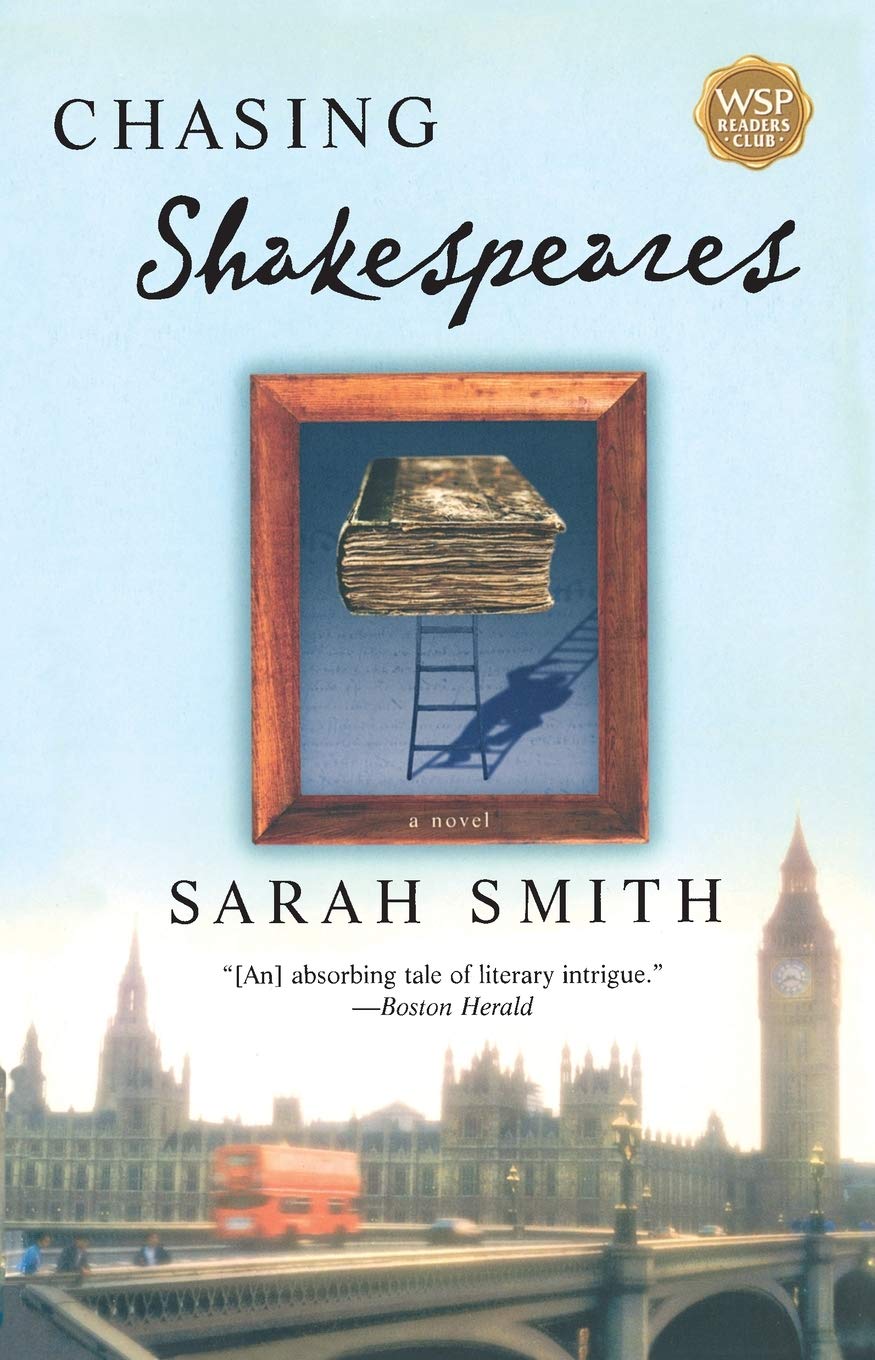
Book Note: Chasing Shakespeares

Smith, Sarah. Chasing Shakespeares. New York: Atria, 2003.

I just finished reading this very frustrating novel. The frustration arises in part because it deals with the authorship issue and in part because its plot is unsatisfactory; however, the main frustration is that this could have been a magnificent book but it falls spectacularly flat.

The three main characters are very interestingly drawn in the first fifty pages or so. Joe and Mary Cat are graduate students tasked with detailing the inventory of the imagined Kellogg Collection. The Collection is full of spurious and forged Shakespeareana. Indeed, it seems that it's nothing but forgeries. Mary Cat leaves to become a nun. Enter Posy Gould. She's meant to be the character who is endlessly attractive and alluring. The novel makes a big deal about the rumor that she has a tattoo of Queen Elizabeth I somewhere on her person (we never learn whether that's true or not).

All that is fine and quite interesting. And then Joe discovers a letter that he hopes with all his heart is another forgery. It's a letter from Shakespeare to Fulke Greville. It reads, in part (our graduate student has a fair amount of difficulty reading secretary hand, but he can make out this bit quite clearly), "Those that are given out as children of my brain are begot of his wit, I but honored with their fostering" (12; 35-36).

And that's where Posy stops talking like an interesting creation of the author. Instead, she starts to sound eerily like Charlton Ogburn, noted Oxfordian and author of The Mysterious William Shakespeare: The Man and the Myth.

Much of the rest of the book reads like very dull Oxfordian propaganda. Joe doesn't know what to think, but he explores the question seriously, including listening to all the old redating-the-play arguments necessary to keep Oxford actively composing after his death (and subsequent decomposing) in 1604.

I won't give any spoilers as to whether the letter is proved authentic, proved to be a forgery, or left in limbo between the two, but I will say that I was disappointed at the way the plot runs from the middle of the book to its end. The characters are forced into plot elements that strike me as false.

Yet the book could have been great. I'll need to read other works by Sarah Smith; she seems capable of good writing, and a novel without an agenda might demonstrate that better than this does.

Links: The Author's Web Site.


Click below to purchase the book from amazon.com
(and to support Bardfilm as you do so).

Tuesday, November 12, 2013

Kolberg and Henry V

Kolberg. Dir. Veit Harlan and Wolfgang Liebeneiner. Perf. Heinrich George, Kristina Söderbaum, and Horst Caspar. 1945. DVD. International Historic Films, 2013.

This post will attempt to bring together several separate strands of thought into a more-or-less cohesive whole. Wish me luck.

The delightful novel Friedrich Harris: Shooting the Hero (for which, q.v.) mentions the German propaganda film Kolberg in conjunction with the Laurence Olivier production of Henry V from 1944.

I watched Kolberg recently, and, although I haven't had much time to think about it, I think someone—someone who is not so far behind in the grading as I am—should consider the similarites between the scene below and Olivier's grand scene of horses galloping together at the beginning of the Battle of Agincourt (for which, q.v.).

Before the battle begins, there's a rousing speech. Then the armies gallop together in truly budget-breaking form.

I wonder—had the Nazi high command seen Olivier's Henry V? Were they interested in reclaiming Shakespeare for Germany (for which, q.v.)? Who has a bit of time—a Master's Thesis in Shakespeare and Film, for example—to investigate the possibilities?


Links: The Film at IMDB.

Click below to purchase the film from amazon.com
(and to support Bardfilm as you do so).

Thursday, October 31, 2013

SoxSpeare: A Sonnet on the World Series Victory of the Red Sox in 2013

Jones, Keith. "A Sonnet on the World Series Victory of the Red Sox in 2013." 31 October 2013.

The wager was made (for which, q.v.).

And now it's time to pay up.

I am very sad that the Cardinals did not win the World Series this year, but I must genuinely and sincerely acknowledge the true majesty of the Red Sox. They played astonishingly well.

At the end of the regular season, both teams were at the top of their divisions, tied with each other for the best win / loss percentage in baseball:  .599.  They were well-matched, and the World Series was filled with thrilling plays.

To honor my bet with Shakespeare Geek, I have written a sonnet in praise of the Red Sox.  Enjoy.

A Sonnet on the World Series Victory of the Red Sox in 2013

Wear red upon your feet with hoops of steel.
Eat beans and cod and things Bostonians like.
Beware the vast green monster in left field.
It mocks the very balls that do it strike.
The Cardinals cannot say you taunt or tease—
We cannot blame the outcome on a curse.
We fear the beard and batting of Ortiz.
Of two teams meeting, one must be the worse.
Two teams, alike in dignity, did meet;
The Red Sox are the better team this fall.
Impediments did not impede your feet:
Your fielding, hitting, running stunned us all.
I must reply, to all repeated queries,
“The mighty Red Sox won this year’s World Series.”

Note: This sonnet made its way into a news story by KSDK reporter Anne Allred about bets that St. Louisans have had to settle since the end of the World Series:

Tuesday, October 29, 2013

New Silent King John Film

King John. Dir. Michael Merriam. Perf. John Glosser, Carolyn Bishop, Hugo Martin, Gabriel Kalomas, Tyler Heathman, and James Younis. 2013. Vimeo.

Shakespeare and Film aficionados often nerdily quiz people on what the very first Shakespeare film was. The answer is King John (for which, q.v.). And the qualifiers are (1) that it's just the deathbed scene, and (2) that it's about seventy-six seconds long.

That's one reason I was really fascinated to hear from Michael Merriam, the director of a new silent film version of King John—or, to be more specific, of its first scene. Aesthetically, it's enormously pleasing. And as a nostalgic connection to the first King John film ever made, it's peerless. Observe and enjoy:


Monday, October 28, 2013

Lou Reed (R.I.P.) Performs the Dagger Speech from Macbeth

Reed, Lou. "The Dagger Speech." Macbeth. Unknown origin. Unknown date.

I enjoy collecting versions of the Dagger Speech from Macbeth. That speech alone can reveal a great deal about the direction the rest of the production is pursuing (cf., for example, this post, one of a series addressing various dagger speeches).

I also enjoy The Velvet Underground, Lou Reed's foundational, inspirational Rock 'n' Roll band. Saddened to learn of his death yesterday, I mentioned it to Shakespeare Geek, who often knows odd celebrity Shakespeare connections.  He nearly instantly pointed me to this clip of Lou Reed reciting the Dagger Speech:


Flabbergasted is not too strong a term to describe how I felt on seeing that. I wanted to share it right away—even though the scholarly side wanted to wait until I knew more about where it came from. I'll try to track that information down; in the meantime, Candy Says that Stephanie Says that Lisa Says that Sweet Jane (Who Loves the Sun), Found a Reason that Lou Reed (and Sister Ray) are Beginning to See the Light—After Hours.  And That's the Story of my Life.  R.I.P., Lou Reed.

Note: Here's a second video file in case the file above vanishes:

Wednesday, October 23, 2013

This Friday's Film Night at the MacLaurin Institute: Joss Whedon's Much Ado About Nothing

Much Ado About Nothing. Dir. Joss Whedon. Perf. Amy Acker, Alexis Denisof, Nathan Fillion, Clark Gregg, Reed Diamond, Fran Kranz, Jillian Morgese, Sean Maher, Spencer Treat Clark, Riki Lindhome, Ashley Johnson, Emma Bates, and Tom Lenk. 2012. DVD. Lions Gate, 2013.

At 7:00 p.m. this Friday, October 25, 2013, the MacLaurin Institute will be screening Joss Whedon's Much Ado About Nothing. Following the screening, I'll be leading a discussion on the film.

Come if you can. The film is redolent of a great deal of fruitful discussion (even if, as in the scene below, the acting is a bit uneven). For example, why did the director chose to place the first "war of wits" between Beatrice and Benedick in an inner courtyard with no one else observing their exchange?


I genuinely hope to see you there!

Links: The Film at IMDB.  More Information about the Screening.

Click below to purchase the film from amazon.com
(and to support Bardfilm as you do so).

Monday, October 21, 2013

A Shakespearean Wager on the Globe . . . I mean World . . . Series

Author: To Be Determined. Title: To Be Determined. Date: 24 October 2013 at the earliest; 31 October 2013 at the latest.  

Update: The Wager is Paid Off.

Careful readers of Bardfilm will already know that its author is fanatical about The St. Louis Baseball Cardinals (cf., for example, this post comparing Merchant of Venice and the 2011 World Series).

Careful readers of Shakespeare Geek will know that its author hails from Boston and is rabidly in favor of the Red Sox.

And that brings us to the current wager between the two blogs. In the interest of making the Series just a little bit more interesting, we've agreed to the following: The supporter of the losing team will have to write an original sonnet in praise of the winner's team and post it on his blog.

I'm not searching particularly hard for words that rhyme with "beans," "wicked good," or "fake beard," but I'm eager to supply rhymes for "Yaddi," "Wacha," and "Arch."  When you're ready for them, Shakespeare Geek, just ask!

Bonus Material:  The First Stanza of a Sonnet Combining the Glories of the Two Teams.
My mistress’ eyes are nothing like the Sox.
The Cards wear red that makes her lip’s red thin.
If Sox be red, why then her socks are chalk.
If beards be wires, black wires grow on her chin.
Bardfilm is normally written as one word, though it can also be found under a search for "Bard Film Blog." Bardfilm is a Shakespeare blog (admittedly, one of many Shakespeare blogs), and it is dedicated to commentary on films (Shakespeare movies, The Shakespeare Movie, Shakespeare on television, Shakespeare at the cinema), plays, and other matter related to Shakespeare (allusions to Shakespeare in pop culture, quotes from Shakespeare in popular culture, quotations that come from Shakespeare, et cetera).

Unless otherwise indicated, quotations from Shakespeare's works are from the following edition:
Shakespeare, William. The Riverside Shakespeare. 2nd ed. Gen. ed. G. Blakemore Evans. Boston: Houghton Mifflin, 1997.
All material original to this blog is copyrighted: Copyright 2008-2039 (and into perpetuity thereafter) by Keith Jones.

The very instant that I saw you did / My heart fly to your service; there resides, / To make me slave to it; and, for your sake, / Am I this patient [b]log-man.

—The Tempest