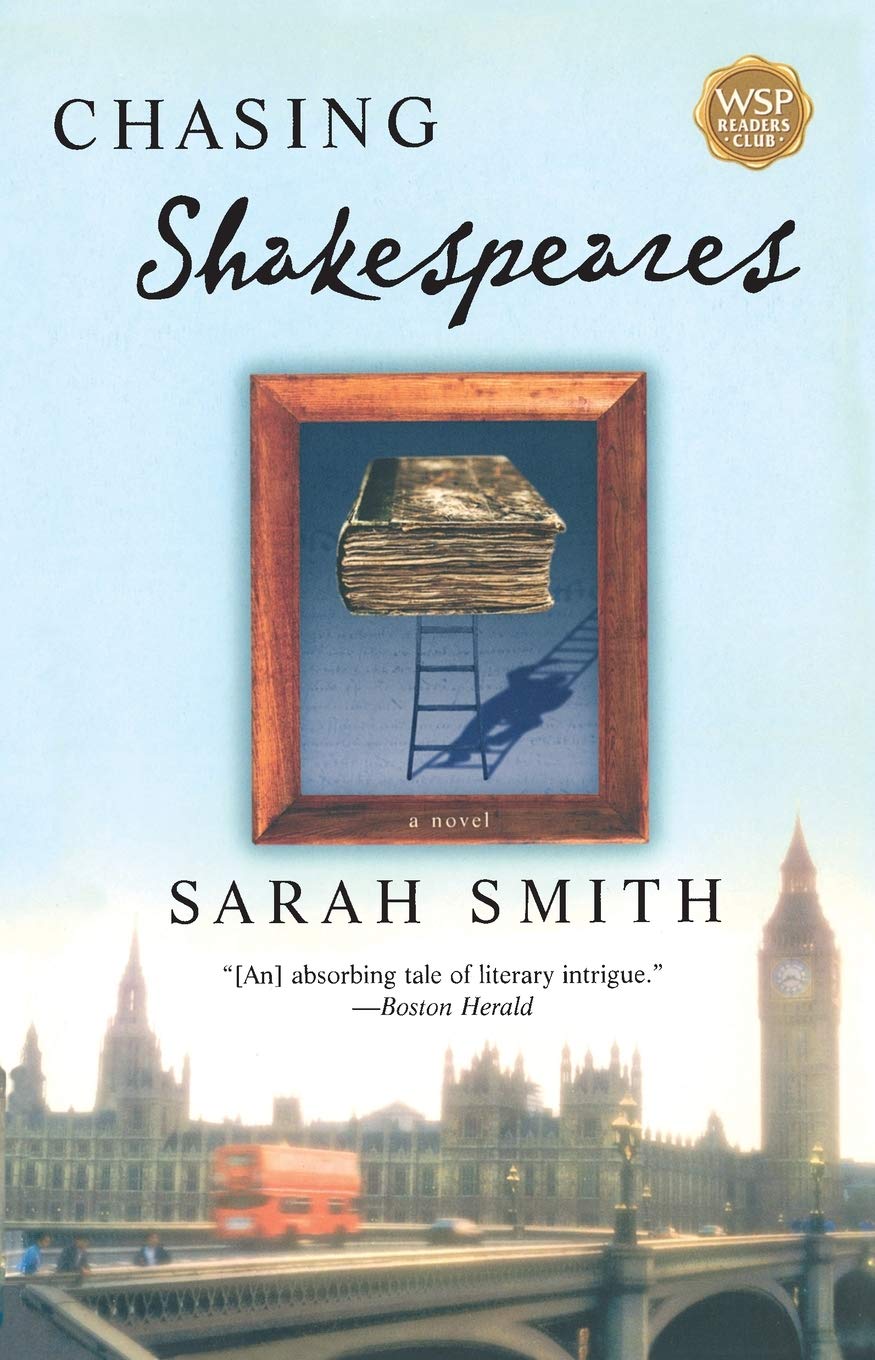
Smith, Sarah. Chasing Shakespeares. New York: Atria, 2003.
I just finished reading this very frustrating novel. The frustration arises in part because it deals with the authorship issue and in part because its plot is unsatisfactory; however, the main frustration is that this could have been a magnificent book but it falls spectacularly flat.
The three main characters are very interestingly drawn in the first fifty pages or so. Joe and Mary Cat are graduate students tasked with detailing the inventory of the imagined Kellogg Collection. The Collection is full of spurious and forged Shakespeareana. Indeed, it seems that it's nothing but forgeries. Mary Cat leaves to become a nun. Enter Posy Gould. She's meant to be the character who is endlessly attractive and alluring. The novel makes a big deal about the rumor that she has a tattoo of Queen Elizabeth I somewhere on her person (we never learn whether that's true or not).
All that is fine and quite interesting. And then Joe discovers a letter that he hopes with all his heart is another forgery. It's a letter from Shakespeare to Fulke Greville. It reads, in part (our graduate student has a fair amount of difficulty reading secretary hand, but he can make out this bit quite clearly), "Those that are given out as children of my brain are begot of his wit, I but honored with their fostering" (12; 35-36).
And that's where Posy stops talking like an interesting creation of the author. Instead, she starts to sound eerily like Charlton Ogburn, noted Oxfordian and author of The Mysterious William Shakespeare: The Man and the Myth.
Much of the rest of the book reads like very dull Oxfordian propaganda. Joe doesn't know what to think, but he explores the question seriously, including listening to all the old redating-the-play arguments necessary to keep Oxford actively composing after his death (and subsequent decomposing) in 1604.
I won't give any spoilers as to whether the letter is proved authentic, proved to be a forgery, or left in limbo between the two, but I will say that I was disappointed at the way the plot runs from the middle of the book to its end. The characters are forced into plot elements that strike me as false.
Yet the book could have been great. I'll need to read other works by Sarah Smith; she seems capable of good writing, and a novel without an agenda might demonstrate that better than this does.
Links: The Author's Web Site.
Friday, November 22, 2013
Tuesday, November 12, 2013
Kolberg and Henry V
Kolberg. Dir. Veit Harlan and Wolfgang Liebeneiner. Perf. Heinrich George, Kristina Söderbaum, and Horst Caspar. 1945. DVD. International Historic Films, 2013.
This post will attempt to bring together several separate strands of thought into a more-or-less cohesive whole. Wish me luck.
The delightful novel Friedrich Harris: Shooting the Hero (for which, q.v.) mentions the German propaganda film Kolberg in conjunction with the Laurence Olivier production of Henry V from 1944.
I watched Kolberg recently, and, although I haven't had much time to think about it, I think someone—someone who is not so far behind in the grading as I am—should consider the similarites between the scene below and Olivier's grand scene of horses galloping together at the beginning of the Battle of Agincourt (for which, q.v.).
Before the battle begins, there's a rousing speech. Then the armies gallop together in truly budget-breaking form.
I wonder—had the Nazi high command seen Olivier's Henry V? Were they interested in reclaiming Shakespeare for Germany (for which, q.v.)? Who has a bit of time—a Master's Thesis in Shakespeare and Film, for example—to investigate the possibilities?
Links: The Film at IMDB.
This post will attempt to bring together several separate strands of thought into a more-or-less cohesive whole. Wish me luck.
The delightful novel Friedrich Harris: Shooting the Hero (for which, q.v.) mentions the German propaganda film Kolberg in conjunction with the Laurence Olivier production of Henry V from 1944.
I watched Kolberg recently, and, although I haven't had much time to think about it, I think someone—someone who is not so far behind in the grading as I am—should consider the similarites between the scene below and Olivier's grand scene of horses galloping together at the beginning of the Battle of Agincourt (for which, q.v.).
Before the battle begins, there's a rousing speech. Then the armies gallop together in truly budget-breaking form.
I wonder—had the Nazi high command seen Olivier's Henry V? Were they interested in reclaiming Shakespeare for Germany (for which, q.v.)? Who has a bit of time—a Master's Thesis in Shakespeare and Film, for example—to investigate the possibilities?
Links: The Film at IMDB.
Thursday, October 31, 2013
SoxSpeare: A Sonnet on the World Series Victory of the Red Sox in 2013
Jones, Keith. "A Sonnet on the World Series Victory of the Red Sox in 2013." 31 October 2013.
The wager was made (for which, q.v.).
And now it's time to pay up.
I am very sad that the Cardinals did not win the World Series this year, but I must genuinely and sincerely acknowledge the true majesty of the Red Sox. They played astonishingly well.
At the end of the regular season, both teams were at the top of their divisions, tied with each other for the best win / loss percentage in baseball: .599. They were well-matched, and the World Series was filled with thrilling plays.
To honor my bet with Shakespeare Geek, I have written a sonnet in praise of the Red Sox. Enjoy.
Note: This sonnet made its way into a news story by KSDK reporter Anne Allred about bets that St. Louisans have had to settle since the end of the World Series:
The wager was made (for which, q.v.).
And now it's time to pay up.
I am very sad that the Cardinals did not win the World Series this year, but I must genuinely and sincerely acknowledge the true majesty of the Red Sox. They played astonishingly well.
At the end of the regular season, both teams were at the top of their divisions, tied with each other for the best win / loss percentage in baseball: .599. They were well-matched, and the World Series was filled with thrilling plays.
To honor my bet with Shakespeare Geek, I have written a sonnet in praise of the Red Sox. Enjoy.
A Sonnet on the World Series Victory of the Red Sox in 2013
Wear red upon your feet with hoops of steel.
Eat beans and cod and things Bostonians like.
Beware the vast green monster in left field.
It mocks the very balls that do it strike.
The Cardinals cannot say you taunt or tease—
We cannot blame the outcome on a curse.
We fear the beard and batting of Ortiz.
Of two teams meeting, one must be the worse.
Two teams, alike in dignity, did meet;
The Red Sox are the better team this fall.
Impediments did not impede your feet:
Your fielding, hitting, running stunned us all.
I must reply, to all repeated queries,
“The mighty Red Sox won this year’s World Series.”
Note: This sonnet made its way into a news story by KSDK reporter Anne Allred about bets that St. Louisans have had to settle since the end of the World Series:
Tuesday, October 29, 2013
New Silent King John Film
King John. Dir. Michael Merriam. Perf. John Glosser, Carolyn Bishop, Hugo Martin, Gabriel Kalomas, Tyler Heathman, and James Younis. 2013. Vimeo.
Shakespeare and Film aficionados often nerdily quiz people on what the very first Shakespeare film was. The answer is King John (for which, q.v.). And the qualifiers are (1) that it's just the deathbed scene, and (2) that it's about seventy-six seconds long.
That's one reason I was really fascinated to hear from Michael Merriam, the director of a new silent film version of King John—or, to be more specific, of its first scene. Aesthetically, it's enormously pleasing. And as a nostalgic connection to the first King John film ever made, it's peerless. Observe and enjoy:
Shakespeare and Film aficionados often nerdily quiz people on what the very first Shakespeare film was. The answer is King John (for which, q.v.). And the qualifiers are (1) that it's just the deathbed scene, and (2) that it's about seventy-six seconds long.
That's one reason I was really fascinated to hear from Michael Merriam, the director of a new silent film version of King John—or, to be more specific, of its first scene. Aesthetically, it's enormously pleasing. And as a nostalgic connection to the first King John film ever made, it's peerless. Observe and enjoy:
Monday, October 28, 2013
Lou Reed (R.I.P.) Performs the Dagger Speech from Macbeth
Reed, Lou. "The Dagger Speech." Macbeth. Unknown origin. Unknown date.
I enjoy collecting versions of the Dagger Speech from Macbeth. That speech alone can reveal a great deal about the direction the rest of the production is pursuing (cf., for example, this post, one of a series addressing various dagger speeches).
I also enjoy The Velvet Underground, Lou Reed's foundational, inspirational Rock 'n' Roll band. Saddened to learn of his death yesterday, I mentioned it to Shakespeare Geek, who often knows odd celebrity Shakespeare connections. He nearly instantly pointed me to this clip of Lou Reed reciting the Dagger Speech:
Flabbergasted is not too strong a term to describe how I felt on seeing that. I wanted to share it right away—even though the scholarly side wanted to wait until I knew more about where it came from. I'll try to track that information down; in the meantime, Candy Says that Stephanie Says that Lisa Says that Sweet Jane (Who Loves the Sun), Found a Reason that Lou Reed (and Sister Ray) are Beginning to See the Light—After Hours. And That's the Story of my Life. R.I.P., Lou Reed.
Note: Here's a second video file in case the file above vanishes:
I enjoy collecting versions of the Dagger Speech from Macbeth. That speech alone can reveal a great deal about the direction the rest of the production is pursuing (cf., for example, this post, one of a series addressing various dagger speeches).
I also enjoy The Velvet Underground, Lou Reed's foundational, inspirational Rock 'n' Roll band. Saddened to learn of his death yesterday, I mentioned it to Shakespeare Geek, who often knows odd celebrity Shakespeare connections. He nearly instantly pointed me to this clip of Lou Reed reciting the Dagger Speech:
Note: Here's a second video file in case the file above vanishes:
Wednesday, October 23, 2013
This Friday's Film Night at the MacLaurin Institute: Joss Whedon's Much Ado About Nothing
Much Ado About Nothing. Dir. Joss Whedon. Perf. Amy Acker, Alexis Denisof, Nathan Fillion, Clark Gregg, Reed Diamond, Fran Kranz, Jillian Morgese, Sean Maher, Spencer Treat Clark, Riki Lindhome, Ashley Johnson, Emma Bates, and Tom Lenk. 2012. DVD. Lions Gate, 2013.
At 7:00 p.m. this Friday, October 25, 2013, the MacLaurin Institute will be screening Joss Whedon's Much Ado About Nothing. Following the screening, I'll be leading a discussion on the film.
Come if you can. The film is redolent of a great deal of fruitful discussion (even if, as in the scene below, the acting is a bit uneven). For example, why did the director chose to place the first "war of wits" between Beatrice and Benedick in an inner courtyard with no one else observing their exchange?
Links: The Film at IMDB. More Information about the Screening.
At 7:00 p.m. this Friday, October 25, 2013, the MacLaurin Institute will be screening Joss Whedon's Much Ado About Nothing. Following the screening, I'll be leading a discussion on the film.
Come if you can. The film is redolent of a great deal of fruitful discussion (even if, as in the scene below, the acting is a bit uneven). For example, why did the director chose to place the first "war of wits" between Beatrice and Benedick in an inner courtyard with no one else observing their exchange?
I genuinely hope to see you there!
Links: The Film at IMDB. More Information about the Screening.
Monday, October 21, 2013
A Shakespearean Wager on the Globe . . . I mean World . . . Series
Author: To Be Determined. Title: To Be Determined. Date: 24 October 2013 at the earliest; 31 October 2013 at the latest.
Update: The Wager is Paid Off.
Careful readers of Bardfilm will already know that its author is fanatical about The St. Louis Baseball Cardinals (cf., for example, this post comparing Merchant of Venice and the 2011 World Series).
Careful readers of Shakespeare Geek will know that its author hails from Boston and is rabidly in favor of the Red Sox.
And that brings us to the current wager between the two blogs. In the interest of making the Series just a little bit more interesting, we've agreed to the following: The supporter of the losing team will have to write an original sonnet in praise of the winner's team and post it on his blog.
I'm not searching particularly hard for words that rhyme with "beans," "wicked good," or "fake beard," but I'm eager to supply rhymes for "Yaddi," "Wacha," and "Arch." When you're ready for them, Shakespeare Geek, just ask!
Bonus Material: The First Stanza of a Sonnet Combining the Glories of the Two Teams.
Update: The Wager is Paid Off.
Careful readers of Bardfilm will already know that its author is fanatical about The St. Louis Baseball Cardinals (cf., for example, this post comparing Merchant of Venice and the 2011 World Series).
Careful readers of Shakespeare Geek will know that its author hails from Boston and is rabidly in favor of the Red Sox.
And that brings us to the current wager between the two blogs. In the interest of making the Series just a little bit more interesting, we've agreed to the following: The supporter of the losing team will have to write an original sonnet in praise of the winner's team and post it on his blog.
I'm not searching particularly hard for words that rhyme with "beans," "wicked good," or "fake beard," but I'm eager to supply rhymes for "Yaddi," "Wacha," and "Arch." When you're ready for them, Shakespeare Geek, just ask!
Bonus Material: The First Stanza of a Sonnet Combining the Glories of the Two Teams.
My mistress’ eyes are nothing like the Sox.
The Cards wear red that makes her lip’s red thin.
If Sox be red, why then her socks are chalk.
If beards be wires, black wires grow on her chin.
Tuesday, August 27, 2013
Julius Caesar in (Naturally Enough) The Emperor's Club
The Emperor's Club. Dir. Michael Hoffman. Perf. Kevin Kline and Emile Hirsch. 2002. DVD. Universal Studios, 2003.
The school year is beginning again, and all the books and articles I've read and all the films I've seen have created a tremendous backlog.
One film that falls generally into the category of "teacher attempts to use Shakespeare to reach troubled students" is The Emperor's Club. Despite Kevin Kline's masterful performance, the film fell somewhat flat. The clip below has subtitles, which indicates that I watched it at three times the speed—and it seemed a little long at that.
Nonetheless, there's an interesting exchange related to Julius Caesar in the film. I've excerpted an obscenity in the middle of this exchange, but it's a student's attempt to critique Brutus' role in the assassination of Caesar—not in arguing that he ought not to have participated but in claiming that he didn't go far enough. It's an argument that the text itself invites us to contemplate, and this student, however disinterested in Shakespeare, has hit on a good question. Observe:
Links: The Film at IMDB.
The school year is beginning again, and all the books and articles I've read and all the films I've seen have created a tremendous backlog.
One film that falls generally into the category of "teacher attempts to use Shakespeare to reach troubled students" is The Emperor's Club. Despite Kevin Kline's masterful performance, the film fell somewhat flat. The clip below has subtitles, which indicates that I watched it at three times the speed—and it seemed a little long at that.
Nonetheless, there's an interesting exchange related to Julius Caesar in the film. I've excerpted an obscenity in the middle of this exchange, but it's a student's attempt to critique Brutus' role in the assassination of Caesar—not in arguing that he ought not to have participated but in claiming that he didn't go far enough. It's an argument that the text itself invites us to contemplate, and this student, however disinterested in Shakespeare, has hit on a good question. Observe:
Links: The Film at IMDB.
Thursday, August 22, 2013
Book Note: Shakespeare's Stationers
Straznicky, Marta, ed. Shakespeare's Stationers: Studies in Cultural Bibliography. Philadelphia: University of Pennsylvania Press, 2013.
Forgive the brevity of this post. I'm realizing more and more clearly that, if I don't jot down just a few notes on even the most important texts that I encounter very soon after I encounter them, I shall never jot down anything about them at all.
This collection of articles about the book trade of Shakespeare's day is marvelous and meticulous. Not every article will appeal to all readers, but I'm confident that there's something here for everyone.
I've been most moved by Kirk Melnikoff's "Nicholas Ling's Republican Hamlet (1603)" (95-111). It's encouraged me to return to a project I set out to accomplish many years ago: to read through Q1 of Hamlet—straight through, without reference to other editions of the play at all—in a facsimile. When the British Library revealed its astonishing on-line access to quartos of Shakespeare plays, I printed out Q1 of Hamlet with every intention of reading it through right away. Melnikoff's article has renewed that desire.
The entire volume serves to place William Shakespeare even more firmly in his cultural and historical context.
Forgive the brevity of this post. I'm realizing more and more clearly that, if I don't jot down just a few notes on even the most important texts that I encounter very soon after I encounter them, I shall never jot down anything about them at all.
This collection of articles about the book trade of Shakespeare's day is marvelous and meticulous. Not every article will appeal to all readers, but I'm confident that there's something here for everyone.
I've been most moved by Kirk Melnikoff's "Nicholas Ling's Republican Hamlet (1603)" (95-111). It's encouraged me to return to a project I set out to accomplish many years ago: to read through Q1 of Hamlet—straight through, without reference to other editions of the play at all—in a facsimile. When the British Library revealed its astonishing on-line access to quartos of Shakespeare plays, I printed out Q1 of Hamlet with every intention of reading it through right away. Melnikoff's article has renewed that desire.
The entire volume serves to place William Shakespeare even more firmly in his cultural and historical context.
Click below to purchase the book from amazon.com
(and to support Bardfilm as you do so).
Wednesday, August 21, 2013
Shakespeare in Arrested Development
“Bringing Up Buster.” By Mitchell Hurwitz and Richard Rosenstock. Perf. Justin Grant Wade, Jason Bateman, Michael Cera, Alia Shawkat, and David Cross. Dir. Joe Russo. Arrested Development. Season 1, episode 3. Fox. 16 November 2003. DVD. Twentieth-Century Fox, 2013.
A great amount of fluster and flurry surrounded the recent release of a new fourth season of Arrested Development. Having missed most of the episodes of the show when it originally aired and feeling reluctant to be left out, I started catching up. Not far in, I found some good Shakespeare.
The plot is complicated. Those who know the show probably already know what's going on; those who don't are advised to read the Wikipedia article on the episode for more details.
In short, the high school is putting on a production of Much Ado About Nothing; various members of the family try out for it for various reasons. The father of one (and the uncle of the other) takes over as the show's director in order to meddle. I've excerpted the key scenes in the clip below.
Links: The Episode at Wikipedia.
A great amount of fluster and flurry surrounded the recent release of a new fourth season of Arrested Development. Having missed most of the episodes of the show when it originally aired and feeling reluctant to be left out, I started catching up. Not far in, I found some good Shakespeare.
The plot is complicated. Those who know the show probably already know what's going on; those who don't are advised to read the Wikipedia article on the episode for more details.
In short, the high school is putting on a production of Much Ado About Nothing; various members of the family try out for it for various reasons. The father of one (and the uncle of the other) takes over as the show's director in order to meddle. I've excerpted the key scenes in the clip below.
Links: The Episode at Wikipedia.
Monday, August 19, 2013
Book Note: Loving Will Shakespeare
Meyer, Carolyn. Loving Will Shakespeare. Orlando: Harcourt, 2006.
The story of Anne Hathaway's relationship with William Shakespeare is here transformed into a young adult novel. It begins with a letter from Will to Anne in 1611; he announces his intention to return to Stratford permanently. Anne, our narrator, then takes us back to the beginning of her life, traces it through to her falling for, sleeping with, and being wedded to William Shakespeare.
The book is on the sappy side of the spectrum, and I'm afraid I didn't overly enjoy its characterization of Anne, who seems to fall in love with, to attempt to elope with, or to become affianced to a new man in just about every other chapter.
Still, it's pretty strong on general historical accuracy (apart from its characterization). And it's a quick and easy read. If that's what you're looking for, you've found it.
The story of Anne Hathaway's relationship with William Shakespeare is here transformed into a young adult novel. It begins with a letter from Will to Anne in 1611; he announces his intention to return to Stratford permanently. Anne, our narrator, then takes us back to the beginning of her life, traces it through to her falling for, sleeping with, and being wedded to William Shakespeare.
The book is on the sappy side of the spectrum, and I'm afraid I didn't overly enjoy its characterization of Anne, who seems to fall in love with, to attempt to elope with, or to become affianced to a new man in just about every other chapter.
Still, it's pretty strong on general historical accuracy (apart from its characterization). And it's a quick and easy read. If that's what you're looking for, you've found it.
Tuesday, July 9, 2013
A Perfect Twelfth Night at the Great River Shakespeare Festival
Twelfth Night. Dir. Paul Mason Barnes. Perf. Corey Allen, Doug Scholz-Carlson, Christopher Gerson, Tarah Flanagan, Donny Repsher, John Maltese, Kyle Cotton, Gerrad Alex Taylor, Benjamin Boucvalt, Brian White, Stephanie Lambourn, Laura Jacobs, Chris Mixon, Michael Fitzpatrick, Jonathan Gillard Daly, Robert Montgomery, Jamie Dufault, Peter Eli Johnson, Katie Bowler, Eva Rose Scholz-Carlson, Carter Briggs, Anna Scholz-Carlson, and Bailey Bestul. Great River Shakespeare Festival. Winona, Minnesota. 2013.
On Friday afternoon, I saw a rare thing indeed. I saw a perfect performance of Twelfth Night.
I've always admired the productions put on by the Great River Shakespeare Festival, but I was even more impressed than usual with Director Paul Barnes' Twelfth Night. The usual adjectives describing a Great River Shakespeare Festival performance—magnificent, marvelous, compelling, brilliant—are inadequate. Perfect is the only word.
Friday's performance redeemed the play for me. I've had a checkered past with Twelfth Night. My first encounter with Twelfth Night was on a grade school field trip. I was amazed at how much spit the actors produced, how funny my classmates thought that was (I was more interested than amused), and how much energy the actors expended while leaping about singing "Hold Thy Peace." In short, I enjoyed it very much.
And then Trevor Nunn's 1996 film version of the play came along. The film was so dark, dreary, and depressing that it put me entirely off the play. After that, I taught the play a few times in introductory literature classes, but without much interest and with very little passion.
In short, any production of Twelfth Night had a very long way to go to convince me of the humor, significance, and value of the play. The Great River Shakespeare Festival's production tore up all my doubts and left them in the dust by the side of the road a thousand miles away.
The production avoids every trap into which it could have fallen. Its melancholy parts are poignant and deep, but they do not tip the balance of the play into despondency. The humorous parts are hysterically funny, but they never descend into pointlessness. Malvolio's imprisonment is treated seriously but not with sadistic cruelty, and his response is measured, not casting a pall over the reconciliations at the end of the play.
Moreover, every single role was cast and played perfectly. Secondarily, the music was carefully and thoughtfully integrated into the play as a whole. Sixth and lastly, the set was beautifully constructed. Thirdly, the choreography—particularly of the scene in which Malvolio finds the letter—was brilliantly conceived and flawlessly executed. And, to conclude, the Great River Shakespeare Festival has produced a perfect Twelfth Night.
I could go on for days about the magnificent details of this production, but I need to curb my enthusiasm and keep myself to mentioning just a few small points.
The production is set in Victorian England at Christmas time. The costumes are generally dark and somber, fitting the mourning and melancholy that are, in part, the play's concerns. That somber look is balanced by the music and revelry. The characters (particularly those affiliated with Sir Toby Belch) occasionally break into a rowdy wassail, perfectly complementing the play's more somber moments. The show also made incredible use of the folk song "The Water is Wide" throughout. It became a theme of separation and eventual reunion and reconciliation.
Jonathan Gillard Daly's Feste was simply superb. His singing voice and his acting are at the topmost level, but he casually and seemingly-effortlessly delivers Feste's witty lines and songs. They felt completely comfortable and sustaining. The music for Feste's songs was written for this production, and it was magnificent. Indeed, if I were absolutely forced to admit that this production had some flaw somewhere, I would very reluctantly say that having live music (as the Great River Shakespeare Festival did with its Comedy of Errors in 2010) rather than canned would give even greater flexibility and depth to the excellencies of the performance.
Daly's Feste is also one who knows much. When he exits in Act I, scene v, he gives Malvolio a prophetic glance as he says "the fool shall look to the madman" (I.v.137-38). He also starts saying "Sir" with great, incredulous emphasis during an early exchange with Viola-disguised-as-Cessario. This gave a great and pleasing wisdom to the fool.
I was completely floored by Christopher Gerson's Malvolio. He played the sour and demanding steward with empathy, bringing out his honest sense of duty to Olivia to balance his less-pleasing characteristics. And he played Malvolio's imagination—both before and after his discovery of the letter—so vividly that we saw his every thought. Peter Saccio, who has lectured on this scene and who will be speaking at the Great River Shakespeare Festival later this summer, will be immensely pleased at Gerson's rendition of the character.
Gerson also was able, in the scene where the letter instructs him to smile, to keep the audience in hysterical laughter for three full minutes without saying a word. The experience was unparalleled—although we laughed nearly as much when he re-entered in yellow stockings (and a costume likewise vibrant with yellow). The dark and somber costuming and set design would be worth it if it only served as a contrast to Malvolio's yellow outfit.
Sir Toby Belch (Michael Fitzpatrick) and Sir Andrew Aguecheek (Chris Mixon) formed an astonishing pair, particularly when joined by Fabian (Brian White) and Maria (Laura Jacobs). Their comic timing could not have been better. Especially (but not exclusively) in the trickery scene, they hit the laugh lines and actions absolutely right—particularly when Fitzpatrick, Mixon, and White had to disguise themselves suddenly as a nativity scene under the Christmas tree behind which they had been hiding. Genius.
Tarah Flanagan's Viola was moving and funny and touching and remarkable. She was able to convey the bifurcated nature of her position—wishing to serve Orsino in his wooing of Olivia while desiring his love for herself—in a deeply sympathetic way. She was also able to banter with Feste, critique (and compliment) Olivia, and react to the news that her brother was still alive in extraordinarily complex ways. Flanagan's versatility as an actor was able to bring out the versatility in the character in astounding ways.
Too many other marvelous things happened in this performance to list, let alone to detail. I wish I could say more about the role of The Caroler (played by Doug Scholz-Carlson), who, Chorus-like, introduced us to the background of the play and served a something of a foil to Feste; the distribution of Christmas ornaments during the curtain call—and Malvolio's reception of only a lump of coal; the slapstick surrounding the fight between Viola and Sir Andrew; the decisions Paul Barnes made as director; and the power Corey Allen brought to the role of Orsino. Instead, I must on your imaginary forces work to fill that in—or, better yet, you can see the show yourself.
I do admonish each of you to get to the Great River Shakespeare Festival this year to see a perfect Twelfth Night.
Links: The Great River Shakespeare Festival.
On Friday afternoon, I saw a rare thing indeed. I saw a perfect performance of Twelfth Night.
I've always admired the productions put on by the Great River Shakespeare Festival, but I was even more impressed than usual with Director Paul Barnes' Twelfth Night. The usual adjectives describing a Great River Shakespeare Festival performance—magnificent, marvelous, compelling, brilliant—are inadequate. Perfect is the only word.
Friday's performance redeemed the play for me. I've had a checkered past with Twelfth Night. My first encounter with Twelfth Night was on a grade school field trip. I was amazed at how much spit the actors produced, how funny my classmates thought that was (I was more interested than amused), and how much energy the actors expended while leaping about singing "Hold Thy Peace." In short, I enjoyed it very much.
And then Trevor Nunn's 1996 film version of the play came along. The film was so dark, dreary, and depressing that it put me entirely off the play. After that, I taught the play a few times in introductory literature classes, but without much interest and with very little passion.
In short, any production of Twelfth Night had a very long way to go to convince me of the humor, significance, and value of the play. The Great River Shakespeare Festival's production tore up all my doubts and left them in the dust by the side of the road a thousand miles away.
The production avoids every trap into which it could have fallen. Its melancholy parts are poignant and deep, but they do not tip the balance of the play into despondency. The humorous parts are hysterically funny, but they never descend into pointlessness. Malvolio's imprisonment is treated seriously but not with sadistic cruelty, and his response is measured, not casting a pall over the reconciliations at the end of the play.
Moreover, every single role was cast and played perfectly. Secondarily, the music was carefully and thoughtfully integrated into the play as a whole. Sixth and lastly, the set was beautifully constructed. Thirdly, the choreography—particularly of the scene in which Malvolio finds the letter—was brilliantly conceived and flawlessly executed. And, to conclude, the Great River Shakespeare Festival has produced a perfect Twelfth Night.
I could go on for days about the magnificent details of this production, but I need to curb my enthusiasm and keep myself to mentioning just a few small points.
The production is set in Victorian England at Christmas time. The costumes are generally dark and somber, fitting the mourning and melancholy that are, in part, the play's concerns. That somber look is balanced by the music and revelry. The characters (particularly those affiliated with Sir Toby Belch) occasionally break into a rowdy wassail, perfectly complementing the play's more somber moments. The show also made incredible use of the folk song "The Water is Wide" throughout. It became a theme of separation and eventual reunion and reconciliation.
Jonathan Gillard Daly's Feste was simply superb. His singing voice and his acting are at the topmost level, but he casually and seemingly-effortlessly delivers Feste's witty lines and songs. They felt completely comfortable and sustaining. The music for Feste's songs was written for this production, and it was magnificent. Indeed, if I were absolutely forced to admit that this production had some flaw somewhere, I would very reluctantly say that having live music (as the Great River Shakespeare Festival did with its Comedy of Errors in 2010) rather than canned would give even greater flexibility and depth to the excellencies of the performance.
Daly's Feste is also one who knows much. When he exits in Act I, scene v, he gives Malvolio a prophetic glance as he says "the fool shall look to the madman" (I.v.137-38). He also starts saying "Sir" with great, incredulous emphasis during an early exchange with Viola-disguised-as-Cessario. This gave a great and pleasing wisdom to the fool.
I was completely floored by Christopher Gerson's Malvolio. He played the sour and demanding steward with empathy, bringing out his honest sense of duty to Olivia to balance his less-pleasing characteristics. And he played Malvolio's imagination—both before and after his discovery of the letter—so vividly that we saw his every thought. Peter Saccio, who has lectured on this scene and who will be speaking at the Great River Shakespeare Festival later this summer, will be immensely pleased at Gerson's rendition of the character.
Gerson also was able, in the scene where the letter instructs him to smile, to keep the audience in hysterical laughter for three full minutes without saying a word. The experience was unparalleled—although we laughed nearly as much when he re-entered in yellow stockings (and a costume likewise vibrant with yellow). The dark and somber costuming and set design would be worth it if it only served as a contrast to Malvolio's yellow outfit.
Sir Toby Belch (Michael Fitzpatrick) and Sir Andrew Aguecheek (Chris Mixon) formed an astonishing pair, particularly when joined by Fabian (Brian White) and Maria (Laura Jacobs). Their comic timing could not have been better. Especially (but not exclusively) in the trickery scene, they hit the laugh lines and actions absolutely right—particularly when Fitzpatrick, Mixon, and White had to disguise themselves suddenly as a nativity scene under the Christmas tree behind which they had been hiding. Genius.
Tarah Flanagan's Viola was moving and funny and touching and remarkable. She was able to convey the bifurcated nature of her position—wishing to serve Orsino in his wooing of Olivia while desiring his love for herself—in a deeply sympathetic way. She was also able to banter with Feste, critique (and compliment) Olivia, and react to the news that her brother was still alive in extraordinarily complex ways. Flanagan's versatility as an actor was able to bring out the versatility in the character in astounding ways.
Too many other marvelous things happened in this performance to list, let alone to detail. I wish I could say more about the role of The Caroler (played by Doug Scholz-Carlson), who, Chorus-like, introduced us to the background of the play and served a something of a foil to Feste; the distribution of Christmas ornaments during the curtain call—and Malvolio's reception of only a lump of coal; the slapstick surrounding the fight between Viola and Sir Andrew; the decisions Paul Barnes made as director; and the power Corey Allen brought to the role of Orsino. Instead, I must on your imaginary forces work to fill that in—or, better yet, you can see the show yourself.
I do admonish each of you to get to the Great River Shakespeare Festival this year to see a perfect Twelfth Night.
Bonus Image: The Fool and King Lear from the Great River Shakespeare Festival's 2012 season.
Links: The Great River Shakespeare Festival.
Tuesday, July 2, 2013
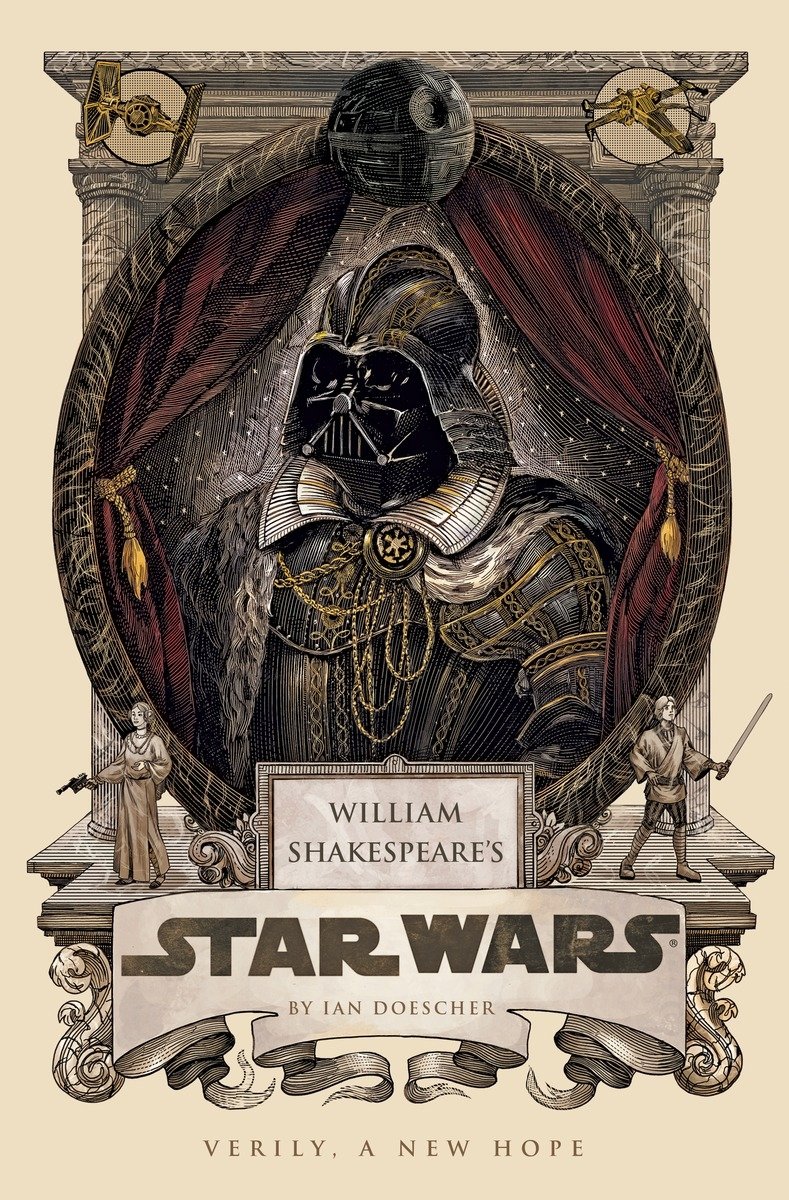
Book Note: William Shakespeare's Star Wars: Verily, A New Hope
Doescher, Ian. William Shakespeare's Star Wars: Verily, A New Hope. Philadelphia: Quirk Books, 2013.
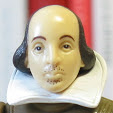
I have nothing against Novelty Shakespeare—not even when it's connected to Star Wars. Indeed, I think I was the first person to give the world these gimmicky gems:
Naturally, then, I was curious when I heard about a retelling of the plot of Star Wars: A New Hope entirely in iambic pentameter, and I was grateful when they sent me a copy. And the author of the book has clearly put a lot of thoughtful time into its creation. But, in all honesty, the book begin to pall pretty quickly. Good, strong lines lines like these (something of a silolquy by Darth Vader) . . .
I have nothing against Novelty Shakespeare—not even when it's connected to Star Wars. Indeed, I think I was the first person to give the world these gimmicky gems:
A Tauntaun! A Tauntaun! The Third Moon of the Ice Planet Hoth for a Tauntaun!
Alas, poor Yorick. I knew him, Obi-wan. Pah! And I thought he smelled bad on the outside!
Act III, scene ii. Another part of the heath. Stormtroopers still.
Jedi have died from time to time, and worms have eaten them—but they always come back as shiny, shiny ghosts.
Note: For others, see this post on Shakespeare Geek's blog.You don't need to see his identification. We don't need to see his identification. The Earl of Oxford is not the poet you're looking for. The Earl of Oxford is not the poet we're looking for. He can go about his scholarship without distractions about the authorship issue. You can go about your scholarship without distractions about the authorship issue. Move Along. Move along.
Luke, I am thy father's spirit, doomed for a certain term to walk the night.
Naturally, then, I was curious when I heard about a retelling of the plot of Star Wars: A New Hope entirely in iambic pentameter, and I was grateful when they sent me a copy. And the author of the book has clearly put a lot of thoughtful time into its creation. But, in all honesty, the book begin to pall pretty quickly. Good, strong lines lines like these (something of a silolquy by Darth Vader) . . .
. . . are offset by lines that are a bit too tedious:And so another dies by my own hand,
This hand, which now encas’d in blackness is.
O that the fingers of this wretched hand
Had not the pain of suff’ring ever known.
But now my path is join’d unto the dark,
And wicked men—whose hands and fingers move
To crush their foes—are now my company.
So shall my fingers ever undertake
To do more evil, aye, and this—my hand—
Shall do the Emp’ror’s bidding ever more.
And thus we see how fingers presage death
And hands become the instruments of Fate. (I.ii.27-38)
On the other hand, the publisher has put together this amusing trailer for the book:LUKE: It seemeth that the Sand People have done
This wretched deed—yon gaffi sticks and tracks
Of bantha, aye. But ne’er in all my years
Have Tuskens gone awry so far as this.
OBI-WAN: And they have not, though they who this vile deed
Have done, would make us think Sand People did.
But hark! Take note, and look ye thereupon:
Yon tracks are side by side, yet Sand People,
’Tis known, e’er one behind the other ride,
So better may they hide their numbers large. (II.iv.1-10)
The book is excellent in the genre of Novelty Shakespeare and will make a lovely gift for the Star Wars and / or Shakespeare fans in your life, but I'm not certain it will bear multiple readings.
Thursday, June 27, 2013
Horatio in Star Trek
“Conspiracy.” By Tracy Tormé and Robert Sabaroff. Perf. Patrick Stewart, Jonathan Frakes, LeVar Burton, Michael Dorn, Denise Crosby, Gates McFadden, Marina Sirtis, Brent Spiner, and Wil Wheaton. Dir. Cliff Bole. Star Trek: The Next Generation. Season 1, episode 25. Syndicated television. 9 May 1988. DVD. Paramount, 2002.
Every time I think my Shakespeare and Star Trek Complete post is complete, I find just one more reference to Shakespeare.
Near the end of Star Trek: The Next Generation's first season, the captain of the USS Enterprise has a secret meeting with the captains of three other starships. One of those ships is named the USS Horatio.
Some may think that the starship is named for Horatio Nelson, but I think it more likely to have been named after the character in Hamlet. Watch the salient points in the clip below and see if you don't agree:
Links: Shakespeare and Star Trek Complete. The Noble Heart of Star Trek.
Every time I think my Shakespeare and Star Trek Complete post is complete, I find just one more reference to Shakespeare.
Near the end of Star Trek: The Next Generation's first season, the captain of the USS Enterprise has a secret meeting with the captains of three other starships. One of those ships is named the USS Horatio.
Some may think that the starship is named for Horatio Nelson, but I think it more likely to have been named after the character in Hamlet. Watch the salient points in the clip below and see if you don't agree:
Alas, poor Horatio.
The Horatio is an ambassador-class vessel. In Hamlet, Horatio's involvement with the new reign of Fortinbras at the end of the play makes him a de facto ambassador. The Horatio is associated with a large amount of wreckage. In Hamlet, Horatio is associated with all those dead bodies lying around the stage. It's pretty clear that the ship is named after the character in Hamlet, making this one more Shakespeare allusion in Star Trek.
Note: For more connections between Hamlet and Star Trek, try The Noble Heart of Star Trek, a recent project by a student at The George Washington University.
Links: Shakespeare and Star Trek Complete. The Noble Heart of Star Trek.
Wednesday, June 26, 2013
See the First U.S. Preview Screening of Muse of Fire at the Great River Shakespeare Festival
Muse of Fire. Dir. Dan Poole and Giles Terera. Perf. Dan Poole, Giles Terera,
Ian McKellen, Judi Dench, Ralph Fiennes, John Hurt, Ben Kingsley, Michael Gambon, Zoë Wanamaker, Jeremy Irons, and Simon Russell Beale. Muse of Fire Film, Timebomb Pictures, Lion Television, 2013. Screening at the Great River Shakespeare Festival on 6 July 2013 at 10:30 a.m.
The Great River Shakespeare Festival. 26 June to 4 August 2013.
The Great River Shakespeare Festival offers some of the best Shakespeare productions in the midwest. This year, the Festival presents Twelfth Night and Henry V, and that's thrilling enough.
But, in conjunction with Winona’s Frozen River Film Festival, they are also offering a preview screening, for the first time in the United States, the documentary Muse of Fire, an innovative film in which two actors set out on a quest to find out more about Shakespeare. And they seem to have interviewed everyone from Dame Judi Dench to Sir Ian McKellen—and even people who don't have OBEs—in their effort to do so.
The preview screening will be on July 6, 2013, at 10:30 a.m.
I could say more, but let me allow the actors and directors to make the case themselves for coming to the preview screening at The Great River Shakespeare Festival:
And if that doesn't move you, let me tell you this: I, Bardfilm, will be there in person to lead a discussion after the screening.
All right. If even that doesn't move you, perhaps this picture of Sir Ian Mckellen during the making of the film will be the final encouragement that will enable you to come see the film:
I hope to see you there!
Links: The Official Site for Muse of Fire. The Film at IMDB. The Great River Shakespeare Festival.
The Great River Shakespeare Festival. 26 June to 4 August 2013.
The Great River Shakespeare Festival offers some of the best Shakespeare productions in the midwest. This year, the Festival presents Twelfth Night and Henry V, and that's thrilling enough.
But, in conjunction with Winona’s Frozen River Film Festival, they are also offering a preview screening, for the first time in the United States, the documentary Muse of Fire, an innovative film in which two actors set out on a quest to find out more about Shakespeare. And they seem to have interviewed everyone from Dame Judi Dench to Sir Ian McKellen—and even people who don't have OBEs—in their effort to do so.
The preview screening will be on July 6, 2013, at 10:30 a.m.
I could say more, but let me allow the actors and directors to make the case themselves for coming to the preview screening at The Great River Shakespeare Festival:
If that doesn't sway you, take a look at the trailer for the film. It's brilliant:
And if that doesn't move you, let me tell you this: I, Bardfilm, will be there in person to lead a discussion after the screening.
All right. If even that doesn't move you, perhaps this picture of Sir Ian Mckellen during the making of the film will be the final encouragement that will enable you to come see the film:
I hope to see you there!
Links: The Official Site for Muse of Fire. The Film at IMDB. The Great River Shakespeare Festival.
Subscribe to:
Posts (Atom)
Bardfilm is normally written as one word, though it can also be found under a search for "Bard Film Blog." Bardfilm is a Shakespeare blog (admittedly, one of many Shakespeare blogs), and it is dedicated to commentary on films (Shakespeare movies, The Shakespeare Movie, Shakespeare on television, Shakespeare at the cinema), plays, and other matter related to Shakespeare (allusions to Shakespeare in pop culture, quotes from Shakespeare in popular culture, quotations that come from Shakespeare, et cetera).
Unless otherwise indicated, quotations from Shakespeare's works are from the following edition:
Shakespeare, William. The Riverside Shakespeare. 2nd ed. Gen. ed. G. Blakemore Evans. Boston: Houghton Mifflin, 1997.
All material original to this blog is copyrighted: Copyright 2008-2039 (and into perpetuity thereafter) by Keith Jones.
—The Tempest