Monday, February 9, 2009

Peter Brook's 1970 Midsummer Night's Dream

“Shakespeare: Drama’s DNA.” Perf. Richard Eyre, Peter Brook, and Judy Dench. Dir. Roger Parsons. Changing Stages: 100 Years of Theatre. Episode 1. BBC. 5 November 2000. Videocassette. Films for the Humanities, 2001.
Another genuinely micro MicroBlog post follows.

I wish I had more time to comment on this clip of Peter Brook's 1970 stage production of Midsummer Night's Dream. The clip appeared on the video listed above—more evidence (if any were needed) that those inconspicuous videocassettes in the basement of your local library often yield marvelous treasure.

The production was a truly innovative one, and it influenced scads of Shakespeareans. David Bevington, for example, writes this about it:
[Jan] Kott's challenging interpretation had an immense effect on theatrical performances of Shakespeare, as seen for example in Peter Brook's A Midsummer Night's Dream(1970), with its intensely metatheatrical demystifying of fairy magic; gone were realistic scenery and fairies with gossamer-winged costumes in favour of a white box filled with circus--act performers on trapezes. (239-40)
Peter Orgel calles it "Peter Brook's famous, dazzling, radically-destabilizing production of 1970" (86).

And here, ladies and gentlemen, is a glimpse at the production:


Note: A newer post incorporates a few more clips from this production.


Works Cited

Bevington, David. Shakespeare: Seven Ages of Human Experience. 2nd ed. Oxford: Blackwell, 2005.

Orgel, Stephen. Imagining Shakespeare: A History of Texts and Visions. Palgrave: Houndmills, Basingstoke, 2003.

Friday, February 6, 2009

New Tempest and New Lear on the Horizon

Tempest. Dir. Julie Taymor. Perf. Helen Mirren, Djimon Hounsou, Felicity Jones, and Ben Whishaw. Chartoff Productions, 2009.
No one tells me anything! It's only recently come to my attention that Julie Taymor is directing a film version of The Tempest and Al Pacino and Michael Radford are planning to do King Lear.

Julie Taymor's Tempest, as one would expect from the director of Titus and Across the Universe, is visually intriguing. Also, Helen Mirren plays Prospera (no, that's not a typo: the female Prospero will go by Prospera in this film). And that's bound to be exciting!

Pacino's Lear, which I learned about from ShakespeareGeek, is also interesting. It will be directed by Michael Radford, who directed Pacino in his recent Merchant of Venice. According to the article in Variety, " "Radford, who wrote the script, is making his second Shakespearean foray with Pacino." Wrote the script? Really? Not "adapted the play" or "composed the screenplay"?

In any case, my view is that the more Shakespeare films we have, the more we can think and talk about Shakespeare. I imagine Taymor's will be brilliant and Radford / Pacino's will muddle through. But I'm prepared to be surprised on both counts.


Links: Taymor's Tempest at IMDB.

Thursday, February 5, 2009

Stewie Griffin as Richard III

“The King is Dead.” By Craig Hoffman. Perf. Seth MacFarlane and Alex Borstein. Dir. Monte Young. Family Guy. Season 2, episode 7. FOX. 28 March 2000. DVD. Twentieth Century Fox, 2003.

A student recently called my attention to a Richard III reference in Family Guy.

I wasn't able to find a video clip, but I did track down the audio, which I've mashed up in this mix of Laurence Olivier and The Family Guy Players. Note: Due to the great YouTube crash of 2009, the mash-up has been lost. Instead, here's the actual footage.


Click below to purchase the full run from amazon.com
(and to support Bardfilm as you do so).

Wednesday, February 4, 2009

Special Offer on Tickets from the Guthrie Theatre

Two Gentlemen of Verona. Dir. Joe Dowling. Perf. Sasha Andreev, Sam Bardwell, Michael Booth, Sun Mee Chomet, Laura Esping, Nathaniel Fuller, Jonas Goslow, Hugh Kennedy, Jim Lichtscheidl, Valeri Mudek, Kris L. Nelson, Lee Mark Nelson, Isabell Monk O'Connor, Randy Reyes, John Skelley, and Wyatt Jensen. Guthrie Theatre Company. Minneapolis. 24 January—29 March 2009.
The Guthrie has very kindly extended readers of Bardfilm a special price for tickets to its production of Two Gentlemen of Verona! Please see the details below—and come join the many-headed multitude as we enjoy one of Shakespeare's delightful early comedies.
Enjoy $20 tickets to any Sunday, Tuesday, or Wednesday Evening performance of The Two Gentlemen of Verona, playing now until March 29 on the Wurtele Thrust Stage at the Guthrie. To order tickets, please call the Guthrie Box office at 612-377-2224 and quote price code A74. Excludes Area 1 seating. Offer not valid online or on previously purchased tickets.
Thank you very much, Guthrie, for your kind offer!

Links: The Guthrie Theatre.

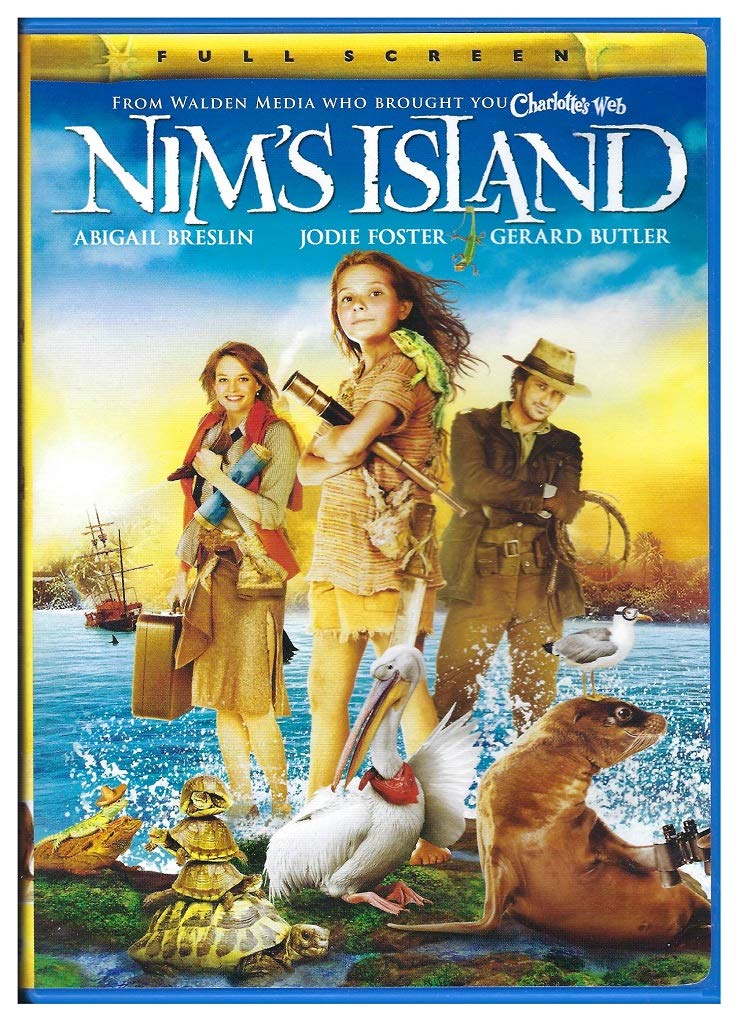
O Brave New World: Nim's Island as The Tempest

Nim’s Island. Dir. Jennifer Flackett and Mark Levin. Perf. Abigail Breslin, Jodie Foster, and Gerard Butler. 2008. DVD. Twentieth Century Fox, 2008.

Some time ago, I argued that the film version of Nim's Island is a [very] loose retelling of The Tempest.

Now I have more substantial evidence to back up that claim.

Observe what happens when Nim, uncertain whether the boy who has wandered away from a group of tourists into the interior of her island is real or not, recognizes that he's as real as she is:

                                                          O, wonder!
How many goodly creatures are there here!
How beauteous mankind is! O brave new world,
That has such people in't! (V.i.182-85)
Nim is Miranda.  That's all there is to it.

The original claim (and Wendy Orr's comments) can be found elsewhere on this blog.

Links: Official site for the movie

Click below to purchase the film or the book 
from amazon.com (and to support Bardfilm as you do so).


Tuesday, February 3, 2009

The Guthrie Theatre Presents Two Gentlemen of Verona

Two Gentlemen of Verona. Dir. Joe Dowling. Perf. Sasha Andreev, Sam Bardwell, Michael Booth, Sun Mee Chomet, Laura Esping, Nathaniel Fuller, Jonas Goslow, Hugh Kennedy, Jim Lichtscheidl, Valeri Mudek, Kris L. Nelson, Lee Mark Nelson, Isabell Monk O'Connor, Randy Reyes, John Skelley, and Wyatt Jensen. Guthrie Theatre Company. Minneapolis. 24 January—29 March 2009.
The same director who gave us A Midsummer Night's Dream last season (for which, q.v.) is currently directing the Guthrie's production of Two Gentlemen of Verona. I promise a review once I've seen it; in the meantime, you'll have to be content with the image from the newspaper and it's lovely caption (click the image above to enlarge it). Although the seeming strangeness of the first phrase of the caption can be explained away by the fact that the dog's name sounds very much like a person's name, I still think a picture with a man and a dog and the phrase "Jim Lichtscheidl, left" is a little odd.

However, I can't want to see Wyatt Jensen's Crab. His portrayal of Moonshine's dog (opposite an intriguing thorn bust and a well-mannered lanthorn) was understated but effective.

Links: The Guthrie Theatre.

Monday, February 2, 2009

The Emperor and Henry V

Henry V. Dir. Kenneth Branagh. Perf. Kenneth Branagh, Emma Thompson, and Judi Dench. 1989. DVD. MGM, 2000.

The Empire Strikes Back. Dir. Irvin Kershner. Perf. Mark Hamill, Harrison Ford, Carrie Fisher, and James Earl Jones. 1980. DVD.  Twentieth-Century Fox, 2008.

This possible allusion to The Empire Strikes Back is much more tenuous than the previous one, but the idea that Branagh's Henry V embodies both Darth Vader and the Emperor—the only one who could command Darth Vader—is intriguing.  It's particularly intriguing in a scene where Henry V thinks back on the evils his father had done.  Hmmm.  Maybe it's not so tenuous!


Links: The Empire Strikes Back at IMDB. Henry V at IMDB.

Click below to purchase the films from amazon.com
(and to support Bardfilm as you do so).


Darth Vader and Henry V

Henry V. Dir. Kenneth Branagh. Perf. Kenneth Branagh, Emma Thompson, and Judi Dench. 1989. DVD. MGM, 2000.

Star Wars. Dir. George Lucas. Perf. Mark Hamill, Harrison Ford, Carrie Fisher, and James Earl Jones.

Allusions in film are tricky. Is one film alluding to another? It is paying it homage? It is plagiarism? Or is it all in the mind of the viewer?

In these two scenes, I think that Branagh is making an allusion to Star Wars:


When I asked my students whether they got a sense of Darth Vader's entrance (without showing the two clips side-by-side), they thought it extremely likely.

But I don't yet know whether the allusion is more purposeful than giving us a powerful entrance—one which, in Henry V's case, is undermined somewhat by his extreme youth and small stature. Shakespeare's Henry has a dark side that Branagh's usually lacks. Is the visual allusion to Darth Vader an attempt to present this aspect subtly? Or is it just kind of neat?

Links: Star Wars at IMDB. Henry V at IMDB.

Click below to purchase the films from amazon.com
(and to support Bardfilm as you do so).


Thursday, January 29, 2009

Sonnet 94

Selected Sonnets. Dir. Kevin Billington. Perf. Michael Bryant and John Mortimer. Videocassette. Films for the Humanities, 1988.
You're apt to find some odd things when you wander around the videocassette section of a college library. Handbell care videos, advanced bowling seminars, cat show documentaries, and presentations of Shakespeare sonnets are among these oddities.

In the last category, I found a video with John Mortimer offering some explication of Sonnet 94: "They that have power to hurt, and yet do none." First, an actor reads (quite well, I think) the sonnet; then Mortimer offers some thoughts. I'm only offering a small but representative sample of his delightful ten-minute commentary:


There you have a slice of what is really quite an interesting video—though the commentators are far too inclined to state with absolute and reductive certainty which precise people Shakespeare had in mind while writing the sonnets. As an example of the limits and benefits of what is now called "Old Historicism," it works well.

And that final, stunning couplet keeps ringing in my ears:
For sweetest things turn sourest by their deeds;
Lilies that fester smell far worse than weeds.

Click below to purchase the film from Films for the Humanities and Sciences

Tuesday, January 27, 2009

Shakespeare in Vietnam

A Dream in Hanoi: A True Story of Love, Stage Fright, and Noodle Soup. Dir. Tom Weidlinger. Perf. The Central Dramatic Company of Vietnam; Artists Repertory Theatre of Portland, Oregon; F. Murray Abraham. 2002. Videocassette. Bullfrog Films, 2002.
This magnificent documentary tells the story of a collaborative production of A Midsummer Night's Dream by two acting companies—one Vietnamese, one American. The entire process is fascinating beyond belief, especially when it centers on the places where the two cultures clash.

In this brief clip, we see the clash manifesting itself in the directors' visions of Puck:


These singing, laughing, drum-beating servants become the source of a number of conflicts throughout the rest of the rehearsals and the production run. Yet there is more at work here than two directors’ competing ideas of what constitutes a valid adaptation of a Shakespeare play. East and west are brought together, but the result is far from harmonious. The reason for the dissonance lies in the west—in its reluctance to collaborate, to compromise, to comprehend another culture, and to carry out its stated intentions consistently and conscientiously.

Doan's idea of adding servants for Puck seems to be the ideal place for a Vietnamese appropriation of Shakespeare (rather than the other way around). Doan is appealing to the Cheo drama itself. Cheo drama and Vietnamese water puppetry are two forms of dramatic entertainment that are uniquely Vietnamese. Each developed over several centuries, and each has its own conventional characters, stories, and songs. Cheo drama traditionally tells stories in an intensely lyrical manner, and these stories are nearly always humorous and quite frequently involve turning ordinary things inside out and upside down. They are always accompanied by song and dance and the characters are painted with broad, stereotypical brushes. If all that is reminiscent of the commedia d’elle arte, it should also sound like the Athenian actors in the forest—and like A Midsummer Night’s Dream itself.

At other parts of the documentary, one of the American producers describes Doan's efforts as “Broadway extravaganza” and mentions them in the same breath as “Disneyland and Peter Pan.” This seems profoundly layered—to bring typical American flamboyancy to describe a subtle, long-lasting Vietnamese tradition and to object to it because such things have no place in Shakespeare.
Links: The Film at IMDB.

Click below to purchase (or rent) the film from Bullfrog Films.

Monday, January 26, 2009

Non Nobis: Branagh's Henry V

Henry V. Dir. Kenneth Branagh. Perf. Kenneth Branagh, Emma Thompson, and Judi Dench. 1989. DVD. MGM, 2000.

I've written about this scene before, but a comment from Alex Bledsoe made me revisit the scene.

Earlier, I was interested in the women who approach Henry in the middle of the scene; this time, I'm interested in the long, tracking shot that takes us over the exhausted battlefield (the movement from left to right after the battle is a mirror image of the movement from right to left in Olivier's Henry V before the battle) while the Non Nobis swells in the background. Take a look:


Now that you've seen that, think about the purpose(s) behind portraying the scene with that music and those words (Non nobis, Domine—Non nobis, sed nomine tuo de Gloriam:  "Not to us, O Lord, but to your name be glory") over it. Could it be that this Henry V is passing not only the responsibility of the victory to God—"Praised be God, and not our strength, for it" (IV.vii.86)—but also the blame of the battle's many dead—"Take it, God, / For it is none but thine" (IV.viii.112-13)?

Perhaps that case would be easier to make if they were singing Non nobis, sed nomine tuo de culpa, but I'd like everyone to consider the possibility at least.

Links: The Film at IMDB.

Click below to purchase the film from amazon.com
(and to support Bardfilm as you do so).

Thursday, January 22, 2009

Olivier's Richard III: The Image of the Crown

Richard III. Dir. Laurence Olivier. Perf. Laurence Olivier and Sir John Gielgud. 1955. DVD. Criterion, 2004.

I've been having some trouble uploading some interesting clips, but that's no reason you should suffer without a dose of Shakespeare and Film.

Our class watched parts of Olivier's Richard III in class this week. In that film, the crown becomes the image par excellence. In the image above, Richard has walked directly in a line from a giant crown hanging from the ceiling toward the camera—until the crown appears to be on his own head. Here's a close-up of that image for better viewing:


It's none too subtle, but it's interesting. It's also interesting to see, in the earlier image, how unlikely Richard is to fit into the crown. In this image, it looks completely unobtainable:

The closer Richard is to the audience, the more fitting the crown seems to be.  That's metaphorical, but it turns out to be metaphorical on a number of different levels.

Links: The Film at IMDB.

Click below to purchase the film from amazon.com
(and to support Bardfilm as you do so).

Tuesday, January 20, 2009

John Mortimer, RIP

Will Shakespeare [a.k.a. Life of Shakespeare]. By John Mortimer. Perf. Tim Curry and Ian McShane. Dir. Mark Cullingham and Robert Knights. 1978. DVD. A & E Home Video, 2008.

R.I.P. stands for Rumpole in Peace. Yesterday, the author of the Rumpole of the Bailey books, numerous telescripts, and the 1978 Will Shakespeare, which starred Tim Curry as Shakespeare, died at his home.

Bardfilm's interest in him lies mainly in his authoring Will Shakespeare. In his honor, let's look at a thought-provoking scene from that miniseries.

In this section, Tim Curry plays William Shakespeare playing George, Duke of Clarence in Richard III. The scene opens with Clarence's dream about his own death. Backstage, the mother of a young and aspiring actor is dying of plague. In order to cheer him up (and to prevent him from reporting the death by plague, which would close the theatre), the company offers him everything at their disposal. All he wants, however, is to play Lady Anne:


The metatheatrical element is hard to miss: Sir John Mortimer takes the speech Shakespeare gave to Clarence foreshadowing Clarence's death to a character called Will Shakespeare who has given them to the Clarence that he himself plays. While that Clarence speaks, mortality is heavy in the air.

Click below to purchase the film from amazon.com
(and to support Bardfilm as you do so).

Monday, January 19, 2009

Best Henry V Battle Scene: "Think, when we talk of horses—"

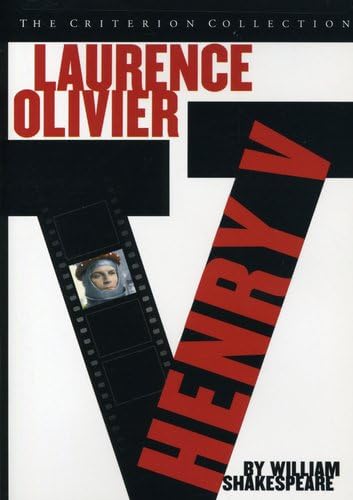
Henry V. Dir. Laurence Olivier. Perf. Laurence Olivier and Renée Asherson. 1944. DVD. Criterion, 1999.

The number of things to say about Laurence Olivier's Henry V boggles the mind. I'm always of two minds about it—whether to show all of Olivier's and bits and pieces of Branagh's or all of Branagh's and bits and pieces of Olivier's. (I usually go with Branagh's because it generally pleases the many-headed more than Olivier's does).

But Olivier's does have a remarkable opening. And it does have this remarkable battle scene. It's simply amazing how long the camera tracks with the galloping horses. It's wonderful. The Chorus of the play enjoins us to
Think, when we talk of horses, that you see them
Printing their proud hoofs i' the receiving earth.
With Olivier's film (no offense, Shakespeare!), we don't need to use our imaginations quite so much:


Links: The Film at IMDB.

Click below to purchase the film from amazon.com
(and to support Bardfilm as you do so).

Friday, January 16, 2009

Which is the Merchant here? And which The Shrew?

Merchants of Venice. Dir. Various. Perf. Various. Various Years. Various Formats.

The Tamings of the Shrews. Dir. Various. Perf. Various. Various Years. Various Formats.

The results came in on the poll about which play(s) / film(s) to cut from the Shakespeare and film syllabus.  No one wanted to cut Richard III or Henry V; the votes were almost right down the middle for cutting either The Merchant of Venice or The Taming of the Shrew.

So I kept them both and added The Tempest.

I know, I know. The whole point was to streamline the syllabus to make room for additional works.  And I've added works without subtracting any.  But I couldn't not have Kiss me, Kate.  It's just such a marvelous musical!  And I really couldn't not present my students with the extraordinary power of Trevor Nunn's Merchant.  And the Mary Pickford / Douglas Fairbanks Taming of the Shrew is extraordinarily important for an understanding of cinema history (and it's the only full-scale, Hollywood studio, feature-length version of a Shakespeare play that we cover in full in the class).

So I've re-arranged things so that we watch pieces of most of these, and I hope that will whet the students' appetites for more, more, more!

Speaking of more, here are some more images of each of these actors in these roles:

Merchant of Venice. Dir. John Sichel Perf. Laurence Olivier, Joan Plowright, Jeremy Brett, and Michael Jayston. 1973. Videocassette. LIVE Home Video, 1993.

Merchant of Venice. Dir. Trevor Nunn. Perf. Gabrielle Jourdan and Lawrence Werber. 2001. Videocassette. Lexington Road Entertainment Group, 2001.

Merchant of Venice. Dir. Michael Radford. Perf. Al Pacino, Jeremy Irons, Joseph Finnes, and Lynn Collins. 2004. DVD. Sony Pictures, 2005.

The Taming of the Shrew. Dir. Sam Taylor. Perf. Mary Pickford and Douglas Fairbanks. 1929. DVD. Aikman Archive, 2005.

The Taming of the Shrew. Dir. Franco Zeffirelli. Perf. Elizabeth Taylor and Richard Burton. 1967. DVD. Sony, 1999.

Kiss me, Kate. Dir. George Sidney. Perf. Kathryn Grayson, Howard Keel, and Ann Miller. 1953. DVD. Warner Home Video, 2003.


Bardfilm is normally written as one word, though it can also be found under a search for "Bard Film Blog." Bardfilm is a Shakespeare blog (admittedly, one of many Shakespeare blogs), and it is dedicated to commentary on films (Shakespeare movies, The Shakespeare Movie, Shakespeare on television, Shakespeare at the cinema), plays, and other matter related to Shakespeare (allusions to Shakespeare in pop culture, quotes from Shakespeare in popular culture, quotations that come from Shakespeare, et cetera).

Unless otherwise indicated, quotations from Shakespeare's works are from the following edition:
Shakespeare, William. The Riverside Shakespeare. 2nd ed. Gen. ed. G. Blakemore Evans. Boston: Houghton Mifflin, 1997.
All material original to this blog is copyrighted: Copyright 2008-2039 (and into perpetuity thereafter) by Keith Jones.

The very instant that I saw you did / My heart fly to your service; there resides, / To make me slave to it; and, for your sake, / Am I this patient [b]log-man.

—The Tempest