Thursday, January 15, 2009

Dogberry and the Keystone Cops?

Much Ado about Nothing. Dir. A. J. Antoon and Nick Havinga. Perf. Sam Waterson, Kathleen Widdoes, Barnard Hughes, and Douglas Watson. 1973. DVD. Kultur, 2002.

The New York Shakespeare Festival did a version of Much Ado about Nothing set in the early 1900s—during Teddy Roosevelt's administration. It's a fairly good, fairly straightforward version. And it has at least the distinction of having a comprehensible Dogberry: Barnard Hughes plays the role forcefully and articulately.

Even more memorable than that is what the production does with Shakespeare's Men of the Watch. They have been transmuted into Keystone Cops.

I offer, for your educational edification, a clip that demonstrates both these claims.


Now that you've watched that, I can offer this image:

The Men of the Watch Thumb their Noses at Dogberry

The film itself is a filmed-for-television version of a stage production.  On the whole, it's light-hearted.  It's not nearly as extravagant as Branagh's or as interesting as Shakespeare Retold's version, but it's still worthwhile.

Links: The Film at IMDB. [Note: IMDB gives 1973 as the date, but the case says the program was broadcast on CBS in 1972 (though it also gives a copyright date of 1973). Most informal sources that I've consulted also give 1973 as the date.]

Click below to purchase the film from amazon.com
(and to support Bardfilm as you do so).

Wednesday, January 14, 2009

Poems about Poetry

Pastan, Linda. “A Glass of Cold Water.” The Last Uncle. New York: W. W. Norton, 2002. 7.
Jones, Keith. "       Poeti / cs, or An Ans / wer to ‘What is Poetr / y?’”

Although these poems are not, strictly speaking, Shakespeare related, they relate to the general study of literature. In Literary Theory, we began discussing and attempting to define these terms: poem, text, author, reader, and reality. And Shakespeare did write something of a definition of a poet:
The poet's eye, in fine frenzy rolling,
Doth glance from heaven to earth, from earth to heaven;
And as imagination bodies forth
The forms of things unknown, the poet's pen
Turns them to shapes and gives to airy nothing
A local habitation and a name. (A Midsummer Night's Dream, V.i)
So I though it would be reasonable to provide you all with two poems about poetry.  The first is by Linda Pastan, and it works by saying what it isn't at the same time that it says what it is:
Linda Pastan

"A Glass of Cold Water"


Poetry is not a code
to be broken
but a way of seeing
with the eyes shut,
of short-
circuiting the usual
connections until
lioness and
knee become
the same thing.

Though not a cure
it can console,
the way cool sheets
console
the dying flesh,
the way a glass of cold
water can be
a way station
on the unswerving
road to thirst.
That's a marvelous poem.  For my literary theory class, I wrote a poem about poetry of my own—my own glass of water as it were!  Ha, ha, ha!  Today I'll ask them whether it counts as a poem or not.  On Friday, we'll get to whether it's a good poem.
“          Poeti
cs, or An Ans
wer to ‘What is Poetr
y?’”


A bird of which the ancients fabled that it bred about the time of the winter solstice in a nest floating on the sea, and that it charmed the wind and waves so that the sea was specially calm during the period.

A small vessel propelled by oars or lateen sails, or both, used, chiefly in the Mediterranean, for coasting voyages.

A unit of electromagnetic flux density used in radio astronomy, equal to 10-26 watts per square metre per hertz.

An ornamental receptacle, pot, or stand for the display of growing flowers within doors, or on a window-sill, balustrade, or other part of a building; also for the display of cut flowers for the decoration of the table, etc.

A rhythmically occurring event, esp. in the environment, which acts as a cue in the regulation of certain biological rhythms in an organism.

A drinking cup of silver (?).

The dry, usually hollow, stem of various herbaceous plants, esp. of large umbelliferous plants, such as Cow Parsnip, Wild Chervil, and Marsh Angelica.

Tuesday, January 13, 2009

“An Address to Shakespeare" by William McGonagall

McGonagall, William. “An Address to Shakespeare.” More Poetic Gems Selected from the Works of William McGonagall, Poet and Tragedian, with Biographical Sketch and Reminiscences by the Author. Dundee: David Winter, 1962.
I have occasionally attempted to write Shakespeare-inspired poetry (not counting my prize-winning Hamlet Haiku). Fortunately, I've never churned out anything as bad as this gem, written by William McGonagall, who has often been called the worst poet in the world. Enjoy!

An Address to Shakespeare

Immortal! William Shakespeare, there’s none can you excel,
You have drawn out your characters remarkably well,
Which is delightful for to see enacted upon the stage—
For instance, the love-sick Romeo, or Othello, in a rage;
His writings are a treasure, which the world cannot repay,
He was the greatest poet of the past or of the present day⎯
Also the greatest dramatist, and is worthy of the name,
I’m afraid the world shall never look upon his like again.
His tragedy of Hamlet is moral and sublime,
And for purity of language, nothing can be more fine⎯
For instance, to hear the fair Ophelia making her moan,
At her father’s grave, sad and alone.
In his beautiful play, As You Like It, one passage is very fine,
Just for instance in the Forest of Arden, the language is sublime,
Where Orlando speaks of his Rosalind, most lovely and divine,
And no other poet I am sure has written anything more fine;
His language is spoken in the Church and by the Advocate at the bar,
Here and there and everywhere throughout the world afar;
His writings abound with gospel truths, moral and sublime,
And I’m sure in my opinion they are surpassing fine;
In his beautiful tragedy of Othello, one passage is very fine,
Just for instance where Cassio looses his lieutenancy by drinking too much wine;
And in grief he exclaims,
“Oh! that men should put an enemy in their mouths to steal away their brains.”
In his great tragedy of Richard the III., one passage is very fine
Where the Duchess of York invokes the aid of the Divine
For to protect her innocent babes from the murderer’s uplifted hand,
And smite him powerless, and save her babes, I’m sure ’tis really grand.
Immortal! Bard of Avon, your writings are divine,
And will live in the memories of your admirers until the end of time;
Your plays are read in family circles with wonder and delight,
While seated around the fireside on a cold winter’s night.

Monday, January 12, 2009

Shakespearean Affinities: Hot Fuzz and Last Action Hero

Hot Fuzz. Dir. Edgar Wright. Perf. Simon Pegg and Nick Frost. 2007. DVD. Universal Studios, 2007.

Last Action Hero. Dir. John McTiernan. Perf. Arnold Schwarzenegger, F. Murray Abraham, Art Carney, and Austin O'Brien. 1993. DVD. Sony, 2007.

While scanning through Last Action Hero to see if I should make it required or optional viewing for my Shakespeare and Film class, I noticed a number of affinities between it and Hot Fuzz. They both have scenes that refer directly to Shakespeare, for example.

Here's Hot Fuzz's version of Romeo and Juliet:


Here's Last Action Hero's Hamlet trailer:


They're also both mystery films that mock the conventions of their respective genres (American Action Film and British County Mystery) by employing every cliché of those genres. And they both have extreme, over-the-top violence.

One thing that the American film has that the British film seems to lack is intense, over-the-top product placement! Observe these images from the big car chase that opens the movie-within-the-movie (itself another nod to Hamlet):

Baskin-Robbins—Just the treat for after a car chase!

What goes up must come down—but nothing goes down as smoothly as a nice, fresh Coca-Cola!

These moments remind the audience that we're in the middle of a conventional film—particularly when most of the other product placements refer to the ACME Company of Wile E. Coyote fame (cf. the ice cream truck into which one of the villains is thrown)!


Links: Hot Fuzz at IMDB. Last Action Hero at IMDB.

Click below to purchase the films from amazon.com
(and to support Bardfilm as you do so).


Wednesday, January 7, 2009

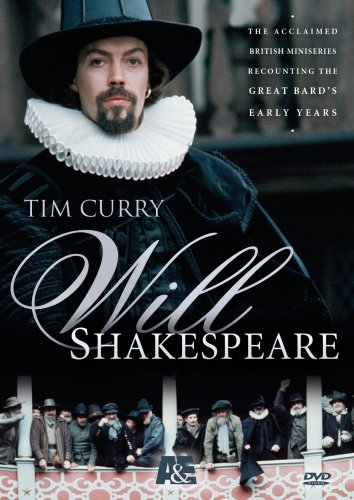
Tim Curry as Will Shakespeare

Will Shakespeare [a.k.a. Life of Shakespeare]. By John Mortimer. Perf. Tim Curry and Ian McShane. Dir. Mark Cullingham and Robert Knights. 1978. DVD. A & E Home Video, 2008.

Yesterday, the recently-released-on-DVD Will Shakespeare arrived! I had ordered it, sight unseen, back in November, as you remember.

At first, I was thrilled. Then I was slightly disappointed. Now, I'm back to excited again—it was well worth the purchase price, and it's well worth watching. I had mistakenly thought that this was a brand-new mini-series; instead, it's a release of 1978's Life of Shakespeare with a savvier, classier title. I noticed the BBC-in-the-1970s production values at once, but the story does hold up despite them.

The plot does pull up some old and tired turnips of the Shakespeare biography industry: Shakespeare merely holds the horses outside the Rose Theatre, Christopher Marlowe's death isn't merely a pub brawl, there's something more than meets the eye about the Earl of Southampton, Ann Shakespeare is a shrew, et cetera. But it's still well-written (thanks, John Mortimer!) and interesting.

As a bonus, John McEnery (who played Lucio in the BBC's Measure for Measure) plays Hamnet Sadler, down to London from Stratford to visit his old friend Will. Additionally, Shakespeare wears a red cap (watch for him—he appears sooner than you expect him to), Hamnet Sadler carries a chicken, London in 1590 is a dirty and noisy place, and the BBC of 1978 wanted its audience to know that it was broadcasting in colour:


N.B.:


Links: The Film at IMDB.

Click below to purchase the film from amazon.com
(and to support Bardfilm as you do so).

Tuesday, January 6, 2009

New Poll: Revising the Shakespeare and Film Syllabus

Jones, Keith.  "Shakespeare and Film."  Course Syllabus.  12 January 2009.
In less than a week, I'll be embarking on the third time through the Shakespeare and Film course I developed at my college.  There were substantial revisions between the first and the second, and I'm considering substantial revisions for the third.  

To make room for some additions, I need to cut something.  That's where I need your help!  The poll to the right (and / or the comments below) invite your opinion.  Should I cut Merchant of Venice and lose all the fun of comparing Laurence Olivier, Trevor Nunn, and Al Pacino?  Should I cut The Taming of the Shrew and risk abandoning Kiss me, Kate as a result?  I'm not sure I can bear to cut Richard III—I wouldn't be able to show Ian McKellen in the role, and that would be a shame.  And how could I prevent myself from showing Branagh's Henry V, a play I have grown to appreciate, especially for its discussion value?

Please, weigh in!  The poll closes on Sunday night at midnight.

Friday, January 2, 2009

The Five Most Important Shakespeare Allusions in Willy Wonka and the Chocolate Factory

Willy Wonka and the Chocolate Factory. Dir. Mel Stuart. Perf. Gene Wilder, Jack Albertson, and Peter Ostrum. 1971. DVD. Warner Home Video, 2005.

The Thanksgiving Family Movie Night Feature (Doctor Dolittle) reminded me of the large number of literary allusions in Willy Wonka and the Chocolate Factory. I gathered them together in this annotated video clip; you will first see the quotation and then you'll hear the allusion. “Allusion” is the appropriate term—they are not always quotations. You'll see statements turned into queries, you'll find omissions, and you'll discover rewordings, but there's a wonderfully pervasive sense of the Shakespearean in the film as a whole and in these clips in particular:


Links: The Film at IMDB.

Click below to purchase the film from amazon.com
(and to support Bardfilm as you do so).

Sunday, December 28, 2008

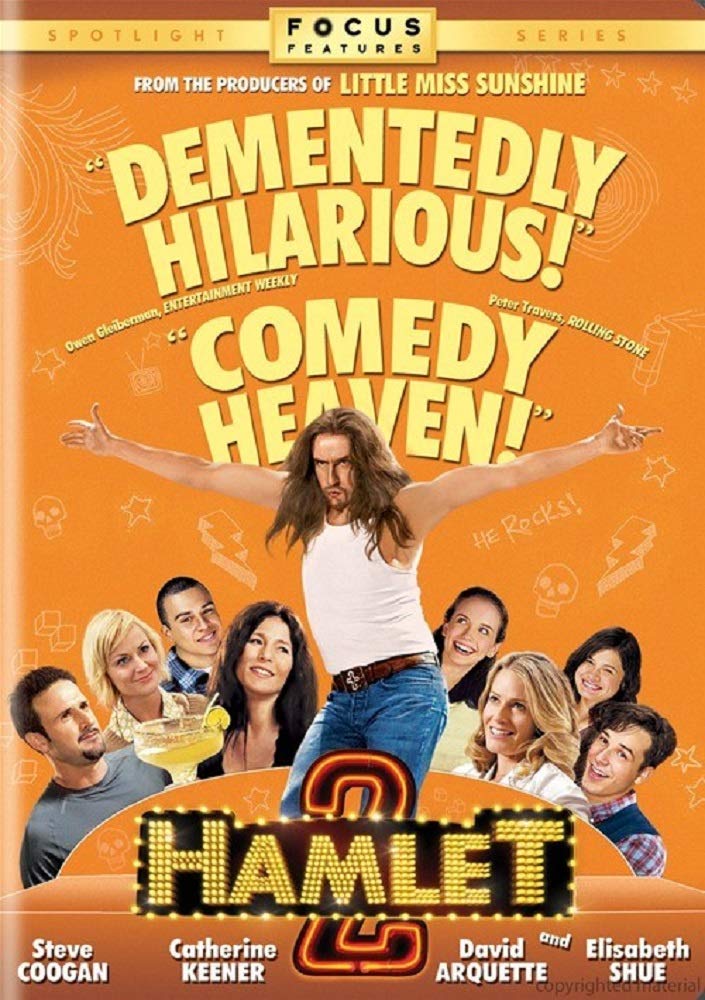
Hamlet 2: The MicroReview

Hamlet 2. Dir. Andrew Fleming. Screenplay by Pam Brady and Andrew Fleming. Perf. Steve Coogan, Catherine Keener, David Arquette, and Elisabeth Shue. 2008. DVD. Universal Studios, 2008.

My parents (God bless 'em) gave me the DVD of Hamlet 2 for Christmas! Hurrah!

What's more, we had the opportunity to watch the whole thing last night. Huzzah!

But when it comes to reviewing it . . . well, I just . . . don't . . . have . . . the words. It's—unfathomable.

I can certainly say that it's not for all tastes. It's odd. It's quirky. It has a lot of language. [Let me clarify that: it has a lot of bad language, most of which was grauitious.] And it has scenes in which Jesus arrives in Elsinore in a time machine that he gives to Hamlet so that he can go back in time to prevent Gertrude's poisoning and Ophelia's drowning.

But I thought it worked quite well. There were some very funny moments—moments that parodied the "endearing teacher inspires students" movie genre. And the production of Hamlet 2 (aptly enough, the play-within-the-film) toward which students and teachers are moving and of which we get pieces near the end of the film is very intriguing. The image that heads this post is from that production—Ophelia spins in front of a giant seascape video while a glee club sings a version of Elton John's "Someone Saved my Life Tonight."


Visually, it's a cross between Peter Greenaway's Prospero's Books and A Midsummer Night's Rave.  Whatever else might be said about those two visual styles, they can't be called boring.

And the plot itself is well-crafted.  Though it's set in a high school, it doesn't spend too much time grappling with the emotions of the high schoolers—it's more interested in the drama teacher.  Some of the funniest scenes involve his interactions with the school newspaper's drama critic.

I really don't want to give you any spoilers—the film is worth watching.  But I will give you these two stills from the film:

After reviving Ophelia with CPR, Hamlet looks at her with new eyes.

The delightfully-named "Prickly Pear Fertility Clinic."

Links: Trailer. Official site. Previous Post One. Previous Post Two. Previous Post Three. The Film at IMDB.

Click below to purchase the film from amazon.com
(and to support Bardfilm as you do so).

Friday, December 26, 2008

After Shakespeare After All

Garber, Marjorie. Shakespeare and Modern Culture. New York: Pantheon, 2008.

The New York Times recently reviewed Marjorie Garber's new book, and it sounds very interesting, despite the mixed critique the article gives it. Her previous book, Shakespeare After All, is enormous—and well worth reading (which isn't to say I've finished it). Like Harold Bloom's The Invention of the Human, Garber considers each of the plays in turn in that copious volume.

In this book, she deals with ten plays. According to the review, the scope is enormous. It also indicates something of its thesis:
Shakespeare and Modern Culture is founded on proving the truth of a mind-bending formulation, that “Shakespeare makes modern culture and modern culture makes Shakespeare.” The history of the plays as they have been performed and debated across the centuries is “the story of a set of mutual crossings and recrossings across genres, times and modes.” The book’s overarching idea derives from the rhetorical device known as chiasmus, or “crossing of words”—the theoretical two-way street illustrated by that phrase about Shakespeare both making and being made.
It's intriguing, and I'm asking my library to buy it for me (as a late Christmas gift). Any book that quotes from Dire Straits and Ali MacGraw— well, from Dire Straits, at least—is all right in my book.

Click below to purchase the book from amazon.com
(and to support Bardfilm as you do so).

Tuesday, December 23, 2008

There Will Be a Shakespearean Title

There Will Be Blood. Dir. Paul Thomas Anderson. Perf. Daniel Day-Lewis, Paul F. Tompkins, Paul Dano, and Randall Carver. 2007. DVD. Paramount, 2008.

Since it's proving desperately difficult to upload a video at present (after four hours, the two-minute clip I planned still hadn't uploaded), you'll have to be satisfied by these comments on a film that I have not seen.

However, it does have a Shakespeare allusion (though not a direct quotation, so it's not exactly titularly parasitic) in its title. There Will Be Blood seems to allude to this speech of Macbeth's from III.iv:
It will have blood; they say, blood will have blood.
Although I haven't seen the film, the themes do seem to be Shakespearean—Macbethean, to be more precise. Those who have seen it, let me know if the allusions run deeper than that!

And everyone can wait until after Christmas for the intended video clips. I'll store them up for later distribution!

Links: The Film at IMDB.

Click below to purchase the film from amazon.com
(and to support Bardfilm as you do so).

Thursday, December 18, 2008

Take Arms Against a Sea of Tribbles

“The Trouble with Tribbles.” By David Gerrold. Perf. William Shatner, Leonard Nimoy, DeForest Kelley, and James Doohan. Dir. Joseph Pevney. Star Trek. Season 2, episode 15. NBC. 29 December 1967. DVD. Paramount, 2008.

Shatner, William. “Hamlet / It Was A Very Good Year.” The Transformed Man. Decca, 1968.

I nearly forgot Captain Kirk's famous version of the "To be or not to be" soliloquy from Hamlet.


All right, so it didn't happen exactly that way. I've taken the audio from Shatner's 1968 album that combined the classics of literature with modern song lyrics—all in the inimitable style of William Shatner—and grafted it to the "Trouble with Tribbles" episode.  It actually works, in a weird, wild, wonderful way.

For more connections between Star Trek and Shakespeare, head to Shakespeare and Star Trek Complete.

Click below to purchase the DVDs from amazon.com
(and to support Bardfilm as you do so).

Wednesday, December 17, 2008

Secrets of the Star Trek Title Sequence Revealed

“Title Sequence.” Star Trek. Seasons 1-3 (Original Series); Seasons 1-7 ( The Next Generation). DVD. Paramount, 2002.

From its beginning—from the first word of its title sequence, in fact—Star Trek has been deeply indebted to Shakespeare. In this clip and in the text below it, I reveal the allusions to Shakespeare made in the opening title sequence. For the first time, you may trace the origins of the word "space" and the name of the multiple Enterprises that fill the screens of Star Trek lore:

“I could be bounded in a nut shell and count myself a king of infinite space[: The final frontier].”
—Hamlet
“Goes it against the main of Poland, sir, or for some [final] frontier?”
—Hamlet
“With her I lived in joy; our wealth increased / By prosperous voyages [of the starship Enterprise].”
—Aegeon
[These are the voyages of the starship] Enterprises of great pith and moment.”
—Hamlet
“Whose glorious deeds, but in these fields of late, / Made emulous [five-year] missions ’mongst the gods themselves.”
—Ulysses
“O brave new world, [O strange new worlds] / That [have] such people in [them]!”
—Miranda
“I thank your majesty, and her, my lord: / These words, these looks, infuse new life [and new civilizations] in me.”
—Titus Andronicus
“Sound drums and trumpets [to] boldly and cheerfully [go where no one has gone before]; / God and Saint George!”
—Henry V

For more connections between Star Trek and Shakespeare, head to Shakespeare and Star Trek Complete.

Click below to purchase the DVDs from amazon.com
(and to support Bardfilm as you do so).

Tuesday, December 16, 2008

Star Trek's Tempest

“Emergence.” By Joe Menosky. Perf. Patrick Stewart, Jonathan Frakes, LeVar Burton, Michael Dorn, Gates McFadden, and Brent Spiner. Dir. Cliff Bole. Star Trek: The Next Generation. Season 7, episode 23. Syndicated television. 22 May 1994. DVD. Paramount, 2002.

It's been nearly a month since Shakespeare and Star Trek week began here at Bardfilm. I imagine that it's about time to wrap things up with some final clips and some final commentary.

The Tempest is very good on endings. The number of scholars who have considered it to be Shakespeare's farewell to the stage is very great. I think that that may have been in the minds of Star Trek's writers as they neared the end of their seventh—and last—season.

In this episode, Data is trying to put on a production of The Tempest, but he's interrupted: the Enterprise runs amok, goes crazy, and gives birth, which is the reason for Data's confusing remark at the end of the clip (I conflated the beginning and the end of the episode into one file). Please excuse the darkness of the clip: as you'll see, it was Data's decision, not mine, to have it so dark.


For more connections between Star Trek and Shakespeare, head to Shakespeare and Star Trek Complete.

Click below to purchase the DVDs from amazon.com
(and to support Bardfilm as you do so).

Sunday, December 14, 2008

Notorious W.S.

Free Enterprise. Dir. Robert Meyer Burnett. Perf. William Shatner, Eric McCormack, and Audie England. 1998. DVD. Anchor Bay, 2006.

I would genuinely feel remiss in my Bardfilm duties if I didn't point you toward William Shatner's rap version of Mark Anthony's speech, cunningly entitled "No Tears for Caesar." It comes from a film cunningly entitled Free Enterprise, in which William Shatner plays the character of William Shatner—a William Shatner who, like that more famous (literarily speaking) W.S., is interested in putting the story of Julius Caesar on stage. The difference is that this version is performed entirely in rap.

For your convenience in doing a comparative analysis, I'm also providing in this post the version presented by The Cosby Show, which I've written about here. Please vote for the one you like best in the comments below!


P.S. The original title of this post was "Rapmaster J.C." But I realized that "Rapmaster M.A." would be more appropriate. But that didn't sound right. So I tried "M.A., M.C." or "M.C. M.A." They were too obscure or sounded like I was granting degrees to Mark Anthony. I finally decided on "Notorious W.S." as an interesting title with a rap allusion and ambiguity as to the antecedent of W.S.—Shakespeare scholars are sure to drool over that. Perhaps "A Funeral Elegy by W.S." should be attributed to the Shatner W.S. and not to the Shakespeare W.S.

Links: The Show at IMDB. The film at IMDB.

Click below to purchase the film or
every single season of The Cosby Show
from amazon.com
(and to support Bardfilm as you do so).


Friday, December 12, 2008

Mark Anthony in the Comics

Pastis, Stephen. Pearls Before Swine. 7 December 2008. comics.com. 12 December 2008 {http://comics.com/pearls_before_swine/2008-12-07/}.

While we're in a Julius Caesar mood, let's take a look at this comic (forwarded to me by a colleague).

It's something that might be called "Elizabethan Pearls before Modern Swine":


Links: The Comic Strip at comics.com.

Click below to purchase a Pearls Before Swine collection from amazon.com
(and to support Bardfilm as you do so).

Bardfilm is normally written as one word, though it can also be found under a search for "Bard Film Blog." Bardfilm is a Shakespeare blog (admittedly, one of many Shakespeare blogs), and it is dedicated to commentary on films (Shakespeare movies, The Shakespeare Movie, Shakespeare on television, Shakespeare at the cinema), plays, and other matter related to Shakespeare (allusions to Shakespeare in pop culture, quotes from Shakespeare in popular culture, quotations that come from Shakespeare, et cetera).

Unless otherwise indicated, quotations from Shakespeare's works are from the following edition:
Shakespeare, William. The Riverside Shakespeare. 2nd ed. Gen. ed. G. Blakemore Evans. Boston: Houghton Mifflin, 1997.
All material original to this blog is copyrighted: Copyright 2008-2039 (and into perpetuity thereafter) by Keith Jones.

The very instant that I saw you did / My heart fly to your service; there resides, / To make me slave to it; and, for your sake, / Am I this patient [b]log-man.

—The Tempest