Thursday, November 30, 2023

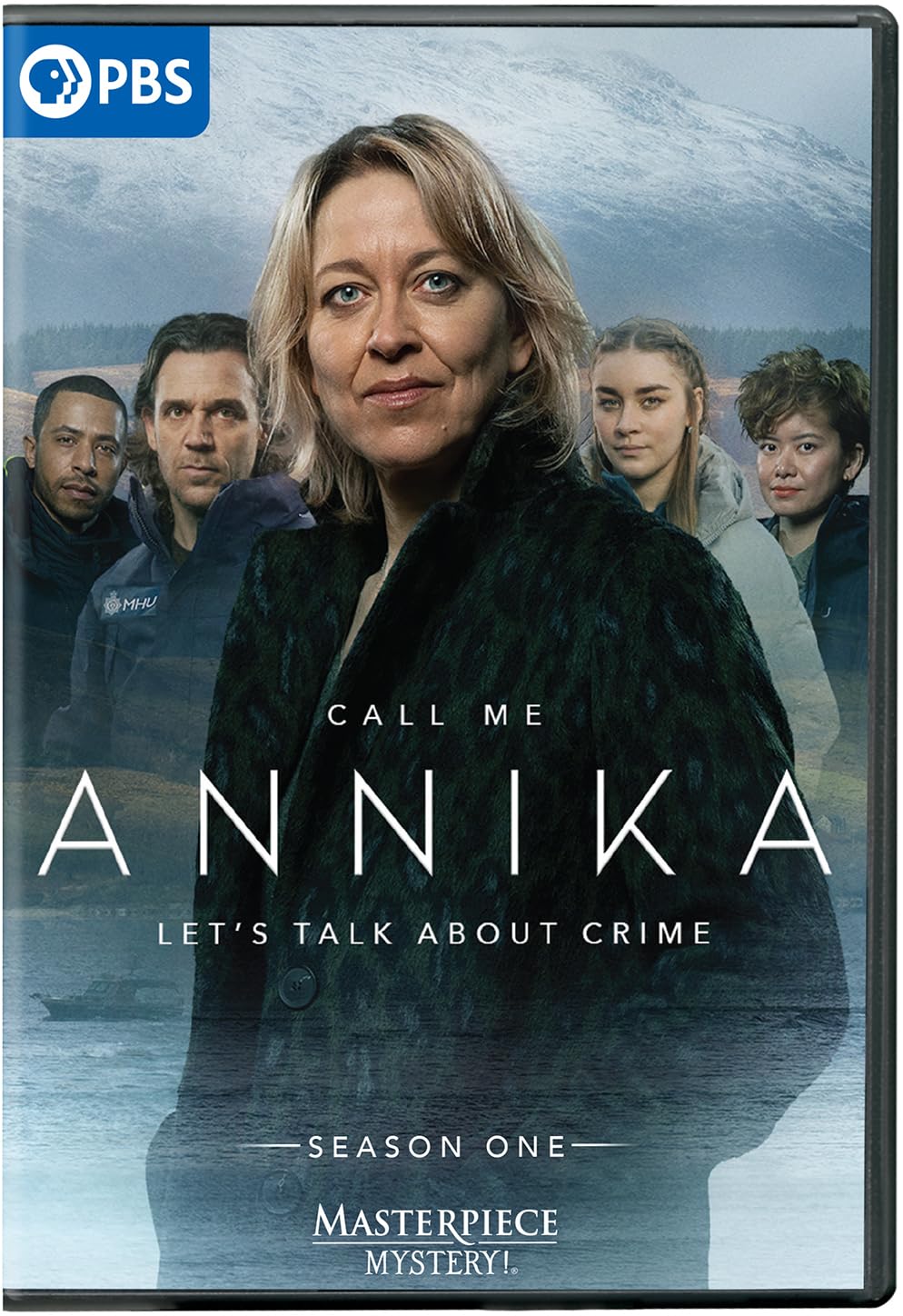
Twelfth Night in Annika

“Episode #6.1.” By Nick Walker. Perf. Nicola Walker, Jamie Sives,  and Katie Leung. Dir. Fiona Walton. Annika. Season 1, episode 6. Alibi (later, PBS). 21 September 2021. DVD. PBS (Direct), 2022.

Annika is a modern police procedural set in Scotland. It has some things that are typical of the genre—the detective who is good with technology, a tendency toward dark humor, interpersonal conflict that leads to deepening relationships, mysterious deaths, and so on—but what stands out is its decision to have the main detective break the fourth wall so frequently.

Within that, there is often a literary element. Annika often explains to the camera literary plots that connect—sometimes substantially, sometimes tangentially—to the investigation. In the first episode, for example, someone is murdered with a harpoon. Not unexpectedly, we get some Moby-Dick allusions.

At the end of the first season, Shakespeare's Twelfth Night is connected to the episode's plot.

Note: Spoilers follow. Stop here and watch the episode (which I highly recommend) before proceeding.

But the investigation doesn't precisely follow the plot of Twelfth Night. I keep looking for twins, but to no avail. We do get elements of mistaken identity when someone intentionally pretends to be what they're not in order to swindle someone else. In the clip below, you'll see our villain say, "People should just be who they say they are," which could be part of a theme from Twelfth Night.

Here are the relevant Shakespeare-related clips, including a brief reference to Hamlet as a bonus: 


I'm fond of these Shakespearean asides to the audience (Shakespearean in that they deal with Shakespeare but also Shakespearean in reflecting the practice on Shakespeare's stage), even when the well-read Annika gets it slightly wrong. She's right about "petard" meaning, according to the OED, "A small bomb made of a metal or wooden box filled with powder, used to blow in a door, gate, etc., or to make a hole in a wall," but its etymology is from the French meaning "small firework which makes a loud bang" (which, I suppose, could be stretched to apply to flatulance . . . but I digress). 

I'm fond of the show at large. The writing and the literary references are a key part of that, but the plots are intriguing and the characters engaging, and the acting is particularly fine.

Click below to purchase the series from amazon.com
(and to support Bardfilm as you do so).

Bonus Image!


Tuesday, November 28, 2023

Lewis Mirrors Hamlet

“Reputation.” By Russell Lewis and Stephen Churchett. Perf. Charlie Cox, Sophie Winkleman, and Colin Starkey. Dir. Bill Anderson. Lewis. Season 1, episode 1. BBC. 30 July 2066. DVD. PDX, 2008.

Having enjoyed the Endeavor series quite a bit and having a vague familiarity with the Morse series to which it is a prequel (and having not enjoyed it too terribly much), I decided to try the Lewis series, which is Morse's sequel.

Right off the bat, we get some Shakespeare. A woman named Regan Peveril (her name may be an allusion to King Lear, but it's conceivably just coincidence), a brilliant mathematics student, has been murdered. As we get into the case, which involves upper-level maths and high-end automobiles, we start to suspect that a fellow student, Daniel Griffon, is the guilty party. He's a somewhat awkward young man whose father died and whose uncle took over his father's company. And the uncle's name is Rex.

Ringing any bells with anyone out there? It's a bit more subtle than having the uncle named "Claude," but still. And then we learn that his mother's name is Trudi. And then we learn that Rex is the younger of a set of twins, always passed over while everything went to his older (if only slightly) brother. And Daniel suspects him of having tampered with the brakes in his father's car, leading to the accident that caused his death.

There's a friend of the family named Tom Pollock, and he has a daughter—Jessica—who is in love with Daniel. This gives us the possibility of an Ophelia analogue.

More incidentally, one character asks another if, when his aunt died, she "made a good end," which is what Ophelia, in her madness, says about her father.

And here's one more quick crossover.  Michael Maloney plays the role of Igor Denniston, the maths professor. I know him best for two Hamlet-related roles: Laertes in the Kenneth Branagh Hamlet and the director/ actor in A Midwinter's Tale.

Note: Probable Spoilers from this point forward.

Years earlier, Morse had investigate a case involving Daniel Griffin. It turns out that Daniel tampered with the brakes in his uncle's car in an attempt to gain revenge on his uncle. But nothing came of it—except a crypic note alongside one of Morse's beloved crossword puzzles: "Polo not king after all"

Later, we learn that the reason Daniel thinks his uncle killed his father—despite the police case indicating that there were no problems with the brakes and ruling the death an accident—was that his father appeared to him in a vision and told him that his brother had murdered him.

Eventually, all the clues start to come together. Secrets are revealed. Our Ophelia analogue walks into a river with her pockets full of rocks because of one of those revelations. And it all wraps up.

Here's a fairly-lengthy clip with the relevant Hamlet material:


I'm not going to give you spoilers beyond what I've already given. But the episode plays cleverly and amusingly with the plot of Hamlet—with some important twists to keep us guessing. Track it down and give it a try.

Links: The Episode at IMDB.

Click below to purchase the complete season from amazon.com
(and to support Bardfilm as you do so).

Friday, November 24, 2023

Shakespeare in FoxTrot's Think iFruity

Amend, Bill. Think iFruity. Kansas City: Andrews McMeel, 2000.

Moving one book forward in our push to cover all the Shakespeare in FoxTrot, we find two brief connections.

The first is the usual paraphrase (or, to be harsher, misquotation) of a passage from 1 Henry IV.  Late in that play, Falstaff says, "The better pat of valor is discretion, in the which better part I have sav'd my life" (V.iv.119-21). In FoxTrot, Andy tries to remind Jason that "Discretion is the better part of valor" when he's angry about his video game performance:


We also have Paige's overjoyed response to her completing her math exam:


Again, it's not quite as much Shakespeare as I'd like, but 'tis enough—'twill serve.

Links: The Film at IMDB.

Click below to purchase the book from amazon.com
(and to support Bardfilm as you do so).

Monday, November 20, 2023

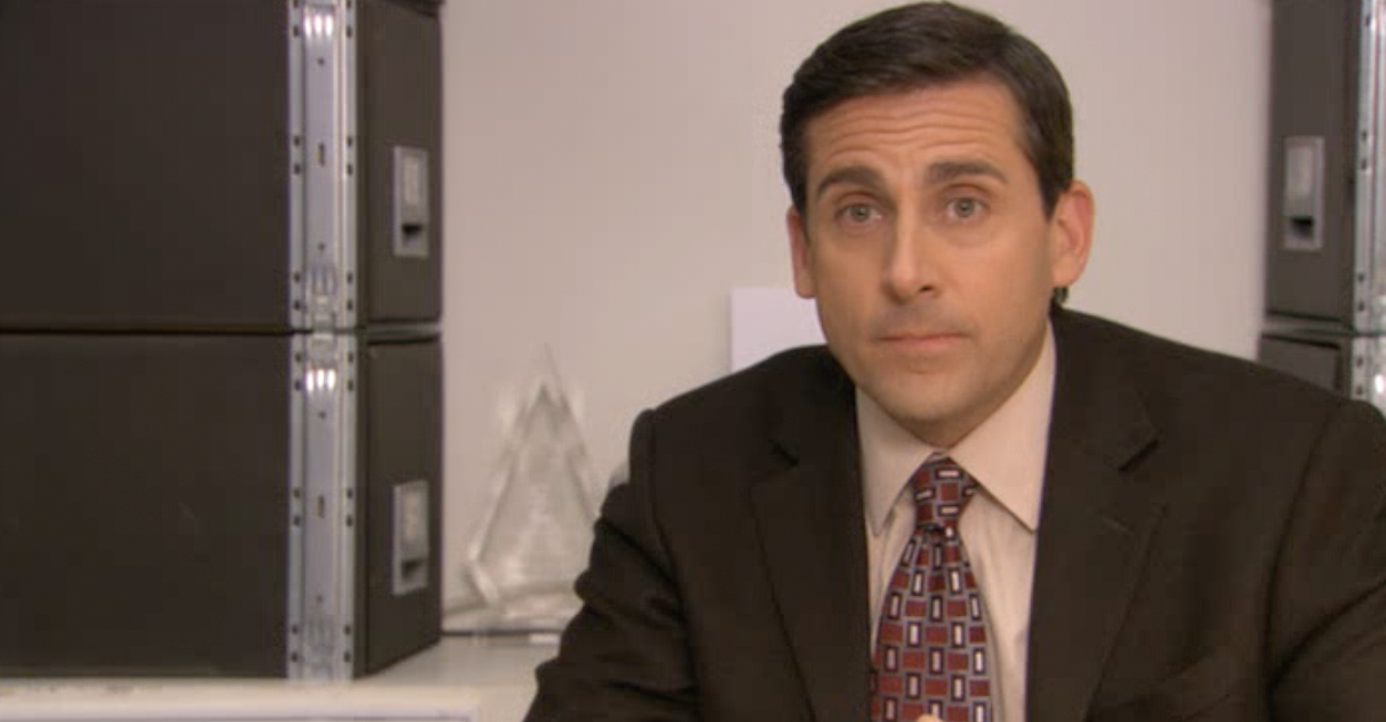
Shakespearean Deep Cuts from The Office

"Broke." By Charlie Grandy. Perf. Steve Carell. Dir. PSteve Carell. The Office. Season 5, episode 23. NBC. 23 April 2009. Deleted Scene. DVD. Universal Studios, 2009.

Having covered the overt and canonical Shakespeare-related material in The Office, it's exciting to discover even more material waiting in the deleted scenes.

In this episode (which aired on the date we commemorate Shakespeare's birth), the small Michael Scott Paper Company is going up against the much larger Dunder Mifflin Paper Company, and it feels like David against Goliath:


Michael, Pam, and Ryan are each David, and they're going up against another David—David Wallace, the CEO—but that David is really Goliath. The Shakespeare comes in the last analogy: Charles (the manager of the Scranton branch of Dunder Mifflin) is Othello, apparently for no better reason than that Michael needs to reach for a person from classic literature who is black.

Links: The Episode at IMDB.

Click below to purchase the season from amazon.com
(and to support Bardfilm as you do so).

Friday, November 17, 2023

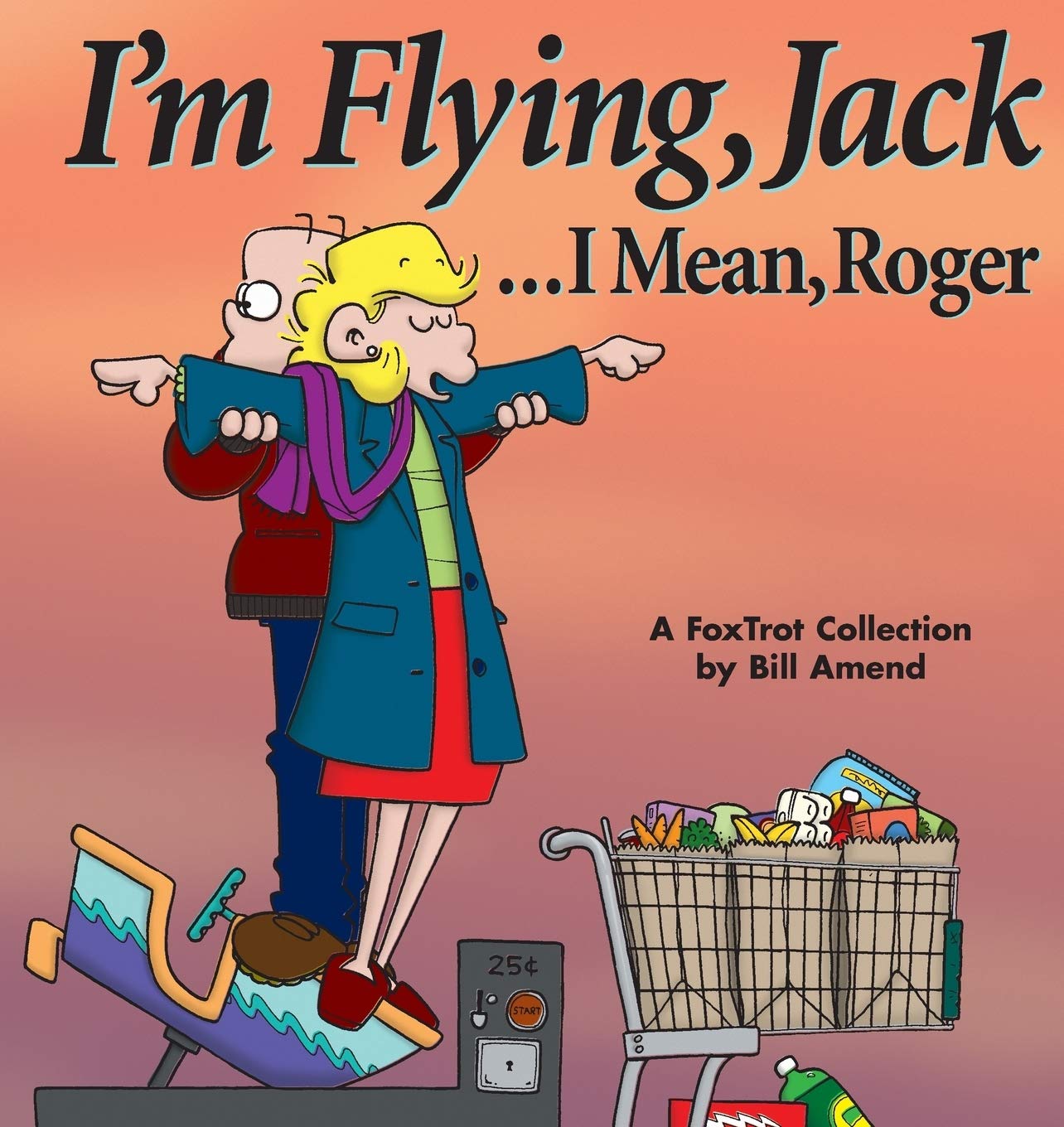
Shakespeare in FoxTrot's I'm Flying, Jack . . . I Mean, Roger

Amend, Bill. I'm Flying, Jack . . . I Mean, Roger. Kansas City: Andrews and McMeel, 1997.

The next FoxTrot chronologically in our trip to find all the Shakespeare in that comic strip is Welcome To Jassorassic Park, but I couldn't find anything there. I'll head back there eventually to see if I missed something, which is entirely possible. In the meantime, I'm Flying Jack . . . I Mean, Roger has a bit to offer.

The first simply includes Shakespeare in a list of works worth studious attention:


And the second (and, I'm afraid, the only other Shakespeare-related comic in the volume) gives us another take on the "Infinite Monkeys and Shakespeare" theorem:


Naturally, I'd rather have two- or three-week-long Shakespeare plots. But these are clever, and I'll gladly accept them.

Click below to purchase the book from amazon.com
(and to support Bardfilm as you do so).

Thursday, November 16, 2023

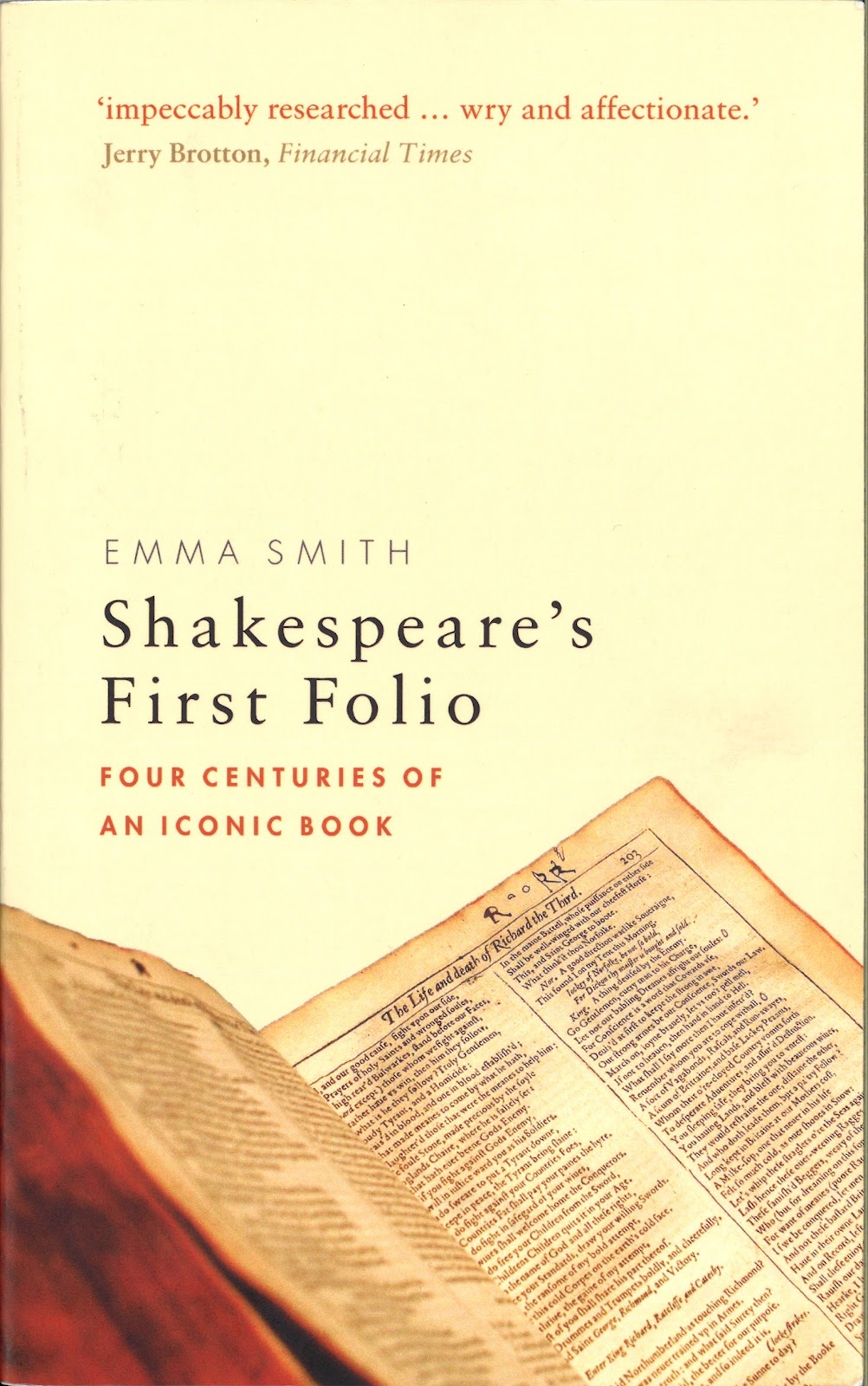
Book Note: Shakespeare's First Folio: Four Centuries of an Iconic Book

Smith, Emma. Shakespeare's First Folio: Four Centuries of an Iconic Book. Oxford: Oxford University Press, 2016.

This year marks the four hundredth anniversary of the publication of Mr. William Shakespeare's Comedies, Histories & Tragedies, and that naturally comes with a great deal of study and celebration.

It's hard to determine a specific birthday for the First Folio, but the date it was entered into the Stationers' Register might be a good one: November 8, 1623 (see the entry and read more about it here).

Since I totally missed that, perhaps the date of the first recorded sale of the volume would be in order. Sir Edward Dering bought a copy on December 5, 1623, and I learned that information from Emma Smith's marvelous book Shakespeare's First Folio: Four Centuries of an Iconic Book (2).

Smith's account of the First Folio is both scholarly and approachable. I recommend it highly for experts and enthusiasts alike. With great attention to contemporary documents and a wealth of anecdotes, Smith covers five different ways of looking at the Folio: Owning, reading, decoding, performing, and perfecting. Each of these separate chapters is fascinating and takes us on a four-hundred-year journey with those subjects as the focus.

I found it hard to extract sample passages from such a full and varied text. Should I show Smith's analyses of how people annotated their First Folios over the years? Should I show the work of the cryptographers who found codes embedded in the First Folio texts in particular? Should I provide something about how actors embraced (or didn't) the First Folio texts for performance?

All that is there, but, instead, I'll provide the part of Smith's introduction where she covers the scope of the book:


Shakespeare's First Folio: Four Centuries of an Iconic Book is a terrific study of the amazing First Folio, and it's a terrific way to celebrate the book's four hundredth birthday.

Click below to purchase the book from amazon.com
(and to support Bardfilm as you do so).

Wednesday, November 15, 2023

A Tiny Bit of Shakespeare in a Friends Subplot

"The One with the Fake Monica." By Adam Chase and Ira Ungerleider. Perf. Matthew Perry, Matt LeBlanc, and Philip Rayburn Smith. Dir. Gail Mancuso. Friends. Season 1, episode 21. NBC. 27 April 1996. DVD. Studio Distribution Services, 2010.

ShakespeareGeek surprised me recently by asking if I had seen the Friends episode where Joey auditions for the role of Mercutio in a production of Romeo and Juliet. I remembered the small reference to Lady Macbeth (for which, q.v.). And I knew that I myself had raised the question of what role Joey played in Macbeth (for which, q.v.). Beyond that, I knew nothing.

I didn't rest long in my ignorance. At the end of "The One with the Fake Monica," ShakespeareGeek told me, we see Joey start an audition for Mercutio.

Let me set the scene. Joey Tribbiani's agent has suggested that he take on a stage name that doesn't sound quite so Italian. Chandler, as a joke, suggests "Joe Stalin." And when he realizes that Joey has no idea who that is, he keeps the joke going—even suggesting that he go with "Joseph" instead of "Joe."

Later in the episode, Joey complains that there's already a guy named Joseph Stalin and that he wasn't particularly nice.

Finally, during the closing credits, we see Joey auditioning for Mercutio:


And there's the joke. Chandler has convinced Joey that a good stage name would be "Holden McGroin."

But remember that we got there by way of Shakespeare (and, of course, by way of ShakespeareGeek).

Links: The Episode at IMDB.

Click below to purchase the season from amazon.com
(and to support Bardfilm as you do so).

Monday, October 30, 2023

A Brief Quote from Hamlet in a Sherlock Holmes–Related Episode of Star Trek (and it's Not the Quote You're Thinking of)

“Elementary, Dear Data.” By Brian Alan Lane. Perf. Patrick Stewart, Jonathan Frakes, LeVar Burton, Michael Dorn, Diana Muldaur, and Brent Spiner. Dir. Rob Bowman. Star Trek: The Next Generation. Season 2, episode 3. Syndicated television. 3 December 1988. DVD. Paramount, 2002.

I've spent (probably) far more time than I should compiling all the Shakespeare references in Star Trek (for which, q.v.). And every time I think I've reached the end, one more quotation or allusion or reference comes my way.

I recently finished reading Sir Patrick Stewart's Making it So, a fascining memoir that has even more Shakespeare than Star Trek. I also occasionally listen to audiobooks or television shows when I'm having trouble sleeping. The former led me to listening to the latter this week. In other words, I wasn't setting out to re-watch all the episodes of Star Trek: The Next Generation, which makes it very serindipitous that I happened to hear a Shakespeare quote that I hadn't noticed before. 

The quote occurs in the first Sherlock Holmes episode—the one where Data quotes Sherlock Holmes quoting Henry V (for which, q.v.). Let's give it a try:


There you have it! A Sherlock Holmes–Related Episode of Star Trek with a brief quote from Hamlet's father's ghost: "Murder most fowl" comes in Act I, scene v, line 27.

Links: The Episode at IMDB.

Click below to purchase the season from amazon.com
(and to support Bardfilm as you do so).

Friday, October 6, 2023

Shakespeare in Ray Bradbury's The Illustrated Man

Bradbury, Ray. The Illustrated Man. New York: 
William Morrow Paperbacks, 2011.
Since this summer, I've been re-reading (or reading, in some cases) the works of Ray Bradbury. I was amazed anew at The Martian Chronicles. I'm delightedly and agonizingly in the middle of Fahrenheit 451 once more. And I read The Illustrated Man for the first time.

In that volume—which is a loosely-connected series of stories, some previously published—I found some Shakespeare.

In a story entitled "The Exiles" (which had previously been published under the title "The Mad Wizards of Mars"—see below), we switch between two settings: (1) Men on a rocket ship bound for Mars with the purpose of eradicating forever the books that Earth has banned and (2) The inhabitants of Mars itself. In this later group, we find the authors who have been banned and their characters.

The Martians (not really Martians, you understand, but that's a good shorthand term for this story) are putting up a terrific fight. The Weïrd Sisters are there, casting spells against the invaders. Edgar Allen Poe is there, serving as the leader of the Martians. Charles Dickens is there . . . but he's refusing to fight because he doesn't believe his books should have been banned in the first place.

I'm not going to provide any spoilers—you should read this yourself!—but here are the first few pages to entice you into reading it yourself:


Bonus Image: The Story's First Appearance

Click below to purchase the book from amazon.com
(and to support Bardfilm as you do so).

Saturday, September 30, 2023

Shakespeare in FoxTrot's Welcome to Jasorassic Park

Amend, Bill. Welcome to Jasorassic Park. Kansas City: Andrews McMeel, 1992.

Note: I'm backdating this post from its actual composition date of 15 December 2023 so that it fits into the chronological journey through all the FoxTrot volumes. 

As with Eight Yards, Down and Out, my first trip through Bill Amend's Welcome to Jasorassic Park didn't reveal any Shakespeare. But Bardfilm doesn't give up that easily. Bardfilm will, of course, see things that aren't really there and say they're related to Shakespeare.

In this case, though, there really is some Shakespeare in one comic strip in Welcome to Jasorassic Park. In the last panel of this back-to-school strip, Paige has a stack of books. We can't see any of the titles, but I recognize the third one up as a copy of The Tempest (the Penguin edition). It's encouraging that her teachers assigned her not only the longest book Tolstoy ever wrote but also a delightful example of late Shakespeare.

With that in mind, enjoy this strip even more!

Click below to purchase the book from amazon.com
(and to support Bardfilm as you do so).

Friday, September 29, 2023

Shakespeare in FoxTrot's Come Closer, Roger, There's a Mosquito on your Nose

Amend, Bill. Come Closer, Roger, There's a Mosquito on your Nose. Kansas City: Andrews and McMeel, 1997.

Even though it doesn't have any sweeping week-long Shakespeare-related series of strips, I'm quite fond of Come Closer, Roger, There's a Mosquito on your Nose.

What it may lack in scope it more than makes up for with its sharp, focused use of Shakespeare.

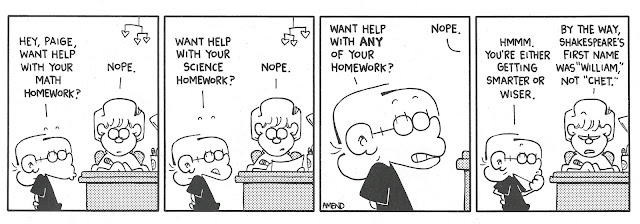
For example, in one of the first strips in the volume, Jason is asking Paige if she needs any help with her homework. First, he asks about Math. Then he asks about Science. Then it becomes evident that he's already "helped" her with her English homework:


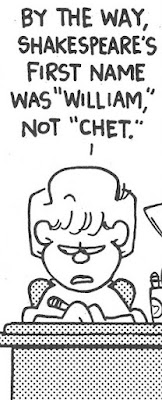
I just love the idea that he was trying to sabotage her homework by saying something about the great Elizabethan dramatist Chet Shakespeare.

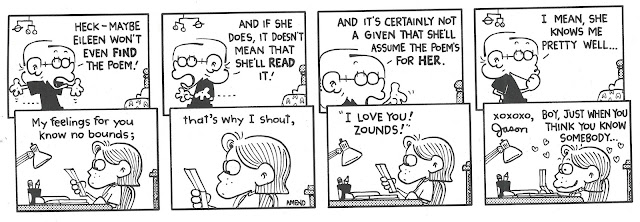
The next strip we'll look at doesn't seem very Shakespearean . . . but give it a chance. Jason has written his mom a mushy card, trying to butter her up so she'll do something he wants. But he accidentally left it in Eileen Jacobson's book. 


It's the "Zounds!" that connects us to Shakespeare. After all, he uses the word over twenty times in his plays.

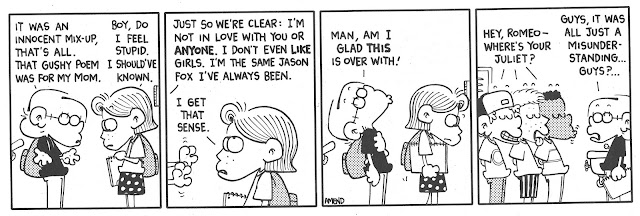
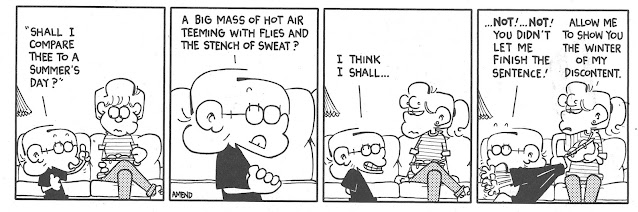
And if you didn't think that was particularly Shakespearean, try this strip. Jason's friends are mocking him—and using Shakespeare to do so:


I don't often see the sonnets used in Shakespeare-related comic strips. But Amend is versatile (as is, I suppose, Jason). Sonnet XVIII finds its way in here:


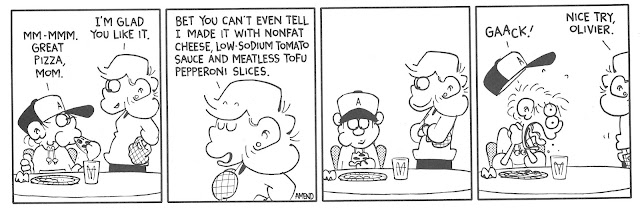
And, finally, here's a nicely subtle Shakespeare reference:


At first, I misread that as "Nice try, Oliver," and I thought it was somehow a joke related to Oliver Twist, who is notoriously served bad food. But, no. Andy is saying "Nice try, Olivier," indicating that Peter's performance may be equal to the acting prowess of one of the most well-known Shakespearean actors, but she's not buying it.

Click below to purchase the book from amazon.com
(and to support Bardfilm as you do so).

Friday, September 22, 2023

Shakespeare in FoxTrot's At Least This Place Sells T-Shirts

Amend, Bill. At Least This Place Sells T-Shirts. Kansas City: Andrews and McMell, 1996.

The quest to track down all the Shakespeare in FoxTrot continues with one small reference to Shakespeare.

Paige seems to be the main one to have Shakespeare homework, at least in this era of the strip:


There you have it!
Click below to purchase the book from amazon.com
(and to support Bardfilm as you do so).

Thursday, September 21, 2023

A Shakespeare Allusion in Season Eight of The Office

"Special Project." By Amelie Gillette. Perf. Rainn Wilson, Mindy Kaling, Ed Helms, Leslie David Baker, Kate Flannery, Lindsey Broad, and Oscar Nuñez. Dir. David Rogers. The Office. Season 8, episode 14. NBC. 9 February 2012. DVD. Universal Pictures Home Entertainment, 2019.

In Office time, it's been six years since our last (possible? probable?) Julius Caesar allusion (for which, q.v.). 

In the intervening time, Dwight seems to have brushed up on his Shakespeare.

In the episode, Andy has made a decision about who gets to travel to Florida for a special project—and Dwight doesn't like it. But he knows that a straightforward approach won't work. Instead, he praises Andy's decision (while asserting that he doesn't understand the logic of it) and riles up his fellow employees to bring Andy's decision into question.

Does that sound familiar? 

If not, what if I add that Dwight says, "Andy is an honorable man"?

I can't be the only Shakespeare / Office fan who finds in the setup an allusion to Mark Antony's surreptitious attack on Brutus in Julius Caesar during Caesar's funeral. Let's take a look:


I acknowledge that that is an allusion rather than a quotation, but it seems entirely in character for Dwight to employ the sneaky rhetorical strategy of Anthony in his own plan to bring down Andy.

Links: The Episode at IMDB.

Click below to purchase the season from amazon.com
(and to support Bardfilm as you do so).

Friday, September 15, 2023

Shakespeare in FoxTrot's The Return of the Lone Iguana

Amend, Bill. The Return of the Lone Iguana. Kansas City: Andrews and McMeel, 1996.

As we continue on our quest to track down all the Shakespeare in Bill Amend's wondrous FoxTrot comics, we continue to go over old ground. 

I've written about Paige's starring as Cleopatra before (for which, q.v. et q.v.). But there were a couple other strips that connected to Shakespeare in one way or another.

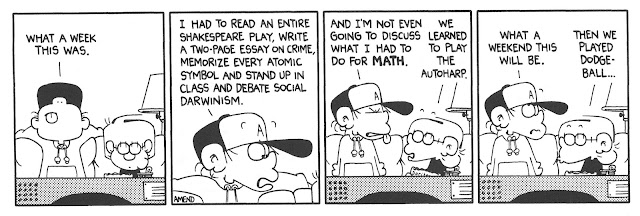
First, then, those others. We start with Peter complaining about his school day:


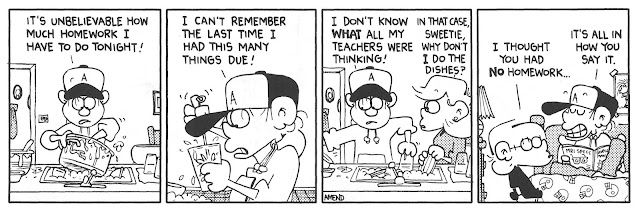
Later in the book, we return to this them, but with a decided difference:


Yes, it connects to Shakespeare. Tangentially. I mean, the homework he doesn't have is probably Shakespeare-related, right?

Okay, fine. 

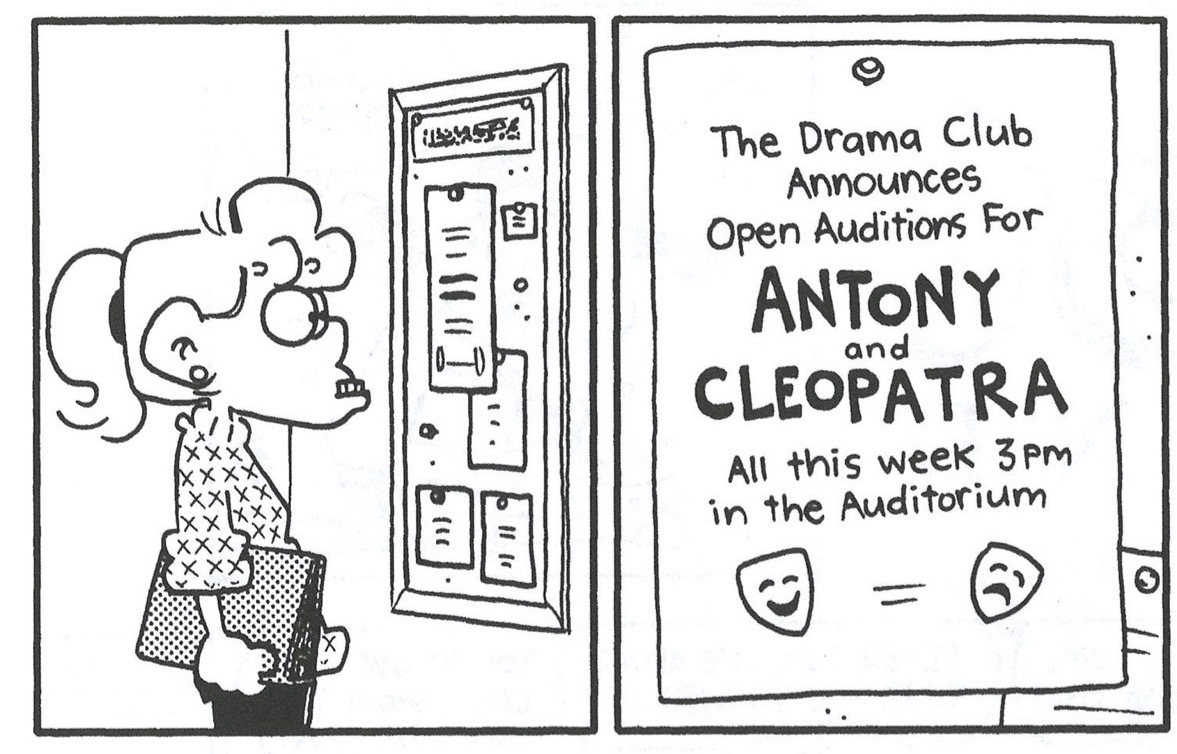
Let's turn to some unquestionably Shakespearean strips. This time, Amend gives us a two-week sequence about Paige playing Cleopatra in Shakespeare's Antony and Cleopatra. Enjoy!


Click below to purchase the book from amazon.com
(and to support Bardfilm as you do so).

Bardfilm is normally written as one word, though it can also be found under a search for "Bard Film Blog." Bardfilm is a Shakespeare blog (admittedly, one of many Shakespeare blogs), and it is dedicated to commentary on films (Shakespeare movies, The Shakespeare Movie, Shakespeare on television, Shakespeare at the cinema), plays, and other matter related to Shakespeare (allusions to Shakespeare in pop culture, quotes from Shakespeare in popular culture, quotations that come from Shakespeare, et cetera).

Unless otherwise indicated, quotations from Shakespeare's works are from the following edition:
Shakespeare, William. The Riverside Shakespeare. 2nd ed. Gen. ed. G. Blakemore Evans. Boston: Houghton Mifflin, 1997.
All material original to this blog is copyrighted: Copyright 2008-2039 (and into perpetuity thereafter) by Keith Jones.

The very instant that I saw you did / My heart fly to your service; there resides, / To make me slave to it; and, for your sake, / Am I this patient [b]log-man.

—The Tempest