Tuesday, May 26, 2015

Book Note: Romeo and Juliet: The War

Work, Max, Stan Lee, and Terry Dougas. Romeo and Juliet: The War. Illus. Skan Srisuwan. Dallas: Viper Press, 2011.

In 2010, Shakespeare Geek mentioned an upcoming comic release he'd spotted somewhere.

In 2011, he had somehow managed to track down an advance copy, and he offered the world an encouraging review and described the book as looking "like a movie," suggesting that an actual film version of the book would be "pretty awesome."

In 2015, his prediction / suggestion seems to be coming true—a film is in production.

Well, when Shakespeare Geek says something once, I read it. When he says something twice, I ponder it. And when he says something thrice, I actually make sure I investigate what he's talking about.

The book has been officially out since 2011, and I managed to track down a copy. It's not my particular cup of tea, actually, but I see that it might be a way of thinking about the story that could yield some useful food for thought about the play itself—and / or serve as a way of familiarizing an unfamiliar audience with the basic plot, including the tensions between the Montagues and the Capulets.  

I can't outdo Shakespeare Geek, but I can provide something he didn't—a sample of the book. Below are the first dozen pages of the book. I'll leave it to the individual to gauge interest in the book:


Click below to purchase the book from amazon.com
(and to support Bardfilm as you do so).

Wednesday, May 13, 2015

Paule Marshall Re-imagines Caliban

Marshall, Paule. "Brazil." Soul Clap Hands and Sing. Washington, D.C: Howard University Press, 1988. 131-77.

In her 1961 short story "Brazil" (one of four long short stories in the volume Soul Clap Hands and Sing), African-American author Paule Marshall interestingly re-imagines Caliban.

The opening of the story is in the image to the right (click on it to enlarge it). It sets the stage of a nightclub in Brazil and its long-time headlining show: The Great Caliban and the Tiny Miranda.

We soon learn that Miranda is a very tall white woman and Caliban is an extremely diminutive black man.

The story is leisurely in its teasing out the relationships and the setting.  Caliban is set to retire soon—as he's threatened many times before—and the two performers are barely on speaking terms.

As he ponders his retirement, we find Caliban in something of an identity crisis. Everyone calls him "Senhor Caliban" or "Caliban"—even his young wife—and he thinks that he's forgotten who he's meant to be.

We learn this in one of the only direct allusions to Shakespeare in the piece. Some Americans who had been at the nightclub stop him as he walks the streets, hoping he can help them communicate with their taxi driver. After he does so, one of the Americans asks, "Say, aren't you the comedian from the club? What's your name again?" (150) It brings a desire to be known under his old name, "Heitor Baptista Guimares" (151):


The story continues for some time with Heitor / Caliban trying to figure out who he is—is he who he was born or who the public considers him to be? It's a remarkable exploration of the nature of identity.

Click below to purchase the book from amazon.com
(and to support Bardfilm as you do so).

Thursday, May 7, 2015

Rita Dove in Muse of Fire

Muse of Fire. Dir. Dan Poole and Giles Terera. Perf. Dan Poole, Giles Terera, Ian McKellen, Judi Dench, Ralph Fiennes, John Hurt, Ben Kingsley, Michael Gambon, Zoƫ Wanamaker, Jeremy Irons, and Simon Russell Beale. Muse of Fire Film, Timebomb Pictures, Lion Television, 2013.

Longtime readers may remember the U.S. premiere of Muse of Fire (for which, q.v.). The film (presented by Bardfilm, if I remember correctly) was very well-received, and it is now
available to rent or to purchase from iTunes. The film provides, in an intriguing, compelling manner, an impressive array of voices on Shakespeare.

As my grandmother used to say, I told you that to tell you this: Rita Dove was one of those voices.

In the clip below, she reads part of her poem "Shakespeare Say" (for which, q.v.) and comments on her experiences with Shakespeare.


Links: The Official Site for Muse of Fire. The Film at IMDB.

Click here to rent or to purchase the film from iTunes

Wednesday, May 6, 2015

Another Shakespeare Poem by Rita Dove

Dove, Rita. "Blues in Half-Tones, 3/4 Time." American Smooth: Poems. New York: W. W. Norton, 2004. 97-98.

In this poem, Rita Dove weaves together allusions from King Lear, Hamlet, and Macbeth to make a kind of blues. As with the previous post, I don't have a ton of explication to add to the poem itself—I'll just let the poem speak for itself and hope that you enjoy it as much as I do.
Rita Dove (1952— )

Blues in Half-Tones, 3/4 Time

From nothing comes nothing,
don't you know that by now?
Not a thing for you, sweet thing,
not a wing nor a prayer,
though you got half
by birthright,
itching under the skin.

(There's a typo somewhere.)
Buck 'n' wing,
common prayer—
which way do you run?
The oaken bucket's
all busted
and the water's all gone.

I'm not for sale because I'm free.
(So they say. They say
the play's the thing, too,
but we know that don't play.)
Everyone's a ticket
or a stub, so it might as well
cost you, my dear.

But are you sure you lost it?
Did you check the back seat?
What a bitch. Gee, that sucks.
Well, you know what they say.
What's gone's gone.
No use crying.
(There's a moral somewhere.)

Click below to purchase the book from amazon.com
(and to support Bardfilm as you do so).

Tuesday, May 5, 2015

A Shakespeare Poem by Rita Dove

Dove, Rita. "Shakespeare Say." Museum: Poems. Pittsburgh: Carnegie-Mellon University Press, 1983. 33-34.

I've been wanting to continue in the vein of African-American poets writing with Shakespeare in mind, but end-of-the-semester madness has intervened. Still, I'm determined to call our collective attention to a couple poems by Rita Dove, U.S. Poet Laurate from 1993 to 1995.

"Shakespeare Say" was published ten years before Dove became poet laureate. I don't have too much in the way of explication of the poem, but I enjoy the feel of the poem—I feel some Langston Hughes here, though not in the imagery from German—and I'm very fond of these lines: "Shakespeare say / man must be / careful what he kiss / when he drunk" (41-44). The last few lines of the poem are also pretty magnificent.

Without much ado, here's Rita Dove's "Shakespeare Say."
Rita Dove (1952—     )

Shakespeare Say

He drums the piano wood,
crowing.

Champion Jack in love
and in debt,
in a tan walking suit
with a flag on the pocket,
with a red eye
for women, with a
diamond-studded
ear, with sand
in a mouthful of mush—

poor me
poor me
I keep on drifting
like a ship out
on the sea


That afternoon two students
from the Akademie
showed him the town.
Munich was misbehaving,
whipping
his ass to ice
while his shoes
soaked through. His guides
pointed at a clock
in a blue-tiled house.
And tonight

every song he sings
is written by Shakespeare
and his mother-in-law.
I love you, baby,
but it don’t mean
a goddam thing
.
In trouble

with every woman he’s
ever known, all of them
ugly—skinny legs, lie gap
waiting behind the lips
to suck him in.

Going down slow
crooning Shakespeare say
man must be
careful what he kiss
when he drunk
,
going down
for the third set
past the stragglers
at the bar,
the bourbon in his hand
some bitch’s cold
wet heart,
the whole joint

stinking on beer;
in love and winning
now, so even the mistakes
sound like jazz,
poor me, moaning
so no one hears:

my home’s in Louisiana,
my voice is wrong
I’m broke and can’t hold
my piss;
my mother told me
there’d be days like this
.

Click below to purchase Museum: Poems from amazon.com
(and to support Bardfilm as you do so).

Tuesday, April 14, 2015

“Shakespeare was a Black Woman”: Maya Angelou's Statement in Context

Angelou, Maya. "The Role of Art in Life." [Transcript of address given to the National Assembly of Local Arts Agencies Convention in Cedar Rapids, Iowa, 12 June 1985.] Connections Quarterly September 1985: 14+.

On multiple occasions, I've read that Maya Angelou said, “Shakespeare was a Black Woman,” but I was never able to track down the full context of that statement.

Let's hear it for Reference Librarians again! Although this was a bit of a knotty problem to unravel, a reference librarian at my institution was able to find the address in which she made that statement (or at least the largest extraction from that address I've seen).

The context it provides is very interesting. Maya Angelou voluntarily refrained from speaking from age seven to age twelve. A woman of the town took it on herself to read to Angelou:
She knew I loved poetry. I had James Weldon Johnson, County Cullen, Langston Hughes, and Paul Lawrence Dunbar at the tip of my tongue. I loved Shakespeare—I didn't understand that much, I but I loved it. I would record whole scenes and plays, and all the sonnets I could just choke down. (14)
This woman encouraged Angelou to speak by telling her that she would never truly love poetry unless she could speak it out loud. Eventually, Angelou determined to do a "rendition" at a church meeting:
. . . at twelve-and-a-half, I had my voice back, and I decided I would render a rendition. In the CME Church in Stamps, Arkansas, I decided that I would render Portia's speech from The Merchant of Venice. That | would get them. That would knock them right off their pews—I could see myself doing it: "The quality of mercy" (pause) "is not strained. It droppeth" (long pause) "As a gentle rain—" I had it choreographed; it was going to be fantastic. But then, mama asked me, "Sister, what are you planning to render?" So I told her, "A piece from Shakespeare, Mama." Mama asked, "Now sister, who is this very Shakespeare?" I had to tell her that Shakespeare was white. And Mama felt the less we said about whites, the better, and if we didn't mention them at all, maybe they'd just get up and leave. I couldn't lie to her, so I told her, "Mama, it's a piece written by William Shakespeare who is white, but he's dead. And has been dead for centuries." Now, I thought then she would forgive him that little indiosyncracy [sic]. Mama said, "Sister, you will render a piece of Mister Langston Hughes, Mister County Cullen, Mister James Weldon Johnson, or Mister Paul Lawrence Dunbar. Yes ma'am, little mistress, you will."

Well, I did. But years later, when I physically and psychologically left that country, that condition, which is Stamps, Arkansas, a condition I warrant, regrettably, that a number of people in this very room abide today, I found myself, and still find myself, whenever I like stepping back into Shakespeare. Whenever I like, I pull to me. He wrote it for me. "When in disgrace with fortune in [sic] men's eyes / I all alone beweep my outcast state / and trouble deaf heaven with my bootless cries / and look upon myself and curse my fate / wishing me like to one more rich in hope / featured like him, like him with friends possessed / desiring this man's art and that man's scope / with what I most enjoy contented least. . . ." Of course he wrote it for me; that is a condition of the black woman. Of course, he was a black woman. I understand that. Nobody else understands it, but I know that William Shakespeare was a black woman. (28)
It's fascinating to hear Angelou's account of her engagement with Shakespeare—and I dearly wish she had given the Portia speech. Angelou was able to find in Shakespeare her own voice: The voice of a black woman.

I'm including images of the entire article below so that you all can enjoy the full context of Angelou's words. Click on the images to enlarge them.


Thursday, April 2, 2015

The Play Shakespeare in Harlem—Based on Poems by Langston Hughes

Glenn, Robert. Shakespeare in Harlem. Adapted from poems by Langston Hughes. N.p.: N.p., n.d.

In a recent post on a poem entitled "Shakespeare in Harlem" in a volume entitled Shakespeare in Harlem (for which, q.v.), I pondered the question of a play entitled Shakespeare in Harlem.

Let me preface the rest of the post with this statement: Librarians are Amazing.

A careful reader of Bardfilm asked me about a statement in James Shapiro's volume Shakespeare in America (for which, q.v.). The introduction to the poem "Shakespeare in Harlem" concludes by saying,
A short, lyrical play by Hughes, also called "Shakespeare in Harlem," and which also riffs on As You Like It (taking as its frame the famous speech about the Seven Ages of Man but turning it into "a man's blues have seven ages") was staged in New York in 1960. (450)
Having run into dead ends in my own research (which wasn't actually all that shabby), I turned the question over to a reference librarian at my institution. She was able to find out the following information:

Shakespeare in Harlem was a play composed by a white playwright named Robert Glenn. According to Gospel Plays, Operas, and Later Dramatic Works, volume six of The Collected Works of Langston Hughes,
Hughes wrote Mister Jazz as an opener for the Broadway production of Shakespeare in Harlem, a one-act play derived from his poetry by a young white playwright, Robert Glenn. So successful was the August 1959 production of Shakespeare in Harlem in Lucille Lortel's White Barn Theater in Westport, Connecticut, that she brought it to her Theatre de Lys in Greenwich village for one night, October 27, 1959, pairing it with Hughes's Soul Gone Home. The Broadway production, at the 41st Street Theater, was paired with a dramatic rendition of James Weldon Johnson's God's Trombones. It lasted only thirty-two performances despite good reviews. It seems that Mister Jazz has never been performed, Alvin Hayley expressed interest in it as a ballet libretto. (246)
The reference book Off Broadway Musicals, 1910-2007: Casts, Credits, Songs, Critical Reception and Performance Data of More Than 1,800 Shows provides a cast list:

Jay Riley (Narrator), John McCurry (Blues Man, Preacher), Alma Hubbard (Alberta K. Johnson), Ted Butler (Old Man), Calden Marsh (Young Man), Frank Glass (Cat, Killer Boy), Richard Ward (Sick Man, Bartender), Isabel Sanford (Girl in Bar), Royce Wallace (Chippie). (401)

It also interestingly notes that, "On February 3, 1977, the AMAS Repertory Theatre presented the Off Off Broadway production Come Laugh and Cry with Langston Hughes, a new version of Shakespeare in Harlem which was adapted by Rosetta LeNoire and Clyde Williams" (401).

The 13 February 1960 edition of the Daytona Beach Morning Journal has this review:


Interestingly, the "Cat, Killer Boy" of the cast list has become "the cat killer boy of modern juvenile gangs" in the review.

There's a longer review by Brooks Atkinson in the New York Times from 10 February 1960. It includes these paragraphs:
An old man, sitting on a curbstone, ponders the problem of migration to Harlem from the South and the West Indies. A jovial madam recalls the series of worldly misfortunes that have driven her out of respectable businesses. A college student wonders if he can communicate his private hopes and thoughts to a white instructor. A Harlem man whose girlfriend has left him tries to convince himself that he is happier alone.

There are four or five other vignettes in rhyme--all of them small, none of them dazzling. Mr. Hughes seems to be sitting alone, reflecting on the heedless life that pours through the streets, bars and tenements around him. If he were a bitter man, the reflections would be full of passion.
A more detailed account of the play's origin can be found in Lucille Lortel: The Queen of Off-Broadway (New York, Limelight Editions, 2004):
In Dallas [Glenn] had directed the Little Theatre, one of the first African-American theatre groups there. "I couldn't find scripts for them," he recounted, "so I put some of Langston Hughes' poetry, some music and called it Shakespeare in Harlem," a title borrowed from one of Hughes' books of poetry. (156)
The description continues on page 157:


From this we learn that the play was made up of more than poems from Hughes' 1942 volume Shakespeare in Harlem. It contains "Theme from English B," which appeared in the 1951 volume Montage of a Dream Deferred. It also contains (as is stated outright) an ending from that volume. The ending comes from the poem "Good Morning" (pages 426-27 of The Collected Poems of Langston Hughes):


All of that is completely fascinating. But where's the script?

The answer is . . . I don't know—yet.

The New York Public Library wrote back to say that
. . . folder 17, in box 26 does contain an excerpt which was performed at the 20th Anniversary Gala, ANTA Matinee Series, Theatre de Lys (New York, N.Y.) [held on 1 December 1975]. The format appears to be poetry set to characters in play form. Although we have programs and clippings from productions of the piece, that is the only script to be found.
From here, it's a matter of going to the NYPL and asking for Box 26, Folder 17 of the Lortel Papers in the Billy Rose Theatre Division. A list of its contents can be found right here. If any enterprising reader in the New York City area is up to the investigation, I'd welcome a report! Otherwise, it looks like I could obtain a copy of the material for $25 to $35—but I'm out of funds for the year. When the new fiscal year starts (on August 1), I will be able to resume the search and find out, as best I can, the specific contents of Langston Hughes' poetry as adapted by Robert Glenn into Shakespeare in Harlem.

Thanks very much to the Berntsen Library at the University of Northwestern—St. Paul and to one reference librarian in particular. If it weren't for her good, hard work, I wouldn't know any of this.

Update: The Library also has a budget for inter-library loan items like this one! Thanks again, Berntsen Library! Readers, I'll keep you informed about the research progress.

Click below to purchase The Collected Poems of Langston Hughes from amazon.com
(and to support Bardfilm as you do so).
Wednesday, April 1, 2015

More Fools of April in the Renaissance: What do “Bunny Ears” Mean?

Shakespeare, William. As You Like It. [Arden Shakespeare, Second Series.] Ed. Agnes Latham. London: Routledge, 1975.

In Act IV, scene i of As You Like It, Rosalind (disguised as a man going under the name of Ganymede, but pretending to be Rosalind—long story) and Orlando share the following exchange:
Rosalind: Nay, and you be so tardy, come no more in my sight: I had as lief be wooed of a snail.

Orlando: Of a snail?

Rosalind: Ay, of a snail; for though he comes slowly, he carries his house on his head; a better jointure, I think, than you make a woman: besides he brings his destiny with him.

Orlando: What's that?

Rosalind: Why, horns, which such as you are fain to be beholding to your wives for: but he comes armed in his fortune and prevents the slander of his wife.

Orlando: Virtue is no horn-maker; and my Rosalind is virtuous. (IV.i.49-61)
This demonstrates one example (of a hundred thousand) of the "horns of the cuckold" joke. The English Renaissance Stage could not get enough jokes about cuckolds. The idea is that a cuckold (a husband whose wife has been unfaithful to him) had invisible horns. Hilarious.

The following image shows George Lucas giving "bunny ears" to Steven Spielberg:


What's the connection? Well (without intending to cast any aspersions on either the former or the current Mrs. Spielberg), the gesture indicates that he has the horns of a cuckold.

I don't suppose that most people realize they're issuing a pretty severe insult whenever they make "bunny ears" in a photo. And, on April First, I don't suppose you really believe that there's a connection between the two.

Perhaps two paintings (one of which seems to be a reimagining of the former) will serve to convince you. Here, a particular character in the Commedia Dell'Arte is given the horns of the cuckold in a manner very similar to the way Lucas is giving them to Spielberg:


A Scene from the Commedia Dell'Arte, c. 1580


FranƧois Bunel,  Actors of the Commedia Dell'Arte (c. 1590s)—Detail

The gesture has remained, though its meaning has largely been lost to the mists of obscurity. But remember it the next time you're tempted to give someone "bunny ears" in a photograph—it has a long and dignified history.  Well, it has a long history, at least.

Click below to purchase the Arden edition of the play from amazon.com
(and to support Bardfilm as you do so).

Renaissance April Fools: The Good Old "We Three" Joke

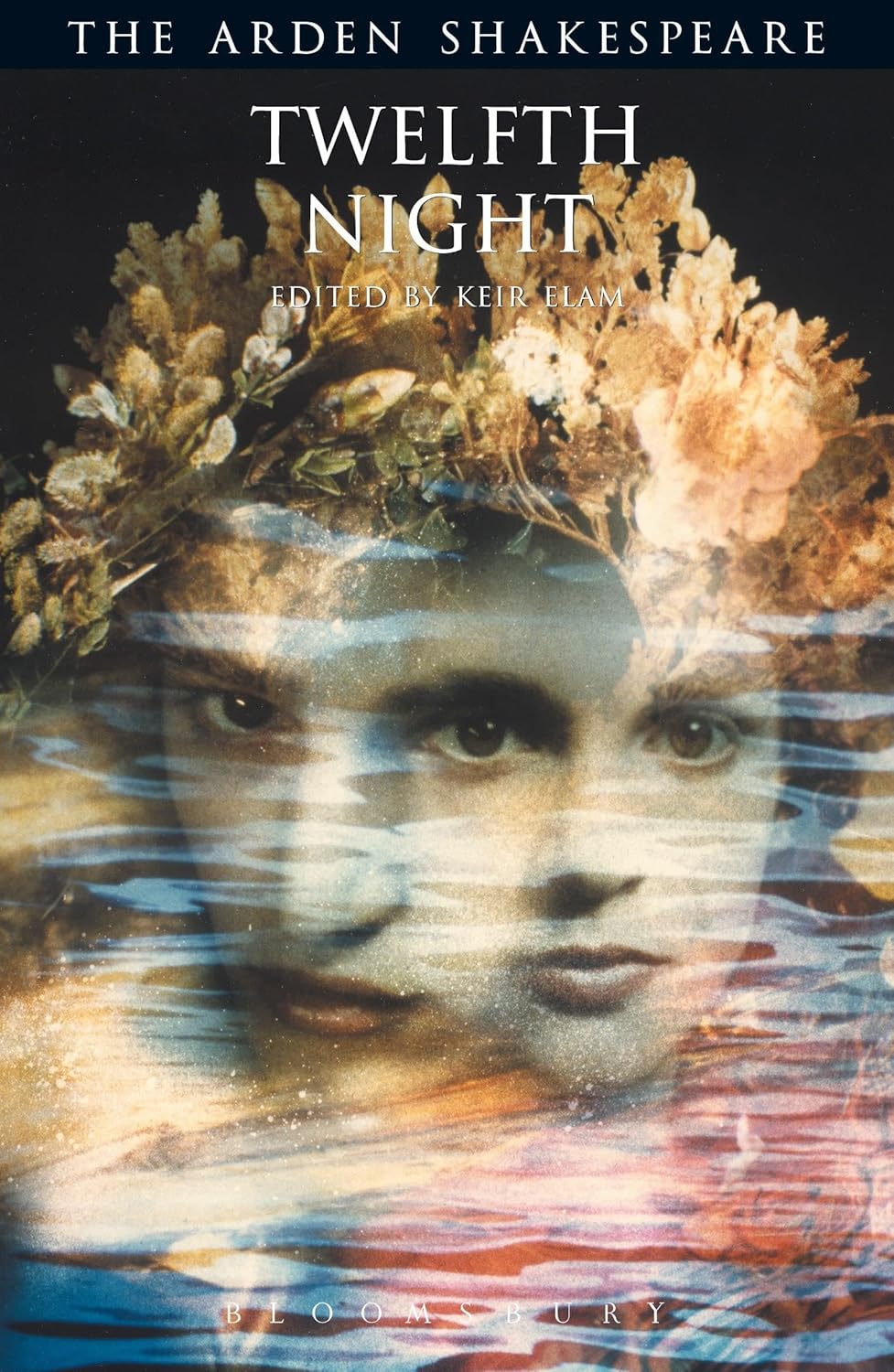
Shakespeare, William. Twelfth Night, or What you Will. [Arden Shakespeare, Third Series.] Ed. Keir Elam. Lodon: Centage Learning, 2008.

When Sir Toby Belch, Sir Andrew Aguecheek, and Feste (the jester) meet up in Act II of Twelfth Night, we get this exchange:
Sir Andrew: Here comes the fool, i'faith.

Feste: How now, my hearts? Did you never see the picture of "we three"?

Sir Toby: Welcome, ass. (II.iii.14-17)
The footnote to the Arden Shakespeare (Third Series) explains this in this way:
. . . alludes to a painting or inn sign representing two asses or loggerheads; the caption "we three" implicated the spectator—here presumably Feste himself—as the third ass or loggerhead (i.e., fool) . . . (212)
The Shakespeare Birthplace Trust has just such an image, dated from 1600-1625:


One fool looks at another fool who, in turn, looks out on the third fool: you, the viewer! April Fool!

The audience participation part of the joke is the best part. The observer needs to be present for the "We Three" to be fulfilled.

There are a number of other related images, including these two signs from a pub in Mold, Whales:


Some images seem to have been created by someone who didn't get the joke and included all three figures in the image itself, leaving out the audience participation:


But additionally interesting is the plethora of postcards around the year 1900 that have combined this Shakespeare-era joke with a Shakespeare quote. They're most often (as in the image that heads this post) an image of two donkeys with the caption "When shall we three meet again?"


Yes, as I said, a plethora. At least one plethora. Perhaps even a multitude of plethora. Again, I like the audience participation aspect of this. The card with two donkeys and the query "When shall we three meet again?" is sent to a person who is absent. At first glance, it seems like the message being conveyed is on the order of "Wish you were here," but the two donkeys turn it into a clever insult—the recipient is the third ass of three.

And remember, if you ever look at an image like this, it means that someone is calling you a donkey: you become the third ass of three.  This April Fools' Day, don't let anyone fool you with a similar joke. 

Oh, wait—I just did. A plethora of times.  April Fool!

Click below to purchase the Arden edition of the play from amazon.com
(and to support Bardfilm as you do so).

Tuesday, March 31, 2015

Spaghetti Shakespeare: Contemporary Review of Johnny Hamlet

"Johnny Hamlet." Review of Johnny Hamlet, dir. Enzo G. Castellari. Variety 10 May 1972: 20+.

As thrilled as I am by the prospect of a Spaghetti Western that retells the story of Hamlet in one way or another (for which, q.v.), not everyone shares my enthusiasm.

Witness the nearly-contemporary review of the film from a 1972 Variety (the film was reeled in 1968):
. . . this "Hamlet" effot is so inept in concept and playing that it is more likely to grow old on the bottom half of an action doublebill. (20)
The review continues . . .
Corman [who plays Johnny Hamlet], with a makeup job that makes him look more like a Q-T suntan ad than a cowboy, is dreadful but Roland [as Horace, the Horatio analogue,] almost makes his ridiculous role dignified. The rest of the cast has been sliced off the same prosciutto as Corman. (34)
I gather than you can't please all the critics all the time. If you'd like to read more of the review, click on the image below to enlarge it—and then take it all with a few grains of finest Italian sea salt.


Links: The Film at IMDB.

Click below to purchase the film from amazon.com
(and to support Bardfilm as you do so).


Bardfilm is normally written as one word, though it can also be found under a search for "Bard Film Blog." Bardfilm is a Shakespeare blog (admittedly, one of many Shakespeare blogs), and it is dedicated to commentary on films (Shakespeare movies, The Shakespeare Movie, Shakespeare on television, Shakespeare at the cinema), plays, and other matter related to Shakespeare (allusions to Shakespeare in pop culture, quotes from Shakespeare in popular culture, quotations that come from Shakespeare, et cetera).

Unless otherwise indicated, quotations from Shakespeare's works are from the following edition:
Shakespeare, William. The Riverside Shakespeare. 2nd ed. Gen. ed. G. Blakemore Evans. Boston: Houghton Mifflin, 1997.
All material original to this blog is copyrighted: Copyright 2008-2039 (and into perpetuity thereafter) by Keith Jones.

The very instant that I saw you did / My heart fly to your service; there resides, / To make me slave to it; and, for your sake, / Am I this patient [b]log-man.

—The Tempest