Friday, March 25, 2011

The Huntington Library and the Shakespeare Scholar

Photo Credit: "View of the exterior of the Library Exhibition Hall." © The Huntington. The Huntington Library, San Marino, California.
Research in and around the environs of the Huntington Library is a delight to the scholar. Not only does the library have some of the most magnificent and rare books and manuscripts imaginable, but the grounds and the surrounding area—in both San Marino and Pasadena—have a great deal to offer the scholar.

That proves particularly true during times like this one, when the scholar is waiting for the lunch hour to end and for the rare books to be brought back in for viewing.

During such times, the Shakespeare scholar in particular may wish to stroll the grounds in search of some botanical references to Shakespeare:

"Cleopatra (Anthony)." Plant. Huntington Botanical Gardens, San Marino, California. Digital Image requested by Keith Jones.

Or the hungry Shakespeare scholar might venture into neighboring Pasadena for a delicious meal at a (sort of) Shakespeare-related establishment:

Hamburger Hamlet. Restaurant. Pasadena, California. Digital Image by Keith Jones.

All of this can be done while the Shakespeare scholar stores bulky items in the perfect locker:

"2B." Locker. Huntington Library, San Marino, California. Digital Image by Keith Jones.

Links: The Huntington.

Wednesday, March 23, 2011

Elizabeth Taylor (R.I.P.) as Katherine in The Taming of the Shrew

The Taming of the Shrew. Dir. Franco Zeffirelli. Perf. Elizabeth Taylor and Richard Burton. 1967. DVD. Sony, 1999.

Today, 23 March 2011, Elizabeth Taylor died. Her Katherine was magnificent, as was the Helen of Troy she played in the Doctor Faustus directed by Richard Burton.

I'm out of town, so I can't cull a clip right now, but her version of Katherine's "I am ashamed that women are so simple" speech is remarkable. She plays it absolutely straight, leaving it up to us to determine just how much of it Katherine embraces and how much is merely a façade.

The face (or the eyes?) that launched a thousand ships (and seven or eight marriages, depending on whether you count Richard Burton once or twice) has departed from the world, but she has left a marvelous legacy behind her.

Links: The Film at IMDB.

Click below to purchase the two films mentioned above from amazon.com
(and to support Bardfilm as you do so).


Friday, March 18, 2011

The Huntington Library and its Shakespeare Collection

[Shakespeare, William.] The Tragedy of King Richard the Third. London: Printed by Valentine Sims, for Andrew Wise, dwelling in Paules Chuch-yard [sic], at the Signe of the Angell, 1597. Huntington Library Call Number 69350. Huntington Library, San Marino, California. Digital Image by Keith Jones. Original housed in the Huntington Library, San Marino, California. No copies may be made.
A few days ago, I read Richard III. I read it in the first printed edition—the First Quarto (Q1), which was printed in 1597. It was not a facsimile; it was not on-line. It was a copy that was on sale in London in 1597. And it was astonishing.

The librarians and curators at the Huntington have been effusively kind and helpful, and I'm enormously grateful to be here—and I'm particularly grateful to have been able to handle this copy and to make a few photographs of it. The image above is one of them—it's a bit blurry, I'm afraid, but click on it to enlarge it, and you'll see that it contains the oft-quoted line "A horse! A horse! My kingdom for a horse!"

The pages have been removed from their binding and pasted on larger sheets, that have rectangular holes cut in them to allow viewing of both the recto and the verso of each page and that were, in their turn, bound as a book. I could feel the graininess of the paper, note the occasional imperfections, hold it up to the light, and make scholarly determinations about it. I could also smell it. If you'd like a rough approximation, take a modern cereal box, tear it slightly, and sniff. That faint odor is similar to the smell of the Huntington's copy of Q1 of Richard III.

I was also able to establish, to my own satisfaction, that some of the quires of this copy of Q1 are older than the related quires in the British Library's copy. For example, the Huntington Library's copy has this typographical error on Signature L3v, line 12: "Good lordsc onduct him to his regiment.” The British Library's copy corrects the line to read “Good lords conduct him to his regiment.” There are other, similar corrections to the British Library's copy that are not made to the Huntington Library's copy, but I don't want to give the game away completely, so I'll keep those under my hat for now.

[Shakespeare, William.] The Tragedy of King Richard the Third. London: Printed by Valentine Sims, for Andrew Wise, dwelling in Paules Chuch-yard [sic], at the Signe of the Angell, 1597. Sig. L3v. Huntington Library Call Number 69350. Huntington Library, San Marino, California. Digital Image by Keith Jones. Original housed in the Huntington Library, San Marino, California. No copies may be made.

At some point during the print run, this error was noted and corrected; newer printings from the slightly-altered block do not have the error.

There are two ways of looking at this. 1. The British Library has a "better" (i.e., less error-filled) copy of Q1 of Richard III. 2. The Huntington Library's copy of Q1 of Richard III is, in some quires at least, incrementally older than the British Library copy. If antiquity counts for anything, the Huntington scores bonus points!

The other work I'm doing here is also exciting, but you'll have to wait until I gather more material and draw some preliminary conclusions. And I'll see if they'll let me look at Q2 of the play next week!
Links: The Huntington.
Tuesday, March 1, 2011

A Few Brief Comments on Gnomeo and Juliet

Gnomeo and Juliet. Dir. Kelly Asbury. Perf. Emily Blunt, James McAvoy, Michael Caine, Maggie Smith, Patrick Stewart, Stephen Merchant, Hulk Hogan, Ozzy Osbourne, and Elton John. Touchstone Pictures. 11 February 2011.
I have an awful lot on my plate for the next few weeks, but I saw Gnomeo and Juliet this past weekend, and I wanted to get some ideas down before they fade. It's a fabulous, fast-paced film that is exceedingly well-crafted, well-voiced, well-conceived, and well-presented. It's absolutely delightful from start to finish. If you haven't yet seen it, stop here and go see it instantly. Otherwise, the spoilers below may detract from the joy of your experience of the film.

At first, I thought of titling this post "Meta-theatricality in Gnomeo and Juliet," but that seemed a bit heavy. Still, that's the point of this film that caught my attention (and forgive me if this ground has already been covered—I've been intentionally avoiding reviews of the film until I could see it myself).

The film is a derivative version of Shakespeare's Romeo and Juliet, and its debt to Shakespeare is more than just the idea of star-crossed lovers making a good film. There are a dozen in-jokes calculated to delight the Shakespeare aficionado portion of the audience, and I was delighted to see that they are jokes that children can grow into as their familiarity with Shakespeare's works increases. The truck with "Rosencrantz and Guildenstern Moving Company" is just one of them. The film's setting—in Stratford-upon-Avon itself!—is another.

But the most interesting element of the film is its Shakespearean sensibility about self-reflexivity. A Shakespeare play is often keenly aware—and makes its audience keenly aware—that it is a play. That meta-theatricality is enhanced and developed in Gnomeo and Juliet. The film is keenly aware—and makes its audience keenly aware—that it is a film. And it also is keenly aware that it is a film derived from a Shakespeare play—and it makes its audience keenly aware of that, too.

The film has a character called "Bill Shakespeare" (voiced to the point of absolute perfection by Patrick Stewart); his appearance brings the self-reflexivity to the fore. Gnomeo tells Bill (who is a statue) his story, and that story reminds Bill of a story he once told. Of course, Bill's story ended tragically—with the deaths of the two lovers in question. The character is actually slightly smarmy about it, insisting that he likes the tragic ending better than other possible endings Gnomeo suggests. And he keeps saying, "I told you so!" when things look bleak.

In this, the film stunningly builds in a counterargument to its own existence, reminding us that there may be those who want Shakespeare to stay Shakespeare—those who argue that a derivative version of Shakespeare (particularly one that changes the ending so drastically) is too far from Shakespeare to be Shakespeare any longer. But it simultaneously makes the case that derivative versions of Shakespeare can be evaluated on their own terms. Yes, something has changed, but we can find interest and significance in what the new entity offers. Much more could be said on that topic alone—it's one point where the film opens a debate and expects its audience to think about it.

The end of the film is, in essence, a curtain call. All the characters make an appearance (even the one we thought smashed beyond repair), and we are reminded that the opening introduced us to a play rather than a film. That, too, was a marvelous device, making us think that all these gnomes are actors putting on the story of Gnomeo and Juliet, and we start to think that they are "The best actors in the world, either for tragedy, comedy, history, pastoral, pastoral-comical, historical-pastoral, tragical-historical, tragical-comical-historical-pastoral, scene individable, or poem unlimited," as Polonius puts it (Hamlet, II.ii.396-400).

And, in the category of other things I'd like to mention, I was a bit put off by some of the jokes geared toward the older audience exclusively. For example, the Nurse analogue (Nanette, the frog) comments that Juliet has some "junk in the trunk," and I think that's unnecessary. Come to think of it, it's also fairly unfunny.

But the sound effects were perfect. Whenever a gnome would brush up against another, grating noises—however slight—occurred. It reminded us effectively of the way these gnomes are unlike us—even while convincing us that we are very much alike.

At some point, I'd like to think more deliberately through the film's ending. [Note: Specific Spoilers Follow.] The blame for the chaos and destruction at the end is interestingly divided. The main instigator of the demolition is an inanimate object—by which, I mean an object that is more inanimate than garden gnomes are normally thought to be. Because the destruction comes from an out-of-control lawn tractor rather than from any specific gnome (though, certainly, specific gnomes start the sequence of events leading up to the devastation), the guilt is somewhat sublimated. Still, both red and blue gnomes acknowledge the blame, and it's shared evenly among all parties.

The film is something you should certainly see. And if you need further convincing, here's the trailer:

Click below to purchase the book from amazon.com
(and to support Bardfilm as you do so).

Thursday, February 17, 2011

Micro-Review of This Wide and Universal Theater by David Bevington

Bevington, David M. This Wide and Universal Theater: Shakespeare in Performance, Then and Now. Chicago: University of Chicago Press, 2007.

If you are drawn to the "Performance History" section of whatever play you're reading—and I know I am—then you'll thoroughly enjoy David Bevington's book. It is filled with marvelous anecdotes about the ways many of Shakespeare's plays have been staged.

I found it to be a delightful read, but it's also a valuable resource for scholars, actors, and directors who are searching for a deeper understanding of the nuances that resonate in every scene Shakespeare ever wrote.

As an example, here's a paragraph from the middle of a discussion of productions of Hamlet:
At Wisdom Bridge Theatre in Chicago in 1985, directed by Robert Falls, Claudius was a Great Communicator in the style of movie-actor turned governor of California and then president of the United States, Ronald Regan: Claudius himself never appeared onstage in 1.2 for his first big scene of explaining the necessity of his marriage to Gertrude, but was instead seen on television monitors to left and right, while the stage itself was given over to his advance men and PR experts setting up for a press party where the "spin" of the new administration was being manufactured. Fading and torn posters of the previous king hung from the walls as a bleak reminder of an administration now nearly lost to memory. Polonius (Del Close) was a businessman in the three-piece suit taking down conversations on his tape recorder; Hamlet (Aidan Quinn) was a young rebel with a cause, spray-painting "To be or not to be" on a bulkhead and then stepping back admiringly to observe, "Now, that is the question." (147)
The book is filled with anecdotes of this sort, complemented with insightful commentary.

Click below to purchase the book from amazon.com
(and to support Bardfilm as you do so).

Monday, February 14, 2011

Valentine's Day Wishes to Anne Shakespeare from William Shakespeare
(As Forged by William-Henry Ireland)

Schoenbaum, S. William Shakespeare: Records and Images. Oxford: Oxford University Press, 1981.

Last Valentine's Day, I wrote about Samuel Schoenbaum's Shakespeare’s Lives and the account of Willam-Henry Ireland's forgery of love poems from Will Shakespeare to Anne Shakespeare (for which, q.v.).

At that time, I tried to find a facsimile (as opposed to a transcription) of the original forgeries.

Perseverance paid off. I tracked down the poems in Schoenbaum's earlier work William Shakespeare: Records and Images. The image above contains "Shakespeare's Verses to Anna Hatherrewaye" (124), which is how Ireland spelled Anne's maiden name. My favorite is still the one in the image below (the transcription follows):


Is there inne heavenne aught more rare
Thanne thou sweete Nymphe of Avon fayre
Is there onne Earthe a Manne more trewe
Thanne Willy Shakespeare is toe you.
Ah, young love. It gets you every time.

Happy Valentine's Day, everyone!

Links: Wikipedia's article on William Henry Ireland.

Click below to purchase the book from amazon.com
(and to support Bardfilm as you do so).

Sunday, February 13, 2011

A Brief Review of The Boy Who would be Shakespeare: A Tale of Forgery and Folly

Stewart, Doug. The Boy Who would be Shakespeare: A Tale of Forgery and Folly. Philadelphia: Da Capo Press, 2010.

Samuel Schoenbaum's Shakespeare's Lives (for which, q.v.) writes in a very scholarly way about William-Henry Ireland, one of the great forgers of Shakespeareana the world has ever known. Doug Stewart tells the story in more detail and with a more popular audience in mind.

The story of Ireland's discovery of a gigantic collection of undiscovered works by Shakespeare (for a tiny glimpse of which, q.v.) consists of equal parts tragedy, humor, and incredulity.

The basic story could be put as a question of supply and demand. William-Henry Ireland saw that the world longed for more Shakespeare—particularly, documents in his own hand. His father, a collector and dealer in rare items, was extremely keen to get a Shakespeare signature. Well, who isn't, to be honest? William-Henry supplied one. From that starting point, he forged letters, poems, financial transactions, legal documents, and a play.

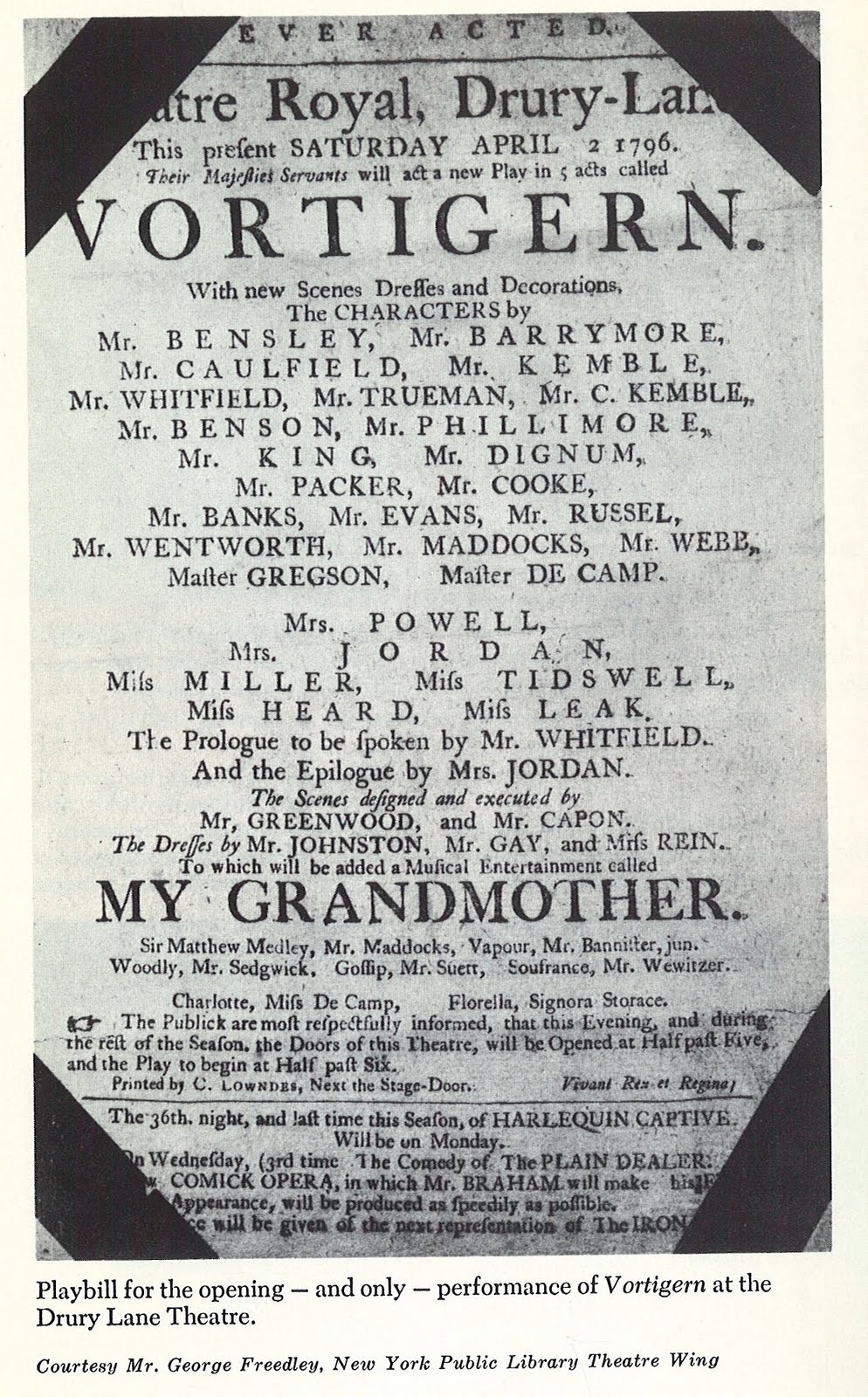
Stewart writes very engagingly about the topic throughout his work, but one of the most interesting passages is his description of the opening (and closing) night performance of Vortigen, a play Ireland had duped many people into accepting as an undiscovered work by Shakespeare himself. The audience that night—2 April 1796—was mixed with those who fervently believed they were about to see a performance of a play lost for nearly two hundred years; those who, following Edmund Malone, the greatest Shakespeare scholar of the age, were intensely skeptical about the whole affair (the Malonites); and those who were simply caught up in the curiosity of the moment.

Here's Stewart's account of the chaos at the end of the play:
In the climactic fifth act, King Vortigern . . . recounts a vision of hell that has just gripped him . . . . After describing with horror Death's "rattling fingers" and "bony jaws," Kemble came to the words "And when this solemn mockery is ended . . . ." The actor drew out the line, William-Henry recalled, "in the most sepulchral tone of voice possible." Immediately, as if it were a prearranged signal to the Malonites—which William-Henry was convinced it was—"the most discordant howl echoed from the pit that ever assailed the organs of hearing." There was bedlam for at least ten minutes.

According to William-Henry's account, when the theater had finally calmed down, Kemble, "in order to amuse the audience still more," repeated the line in an even deeper and more emphatic voice. He left no doubt as to what mockery he was referring to. Again, the audience burst into prolonged whistling and sarcastic cheers. Kemble had to beg the crowd once more to allow the performance to continue.

At this point, Vortigen was doomed, even though the rest of the play was performed without disruption. At the final curtain, prolonged booing was mixed with enthusiastic applause. Mrs. Jordan, still in a boy's tights, delivered the epilogue with her customary good cheer. She was given an ovation for her efforts—a gauge more of her popularity than the play's. On Sheridan's instructions, the actor playing Aurelius, who used the stage name Barrymore, announced that Vortigen would next be performed on Monday evening. His words were quickly shouted down by catcalls and heckling from every part of the theater. Fighting broke out among believers and non-believers. Charles Sturt, swaying drunkenly next to his box, gripped a stagehand in a headlock and was pelted with oranges. (183-84)
The book is a delightful and interesting read, proving useful insight not only into the forgery itself but into the keen desire we all share to have more of Shakespeare's work.

Click below to purchase the book from amazon.com
(and to support Bardfilm as you do so).

Friday, February 11, 2011

The Story of Edgar Sawtelle: Recommended for Hamlet Lovers Everywhere

Wroblewski, David. The Story of Edgar Sawtelle: A Novel. New York: Ecco, 2008.

I don't always have time to sit down with a thick novel, no matter how good it is. Often, I listen to the audiobook version. One of the benefits of doing so is that I can listen to it while driving, shoveling snow, doing chores, shoveling snow, working out, or shoveling snow (I do live in Minnesota, after all). Another is that I can listen to it at twice the speed, thus saving time. For The Story of Edgar Sawtelle, I didn't save any time. It was so good that I listened to it twice.

I don't want to give away any part of the plot. You may know that it is structured on the plot of Hamlet, but part of the joy for me in listening to the novel was being uncertain just where or how it would deviate from Hamlet's plot. The best parts in that respect are the section that is analogous to Hamlet's exile to England and encounter with the pirates and the culmination of the novel. You really ought to read or listen to this novel yourself. It's highly recommended.

Links: The Novel at Wikipedia.

Click below to purchase the novel from amazon.com
(and to support Bardfilm as you do so).

Wednesday, February 9, 2011

Richard III and Black Adder

“The Foretelling.” By Richard Curtis and Rowan Atkinson. Perf. Rowan Atkinson, Brian Blessed, and Peter Cook. The Black Adder. Season 1, episode 1. BBC. 15 June 1983. DVD. 2 Entertain Video, 2009.

Burnett, Mark Thornton. “Parodying with Richard.” Shakespeare on Screen: Richard III. Ed. Sarah Hatchuel and Nathalie Vienne-Guerrin. Ruon: Publications de l’Université de Rouen, 2005. 91-112.
Tempera, Mariangela. “Winters and Horses: References to Richard III on Film and Television.” Shakespeare on Screen: Richard III. Ed. Sarah Hatchuel and Nathalie Vienne-Guerrin. Ruon: Publications de l’Université de Rouen, 2005. 65-89.


As strange as it may seem, I (a long-time fan of Monty Python and Mr. Bean) never got into Black Adder. And I'm still not into it—but two articles (listed above), each in a volume entitled Shakespeare on Screen: Richard III, mention its place in popular culture and write about its use of Richard III. Their alluding to the show was enough to bring me around to try it again.

The opening sequence is really quite marvelous. It presents a revisionist version of Richard III. Here, he's not a misshapen tyrant. No. Instead of a hump under his cloak, he carries a bag of toys! Instead of being hunched over—well, you'll see.

The most intriguing part of this clip is the mixing of lines from Richard III with some from Henry V in a revised version of the speech before the Battle of Bosworth Field.


Of course, the comic version of Richard III's calling for a horse is also brilliant. Oh, and the visual allusions to Olivier's Henry V (that's the same crown) were beautifully done.

Links: The Episode at IMDB.

Click below to purchase the film from amazon.com
(and to support Bardfilm as you do so).

Monday, February 7, 2011

Bob Dylan, Will Shakespeare, and Measure for Measure

kj. "Imagine Bob Dylan Singing the Plot of Measure for Measure." Bardfilm: The Shakespeare and Film Microblog. Web. 7 February 2011.
I've used Bob Dylan's "Seven Curses" (for which, q.v.) as a way of talking about the folk narrative background to Shakespeare's problem play Measure for Measure (for which, q.v.). 

This is a little something that grew out of that endeavor. For my Shakespeare class last semester, I wrote and performed this song. And why should they get to hear something that the readers of Bardfilm don't (apart from the fact that they pay tuition, earn scholarships, write papers, study for hours, take examinations, and get college credit for the course)? 

 Imagine, then, if you will, what would happen if Bob Dylan were to sing the plot of Measure for Measure to the tune of his "Seven Curses" in about five minutes. Actually, you don't need to tax your imagination too much. Just watch the video below. Enjoy!


In case you want to follow along with the lyrics, here they are:
Imagine Bob Dylan Singing the Plot of Measure for Measure

Now Claudio got Julietta pregnant.
And they caught him and they brought him in.
But the Duke was out of town when the deal was going down,
And Angelo stood in for him.

Angelo . . . well, he was perfect.
He liked enforcing laws that mentioned lust.
But he wasn’t very nice; his urine was congealed ice.
And, all in all, he wasn’t just.

So even though Claudio’s marriage might have been legal—
Sponsalia per verba de futuro
He was condemned to die for begetting his small fry,
Condemned to die by Angelo.

Escalus spoke up for Claudio,
But Angelo wouldn’t listen at all.
“That man must surely die for begetting his small fry,
’Tis one thing to be tempted, another thing to fall.”

Did I mention that Claudio had a sister?
Well, he did, and her name was Isabel.
And she was pretty and young, and she wanted to be a nun.
With her in love Angelo fell.

“In order to release your brother,
Resign yourself to sleep with me,” he said.
“You must be kidding me! I’m a nun—about to be.
I’d rather see my brother dead.”

When Claudio heard Isabella’s story
He was mad that Angelo should be so base.
“That hypocrite! That cad! Why, he’s really very bad.
You mustn’t go. Remain chaste.”

Claudio thought Isabella shouldn’t.
But then he had another thought.
“Say, Isabel, my dear. Death is something all should fear:
To lie in cold obstruction and to rot.

“I think maybe you should do it.
It’s not such a deadly Deadly Sin.
You’ve got a lot to give. Sweet sister, let me live!
A vice can have a virtue hid within.”

Well, Isabella didn’t like the idea.
“I'll pray a thousand prayers for thy death,” she said.
And she might have—I don’t know—she was just about to go
When this Friar had a word with her instead.

I forgot to mention something important:
Something clearly crucial to the plot.
The Duke, who dressed in sienna, hadn’t really left Vienna
He disguised himself and overheard a lot.

“Now we know,” he said, “what these seemers be.
Angelo doesn’t seem that great to me.
But I’ll show you something strange—follow me to the moated grange,
And we’ll meet Angelo’s bride to be.”

“He has a fiancée?” asked Isabel.
“Not exactly—no—not anymore.
They were fixin’ to be wed, when Mariana said,
‘The dowry didn’t come through; I’m kinda poor.’

“So Angelo broke off the engagement.
But Mariana still loves that bozo.
She’ll be glad to take your place; and he’ll never see her face.
We’ll trick him into a ‘marriage’ sort of like Claudio’s.”

So they did. And Claudio’s pardon
Was expected by the Duke at any time.
But when the order came, the sentence was just the same.
Angelo was covering up his crime.

“Well, what do we do now?” asked the Provost.
The Duke said, “Well, we can’t kill Claudio.
But Angelo has to have a head. Use this pirate’s one instead,
And Angelo will never know.”

Then the Duke “returned”—himself—in person—
Heard everyone’s explanations with great pleasure.
Then he said, “Well, there you go. We should behead Angelo.
The title of the play is Measure for Measure.”

And then—well, it gets complicated.
Mariana begs for Angelo’s life.
And Isabel, who has her doubts, says, “All right. Pardon the lout.”
And the Duke says to her, “Be my wife.”

The moral of this whole story—
Forgive me if I start to preach—
Is “Hypocrites and liars (and Dukes disguised as Friars)
Should all show mercy each to each.”
Note: The finger puppets are from Michael Rogalski's Masterpuppet Theater: The World of Shakespeare—At Your Fingertips! set (for which, q.v.)—although the names have been changed to protect the innocent.
In case the link above fails, here's a blog-native version of the video:


Saturday, February 5, 2011

Measure for Measure with Action Figures

Shakespeare's Measure for Measure. Dir. Vindwyn. Perf. Vindwyn and Vindwyn's Husband. 2008. Web. 26 January 2010.
While we're on the subject of Measure for Measure, I simply must call your attention to this truly remarkable derivative version created using action figures (a.k.a. Barbie™ and Ken™ figures).

It's a derivative, according to Kenneth Rothwell's magnificent terminology (for which, q.v.), because it abandons most of Shakespeare's language while retaining the plot. Observe the equivalent scene to the one covered in a recent post:


That is quite wonderful (though it does simplify Isabella's motivation to such a degree that it may lead to misinterpretation of the play as a whole)—and so is the rest of the film. The entire video is about twenty minutes long, and it serves as a marvelous (and marvelously-humorous) introduction to the plot of the play. Thanks so much, Vindwyn and Vindwyn's Husband!
Links: The Complete Video at YouTube (also embedded below).

Thursday, February 3, 2011

“A Sad Tale's Best for Winter”
The Winter's Tale at the Guthrie

The Winter's Tale. Dir. Jonathan Munby. Perf. Ansa Akyea, Christina Baldwin, Raye Birk, Helen Carey, John Catron, Bob Davis, Sean Michael Dooley, Tyson Forbes, Emily Gunyou Halaas, Michael Hayden, Michael Thomas Holmes, Juan Rivera Lebron, Bill McCallum, Michelle O'Neill, Suzanne Warmanen, Christine Weber, Stephen Yoakam, Noah Coon,and Devon Solwold. Guthrie Theatre Company. Minneapolis. 29 January—27 March 2011.
Thanks to the Guthrie, I was able to see its production of The Winter's Tale last night. The Guthrie gave us a solid, good production of a difficult play.

The play is difficult because its scope is so large. There are shadows of Othello (in the jealously of Leontes), Macbeth (in Camillo's contemplation of the murder of an anointed king), Hamlet (with Perdita's distribution of flowers), and A Midsummer Night's Dream (with surreal elements creeping in from time to time).

A review of this production is also difficult for similar reasons. This is a big, big production. It's amazing how much is going on! To make it a bit more manageable, I'm breaking it into categories ("Brilliant," "Interesting," "Unusual," and "Uncertain") below.

Note: There may be inadvertent spoilers here. If you'd rather not know beforehand, go see the play before reading further.

Brilliant.
  • Lighting. I was immensely impressed with the use of lighting, color, and shadow for this production. The effects of the characters' shadows descending into the prison cell, for example, could compete with Orson Welles on a level playing field. The level of attention to the marriage of color to text was truly thrilling. The rustic scenes started with warm oranges, reds, and yellows, but the colors were subtly washed out when things start to turn sour in that world. And there were some bizarre and wonderful blue lights during the scene where Antigonus leaves the baby on the beach that were simply beyond my understanding.
  • Point of View. Several scenes invite us to see the actions on stage from a particular character's point of view. While common enough in film, it's not done as often in a stage production. But it was very effective. Early in the play, when Leontes is first becoming jealous of Hermione, we gather that we are meant to see Hermione and Polixenes from Leontes' point of view. They aren't really being as affectionate toward each other as Leontes thinks. Later, we have something of a dream sequence from Leontes' tortured mind. It was quite effective. The use of filmic devices for a stage production was marvelous.
  • Leontes. Michael Hayden, as Leontes, delivered a speech from I.ii brilliantly. He was able to give it just the right tone to make every single person in the audience—male and female—squirm at its implications. His own mind has been poisoned with jealousy; he works hard at poisoning the audience with jealousy. Here's the speech:
Now while I speak this, holds his wife by the arm,
That little thinks she has been sluiced in's absence
And his pond fish'd by his next neighbour, by
Sir Smile, his neighbour.
  • Leontes again. In Othello, it takes Iago until Act III, scene iii to work Othello into a fever pitch of jealousy. In The Winter's Tale, Leontes must get to that point—and believably, too—in one and a half scenes. Again, Michael Hayden manages it.
  • Public exchanges / private exchanges. At the beginning of Act I, scene i, Polixenes makes the case for his heading back to his home country of Bohemia. This production chose to have him deliver that speech very publicly; Leontes tries to dissuade him from going—that, too, is very public. That gives the entire exchange an interesting depth. Both characters are in danger of losing face. It adds another intriguing layer to the exchange—and to the audience's understanding of what's at stake when Polixenes gives in to Hermione.
  • Use of the trap. I love the Guthrie's trap and the many uses to which it has been put, but I've never seen it used as effectively as it was in this play. I'm in danger of giving away a major spoiler, and I want those who see the show to be surprised, so I'll stop there.
  • Some of the music. The show opens with four jazz standards. They were well sung, they set the mood, and they enabled the audience to witness some dancing that was lovely to see. Moreover, this refined music and dancing served as an interesting contrast to the folksy, bluegrass numbers in the play's rustic setting. But the best song, and the one that indicated this production's indebtedness to Ian McKellen's film version of Richard III, was a bluegrass version of Kit Marlowe's "The Passionate Shepherd to his Lass." McKellen's film has a jazz song with those lyrics near its beginning. Hearing "Come live with me and be my love" as a bluegrass number with the ensemble doing country dancing was certainly a highlight of this production.
Interesting.
  • Debt to McKellen's Richard III. The song mentioned above isn't the only connection between this stage production and McKellen's film production. They both employ an old-fashioned microphone that becomes a key part of the action. They both use the color red to great effect. And they both present the villain of the piece in a fairly-sympathetic light.
  • Antigonus and the Bear. The Winter's Tale has Shakespeare's most notorious stage direction: "Exit, pursued by a bear." Antigonus is reluctantly following Leontes' orders to expose the baby Leontes thinks isn't his own (though it is) on the coast of Bohemia (though it doesn't have one). In any case, his exit pursued by and subsequent consumption by a bear can be read as just deserts: he's eaten by a bear because he followed the unjust command of his king. In this production, Antigonus is given a more noble exit than that. The bear (and the bear in this production is really something you have to see to believe!) heads for the baby at first, but Antigonus distracts it from her—at the cost of his own life. It goes some way to redeeming his character.
  • Sets. The sets were extravagant and beautiful. The rustic scenes have a marvelous forest of birch trees and a Chevvy. The final scene is remarkable, with a circular curtain descending from the top of the ceiling to enshroud the statue at the end.
Unusual.
  • The Oracle of Delphi. Leontes sends to the Oracle of Delphi to find out the truth of the situation. He's convinced that the Oracle will confirm his suspicions. The text calls for the Oracle's response to be read after the seals are broken on the message. This production brings the Oracle herself on stage—in a wheelchair and with a muzzle on. The muzzle is removed so that she can speak the truth to Leontes. I'm interested in the decision, but I would have liked to see more done with it. Perhaps the Oracle could be re-muzzed later in the scene—Leontes, perhaps, wanting to silence the truth.
  • Pre-empting Time's speech. The play is also known for violating the unities in no uncertain terms. At the beginning of Act IV, Time himself enters and tells us how sixteen years have passed by. It's brilliant and daring. This production has those sixteen years pass by in quicker than an instant. At the end of Act III, the shepherd throws the clothes that wrapped the baby into the air and a sixteen-year-old girl approaches.
Uncertain.
  • Some of the music in the rustic scenes. The bluegrass "Passionate Shepherd" was brilliant. However, a number of the other songs seemed forced. They did not naturally fit the music.
  • Use of audio voiceovers. At a few points—notably Antigonus' reporting of the vision of Hermione he had seen—the audio cuts in to provide dialogue. I'm afraid it was a bit awkward and confusing rather than clear and convincing.
  • The accusation scene. Act II, scene i contains Leontes' accusation of infidelity. The night I saw the play, the scene was pretty flat. None of the characters seemed to react at all to the accusation. Instead, they passively waited for the scene to progress.
But don't get me wrong about those "Uncertain" items. The play is so large and the production so enormous that there's room for things to be slightly uneven.

You should certainly go see this play. And don't forget to check the details on discount tickets to the Guthrie that you can get by mentioning Bardfilm!
Note: I just discovered a brief video clip from the Guthrie's website. It will give you a general sense of the production (including, at the end, part of the bluegrass version of "The Passionate Shepherd to his Love"):


Links: The Play at the Guthrie Theater.

David Tennant as Angelo in Measure for Measure

Conjuring Shakespeare. Perf. David Tennant. 10 September 1997.
Once again, we have a fragment where we'd like to have a complete record.

David Tennant played Measure for Measure's Angelo in at least one scene for a 1997 documentary entitled Conjuring Shakespeare. There's very little I can find out about that documentary, but a clip of one scene has been making its way around the internet. The threat of violence is present in almost every minute of it. Here's a selection of it (the text and commentary follow):


The clip comes from Act II, scene iv:
Isabella
. . . your virtue hath a licence in't,
Which seems a little fouler than it is,
To pluck on others.

Angelo
Believe me, on my honor,
My words express my purpose.

Isabella
Ha! little honour to be much believed,
And most pernicious purpose! Seeming, seeming!
I will proclaim thee, Angelo; look for't:
Sign me a present pardon for my brother,
Or with an outstretch'd throat I'll tell the world aloud
What man thou art.

Angelo
Who will believe thee, Isabel?
My unsoil'd name, the austereness of my life,
My vouch against you, and my place i' the state,
Will so your accusation overweigh,
That you shall stifle in your own report
And smell of calumny. (II.iv.145-59)
The scene shows each of them at their worst. Angelo, of course, refers to his "honor," which he no longer has. Isabella sinks somewhat toward his level—it's a bit like blackmail on her part to demand a pardon for her brother on the strength of her silence about Angelo's—to use a modern term—sexual harassment.

Links: What little is known about the Documentary at IMDB. The complete clip (nearly eight minutes in all).

Tuesday, February 1, 2011

Will's Quill: A Shakespeare-Related Children's Book by the Author of Corduroy

Freeman, Don. Will's Quill. New York: Viking, 1975.

Don Freeman, the author of Corduroy, Dandelion, Norman the Doorman, and other favorites, also wrote and illustrated a children's book set in Shakespeare's London.

It's good—despite the faux-Elizabethan dialogue that is a bit strained: "Forsooth, it does seem life is full of woe, e'en for a lowly goose," as you can see in the image above (to enlarge the image, simply click on it).

However, it's not without its multi-age humor. When the man we first meet in the image above offers the goose (our protagonist) some berries, he says, "Here, my friend . . . . Thy need is greater than mine," making us wonder if we've run up against Sir Philip Sidney.

The gentleman turns out to be Shakespeare himself. And Willoughby Waddle (for that's the name of our heroic goose) saves the day in a manner that I will not reveal to you. I'm afraid you'll have to track down Will's Quill to satisfy your curiosity. I will say this: It has something to do with a quill from a goose and William Shakespeare.

Click below to purchase the film from amazon.com
(and to support Bardfilm as you do so).

Saturday, January 29, 2011

Bardfilm's Fair Use Policy

kj. Bardfilm: The Shakespeare and Film Microblog. Web. 1 January 2011.
I've been thinking through Bardfilm's structure, and it occurred to me that it might be wise to state Bardfilm's policy regarding video use and to explain why Bardfilm's use falls under the "fair use" doctrine of United States law as articulated in, for example, Golan v. Gonzales, 501 F.3d 1170 (2007). That ruling provides, in part, a "guarantee of breathing space within the confines of copyright."

Accordingly, Bardfilm's policy follows these strict rules:
  1. Bardfilm's purpose is educational. I hope to educate my readers by providing commentary and appropriate illustrative material.

  2. Bardfilm always provides the most complete bibliographic information possible about the material it cites. It attempts to follow the format provided by The Chicago Manual of Style, eighteenth edition, though the nature of the material cited here means that its form must often be adapted.

  3. Bardfilm provides, wherever possible, links to places to purchase the material it cites. In this way, it serves something of a promotional purpose for the manufacturers and distributers of the material it cites.

  4. Bardfilm does not make a profit. A small percentage of sales from the links I provide to books and DVDs on Amazon.com does return in the form of Amazon.com credit; however, those funds are used in their entirety (and their entirety is admittedly quite minuscule) to purchase materials to be reviewed by Bardfilm. Although there are ads on Bardfilm's site (provided by blogger.com), I haven't yet made any money from the ads. When I do, those funds will be used in their entirety to purchase materials to be reviewed by Bardfilm.

  5. Bardfilm never provides a video in its entirety. Not even "out of print" material is provided in total. This will encourage those who encounter the material to seek out the fuller version from its source.

  6. Bardfilm does not provide the highest video quality possible. This, too, will encourage readers to seek out higher quality video from its sources.
I hope that stating these policies will clarify Bardfilm's role. Bardfilm desires to help create, develop, and expand the market for Shakespeareana of every kind; it does not intend to hinder the market in any way or to prevent artists, actors, writers, and studios from profiting from their creations. Rather, it attempts to promote such profit and to encourage future creative work involving Shakespeare.

Thank you very much.

Bardfilm is normally written as one word, though it can also be found under a search for "Bard Film Blog." Bardfilm is a Shakespeare blog (admittedly, one of many Shakespeare blogs), and it is dedicated to commentary on films (Shakespeare movies, The Shakespeare Movie, Shakespeare on television, Shakespeare at the cinema), plays, and other matter related to Shakespeare (allusions to Shakespeare in pop culture, quotes from Shakespeare in popular culture, quotations that come from Shakespeare, et cetera).

Unless otherwise indicated, quotations from Shakespeare's works are from the following edition:
Shakespeare, William. The Riverside Shakespeare. 2nd ed. Gen. ed. G. Blakemore Evans. Boston: Houghton Mifflin, 1997.
All material original to this blog is copyrighted: Copyright 2008-2039 (and into perpetuity thereafter) by Keith Jones.

The very instant that I saw you did / My heart fly to your service; there resides, / To make me slave to it; and, for your sake, / Am I this patient [b]log-man.

—The Tempest