Wednesday, March 18, 2015

Book Note: Shakespeare Beyond Doubt? Puts the Authorship Question to Rest in a Different Way

Shahan, John M. and Alexander Waugh. Shakespeare Beyond Doubt?: Exposing an Industry in Denial. Tamarac: Llumina Press, 2013.

By way of contrast to Shakespeare Beyond Doubt, Shakespeare Beyond Doubt? (note the clever question mark that is part of its title) offers nothing new, substantive, or interesting. It trots out the same old conspiracy theory verbiage that has been debunked and debunked and debunked like a platoon of the  Marine Corps hearing reveille for the thousandth time.

The image above provides a side-by-side comparison of the two volumes. While larger in size than Shakespeare Beyond Doubt, Shakespeare Beyond Doubt? evidently failed to get the rights to use an image from Shakespeare in Love (or even Anonymous, which might be a logical second choice) for its cover. Shakespeare Beyond Doubt was published by Cambridge University Press, an immensely reputable press; Shakespeare Beyond Doubt? was published by Llumina Press—well, really, it was self-published: Llumina Press is a vanity press rather than a press with an editorial board and a peer review system.

But that's all, so to speak, judging two books by their covers. The contents are the more important part. Here we find that Shakespeare Beyond Doubt has listened to authors like the authors of Shakespeare Beyond Doubt? and carefully, thoughtfully, and meticulously dealt with their misapprehensions. The authors of Shakespeare Beyond Doubt? (which was published after Shakespeare Beyond Doubt) seem not to have read Shakespeare Beyond Doubt. They do not respond to the careful argumentation of Shakespeare Beyond Doubt; instead, they return to their misapprehensions and misrepresentations and merely reiterate them.

For example, here are a few of the "Twenty-One Good Reasons to Doubt that Shakespeare was 'Shakespeare'" (xi):


Like much conspiracy theory argument, this might be technically true up to a point. There's no postcard saying, "Hi, I'm Shakespeare, author of works like Hamlet or Othello," and Shakespeare didn't see his complete works through publication (like Ben Jonson did). But he did supervise the publication of Venus and Adonis and Lucrece, each of which has a dedication signed "William Shakespeare." The dedication of Venus and Adonis begins with these words: "I know not how I shall offend in dedicating my unpolished lines to your Lordship." Could that possibly be construed as a claim to the authorship of the lines that follow? Perhaps the multiple other publications that bear his name could also be considered claims of authorship.


In trying to figure out a way that this could count as technically true, I hurt my brain. Perhaps no one used the word "met" in describing the ways they encountered, interacted with, saw, talked to, wrote to, received messages from, appeared in court with, took a deposition from, or acted with Shakespeare. I point to Stanley Wells' "Allusions to Shakespeare to 1642" in Shakespeare Beyond Doubt for a mass of contemporary connections between people and the playwright Shakespeare.

The second sentence above could do with some clarification. Who thought it was a pseudonym at the time? Where did they say so? How did they say so? When did they say so? That claim needs substantial support.


The parenthetical remark "(after his first two dedications)" undermines good reason number one above. I also fail to understand why direct address to the public is a prerequisite for authorship in the English Renaissance. I also think the Epilogue to 2 Henry IV would count as a public address if such a requirement is necessary. The rest of this good reason is filled with red herrings. With the exception of some actors with star power (Shakespeare was a great author, but he didn't take starring roles—either because he was too busy or because he didn't have the gift of great acting), we know very little about who played what role when. It's not fair to demand that we know something about Shakespeare that we don't know about the majority of actors of the period.


This point is both misleading and irrelevant—especially the word "most." There are letters from some other writers of the period—but how does the absence of a surviving letter disprove authorship? And how about a letter to Shakespeare. We have a draft of one of those. By the way, even though I would like to use that as evidence of Shakespeare's authorship of the plays, I recognize that it, too, is irrelevant to the question of authorship.


First, there's not a clear, consistent difference between the spellings of these (imaginatively distinct) two groups. Second, frankly, who cares? Spelling, whether of names or of words, was notoriously unfixed in the era, and the spelling of the name is irrelevant to the question of authorship.


Really? He had bad handwriting, so he can't have written the plays attributed to him? That's just silly. Indeed, I think it counts in favor of Shakespeare's authorship of Shakespeare. You try writing out thirty-seven or so plays (not to mention a great number of other poems—and not even counting all the drafts for those works) by hand with a goose quill and then sign a document when you are (presumably) ill and (definitely) toward the end of your life. See if your handwriting doesn't suffer a bit!


At least there's an admission that a "commoner" could have "acquired the vast knowledge found in the works" in this good reason. I think that's good enough—a commoner could have done so; one named Shakespeare did do so. I don't even need to mention that Ben Jonson, at least as learned as Shakespeare if not more so, had the same level of education that Shakespeare had.

Shakespeare Beyond Doubt? goes on and on and on in very much the same vein, producing no new evidence (no evidence at all, really) and no new argument. Since the arguments have all been addressed and debunked, the volume simply indicates that the argument is stagnant. The era of questioning Shakespeare's authorship of Shakespeare's plays has come to an end.

Click below to purchase the book from amazon.com
(and to support Bardfilm as you do so).

Sunday, March 15, 2015

Book Note: Shakespeare Beyond Doubt Puts the Authorship Question to Rest

Edmondson, Paul, and Stanley Wells, eds. Shakespeare Beyond Doubt: Evidence, Argument, Controversy. Cambridge: Cambridge University Press, 2013.

Shakespeare Beyond Doubt might have been a rehashing of the fully-convincing arguments put forward in favor of Shakespeare's authorship of the plays attributed to Shakespeare. Instead, it's a genuinely interesting, thoroughly scholarly account both of the state of the authorship question since Delia Bacon's 1857 The Philosophy of the Plays of Shakspere [sic] Unfolded and of the increasing evidence in favor of Shakespeare's authorship.

The first several essays debunk the common claimants to the authorship, essentially showing, one after the other, why Bacon didn't write the works of Shakespeare, why Marlowe didn't write the works of Shakespeare, why Oxford didn't write the works of Shakespeare, and why no one else wrote the works of Shakespeare.

The next section of the book asserts—in convincing, reasonable, and readable prose—why Shakespeare wrote the plays. Here, I was particularly struck by Stanley Wells' "Allusions to Shakespeare to 1642," in which he piles up text after text that connect Shakespeare to the works written by Shakespeare both during his lifetime and during the years immediately after his death.

The final section thinks carefully about the nature of the authorship question—why it persists, what kinds of stories are told about authorship, and how the doubters have grown skeptical about the nature of historical evidence. There's also a scholarly analysis of Anonymous (for my own take on the film, see this post) and how it failed to achieve its Oxfordian goals.

I expected a rehashing of old arguments—I considered that it might be a shame that these scholars were having to devote time to something that is so self-evident—but I got an intriguing new look at old arguments and quite a bit of good new material that helps to enlarge my appreciation for Shakespeare—both the man and the works.

Click below to purchase the book from amazon.com
(and to support Bardfilm as you do so).

Tuesday, March 10, 2015

Orson Welles and Lucille Ball do Romeo and Juliet

"Lucy Meets Orson Welles." By Madelyn Martin; Bob Carroll, Jr.; Bob Schiller; and Bob Weiskopf. Perf. Lucille Ball, Desi Arnaz, Vivian Vance, William Frawley, and Orson Welles. Dir. James V. Kern. I Love Lucy. Season 6, episode 3. CBS. 15 October 1956. DVD.

Every year in my Shakespeare and Film course, during the class session after the midterm examination and before spring break, I host a day of Mystery Shakespearean Adaptations. It's different every year, and some years it's more successful that others. Thanks to a post by Shakespeare Geek, I tried an episode of I Love Lucy with Orson Welles. I hope that it will usefully tie the first half of the course, which briefly addressed the film Me and Orson Welles (for which, q.v.), and the second half, which will have Orson Welles' Macbeth (for which, q.v.) as one of its central films.

The episode was well-received. There's the usual Lucile Ball wackiness, and there's a wonderful scene where Lucy lays on the flattery and Orson, in his dry, inimitable way, eats it up and ends up delivering Romeo's death speech:


Most impressive about that scene is the way even Lucy's frenzy calms as the language of Shakespeare takes over (and Ricky also notices something marvelous in the speech and its delivery). And Orson Welles' voice certainly is something astonishing. 

Links: The Episode at IMDB.

Click below to purchase the complete series from amazon.com
(and to support Bardfilm as you do so).

Monday, March 2, 2015

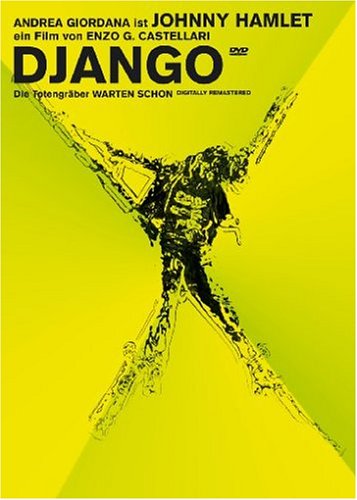
Spaghetti Shakespeare Number One: Johnny Hamlet

Johnny Hamlet [Quella Sporca Storia nel West (a.k.a. That Dirty Story of the West; a.k.a. Django)]. Dir. Enzo G. Castellari. Perf. Andrea Giordana, Gilbert Roland, Horst Frank, Ennio Girolami, Ignazio Spalla, Françoise Prévost, Stefania Careddu, Manuel Serrano, Franco Latini, Giorgio Sammartino, and Gabriella Grimaldi. 1968. DVD. Eagle Pictures, 2008.

Note: I use the term "Spaghetti Shakespeare" advisedly, knowing that it might seem flippant or insulting; however, in Johnny Hamlet, we have a subset of the recognized genre "Spaghetti Western," so the term seems viable.

A student and I have received a Faculty / Student Collaboration grant from University of Northwestern—St. Paul to study film versions of Shakespeare made in Italy, and I'm thrilled to be able to explore a section of Shakespeare and Film that has been relatively closed to me because I do not speak Italian and many of the films lack English-language subtitles. We intend to study five or six films and to collaborate on a presentation and an essay. In the meantime, we will be collaborating on and individually composing blog posts on the subject. You can therefore expect some guest posts from Ceciley Pund, the author of the blog What Consolation, as we discover intriguing and significant elements of these films.

One film I've been able to watch for the collaboration is Quella Sporca Storia nel West, commonly known as Johnny Hamlet. Particularly astute readers may be able to hypothesize that the film recasts the plot of Hamlet in the American Wild West, but that guess (which is, in essence, absolutely correct) will not necessarily prepare them for the way the film addresses those themes.

Much more will follow about this film in the weeks to come, but I want you all to jump right in with us in our exploration of this film. To that end, I'm providing the first five minutes of the film in the clip below. You'll see a ghost sequence, a glimpse of an Ophelia or two (Ophelia is bifurcated into a performer / possible prostitute and the sheriff's daughter), the traveling players, the deaths of Rosencrantz and Guildenstern, and an extremely intriguing use of "To be or not to be."


All right—I was probably joking about Rosencrantz and Guildenstern, but all the rest is intriguingly built in to the opening sequence. Knowing that the film is a derivative version of Hamlet, the viewer is startled by having what appears to be a voiceover of fragments of an Italian translation of "To be or not to be" delivered by a man in Elizabethan costume. Knowing that the film is Italian, we may not be surprised to see a figure in contemporary clown costume surreally turning backflips on a beach behind a horse—but it doesn't take long for these unexpected elements to resolve themselves into what looks like a more straightforward western . . . although they won't stay there for long, either.

Please stand by for further glimpses at this fascinating film and into our collaborative project.

Links: The Film at IMDB.

Click below to purchase the film from amazon.com
(and to support Bardfilm as you do so).

Thursday, February 26, 2015

A tiny fragment of Shakespeare in Darwin: The Series

Darwin: The Series. By Karl Kenzler [Episodes 1, 6, 7, 8, 9, 10] and Lynn Rosen [Episodes 2, 3, 4, 5, 11, 12]. Dir. Carrie Preston [Episodes 1-10] and Greg Ivan Smith [Episodes 11-12]. Created by Christopher Gerson, Karl Kenzler, and Lynn Rosen. Perf. Karl Kenzler, Christopher Gerson, Celia Keenan-Bolger, Bill Heck, Joel de la Fuente, Tarah Flanagan, Victor Williams, Peter Bradbury, Kevin Orton, Scott Aiello, Bhavesh Patel, Alysia Reiner, and Steve Small. Web Series. 2015.

By dint of my connections with the Great River Shakespeare Festival (for which, q.v.), I learned of the quirky web series Darwin some time ago, but the first complete run of the series was only released recently.

The show itself is brilliant, intriguing, clever, and a lot of fun. A number of thrillingly odd characters are thrown together in a tale of getting a handle on life and love—a bit like a combination of Flight of the Conchords and a Woody Allen film (one of the really good ones). The basic plot involves a Life Coach named Leo Darwin whose own life is falling apart. His only client is Michael Yensbourg, a multimillionaire who suffered a highly-publicized nervous breakdown at a Wagner concert—the YouTube video of it went viral. Leo has written a self-help book called Darwin's Tree, and bits and pieces of psycho-babble advice periodically appear on the screen:  "Nobody is Superman—not even Superman," for example. But you'll learn more from the trailer than from my attempt at a summary:


I told you that to tell you this. Later in the series, in an attempt to get Michael to get out of his gaming basement ("You know what you need to do, Michael?" "Tobogganing?"), Leo Darwin tries to interest him in LARPing, but Michael considers that crowd to be losers. In the scene from Episode Five ("Digging Deep") below, Michael (played extremely convincingly by Christopher Gerson, one of the brightest stars in the firmament of the GRSF) chances upon a LARPing festival / Renaissance Faire while Leo chances upon the concept of "Rage Yoga" in an attempt to get his own life back on track. That's where the Shakespeare comes in:


"Back off, Hamlet! I'm not one of you!"  

That may be the only direct use of Shakespeare in the series, but the series itself is Shakespearean in its farce, its parody, and its use of language. Give it a try.

Links: The Official Web Site of Darwin: The Series.


Bonus Image:  Christopher Gerson, as Michael Yensbourg, 
finds that speaking to a beautiful woman isn't really that bad.


Friday, February 20, 2015

Warm Bodies: Now with the Balcony Scene from Romeo and Juliet

Warm Bodies. Dir. Jonathan Levine. Perf. Nicholas Hoult, Teresa Palmer, and John Malkovich. 2013. DVD. Summit Entertainment, 2013.

Some years ago, I wrote a post on the novel Warm Bodies (for which, q.v.). It's taken awhile, but, thanks to a student who presented on the film (students are wonderful, aren't they?), I've finally gotten to the film.

Essentially, the student got me interested again in noting that, at the end (spoiler alert, people), R (the Romeo analogue) takes exactly the opposite course from that which Romeo (of Shakespeare's play) takes.  Romeo goes from life to death because of love; R goes from death to life because of love.

Yes, it's cheesy, but it's also interesting. The film attempts to rise above typical zombie movie fare, for a time looking more like an allegory than a zombie film: we're all the walking dead without love.

In any case, it's still not my cup of tea (the subtitles in the clip below are a clue to my having watched the film at three times the speed with the subtitles on), but I would be remiss if I didn't present the balcony scene from the film, with its touch of Julie (the Juliet analogue) delivering a modernized version of this speech from Romeo and Juliet:
How camest thou hither, tell me, and wherefore?
The orchard walls are high and hard to climb,
And the place death, considering who thou art,
If any of my kinsmen find thee here. (II.ii.62-65)
Enjoy!


Links: The Film at IMDB.

Click below to purchase the film from amazon.com
(and to support Bardfilm as you do so).

Friday, February 6, 2015

A Return to Prince of the Himalayas

Prince of the Himalayas [Ban dao yin xiang; a.k.a. Ximalaya wangzi]. Dir. Sherwood Hu. Perf. Purba Rgyal, Dobrgyal, Zomskyid, Sonamdolgar, Lobden, and Lopsang. Hus Entertainment, Shanghai Film Studios. 20 October 2006.

Every other year, I try to incorporate Prince of the Himalayas (for which, q.v.) into my Shakespeare and Film course. I'm always hampered by the film's distressing lack of availability. But I'm going to throw caution to the winds this year and explore this film in some considerable depth.

For one thing, it's the only derivative of Hamlet covered in Simon Crowl's Screen Adaptations:  Shakespeare’s Hamlet:  The Relationship between Text and Film, which I've adopted as a textbook for the course this year.

For another thing, it's quite an incredible film. I've given a fairly-extensive plot summary here, but I didn't provide more than a trailer at that point. I was still (and am sill) desperately hoping for a theatrical or DVD release of the film. But, since I haven't heard any rumblings for several years, I think it would be all right to give a sample here.

In this scene, Lhamoklodan, the Hamlet analogue, has returned to ask one simple but enormous question: "Why?" His mother thinks he means "Why did my father have to die?" but he really means "Why did you bury my father before my return?" You can observe the answer to that question in the clip. You'll then also see Odsaluyang (the Ophelia analogue) welcoming Lhamoklodan home.

Finally, you'll see the pomp and circumstance of the installation of Kulo-ngam, the Claudius analogue. As you watch it, note the response of one of the high officials:


That's Po-lha-nyisse (can you guess whose analogue he is?) reacting with shock to the idea of Kulo-ngam and Nanm marrying. That moment is fascinating. It gives us insight into one possible reaction to the marriage of Kulo-ngam to his brother's widow—and that reaction doesn't come from Lhamoklodan. We would expect Lhamoklodan to feel that way, but this is the Polonius analogue (had you guessed that already?), and those are usually on the side of any Claudius analogues out there.

I'm actually getting more and more excited about the prospect of taking a deep, hard look at this film with my class—and I continue to hope for a US DVD release at some point!

Links: The Film at IMDB.

Thursday, February 5, 2015

Book Note: That Shakespeare Kid

LoMonico, Michael. That Shakespeare Kid. North Charleston, South Carolina: CreateSpace Independent Publishing Platform, 2013

I recently read this book, having heard of it through a Kickstarter campaign and Shakespeare Geek's blog. It came out as a self-published book a couple years ago.

The gimmick is intriguing. A kid gets a concussion and is only able to speak in quotations from Shakespeare. As plot devices go, it has its positive side, but it does start to pall fairly quickly. It seems like it might work for a short story, but it does tend toward the tedious.

I think a good example of this comes in a scene where our narrator and the Shakespeare Kid end up at a Mets game. During the course of the game, the Shakespeare Kid provides a running commentary drawn from every quote that could apply to baseball. Click on the image below to enlarge it and to give it a try:


It's a tour de force of the genre, and it does demonstrate the cleverness of the author—I'll certainly give it that! But it does carry on. The possible monotony is broken by a couple devices—the Shakespeare Kid is able to text the narrator in modern English; later, he can use a whiteboard to communicate with her and with his teachers.

Apart from the overuse of the gimmick, the novel was interesting enough, giving us some colorful characters, some romance, and some tension that carries the book through to the end.

Links: A Review of the Book at Shakespeare Geek.

Click below to purchase the book from amazon.com
(and to support Bardfilm as you do so).

Wednesday, February 4, 2015

Juliet on the Couch in "Shakespearean Therapy"

"Shakespearean Therapy." Studio C. BYUtv. BYU Broadcasting. 14 February 2013. Web. 4 February 2015.

The students are at it again, finding me terrifically interesting material that I had never encountered before.

A student in my Modern Shakespearean Fiction class (yes, it's amazingly cool that I have a class like that) presented a sketch from a comedy group called Studio C. In the sketch, Juliet is on the couch visiting her psychologist. Both characters speak a form of Renaissance English—except when they interestingly deviate into modern language choices (e.g., "Thou lovest him . . . a lot?" and "Dost thou hear thyself?"). And the language is done well enough that it (mostly) doesn't become annoying (which is always a danger in "Shakespearey" talk).

What I particularly admire about the sketch is its defamiliarization of the narrative. We're taken to an outsider's perspective on the events of the play, and that enables us to see and think about the play in a new light. Here, it's a comedic light, shining on just how ridiculous the plot of Romeo and Juliet is.

One other line I like involves the different uses of a word available both to Shakespeare and to a modern audience—and how the sketch nicely helps us see the different meanings. A little more than halfway through, Juliet's psychiatrist says, "This man seemeth to me a player—and not the kind on the stage."

I'm embedding the sketch below, and I'm also including a blog-native version in case the YouTube embedding fails or falters. Enjoy!


Links: The Sketch on YouTube.

Monday, February 2, 2015

Fight Scenes in Richard III

King Richard III. Dir. Michael Bogdanov. Perf. Andrew Jarvis, Michael Pennington, Anne Penfold, June Watson, and Susanna Best. Wars of the Roses. 1990. DVD. Films for the Humanities & Sciences, 2005.

My students often ask incredibly compelling questions; I occasionally have answers to them. When I don't have an answer, I try to find one (rather than making one up, which is not the best pedagogical practice).

In my Shakespeare and Film class, we study the film versions of Loncraine (with Ian McKellen) and Olivier (with Olivier) fairly extensively. While doing some heavy comparison and contrast, a student asked whether there was a film version of Richard III that had more of a traditional one-on-one battle sequence at the end.

The question was quite astute and very interesting. The stage direction in the first Quarto of the play (which I was able to view at the Huntington Library—for which, q.v.) is very sparse, reading only "Enter Richard and Richmond, they fight, Richard is slain" (click on the image below to enlarge it).


[Shakespeare, William.] The Tragedy of King Richard the Third. London: Printed by Valentine Sims, for Andrew Wise, dwelling in Paules Chuch-yard [sic], at the Signe of the Angell, 1597. Huntington Library Call Number 69350. Huntington Library, San Marino, California. Digital Image by Keith Jones. Original housed in the Huntington Library, San Marino, California. No copies may be made.

Such a vague stage direction allows for considerable latitude in actors' and directors' decisions. Loncraine's is to have Richard flee to the top of an abandoned warehouse; Olivier's is to have Richard, after a brief initial exchange with Richmond, attacked by the entire army. My students wanted to see some traditional hand-to-hand combat, and I was stymied—at first.

I decided to try the end of the Richard III that is part of the series The Wars of the Roses, the English Shakespeare Company's astonishing production of both tetralogies (for which, q.v.). And I found what we were all looking for.

It was a little unusual, I suppose, to find it there.  The film is largely in modern dress with modern warfare. The clip below will give you a flavor of that at the beginning (with gunfire) and the end (with an address to the nation that gives the events of the play a very pro-Richmond spin). In the middle, however, we get knights in armor (see if you can guess which one is Richard and which was in Richmond) in old school hand-to-hand combat.


I was very grateful for the good question. It enabled us to explore this production and to discuss a number of deep reasons the production might have had for presenting this battle in this way.

Links: The Series at IMDB.

Click to purchase
(or to have your library purchase)
the films from Films for the Humanities and Sciences.

Friday, January 23, 2015

An Honourable Murder: A Derivative of Julius Caesar

An Honourable Murder. Dir. Godfrey Grayson. Perf. Norman Wooland, Margaretta Scott, and Lisa Daniely. 1960. DVD. Danziger Productions, 2010.

I'm always pleased when I discover a derivative film version of a play that is less-often made into derivative versions. One example is The Street King, a derivative version of Richard III (for which, q.v.). I'm still waiting and hoping for a derivative version of Henry V—one set, perhaps, in Vietnam under French Colonial Rule. You wouldn't even need to change the name of the enemy! But I digress.

Encountering a disparaging remark against it, I recently learned about An Honourable Murder, a 1960 film that recontextualizes Shakespeare's Julius Caesar in the business world. A business mogul named Julian Caesar—the Chair of the Board of Empire Petroleum—has been working hard for a merger with Pompey Shipping, but his motives become suspect, and Brutus Smith is reluctantly convinced to join in a vote against him at a meeting that Mark Antony has been tricked into missing.

The disparaging remark was about the film's lack of significance. No, it's not as earth-shaking as the assassination of Julius Caesar, but if it's approached more in terms of a domestic tragedy and as a business rather than a political thriller, the film will provide some interest.

To give a flavour of the film, I've excerpted the analogue of the assassination scene below:


And I don't suppose I can provide that scene without providing the debate before the citizens (here, shareholders) over Caesar's removal:


I found the film compelling but not thrilling. Perhaps it can serve as an entrée en matière for the business majors in my Shakespeare and Film class.

Links: The Film at IMDB.

Click here to purchase the film from amazon.co.uk
(it's only available as a Region 2 DVD).

Thursday, January 22, 2015

Hamlet, the Vampire Slayer: Not a Mockumentary


Hamlet, the Vampire Slayer. Dir. Jason Witter. Perf. Kevin R. Elder, Leslie Nesbit, and Doug Montoya. 2008. DVD. N.s., 2011.

On the other end of the Hamlet and the Undead spectrum from Zombie Hamlet (for which, q.v.; see also Rosencrantz & Guildenstern are Undead and Romeo and Juliet vs. The Living Dead) stands Hamlet, the Vampire Slayer. But I think it might as well lie back down in the coffin and have a nice rest.

I tried to enjoy this film—I genuinely made an effort—but it's so dull, awkwardly shot, and (for lack of a better term) bad that I couldn't get much out of it.

The essential plot is that Hamlet, aspiring male cheerleader, is upset at his father's death and his mother's o'er hasty marriage to Hamlet's Uncle, Enrique Claudio, who is a Vampire who only speaks Spanish. As a trope, it gets quite old quite quickly, as does the device of a vampire slayer with a mostly inexplicable Scottish accent, a Buffyesque character, two frat boys named Rosenchad and Guildenbrad, the frequent obscenities, and a rap version of the play-within-the-play.

The best (and least inappropriate) sample I can show you is the analogue to Claudius at prayer.


There you have it. Aren't you glad I watch these films in their entirety so that you don't have to?

Links: The Film at IMDB.

Click below to purchase the film from amazon.com
(and to support Bardfilm as you do so).

Wednesday, January 21, 2015

The Mockumentary Zombie Hamlet

Zombie Hamlet. Dir. John Murlowski. Perf. John Amos, A.J. Buckley, K.C. Clyden Brendan Michael Coughlin, John de Lancie, Vanessa Evigan, June Lockhart, Shelley Long, Travis Wester, and Emmalee Wilson. 2012. DVD. Level 33 Entertainment, 2013.

I should have viewed this sooner. The title misled me into thinking it was going to turn out to be something on the lamer side of Hamlet derivatives. Had the term "mockumentary" been mentioned, I would have been much quicker to draw the remote and give it a try. That's the reason for my foregrounding the term, in fact.

Zombie Hamlet—or, really, Bringing the Undead to Life: The Making of Zombie Hamlet, as the documentary detailing elements of the production of Zombie Hamlet—is a clever, well-acted, surprisingly well-cast film (they got John Amos, the dad from Good Times and John De Lancie, Q from Star Trek in this film!) that tells the story of what two filmmakers do when they learn, in the middle of a location hunt, that their $24,000,000 budget has been cut. The helpful old lady who owns the location (played by June Lockhart!) offers $300,000 to fund the film; reluctantly, they abandon their plans to make a tasteful, thoughtful Civil War Hamlet and go with a low-budget zombie film version instead.

My favorite parts of the film are those that make fun of different auteurs and their typical style. In the following clip, the director and one of the producers discuss ideas for Zombie Hamlet, contemplating following first the style of Stanley Kubrick (the image above is from that imagined version), then Stephen Spielberg (with some intriguing and Spielbergian camera work), and then Michael Bay (director of Armageddon and Pearl Harbor).


I suppose I should have expected such interesting parody when, earlier in the film, we learned that the director had been responsible for the following commercial:


There's not too much actual Hamlet in this film, but it does appear from time to time—most often when the mockumentary focuses on the production of the actual film. This clip will give you a flavor of that—as a bonus, it includes the following tag line (which also appeared in the trailer for the film): "To not to be or to not not to be: that is the question."


The fast-paced plot (including some Weekend at Bernie's material) wraps up, leaving some room for commentary on the documentary. I appreciate the gentle mockery of critics like me in the following clip. And I also appreciate (but do not share) the distain of the "Shakespeare Purist" at the end of the clip:


Finally, when you least suspect it, this:


Yes, that's Hulk Hogan as a Weïrd Sister (using the word "brother").

The film will, at least in bits and pieces, make its way into my Shakespeare and Film course this year. Watch this fun, frantic film for lighthearted jabs at the film industry, a speculative take on Hamlet, and an interestingly-constructed plot.

Links: The Film at IMDB.

Click below to purchase the film from amazon.com
(and to support Bardfilm as you do so).

Monday, January 12, 2015

Book Note: The Bible in Shakespeare

Hamlin, Hannibal. The Bible in Shakespeare. Oxford, United Kingdom: Oxford University Press, 2013.

This book fell into my path last summer, and I read it on and off that summer and into the fall semester. It's enthralling.

Hannibal Hamlin’s book is the most current available on the topic of the Bible in Shakespeare.  Filled with incredible, well-researched information, the book doesn't attempt to catalogue every quotation or biblical allusion in Shakespeare, but it does offer intriguing scholarly commentary on a wide range of different uses Shakespeare makes of the Bible.

Hamlin's introduction presents a good apology for the study:
This book is about allusions to the Bible in Shakespeare's plays. It argues that such allusions are frequent, deliberate, and significant, and that the study of these allusions is repaid by a deeper understanding of the plays. A supplementary argument, or perhaps a presupposition, is that Shakespeare's culture as a whole was profoundly and thoroughly biblical, a culture in which one could assume a degree of biblical knowledge that is difficult to imagine in today's mass-media global culture. One grips for a modern analogy, but there is none. Imagine a television program that everyone in the country has been watching every week, sometimes more than once, for their entire lives, having seen some episodes dozens of times. Suppose your parents and grandparents had watched all the same episodes, and suppose further that millions of people in other neighboring countries had watched these episodes too, dubbed into their own languages. Suppose that it was illegal not to watch this show and, moreover, that your eternal salvation was understand to depend on it. Suppose that this TV show was the basis for your country's literature and art, its political theory, its history, its philosophy, its understudying of the natural word as well as human nature, and essential to most other fields of knowledge as well.  In sixteenth- and seventeenth--century England, the Bible was that show; it was always in reruns, and it never went off the air. (1)

That's a good argument, in fact, for reading this book as well as for developing much greater familiarity with the Bible.

Hamlin stages his examination of Shakespeare's plays well with three sections on the culture of Shakespeare's day as it relates to the Bible, the way interest in Shakespeare's use of the Bible has waxed and waned (and its reasons for doing so), and Shakespeare's general practice of allusion.  He then provides five well-reasoned sections dealing with the specifics of Shakespeare's use of the Bible. A section on Shakespeare's use of Genesis 1-3 is followed by one on allusions in the Roman plays. Sections on Falstaff, Macbeth, and King Lear follow.

I don't agree with everything Hamlin has to say, but his book is a phenomenal study of the significance of biblical allusion in the works of Shakespeare.

Click below to purchase the book from amazon.com
(and to support Bardfilm as you do so).
Thursday, January 8, 2015

I, Robot Macbeth

The Tragedy of Macbeth. Dir. Dan Gallagher. Perf. Mirai Booth-Ong, J. A. Curcione, and Dan Gallagher [The Robot Shakespeare Company]. DVD. Bright Red Productions, 2012.

A few years ago, I spotted a Kickstarter request proposing to film an all-robot Macbeth (for which, q.v.). Well, they got their funding, and they made their film!

The film is . . . mildly interesting. The animation is adequate, and the film angles are often quite interesting, but I was hoping for something a bit less straightforward. I'm now wondering how to use it. Would it be good for introducing the play to kids? To robots? To robot kids?

I'm a bit ambivalent about another aspect of the film. They've provided modernized subtitles (as in the image above) for the entire play. I suppose this, too, could be useful to viewers who are having trouble with the language, but they're a bit too simplified. They might be a good crutch, but they would be a bad stick.

As is my wont, I'm providing the dagger speech here to give you a sense of how they handled it—and, by it, a sense of the rest of the production.


Click below to purchase the film from amazon.com
(and to support Bardfilm as you do so).

Bardfilm is normally written as one word, though it can also be found under a search for "Bard Film Blog." Bardfilm is a Shakespeare blog (admittedly, one of many Shakespeare blogs), and it is dedicated to commentary on films (Shakespeare movies, The Shakespeare Movie, Shakespeare on television, Shakespeare at the cinema), plays, and other matter related to Shakespeare (allusions to Shakespeare in pop culture, quotes from Shakespeare in popular culture, quotations that come from Shakespeare, et cetera).

Unless otherwise indicated, quotations from Shakespeare's works are from the following edition:
Shakespeare, William. The Riverside Shakespeare. 2nd ed. Gen. ed. G. Blakemore Evans. Boston: Houghton Mifflin, 1997.
All material original to this blog is copyrighted: Copyright 2008-2039 (and into perpetuity thereafter) by Keith Jones.

The very instant that I saw you did / My heart fly to your service; there resides, / To make me slave to it; and, for your sake, / Am I this patient [b]log-man.

—The Tempest