Wednesday, March 28, 2012

Book Note: Enter Three Witches

Cooney, Caroline B. Enter Three Witches. New York: Scholastic Press, 2007.

Enter Three Witches, a Shakespeare-related young adult novel, offers a compelling and intriguing take on Macbeth. In a series of short vignettes at the beginning of the novel, Cooney establishes and develops her main characters—from that point on, I found it hard to put the book down.

The plot of Shakespeare's Macbeth is conveyed through the eyes of a number of characters, but the chief among them are Lady Mary, the daughter of the treacherous Thane of Cawdor, living in the Macbeths' castle; Swin, a servant girl with a brusque exterior that she uses to hide a brusque interior (which, in turn, hides some good qualities); Ildred, a companion to Lady Macbeth and the holder of a secret; and Seyton and Fleance, who reprise their roles from the play and develop in interesting ways through the plot of the novel. Despite the title, the Weïrd Sisters don't take a prominent role. They are present, and they are powerful, but their role in the novel is more incidental than central.


I admire the novel's construction and its author's skill with both plot and language. Lady Mary, overlooked after her father's execution as a traitor, is able to observe many of the key scenes from Shakespeare's play unobserved and to contemplate and to comment on them as she does so. It's a clever device, and it's also cleverly used. The speeches she overhears are mostly modernized prose versions of Shakespeare's speeches (with the notable exception of "Tomorrow and tomorrow and tomorrow"), but the modernizing is done with a light touch that does not distract from the plot.

And Cooney doesn't pull any punches with the plot, though much of the violence takes place offstage. It's written for a younger audience, but I imagine that readers younger than eleven or so will be troubled by some elements in the story.

Enter Three Witches is one of the best Shakespeare-related young adult novels I've read recently. I highly recommend it—but don't start it until you have time enough to finish it! It will pull you in and refuse to let you go.


Click below to purchase the book from amazon.com
(and to support Bardfilm as you do so).

Tuesday, March 27, 2012

Shakespeare at the Grocery Store

Shakespeare, William. King John. Ed. E. A. J. Honigmann. London: Arden Shakespeare, 1981.
While walking through aisle 2B in my local grocery store (Was it 2B? I can't remember), I looked up and spotted the Shakespeare quote pictured above:
"My life, my joy, my food . . ." william shakespeare
I'll be quite honest. I didn't recognize the quotation—until I looked it up—and when I did, I began to wonder about its appropriateness (even though it's not from Titus Andronicus).

The quote comes from King John. Constance, the mother of Arthur, delivers these incredibly sad and moving lines after his death:
Grief fills the room up of my absent child,
Lies in his bed, walks up and down with me,
Puts on his pretty looks, repeats his words,
Remembers me of all his gracious parts,
Stuffs out his vacant garments with his form;
Then, have I reason to be fond of grief?
Fare you well: had you such a loss as I,
I could give better comfort than you do.
I will not keep this form upon my head,
When there is such disorder in my wit.
O Lord! my boy, my Arthur, my fair son!
My life, my joy, my food, my all the world!
My widow-comfort, and my sorrows' cure! (III.iv.93-105)
I'm all for incorporating Shakespeare into all aspects of life—even grocery shopping—but the context of the speech is radically different from the store's use of the quote. Constance is bemoaning the fact that her very life, her spirit's joy, her soul's food is gone forever.

On the other hand, the quotation lists things that are important ingredients (sorry—an inadvertent pun, I assure you) to a happy life—while suggesting that the product the store sells is the life and the joy the quote speaks about.

Do you all have any thoughts on the subject or other examples of Shakespeare out of context?

Monday, March 26, 2012

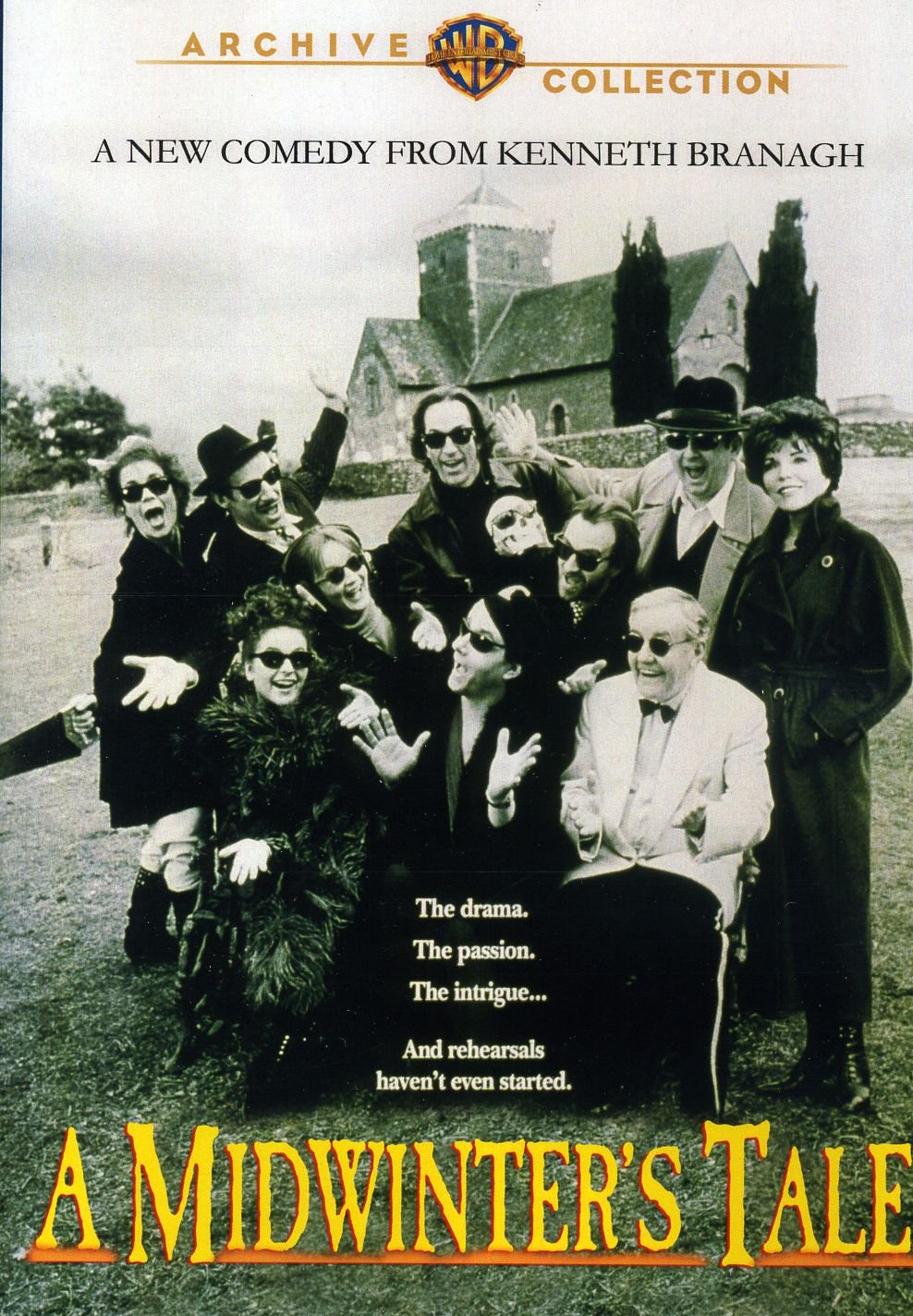
Kenneth Branagh's A Midwinter's Tale on DVD!

A Midwinter's Tale [a.k.a. In the Bleak Midwinter. Dir. Kenneth Branagh. Perf. Richard Briers, Hetta Charnley, Joan Collins, Nicholas Farrell, Mark Hadfield, Gerard Horan, Celia Imrie, Michael Maloney, Jennifer Saunders, Julia Sawalha, and John Sessions. 1995. DVD. CR/WB, 2012.

While preparing an assignment sheet for my Shakespeare and Film class, I discovered that Kenneth Branagh's A Midwinter's Tale has finally been released on DVD!

I've written about the film multiple times (for one of which, q.v.). But the film has been hard to track down—and it's been exclusively available in VHS. But I was thrilled to discover and I'm thrilled to announce that a DVD of the film has been released. Even though it apparently lacks the usual bells and whistles of the modern DVD, it is available, and that is an enormous step forward.

One of my favorite scenes involves the auditions. Watch this, and then see if you can resist buying the DVD immediately:


Complete kudos to whoever decided that it was time for a DVD release of this magnificent (and magnificently-funny) film.

Links: The Film at IMDB.

Click below to purchase the film from amazon.com
(and to support Bardfilm as you do so).

Book Note: The Best House in Stratford

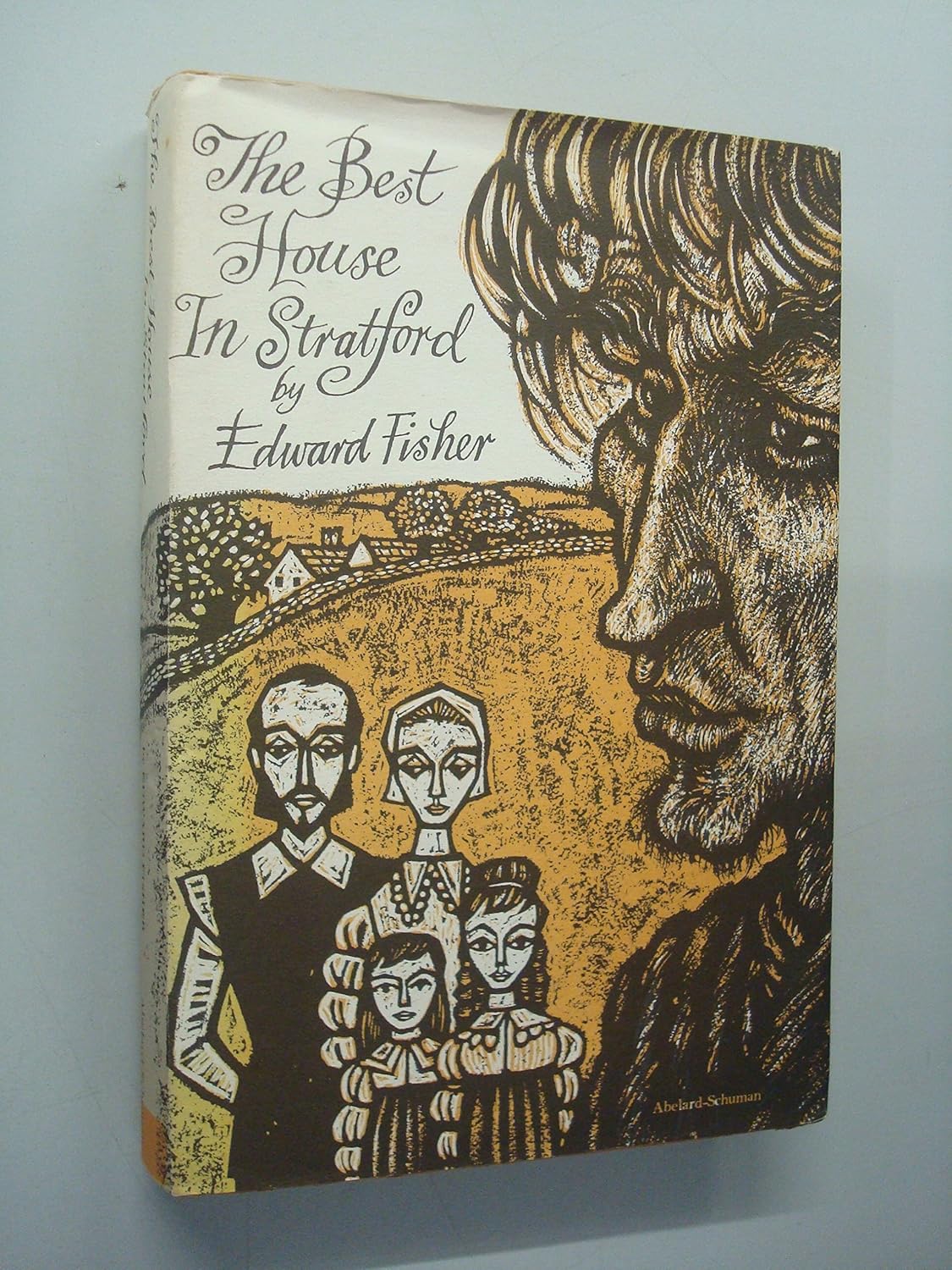
Fisher, Edward. The Best House in Stratford. London: Abelard-Schuman, 1965.

Editor's Note: In case you're wondering, I will be getting to some marvelous Shakespeare-related fiction. This is the build-up that will lead to the delightful payoff. Thank you.

Another of the Shakespeare-related novels I encountered that turned me away from Shakespeare-related novels was The Best House in Stratford, which I read some considerable time ago. Perhaps I was insufficiently tuned in to Shakespeare's biography at that point. Or perhaps it was because this volume is the third in a trilogy (the first two books are entitled Shakespeare & Son and Love's Labour's Won) and I only read the last book. In any case, the novel (to paraphrase Douglas Adams) more or less exactly failed to please. Here's a brief quotation by way of example:
A mangy dog, scavenging in a midden heap, began barking at him.

“What have I, Ben Jonson, descendant of Scottish lords and gentry, to do with such parcel-poets as these, who all write for sinners in the suburbs?”

“Bow wow wow!” said the dog.

Ben Jonson heaved a clod at him. (16)
I know it's unkind of me to think so, but I feel like heaving a clod at Ben Jonson at this point. And I imaging the mangy, midden-heap-scavenging dog feels roughly the same.


Click below to purchase the book from amazon.com
(and to support Bardfilm as you do so).

Friday, March 23, 2012

Book Note: Shake-speare's Sweetheart

Sterling, Sara Hawks. Shake-speare's Sweetheart. Philadelphia: George W. Jacobs, 1905.

The recent posts on Shakespeare-related fiction reminded me of some genuinely disappointing novels that almost put me off reading any other such literature. One of them is Shake-speare's Sweetheart.

This 1905 novel gives us the story of Shakespeare's life in flashback from Anne Shakespeare's point of view. That, in itself, isn't a terrible idea—but the combination of extreme sentimentality, nostalgia, and pseudo-Jacobean language is too much.

To give it its due, it tells an interesting story—one with a strong Anne who follows Shakespeare to London for a time (although to tell you how would provide spoilers). And the illustrations are charmingly done.

But the language tends toward the tedious. By way of an example, here's the opening page (click on the image to enlarge it):


For I was Shakespeare's sweetheart—verily and alone his sweetheart, even after I became his wedded wife. From that first wondrous day when we read in each other's eyes the new-born love which was to live forever, to the time when he left me for a while, five years ago; nay, even until now, I am Shakespeare's sweetheart. And so it is my right, as it is also my pride and delight, to tell the story of our love for the great multitudes who held Will dear, for the shadowy, unborn multitudes who shall pay homage to his memory in years to come. Truly, the story is sacred to me; but he is not mine alone; he is also the world's, the world that loves him, that he loved. (13-14)
All in all, it's just a bit too much.


Click below to purchase the book from amazon.com
(and to support Bardfilm as you do so).

Wednesday, March 21, 2012

Book Note: Lady Macbeth by Susan Fraser King

King, Susan Fraser. Lady Macbeth. New York: Crown Publishers, 2008 .

Since I seem to be mentioning the Shakespeare-related novels I've read or listened to over the past two years, I thought I'd continue in that vein.

King's novel is called Lady Macbeth primarily because a book called Gruadh or Lady Gruadh or even Lady Gruoch (the usual spelling) wouldn't have nearly the same selling power.

Lady Macbeth is a historical novel, well-researched and (mostly) historically consistent. It tells the story of Gruoch, the woman who married Mac Bethad mac Findláech. A quick overview over here will give you more details.

Of course, I was looking for the Shakespearean connection. Even in a novel that attempts to redeem Macbeth and Lady Macbeth, I would expect some connections to the particularities of Shakespeare's plot and his language. But this is really its own thing, telling the story of Gruadh from her point of view.

My expectations—rather than the quality of the book itself—were probably what made this book a bit disappointing. I did enjoy the alternate reading of Lady Macbeth's character that the development of Gruadh's character provides—particularly in terms of the romantic attachment between Macbeth and Lady Macbeth.

Click below to purchase the book from amazon.com
(and to support Bardfilm as you do so).
Tuesday, March 20, 2012

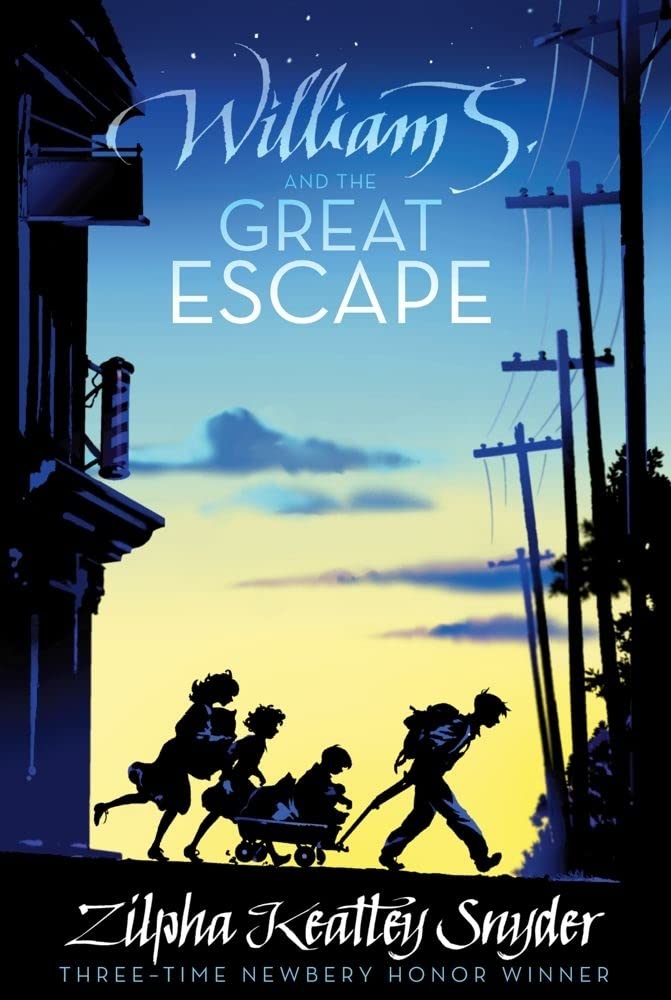
Book Note: William S. and the Great Escape: The book to which William's Midsummer Dreams is the Sequel

Snyder, Zilpha Keatley. William S. and the Great Escape. New York: Atheneum, 2009.

Reading the sequel before the first book may have given me a skewed view of both of them. But I requested the earlier young adult novel by Snyder dealing with William S. Hardison though an inter-library loan system and gave it a chance. Doing so gave me a greater appreciation for the sequel—though this volume is probably the more successful one of the two.

In William S. and the Great Escape, we get the story of how and why William S. and his three younger siblings ran away from his father and step-mother (and his step-siblings from his father's first marriage) to live with his dead mother's sister. One of the two main Shakespearean points of interest in the book is William's previous acting experience—he played Ariel in a school production of The Tempest but didn't tell any members of his family out of fear that they would make fun of him or beat him up. The other is his presentation of Shakespeare to his two youngest siblings—with the encouragement of his next youngest sister.

The image below (click on the image to enlarge it) is part of that scene. What interested me particularly is that it didn't take the "Everyone Always Loves Shakespeare All the Time, No Matter What Age" approach. Instead, the novel indicates that not everyone could get the youngest children interested in Shakespeare—but William S. could. In other words, it's not solely the material that grips its audience's attention; the presentation matters as well:


The thoughtfulness of the approach is a significant part of the presentation of Shakespeare—and I think that's an important point.

At first, I found the William's Midsummer Dreams (the sequel to this novel) fairly ordinary, but I think I have a better appreciation for it after having read William S. and the Great Escape.


Click below to purchase either or both of the books from amazon.com
(and to support Bardfilm as you do so).


Monday, March 19, 2012

Book Note: The Sonnet Lover

Goodman, Carol. The Sonnet Lover. New York: Ballantine Books, 2007.

This is another very quick mention of a book rather than a full-fleged review or commentary.

I listened to the audio book of this novel because of its Shakespearean elements. The plot revolves (rather loosely, admittedly) around some sonnets that might or might not be by Shakespeare and around the identity of the Dark Lady.

The novel is very light—some scenes near its end are pretty much cliché murder mystery / thriller scenes—and that may be its ultimate downfall. Goodman paints absolutely beautiful images—especially in her Italian scenes—but the characters seem very shallow and the engagement with the Shakespearean elements is tangential (and sometimes a bit silly).

In short, I'm afraid the novel was, for me, disappointing. But it was also readable and enjoyable. It's good for the beach—if not for the classroom.

Click below to purchase the book from amazon.com
(and to support Bardfilm as you do so).
Friday, March 16, 2012

Book Note: The Weird Sisters

Brown, Eleanor. The Weird Sisters. New York: Amy Einhorn Books, 2011.

This novel isn't a retelling of a Shakespeare plot—even though it does involve three sisters and their relationship with their father (and their mother, who is undergoing treatment for breast cancer and is more in the background). But it is peppered with Shakespeare quotes and allusions, including the names of the protagonists: Rose (Rosalind), Bean (Bianca), and Cordy (Cordelia). Their father is a Shakespeare professor, after all.

The novel doesn't just use Shakespeare as a gimmick. There's real depth to the way each of the characters uses Shakespeare to interpret his or her life experiences—and that usage is sometimes interestingly called into question.

This is just a brief mention of the book. The blog Lifetime Reading Plan has reviewed the novel more fully. Indeed, that blog's author graciously sent me her copy when she was done with it. In turn, I've sent it on to ShakespeareGeek—and no one knows where it will go from there!

Update: See what ShakespeareGeek has to say about it!

Click below to purchase the book from amazon.com
(and to support Bardfilm as you do so).

Monday, March 5, 2012

William's Midsummer Dreams: Another Shakespeare-Related Young Adult Novel

Snyder, Zilpha Keatley. William's Midsummer Dreams. New York: Atheneum, 2011.

I spotted this novel at the local library recently; naturally, I snatched it up. Here are a few quick thoughts on it.

In a mix of narration and journal entries, it tells the story of William S. Hardison, a boy trying out for the role of Puck in a professional summer production of A Midsummer Night's Dream. He gets the role, to the chagrin of the other boy who was auditioning, and accidents start to happen. For example, someone smears the rope he swings on to make his big entrance with bacon fat, nearly causing him to fall. In addition, Hardison is trying to escape from a difficult family history.

The book is a sequel to William S. and the Great Escape, which I haven't yet read. [Update: Yes, I have, and I've reviewed it here.]  It's not a bad novel, but it's fairly ordinary. And it does have one oddity that is pretty irksome. Whenever Shakespeare, A Midsummer Night's Dream, the middle initial of the protagonist, or any lines from the play are mentioned, they are put in a strange "Old English" font. This has the effect of making them stand out—and of alienating the reader. Here's a sample from the protagonist's audition (click on the image to enlarge it):


Instead of integrating Shakespeare into the text, this has the effect of separating it.

Click below to purchase either or both of the books from amazon.com
(and to support Bardfilm as you do so).


Wednesday, February 8, 2012

Hamlet in the Style of Fun with Dick and Jane; a.k.a. "Fun with Hamlet & his Friends."

Siegel, Larry. "Fun with Hamlet & his Friends." Humbug 1.7 (February 1958): 27-28, 32.

"Laugh, Teacher, Laugh." Time 20 July 1962. 53.

Note: See the update at the end of this post.

Browsing through a Shakespeare dictionary the other day (A Dictionary of Shakespeare by Stanley Wells, to keep the record straight), I was interested to see something the dictionary titled "Teaching Hamlet by the 'look-and-tell' method." That's the method embodied in the 1946 children's book Fun with Dick and Jane. But the dictionary didn't give any context for it other than the reference "from Time-Life (20 July 1962)." I wanted to know more about the history behind this cultural artifact.

With the help of a reference librarian, I managed to track down the specific article (cited above). The article itself says that this anonymous work was passed around during the 1962 National Education Association Convention. The title it gives is Fun with Hamlet and his Friends—and, even more fascinatingly, it says that the section it printed (and which was subsequently included in Wells' dictionary) is merely an excerpt. I wonder if the work in its entirety survives anywhere.

Until it resurfaces, we'll have to be content with the following (and I imagine we can be quite content with this segment alone):
Fun with Hamlet and his Friends

See Hamlet run. Run, Hamlet, Run.

He is going to his mother’s room.

“I have something to tell you, mother,” says Hamlet. “Uncle Claudius is bad. He gave my father poison. Poison is not good. I do not like poison. Do you like poison?”

“Oh, no, indeed!” says his mother. “I do not like poison.”

“Oh, there is Uncle Claudius,” says Hamlet. “He is hiding behind the curtain. Why is he hiding behind the curtain? Shall I stab him? What fun it would be to stab him through the curtain.”

See Hamlet draw his sword. See Hamlet stab. Stab, Hamlet, stab.

See Uncle Claudius’ blood.

See Uncle Claudius’ blood gushing.

Gush, blood, gush.

See Uncle Claudius fall. How funny he looks, stabbed.

Ha, ha, ha.

But it is not Uncle Claudius. It is Polonius. Polonius is Ophelia’s father.

“You are naughty, Hamlet,” says Hamlet’s mother. “You have stabbed Polonius.”

But Hamlet’s mother is not cross. She is a good mother. Hamlet loves his mother very much. Hamlet loves his mother very, very much. Does Hamlet love his mother a little too much? Perhaps.

See Hamlet run. Run, Hamlet, Run.

“I am on my way to find Uncle Claudius,” Hamlet says.

On the way he meets a man. “I am Laertes,” says the man. “Let us draw our swords. Let us duel.”

See Hamlet and Laertes duel. See Laertes stab Hamlet. See Hamlet stab Laertes. See Hamlet’s mother drink poison. See Hamlet stab King Claudius.

See everybody wounded and bleeding and dying and dead.

What fun they are having!

Wouldn’t you like to have fun like that?

Siegel, Larry. "Fun with Hamlet & his Friends." Humbug 1.7 (February 1958): 27-28, 32.

Shortly after this post was published, careful reader Christine pointed us toward a text-only version of the complete work going under the title "The Dick and Jane Hamlet"; much more recently, careful reader Will Linden gave us the name of the author—Larry Siegel, of Mad magazine fame—and the name of the original source—Humbug.

With those clues and the help of the extraordinary reference desk at my library (O, those marvelous librarians—O, that marvelous research), we now have not only the full citation for the original publication (four years earlier than the Time article above) but the full illustrated text from the publication.

Thanks, Will Linden; thanks, Christine; thanks, all careful readers everywhere!  And enjoy (click on the images below to enlarge them).


Monday, February 6, 2012

Shakespeare in Love on Blu-Ray Winners!

Shakespeare in Love. Dir. John Madden. Perf. Gwyneth Paltrow, Joseph Fiennes, Judi Dench, Colin Firth, Geoffrey Rush and Tom Wilkinson. 1998. Blu-ray. Miramax Lionsgate, 2012.

Thanks to all who submitted their film ideas to our recent Shakespeare in Love on Blu-Ray Giveaway (for which, q.v.). We have our winners:
  • Christina S.

  • Reynaldo Makefoil

  • Fretful Porpentine
Congratulations to all our winners, and thanks again to all who submitted. And thanks, too, to Miramax Lionsgate and Click Communications, who provided the discs as prizes.

Please e-mail me your shipping address, winners, to claim your prizes. As soon as I receive your addresses, I'll forward them along to Click Communications—they will take care of the actual shipping. You can find my e-mail under the "Contact" section of my complete profile. Enjoy!

Links: The Film at IMDB.

If you didn't win, you know you still want a copy, don't you?
Click below to purchase the film from amazon.com
(and to support Bardfilm as you do so).

Wednesday, February 1, 2012

Ralph Fiennes' Coriolanus: I Can't See the Film, but I Can Read the Screenplay

Coriolanus. Dir. Ralph Fiennes. Perf. Ralph Fiennes, Gerard Butler, Brian Cox, Jessica Chastain, and Vanessa Redgrave. Hermetof Pictures, 20 January 2012. Film.

Logan, John. Coriolanus: The Shooting Script. Forward by Ralph Fiennes. New York: Newmarket Press, 2011.

Update: The DVD is now available! See below.

Like most of the rest of the world, I patiently await the news that Ralph Fiennes' Coriolanus is opening in a theatre near me.

Fortunately, the good people of Newmarket Press heard the drumming of my fingers all the way from New York City and sent me a copy of the screenplay.

It's astounding, and it's astonishingly helpful. It has a forward by and a concluding Question and Answer section with Ralph Fiennes and an introduction by John Logan (the author of the screenplay). Each of those three segments is thoughtful.

And the screenplay itself has turned my drumming fingers from patient to impatient. I can't wait to see this film.

In the meantime, I'll have to make due with the trailer:


Links: The Film at IMDB.

Click below to purchase the screenplay or the DVD from amazon.com
(and to support Bardfilm as you do so).


Tuesday, January 31, 2012

FoxTrot Presents . . . The Cliffs Cliffs Notes on Hamlet

Amend, Bill. FoxTrot. Exact details of publication uncertain. See the official FoxTrot website listed below.
All the talk about modernized versions of Shakespeare's plays and Cliffs Notes versions and Video Derivative versions of Cliffs Notes versions has reminded me of an important fact:

Bill

Amend

was

there

first.

Peter and Paige discuss "Cliffs Cliffs Notes" (click on the image to enlarge it):


Links: Foxtrot's Official Site.

Merchant of Venice in Third Rock from the Sun

“Hotel Dick.” By Bonnie Turner and Terry Turner. Perf. John Lithgow, Kristen Johnston, French Stewart, Joseph Gordon-Levitt, and George Takei. Dir. Robert Berlinger. 3rd Rock from the Sun. Season 2, episode 13. NBC. 29 September 1996. DVD. Mill Creek Entertainment, 2011.

Very briefly, here is one last Shakespeare allusion in 3rd Rock from the Sun—once again provided by avid Bardfilm reader and Twitter user @GtThee2ANunnery.

In this episode, the aliens confront human prejudices against them, delivering a riff on Shylock's "Hath not a Jew hands?" speech. Of additional interest is its delivery to George Takei—Mr. Sulu of Star Trek fame, brining to mind Data's use of the same speech in a Star Trek: The Next Generation episode (for which, q.v.).

In any case, here it is!


Links: The Episode at IMDB.

Click below to purchase all six seasons of the show  from amazon.com
(and to support Bardfilm as you do so).

Bardfilm is normally written as one word, though it can also be found under a search for "Bard Film Blog." Bardfilm is a Shakespeare blog (admittedly, one of many Shakespeare blogs), and it is dedicated to commentary on films (Shakespeare movies, The Shakespeare Movie, Shakespeare on television, Shakespeare at the cinema), plays, and other matter related to Shakespeare (allusions to Shakespeare in pop culture, quotes from Shakespeare in popular culture, quotations that come from Shakespeare, et cetera).

Unless otherwise indicated, quotations from Shakespeare's works are from the following edition:
Shakespeare, William. The Riverside Shakespeare. 2nd ed. Gen. ed. G. Blakemore Evans. Boston: Houghton Mifflin, 1997.
All material original to this blog is copyrighted: Copyright 2008-2039 (and into perpetuity thereafter) by Keith Jones.

The very instant that I saw you did / My heart fly to your service; there resides, / To make me slave to it; and, for your sake, / Am I this patient [b]log-man.

—The Tempest