Monday, February 27, 2023

Book Note: Evoking (and Forgetting) Shakespeare


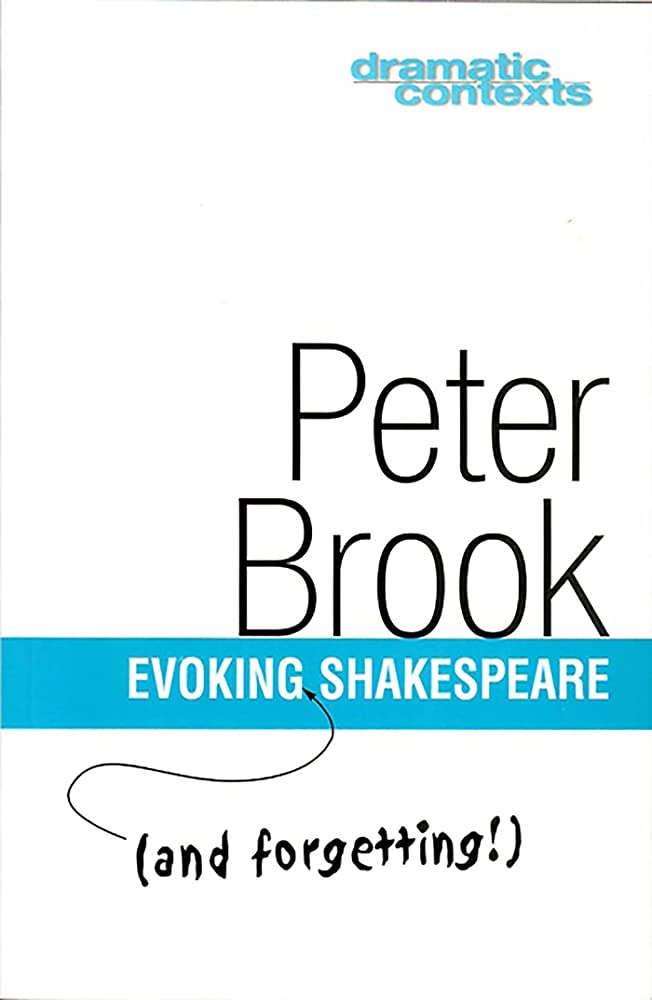
Brook, Peter. Evoking (and Forgetting) Shakespeare. New York: Theatre Communications Group, 2003.

This brief volume has considerable profundity. It consists of a lecture Peter Brook gave in Berlin in 1998 and (if I'm reading it right) a second, shorter speech he gave in Paris in 1994.

It's the second that particularly interested me. It gives a general overview of acting principles during Brook's long life in the theatre and his advice for portraying Shakespeare characters.


As one would expect from something by Peter Brook, that's insightful. I'm not sure I agree with everything there, but it is certainly an invigorating process that he imagines.

Click below to purchase the book from amazon.com
(and to support Bardfilm as you do so).

Friday, February 24, 2023

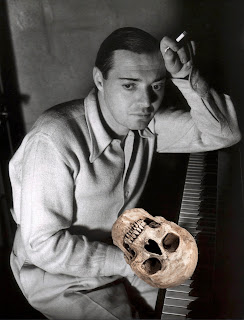
Peter Lorre as Hamlet?

Youngkin, Stephen D. The Lost One: A Life of Peter Lorre. Lexington: University Press of Kentucky, 2012.

I've recently become interested in Peter Lorre again. This time, instead of just re-watching  Casablanca or Arsenic and Old Lace, I decided to read a biography.

And what a biography I found! Stephen Youngkin's The Lost One is an astonishingly-detailed and utterly fascinating account of the varied and complex life of Peter Lorre.

By its means, I learned two things I did not know before, and they both have to do with Shakespeare.

The first is what Peter Lorre said in a discussion about why he was typecast—why he never got an important role.

Lorre asked if they meant something like Hamlet. And then . . . well, read on to see what happened (from pages 82–83) . . .


I, for one, would be very happy with a Hamlet with just the Gravedigger . . . as long as the Gravedigger was played by Peter Lorre.

The second thing I learned was that Peter Lorre, Bertolt Brecht, and Ferdinand Reyher wrote a screenplay called Lady Macbeth of the Yards (with the alternate working titles of All Our Yesterdays, All Our Yesterdays: Macbeth 1946, and Blood Will Have Blood). It sounds absolutely fabulous, and I only wish it had been made into a film (this is from pages 275–77):


Ah, Hollywood. Why did you green-light other projects in 1946 (not naming any names) but cancel this one?

But instead of continuing to complain, I'll start trying to see if the screenplay is extant anywhere. 

Click below to purchase the biography from amazon.com
(and to support Bardfilm as you do so).

Thursday, February 23, 2023

Book Note: The Shakespeariad

Snider, Denton Jaques.The Shakespeariad: The Poetic Evolution of Shakespeare. St. Louis: The William Harvey Miner Co., Inc., 1916.
———.The Shakespeariad: A Dramatic Epos. St. Louis: The William Harvey Miner Co., Inc., 1923.

If you grew up in St. Louis and went to the headquarters branch of the St. Louis County Library, the term H+ may have a special resonance for you. H is the code for Headquarters—a book with an H on its card catalogue listing or on a sticker on its spine would be shelved in the open stacks of Headquarters.  H+ was for those books that weren't shelved openly. You had to ask a librarian in person for an H+ book, which could be embarrassing because H+ books were the kind of books that maybe not everyone should read.

In "Murder at Pentecost," one of Dorothy L. Sayers' Montague Egg stories, we learn that some books in the Bodleian Library are classified as Phi books (with the Greek letter Φ). Here's how one character explains the classification:  "A Phi book . . . is a book deemed by Bodley's Librarian to be of an indelicate nature, and catalogued accordingly, by some dead-and-gone humorist, under the Greek letter phi."

That was H+, and it was always with a mixture of excitement and embarrassment that I passed my request slip to the librarian on duty. Quick Note: The books I was requesting weren't that indelicate. They were usually older novels translated into English.

But not all H+ books were indelicate. Some were H+ for storage reasons. These were the books that not very many people would grab off a shelf if they spotted it. And that was the majority of the H+ books I requested. I read a very lovely history of the typewriter, something about Swedenborgianism, and a book on fonts.  And I think the videocassettes of the BBC Shakespeare series were also classified H+. They came in a huge brown case with intimidating straps all over it, and the librarians threatened you with your life (and / or a $300 fine, which, for me, was about the same thing) if you lost or damaged a cassette.

I told you that to tell you this (as my Grandmother Jones used to say).

It was in H+ that I discovered The Shakespeariad. It looked interesting because the -iad suffix (or -id or -id) means "story of," as in The Iliad (the story of Ilium, a.k.a. Troy) or The Aeneid (the story of Aeneas). So this was the story of Shakespeare! In verse! First published three hundred years after the poet's death!  Republished seven years later (i.e., three hundred years after the publication of the First Folio)!

It wasn't as interested as it sounded. And I find now that its interest lies in its existence rather than in its content.

The plot (such as it is) takes us to Prospero's (or is it Caliban's?) "Magic Isle," where we find Caliban in sole position . . . until Prospero returns. Then Hamlet wanders by—as do Ariel, Horatio, Rosalind, Hermione, et cetera.

In the second part, we head to "Shakespearopolis, the City of the Magic Isle" to meet with a bunch of women from Venice. 

Part the Third takes us to Hamlet's palace (and, later, Prospero's temple) in "The Magic Overworld."

Again, what happens in the overall plot is not very interesting. But the idea that this was written in the early days of World War I as a way to see how Shakespeare's characters might fare in a modern age is. And some of the details of how that works out are really quite fascinating.  [Note: The book was republished in 1923 , but the main difference I can detect is the addition of an appendix to that printing; the poem itself seems unaltered.]

Let's take a look at the opening of the poem.  We start with Caliban solus, and he professes a longing to be Prospero's servant once again. This is from the 1923 edition, but the main difference I can detect between the 1916 and the 1923 versions (I have both editions) is the addition of an appendix to the second edition; the poem itself seems unaltered.


I find that very interesting. No, not the verse so much (though the appendix to the 1923 edition mentions that it employs the new principles of "Free Verse" . . . but within reason), but the framing of these characters after three years. Prospero has been worried that Caliban would become less civilized, and he's surprised that Caliban seems to be wording (his verb) it very well. But it's also interesting that Prospero is not really here to catch up on old times with Caliban. He's really looking for Ariel.

I didn't think that when I first checked the book out from the H+ stacks in St. Louis. But I'm finding that worth exploring now.

Note to graduate students: No one seems to have written on this work at all. A search of the MLA Bibliography for "Shakespeariad" turns up no results. Perhaps this book is the topic of your next conference paper!

Bonus Image: The 1916 and 1923 editions compared.  The 1923 edition is much larger, but it does not contain much additional material.

Click here to purchase the book from AbeBooks.
Monday, January 30, 2023

Book Note: Much Ado About Nothing: Kenneth Branagh's Screenplay

Branagh, Kenneth. Much Ado About Nothing by William Shakespeare: Screenplay, Introduction, and Notes on the Making of the Movie by Kenneth Branagh: Photographs by Clive Coote
. New York: W. W. Norton, 1993.

I've taught Branagh's Much Ado About Nothing in my Shakespeare and Film class nearly every year. But I somehow failed to realize that the screenplay was availble.

I've found the screenplay for Branagh's Henry V to be very interesting, providing telling details that aren't fully revealed in the script. The Much Ado screenplay has fewer moments like that, but they are telling.

I'm providing a few images of places where the script gives us insight into what's going on in the director's mind.


And I'm also providing a few images from the section called "The Shoot"—photographs taken on the set with brief descriptive labels.


Click below to purchase the book from amazon.com
(and to support Bardfilm as you do so).

Thursday, January 26, 2023

A Return to Prospero's Books—with LaserDisc Technology!

Prospero's Books
. Dir. Peter Greenaway. Perf. Sir John Guelgud, Michael Clark, Isabelle Pasco, and Orpheo. 1991. LaserDisc. Fox Video / Media Home Entertainment / Image Entertainment, 1992
.

I haven't written about Peter Greenaway's remarkable film Prospero's Books since 2008 (you can find the links to those posts at the end of this post). In all those years, I've been waiting patiently for an official DVD—or even (be still, my beating heart) a Blu-ray—to come out. But to no avail. And I know that all the DVDs for sale out there are dubs of the VHS (and probably illegal).

Then I spotted a LaserDisc for not too much. "Well," I said to myself, "our library has a LaserDisc player. I'll give it a shot."

Long and short, the library's LD player was broken and irreparable. So I found someone in California who could convert an LD to a DVD for a fee that still wasn't too much. With a few tracks lost to something called "LD rot," I now have a high-quality version of the film!

And it makes such a difference. It's not the same as watching it in the theatre (I was able to do that when it was first released, and it shook me to my bones), but it's much better than what I've been able to see (if you look at the links below, you'll see the poor quality of a capture from a VHS tape of the film).

And it makes me feel like sharing! So come on over this Friday night . . . .

Wait. That might not actually work. But I'll provide some key clips below, still following Bardfilm's Fair Use Policy. And I'll also leave out the nudity. [Note: The quality won't be the same as watching the actual LaserDisc, but it will be much improved over previous clips.]

Here's the opening, setting the stage for the background of looking through many different "books."


Continuing the "book" theme, let's look at a brief sampling. [Note: I'm finding it hard to find lengthy clips without nudity. And, although the nudity would probably be classified as "artistic" rather than "naughty," there's too much of it.]


In this penultimate clip, we have the meeting of Miranda and Ferdinand. You'll also get a sense of how Sir John Guilgud's voice takes nearly all the lines in the film.


And last, we have the last scene in the film. Prospero is drowning his books . . . and all but two are lost. Caliban manages to save those two from destruction.


I'm still not sure why this highly-visual, tremendously-innovative film version of The Tempest still hasn't been issued in DVD or Blu-ray—it deserves it!

Now . . . is it worth it to go through the whole process again with another LD to get those LD-rotted tracks?  Hmmmmmm.

Links: The Film at IMDB. Previous Posts on Bardfilm about Prospero's Books: "The Granddaddy of Modern Tempests," "The Odd, Layered Opening of Prospero's Books," "The Odd, Layered Closing of Prospero's Books."

Click below to purchase the film—on LaserDisc, no less—from amazon.com
(and to support Bardfilm as you do so).

Wednesday, January 25, 2023

King James the First in Doctor Who

“The Witchfinders.” By Joy Wilkinson. Perf. Jodie Whittaker, Tosin Cole, and Alan Cumming.  Dir. Sallie Aprahamian. Doctor Who. Series 11, episode 8. BBC One. 25 November 2018. DVD.  Studio Distribution Services, 2019.

As I noted recently, I haven't been watching Doctor Who that much. But I feel the need to be culturally literate, so I've slogged on to see what it's like to have a female doctor.

And that means that I made it to an episode with King James I. And it was an episode that had something to do with witches! "Here we go," I thought. "The last time we met up with Shakespeare in Doctor Who was in the episode called 'The Shakespeare Code'—another one with witches and an appearance (albeit a brief one) of an English monarch (in that instance, it was Queen Elizabeth I)." Note: Yes, I have many parenthetical phrases when I think as well as when I write.

I certainly didn't expect Shakespeare to show up in this episode. But I thought there might be some nice self-referential elements. I mean—Queen Elizabeth I & witches and James I & witches—surely the second monarch would reference some of the rumor flying about during the first monarch's reign!

But, no. We don't get that.

But we do get James revealing a bit of his biography. And I suppose we should be content with that.


Links: The Episode at IMDB.

Click below to purchase the Eleventh Series from amazon.com 
(and to support Bardfilm as you do so).


Friday, January 20, 2023

The Joel Coen Macbeth

The Tragedy of Macbeth
. Dir. Joel Coen. Perf. Denzel Washington and Francis McDormand. 2022. Apple TV+.

These are a few scattered thoughts on the Joel Coen Macbeth with Denzel Washington, together with a bemoaning of subscription streaming service Shakespeare.

Let's start with the latter. The problem I have with streaming services is how limited they are. I'm OG on DVDs—even if that makes me seem like a dinosaur. A DVD can easily be loaned to a student (or purchased by a library for wider circulation). It's easy to bring a DVD to class to show. It's easy to extract particular scenes from a DVD to embed in a presentation for educational purposes . . . or to put on a Shakespeare and Film blog of one sort or another.

Streaming services make all that very difficult—which is why I've never seen the David Tennant / Catherine Tate Much Ado About Nothing (I've hoped for years that it would be released on DVD—I'd buy it in a shot, even though it's not considered to be very good). And such limitations invite bootlegging, which hurts just about everyone.

All that is to say that I wish they would release the Joel Coen Macbeth on DVD. Purchasing it would be a privilege and a delight!

I did see a fair bit of the film (I happened to have a three-month Apple TV+ trial at the time). And I suppose my reaction tread a path others went down: I was intensely excited and then pretty disappointed.

Visually, the film is quite remarkable. Here's the official trailer to give you a flavor of that:

  
The film's portrayal of the Wëird Sisters (or, really, Sister) is also very interesting. Conflated into one (but sometimes presented as three), the Wëird Sister—played astonishingly well by Kathryn Hunter) goes through all sorts of contortions and transformations that ally her with the crows encircling the battlefields. I want to avoid using bootlegged clips of the film (see my point above), but a quick search of the internet will enable you to find some.

Visually, then, a great film. Use of the witches? Top notch. The rest of the film? Just flat. It seemed like a read-through of the play rather than something brought to life.

I do want to share the dagger speech with you. There's some interest in how it's portrayed, but, even here, the acting is flat. [Note: Why isn't this a bootlegged clip? Well, see my Fair Use Policy for the answer.] 


You will have noticed that point six of the Fair Use Policy is "Bardfilm does not provide the highest video quality possible." Indeed, this was filmed with a phone in front of a monitor streaming the film. But it's the best I'm going to try to do (until a DVD comes out . . . please!), and it gives you a sense of what I'm talking about: (1) It's neat that Macbeth never really noticed how much that door handle looks like a dagger. There's no hallucination here—just imagination. (2) The delivery is just not that interesting.

Links: The Film at IMDB.

Click here to subscribe to Apple TV+.
 
It's currently an astonishing $6.99 a month (!), which is only $83.88 a year (!).

Wednesday, December 7, 2022

A Rare Typo in an Arden Edition

Shakespeare, William. King Lear. Ed. R. A. Foakes. Arden Shakespeare. Third Series. London: Routledge, 1997.
Shakespeare, William. King Lear. Ed. Kenneth Muir. Arden Shakespeare. Second Series. London: Routledge, 1972.
Shakespeare, William. The Parallel King Lear: 1608-1623. Prepared by Michael Warren. Berkeley: University of California Press, 1989.
Shakespeare, William. The Riverside Shakespeare. 2nd ed. Gen. ed. G. Blakemore Evans. Boston: Houghton Mifflin, 1997.

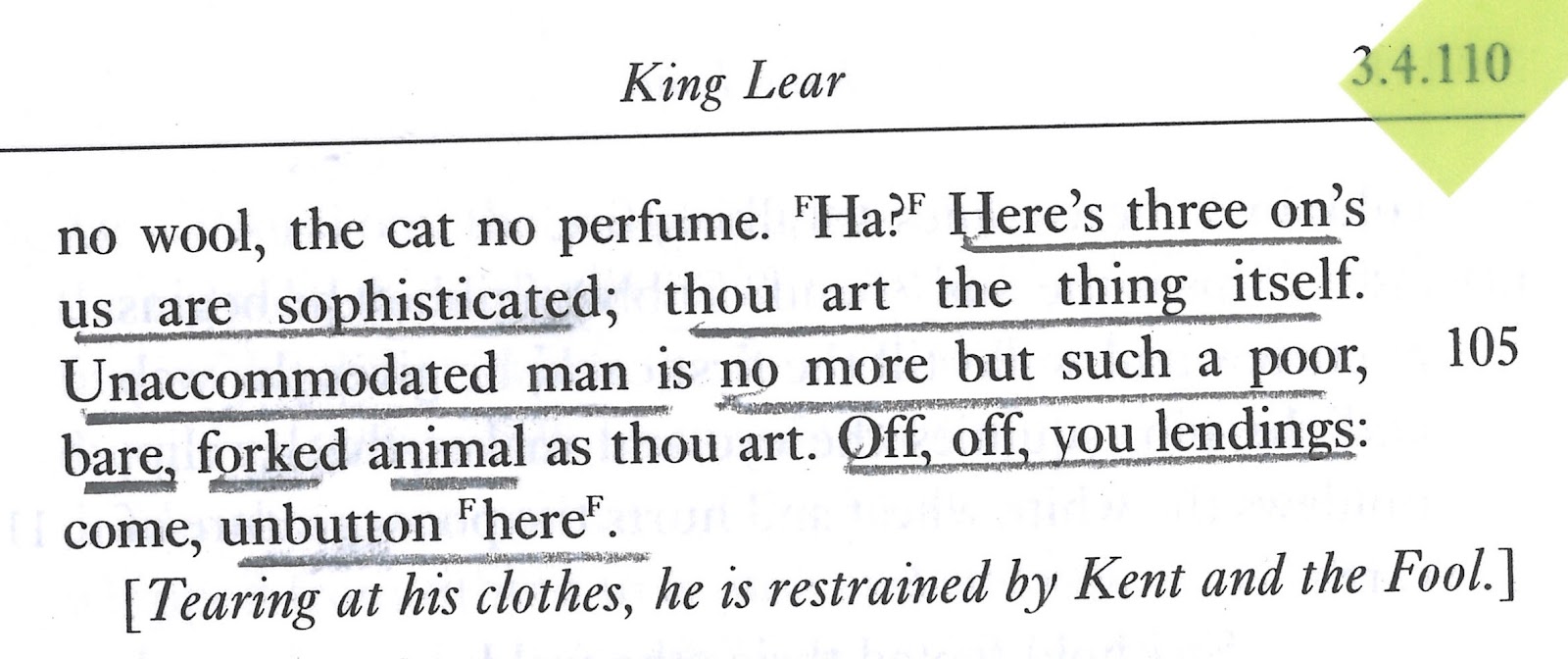
In re-reading King Lear once more, I was working through Lear's speech on the heath when he has encountered Edgar, who is disguised as Poor Tom. And something struck me as odd . . . unusual . . . unfamiliar.

"Could it be a typo?" I thought. I then dismissed the thought. After all, this is the Arden edition. How many times had this text been viewed by how many people? "It's your overwrought imagination," I told myself, "combined with the work you're doing for your editing and proofreading class.

But then I looked again.

All right, I'll give away the spoiler. It was (and is) a typographical error! Before I walk you through the process I went through to confirm it as a typo, take a look at the image above or the image immediately below. Can you spot the error?


It's in the line "Here's three on's us [sic] are sophisticated." That "on's" is a contraction meaning "of us"—the extra "us" is merely superflux (that's a Shakespearean coinage from this very play).  "Here's three of us us are sophisticated" doesn't make sense.

But we are dealing with multiple texts of King Lear. Perhaps this merely reflects a textual variant.

I grabbed a couple other modern editions to see what they did with the line—and whether they had any note about that seemingly-extra "us."

The Arden Section Series edition did not have it:


Neither did the Riverside:


I then took a quick gander at my parallel text edition (for which, q.v.), which compares Q1 and F of Lear.


I like the spacing Q1 provides: "her's three ons are so phisticated."  It reminds me of the phrase "You think you're all that?  You think you're so phisticated, don't you?"

The long and short of it is that it is a typo—a genuine rarity in an Arden edition. Since it occurs over a line break, it's easy to miss. I've read that speech multiple times myself and never noticed. In other words, I'm not finding fault—I'm just finding interest!

Tuesday, December 6, 2022

Two Quotes from Macbeth in an Episode of Doctor Who

"Sleep No More." By Mark Gatiss.  Perf. Peter Capaldi and Jenna Coleman. Dir. Justin Molotnikov. Doctor Who. Series 9, episode 9. BBC One. 14 November 2015. DVD. BBC Home Entertainment, 2016.

Well, that didn't take long! I was just complaining (mildly, to be fair) that an Agincourt reference in a Doctor Who episode didn't bring in any Shakespeare. Just a few episodes later, the Doctor quotes from Macbeth in an episode about sleep (and the lack thereof).

You can read the details of the plot of the episode by following the link at the end of this post. In the meantime, let's cut right to the Shakespeare:


We get two separate speeches from Act II, scene ii of Macbeth. They're both spoken by Macbeth very soon after the murder of Duncan. The first is slightly different from the text of the play. Here's how that reads:

Sleep that knits up the ravell'd sleave of care,
The death of each day's life, sore labor's bath,
Balm of hurt minds, great nature's second course,
Chief nourisher in life's feast.  (II.ii.34–37)

The doctor drops "nature's second course" and drops the "great" down to the next line.

In the second scene, it seems like the Doctor is on the verge of giving us some Hamlet. He says, "To die . . . to die, to die," and I'm waiting for the ". . . to sleep— / No more" from III.i.59-60 of Hamlet. Instead, we get a different "sleep no more"—together with a pan across the room that reveals a bunch of potential daggers.

I'm not so sure about the concluding reflection on the Shakespeare speeches. It seems somewhat lacking. I take "He really knew his stuff" as a starting point for Shakespeare study; it seems to be something of a conclusion here. Still, I appreciate the working in of Shakespeare to this pop culture artifact.

Links: The Episode at IMDB.

Click below to purchase the season from amazon.com
(and to support Bardfilm as you do so).

Monday, December 5, 2022

A Henry V–Adjacent Moment in Doctor Who

“The Woman Who Lived.” By Catherine Tregenna. Perf. Peter Capaldi and Maisie Williams.  Dir. Edward Bazalgette. Doctor Who. Series 9, episode 6. BBC One. 24 October 2015. DVD.  BBC Home Entertainment, 2016.

I'll admit that I haven't kept up with my Doctor Who. I lost interest somewhere in Series Seven. And I haven't really recovered it. But I've had some episodes on in the background while doing other things, and that enabled me to notice a brief reference to the Battle of Agincourt. 

The plot involves a character that the Doctor last saw back in the age of the Vikings. He healed her—but the healing granted her a kind of immortality. 

In this scene, the character (a woman named Ashildr who is calling herself "Me") recounts some of her life experiences between the Viking era and the Interregnum. It turns out that she was at Agincourt:


No, that's not much.  And yes, alas, we don't get any direct connection to Shakespeare. Still, I thought I'd mention it! After all, it's a bit of Joan of Arc (think 1 Henry VI) meets Nym (among the "regular" soldiery in Henry V).

I don't expect any of the Doctors will revisit Shakespeare—the episode "The Shakespeare Code" (for which, q.v.) covered it well. But we can hope for Shakespeare-related plots and allusions to and quotations from Shakespeare. I'll keep my eye out.

Links: The Episode at IMDB.

Click below to purchase the Ninth Series from amazon.com 
(and to support Bardfilm as you do so).

Tuesday, November 29, 2022

Shakespeare in Hee Haw

“Episode 13.” By John Aylesworth, Frank Peppiatt, Buck Owens, Roy Clark, et al. Perf. Buck Owens, Lulu Roman, and Junior Samples (et a whole lot of other al., but those are the ones in the clip below). Dir. Bill Davis. Hee Haw. Season 1, episode 13. CBS. 17 December 1969. DVD. Time Life, 2015.

You may be asking why I, a Shakespeare and film blogger of some repute (no, I didn't say what kind of repute) and a Shakespeare scholar who is highly respected (quiet down there, you in the back, or I'll send you out in the hall) am watching a show from the 1970s that is full of corny jokes (literarily corny some of the time—they were often delivered in a corn field) and country bumpkin stereotypes.

But is the Shakespeare scholar not able to have other fields of interest? Can we not find amusement—nay, even pleasure—in things that smack less of Shakespeare than other things? Does not even Shakespeare Geek himself enjoy WWF wrestling? If you tickle us, do we not laugh? If you . . .

Sorry. I got carried away.

I grew up on Hee Haw, and the Ken Burns documentary on Country Music (which, even though others make fun of me for so doing, I rewatch once or twice a year) reminded me of the show. A few ILL requests later, and I had me some Hee Haw to watch.

And that's when I spotted the Shakespeare in it! In the episode listed above, the "Hee Haw Players" give us a bit of Shakespeare. Let's take a look . . .


In the Romeo and Juliet scene, we have the expected joke. But with a twist. Lulu Roman says "Whereforth art thou, Romeo," which makes Junior Samples' reply ("Any fool can see I'm right here at the bottom of this stupid ladder") not quite fit. Then again, since neither "wherefore" nor "whereforth" mean "where," any reply about location is equally nonsensical.

In the second scene, we have a line from Richard III . . . followed by Gordie Tapp, dressed as Julius Caesar of all people and smoking a big cigar, giving a tip on a horse race and trying to make Junior break.

All in all, I suppose there not much depth there. But I find it intriguing to have additional evidence of how pervasive Shakespeare is in modern Western culture.

Note: ShakespeareGeek says that calling it WWF is "a very old school thing to do." That's a compliment, I imagine.

Links: The Episode at IMDB.

Click below to purchase some Hee Haw from amazon.com
(and to support Bardfilm as you do so).

Monday, November 14, 2022

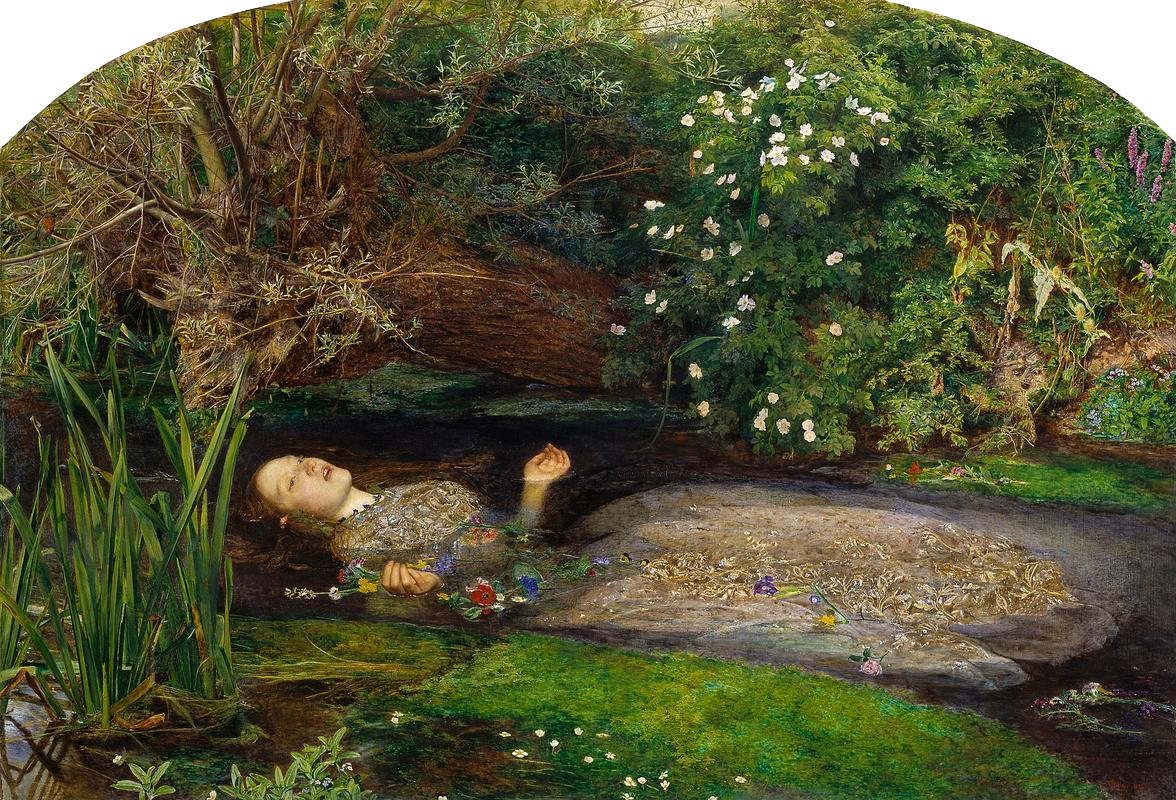
Art Note: John Everett Millais's Ophelia

Millais, John Everett. Ophelia. 1851–1852.  Oil on canvas. Tate Britain [formerly known as the Tate Gallery {and, before that, known as the National Gallery of British Art}].  https://www.sartle.com/artwork/ophelia-john-everett-millais (and elsewhere).

Hamlet wears black and carries a skull.  Ophelia is surrounded by flowers.  Lady Macbeth looks like the kind of person you wouldn’t want to invite to dinner.

All that is right, right?  But how do you know?

Well, sure, you could read the plays carefully, noting every line and every nuance of every line.  Or you could let artists throughout art history do the work for you!

Let’s start with Ophelia, who has received a great deal of artistic attention over the centuries.  The top contender for “Most Recognized Portrait of Ophelia” is probably the one by John Everett Millais.

The painting visualizes a scene that is not actually put on stage in Shakespeare’s play.  It’s a visualization of Queen Gertrude’s “willow” speech reporting Ophelia’s death to King Gertrude and to Ophelia’s brother Laertes.  Here are a few key sections from that speech:

There is a willow grows askant the brook
That shows his hoary leaves in the glassy stream.
Therewith fantastic garlands did she make.
. . . . . .
[Then she] fell in the weeping brook.  Her clothes spread wide,
And mermaid-like awhile they bore her up,
Which time she chanted snatches of old lauds . . . .
. . . . . .
. . . But long it could not be
Till that her garments, heavy with their drink
Pull’d the poor wretch from her melodious lay
To muddy death. (IV.vii.165ff, passim)

Let’s take a moment to paraphrase Gertrude’s speech.  “You know where that willow over the brook is?  Well, Ophelia went there and made a bunch of daisy chains with all sorts of flowers (not just daisies).  Then she fell in, singing all sorts of hits from the ’80s all the time.  And it looked like it would be all right for a moment—you know how your swimming suit is full of bubbles when you first get in the pool?  But it didn’t take long for her clothes to fill with water and drag her down to the bottom.  And when they did, she died.”

This painting picks all those details up and gives them, in words from another Shakespeare play, “a local habitation and a name.”  It fixes the lyricism of Gertrude’s speech in a specific image we can all contemplate.  The willow is there—if we think of the brook as flowing from right to left, she’s about to float under it; if she’s heading downstream feet-first (the order in which the images are presented in the text), she’s just passed under it.  The garlands are there—notice one woven together as a laurel crown floating near Ophelia’s right foot.  Either it’s following her downstream or it’s proceeding her.  The singing might be there in that expression on Ophelia’s face—or it might not. There’s ambiguity in what her open mouth portrays.  But there’s less ambiguity in the garments that are also there.  They are clearly getting “heavy with their drink”—mostly around the waist at the moment the picture portrays, but we can imagine the currently-floating skirt of the dress filling with water and eventually bringing Ophelia fully under.

You may think I’m making too much of the ambiguity about which way the water’s flowing and whether Ophelia is singing and what I mean by the “eventually” of Ophelia’s drowning, but those are all important components of the painting.

In a recent Twitter poll, more people thought the brook is flowing to the left (i.e., Ophelia is floating headfirst down the stream) than the other options. And some respondents were pretty vehement about it!


Why does it matter which way the brook is flowing?  Frankly, it doesn’t.  But that’s kind of the point.  When Laurence Olivier made a film of Hamlet in 1948, he provided images of Ophelia drowning while Gertrude’s speech plays in voiceover.  (As a side note, not all films of Hamlet show Ophelia at this point—Kenneth Branagh doesn’t—apart from a quick image of Ophelia already drowned; Franco Zeffirelli does—for a few seconds . . . from a great distance.)  Olivier deliberately appropriates Millais’ vision of Ophelia, but he makes some changes.  Olivier’s film is filmed in black and white, which clearly mutes the vibrant colors Millais uses.  And Ophelia’s feet are to the left in Olivier’s film (though I don’t know that that’s a significant change).  And she’s floating feetfirst down the stream:


That might not be a change from Millais’ painting, but it is a decision that an artist in film made based on the vision of an artist in paint.  And it matters!  It matters because Millais’ painting is a snapshot—the same way Gertrude’s speech is a snapshot.  Notice that (despite my paraphrase) Gertrude doesn’t say “She died.”  She says “But long it could not be . . .”  She’s holding Ophelia in an indeterminate position.  She’s still alive, and she won’t be alive long, and it won’t be long until she’s not alive . . . but she’s not actually declared dead in Gertrude’s speech.  Gertrude just says “long it could not be till . . . death.”


Millais is doing the same.  We don’t know which way the brook flows because it doesn’t matter in Millais.  He wants us to have the suspense of the alternatives.  Ophelia becomes a Schrödinger’s cat of sorts.  In Schrödinger’s thought experiment, the cat is simultaneously dead and alive.  It has to do with the uncertainty principle and quantum physics—and you can find someone better qualified to explain it to you.  But in terms of art, we have Ophelia simultaneously dead and alive in this painting.


In the same way, we don’t know whether Ophelia is singing.  She could be singing—or we could imaging her mouth being open to take her very last breath.


In the Olivier film, Ophelia floats past the camera (feetfirst, from right to left, in black and white).  Then the camera pans to catch up with her, and we just see some garlands floating downstream and under the water.  Olivier can’t stop the film—he has to go on to tell the rest of the story.  Millais has the . . . shall we call it a luxury?  Millais has the luxury to show us one slice of Ophelia’s life without reaching the conclusion—however inevitable that conclusion will be.

Links: The Painting at Tate Britain.

Click below to purchase a giclee print on canvas reproduction of the painting
from amazon.com
(and to support Bardfilm as you do so).

Thursday, September 8, 2022

One More Calvin & Hobbes & Shakespeare

Watterson, Bill. "Whither Goest Thou, Young Rogue?" The Complete Calvin and Hobbes. 3 vols. Vol. 3: 1992-1995.
Kansas City: Andrews McMeel Publishing, 2005. 3 May 1992. 42.

Remember when Robin Williams gave us some Shakespeare-esque language in Mork and Mindy (for which, q.v.)? Here, Bill Waterson does the same.


I'm very fond of Calvin & Hobbes, but I don't think the punchline here really pays off. Calvin seems to think that cop shows are full of highfalutin language—like . . . Shakespeare plays are?

It also strikes me as a bit strange that Calvin, complaining about a lack of real dialogue in the show, begins his complaint with "Holy Schlamoly." Perhaps his perspective on realistic dialogue is a bit skewed.

Click below to purchase the set from amazon.com
(and to support Bardfilm as you do so).
Bardfilm is normally written as one word, though it can also be found under a search for "Bard Film Blog." Bardfilm is a Shakespeare blog (admittedly, one of many Shakespeare blogs), and it is dedicated to commentary on films (Shakespeare movies, The Shakespeare Movie, Shakespeare on television, Shakespeare at the cinema), plays, and other matter related to Shakespeare (allusions to Shakespeare in pop culture, quotes from Shakespeare in popular culture, quotations that come from Shakespeare, et cetera).

Unless otherwise indicated, quotations from Shakespeare's works are from the following edition:
Shakespeare, William. The Riverside Shakespeare. 2nd ed. Gen. ed. G. Blakemore Evans. Boston: Houghton Mifflin, 1997.
All material original to this blog is copyrighted: Copyright 2008-2039 (and into perpetuity thereafter) by Keith Jones.

The very instant that I saw you did / My heart fly to your service; there resides, / To make me slave to it; and, for your sake, / Am I this patient [b]log-man.

—The Tempest