Thursday, May 6, 2021

Book Note: The Cambridge Companion to Shakespeare's First Folio

The Cambridge Companion to Shakespeare's First Folio
. Ed. Emma Smith. Cambridge: Cambridge University Press, 2016.

Would you like more detailed information about an aspect of the production of the First Folio?

You've come to the right place!

Well, no, this blog isn't exactly the right place, but the book I'm mentioning is.

I'm not going to give you a full chapter as an example because the topics are so varied—as are your interests. Instead, here's the table of contents and the brief preface. They will let you know what to expect from this remarkable, scholarly anthology of relatively recent research on the First Folio.


Click below to purchase the book from amazon.com
(and to support Bardfilm as you do so).

Wednesday, May 5, 2021

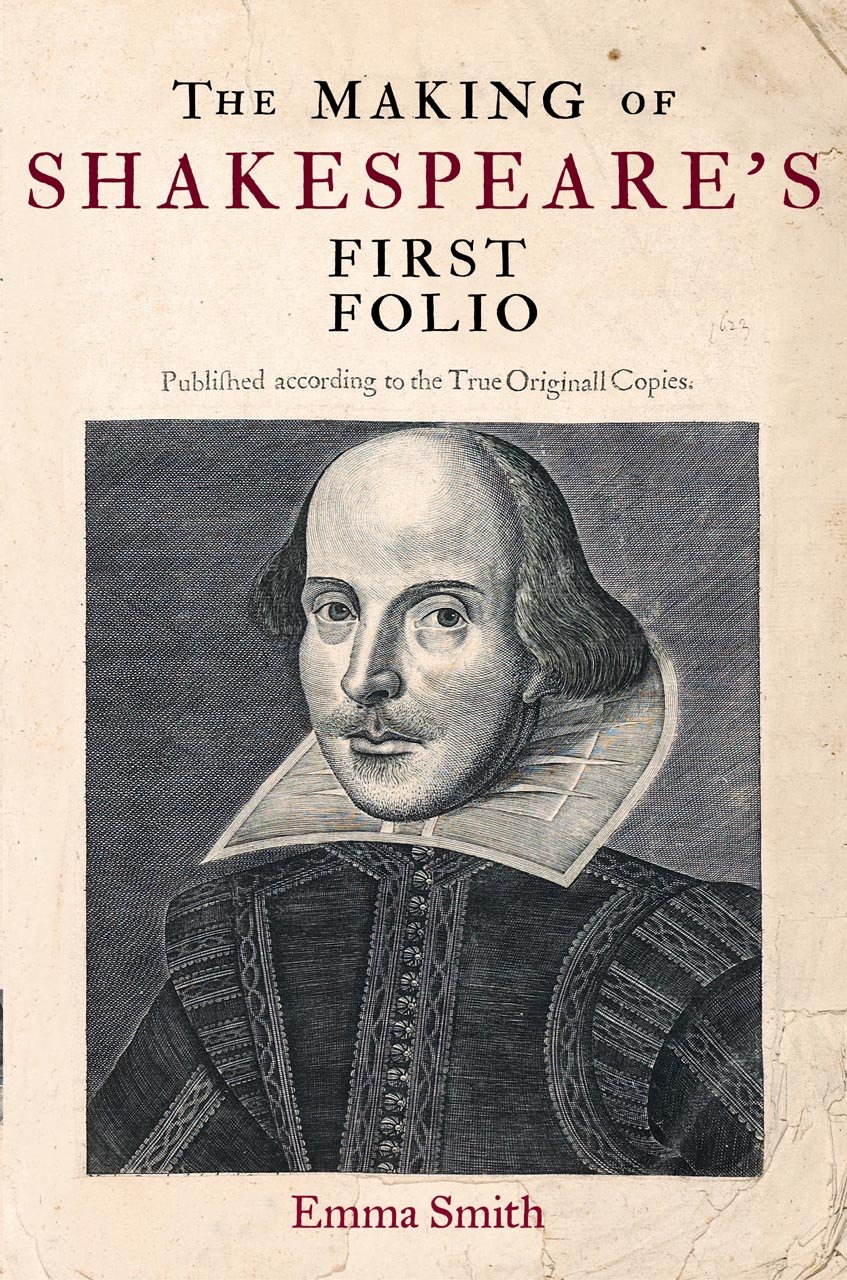
Book Note: The Making of Shakespeare's First Folio

Smith, Emma. The Making of Shakespeare's First Folio. Oxford, Bodleian Library, 2015.

I've been reading a number of books on the First Folio recently. After all, it won't be long before it celebrates its four-hundred-year anniversary!

Emma Smith's has been the best by far so far. It's meticulously accurate and scholarly—but it's written in a marvelously approachable style.

Having read a lot about the First Folio over the years, I wasn't surprised by too much in the volume, but the narrative is so fascinating—and so clearly and intriguingly articulated by Smith—that I'll be re-reading this book before too long.

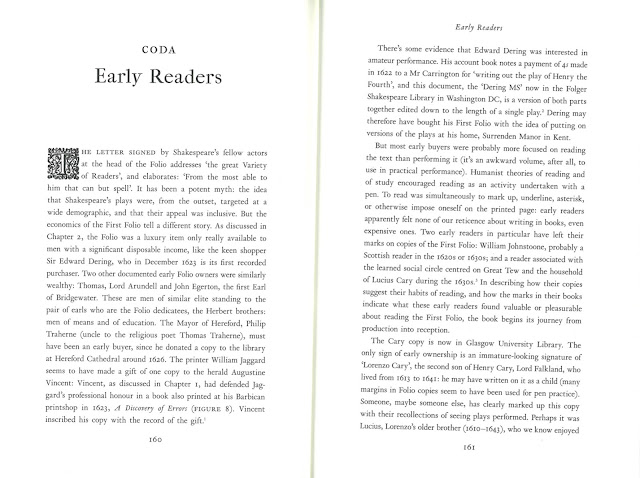
One particularly interesting section was the last. In it, Smith considers early readers of F and what sorts of marginalia they deigned to supply. Sample that section—and then track down the book and start it at the beginning.


Click below to purchase the book from amazon.com
(and to support Bardfilm as you do so).

Tuesday, May 4, 2021

Kevin Kline's Shyriiwook Hamlet

Hamlet
. Dir. Kevin Kline. Perf. Kevin Kline and Diane Venora. 1990. DVD. Image Entertainment, 1990.


One of the alternate language tracks of Kevin Kline's majestical Hamlet is, not unsurprisingly, Shyriiwook, the language Chewbacca speaks:


Enjoy your May the Fourth!

Links: The Film at IMDB.

A bit more Shakespeare and Star Wars here, here, and here.

Friday, April 30, 2021

Buster's Ten-Second Summary of Hamlet in Arrested Development

“Righteous Brothers.” By Mitchell Hurwitz . Perf. Tony Hale. Dir. Chuck Martin. Arrested Deveopment. Season 2, episode 10. Fox. 17 April 2005. DVD. 20th Century Fox Home Entertainment, 2004-2020.

Here's a brief (very brief) something to start your weekend.

There are all sorts of quick-and-easy summaries of Hamlet out there. A ten-minute one gained some notoriety some years back, for example.

But if you really need the quickest possible refresher on Hamlet's plot, I'd go with Buster's. In just ten seconds, he captures the essence of the greatest tragic drama in all of western literature.


Links: The Episode at IMDB.

Click below to purchase the first four seasons from amazon.com
(and to support Bardfilm as you do so).

Thursday, April 29, 2021

Unexpected Agincourt in Mystery Men

Mystery Men
. Dir. Kinka Usher. Perf. Ben Stiller, Janeane Garofalo, and William H. Macy. 1999. DVD. 
Universal Pictures Home Entertainment, 2010.

Here's a little something fun courtesy of ShakespeareGeek, who mentioned it on his blog on Shakespeare day.

It's a brief clip from a film about, according to IMDB, "A group of inept amateur superheroes [who] must try to save the day when a supervillain threatens to destroy a major superhero and the city."

I haven't seen the film myself (but it sounds a bit like the 2000 film The Specials, so I think I'll enjoy it). But this is clearly the scene where the heroes are up against it and ready to give up. Don't give up on the scene—give it a try:  


Well, there's not much of the St. Crispin's speech there, but I still think it's a successful modernization. I'm eager to give the rest of the film a chance. Perhaps there will even be a victor's speech like the one at the end of Richard III.

Links: The Film at IMDB.

Click below to purchase the film from amazon.com
(and to support Bardfilm as you do so).

Tuesday, April 27, 2021

Book Note: Hamnet: A Novel of the Plague

O'Farrell, Maggie. Hamnet: A Novel of the Plague. New York: Alfred A. Knopf, 2020.

This book made quite a splash when it came out, so I'm playing catch-up here.

It's a family drama about the death of Hamnet Shakespeare. Here's where I insert the obligatory note that the names Hamlet and Hamnet were interchangeable in the period. I notice the cover designer put the "n" in italics in case anyone thought they were about to get the story of the Prince of Demark.

There's also a lot about Shakespeare's wife Agnes. Here's where I insert the obligatory note that the names Agnes and Anne were interchangeable.

I highly recommend the book. It's an interesting, touching, tragic, and profound work of imaginative historical fiction. And spoilers are right around every corner, so I'm not going to give you any more. Just read it for yourself.

As a way of showing you the world of the book, I'd like to give you the very prescient amount of just how the plague made its way to Stratford-upon-Avon. The subtitle is A Novel of the Plague, and you can imagine something very like this happening in the current era.


Click below to purchase the book from amazon.com
(and to support Bardfilm as you do so).

Tuesday, April 20, 2021

Book Note: The Millionaire and the Bard

Mays, Andrea E. The Millionaire and the Bard: Henry Folger's Obsessive Hunt for Shakespeare's First Folio. New York: Simon & Schuster, 2015

After waiting for some time for my library to buy this book, process it, and make it available for checking out, I was very excited to dig right in.

I was almost immediately disappointed. But I did give this book a second try, and I'm glad I did.

My disappointment was in the many minor but annoying inaccuracies in describing Shakespeare's life and times.  These included the following:
  • The old canard that it's somehow meaningful that his burial record says "Will. Shakspeare, gent. [sic, including spelling and punctuation]" instead of "Will. Shakspeare, poet."
  • The insistence that Shakespeare's first play was Titus Andronicus.  Yes, it may have been, but there's absolutely no certainty about it.
  • The claim (baldly-stated as a fact) that only three of Shakespeare's signatures survive, together with "by me" on his will as the only words besides his signature in his hand. Yes, there's not much out there, but there are six signatures, the words "by me" (none of which is seriously disputed), and the uncertain but possible "Hand D" in the manuscript of Sir Thomas More. No, the last isn't established as unquestionably Shakespeare's writing, but that point in the book would be the time and place to mention it.
I gave up at that point but later decided to skip all the Shakespeare stuff and cut to the Henry Folger material. My advice is to start on page ninety-one—that's where things get really exciting and the material seems solid.

Read the extract from a later chapter included below and see if you don't agree that there's much interest, suspense, and tension in the story. The section is about Folger's attempts to purchase what became Folger Shakespeare Library Folio Number One—which, in 1903, he eventually bought for £10,000. It was then the most expensive book in the world. The folio (like all folios) is unique—but the ways in which Folger One is unique are that it is the tallest; the only known presentation copy; its presenter was William Jaggard, the First Folio's printer; and the presentation is dated 1623, the year of the First Folio's publication.


Folger made many mistakes in his attempts to buy the folio, but here's Mays' account of the final transactions (you can start on the first full paragraph on 137 or at the top of 136):


It's interesting stuff—just start on page ninety-one.

Click below to purchase the book from amazon.com
(and to support Bardfilm as you do so).

Wednesday, April 14, 2021

Book Note: This Side Idolatry: A Play in Seven Scenes

Jennings, Talbot L. This Side Idolatry: A Play in Seven Scenes.  Unbound typescript, circa 1933, Manuscripts Department, University of North Carolina Library, Chapel Hill, North Carolina.

Some considerable time ago, I was able to get ahold of a play about Shakespeare arriving in London.

It sat on my desk for about ten years.

But I finally got down to that layer of stratification and glanced through the play.

It's interesting, but it's not earth-shattering. And I'm afraid I can't give you any of it without attempting to get the approval of the estate, and I just don't have the time. You can see from the image above that they make their "Do Not Copy" policy pretty clear on every page (I think I'm justified in providing the image describing the manuscript—just not any part of the manuscript itself).

The reason I requested the play in the first place was that Leslie Howard acted in it (he played Shakespeare), a fact I learned while doing research to debunk the silly claim that Howard was an Oxfordian (for which, c.v.).

This Side Idolatry is worth mentioning since it provides evidence of the continual interest in imagining Shakespeare's biography. And, not to give away too much, its second scene is set in Deptford on May 30, 1593. 

Links: More about the production with Leslie Howard.

Wednesday, March 10, 2021

Book Note: I am Juliet (and Others by Jackie French)

French, Jackie. I am Juliet. New York: Angus&Robertson, 2014.

Well, the cover says almost all:  "The girl who famously loved Romeo. / In this story she takes centre stage."

I read this some time ago, but I'm trying to clear off my desk.  Here, then, is a brief review.

First, I am not the target audience for this book. It seems to be directed toward female YA novel readers, and that's not quite my cup of tea.

For the most part, this is a pretty route novelization of the plot of Romeo and Juliet. But it does have one twist—its frame. The narrative starts with Rob, a thirteen-year-old boy actor preparing to play the role of Juliet in 1592. After a few pages of that, we get the story of Juliet as (imagined by? flashed back to? historically re-created by? mystically relayed to?) the actor. Then, at the end, we head back to Rob as he prepares to walk on stage to play the role for the first time.

I'll give you that first short chapter and the first page of the transition to the Juliet section for your edification.


Beyond the frame, there aren't any surprises. But perhaps this is just the sort of book a young, female audience needs to get over all those words, words, words that are part of Shakespeare.

If so, there are others by Jackie French to try: Third Witch (note: not The Third Witch, which I enjoyed, nor Enter Three Witches, which was also pretty good), Ophelia, Queen of Denmark, and The Diary of William Shakespeare. I'll probably give them a try—perhaps I can bring them to the attention of the students in my Young Adult class. For those who become junior high English teachers, they may prove to be a good resource.

Click below to purchase the books from amazon.com
(and to support Bardfilm as you do so).


Tuesday, February 9, 2021

Book Note: Fools and Mortals

Cornwell, Bernard. Fools and Mortals. New York: Harper, 2019.

I was a bit skeptical about this novel when I first started it. It seems like an ordinary adventure novel with a vaguely Elizabethan setting.

But it definitely grew on me.

Here are the basics of the plot:  William Shakespeare's second-youngest brother (Richard) gets in big trouble in Stratford and makes his way to Big Brother Will in London. But Will doesn't really want him around—at all!  He doesn't want to help him, he doesn't want to see him, and he doesn't want him interfering with his life in London. Reluctantly, Will gets Richard a job—with a terrible man who runs a company of boy actors but abuses them all terribly.

Eventually, Richard determines to become a player. And that's really when the book got interesting for me. We meet Will Shakespeare's company, and Richard gets older and demands to be allowed to stop playing women's roles.

After Richard helps Will in some way, Will agrees and gives him a part in his new play—A Midsummer Night's Dream. I'd like to give you some of that scene. The actors in Shakespeare's company behave just like the Rude Mechanicals—squabbling over parts, et cetera. And Richard becomes furious with his brother when he realizes the male role he's been given is that of Francis Flute—who has to play Thisbe. Richard becomes a male actor who doesn't want to play female roles playing a male actor playing a female role.


Later, Shakespeare's scripts are stolen and the whole company needs to work desperately hard to get them back.

Give it a try—it's suspenseful and well-written . . . and it's usually pretty historically accurate in the setting.

Wednesday, January 27, 2021

Shakespearean-Sounding Language in Mork and Mindy

"Pilot." By Garry Marshall. Perf. Robin Williams and Pam Dawber. Dir. Howard Storm. Mork and Mindy. Season 1, episode 1. ABC. 14 September 1978.

Ah, some more sitcom Shakespeare!

I'm teaching a course called "Literature of Humor," and I dipped into the late 1970s show Mork and Mindy, starting (in particular) Robin Williams. Our textbook for the course starts off by talking about the defamiliarization aspect of humor, and Mork and Mindy is about an alien who comes to Earth to research our quaint Earth customs. I thought I might find a brief example to illustrate that principle. In addition to that, I found a bit of Shakespearean language.

Williams often incorporated pseudo-Shakespeare into his stand-up routines, so I shouldn't have been surprised to find that in Mork and Mindy. Here, then, is the brief clip. Enjoy!


Here's the transcript:

Mindy: Now, Mork, that’s what got you the trouble the last time!
Mork: Alas, my lady, you do deal me pain. ’Tis justified, and I shall repent.
Mindy: Oh come on . . . Hey! Where did you get that voice?
Mork: From yon video. ’Twas Shakespeare methinks, or ’twas The Jeffersons.
Mindy: Well that . . . that voice is normal—if you forget the ’twas and the ’twits.
Mork: I’ll ’twy!

Links: The Episode at IMDB.

Click below to purchase the entire run of the show from amazon.com
(and to support Bardfilm as you do so).

Wednesday, December 23, 2020

I’ll Make a King Out of Me (The Richard III Theme Song)


kj. "I’ll Make a King Out of Me (The Richard III Theme Song)." The Potential Musical Version of Richarrd III.

Long-time blog readers will know that I often compose songs for my students as a way of reviewing the material.

But I've always been stymied by Richard III. Well, perhaps "stymied" isn't quite the right word. "Uninspired" might hit the nail on the head.

Until this year. The students suggested some options, and we settled on the rallying song from Mulan.

I've thrown together a rough recording of it (in between grading Shakespeare exams and grading Shakespeare thesis papers)—forgive the roughness, but I thought I'd just take a chance and throw it out there.

The song is in the embedded file—the images are incidental to the song, but they're all from versions of Richard III, and that sometimes leads to some serendipity.

Below the file are the lyrics. Enjoy!


I’ll Make a King Out of Me (The Richard III Theme Song)


Now it is the winter—of our discontent.

We have a King named Edward, who I sure resent.

I can smile and murther while I smile

(That’s from Henry VI, Part Three).

Forsooth, I’ll make a king out of me.


Hacking through a forest and all rent with thorns,

Wondering if my mother wishes I weren’t born,

I’m a twisted, half-formed, wretched man,

But I’ll soon be “Richard Three.”

With luck, I’ll make a king out of me.


I think I’m destined to be a villain

(Lady Anne hopes “He’ll woo me.”)

Oi, so many lives are standing in my way!

When I plot, they think that I am chillin’

But you all know the true me.

I’ll grab that crown from you someday!


(I’ll be king)

I must thank God for my humility,

(I’ll be king)

And quote the Bible to serve my purpose.

(I’ll be king)

I’ll grab me some old Pink Floyd records

And listen to The Dark Side of the Moon.


That’s not strictly relevant, but it fits . . . the line.

Buckingham will back me—almost all the time.

He won’t take the princes down,

So Old Tyrrel will work for me.

And then I’ll be a king—Richard Three.


(I’ll be king)

Let it out that Lady Anne’s sick,

(I’ll be king)

But I would wait ’til the coronation.

(I’ll be king)

I have a hunch Richmond won’t do damage—

As long as I have my horse with me.


(I am king)

I’m going to reign like the storm in King Lear

(I am king)

Richard One and Two can’t outdo me.

(I am king)

I planned all this over four whole plays now

Victorious in the first teratology!


Monday, December 21, 2020

Shakespeare in Wishbone

“Shakespaw.” By Adam Felber. Perf. Larry Brantley, Jordan Wall, and Christie Abbott. Dir. Allison Graham and Joey Stewart.  Wishbone. Season 1, episode 32. ABC. 20 November 1995.  

We have for you a treat that has been years in the making. Students will frequently tell me about their Shakespeare experiences—notably, they talk about their initial encounters with Shakespeare.

It does take a while, but I'm sometimes able to follow their footsteps and track down the things they tell me about.

Here is such a moment!

The show Wishbone (eager to jump on the educational bandwagon) featured a cute dog who explored the literary world by taking on a variety of characters. In this episode, he becomes Ariel (because the local high school is putting on a production of The Tempest). The selection below concentrates mainly on the dog's imagined production, but there are elements of the high school production as well. As is typical in such shows, the bad guys in the show are also the bad guys in real life, and it's only after some wrangling that it all works out. Here you go!


Bonus! Some Shakespeare material from a Romeo and Juliet episode later in the show's run:


Links: The Episode at IMDB.

Friday, December 18, 2020

Book Note: Shakespeare: Upstart Crow to Sweet Swan: 1592-1623

Duncan-Jones, Katherine. Shakespeare: Upstart Crow to Sweet Swan: 1592-1623. London: Arden Shakespeare, 2011. 

I'm sorry that this is the second post in a row that reviews a book that I cannot wholeheartedly recommend. But I suppose that's the way it sometimes goes.

This book has been in my Amazon cart for a very long time. It's very expensive, and it seldom drops in price. But I finally got fed up and (instead of actually purchasing it) requested it through Inter-Library Loan.

I'm glad I did. Though I'm fond of Katheine Duncan-Jones as a scholar, this volume isn't all that scholarly. 

The book centers on Shakespeare as a dramatist and actor, which is an admirable approach. But it's so highly speculative that it loses its claim to scholarship.

Here's a quick example. There's a wonderful chapter that concentrates its efforts on three early encounters with Shakespeare. And that's all to the good—and Duncan-Jones has her head on straight in detailing those encounters. But she provides highly-speculative interpretations of those . . . without letting readers know how speculative they are.

As one among many potential examples, here's her reading of the Peachum illustration of a performance of Titus Andronicus.


All of that is extremely interesting, but it's all highly hypothetical. We really cannot conclude, on the basis of one amateur illustration, that actors in female roles during Shakespeare's age did not employ padding, that war heroes were presented on stage with bare legs, or that "haystacks" is a distinctly superior way to express the idea of "hay stalks." 

Click below to purchase the book from amazon.com
(and to support Bardfilm as you do so).

Bardfilm is normally written as one word, though it can also be found under a search for "Bard Film Blog." Bardfilm is a Shakespeare blog (admittedly, one of many Shakespeare blogs), and it is dedicated to commentary on films (Shakespeare movies, The Shakespeare Movie, Shakespeare on television, Shakespeare at the cinema), plays, and other matter related to Shakespeare (allusions to Shakespeare in pop culture, quotes from Shakespeare in popular culture, quotations that come from Shakespeare, et cetera).

Unless otherwise indicated, quotations from Shakespeare's works are from the following edition:
Shakespeare, William. The Riverside Shakespeare. 2nd ed. Gen. ed. G. Blakemore Evans. Boston: Houghton Mifflin, 1997.
All material original to this blog is copyrighted: Copyright 2008-2039 (and into perpetuity thereafter) by Keith Jones.

The very instant that I saw you did / My heart fly to your service; there resides, / To make me slave to it; and, for your sake, / Am I this patient [b]log-man.

—The Tempest