Wednesday, June 28, 2023

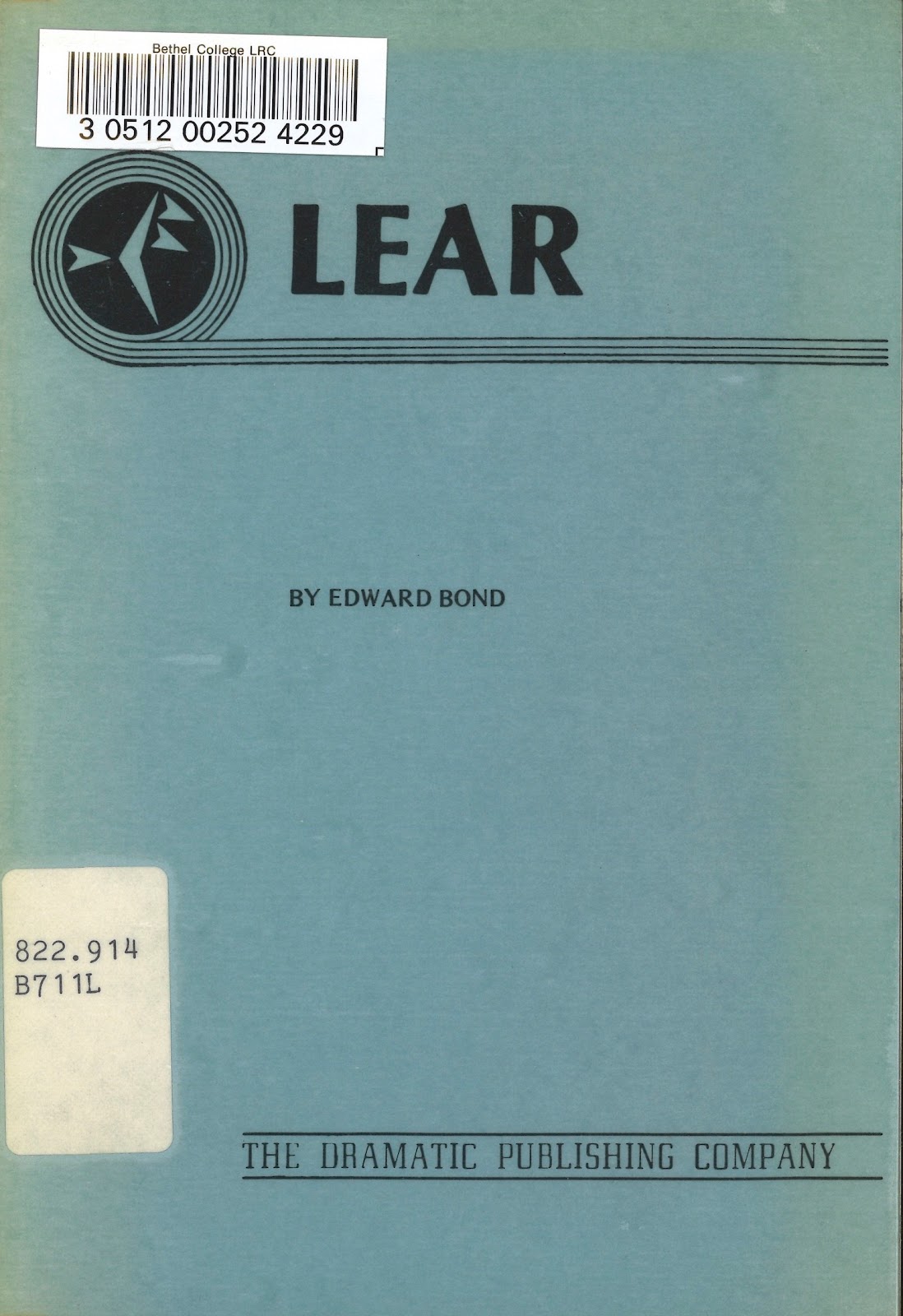
Book Note: Lear by Edward Bond

Bond, Edward. Lear. Chicago: The Dramatic Publishing Company, 1978.

This experimental, somewhat-absurdist, brutal, almost-unreadable, likely-unbearable-in-performance play offers a modern take on King Lear.

Why, then, does Bardfilm bring it up? Well, I suppose it's for completeness—a record of my responses to as much of the Shakespeare-related material I encounter that I can manage to share—and for information—letting readers know what's out there.

But it's a hard and unenjoyable play. To be fair, I'm not sure that "enjoyable" is the first adjective that springs to mind when considering King Lear, but Shakespeare's play does provide redemptive moments and a consideration of the significance of suffering in this world. Bond's Lear doesn't.

Let me give you, as is my wont, a few representative pages. In this first scene, Lear wants to execute a man who has been sabotaging the building of a protective wall (the details of the wall are deliberately left vague, but it's vaguely meant to keep out enemies). His daughters, Fontanelle and Bodice (yes, many of the names are changed) announce their matrimonial intentions.


In our next scene, Lear's eyes (yes, Lear's, not Gloucester's) are extracted by a machine Fourth Prisoner has developed:


Finally, the blind Lear becomes a voice for peace and for tearing down the wall. But he speaks in strange, difficult parables:


It's a very difficult play, and I don't think I'll be buying tickets if any productions come my way. On the other hand, I'm open to having missed something important about this play!  Feel free to comment if you think I'm a dimwitted dolt—but try to be kind about it, please.

Click below to purchase the book from amazon.com
(and to support Bardfilm as you do so).

Monday, June 26, 2023

A Quick Bit of Shakespeare in Remarkably Bright Creatures . . . with a Spoiler

Van Pelt, Shelby. Remarkably Bright Creatures: A Novel. New York: Ecco, 2013.

I thoroughly enjoyed the inventive and entertaining Remarkably Bright Creatures, which tells the story of a man searching out his parentage, a woman adjusting to the possibility of retirement and moving, and an octopus finding meaning in his life and freedom from his captivity. The audiobook was particularly well done, bringing the voice of the octopus to life.

And then there's the Shakespeare in it!

If you haven't read the novel, stop here, track it down, read it, and come back—signifiant spoilers are about to be spilled. The brief connections to Shakespeare will wait.

The man and the woman mentioned in the opening paragraph end up in a scene in the local aquarium (she's been injured, so she's not working there at present; he's taking over her custodial duties) where they return the escaped octopus to his tank. Tova (the woman) convinces Cameron (the man) to keep the escape of the octopus (Marcellus) a secret. Here's the end of that chapter: 


Tova's son died under mysterious circumstances about thirty years prior. The twenty-nine-year-old Cameron will learn much more about that in the course of the novel.

And you've probably grasped the spoiler by now: Cameron is Tova's grandson. The genetic predisposition to like Hamlet is only one clue.

In Marcellus' narrative, the relationship is outlined, and Marcellus seems to have some Shakespeare proclivities himself—or he at least uses a term Shakespeare and other writers in his era frequently used: "Cuckold."   


That's what I have for you: A direct quote from Shakespeare and a Shakespearean term. It's not much, yet it enhances the novel just that little Shakespearean bit.

Click below to purchase the boook from amazon.com
(and to support Bardfilm as you do so).

Tuesday, June 20, 2023

A Little Macbeth with your Agatha Christie?

Christie, Agatha. The Pale Horse. New York: Harper, 2011.

The Pale Horse was published in 1961, a little late in Agatha Christie's career. It doesn't feature any of her major detectives, though Ariadne Oliver (the apple-loving mystery author) makes several appearances in it. But that doesn't make it a good read.

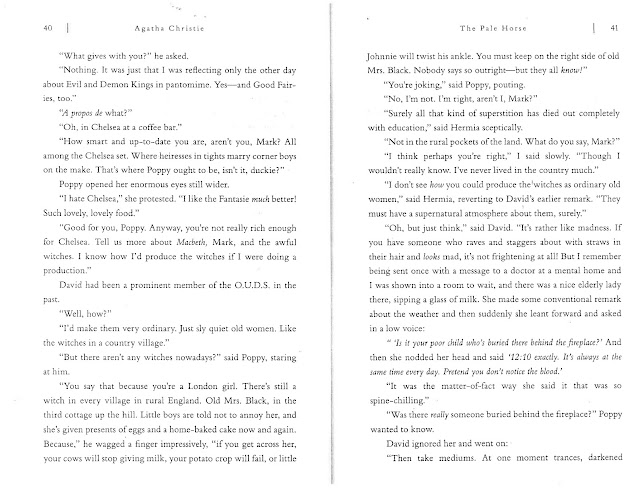
That's particularly the case when the characters start thinking about Macbeth. An alert student pointed the Macbeth in this play out to me. Shakespeare comes up frequently in Christie, but here we get a more extended musing on how the witches might best be portrayed. There are no spoilers here, so feel free to read this except:


I find that conversation decidedly interesting. There's a good discussion about what would be truly frightening in a portrayal of the witches.  Hermia (nice little Shakespearean name there, eh?) thinks that Macbeth is entreating the doctor to euthanize Lady Macbeth.  Poppy thinks perhaps Bacon wrote Shakespeare. Well, all right, that's not terribly interesting, but it serves as a nice bit of comic relief.

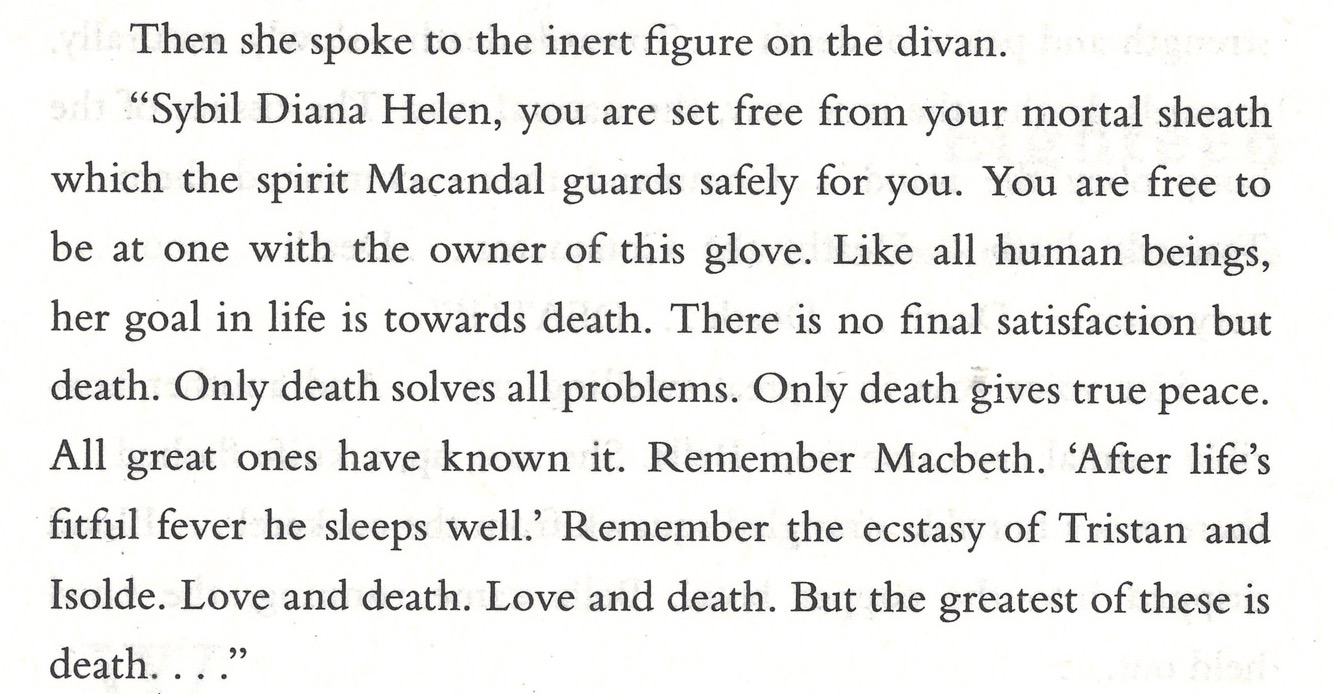
Then, nearer the end of the book, we get one more Macbeth reference:


The main connection to the plot of novel is that question of wanting to put someone out of the way (but not wanting to do it oneself). For Macbeth, Hermia thinks the doctor is being hired for the purpose. In the novel, Poppy gabbles some nonsense about getting it done with a pale horse.

Need something for your reading list this summer? Why not find out more by reading The Pale Horse?

Click below to purchase the book from amazon.com
(and to support Bardfilm as you do so).

Tuesday, May 30, 2023

Shakespeare's Biography Addressed on a Monty Python LP

Monty Python. "Stake Your Claim." Perf. Monty Python et al. Another Monty Python Record. LP. London: Charisma Records, 1971.

Followers of Bardfilm on Twitter may know that I've been going through my LP collection recently. I've enjoyed listening to some rarities from Dire Straights, some stories read by Leonard Nimoy and William Shatner, an album called Shakespeare's "Ages of Man" by Sir John Gielgud, some Louis Jordan, and (naturally) The Bands that Ate New York.

I don't actually have the LP from which this sketch comes, but I had a friend who had.

That said, I hadn't heard this sketch until Clear Shakespeare pointed it out. I've edited it a bit and added some apropos images so that we all can enjoy "Stake Your Claim" and its take on the authorship issue:


Links: The Album at Wikipedia.

Click below to purchase the album from amazon.com
(and to support Bardfilm as you do so).

Thursday, May 25, 2023

Book Note: The Merchant by Arnold Wesker

Wesker, Arnold. The Merchant. London: Methuen Drama Student Editions, 1993.

A much more interesting reworking of Shakespeare's Merchant of Venice than Shylock's Revenge can be found in Arnold Wesker's The Merchant.

Wesker wrote his play because, in his view, Shakespeare's play could not escape from the antisemitism in it. This is what he says in the preface to the play:

[The idea came] when, in 1973, watching Laurence Olivier's oi-yoi-yoi portrayal of Shylock in Jonathan Miller's production at the National, I was struck by the play's irredeemable anti-semitism. It was not an intellectual evaluation but the immediate impact I actually experienced. (xvii–xviii)

The center of his vision of a new version of the play was the different way he imagined Shylock's reaction in the courtroom scene:

The real Shylock would not have torn his hair out and raged against not being allowed to cut his pound of flesh, but would have said "Thank God!" The point of writing a play in which Shylock would utter these words would be to explain how he became involved in such a bond in the first place. (xviii)

That idea led to the fascinating retelling of the plot of Shakespeare's play. In Wesker's, Shylock and Antonio are the best of friends. And Shylock would happily lend Antonio whatever funds he needs—gratis, as Shylock would call it. But Venice has a law that any loan from a Jew to a Christian must be public—a bond must be signed and registered.

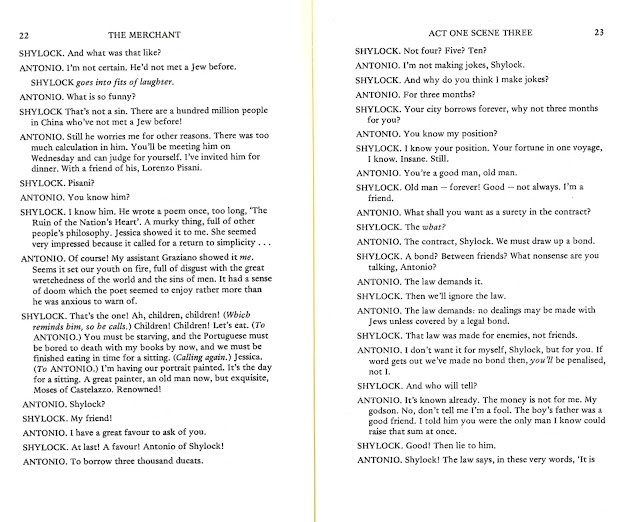
That's when Antonio and Shylock hit on the idea of having a pound of flesh be the collateral for the loan. They want to mock this ridiculous Venetian law and show just how ugly that law is. Let's take a look at that scene:


That sets things up nicely. And the plot flows as we might expect. When Antonio can't pay up, it all comes into court. Shylock can't refuse to collect on his bond: To do so would be to undermine all the laws of Venice, putting the Jews of the city in particular peril.

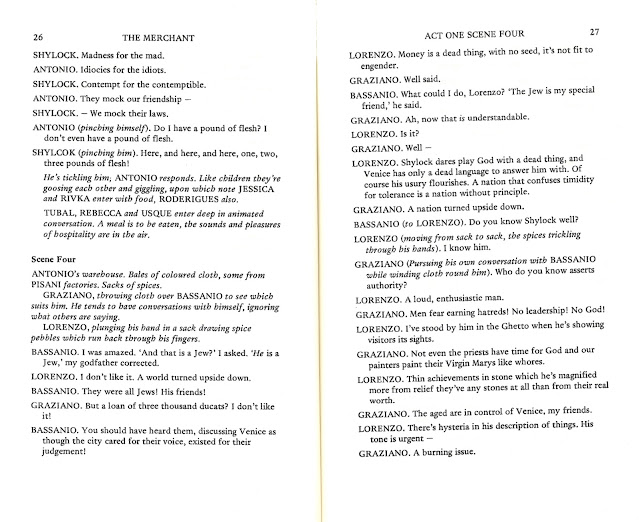
As we build to that point, we see the antisemitism of the Christian characters interrogated—and they do not come off well. Shakespeare's Shylock's famous "Hath not a Jew hands?" speech is given to Lorenzo in the courtroom, making it condescending and patronizing rather than movingly eloquent of shared humanity.


It's a remarkable play that would make a fascinating companion work to be read in conjunction with Shakespeare's Merchant of Venice.

Click below to purchase the book from amazon.com
(and to support Bardfilm as you do so).

Wednesday, May 24, 2023

Book Note: Shylock's Revenge

Smith, David Murray. Shylock's Revenge. From Tales of Chivalry and Romance. Edinburgh: James Robertson & Co., 1826.

I've been doing some work on Merchant of Venice recently, and it involves a number of tangents. Shylock's Revenge isn't terribly interesting, but it has its place in the history of uses of the play.

Largely, it's a prose retelling of the play, but it has its own particularly anti-Semitic characterization of Shylock. I suppose one might expect that from the title—it isn't the story of a merchant of Venice but of his enemy and his attempt to gain revenge.

Let me give you a quick sample:


It's not far from the play's plot, but I think there's a greater connection between Shylock's Jewishness and his desire for vengeance.

Click below to purchase the book from amazon.com
(and to support Bardfilm as you do so).

Monday, May 22, 2023

Eye Shall Not Look Upon His Like Again

Shakespeare, William. A New Variorum Edition of Shakespeare: Hamlet. Ed. Horace Howard Furness. 2 vols. 1877. New York: Dover, 1963.

One of the things I often bring with me when I'm traveling is something to read that I can easily abandon. I'll grab the printouts of articles that I haven't gotten around to reading. Those are ideal—they're easy to read and recycle, and I return from the trip with my head a bit fuller and my bag a bit emptier.

But the last time I had a trip, I didn't have very many articles ready to go; however, I did have a variorum edition of Hamlet that was falling apart, so I grabbed it thinking it would provide some interest and could be left behind without much regret. "Besides," I thought, "I have the Harold Jenkins Arden edition; he probably covers anything this one has."

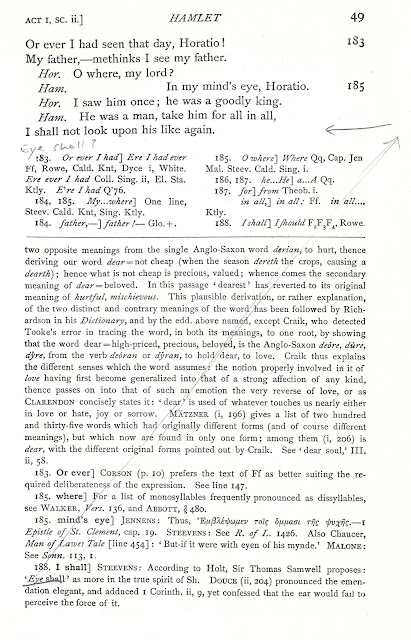
But the thing about a variorum edition is that it can pull from anywhere and everywhere, and I found one note particularly interesting. It's the note on Hamlet's line in Act I, scene ii (line 188 in this edition):


It suggests that the printed line "I shall not look upon his like again" (printed that way in Q1, Q2, and F) could instead by "Eye shall not look upon his like again."

That is an amazing possibility. It takes the line to an additional depth, moving it from "I'll never see anyone like him again" to "No one shall ever see anyone like him again." The first demonstrates Hamlet's individual mourning (which is deep and nothing to be sneezed at) to a more universal loss.

If you add to that the sheer number of times the word "eye" comes up in the play—a quick search shows more than thirty eye(s) in the play; there are only fifteen or so ear(s)—it makes for a significant difference.

The variorum edition notes that the ear will probably hear I rather than eye (or, I suppose, ay), but I good actor would be able to bring the word "eye" forward at that point. Eye, for one, would like to see that.


Click below to purchase the book from amazon.com 
(and to support Bardfilm as you do so).

Thursday, May 18, 2023

South Park's Philip Performs Hamlet

"Terrance and Phillip: Behind the Blow." By Trey Parker, Matt Stone, and David R. Goodman. Perf. Trey Parker, Matt Stone, and Eliza Schneider. Dir. Trey Parker. South Park. Season 5, episode 5. Comedy Central. 18 July 2001. DVD. 
Paramount Pictures Home Entertainment, 2015
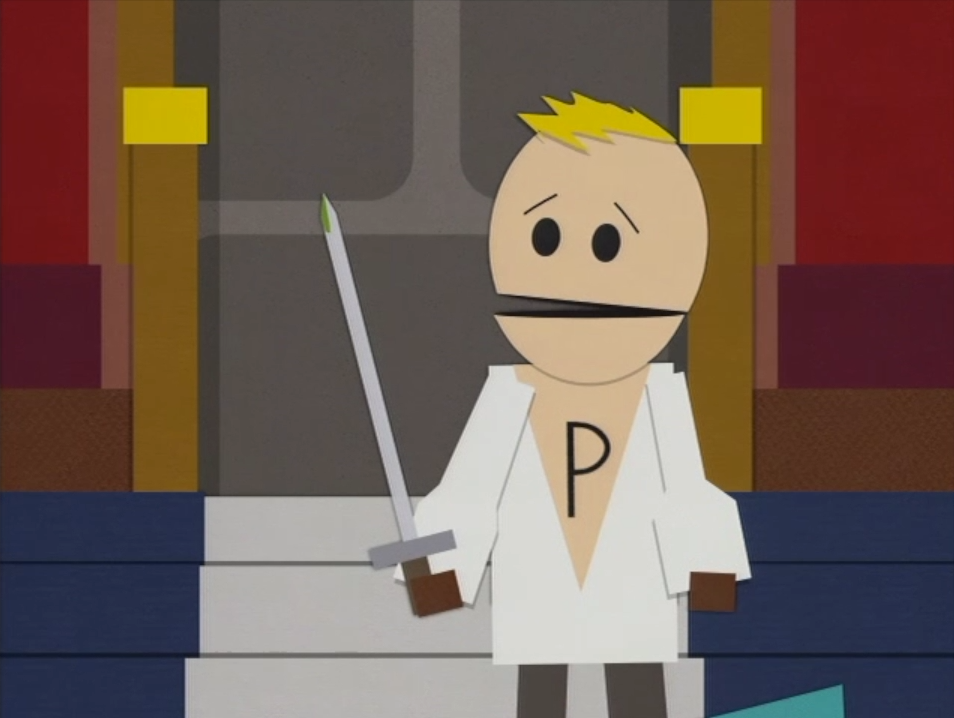
While we're on something of a "Shakespeare in various animated works," we might as well go on down to South Park and see Phillip perform as Hamlet in Hamlet.

Phillip is part of a famous comedy duo (within the world of South Park) called Terrance and Phillip. They are known for their over-the-top scatological humor. 

In this episode, that team has broken up, Terrence trying to continue the act with a replacement Phillip and Phillip pursuing what might be termed more serious drama (though there's plenty of scatological humor in Shakespeare). The South Park kids are trying to get the duo back together for a reunion concert, so they travel to Canada to try to convince Phillip to rejoin the act. Here's what they find:


As you've seen, what they find is a fairly-straightforward production of Hamlet—with some Canadianisms thrown in. The humor relies on knowing that Phillip is much more inclined to make a gross fart joke than to play Hamlet.

That's different from the humor involved in the episode with the turkeys who quote from Henry V (for which, q.v.).

Links: The Episode at IMDB.

Click below to purchase the season from amazon.com
(and to support Bardfilm as you do so).

Wednesday, May 3, 2023

Coraline is a Piece of Work

Coraline
. Dir. Henry Selick. Perf. Dakota Fanning, Teri Hatcher, and John Hodgman. 2009. DVD. Universal Pictures Home Entertainment, 2010.

Really, that should read "Characters in Coraline quote from Hamlet's 'Piece of Work' Speech," but I was going to have to explain the differences between the three contemporary printings of Hamlet and the way the film alters that quote, and that's too much for the title of a blog post.

It might be too much for the body of a blog post, too, but I'm going to do it anyway.

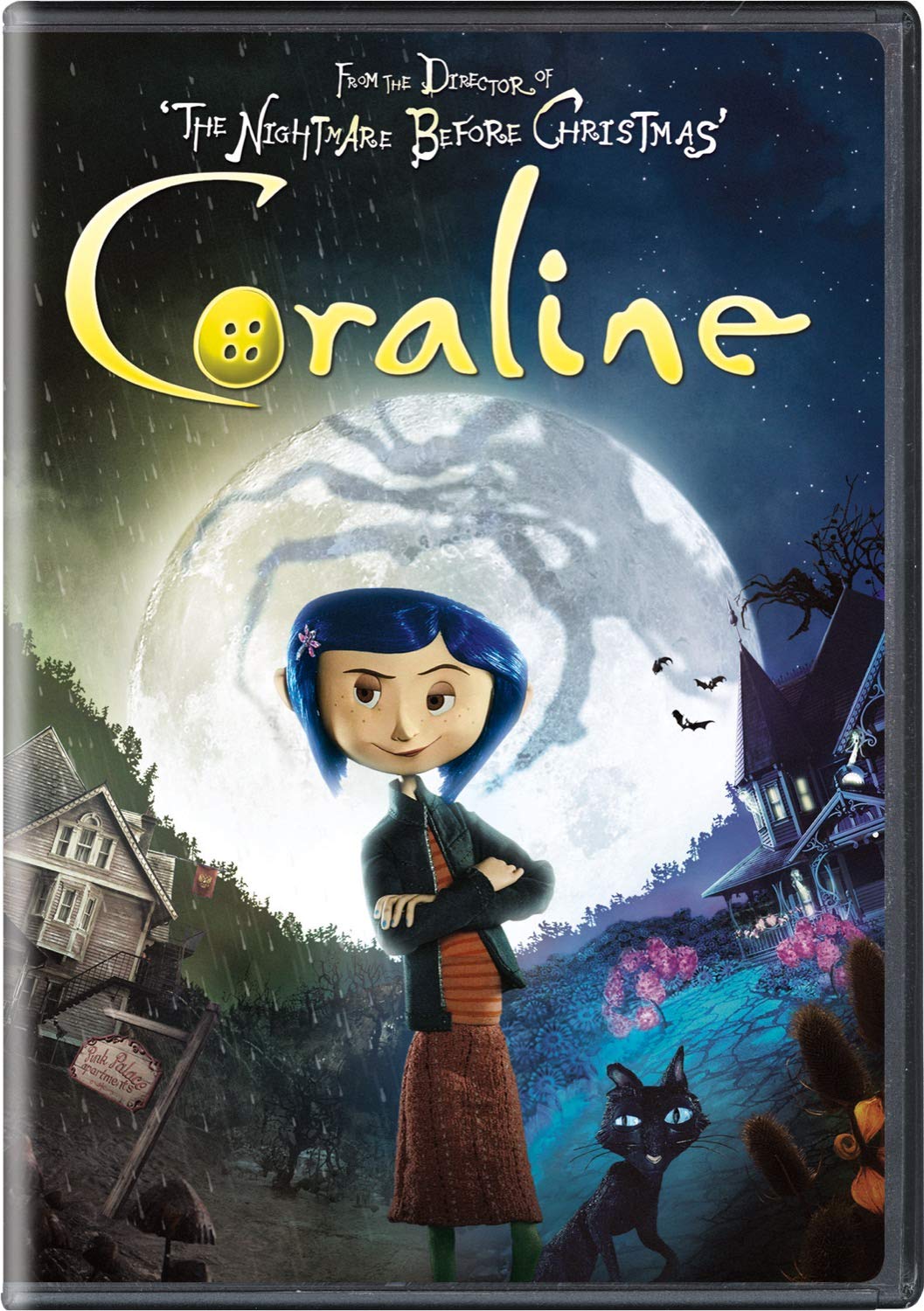
But not yet. Since you're here for the Shakespeare in Coraline, we'll start there (if you need a plot summary, try this Wikipedia entry). First, we get a couple of establishing moments that let us know that there's a Shakespeare festival in the town in one of the two worlds the film presents. Then, in the other world, we a treated to a trapeze performance that includes quotes (and / or misquotes) from Hamlet: 


You may be dismissed—or you can stick around for a bit more.

Here are the relevant passages in Q2 and F and Coraline (Q1 isn't absolutely relevant to this, but I'll include it below for interested parties):

Q1
What peece of worke is a man, how noble in reason, how infinit in faculties, in forme and moouing, how expresse and admirable in action, how like an Angell in apprehension, how like a God: the beautie of the world; the paragon of Annimales . . . .

Q2
What a piece of worke is a man! how Noble in Reason? how infinite in faculty? in forme and mouing how expresse and admirable? in Action, how like an Angel? in apprehension, how like a god? the beauty of the world, the Parragon of Animals . . . .

Coraline
What a piece of work is man! How noble in reason! How infinite in faculty. In form and moving, how express and admirable. In action like an angel. In apprehension, how like a god! The beauty of the world! The paragon of animals!

Q1 isn't relevant because it is essentially a CliffsNotes version, boiling down the much-longer speech to four lines:

Yes, faith, this great world you see contents me not,
No nor the spangled heauens, nor earth nor sea,
No nor Man that is so glorious a creature . . . .

The major differences are "man" instead of "a man" and "In action like an angel" instead of "In action, how like an angel." [The use of "a piece" instead of "peece" follows the Folio, which, in this case, standardized the form of expression.]

The question of whether and to what degree these are significance depends on the interpretation of the insertion of these lines in the film. 

Why, in the creepy alternate world, do these alternate characters give this part (and only this part) of this speech? Frankly, I don't know. The expurgated speech delivered in the film celebrates the human being—coming dangerously close to blasphemy as it does so. Hamlet's full speech, though, brings us down from those heights to "and yet, to me, what is this quintessence of dust?" I interpret that omission as typical of the creepy alternate world—everything is lovely and wonderful and happy; no shadows of unhappiness or dissatisfaction can fall here.

That's my take. What's yours?


Links: The Film at IMDB.

Click below to purchase the film from amazon.com
(and to support Bardfilm as you do so).

Friday, April 28, 2023

Shakespearean Quotations in The Nightmare Before Christmas

The Nightmare Before Christmas
. Dir. Henry Selick. Perf. Danny Elfman, Chris Sarandon, Ken Page, and Catherine O'Hara. DVD. Touchstone, 2018.

I hope the title of this post isn't too misleading. Looking it over, it seems to suggest that there are multiple Shakespearean quotations in the conceived–by–Tim Burton film.

Really, it's just a line about Shakespearean quotations in the middle of a song that the main character, Jack Skellington, sings when he's reflecting on how empty Halloween has become for him.

But we also get a classic "Hamlet with Yorick's Skull" pose along with the line.  Enjoy (even if this post's title should really be "Shakespearean Quotations" in The Nightmare Before Christmas)! 


Links: The Film at IMDB.

Click below to purchase the film from amazon.com
(and to support Bardfilm as you do so).

Thursday, April 27, 2023

A Little More Shakespeare in Hee Haw

Hee Haw
. Fl. 1969–1971. Details for these clips uncertain / Blogger too lazy to track them down. But cf. "Shakespeare in
Hee Haw" for the general kind of information you might need or expect.

I posted something on how Shakespeare made his way into Hee Haw a while ago (see the link above for that post), but I found a little more to add.

The clip below draws from two episodes of the show and two Shakespeare plays. First, we'll have a take on Julius Caesar—the part where Calpurnia tries to dissuade Caesar from going to the Capitol. Next, we'll have a quick examination of a line from Romeo and Juliet.


And there you have it! 

Click below to purchase some Hee Haw from amazon.com
(and to support Bardfilm as you do so).

Wednesday, April 26, 2023

Prince of Players

Prince of Players
. Dir. 
Philip Dunne. Perf. Richard Burton, Maggie McNamara, John Derek, and Raymond Massey. 1955. DVD. Twentieth Century Fox Film Corporation, 2016.
On this day in 1865, John Wilkes Booth died. And that makes Prince of Players an appropriate film to watch today.

The film is about the famous Family Booth—well-known actors in the mid-1800s. Junius Brutus Booth was the father. After acting in England, he made his way to America. Eventually, he and son Edwin Thomas Booth performed in what we would call the Wild West. Another son, John Wilkes Booth, was also an actor. Eventually, he would also become an assassin.

Prince of Players focuses on Edwin's rise to prominence as one of the greatest Shakespearean actors of his age. He's deeply in love with Mary Devlin, his wife, but he's also afraid that he has inherited more than a reputation of a good actor from his father: He worries that he has inherited his father's alcoholism as well.

I've extracted three clips as demonstrative of the film. In the first, a drunken Junius Brutus Booth, having been dragged back from the pub to the theatre by his young son Edwin, quiets the riotous crowd, declaring that they will have to wait—but his Lear will be worth it. (As a side note, it isn't. He's too far gone in drink to carry it off.)

The next scene shows Edwin Booth, years later, delivering a similar speech to a riotous crowd who has learned that the actor playing Richard III is not Junius Brutus Booth but Edwin Booth. That speech is followed by Edwin's delivery of the opening speech from Richard III. (As a side note, I think I'd pay good money to have Richard Burton read anything from randomly-generated text to the phone book. That voice!)

Finally, we have the scene where Edwin meets Mary Devlin for the first time—when he's been summoned from a . . . well, let's just call it a pub, shall we? . . . to the theatre for a rehearsal of Romeo and Juliet.


The film, as a whole, is quite good—though it does cross over into excessive sentimentality at points. And John Wilkes Booth and his evil deed (and his eventual death) are included.

Links: The Film at IMDB.

Click below to purchase the film from amazon.com
(and to support Bardfilm as you do so).

Bardfilm is normally written as one word, though it can also be found under a search for "Bard Film Blog." Bardfilm is a Shakespeare blog (admittedly, one of many Shakespeare blogs), and it is dedicated to commentary on films (Shakespeare movies, The Shakespeare Movie, Shakespeare on television, Shakespeare at the cinema), plays, and other matter related to Shakespeare (allusions to Shakespeare in pop culture, quotes from Shakespeare in popular culture, quotations that come from Shakespeare, et cetera).

Unless otherwise indicated, quotations from Shakespeare's works are from the following edition:
Shakespeare, William. The Riverside Shakespeare. 2nd ed. Gen. ed. G. Blakemore Evans. Boston: Houghton Mifflin, 1997.
All material original to this blog is copyrighted: Copyright 2008-2039 (and into perpetuity thereafter) by Keith Jones.

The very instant that I saw you did / My heart fly to your service; there resides, / To make me slave to it; and, for your sake, / Am I this patient [b]log-man.

—The Tempest