Friday, February 23, 2018

Book Note: Hag-Seed

Atwood, Margaret. Hag-Seed: The Tempest Retold. London: Hogarth Shakespeare 2016.

The Hogarth Shakespeare series has often been disappointing. But Hag-Seed does it just right.

Atwood gives us a "mirror novel"—a novel about a group of actors putting on a play. But it's more than that. She weaves a re-imagined Tempest plot into the production of The Tempest.

In the novel, Felix Phillips finds himself ousted from his position at the theatre where he has basically been king. He moves into something of an exile, taking on a new name and plotting his potential revenge.

Whether it's part of his revenge or not, he takes up a position directing Shakespeare plays at a nearby penitentiary.

I was able to check this out from my library in electronic form—let me use that to do something I haven't done before. It's something of a live-tweet encounter with the novel.

In this first section, Felix, in a wonderfully self-reflexive, self-aware way, starts to see his own story as the story of Prospero:


As one way to get his actors interested in the play, he asks them to find all the curses they can in The Tempest:


In the following scene, Felix contemplates the vengeance he wants to take on the person who ousted him and took his position at the theater:


Here, he defends Shakespeare--and why Shakespeare is valuable for everyone, not just some high-culture upper-crust group:


Here, too, the defense of Shakespeare takes center stage:


We also get his opening speech to his new group of actors, quoting a bit from The Tempest and summing up one answer to "Why do Shakespeare?":


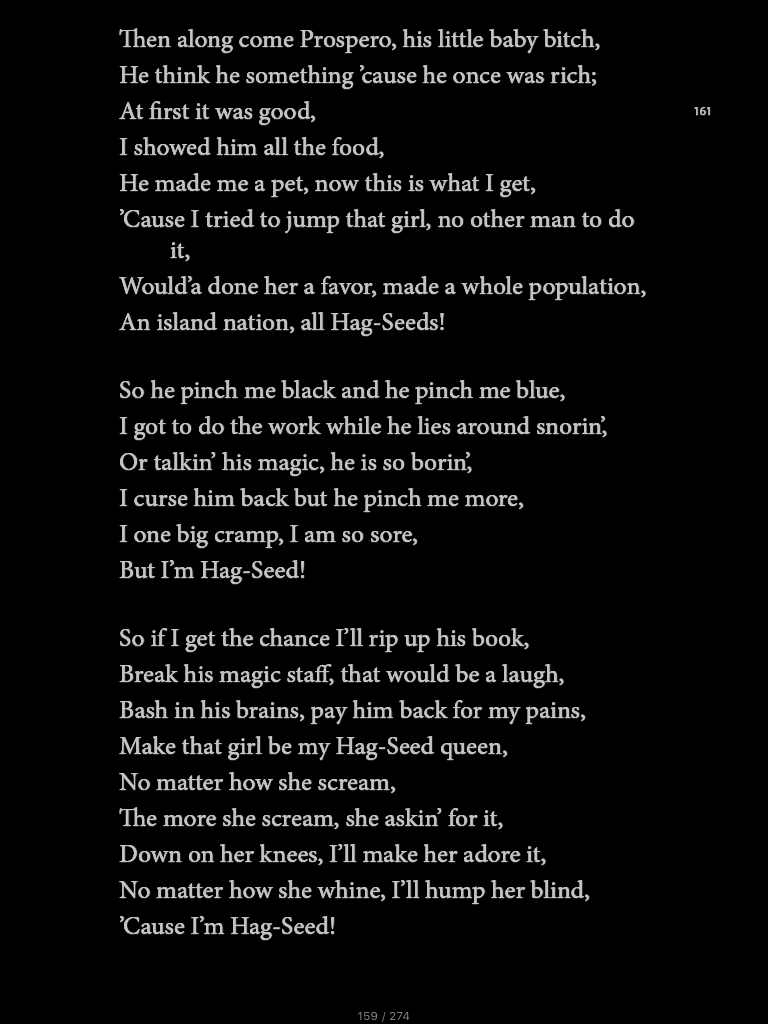
As they rehears, the players decide to come up with a rap for Caliban. Here it is:


I am very impressed by Atwood's careful and intriguing use of The Tempest in her creation of this novel.

Click below to purchase the book from amazon.com
(and to support Bardfilm as you do so).

Thursday, February 22, 2018

Book Note: Macbeth, Illustrated by Salvador Dali

Shakespeare, William. Macbeth. Illus. Salvador Dali. Garden City: Doubleday, 1946.

As you might expect, I have a fairly-large collection of Shakespeare books. I have large scholarly tomes and children's retellings, modern Shakespearean fiction and Shakespeare biographies, critical editions of the plays and books on Shakespeare films.

But I don't have much that would count as rare or valuable—except one book: The first edition of the Macbeth illustrated by Salvador Dali. It's not in great condition, and it doesn't have the slipcase that originally accompanied it, but I picked it up at a bargain rate, and perhaps it will appreciate in value.

If it doesn't, that's fine—that's not the point. The point is that I will grow in my appreciation of it.

I don't dip into it too often, but my eye fell on it (insert King Lear joke here) as I was glancing over my shelves, and I decided to glance through it and give it a write-up here.

The illustrations seem to me to be typical of Dali—they're odd and unexpected . . . and they seem to pop right off the page into the viewer's face. Here, for example, is the illustration of the line about Duncan's horses eating each other:


And here's an illustration that goes with Macbeth's visit to the Weïrd Sisters in Act IV:


The illustrations are wild, interesting, and disturbing. They do seem to fit the play pretty well.

Click below to purchase the book from amazon.com
(and to support Bardfilm as you do so).

Wednesday, February 21, 2018

Book Note: Nutshell

McEwan, Ian. Nutshell: A Novel. New York: Doubleday, 2016.

Whole handfuls of Hamlets have filled bookshelves and DVD racks around the world. There's even a collective noun for a bunch of Hamlets.

It's "a vengeance of Hamlets" for those of you keeping score (for which, q.v.).

Productions of and retellings of Hamlet fill every genre out there: tragedy, comedy, history, pastoral, pastoral-comical, historical-pastoral, tragical-historical, tragical-comical-historical-pastoral, scene individable, or poem unlimited.

There are male Hamlets and female Hamlets, truly insane Hamlets and cagey Hamlets, skeptical Hamlets and religious Hamlets, old Hamlets and young Hamlets.

Speaking of young Hamlets, Ian McEwan retells the story of Hamlet from a record-breakingly young Hamlet. His Hamlet has not yet been born—though he's very nearly ready to do so.

The epigraph for the book is, perhaps unsurprisingly, from Hamlet: "Oh, God—I could be bounded in a nutshell, and count myself a king of infinite space" (II.ii.254-55). That's our narrator—bounded in the womb, he thinks and plans and schemes . . . but cannot act—or can he?

That's a clever device, but McEwan makes more of it than just a passing, fleeting idea. Our narrator overhears the plots his mother and uncle concoct—in this modern setting, juice of cursed hebenon in a vial has been replaced by antifreeze in a smoothie (and it's ingested rather than poured in the ear)—and contemplates the fate that awaits them all

I found it to be a compelling novel, providing an interesting reading of Hamlet's helplessness. Let me give you a sample of the narrator's voice. At the beginning of Chapter Nine, he imagines what he might say to his father (who's a published poet rather than a king)—and contemplates the fallen world:


I've done some preliminary searching to see if anyone has taken a stance on just which Shakespeare sonnet Hamlet alludes to, but I'm not finding anything definitive. It does sound like an awful lot of them, but I wonder if it's Sonnet 74 ("But be contented: when that fell arrest / Without all bail shall carry me away . . ."). If you have another suggestion, please leave a comment!

The novel may not become a mainstay of my modern Shakespearean fiction class, but it's important to know and pretty amusing.


Click below to purchase the book from amazon.com
(and to support Bardfilm as you do so).

Tuesday, February 20, 2018

Book Note: Tom Jones

Fielding, Henry. The History of Tom Jones, A Foundling. New York: Modern Library, n.d.

I've been reading a lot of modern Shakespearean fiction recently—and also Tom Jones, which is really just one of those three. But it does have a lot of Shakespeare in it (by way of quotations or allusions), and some of the comic scenes (particularly those involving exasperating servants) have a Shakespearean flavor to them.

But there's also a scene where some of our main characters head off to the theatre. The summary of Book XVI, chapter v is a beginning:  "In which Jones receives a letter from Sophia, and goes to a play with Mrs Miller and Partridge." But when we get there, we learn not only that they're seeing a production of Hamlet, but they're seeing David Garrick in the title role!

Garrick is known for his tireless promotion of Shakespeare, including his organization of the 1769 Shakespeare Jubilee in Stratford.

In any case, the scene in Tom Jones brings to mind the Shakespeare scenes from Huckleberry Finn (for which, q.v.). Partridge, Tom's loyal traveling companion, doesn't think much of the play—and is particularly scornful of the Ghost, saying, "Though I can’t say I ever actually saw a ghost in my life, yet I am certain I should know one, if I saw him, better than that comes to. No, no, sir, ghosts don’t appear in such dresses as that, neither" (737).

All that changes when he sees how Garrick reacts to the ghost. But I'll let you read it yourself. Note: The full text of the novel is readily-available, but I'm providing images from my copy for your edification. The section in question begins at the second full paragraph on page 737:


It's a fascinating fictional account of a trip to the playhouse in the middle of the 1700s. Would that we had been there. It would have much amazed us.

Click below to purchase the book from amazon.com
(and to support Bardfilm as you do so).

Monday, February 19, 2018

Book Note: Dunbar

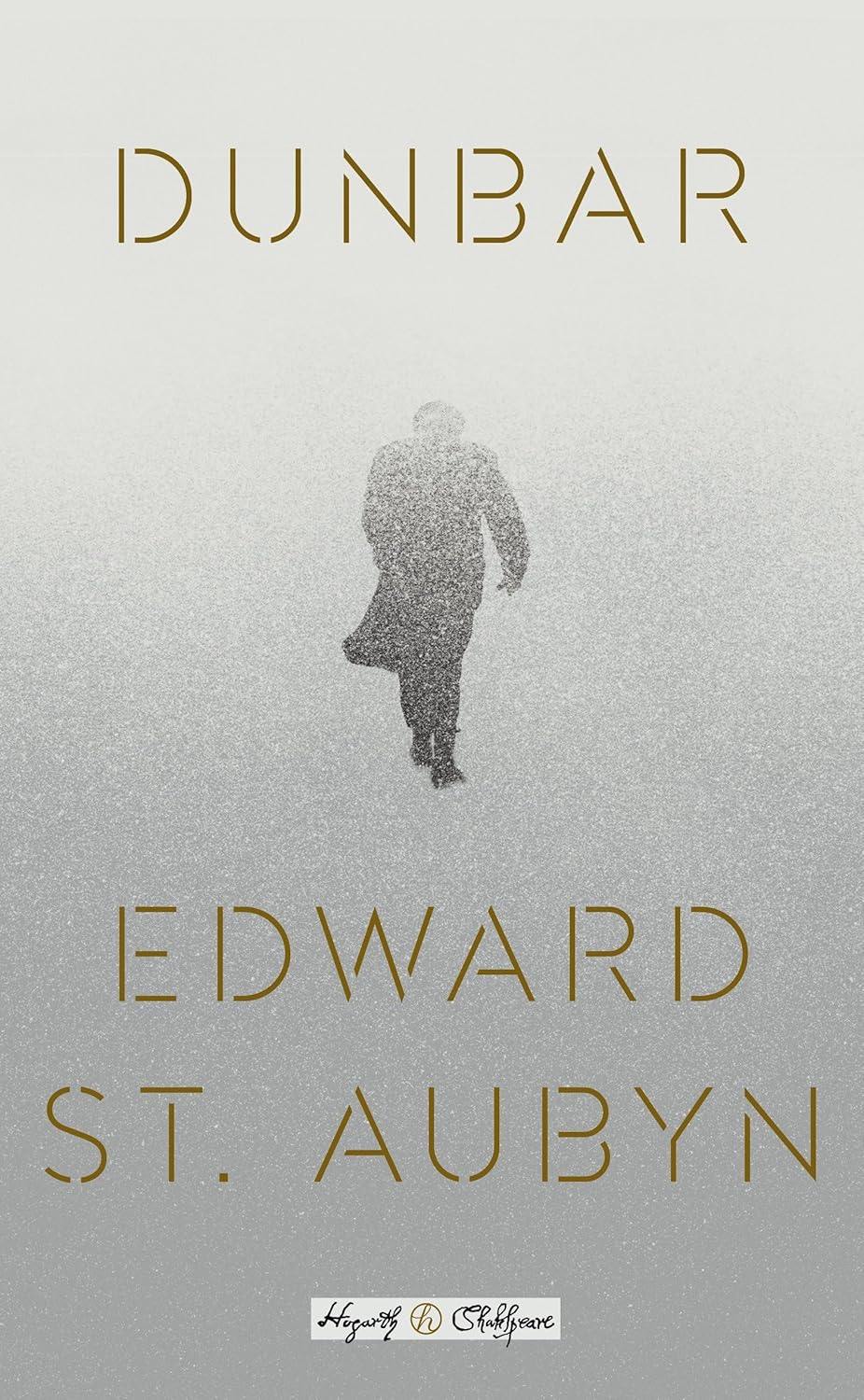
St. Aubyn, Edward. Dunbar. London: Hogarth Shakespeare, 2017.

While we seem to be on the general subject of King Lear, we might consider one of the recent additions to the Hogarth Shakespeare series.

Dunbar is a retelling of King Lear that has some wonderful moments but is also largely unsuccessful.

The best thing about the novel is its starting point. St. Aubyn takes King Lear and begins in medias res. Henry Dunbar, our Lear analogue, is on the point of escaping from a sanitarium into which he's been confined by his greedy, horrible daughters who have an insider trading scheme for taking over his vast media and investment enterprise. He's made an alliance with a deeply-alchoholic retired comedian named Peter Walker to escape and to gain some sort of revenge on his daughters Abby and Megan. In the meantime, Florence (our Cordelia), aided by Wilson (Kent) is on her way to rescue him.

Dunbar's decision to leave the Fool and to try to make his way to London—and his subsequent descent into madness with the elements—is very moving. I'd like to provide an extract from Chapter Seven to illustrate the powerful reimagining of Shakespeare's Lear on the Blasted Heath scenes:


St. Aubyn gives us some tremendous character development and psychological insight in those few pages.

The novel's reimagining of Regan and Goneril are not so subtle. Not to put too fine a point on it, they are sexual deviants (one of them nearly bites off the nipple of Dr. Bob—our Edmund figure—early in the novel, and things go downhill from there).

The conclusion of the novel also leaves much to be desired. St. Aubyn throws a number of balls in the air—particularly in the last twenty percent of the novel—and then walks away, leaving them to fall where they will.

For me, the value of a work of Shakespearean fiction is at least partially found in what it enables us to think about Shakespeare's play. Dunbar makes me want to re-examine the character of King Lear, but it doesn't invite much else.

Click below to purchase the book from amazon.com
(and to support Bardfilm as you do so).

Friday, February 16, 2018

Lear's Shadow: Coming Soon to a Festival Near You

Lear's Shadow. Dir. Brian Elerding. Perf. David Blue, Fred Cross, and  Katie Peabody. 2018. For Film Festival Release. 

Lear's Shadow will soon be making the tour of the film festivals, starting with the Pasadena International Film Festival on March 11. In the meantime, special screenings are making the tour of the Shakespeare blogs.

The film is a stripped-down, bare bones show, all the more impressive for how much it accomplishes.

The premise gradually unfolds in a single setting—a theatre's rehearsal space. A somewhat-confused director—Jack—makes his way in, followed by an actor—Stephen. Jack starts complaining about the scripts and the other actors who haven't shown up. We start to realize that Jack has some sort of short-term memory loss and he's just been released from the hospital.

Stephen, at first as a delaying tactic, starts to talk about King Lear. That's the launching pad for a number of discussions of the play—how it ought to be acted, how it has been acted, what significance it has—as well as a number of performances of key scenes. It becomes something of a mirror movie at that point, the two men working out some longstanding disagreements as well as the recent events that have brought them to such a state.

And that's all I'm going to tell you about the plot. I hope the film will do well on the festival circuit and that it will eventually achieve larger distribution. I hope that because it's good.  It's quite good.

First, I was impressed by the acting. I'm privileged to see a lot of work that hasn't made it to a theatrical release, and a good premise is sometimes played out in a less-than-satisfying manner. That's not the case here. Both in acting their roles and in their roles acting parts of King Lear, David Blue and Fred Cross do magnificent work.

Second, the use of Shakespeare is fascinating here. The writer isn't setting out to make Shakespeare relevant—I get them impression that he knows that Shakespeare is already relevant. Instead, Lear's Shadow reveals Shakespeare's relevance. Parts of King Lear are carefully, organically crafted in to the film, and we're shown one way the suffering of King Lear becomes significant, meaningful, and healing to other sufferers in the world.

If you're able to catch this at a film festival, do so. It's a powerful piece where writing, acting, and concept come together to produce a significant reflection on Shakespeare that stands on its own as well.

Note: I can't provide a clip of the film or a trailer for it at this point, though I will try to add those in a future update. In the meantime, here are a few additional stills from the film.


Links: The Film at IMDB. The Film's Official Website.

Tuesday, February 6, 2018

Book Note: Performing King Lear: Gielgud to Russell Beale

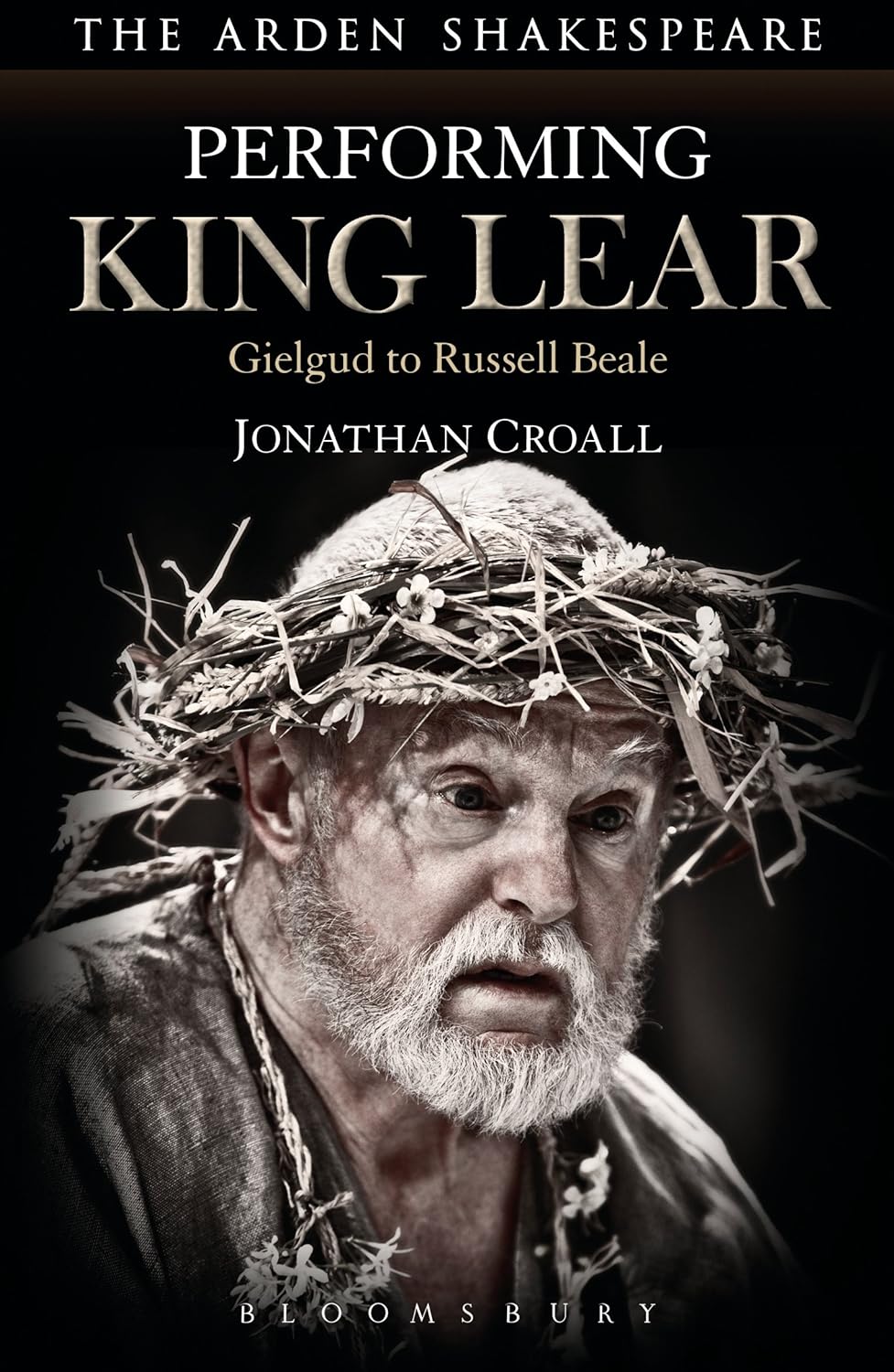
Croall, Jonathan. Performing King Lear: Gielgud to Russell Beale. London: Bloomsbury, 2015.

Jonathan Croall provides the world with an invaluable resource for thinking about King Lear in performance. This book covers dozens of stage performances of the play from 1931 (John Gielgud's first Lear—he was twenty-seven—directed by Harcourt Williams) to 2014 (Simon Russell Beale, directed by Sam Mendes).

The research is intricate and careful, providing contemporary reviews, interviews with actors and directors, and (to a lesser degree) critical commentary on the productions.

The book is organized by performance, which means that readers can either read the work straight through and get a sense of the development of the modern stage by means of how one one play has been staged or pick and choose to read about particular productions / actors / directors that interest them.

Want to know how Peter Brook's production with Paul Scofield influenced nearly every production that followed it?  You'll find that here.  Want to learn how they got a good Lear out of Nicol Williamson? It's here. Want to think about how Derek Jacobi, Ian McKellen, Richard Briers, Christopher Plummer, or Peter Ustinov approached the role? This is every inch the book.

Let me provide a sample page and a sample image from the book. First, here's a bit of the section on richard Briers' performance (directed by Kenneth Branagh):


Next, here's one of an unfortunately-limited selection of images—Joseph Marcell (directed by Bill Buckhurst in 2014):


Croall mentions film versions of King Lear in passing, and the ones he mentions are usually film versions of the stage plays he's detailing. Bardfilm would like to suggest a sequel that covers the films more fully.

But that isn't a weakness. Croall is writing about stage productions that can no longer be seen. We can watch and re-watch a huge number of film versions of Lear, but we can't get a ticket to any of John Gielgud's Lears—not even on StubHub. The only production Croall writes about that I saw is the 2007 Ian McKellen King Lear directed by Trevor Nunn, and Croall provides tremendous insight into that show.

Performing King Lear is an incredibly valuable and utterly fascinating text that gives its readers a detailed sense of the scope and depth of modern productions of King Lear

Click below to purchase the book from amazon.com
(and to support Bardfilm as you do so).

Monday, February 5, 2018

Live-Action Shakespeare in Live-Action Beauty and the Beast

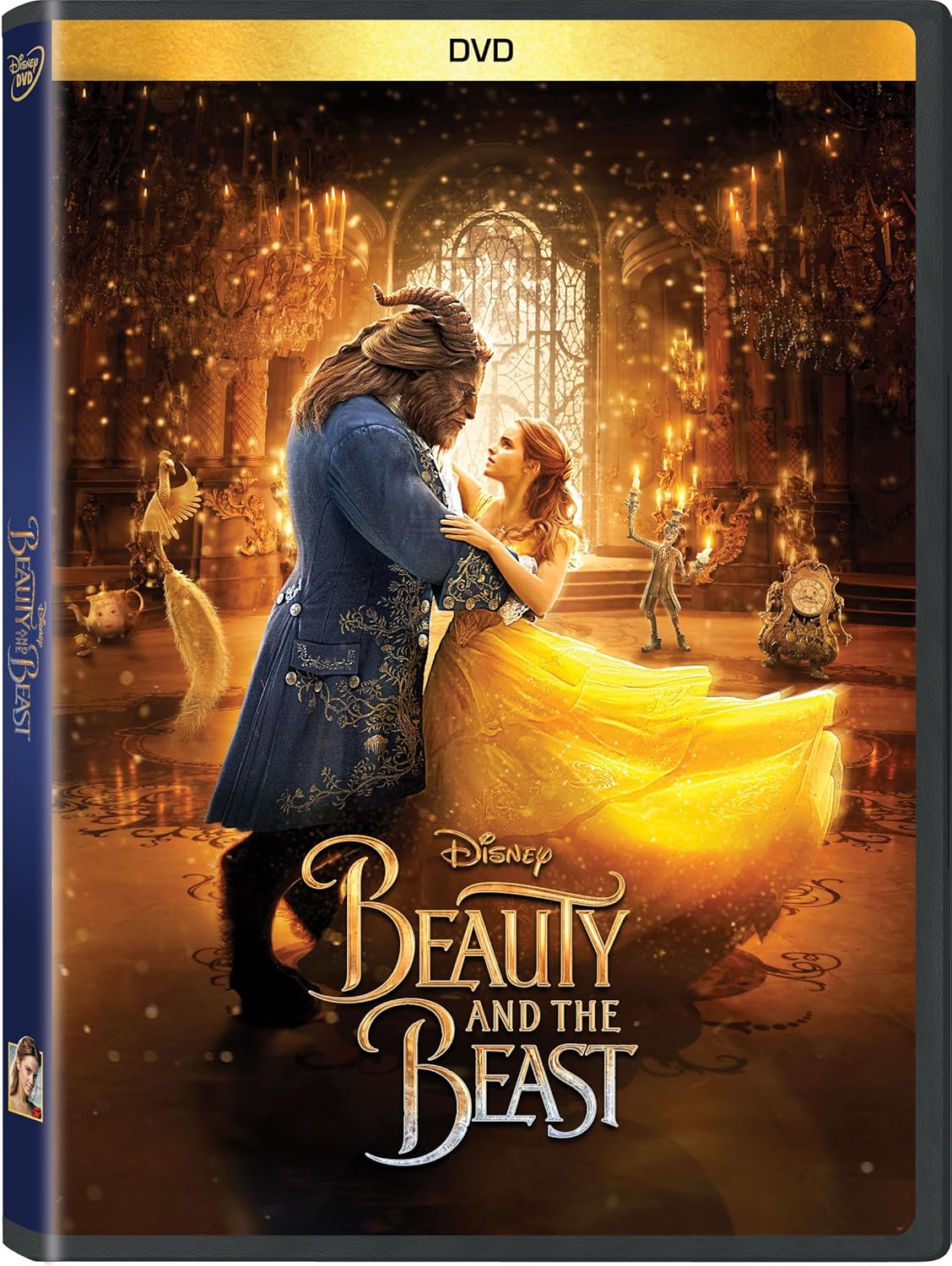
Beauty and the Beast. Dir. Bill Condon. Perf. Emma Watson, Dan Stevens, Luke Evans, and Kevin Kline. 2017. DVD. Walt Disney Studios Home Entertainment, 2017.

Having seen the animated Beauty and the Beast a few times and having gleaned (as I thought) all the Shakespeare it had to offer (for which, q.v.), I wasn't expecting to find any in the live-action remake.

But I was delightfully surprised by hearing a quote from Midsummer Night's Dream and a discussion of Romeo and Juliet in the film.

Prior to this scene, the Beast has been injured saving Belle from the wolves. For some reason (probably one not unrelated to the overall theme of the film), Belle's reciting some lines from Hermia's speech in Act I of Midsummer Night's Dream (I've put editorial brackets around the line that does not actually make its way into the film but that gives an object to the first sentence that does):
[Things base and vile, holding no quality]
Love can transpose to form and dignity.
Love looks not with the eyes but with the mind;
And therefore is wing'd Cupid pointed blind. (I.i.232-35)
The implication is that Beauty can, indeed, love the Beast—love does not look with the eyes, after all. And the rest of the scene, as is plays out, helps us see with the mind rather than with the eyes:


That's interesting in a few ways. First, the Beast says that there "are so many better things to read" than Romeo and Juliet. Perhaps he, too, is thinking of Midsummer Night's Dream, where a lady falls in love with someone whose outer appearance wouldn't usually inspire love: Bottom the Weaver with an ass head.

It's also interesting that the Beast, despite the "expensive education" he says he received, didn't pick up on the rules of iambic pentameter.  The word "wing'd" should not be pronounced with two syllables (i.e., "wingèd") in this line—it ruins the meter! It should read in this way (capitals indicate stressed syllables): "and THEREfore IS wing'd CUpid PAINTed BLIND."

Sorry. That's a bit of a digression. The point is that I was surprised to find Shakespeare in the film.

But the Shakespeare actually comes in quite a bit earlier than this scene. Here's an exchange from Belle's first song
[MONSIEUR JEAN]
Where are you off to? 
[BELLE]
To return this book to Père Robert. It's about two lovers in fair Verona.
[MONSIEUR JEAN]
Sounds boring.
Compare that to the equivalent scene in the 1991 animated version:
[BELLE]
Good morning, Monsieur.

[BAKER]
And where are you off to, today?

[BELLE]

The bookshop. I just finished the most wonderful story about a beanstalk and an ogre and a—

BAKER
That's nice. Marie! The baguettes! Hurry up!
Someone has deliberately foregrounded the Romeo and Juliet narrative in the live-action Beauty and the Beast. Was it to make the live-action Belle more mature, at least in her choice of reading matter? Was it to bring a narrative about a man and a woman forbidden to marry each other by their parents into the film?

Links: The Film at IMDB.

Click below to purchase the film from amazon.com
(and to support Bardfilm as you do so).

Wednesday, January 31, 2018

Shakespeare's Appearance in The Lego Movie

The Lego Movie. Dir. Phil Lord, Christopher Miller. Perf. Jorma Taccone, Chris Pratt, Will Ferrell, and Elizabeth Banks. 2014. DVD. WarnerBrothers, 2014.

Although Bardfilm tries to be completely cutting edge, right on the spot as Shakespeare-related developments occur, we do occasionally have lapses.

Sometimes the lapses are as long as four years.

It's been four years since I saw The Lego Movie in theaters, and I remember wanting to call our collective attention to William Shakespeare's appearance in the film. Then it took time for the DVD to be released and for the library to buy it and for me to remember just where exactly Shakespeare appeared in the film.

But we're all ready now! I've put together one clip with each of the three appearances William Shakespeare makes in The Lego Movie. The first is his only line in the film:  "Rubbish." Shakespeare himself only uses the word twice (not counting "Ay, there's the rub[bish]" from Hamlet's soliloquy. In Julius Caesar, Cassius says, "what trash is Rome, / What rubbish and what offal, when it serves / For the base matter to illuminate / So vile a thing as Caesar!" (I.iii.113-16). In Richard II, the Duchess of York asks Edmund of Langley to pick up his tale from where he left off—where "rude misgovern'd hands from windows' tops / Threw dust and rubbish on King Richard's head" (6-7).

Shakespeare's second appearance is when he flies into battle to save the day.

And, at his final appearance, he does the popular dance known as "The Worm."  Here you go—and apologies for the four-year delay.


Links: The Film at IMDB.

Click below to purchase the film from amazon.com
(and to support Bardfilm as you do so).

Tuesday, January 30, 2018

Julius Caesar Makes its Way into Anthropoid

Anthropoid. Dir. Sean Ellis. Perf. Jamie Dornan, Cillian Murphy, and Brian Caspe. 2016. DVD. Universal Studios Home Entertainment, 2016.

Although I hate to say so, sometimes the Shakespeare in a film seems a bit tangential.

That's the case with its appearance in Anthropoid, a film about Operation Anthropoid, the joint British / Czechoslovakian operation to assassinate Reinhard Heydrich, the Nazi who oversaw the elimination of a great part of the Czech resistance to Hitler and Nazi Germany's expansion.

That, of course, is a much bigger issue than a line from Julius Caesar.

Still, the quote is used effectively, though ambivalently. In one scene, a character asks if those who have attempted the assassination were serious in their declaration that they would commit suicide with signs declaring that they were responsible (in an attempt to reduce Nazi retaliation upon the Czech people). When one of the assassins says, "Maybe," he response with this line: "Cowards die many times before their death, / The valiant never taste of death but once" (II.ii.32-33).

Is that meant to say that such a death would be cowardly or valiant? It's ambitious.

[Caution: Some (probably predictable) spoilers follow.]

Later, just before the assassins kill themselves to prevent themselves from falling into the hands of the Nazis, we see a copy of Julius Caesar float past them.

Here's a clip that includes both scenes:


It's an effective use of Shakespeare, whichever way you read the use of the quotation.

Note: It took an embarrassingly long time, but I finally realized that the film and the play the quote is from are both about assassination and the unexpected ramifications of what might be seen as a reasonably-straightforward assassination. There's greater depth than I first realized in that element.

Links: The Film at IMDB.


Click below to purchase the film from amazon.com
(and to support Bardfilm as you do so).

Monday, January 29, 2018

Czech Hamlet Rock Opera

Ledecký, Janek. Hamlet: The Rock Opera. CD. BMG, 2000.

When I bought this, I was under the impression that it was a DVD, and I crossed my fingers for English subtitles. When it arrived, it was a two-CD set—the soundtrack of a Czech Rock Opera version of Hamlet. It had lyrics, but no English translation of them.

Still, the music is fascinating . . . even though the meaning is mostly a closed book (closed set of liner notes?) to me.

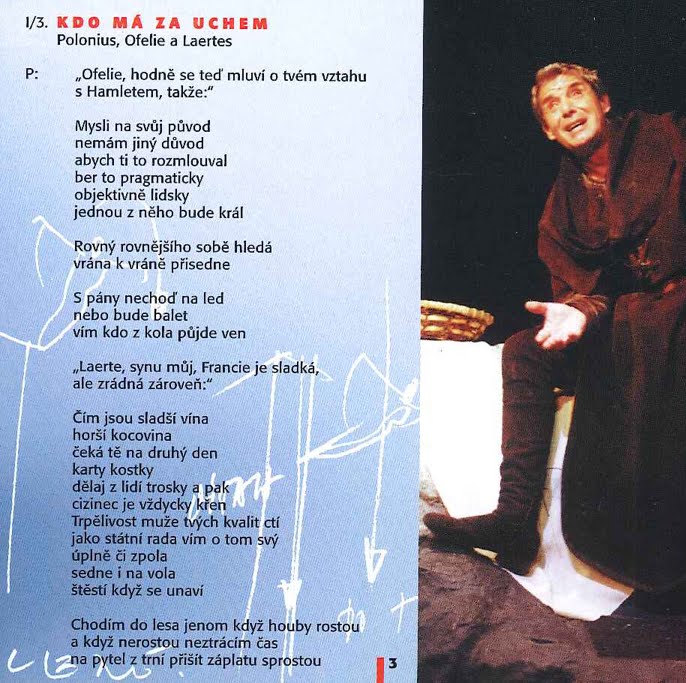
I say "mostly" because I prevailed upon a friend who knows Czech to translate "Kdo Má Za Uchem," one of Polonius' big numbers. First, here's the translation (along with the Czech lyrics sheet):
Ofelia, there is a lot of talk about that relationship of yours with Hamlet, so: 
Think of your origins
I don't have another reason
to be talking you out of it
take it pragmatically
objectively, really
one day he will be a king

Birds of a feather flock together
one best find an equal to himself [Note: This doesn't translate very well—it's a saying—that somewhat has to do with the birds saying]

Don't go on thin ice with the lords
or else you will have to ballet
I know who will lose their place in the dance first

Laertes, my son, France is sweet
but full of betrayal at the same time

The sweeter the wines
the worse the hangover
awaits you the following day
card games and dice
make wrecks out of people
once a foreigner/stranger, always a horseradish
Patience may appreciate your qualities
like the State Council would—I know what I am talking about
all the way or halfway
happiness will sit
even on a bull when it gets tired


I only go to the woods when the mushrooms grow
and when they don't, I don't waste time
I don't fix a bag made of thorns by sewing on a stupid patch


Choir: Blood is no water
that's really too bad
but even that blood is for sale
skip what you can't buy
you'll save yourself the loss
in your own interest
it's different to be digging a hole
let the other try what a fall is

the one that's dirty
will be the last one to laugh
he keeps an arrow as backup

Destiny's horse is tickled in the weak spots
may the one who doesn't want to be better be worse off

that's all I got . . .
And now, here's the song. As always with this blog, I have to provide a video clip with any audio I want to share, and I usually try to make them related in some way. In this clip, the video is from Hamlet Goes Business (for which, q.v.). In any case, the video isn't what's interesting—the music is. Listen:


Now, to add to your knowledge and experience, let me tell you about a website I found when doing a bit of research for this post. It tells something about the history of the rock opera, and it lets us know that the author is currently working on a rock opera version of Othello entitled Iago.

The site also contains some English-language versions of the songs (not, alas, the one I've provided above), including "All My Life I'm Diggin' Graves," which is what you would expect if you cast Leon Redbone as the First Gravedigger. Try that out at this URL (click on the song title to get it to play).

Clearly, we need to advocate for an English-language release of this work.

Note: Shakespeare Geek almost immediately called our attention to this English-language rock opera version of Hamlet. Watch it here, but note that it isn't the same as the one I've been writing about.

Additional Note: Shakespeare Geek almost immediately thereafter called our attention to this Korean-language musical version of Hamlet

Links: The Website that Talks about the Rock Opera.

Friday, January 26, 2018

Lady Macbeth . . . or is she?

Lady Macbeth. Dir. William Oldroyd. Perf. Florence Pugh, Cosmo Jarvis, and Paul Hilton. 2016. DVD. Lionsgate, 2017.

In his great Shakespeare on film classification system (for which, q.v.), Kenneth Rothwell mentions films that are "parasitical" of Shakespeare. I think this film goes in that category.

I spotted this film, and thought we might be treated to a retelling of Macbeth from Lady Macbeth's perspective.

The quote on the cover should have tipped me off: "Imagine Alfred Hitchcock directing Wuthering Heights."

The story is very sparsely told—as if it were an Ernest Hemingway screenplay—with lots of lengthy scenes with no dialogue, as in the image above. It's the story of a woman who is disgusted with her distant and unloving husband, takes a lover from among his workers, and then (sorry if this is a spoiler) kills a bunch of people to try to cover up the affair and to keep her lover.

At first, I thought the writers were just grabbing the name Lady Macbeth to give the main character a sense of coldness and murderousness (even though Lady Macbeth in Shakespeare's play never participates in any actual violence). Then I realized that the film is a derivative version of Nikolai Leskov's Lady Macbeth of Mtsensk, which Dmitri Shostakovich famously made into an opera (Леди Макбет Мценского уезда, variously translated as Lady Macbeth of Mtsensk or Lady Macbeth of the Mtsensk District). The film Siberian Lady Macbeth, directed by Andrzej Wajda, was also based on the work.

The film, therefore, has a longer history than I realized.

But it also doesn't really have any connection to Shakespeare.  Sorry.

Links: The Film at IMDB.

Click below to purchase the film from amazon.com
(and to support Bardfilm as you do so).

Thursday, January 25, 2018

"Making Love" in Shakespeare's Day: A Quick Note on I.i.107 of Midsummer Night's Dream

Shakespeare, William. A Midsummer Night's Dream. Ed. Harold F. Brooks. Arden Shakespeare. London: Methuen, 1979.

A speech in Act I, scene i of Midsummer Night’s Dream often misleads modern readers. In that scene, we’re just learning that Lysander and Demetrius are both in love with Hermia, and then Lysander tells us this interesting bit of information:
Lysander
Demetrius, I’ll avouch it to his head,

Made love to Nedar’s daughter, Helena,

And won her soul; and she, sweet lady, dotes,
Devoutly dotes, dotes in idolatry,
Upon this spotted and inconstant man. (I.i.108-12)
The potentially-misleading phrase is in line 109. What does Lysander mean when he says that Demetrius “made love” to Helena?

He doesn’t mean what the phrase now euphemistically means: to sleep with (or, more embarrassingly but less euphemistically, to have sex with). He does mean what the phrase used to mean: to woo.

How do we know which meaning Lysander has in mind? The OED will help us immensely here.

Midsummer Night’s Dream was written around 1595. To figure out what Lysander’s talking about, we need to see how the phrase “make love” was used at that time.

When we look up “love” in the OED, we find “to make love” defined as a phrase (def. P3 a). Starting in 1567, the phrase meant “To pay amorous attention; to court, woo.” The OED gives several examples of the phrase used in that way, including Shakespeare’s use of the quote in this very speech.

Next, the OED, noting that the origin of this meaning of the phrase comes from the U.S., provides this definition of the phrase in def. P3 b: “To engage in sexual intercourse, esp. considered as an act of love.” The first use of the phrase in that sense appears in 1927.

Therefore, when Shakespeare has Lysander say that Demetrius “made love” to Helena, it means that Demetrius wooed or courted Helena.

Since the meaning has changed over time, it’s very easy to be misled by that phrase into thinking something more happened between Demetrius and Helena than actually happened, and that can give readers a mistaken impression about both characters.

The OED is a marvelous tool for helping us avoid misinterpretation (or, as the OED might put it, misacceptation, misprision, or wresting). Use it wisely and well and frequently!

Click below to purchase the play from amazon.com
(and to support Bardfilm as you do so).

Wednesday, January 24, 2018

Globe-alization: Around the World in Shakespeare Plays

kj. "Shelfspeare One and Shelfspeare Two." Personal Photographs. January 2018.

Each of the two images to the right is a photograph I took in a bookstore.

The question for you is this: Which photograph was taken in a bookstore in Vietnam—Ho Chi Minh City (Saigon), to be exact—and which was taken in a bookstore in the Twin Cities—St. Paul, Minnesota, to be exact?

I've been to Vietnam four times:  twice around sixteen years ago, once about two years ago, and just now. As a casual observer, I've noticed the way globalization has changed at least consumer goods available in the major cities.

Can we call it "The Oreo Factor"? Although I wasn't particularly searching for them, Oreo cookies were not readily available—I didn't see a single one. But when I traveled again, about two years later, I found a few packs of Oreos here and there--in convenience stores geared toward visitors to Vietnam. During my last two trips, I saw Oreos everywhere--even in smaller stores off the beaten path.

The same may be true of Shakespeare. Again, I wasn't looking for Shakespeare during my trips in the early 2000s, but I spotted some during my 2016 trip, and I spotted even more in 2018 (including a number of volumes in the "No Fear Shakespeare" series. And my own purpose in traveling in 2016 and 2018 was to bring more Shakespeare along with me.

I find that to be encouraging. But these volumes are in English, and I'm wondering how much Shakespeare in translation has made its way to Vietnam. Amazon lists two modern translations—Macbeth and Vua Lear—and the only review of one of them is highly disparaging.

I have learned that it's relatively common for graduate students in literature and some undergraduates to read Shakespeare in English as part of their coursework, and familiarity with the plays seems to be increasing (again, from my limited experience and exposure).

I'll be thinking and writing about this and other related matters this semester. Stay tuned. And contemplate the Oreo Factor.

p.s. The photo on the left is from a bookstore in Vietnam; the other is from one in the United States.

Friday, December 15, 2017

Musical Version of Bottom's Dream

"Bottom Dreamed a Dream." Pyramus! Unproduced Off-Broadway Musical.

Most years, I write a song that will help students review the material in my Shakespeare course.

Past hits include Bob Dylan singing the plot of Measure for Measure (for which, q.v.).

The current piece is one I put together last year—and then ran out of time to record. Students had to be satisfied with a live version.

But now we can all enjoy (?) this piece. Imagine, if you will, a new musical based on the play-within-the-play of Midsummer Night's Dream. It's called Pyramus! And this is just one of its many show-stopping numbers.


Note: In case the video above fails to embed properly, I'm attaching a blog-native version here.

Bardfilm is normally written as one word, though it can also be found under a search for "Bard Film Blog." Bardfilm is a Shakespeare blog (admittedly, one of many Shakespeare blogs), and it is dedicated to commentary on films (Shakespeare movies, The Shakespeare Movie, Shakespeare on television, Shakespeare at the cinema), plays, and other matter related to Shakespeare (allusions to Shakespeare in pop culture, quotes from Shakespeare in popular culture, quotations that come from Shakespeare, et cetera).

Unless otherwise indicated, quotations from Shakespeare's works are from the following edition:
Shakespeare, William. The Riverside Shakespeare. 2nd ed. Gen. ed. G. Blakemore Evans. Boston: Houghton Mifflin, 1997.
All material original to this blog is copyrighted: Copyright 2008-2039 (and into perpetuity thereafter) by Keith Jones.

The very instant that I saw you did / My heart fly to your service; there resides, / To make me slave to it; and, for your sake, / Am I this patient [b]log-man.

—The Tempest