The Silent Passenger. Dir.
Reginald Denham. Perf. John Loder, Peter Haddon, Aubrey Mather, Lilian Oldland, Annie Esmond, and Austin Trevor. 1935. DVD. Sinister Cinema, 2010.
From an age when it was probably questionable to do so, I've been reading the mystery fiction of Dorothy L. Sayers. Later, I became entranced with the television adaptations of some of her works—first, the later series (with Edward Petherbridge and Harriet Walker and Richard Morant); later, the former series (with Sir Ian Carmichael and Glyn Houston).
After that, I started reading her works of Christian apologetics—then her radio dramas based on the life of Christ—then her translation of The Divine Comedy.
My experience of Sayers' written work, then, roughly follows the publishing chronology of her literary output. My experience of adaptations of her work runs roughly backwards.
That's why it's taken so long for me to become aware of the first film to capture Lord Peter Wimsey, Sayers' main detective (let's not forget Montague Egg, after all). The film is based on a story conceived of by Dorthy L. Sayers—though she had no control of it once the studio took over.
Sayers hated the film.
And it's pretty easy to see why. By 1935, nearly all the Wimsey novels had been published. Lord Peter had been on the scene for over a decade. Readers had had ample opportunity to get to know his character and to see it develop and grow in depth. The Silent Passenger presents, at best, a mere caricature of Wimsey. And the plot of the film only just hangs together.
As Grandmother Jones used to say, I told you that to tell you this. I keep my eyes peeled and my ears unstopped for all things Shakespeare when I watch a film. And I was pleasantly surprised to find a reference in those otherwise pretty ghastly film.
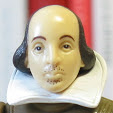
The problem is that I don't fully understand it. And I need the help of all you careful and devoted readers to figure it out. First, here's the Shakespeare:
The transcript runs roughly like this:
Wimsey: Right. Then let's start at the beginning.
Parker: No, thank you. Tell me about the spanner.
Wimsey and Parker (together): Cotter.
[They link pinky fingers.]
The word cotter can be explained by an exchange earlier in the film:
Bunter reveals the murder weapon, which he insists on calling "a cross-head cotter." It's not a simple spanner (or, as the Americans among us would say, a wrench)—it's a cotter. Briefly, the importance of this is that it's a specialized tool—not a random blunt instrument that anyone could lay their hands on.
But what's with this linking pinkies and saying "Shakespeare"? From the context, it seems like something two people do when they happen to say the same word at the same time. Is it the equivalent of "snap" in the British Isles or "jinx" in America?
I've found
some elucidation about this in a post on the
Separated by a Common Language blog. One of the comments says that you have to say the name of a poet before you can speak again—only it must not be Goldsmith. Another comment says saying "Shakespeare" would "spear" the wish, so that poet wasn't used (that poster says this was the case in Tasmania in the 1950s).
It reminds me somewhat of the "Shake . . . speare—sock an ear" game mentioned in an episode of
The Twilight Zone (for which,
q.v.)—another childhood game that I don't understand.
I welcome your insights into this (to me) conundrum! What's it all about?
Links: The Film at IMDB.
Click below to purchase the film from amazon.com
(and to support Bardfilm as you do so).