Tuesday, July 29, 2014

Book Note: Not Hamlet

Suzman, Janet. Not Hamlet: Meditations on the Frail Position of Women in Drama. London: Oberon Books, 2012.

I read this book some time ago and set it in a pile of things to make a few notes about. It's a delightful excursion into the history of women in the theatre by a marvelous woman of the the theatre. I like Janet Suzman best not for her Cleopatra but for her direction of an Othello produced in South Africa under Apartheid (for which, q.v.).

I like this book best not for its contents (which are quite good) but for the section entitled "A Rogue Prologue:  A Heartfelt Plea for a Bit of Common Sense." In it, she takes on the authorship doubters, whom she calls "time-wasters" (14), and the film Anonymous (for which, q.v.).

She goes on at considerable length, but I'd like to give you all just a quick sample of her thoughts and her style
In 2011 a murky and far-fetched film was released —Sony-backed, shame on them wasting their money on
such a bad subject—called Anonymous, the invented story of how this poor put-upon Earl of Oxford was the teal author of the plays. No facts to back it up, just wild submissions and some quite good cinematography of the gloomy historical documentary kind. Some months before seeing it, I had been invited to a debate before it went on release, where incidentally it received universal critical trouncings. Professor Stanley Wells, the Rev. Dr. Paul Edmondson, and Professor Michael Dobson of The Shakespeare Institute and the University of Birmingham were present to defend William. To traduce William were present the director of the film, Roland Emmerich (bet they couldn’t find a British director to do the hatchet job), a distant descendant of the Earl’s, and a little man from a small but perfectly misguided suburban university which gives degrees in maligning Shakespeare and whose name I have forgotten . . . .

Roughly this is how their batty film version goes: Oxford was always secretly writing plays, having written Midsummer Night’s Dream when he was about eight years old and henceforth entranced with his own prodigiousness, he continued in secret. But how was he to get these works into the playhouses without revealing his blue-blood? The Queen would have had him topped had she known. Thus Oxford, desperate for a theatrical conduit, singles out Ben Jonson, playwright, needing money for a reason I cannot now recall, and Ben is duly blackmailed and sworn to silence—a brilliant writer libeled beyond recognition.

Oxford could now feed his plays through Jonson’s bribed hands to reach the actors. However, one day a doltish and illiterate member of the acting company—justify an illiterate actor to me please—namely one William Shakespeare, finds out about the deception and so poor Ben has to pay him clandestinely, courtesy of the rich earl, to keep his mouth shut. Oh, and for the use of his nice name. Thus it is that he, dim-witted Will, got all the kudos for the huge success of these plays. We should be thankful that comical Will Kempe wasn’t chosen as the dupe in this film—a close call; consider the dull thud of The Royal Kempe Company.

Has it never occurred to this bunch of dreamers how such a daft plot, might work in a busy theatre company? Their scenario only works off torture and bribery anyway. There wouldn’t be enough money in the universe to stop all the actors in a company from blabbing till Doomsday, let alone the masses of other people involved in a theatre company; the tirers delivering head dresses, the sewing women mending torn costumes, the butchers and bakers and candlestick-makers. No whispers and sniggers about such a plonking modus operandi, a deception stretching over twenty-five years? Did this doltish William of theirs never crow in his cups about his secret benefactor and his growing wealth? Did the Company never notice how illiterate Will had suddenly turned scribe, brandishing inky cue-sheets under their noses, scribbly fingers freshly stained? Did no one ever mark how rewrites—for rewrites there surely were—happened only after this William returned from a loo-break? We must assume the author earl was in the building that day skulking about in the gods ready for consultation. You think the cleaning-woman didn’t spot him as she swept up the vomit and hazelnut shells? A conspiracy, you understand, demands silence from everyone; unattainable in a theatre company, with skittering boys and prying eyes all on the loose in a building with no doors to shut on secrets. If they didn’t blab they were inhuman, and actors are all human, that’s for sure.

It becomes increasingly evident that the Oxfordian view of human nature is just a touch—well, out of touch. What do people do? They gossip. Universally, they gossip. To this day and forever, they gossip. What makes Oxfordians think human nature has changed? A mystery. When all is said and done the reason why William Shakespeare’s plays remain as vibrant as ever is because human nature hasn’t changed; they tell us stories about recognisable human beings. All of them with natures like ours, some the size of giants, others our size, all of them recognisably us in extremis. These guys have badly lost the plot. (17-21)
She continues in that vein for some time. I found it awfully refreshing to hear the voice of a woman of the theatre—not a trained Shakespeare scholar but a vibrant, life-long participant in the theatre—telling it like it is—and was.

Click below to purchase the book from amazon.com
(and to support Bardfilm as you do so).

Monday, July 28, 2014

Book Note: Anyone But You

Askew, Kim, and Amy Helmes. Anyone But You. Avon: Merit Press, 2014.

Careful readers of the blog will remember a post on the "Twisted Lit" series of Shakespeare books (for which, q.v.). Well, they've released another one.

Anyone But You is the Twisted Lit. answer to Romeo and Juliet, and half of it is pretty interesting. I've read the book myself and I've talked to a member of its target audience, and we agree that the Romeo and Juliet sections are less than intriguing. The better half of the novel addresses a possible backstory for the feud.

In the novel, Romeo and Juliet (Roman and Gigi to us) come from rival Italian restauranteurs. That section is pretty straightforward—with the usual over-the-top current teen drama thrown in. It's also fairly dull. The backstory involves how they came to be rivals, and it's much more interesting. There's considerable back-and-forth between two boys growing up in Chicago between the World Wars. I won't give you more than that, because that's worth reading. But you might want to sip every other chapter until the last thirty pages of the book.

Click below to purchase the book from amazon.com
(and to support Bardfilm as you do so).

Book Note: Shakespeare in America

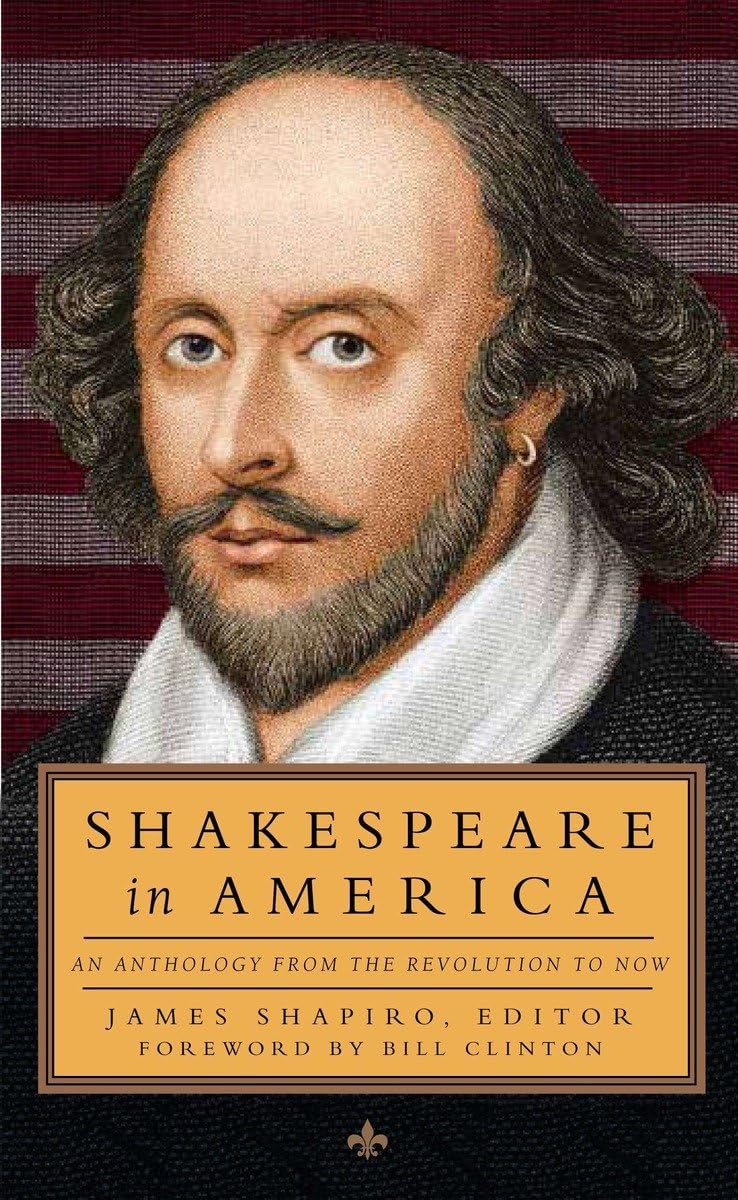
Shakespeare in America: An Anthlogy from the Revolution to Now. Ed. James Shapiro. New York: Library of America, 2013.

Despite the paucity of posts, I've not been entirely idle this summer. I haven't seen too many films, but I've read a fair number of books, particularly in preparation for an American literature course I'll be teaching in the spring.

[Note: When they told me I'd be teaching the course, I said, "American Authors? This is gonna be the best day of my life." But I digress.]

Shakespeare in America is an anthology of Shakespeare-related material edited by the great author and Shakespeare scholar James Shapiro. There's a wealth of magnificent material here (along with some genuinely awful offerings). Reviews of film and stage productions elbow poems commenting on Shakespeare plays and the man himself. Pieces by Nathaniel Hawthorn and Herman Melville bump up against vaudeville burlesques and philosophical works.

I wish that the book provided more supplementary material—particularly for the musical pieces. There are occasional vague links to related material (e.g., a section on Orson Welles' "Voodoo" Macbeth helpfully points interested readers to the URL youtube.com), but they could be more numerous and more precise (e.g. pointing readers to http://bardfilm.blogspot.com/2010/10/rare-clip-of-orson-welles-voodoo.html for a clip from the Welles' production).

All the same, this is a book to add to your library—it will provide hours of interest and enjoyment.

Click below to purchase the book from amazon.com
(and to support Bardfilm as you do so).


Wednesday, July 23, 2014

The Stratford Zoo Midnight Revue Presents: Macbeth

Lendler, Ian. The Stratford Zoo Midnight Revue Presents: Macbeth. Illus. Zack Giallongo. Colors Alisa Harris. New York: First Second, 2014.

First Second Books, who often have really interesting and unusual books in the general realm of the graphic novel, has just published an odd and brilliant book related to Macbeth.

The book, appropriate for grade school kids, high school students, and Shakespeare professors, tells the story of the animals in the zoo at Stratford-Upon-Avon and the antics they get up to at night—namely, putting on a production of Macbeth.

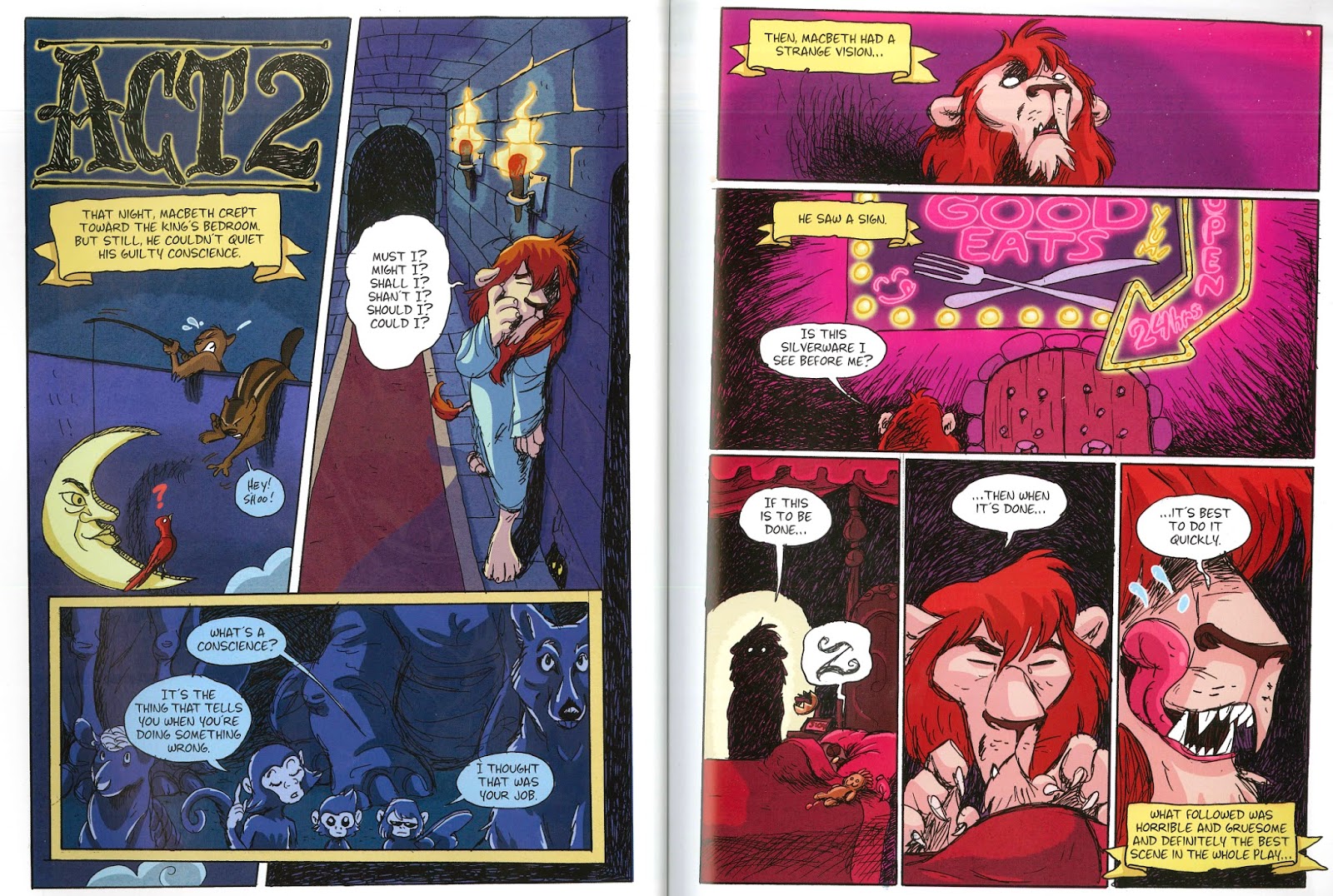
We get an intriguing version of the play (together with comical interaction with the audience). Macbeth, as a lion, is tempted to eat the king; Macduff, a stork and a detective, works to solve the crime. The book tells the general plot, but it addresses it with careful and thoughtful fluidly.

I'm providing two spreads to give an idea of how it does so (and to whet your appetite enough to give it a try). In the first, Macbeth gives in to temptation:


The second gives this book's version of Macbeth's conflicted conscience—and the dagger speech:


I'm fond of the book. It's quirky in ways that break the norms of the graphic novel genre, which I appreciate greatly. Give it a try!

Bonus: The book now has a trailer!  Enjoy!


Click below to purchase the book from amazon.com
(and to support Bardfilm as you do so).

Tuesday, July 22, 2014

Shakespeare in Pearls Before Swine

Pastis, Stephen. Because Sometimes You Just Gotta Draw A Cover With Your Left Hand: A Pearls Before Swine Collection. Kansas City: Andrews McMeel, 2012.

I am always thrilled to find a bit of Shakespeare in the comic pages.

Stephen Pastis occasionally has a Shakespeare gag. His magnum opus on Mark Antony's big speech in Julius Caesar (for which, q.v.) is one of my favorites.

I've chanced upon two more, so I'm passing them along to you.  They're both of the "Huge and Suspicious Setup for Horrible but Brilliant Pun on a Sunday Morning" variety. The first (click to enlarge) deals with Shakespeare more directly:


The Shakespeare in the second comes in at the end—not as the pun itself, but as a Shakespeare-related afterthought. Enjoy!


Click below to purchase the book from amazon.com
(and to support Bardfilm as you do so).


Wednesday, June 18, 2014

A Touch of Julius Caesar in Aladdin

Aladdin. Dir. Ron Clements and John Musker. Perf. Scott Weinger, Robin Williams, and Linda Larkin. 1992. DVD. Walt Disney Video, 2004.

I've just finished directing a production of Julius Caesar for a group of fourth to eighth graders, and it was a marvelous experience. One of the things I love most is the use the students put to Shakespeare:

"Yon Cassius has a lean and hungry look—pass him the mashed potatoes!"

"Let slip the dogs of war—but remember to bring a bag to clean up after them!"

Recently, two of the students pointed out that there's a tiny bit of Julius Caesar in the Disney film Aladdin. As a particular bonus, the clip has a guest appearance by another Disney character: one with not one but two Shakespearean names. I'm talking about Sebastian the Crab, whose familiar name comes from The Tempest (as does the name of The Little Mermaid's Little Mermaid—Ariel) but whose full name—Horatio Thelonius Ignatius Crustaceus Sebastian— has a little bit of Hamlet thrown in.

Here's a brief clip of the Genie pondering how to make Aladdin a prince and quoting from Shakespeare as he does so:


Note: Aladdin also has a character with a name from Shakespeare. Any guesses? It would be a good question for your next trivia quiz . . .

The parrot—the evil henchparrot for the evil Jafar— is named Iago.

Links: The Film at IMDB.

Click below to purchase the film from amazon.com
(and to support Bardfilm as you do so).

Friday, June 13, 2014

Shakespeare Festival St. Louis Presents 1 Henry IV, 2 Henry IV, and Henry V

1 Henry IV and 2 Henry IV. Dir. Tim Ocel. Henry V. Dir. Bruce Longworth. Perf. Jim Butz, Anderson Matthews, Gary Glasgow, Joneal Joplin, Tony DeBruno, Michael James Reed, Jerry Vogel, Alex Miller, Reginald Pierre, Andrew Michael Neiman, Charles Pasternak, Chauncy Thomas, Antonio Rodriguez, Drew Battles, James Hesse, Dakota Mackey-McGee, Kari Ely, Kelley Weber, Eric Dean White, Mason Conrad, Michael Williams, and Dan Haller. Shakespeare Festival St. Louis. St. Louis, Missouri. 2014.

I've wanted to see a Shakespeare Festival St. Louis production for many years, but I'm not usually in St. Louis when they're putting on shows—which is a genuine shame, as I've heard marvelous things about their take on the plays.

I tried to go last night, and I managed to be able to take in a lot of the surrounding and supporting material of the play—but the rain became increasingly torrential, and I, drenched and cold, left at 7:00. The show eventually went on, but it started around 8:40, and I couldn't (alas) have made it that long.

But I urge anyone in the St. Louis area to try it out. It's free, it's outside (which is normally quite pleasant), and you can bring your own chairs or blankets and have a picnic while you watch the show. Additionally, there are lots of fun things to occupy you as you await the beginning of the show. At 6:30, for example, a group of high school students did a twenty-minute version of the play. I was impressed by its use of the text of the play (rather than paraphrase) for most of the story; the actors also did an impressive job. There's also a jester wandering around the crowd (last night, he was having fun imagining that various people in the audience were weasels and exploring the implications of their weaselhood) and "The Wheel of Will," which allows audience members to spin a wheel. Whatever it lands on (sonnet, tragic speech, et cetera), the actors have to do.

You can also take a look at the plot summary of Henry V in the image below (click to enlarge it).


I've also heard that Jim Butz is a really astonishing actor. Some have said that his Hamlet was the best they've ever seen, and the reviews point to his doing a marvelous Henry V as well. In short, go and see it if you possibly can!

Links: The Official Web Site for Shakespeare Festival St. Louis.

Wednesday, June 11, 2014

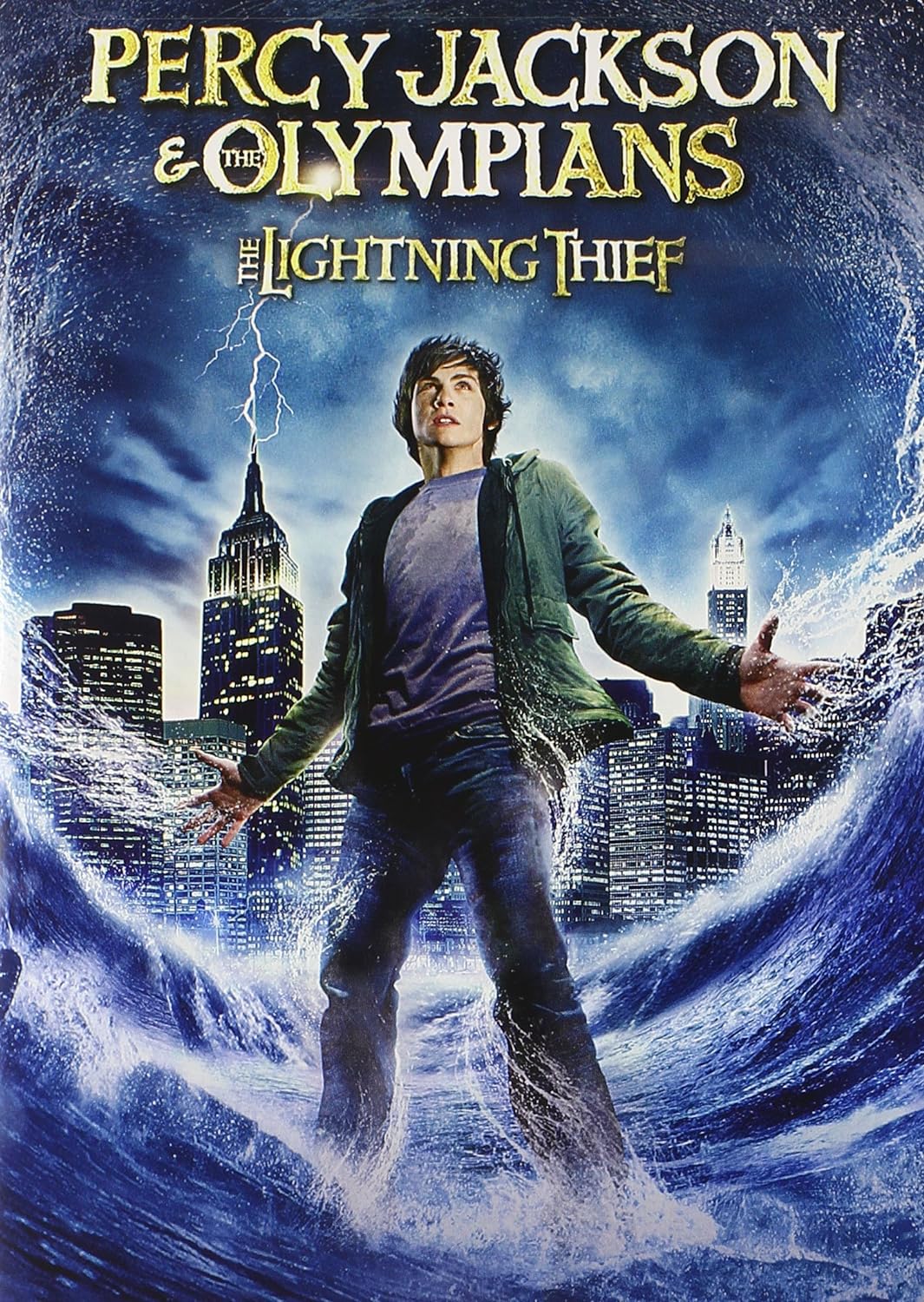
Does Percy Jackson Like Shakespeare?

Percy Jackson & the Olympians: The Lightning Thief. Dir. Chris Columbus. Perf. Logan Lerman, Kevin McKidd, Steve Coogan . 2010. DVD. Twentieth-Century Fox, 2010.

The short answer is "No," but I think a longer answer is a bit more interesting.

The Percy Jackson books and films tell the story of a son of Poseidon in the modern age who eventually discovers his parentage and, thereby, his semi-divine powers.

Early in the film, he appears to be an ordinary high school student (if there is such a thing as an ordinary high school student), struggling through life and a substitute English teacher's class (she later turns out to be an evil, horrible monster—a more literal evil, horrible monster than the stereotypical substitute teacher). At this point, she's not being evil or horrible.  She's presenting some Shakespeare to the class:
I understand a fury in your words,
But not [your] words. (IV.ii.35-36)
Note: I'm away from the office and all its marvelous books, but I have been able to do enough scholarly research on the internet to determine that Q1 of the play (1622) has "But not the words" rather than "your words" as the closing line. The First Folio (1623) omits the line entirely. It looks like the substitute teacher made an intentional or unintentional mistake in transcribing the lines to the board.

She asks the class if anyone can explain the quote and deliberately calls on Percy (even though other students have raised their hands). A point-of-view shot establishes that the letters don't stand still long enough for Percy to read them. At first, I thought that it was an intriguing way to portray dyslexia—and, after a fashion, it is. We later learn that Percy's brain is hard-wired to read ancient Greek—he can read the writing on the Greek sculptures in the museum without any trouble.

Beyond that, it's intriguing that the quote fits the plot. Percy can understand the general tenor of what he reads, but he's not able to make out the words themselves. Further, the word "fury," with its connections to the myths of ancient Greece, has an appropriate flavor.

Here's the scene in question:


In short, Percy Jackson doesn't seem to like Shakespeare—but it's because he's hard-wired for ancient Greek. Perhaps they should try Timon of Athens or even Midsummer Night's Dream for him instead!

Links: The Film at IMDB.

Click below to purchase the film from amazon.com
(and to support Bardfilm as you do so).
Wednesday, May 21, 2014

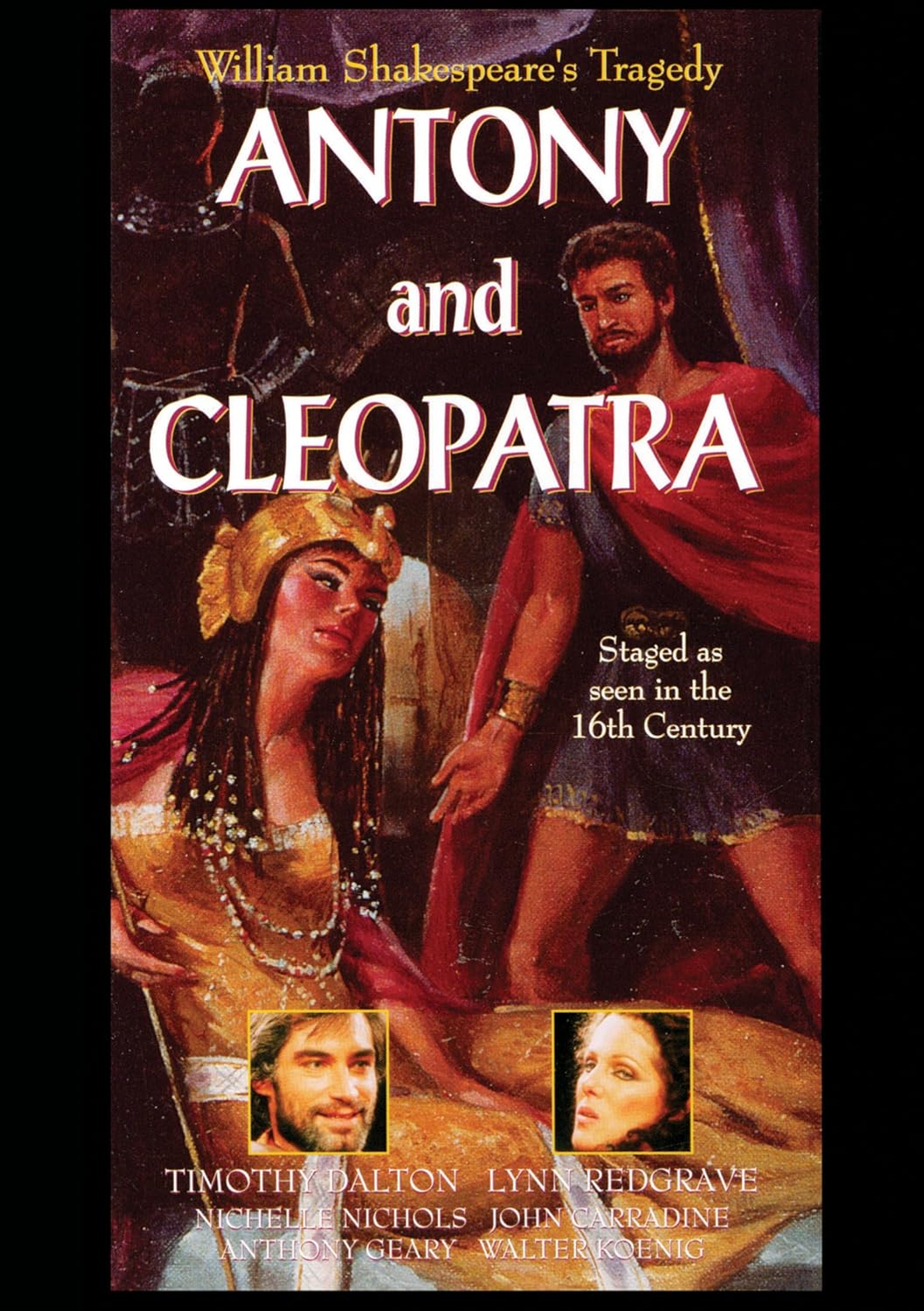
Uhura and Chekov in Antony and Cleopatra?

Anthony and Cleopatra. Dir. Lawrence Carra. Perf. James Avery, Sharon Barr, Michael Billington, Timothy Dalton, Lynn Redgrave, John Carradine,  Walter Koenig, and Nichelle Nichols. 1983. DVD. Bard Productions / Century Home Video, 2012.

The claim "Shakespeare is ubiquitous in the Star Trek universe(s)" can be readily established by my "Shakespeare and Star Trek Complete collection (for which, q.v.). But what about actors from Star Trek who went on to play roles in Shakespeare productions? Yes, I mean besides William Shatner and his Julius Caesar rap (for which, q.v.).

Walter Koenig, who played Checkov, and Nichelle Nichols, who played Uhura, performed in a 1983 television production of Antony and Cleopatra. Here, I must apologize if the title of this post turns out to have been disingenuous. They didn't play the title characters; those roles were left to Timothy Dalton and Lynn Redgrave. Nichols played Charmian, and Koenig was Pompey.

Here's Act I, scene ii, which gives us Charmian at her most playful—though Nichols does give some depth to the character:


I've let the scene run to Cleopatra's entrance so that you can get a glimpse of her and also so that you can see the effect of the interesting "Hush, here comes Antony" . . . "Not he, the queen" (I.ii.79) exchange.

The other scene is Act II, scene i. Despite a small miscue (he jumps on one of his lines too early), Koenig does a fair job with the part and the lines:


The one critique I have is that he seems to be doing Pompey with a slight Russian accent. I suppose old habits die hard.

Links: The Film at IMDB.

Click below to purchase the film from amazon.com
(and to support Bardfilm as you do so).

Wednesday, May 14, 2014

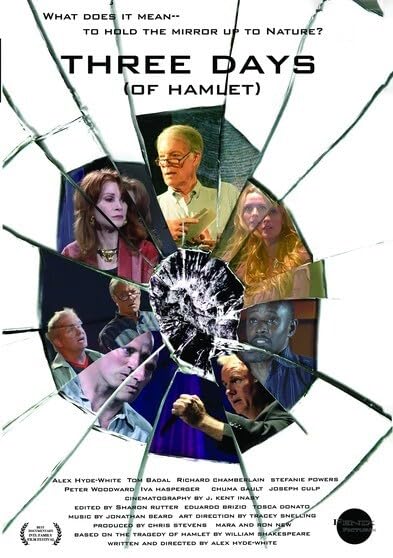
Three Days of Hamlet: A Documentary

Three Days of Hamlet. Dir. Alex Hyde-White. Perf. Alex Hyde-White, Tom Badal, Richard Chamberlain, Iva Hasperger, Stefanie Powers,Chuma Hunter-Gault, and Peter Woodward. 2012. DVD. Fenix Pictures, 2013.

Three Days of Hamlet is a documentary about putting a production of Hamlet together in three days. The most intriguing part of this honestly not-too-intriguing film has to do with the father / son relationship—both in the play and between the director (and the Hamlet) and his father.

Alex Hyde-White, perhaps best known for his role as James Morse in Pretty Woman, is the son of Wilfrid Hyde-White, whom I know best as Pickering in the 1964 film version of My Fair Lady. A fair bit of the documentary contemplates their relationship and the complicated ways in which the appearance of the ghost of Hamlet, Sr. affects Hamlet, Jr.

Some psychological contemplation is clearly underway—to the point where we might see this entire production as Alex's way of proving something to Wilfrid about acting . . . or his life . . . or his desire to pass the torch of the acting profession to his son . . . or . . . something.

The production-within-the-documentary has some occasionally slight interest, but it seems mostly ordinary. The actors read their scripts,which I don't mind, especially given that they have three days to mount the production. But the overall effect is to distance them from the material itself and from their audience. There are also a surprising number of slightly-misread lines:  "Get thy ways to a nunnery," "No, not by this hand," "These foils have all the strength?" et cetera. I'm not quite sure what to do with that, other than to note that it reveals a lack of attention to the text.

The following clip will give you a good sense of the flavor of the documentary:


Links: The Film at IMDB.

Click below to purchase the film from amazon.com
(and to support Bardfilm as you do so).

Tuesday, May 13, 2014

An Early FoxTrot with Shakespearean Overtones

Amend, Bill. The Best of FoxTrot. Andrews McMeel: Kansas City, 2010.

I've always adored FoxTrot. Bill Amend does marvelous things with the genre and provides intriguing insights into all sort of issues.

But I like it best when it has some Shakespeare.

Is anyone surprised?

Despite being from an early period, this comic has some marvelous things to recommend it. Look at the marvelous foreshortening of Antony in the panel above. Yes, it does look a bit like a boot scrubber, but look over that to get at the emotion that's captured there. The third panel below has something of the same intensity. Perhaps Mr. Amend was watching films by Orson Welles when drawing this comic.

In any case, click on the image below to enlarge it—and to enjoy it!


Click below to purchase the book from amazon.com
(and to support Bardfilm as you do so).
Friday, May 2, 2014

Motocrossed: A Twelfth Night Derivative that Predates She's the Man

Motocrossed . Dir. Steve Boyum. Perf. Alana Austin, Trever O'Brien, Riley Smith. 2001. Videocassette. Walt Disney Video, 2002.

I hate a good challenge. So, when Shakespeare Geek pondered out loud on Twitter whether the 2001 Disney film Motocrossed was a derivative version of Twelfth Night, I was annoyed. I knew I would have to find out. It's only available on VHS (and it's very expensive at that), so I had to track down a library that had a copy, obtain it through Inter-Library Loan, digitalize it, and find time to watch it.

Fortunately, it turned out to be, indeed, a derivative version of Twelfth Night—five years before She's the Man came on the scene. In fact, according to IMDB, the film's working title was The Twelfth Lap, which makes a more direct connection to Shakespeare's play.

Unfortunately, it's not terrific (though it's also not terrible). It fits in the genre of "Saturday Afternoon Feel-Good Movie." When Andy Carson is injured, Andi Carson, his twin, enters the race pretending to be her brother. Hijinks ensue.

The gender mix-up is handled intriguingly, but not with very much bite. Andi turns out to have an affinity with the female sex, and another racer (Dean) admires that ability in him; they start hanging out, Dean trying to get Andi to help him develop a relationship with Faryn. She tries her best, but she's falling for Dean and thinks that Faryn isn't at all for Dean. Faryn, of course, falls for Andi, thinking she's Andy.

Here's a representative clip:


Links: The Film at IMDB.

Click below to purchase the film from amazon.com
(and to support Bardfilm as you do so).

Wednesday, April 2, 2014

Celebrate Shakespeare's 450th Birthday with a Forty-Five-Second Film Festival Contest

"Shakespeare 450th Birthday 45-second Film Festival Contest." St. Paul Pioneer Press. Due by noon on 21 April 2014.

This seems like a good deal of fun as well as something that might encourage some interesting, creative approaches to Shakespeare.

The St. Paul Pioneer Press is sponsoring a context ("Brush up your Shakespeare; Start Filming him Now" seems to be one of the tag lines). They're calling for films that are forty-five seconds or shorter that have something to do with Shakespeare:

"We'll consider anything, no matter how wondrous strange. Want to do a hip-hop version of Sonnet 18? A highly condensed version of Romeo and Juliet with an all-cat cast? Henry V’s band of brothers speech in Klingon? Lay on, Macduff."

I'm embedding the official promotional video below. Watch it—and then make something to submit. I know I will!


Update: Actually, I never got around to submitting. But others did. You can find all the films here. And the winner? This was the winner. Enjoy!


Links: Information about the Contest.

Monday, March 31, 2014

Cockatoo Paraphrases Hamlet in Rio 2

Rio 2. Dir. Carlos Saldanha. Perf. Anne Hathaway, Leslie Mann, Rodrigo Santoro, Jemaine Clement, and Kristin Chenoweth. 2014. Twentieth Century Fox / Blue Sky Studios.

In between discussions of The Tempest and its many interesting problems (for which, q.v.), Shakespeare Geek offhandedly mentioned that the trailer for Rio 2 alludes to and gives credit to Shakespeare.

I couldn't resist tracking it down and passing it along. In the brief clip below, a cockatoo with feathers (?) that resemble a ruff adapts a quotation from Hamlet. The line is part of Hamlet's encouragement to the players in the play-within-the-play to get back to business: "The croaking raven doth bellow for revenge" (III.ii.254). Enjoy!


Links: The Film at IMDB.  The full trailer.

Click below to purchase the film from amazon.com
(and to support Bardfilm as you do so).

Friday, March 28, 2014

An Odd Approach to Romeo and Juliet in Orange County

Orange County. Dir. Jake Kasdan. Perf. Colin Hanks, Jack Black, Schuyler Fisk, John Lithgow, Lily Tomlin, George Murdock, Mike White, Chevy Chase, Kevin Kline, and Ben Stiller. 2002. DVD. Warner Bros., 2009.

Orange County is an odd little film about a surfer who finds a book in the sand one day—one written by a professor of creative writing (I infer) at Stanford University. It turns his life around, and he desires nothing more than to become a writer. For him, that involves getting into Stanford.

The one scene that's directly related to Shakespeare takes place in his classroom. A quote above the white board there reads "Is not this something more than fantasy?" I imagine the quote is meant to inspire enthusiasm in the subject matter, but the fact that it's Bernardo's line to the skeptical Horatio taken completely out of context pleases me greatly.

The scene ends up being something of a parody of teachers who use film versions of Shakespeare plays to teach Shakespeare—but that's all right. I can take it. Observe:

“Some great movies are based on his plays: Hamlet, West Side Story, Talented Mr. Ripley, Waterworld, Gladiator, Chocolat . . ."

Well, maybe I can't take it, but I can see how some people might find that amusing.

The rest of the film is devoted to zany antics geared toward getting our protagonist into Stanford (his guidance counsellor sent in the wrong transcript, so he was declined). Finally, he meets the writer who wrote the book he found in the sand . . . and it turns out to be Kevin Kline. I can't help but see that as an allusion to his role as teacher in The Emperor's Club (for which, q.v.).

Links: The Film at IMDB.

Click below to purchase the film from amazon.com
(and to support Bardfilm as you do so).

Bardfilm is normally written as one word, though it can also be found under a search for "Bard Film Blog." Bardfilm is a Shakespeare blog (admittedly, one of many Shakespeare blogs), and it is dedicated to commentary on films (Shakespeare movies, The Shakespeare Movie, Shakespeare on television, Shakespeare at the cinema), plays, and other matter related to Shakespeare (allusions to Shakespeare in pop culture, quotes from Shakespeare in popular culture, quotations that come from Shakespeare, et cetera).

Unless otherwise indicated, quotations from Shakespeare's works are from the following edition:
Shakespeare, William. The Riverside Shakespeare. 2nd ed. Gen. ed. G. Blakemore Evans. Boston: Houghton Mifflin, 1997.
All material original to this blog is copyrighted: Copyright 2008-2039 (and into perpetuity thereafter) by Keith Jones.

The very instant that I saw you did / My heart fly to your service; there resides, / To make me slave to it; and, for your sake, / Am I this patient [b]log-man.

—The Tempest