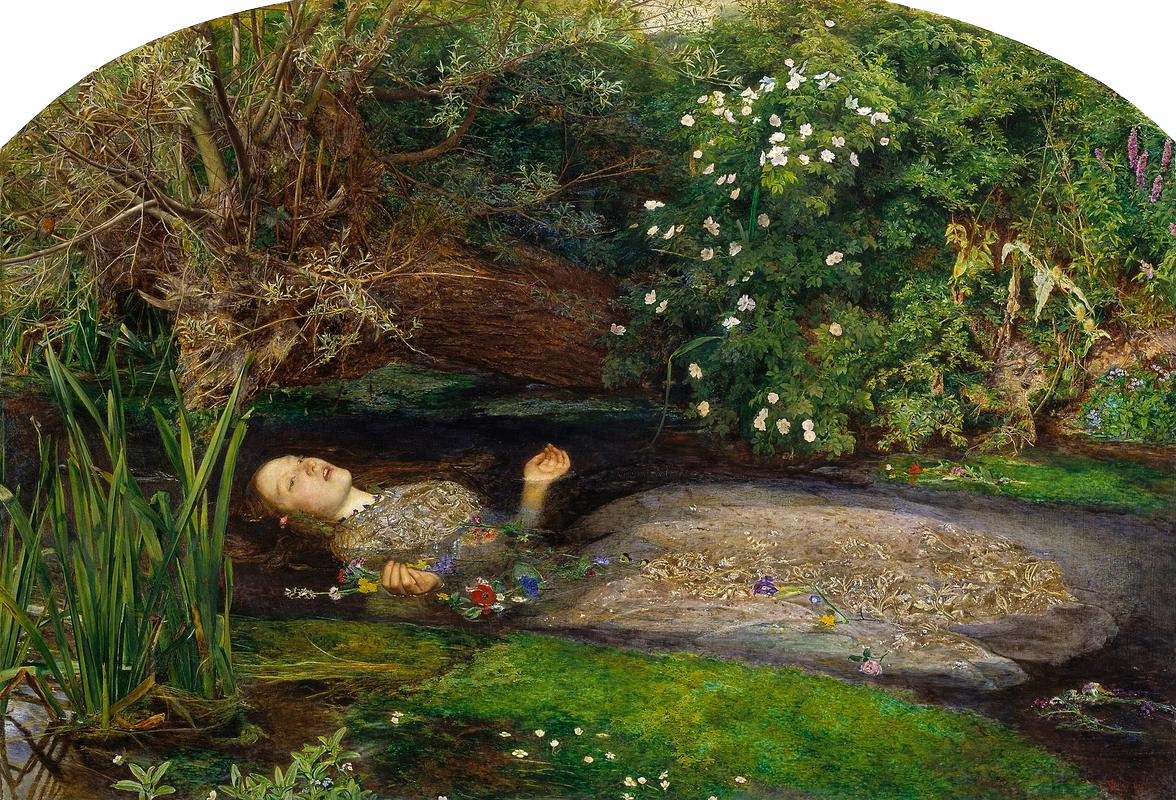
There is a willow grows askant the brookThat shows his hoary leaves in the glassy stream.Therewith fantastic garlands did she make.. . . . . .[Then she] fell in the weeping brook. Her clothes spread wide,And mermaid-like awhile they bore her up,Which time she chanted snatches of old lauds . . . .. . . . . .. . . But long it could not beTill that her garments, heavy with their drinkPull’d the poor wretch from her melodious layTo muddy death. (IV.vii.165ff, passim)

That might not be a change from Millais’ painting, but it is a decision that an artist in film made based on the vision of an artist in paint. And it matters! It matters because Millais’ painting is a snapshot—the same way Gertrude’s speech is a snapshot. Notice that (despite my paraphrase) Gertrude doesn’t say “She died.” She says “But long it could not be . . .” She’s holding Ophelia in an indeterminate position. She’s still alive, and she won’t be alive long, and it won’t be long until she’s not alive . . . but she’s not actually declared dead in Gertrude’s speech. Gertrude just says “long it could not be till . . . death.”
Millais is doing the same. We don’t know which way the brook flows because it doesn’t matter in Millais. He wants us to have the suspense of the alternatives. Ophelia becomes a Schrödinger’s cat of sorts. In Schrödinger’s thought experiment, the cat is simultaneously dead and alive. It has to do with the uncertainty principle and quantum physics—and you can find someone better qualified to explain it to you. But in terms of art, we have Ophelia simultaneously dead and alive in this painting.
In the same way, we don’t know whether Ophelia is singing. She could be singing—or we could imaging her mouth being open to take her very last breath.
In the Olivier film, Ophelia floats past the camera (feetfirst, from right to left, in black and white). Then the camera pans to catch up with her, and we just see some garlands floating downstream and under the water. Olivier can’t stop the film—he has to go on to tell the rest of the story. Millais has the . . . shall we call it a luxury? Millais has the luxury to show us one slice of Ophelia’s life without reaching the conclusion—however inevitable that conclusion will be.
Links: The Painting at Tate Britain.