Tuesday, May 27, 2008

The Reasons Behind it All

“Doctor Who: The City of Death.” By David Agnew (Pseudonym) [David Fisher, Douglas Adams and Graham Williams.] Perf. Tom Baker and Lalla Ward. Dir. Michael Hayes. Doctor Who. Season 17, episodes 5-8. BBC. 29 September-20 October 1979. DVD. BBC Warner, 2005.
Some readers may find it a bit fluffy to be mentioning Shakespearean (Dis)Appearances* in old Cosby Show episodes or Star Trek-related films or, as is the case in the peripheral matter in this post, Doctor Who PORs**.

But, as this blog builds and grows,*** I hope that two of my intentions will be fulfilled.

First, I’d like to aim for completeness—a completeness that I’m unlikely ever to obtain because of the second intention.

Second, I’d like to show the absolute pervasiveness of Shakespeare in modern western pop and not-so-pop culture. I am likely only to show the tip of a veritable Shakespearean iceberg floating toward the Titanic of western culture and the intersection of the twain—which is, I hope, not always as disastrous as the referent to this metaphor.

I see this blog as a resource, of course—I think it’s most helpful to think about Shakespeare from a huge variety of angles, and film versions or pop culture references to Shakespeare offer just such infinite variety. But its very existence points toward the enormous endebtedness we have in Shakespeare.

Why, without Shakespeare, we wouldn’t have nearly as many intriguing intersections between time travel science fiction and Renaissance England. Just scroll down to see a brief example!

Footnotes:

*A Post-Post-Modern title often passes for depth of analysis.

** Points of Reference. I suppose it should, technically, be PsOR, but that looks like a chemical formula instead of an acronym. As it is, it looks a bit like swearing in the comics, but that’s purely unintentional.

*** Yes—mixed metaphors. I know, I know. Watch the clip below to see why I’m prone to them today.


Click below to purchase the story from amazon.com
(and to support Bardfilm as you do so).

The Place to Go for the Julius Caesar Rap

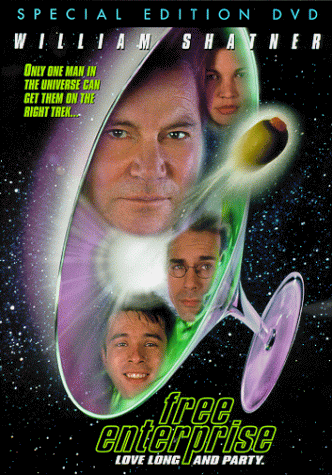
Free Enterprise. Dir. Robert Meyer Burnett. Perf. William Shatner, Eric McCormack, and Audie England. 1998. DVD. Anchor Bay, 2006.
You can go to The Cosby Show to find a rap based on Julius Caesar (for which, q.v.), but if you really want something special, you have to head to a 1998 Star Trek-related film entitled Free Enterprise.

There, William Shatner himself sings (chants? recites? vociferates?) a song with a high percentage of lyrics from the play itself.

It’s pretty hard to describe. So you’ll just have to try it out for yourself!


Click below to purchase the film from amazon.com
(and to support Bardfilm as you do so).

Friday, May 23, 2008

Further Back in Cosby's History, We Find Macbeth

“Theo and Cockroach.” By Thad Mumford. Perf. Bill Cosby, Phylicia Rashad, Malcolm-Jamal Warner, and Carl Anthony Payne, II. Dir. Jay Sandrich. The Cosby Show. Season 2, episode 12. NBC. 30 January 1986. DVD. Urban Works, 2007.
Before they had to read Julius Caesar, they had to read Macbeth.

Although not nearly as entertaining (or as Shakespeare-centered . . . and the two things may go hand in hand), the episode has its moments.

It’s the first appearance of Cockroach, for instance.

Also, it comes down pretty hard on substituting the text with the version by Cliffs Notes.

And their confusion over the LP version of the play is pretty convincing.

And . . . that’s about it!
Links: The Show at IMDB.

Click below to purchase
every available season of The Cosby Show
from amazon.com
(and to support Bardfilm as you do so).

Wednesday, May 21, 2008

Prince Caspian as Prince Hamlet?

The Chronicles of Narnia: Prince Caspian. Dir. Andrew Adamson. Screenplay by Andrew Adamson and Christopher Markus. Perf. Ben Barnes. Walt Disney Pictures, 2008.
In his movie review podcast, A. O. Scott mentions the Hamlet parallel in the story—a usurping uncle is attempting to do away with the rightful heir.

That makes a certain amount of sense—and it’s interesting that (spolier warning here!) Prince Caspian is more successful than Prince Hamlet, turning that element of the plot from tragedy to, if not comedy, romance!

Also, if you rearrange the letters in “Hamlet, Prince of Denmark,” you get “Caspian, King of Narnia.”

Interesting, that!

Circuitous Motion Brings us to The Cosby Show

Note: New, Improved Version of this Post available here!

“Shakespeare.” By Matt Robinson. Perf. Bill Cosby, Phylicia Rashad, Malcolm-Jamal Warner, Roscoe Lee Brown, and Carl Anthony Payne, II. Dir. Jay Sandrich. The Cosby Show. Season 4, episode 5. NBC. 22 October 1987. DVD. Urban Works, 2007.
It took a strange, long time to get there, but I arrived at the Shakespearean moment in The Cosby Show.

It started with the Campbell Scott Hamlet (which people, inexplicably to me, seem to admire beyond all singing of it—more on that later), and ended up with Theo and Cockroach singing something of a rap version of Mark Anthony’s speech.

I was trying to figure out where I’d seen Roscoe Lee Brown (pictured above) before. He plays Polonius in the Scott Hamlet. In a search of IMDB, I saw that he had played a role in a Cosby Show episode entitled “Shakespeare.” Fortunately, our library had a copy readily-available.

Another episode seems to have some Macbeth-related material, but I haven’t gotten there yet.


Monday, May 19, 2008

Shakespeare i’ th’ Summer

Richard III. Dir. Matthew Arbour. Perf. Andrew Borba. Shakespeare Festival St. Louis. St. Louis, Missouri. 21 May—15 June 2008.
To use a phrase popularized by Dave Barry, an alert reader—my mom—sent in this diagram from the St. Louis Post Dispatch. Apparently, Forest Park will be filled with the melodious strains of one of the English Civil Wars.

“Now is the [summer] of our [great] content,” one might say. That is, one might say that if one was the kind of person who used the “one might” construction and suffered from an inclination to paraphrase Shakespeare in the manner of a newspaper caption writer.

Fortunately for one’s gentle readers, one is not that kind of person. But I do wish we could make it to St. Louis this summer. I suppose I’ll have to leave the report on the play to some other alert readers. What are you doing from now until June 15, Dad?

The image is rather small, but if you click on it, it should load up a larger copy.


Saturday, May 17, 2008

An Interesting Lady Macbeth (Warning: Slight Spoiler)

Macbeth. Dir. Jeremy Freeston. Perf. Jason Connery, Helen Baxendale, and Graham McTavish. 1997. DVD. Hurricane Int'l, 2007.
The box set I mentioned also contains a version of Macbeth. In it, Lady Macbeth’s trip to the dead Duncan’s chambers to smear the grooms with the blood of the daggers is presented to us.

In the image above, Lady Macbeth is pondering the blood—she has picked up a drop, and she seems to be contemplating what she has done, looking over at the dead king’s body and showing some preliminary remorse.
Gasp! Wheeze!
The king isn’t dead after all! He’s been seriously wounded, but he reaches out to Lady Macbeth for help! Shriek!

Almost reflectively, Lady Macbeth stabs him again and again, splattering herself with blood.

It was a little too much like a horror film, but it gives Lady Macbeth additional (and, in this case, active) guilt!

Since I did my dissertation on violent female characters in the early plays of Shakespeare, violent female characters interest me. Lady Macbeth was left out of my dissertation because she committed no active violence, though she insites Macbeth to kill the king. Here, she’s in! She makes the cut!

Oh, the Grading! The Grading!

Carey, Andrew. “Hamlet: The Opera.” Shakespearean Screenplay—the Film Pitch and its Accompanying Justification. 1 May 2008.

The sheer volume of grading has kept me from posting to the blog as much as I’d like. It’s overwhelming, if you want to know.

But, when the pressure gets too great, I just think back on any one of the stunning film pitches I was privileged to hear in my Shakespeare and Film class. They were all very interesting, and (though one of them was set among high school students) none of them was set in high school. Thanks, everyone! Hurrah!

Today, I’ve been thinking of the intriguing casting decision Andrew Carey made in his pitch for a Hamlet opera (really, it seemed more like a rock opera): The guys from Flight of the Conchords as Rosencrantz and Guildenstern.

It just works perfectly, doesn’t it?

[For those who don’t know them, they have the perfect blend of cluelessness and sagacity . . . well, cluelessness, at least . . . for the roles. I’d love to see them in a production of Rosencrantz and Guildenstern are Dead by Tom Soppard.]

Now . . . let’s write some songs for them. What rhymes with “My most honored lord”?

Friday, May 16, 2008

Ophelia, the Elder Sibling

Hamlet. Dir. Michael Mundell. Perf. Simon Pegg and Nick Frost. 2003. DVD. Hurricane Int'l, 2007.
I recently received a DVD box set of British TV Shakespearean tragedies. Among the three was a Hamlet. I though it might be an interesting one to use for the final exam, so I skimmed through it. Although not at all stellar, it did make some interesting decisions. It starts with a bright festival atmosphere that descenes into anarchy, for example.

I was also interested in the casting choices. It seems to me that the Ophelia is clearly older than Laertes. (Out of fear that I was misreading the ages—which I’ve been known to do before—I canvassed a few people who agreed that this Ophelia looks older than this Laertes. I also tried to Google the ages of the actual actors, but I was only able to find Ophelia’s true age. But feel free to correct me if I’m in the wrong here.)

It makes Laertes’ advice to his sister interesting if she is, in fact, older than he is. I think it makes it much less appropriate—to a modern audience especially—if he’s giving advice to a sister who is some years his elder.


Tuesday, May 13, 2008

’aply some poison doth yet ’ang on them.

Hot Fuzz
. Dir. Edgar Wright. Perf. Simon Pegg and Nick Frost. 2007. DVD. Universal Studios, 2007.

[Note: This clip may be posted elsewhere on this blog. Think of this as a holding entry. Thank you.]

A Romeo and Juliet portion of Hot Fuzz can be found below!


Click below to purchase the film from amazon.com
(and to support Bardfilm as you do so).

Tuesday, May 6, 2008

The Macbeth Murder Mystery

Thurber, James. “The Macbeth Murder Mystery.” My World and Welcome to It. By James Thurber. New York: Harvest, 1969. 33-39.

All those who read Macbeth should read this short story by James Thurber. The closer you are to your reading of the play, the funnier the story will be.

[Note: I’ve silently—and only slightly—edited the text from its original.]

~~~~~~~~~
“The Macbeth Murder Mystery” by James Thurber.

“It was a stupid mistake to make,” said the American woman I had met at my hotel in the English lake country, “but it was on the counter with the other Penguin books—the little sixpenny ones, you know, with the paper covers—and I supposed of course it was a detective story. All the others were detective stories. I’d read all the others, so I bought this one without really looking at it carefully. You can imagine how mad I was when I found it was Shakespeare.”

I murmured something sympathetically.

“I don’t see why the Penguin-books people had to get out Shakespeare plays in the same size and everything as the detective stories,” went on my companion.

“I think they have different-colored jackets,” I said.

“Well, I didn’t notice that,” she said. “Anyway, I got real comfy in bed that night and all ready to read a good mystery story and here I had The Tragedy of Macbeth—a book for high-school students. And I was just crazy for a good Agatha Christie or something. Hercule Poirot is my favorite detective.”

Over her second cup of tea my companion began to tell the plot of a detective story that had fooled her completely—it seems it was the old family doctor all the time. But I cut in on her. “Tell me,” I said. “Did you read Macbeth?”

“I had to read it,” she said. “There wasn’t a scrap of anything else to read in the whole room.”

“Did you like it?” I asked.

“No, I did not,” she said, decisively. “In the first place, I don’t think for a moment that Macbeth did it.”

I looked at her blankly. “Did what?” I asked.

“I don’t think for a moment that he killed the King,” she said. “I don’t think the Macbeth woman was mixed up in it, either. You suspect them the most, of course, but those are the ones that are never guilty—or shouldn’t be, anyway.”

“I’m afraid,” I began, “that I—”

“But don’t you see?” said the American lady. “It would spoil everything if you could figure out right away who did it. Shakespeare was too smart for that. I’ve read that people never have figured out Hamlet, so it isn’t likely Shakespeare would have made Macbeth as simple as it seems.”

I thought this over while I filled my pipe. “Who do you suspect?” I asked, suddenly.

“Macduff,” she said, promptly.

“Good heavens!” I whispered, softly.

“Oh Macduff did it, all right,” said the murder specialist. “Hercule Poirot would have got him easily.”

“How did you figure it out?” I demanded.

“Well,” she said, “I didn’t right away. At first I suspected Banquo. And then, of course, he was the second person killed. That was good right in there, that part. The person you suspect of the first murder should always be the second victim.”

“Is that so?” I murmured.

“Oh, yes,” said my informant. “They have to keep surprising you. Well, after the second murder I didn’t know who the killer was for a while.”

“How about Malcolm and Donalbain, the King’s sons?” I asked. “As I remember it, they fled right after the first murder. That looks suspicious.”

“Too suspicious,” said the American lady. “Much too suspicious. When they flee, they’re never guilty. You can count on that.”

“I believe,” I said, “I’ll have a brandy,” and I summoned the waiter.

My companion leaned toward me, her eyes bright, her teacup quivering. “Do you know who discovered Duncan’s body?” she demanded. I said I was sorry, but I had forgotten. “Macduff discovers it,” she said . . . . “Then he comes running downstairs and shouts, ‘Confusion has broke open the Lord’s anointed temple’ and ‘Sacrilegious murder has made his masterpiece’ and on and on like that.” The good lady tapped me on the knee. “All that stuff was rehearsed,” she said. “You wouldn’t say a lot of stuff like that, offhand, would you—if you had found a body?” She fixed me with a glittering eye.

“I—” I began.

“You’re right!” she said. “You wouldn’t! Unless you had practiced it in advance. ‘Oh, no, there’s a body in here!’ is what an innocent man would say.” She sat back with a confident glare.

I thought for a while. “But what do you make of the Third Murderer?” I asked. “You know, the Third Murderer has puzzled Macbeth scholars for three hundred years.”

“That’s because they never thought of Macduff,” said the American lady. “It was Macduff, I’m certain. You couldn’t have one of the victims murdered by two ordinary thugs—the murderer always has to be somebody important.”

“But what about the banquet scene?” I asked, after a moment. “How do you account for Macbeth’s guilty actions there, when Banquo’s ghost came in and sat in his chair?”

The lady leaned forward and tapped me on the knee again. “There wasn’t any ghost,” she said. “A big, strong man like that doesn’t go around seeing ghosts— especially in a brightly lighted banquet hall with dozens of people around. Macbeth was shielding somebody!”

“Who was he shielding?” I asked.

“Mrs. Macbeth, of course,” she said. “He thought she did it and he was going to take the rap himself. The husband always does that when the wife is suspected.”

“But what,” I demanded, “about the sleepwalking scene, then?”

“The same thing, only the other way around,” said my companion. “That time she was shielding him. She wasn’t asleep at all . . . She was acting guilty to shield Macbeth.”

“I think,” I said, “I’ll have another brandy,” and I called the waiter. When he brought it, I drank it rapidly and rose to go. “I believe,” I said, “that you have got hold of something. Would you lend me that Macbeth? I’d like to look it over tonight. I don’t feel, somehow, as if I’d ever really read it.”

“I’ll get it for you,” she said. “But you’ll find that I am right.”

I read the play over carefully that night, and the next morning, after breakfast, I sought out the American woman. She was on the putting green, and I came up behind her silently and took her arm. She gave an exclamation. “Could I see you alone?” I asked, in a low voice. She nodded cautiously and followed me to a secluded spot.

“You’ve found out something?” she breathed.

“I’ve found out,” I said, triumphantly, “the name of the murderer!”

“You mean it wasn’t Macduff?” she said.

“Macduff is as innocent of those murders,” I said, “as Macbeth and the Macbeth woman.” I opened the copy of the play, which I had with me, and turned to Act II, Scene 2. “Here,” I said, “you will see where Lady Macbeth says, ‘I laid their daggers ready. He could not miss ’em. Had he not resembled my father as he slept, I had done it.’ Do you see?”

“No,” said the American woman, bluntly, “I don’t.”

“But it’s simple!” I exclaimed. “I wonder I didn’t see it years ago. The reason Duncan resembled Lady Macbeth’s father as he slept is that it actually was her father!”

“Good gracious!” breathed my companion, softly.

“Lady Macbeth’s father killed the King,” I said, “and, hearing someone coming, thrust the body under the bed and crawled into the bed himself.”

“But,” said the lady, “you can’t have a murderer who only appears in the story once. You can’t have that.”

“I know that,” I said, and I turned to Act II, Scene 4. “It says here, ‘Enter Ross with an old Man.’ Now, that old man is never identified and it is my contention he was Macbeth’s father-in-law, whose ambition it was to make his daughter Queen. There you have your motive.”

“But even then,” cried the American lady, “he’s still a minor character!”

“Not,” I said, gleefully, “when you realize that he was also one of the weird Sisters in disguise!”

“You mean one of the three witches?”

“Precisely,” I said. “Listen to this speech of the old man’s. ‘On Tuesday last, a falcon towering in her pride of place, was by a mousing owl hawk’d at and kill’d.’ Who does that sound like?”

“It sounds like the way the three witches talk,” said my companion, reluctantly.

“Precisely!” I said again.

“Well,” said the American woman, “maybe you’re right, but—”

“I’m sure I am,” I said. “And do you know what I’m going to do now?”

“No,” she said. “What?”

“Buy a copy of Hamlet,” I said, “and solve that!” My companion’s eye brightened.

“Then,” she said, “you don’t think Hamlet did it?”

“I am,” I said, “absolutely positive he didn’t.”

“But who,” she demanded, “do you suspect?” I looked at her cryptically.

“Everybody,” I said, and disappeared into a small grove of trees as silently as I had come.

Click below to purchase the book from amazon.com
(and to support Bardfilm as you do so).
Will Someone Please Revive this Play?

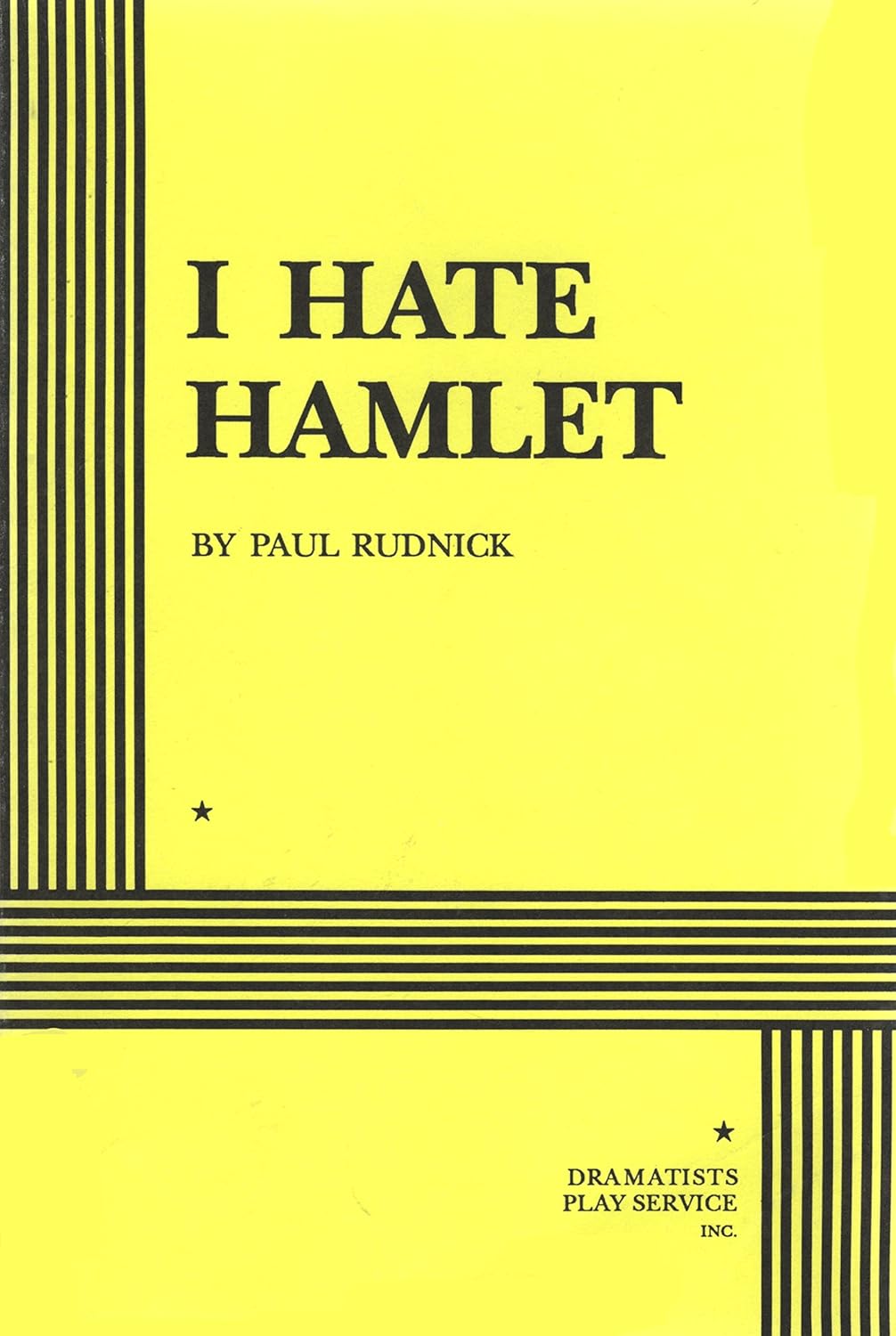
Rudnick, Paul. I Hate Hamlet: A Play by Paul Rudnick. Garden City: The Fireside Theatre, 1991.

“Revive” might be just the right word for a play that depends so much on a play that depends so much on ghosts—and which has its own ghosts.

The play is about a Hollywood television actor who moves to New York and agrees to play Hamlet for Shakespeare in the Park. He moves into the former apartment of the great Shakespearean actor John Barrymore.

Eventually, Barrymore’s ghost shows up to coach Andrew Rally (that’s the television actor’s name) on playing Hamlet. The whole thing is remarkably clever and funny. It reads very well, but I’m sure it would perform better.

Let me give you two marvelous exchanges.

First up, the Hollywood agent reveals how shallow and superficial television and film viewing can be.
FELICIA: I hope he’s good. Although, you know, with Shakespeare—how can you tell?

GARY: Exactly. I mean, it’s foolproof—maybe, with Shakespeare, there’s no difference betweeen bad and good. And everybody’s afraid to say it. I mean, at the movies, on the tube—either you’re funny or you’re cancelled. You’re good-looking, or you're best-supporting. I mean, you can tell. But Shakespeare—it’s just real hard to tell who’s good, without nudity.
Next, Andrew and the ghost are introduced.
ANDREW: You’re . . . Barrymore.

BARRYMORE: Yes. Although my father’s given name was Blythe; he changed it when he became an actor, to avoid embarrassing his family. Your name?

ANDREW: Andrew. Rally. It’s really Rallenberg. I changed it, to avoid embarrassing . . . the Jews.
One is worred that his family will be ashamed of him; the other is worried that he will shame an entire people group. And it’s also a nice reversal—not being embarrassed that you have a Jewish heritage . . . being concerned that you’ll embarrass the Jewish people as a whole!

So who’s up to produce this play again? I’m free to direct at any time . . . .

Click below to purchase the play from amazon.com
(and to support Bardfilm as you do so).

A Waste of Shame . . . But Not a Complete Waste

A Waste of Shame. By William Boyd. Perf. Rupert Graves, Tom Sturridge, Indira Varma, and Anna Chancellor. Dir. John McKay. Shakespeare Retold. 2005. DVD. Open University / BBC, 2005.
I finally managed to get (and then to see, which was an entirely different and entirely frustrating matter) A Waste of Shame—part of the Shakespeare Retold series, but not one released as a commercial DVD in the US.

[Side note: it’s available through amazon.uk at a very high price and in PAL format (so most DVD players . . . apart from those in computers . . . won’t play it) and through Films for the Humanities and Sciences for an even higher price (but in Region 1 format). I managed to get our library to buy the PAL format one, and, with a lot of fighting (the disc seems a bit scratchy & PAL format was confusing), I managed to watch it.]

Update: It's now available in Region 1 format.  See below.

The film is a riff on the sonnets (and on all the scholarly ink that has been spilt all over them), set in contemporary (to Shakespeare) London and its environs (among which we include Stratford). We meet the young man and the dark lady of the sonnets, and we get periodic lines from the sonnets that seem to fit with this fanciful biographical derivative.

I’m trying not to let my disagreement with the interpretation / potrayal get in the way of a commentary on the film itself, but it’s not too easy. I suppose I am guilty of being on the bardolatry side of things, and when Anne Hathaway Shakespeare is presented as a hideous shrew and Shakespeare as an absentee father who sends no money back to Stratford and who (paraphrasing Anne’s accusation) won’t come home to visit a sick child—only a dying one . . . well, it’s disturbing, innit?

There’s much more to say on this subject, but there’s also an awful lot of grading to do. And I really ought to do that.

Click below to purchase the film from amazon.com
(and to support Bardfilm as you do so).

Friday, May 2, 2008

Actors Performing Badly on Purpose in Slings and Arrows

Slings and Arrows. Dir. Peter Wellington. Perf. Martha Burns, Paul Gross, Don McKellar, Mark McKinney, Oliver Dennis, Susan Coyne, Stephen Ouimette, and Catherine Fitch. 2003-2006 (Three Seasons). DVD. Acorn Media, 2006-2007.
Really, this is about actors being directed badly. The image is from a production of Romeo and Juliet directed by Darren Nichols, the incredibly and wonderfully horrific director in Slings and Arrows. They are dressed in costumes made with iron bands and with chess pawns on their heads to indicate man’s inhumanity to man—or something. Terrifically bad idea. Marvelous.

I needed to remind myself that there are really wonderful Shakespearean usages out there. I needed to get the “I think I used one yesterday” nonsense out of my mind.
Links: Episode List at IMDB.

Click below to purchase the show from amazon.com
(and to support Bardfilm as you do so).

Actors Performing Badly

Shakespeare's Soliloquies. Dir. Scott Mansfield. Perf. Not Worth Mentioning. 2001. DVD. Monterey Video, 2004.
In part, we know good Shakespearean acting by knowing bad.

Though it’s extremely painful, hearing a few minutes of the video listed above will make good acting more apparent. It’s a kind of a way to “by indirections find directions out.” And if you’re a Netflix subscriber, you can play it instantly to know instantly how insanely bad it is.

Brief let me be. The film is a collection of bad actors perfoming Shakespeare badly. I should have known with introductoy lines such as these:

The script for our lives has already been written . . . in the words of William Shakespeare . . . . And what wonderful words . . . . Webster defines “soliloquy” as . . . .

But what confirmed its incompatible badness is the utter flippancy of the script. To one actor’s intriguing announcement that, during this film, “. . . you’ll hear many phrases which have become an integral part of our daily conversation, he says the following:

I think I used one yesterday—“The first thing we do--let’s kill all the lawyers”—which I believe was originally from Henry IV, Part One. Used more recently by myself . . . a little irate . . . on the telephone.

He thinks he used one yesterday? He believes it from 1 Henry IV, does he? Preposterous!

The quote is from 2 Henry VI, not 1 Henry IV, first of all. Second of all, good grief.
Click below to purchase the film
(if you absolutely must) from amazon.com
(and to support Bardfilm as you do so).

Bardfilm is normally written as one word, though it can also be found under a search for "Bard Film Blog." Bardfilm is a Shakespeare blog (admittedly, one of many Shakespeare blogs), and it is dedicated to commentary on films (Shakespeare movies, The Shakespeare Movie, Shakespeare on television, Shakespeare at the cinema), plays, and other matter related to Shakespeare (allusions to Shakespeare in pop culture, quotes from Shakespeare in popular culture, quotations that come from Shakespeare, et cetera).

Unless otherwise indicated, quotations from Shakespeare's works are from the following edition:
Shakespeare, William. The Riverside Shakespeare. 2nd ed. Gen. ed. G. Blakemore Evans. Boston: Houghton Mifflin, 1997.
All material original to this blog is copyrighted: Copyright 2008-2039 (and into perpetuity thereafter) by Keith Jones.

The very instant that I saw you did / My heart fly to your service; there resides, / To make me slave to it; and, for your sake, / Am I this patient [b]log-man.

—The Tempest