Friday, April 2, 2010

David Tennant's Hamlet: Now Available in the US (for Pre-Order)


Hamlet. Dir. Gregory Doran. Perf. David Tennant, Patrick Stewart, Penny Downie, Oliver Ford Davies, and Mariah Gale. 2009. DVD. BBC Warner 2010.


The long-awaited, much-anticipated, often-looked-forward-to David Tennant Hamlet is due for release to US markets on May 4, 2010. Feel free to click on the link below and pre-order your copy today!


As a bonus (and as possible encouragement), here's a brief preview:


Note: If you can tune in to a PBS station on April 28, Great Performances will be broadcasting this production. Once again, hooray for PBS.

Links: The Film at IMDB.

Click below to purchase the film from amazon.com
(and to support Bardfilm as you do so).
    

Thursday, April 1, 2010

Fantasy Island is The Tempest!

“Reunion / Anniversary.” By Allen Baron and John Newland. Perf. Ricardo Montalbán and HervĂ© Villechaize. Dir. John Newland. Fantasy Island. Season 1, episode 13. ABC. 29 April 1978. DVD. Sony Pictures, 2005.

I'm thrilled to announce this discovery. I have long suspected that Fantasy Island was, on the whole, a general derivative of The Tempest, and now the time gives it proof! Fantasy Island is The Tempest; Mr. Roarke is Prospero; Tattoo is Ariel!

Only the first season of Fantasy Island has been released on DVD—and that only in a Portuguese-language version in Region Two format. But, thanks to a friend in Portugal, I've obtained this rare DVD (which, most fortunately, has English-language subtitles).

For the most part, Fantasy Island keeps its connection to The Tempest in the background. However, the show made the connection explicit in episode 13, the plot of which exactly mirrors that of Shakespeare's play:


This derivative version of The Tempest makes some particularly interesting decisions, including these:
  • Tattoo's usual cry of "The plane! The plane" is replaced by the cry of "Boatswain! Boatswain!" This change clearly foregrounds the episode's reliance on The Tempest; it also seems to be the origin for the beginning of Peter Greenaway's Prospero's Books (1991), which also begins with that line. Here, it is spoken by Tattoo, the Ariel analogue, rather than by the Shipmaster, as the text has it.

  • When Mr. Roarke, as Prospero, looks skeptically on at Tattoo as Ariel (the script has the stage direction "Enter Tattoo, dressed as a modern Ariel"), Tattoo quotes directly from the play—the forward slash in the subtitle is a clue that he's quoting poetry when he says "I come / To answer thy best pleasure" (I.ii.189-90). This annoys Mr. Roarke, who seems to want to avoid calling attention to the episode's source material. Hence, when Tattoo continues with Ariel's speech ("be't to fly, to swim"), Mr. Roarke interrupts him with another line from the play—but one delivered, this time, as if it were not a direct quote: "Hast thou perform'd the tempest that I bade thee?" (I.ii.193-94).

  • Ariel's line about liberty is delivered not to Prospero but (with a wink) to one of the maids of the island. Is this a conflation of the carnal desires of Caliban with the etherial spirit of Ariel?

  • The same question applies to Tattoo's delivery of a line the text ascribes to Miranda: "Your tale, sir, would cure deafness" is said with a leer at Alonso, Sebastian, and Antonio.

  • Alonso, Sebastian, and Antonio have their genders reversed in this version, even though Mr. Roarke refers to Antonio as "my brother." The fourth of that party, Gonzalo, is present (the gender of his role has been changed, too—he is the tallest of the four) but not mentioned. As the plot unfolds, we realize that this is because Mr. Roarke does not count her among his enemies.

  • Tattoo / Ariel is shocked at some of Prospero's plans. For example, when Prospero, in a calm but not emotionless voice, declares his intention to "plague them all, even to roaring," Tattoo glances at him disapprovingly.

  • In connection with that, Mr. Roarke delivers a line the text reserves for Caliban in his description of this group of enemies: "A devil, a born devil, on whose nature / Nurture can never stick" (IV.i.188-89). Is Caliban abstracted so far as to represent all evil in this derivative, allowing lines normally addressed to him to be spoken directly to the abstraction of evil?

  • When Trinculo and Stephano enter, Mr. Roarke introduces them with a line adapted from the Dramatis Personae instead of from the body of the play: "Trinculo and Stephano: A Jester and a Drunken Butler."

  • Toward the end of this opening sequence, Mr. Roarke promises Ariel his liberty—but he follows it with a quote that the text has Propsero deliver to Gonzalo: "You do yet taste / Some subtitles o' the isle, That will not let you / Believe things certain" (V.i.123-25). Does this turn Ariel / Tattoo into a slave to the isle rather than merely a denizen of it?
If these questions arise out of the first four minutes of the show, what do you imagine the rest of the episode will bring?


Discovered and posted this first day of April, 2010. "You do yet taste / Some subtitles o' the isle, That will not let you / Believe things certain." (V.i.123-25)

Links: The Episode at IMDB.

Click below to purchase the first season from amazon.com
(and to support Bardfilm as you do so).


Bonus image for all those who have scrolled down this far:


A rare image of an early draft of this episode. The notes (in what is known to Fantasy Island scholars as "Hand D") seem to confirm the direct connection between this script and Shakespeare's play.

Wednesday, March 31, 2010

Various Characters from "Shake, Mr. Shakespeare"

“Shake, Mr. Shakespeare.” Dir. Roy Mack. Perf. Carolyn Marsh, Allan Mann, William Hall, and John Bohn. 1934. A Midsummer Night’s Dream. Dir. William Dieterle and Max Reinhardt. Perf. Mickey Rooney, James Cagney, Verree Teasdale, Olivia de Havilland, and Hugh Herbert. 1935. DVD. Warner Video, 2007.

In our last post, we saw a dozen or fifteen dancing Hamlets from the short film “Shake, Mr. Shakespeare.” In this installment, we turn to the way the short film presents Falstaff, Richard III, Romeo, Julius Caesar, and Macbeth. [Note: Othello is there, too, but the presentation of his character strikes me as racist, so I've not-so-silently excerpted his section.]

In this clip, each character get a quick rhymed couplet to indicate his desire or fitness for Hollywood performances:


For those of you who would like to have the lyrics as you watch, here they are!
Falstaff:
As Falstaff, I made them laugh for centuries. Ho, ho!
But with my art in Guy Kibbee parts—Forsooth, I'll steal the show.

Richard III:
As Richard the Third, I must be heard. I'm Hollywood-bound, of course.
My talent leans to those Wild West scenes; my kingdom for a horse.

Romeo:
Romeo in Hollywood! What sublimity!
Does anyone know if Miss Garbo has a balcony?

Caesar:
Who art thou, Durante? Thou knave with monsterous beezer.
Thy flickering is ended—Hachachacha!—make way for Julius Caesar.

Macbeth:
Macbeth will make them cringe in parts so dark and eerie.
I will make them all forget that weakling, Wallace Beery.

Bardfilm is ineluctably indebted to a reader called "mepalmer" for providing explanations to some unintelligible (to me, though not to mepalmer) lyrics. The comment (see below) clarified both what Falstaff sings and what Caesar sings. Before I read the comment, I thought Falstaff was singing "But with my art in 'Guy, give me' part," but I couldn't make reason or rhyme out of that at all. "With my art in comedy parts" would have made a lot of sense, but he's clearly (or unclearly?) not singing that.

Thank you, once again, mepalmer!


Links: The Film at IMDB.

Click below to purchase the film from amazon.com
(and to support Bardfilm as you do so).

Tuesday, March 30, 2010

So Many Dancing Hamlets!

“Shake, Mr. Shakespeare.” Dir. Roy Mack. Perf. Carolyn Marsh, Allan Mann, William Hall, and John Bohn. 1934. A Midsummer Night’s Dream. Dir. William Dieterle and Max Reinhardt. Perf. Mickey Rooney, James Cagney, Verree Teasdale, Olivia de Havilland, and Hugh Herbert. 1935. DVD. Warner Video, 2007.

The short film “Shake, Mr. Shakespeare” was made in 1934 and appears as a special feature on the DVD of the 1935 A Midsummer Night’s Dream. It is, to draw a quote out of the air completely at random, "the silliest stuff that ever I heard" (A Midsummer Night’s Dream, V.i.210).

Yet it has its charm. The plot centers on an overworked Assistant Production Manager who, according to the memo in the image above, is asked by a production manager to "read all Shakespeare's plays tonight and let me know tomorrow morning what they are all about."

After an attempt, the Assistant Production Manager falls asleep and has a dream (does this sound a bit too much like Piers Plowman?)—Shakespeare's characters walk out of the books he has scattered over his desk and declare their happiness at being bound for Hollywood.

The following is the Hamlet segment. When Hamlet realizes that the silver screen desires multitudes of Hamlets, he snaps his fingers and a dozen or so female Hamlets (is this a place to study the long history of women appearing in the role of Hamlet?) appear behind him (all in recognizable Hamlet garb) for a big dance number:


It really is some of the silliest stuff produced.

And it was produced in a period noted for its silliness.

There's some interest, I suppose, in the way Yorick's skull has become part and parcel of the costume of Hamlet—if you want to suggest Hamlet, you need a black outfit, a dagger (optional, but helpful), and a skull.

Perhaps it's a bit reductive, but it does make for some amusing stage business.

In any case, this short film, however ridiculous it might be, is not quite as silly as the biographical shorts made in the period—about which, more anon!

Links: The Film at IMDB.

Click below to purchase the film from amazon.com
(and to support Bardfilm as you do so).

Saturday, March 27, 2010

Shakespeare was from Texas

Dark Command. Dir. Raoul Walsh. Perf. John Wayne, Claire Trevor, Walter Pidgeon, Roy Rogers, and George “Gabby” Hayes. 1940. DVD. Maple Pictures, 2007.

John Wayne's Character in Dark Command suggests that he was, at least.

In the film, the John Wayne Character, Bob Seton (No relation to Macbeth's Bob Seyton), displays an almost Lyle-Lovett-like devotion to his home state of Texas. And he continually spouts aphorisms, prefacing them with "We got a saying down in Texas—" nearly every time.

At the end of the film, Lawrence, Kansas, is burning, but the good guys (I hope this isn't a spoiler) have pulled through, and the male and female lead have (Warning! Spoiler approaching!) found love.

Shakespeare comes in just once—in the last thirty seconds of the film. The female lead's younger brother, Fletcher "Fletch" McCloud (yes, that is Roy Rogers), who is recovering from his injuries, provides a quote from—as well as the title of—All's Well that Ends Well. For Bob Seton, it's irresistible:

"Shakespeare, huh? Well, he musta come from Texas. We been saying that down there for years."

And, with that, the western comes to a close. The sun never sets on Shakespeare—except when the cowboys are riding off into that sunset.

Note: Scott Simmon guided me to this Shakespearean / Western moment. He uses part of the quote from the John Wayne character as the epigraph for the chapter on Shakespeare in Western Films in The Invention of the Western Film: A Cultural History of the Genre's First Half-Century.

Links: The Film at IMDB.

Click below to purchase the film from amazon.com
(and to support Bardfilm as you do so).

Friday, March 26, 2010

What do Billy Crystal and William Shakespeare have in Common?

Hamlet. Dir. Kenneth Branagh. Perf. Kenneth Branagh and Billy Crystal. 1996. DVD. Castle Rock, 2007.

Well, they have the first name in common—but I'm thinking about something else.

Billy Crystal is able to create an entire character with just a few words and some small gestures. Shakespeare, too, can create immensely complicated backstories with a few words.

In the Branagh Hamlet, the two of them come together in the most amazing way. Before Hamlet enters for his part of the Graveyard Scene, the Grave-digger sends "the other clown" off with these eleven words:
Go, get thee to Yaughan; fetch me a stoup of liquor. (V.i.60)
The line could be thrown away easily—by either Shakespeare or Crystal. But Shakespeare doesn't have the Grave-digger utter a mere "Fetch me drink" (which would have served the purpose adequately). Instead, he takes the time to create a character who will never set foot on the stage—a character who only exists beyond the frame of the play. Crystal also creates a greater sense of the character beyond the mere line by delievering it with a slight accent that might be how Yaughan himself says his name and by making two small gestures that create—out of thin air!—a host of ideas about the landlord of this off-stage inn. He seems slightly pudgy, quite hospitable, and willing to take a joke good-humoredly, though not ready to put up with any nonsense—espeically in money matters. Am I reading too much into this? See for yourself:


Many aspects of the character are, I believe, revealed in that one second. But if I'm reading too much into it, at least you now know another good Y name (if someone else chooses Yorick) for the next time you're playing a Shakespearean alphabet game.

Links: The Film at IMDB.

Click below to purchase the film from amazon.com
(and to support Bardfilm as you do so).

Wednesday, March 24, 2010

Who Killed Osric in Branagh's Hamlet?

Hamlet. Dir. Kenneth Branagh. Perf. Kenneth Branagh and Robin Williams. 1996. DVD. Castle Rock, 2007.

Small epiphanies are still epiphanies. When I first saw Branagh's Hamlet, I wondered about Robin Williams' Osric. As I remembered it, immediately after Laertes said "The King—the King's to blame" (V.ii.326) and two women each cry "Treason!" (V.ii.328), he moved to the wall in the great hall, stabbed himself, and looked startled. Later, he gives his last line, raising his bloody hand near the end of the speech:
Young Fortinbras, with conquest come from Poland,
To the ambassadors of England gives
This warlike volley. (V.ii.255-57)
I recall being very puzzled. Was Osric's suicide intended as a comic counterpoise to Hamlet's contemplation of suicide? Osric offers no soliloquy, brooks no delay, ponders no consequences, and reflects on his death not at all, preferring to talk about Fortinbras and the ambassadors of England instead. Very unlike the Dane, that.

When the videocassette was released, I watched the film again. This time, I noticed that it wasn't Osric who stabbed Osric—but I couldn't figure out who did! Who in the Great Hall would have such a grudge against Osric? And why would they seize the opportunity to stab him upon the cry of "Treason"? Was it because he could be a witness to the trechery?

When the DVD came out, I added it to my Shakespeare and Film syllabus and watched it—thrice (once in fits and starts and twice as a complete film)—with my classes. But it was only on this third viewing that I figured it out.

Osric actually exits the Great Hall before he is stabbed!

In this, Branagh seems to be (to a degree) following Harold Jenkins' Arden edition. Jenkins places the stage direction "Exit Osric" at V.ii.318, immediately before Laertes' accusatory speech; Branagh places it after Laertes' speech (and after a moved "Treason! treason!" line). The Folio has the stage direction "Enter Osric" at V.ii. 354—a stage direction that is usually quietly excised. Jenkins leaves it in, and he provides the corresponding exit here. J. Dover Wilson places it in the middle of V.ii.354, thus: ". . . to tell my story. [A march afar off and shot within. Exit Osric.] What warlike noise is this? [Enter Osric.]" But that seems unnecessarily distracting and time-consuming. And it makes sense for Osric to be in on the treason—to however small a degree (he is the one who gives Hamlet and Laertes the foils)—and for him to be cowardly and exit on the first sign that the treachery is revealed.

But who stabs Osric? Will this fourteen-year-old mystery never be solved?

Take a look:


That sleeve is the sleeve of one of Fortinbras' soldiers! Osric is a victim of Fortinbras' general orders to pacify the castle. He lasts long enough to re-enter and to deliver his last line—and then he become another in the pile of bodies at the end of the play.

The death of Osric may not puzzle everyone—nor does it need to be thought about as deeply as this. But I had never noticed the absent exit direction for Osric.

Additionally, I think placing the line "Treason! treason" immediately after Laertes' line is intriguing. Could it be read as an accusation against Laertes? Can Laertes so easily place all the blame (if all the blame is what he's attempting to place) on the King's head? Could it be read alternately—as an accusation against the King and, therefore, as absolution for the action Hamlet is about to do? If so, does it mean that Claudius has been treacherous to kingship itself? To the former King? To Gertrude?

And does the original placement of that line—right after "[Hamlet] wounds the King" (V.ii.326.s.d.)—indicate that the general crowd of Danes considers Hamlet's actions treasonous? Would they be more ready to support Fortinbras because of that?

I'm ready for another epiphany.

Links: The Film at IMDB.

Click below to purchase the film from amazon.com
(and to support Bardfilm as you do so).

Wednesday, March 17, 2010

Is this Joe Macbeth I see before me?

Joe Macbeth. Dir. Ken Hughes. Perf. Paul Douglas and Ruth Roman. 1955. DVD. Lear Media, n.d.
I'm giving a presentation on the question "How universal is Shakespeare?" at the Guthrie Theatre tomorrow evening, and it will honestly help in my presentation if I write a brief post on Joe Macbeth.

The film is very rare—the only extant copy I've been able to find is of poor quality—and fascinating. It's a derivative version of Macbeth set in the 1950s gangster scene. When I have a bit more time, I'd like to write on the film's use of the witches. For now, I'd like to show the parallel to the dagger scene.

In this part of the film, the supernatural has been eliminated entirely. But the idea of an external force leading Macbeth on to the murder hasn't been completely internalized. We are given a Macbeth who has a horror of knives; yet, when the Lady Macbeth analogue hands him one, he accepts it—though he notes that it feels like blood. And you should note the way Lady Macbeth delivers the "Thou marshall'st me the way that I was going" line for Joe Macbeth. It becomes "The knife knows where to go, Joe—just follow it." It's quite astonishing:


We may lose something in abandoning the supernatural at that point in the plot, but we gain something in the exchange. Something tangibly human is relayed in the sweat that feels like blood and in the cold vernacular this version of Lady Macbeth speaks to Joe—and to us.
Links: The Film at IMDB.


Monday, March 15, 2010

Beware the [Monty Python] Ides of March!

Julius Caesar on an Aldis Lamp.” “The Spanish Inquisition.” By Monty Python et al. Perf. Terry Gilliam, John Cleese, Graham Chapman, Terry Jones, Michael Palin, and Eric Idle. Monty Python’s Flying Circus. Episode 15. BBC. 22 September 1970. DVD. New Video, 1999.

If you feel like you need to be warned on March 15, you've come to the right place!
Caesar: What man is that?

Brutus: A soothsayer bids you beware the ides of March.

Caesar: Set him before me; let me see his face . . . .

Soothsayer: Beware the ides of March.

Caesar: He is a dreamer. Let us leave him. Pass. (Julius Caesar, I.ii.18-20; 23-24)
Or, if you prefer to take the warning by way of Aldis Lamp, here's how Monty Python deals with the scene:

Click below to purchase the complete Monty Python from amazon.com
(and to support Bardfilm as you do so).

Sunday, March 14, 2010

Shakespeare and The Little Rascals?

Shivering Shakespeare. Dir. Robert A. McGowan. Perf. Norman “Chubby” Chaney, Bobby “Wheezer” Hutchins, and Mary Ann Jackson. 1930. The Little Rascals: The Complete Collection. DVD. Genius Entertainment, 2008.

Despite the opening shot of a playbill reading, in part, "With acknowledgment of excerpts from | Shakespeare, Confucius, Aristophanes, | Bacon, Cervantes, and Irwin S. Cobb" (see above) nothing more than the titularly parasitic element ties this short Little Rascals film to Shakespeare in general or to any one of his works. There may be something of an authorship joke in having Bacon's name directly below Shakespeare's, but I'm fairly certain that the list of great thinkers and writers is all a build-up to the name of Irwin S. Cobb, an author whose stories were made into films in the early days of Hollywood.

Alas, the film is almost entirely mind-numbingly tedious from start to finish. The Little Rascals are putting on a version of Quo Vadis to deliver high culture to their town. But it's dreadfully uninteresting, unentertaining, and unctuous. Even the slow motion pie fight seems tacked on and obligatory rather than organically arising from the exigencies of the plot (though the slow motion is a nice and thoughtful touch):


I'm afraid this is another dud brought about by Bardfilm's attempt to spoor a potentially-fascinating Shakespearean title to its logical conclusion.

Note: An alert reader pointed out how appropriate it was to post on pie fights on March 14—pi day!

Another Note: I myself showed remarkable restraint in not making any reference to the pie fight in Titus Andronicus—you know, the one where Titus kills Tamora's kids, bakes them in a pie, and serves them to her. I know Bardfilm's readers will appreciate that enormously.

A Third Note: There is something like a food fight in Timon of Athens—I suppose that's relevant to this mostly-irrelevant discussion!

Links: The Film at IMDB.

Click below to purchase all the Little Rascals there are from amazon.com
(and to support Bardfilm as you do so).


Bonus Image: Irvin S. Cobb!

Saturday, March 13, 2010

Shakespeare in What’s Happening!!?

“The Incomplete Shakespeare.” By Mort Scharfman. Perf. Ernest Thomas, Haywood Nelson, Fred Berry, Danielle Spencer , and Mabel King. Dir. Dick Harwood. What’s Happening!! Season 1, episode 12. ABC. 13 January 1977. DVD. Columbia, 2004.

Despite the potential in the title of this episode of What’s Happening!!, not a Shakespeare allusion is to be found. Once again, we're run across something that fits the category of "titularly parasitical"—this time with the name of the Bard himself instead of an allusion to the title of one of his plays, which is the more usual course.

Unfortunately, this is one of the recent duds in Bardfilm's continuing efforts to find and converse about Shakespeare in film and television. The episode is about one member of the gang and his desire to write a script for a television program (that's where the idea of Shakespeare comes in—aspiring writers are often equated with—or, at least, compared to—Shakespeare); he thinks the producers of the show have stolen his idea, but it turns out that it's an idea that the producers recycle in nearly every new show they produce.

The answer, therefore, to the post's title is a tentative "Nope." Besides the title, there is no Shakespeare in What’s Happening!!

Note: It only remains for some wag to quote from Bottom's speech in Act IV of Midsummer Night's Dream. With properly-placed ellipses, it's possible to find some What’s Happening!! in Shakespeare (if not vice versa). Bottom says, "Methinks I have a great desire to a bottle of hay: good hay, sweet hay, hath no fellow" (IV.i.32-33). In other words, he quotes the key catch phrase from What’s Happening!!: "Methinks I have a great desire to . . . hay . . . hay . . . hay!" (IV.i.32-33).

Links: The Episode at IMDB.

Click below to purchase all the What’s Happening!! you can stand from amazon.com
(and to support Bardfilm as you do so).

Friday, February 26, 2010

Peter Brook's Midsummer Night's Dream (1970): Three Rare Clips

Brook by Brook: Portrait Intime. Dir. Simon Brook. 2001. La Tragedie d’Hamlet. Dir. Peter Brook. Perf. Adrian Lester, Shantala Shivalingappa, and Scott Handy. ARTE France DĂ©veloppment. DVD. ARTE France, 2001.

Among the rarest of the rarities—The Holy Grail (or one of the Holy Grails) of Shakespeare production history study—is Peter Brook's 1970 stage production for the Royal Shakespeare Theatre. It was enormously innovative, it changed everything, it influenced everybody, and it's impossible to find. Indeed, knowledge of the actual performance seems almost gnostic—a little like the way people who went to Woodstock (or claim to have gone to Woodstock) speak about that experience.

I just learned that the staging was never filmed in its entirety. Only a few short segments were filmed (by the BBC).

Therefore, we must make do with clips from documentaries on more general topics. For example, Oberon's "I know a bank" speech is available—but (to my knowledge) only in a documentary on Peter Book by Simon Brook (which is itself something like a special feature—a very lengthy special feature—on the DVD of Brook's Hamlet).


I know a bank where the wild thyme blows,
Where oxlips and the nodding violet grows,
Quite over-canopied with luscious woodbine,
With sweet musk-roses and with eglantine:
There sleeps Titania sometime of the night,
Lull’d in these flowers with dances and delight;
And there the snake throws her enamell’d skin,
Weed wide enough to wrap a fairy in:
And with the juice of this I’ll streak her eyes,
And make her full of hateful fantasies. (II.i.249-68)

A Midsummer Night’s Dream: What to Make of Magic. Staging Dreams: Casting and Interpreting Shakespeare. Dir. Perf. 2004. DVD. Films for the Humanities and Sciences, 2004.

This clip is from A Midsummer Night’s Dream: What to Make of Magic, part of the Staging Dreams: Casting and Interpreting Shakespeare series available through Films for the Humanities & Sciences. And you should definitely ask your local library to purchase the DVD.

It is a bit of a disappointment that the clips contained in the documentary are so fragmented and so frequently presented without audible dialogue (the narrator's voice is frequently dubbed over the actor's lines). Still, we get a sense of the costumes and the staging here—in some ways, it's better than a gallery of production stills:


Speaking of production stills, Touchstone Exhibitions provides a marvelous resource (even if it is a bit clunky).

“Shakespeare: Drama’s DNA.” Perf. Richard Eyre, Peter Brook, and Judy Dench. Dir. Roger Parsons. Changing Stages: 100 Years of Theatre. Episode 1. BBC. 5 November 2000. Videocassette. Films for the Humanities, 2001.

I have written a bit on this bit before, but, for the sake of convenience, I'm providing the clip on this post as well.

The clip is from a lengthy documentary series on the development of the stage in England. It's quite well done—but I will always gravitate toward the segments on Shakespeare. In this case, I appreciate the provision of elements from Peter Brook's production:


Click below to purchase Brook by Brook from amazon.com
(and to support Bardfilm as you do so).

Thursday, February 25, 2010

The Dumbshow-within-a-Dumbshow in Rosencrantz & Guildenstern are Dead

Rosencrantz and Guildenstern are Dead. Dir. Tom Stoppard. Perf. Gary Oldman, Tim Roth, and Richard Dreyfuss. 1990. DVD. Image Entertainment, 2005.

The film version of Tom Stoppard's stupendous comedy Rosencrantz and Guildenstern are Dead, even if it could do with a bit of streamlining, is delightful. Of particular interest, because we at Bardfilm seem to be finding connections between puppets and Shakespeare recently, is the Puppet Show Dumbshow.

The film is filled with even more layers of acting than is the play. The Player (that's the designation he's given in the Dramatis Personae) and The Tragedians (likewise) are constantly popping up and telling Rosencrantz and Guildenstern about art, about life, about death (particularly about death), and about theatre.

They're also constantly putting on plays or rehearsing for plays. In this scene, Rosencrantz and Guildenstern come upon The Player and The Tragedians as they rehearse the dumbshow for their production of The Murder of Gongazo. The Player Uncle murders the Player King and marries the Player King. Then one Lucianus, Player Nephew to the Player King, comes up with a plan to detect the Player Uncle's guilt. He commands that a puppet show version of The Murder of Gongazo be put on before the Player Uncle and the Player Queen. That's what we have in the clip below: a film version of a puppet show within a dumb show within a rehearsal for a play-within-a-play that is made up primarily of the backstage parts of another play. The dizziness you feel is aesthetic appreciation—nothing to worry about. Oh, and don't miss Rosencrantz's exit line after all the chaos.

Well, it wasn't that bad!

As you saw, the film cuts from the Player Uncle's realization of his guilt to Claudius' realization of his guilt. If it hadn't, I imagine the Puppet Nephew to the Puppet King would have come up with an idea to show the Puppet Uncle and the Puppet Queen an animated version of The Murder of Gongazo, and the Animated Nephew to the Animated King would have had to show a silent film version of The Murder of Gongazo to the Animated Uncle—and so on—until the Sock Puppet version of The Murder of Gongazo dissolves, making way for the entirety of the Kenneth Branagh Hamlet. And then we cut to Tom Stoppard, waking up screaming.

"I could interpret between you and your love if I could see the puppets dallying."
(Hamlet, III.ii.241-42)

Links: The Film at IMDB.

Click below to purchase the film from amazon.com
(and to support Bardfilm as you do so).

Wednesday, February 24, 2010

Puppets Perform The Taming of the Shrew in Forty-Eight Seconds

The Taming of the Shrew. Dir. Sam Taylor. Perf. Mary Pickford and Douglas Fairbanks. 1929. DVD. Aikman Archive, 2005.

The first full-length talkie Shakespeare film was Sam Taylor's The Taming of the Shrew. [Note: Later in film history, a different Taylor would make her name associated with the play.]

It opens with a slapstick, Punch-and-Judy-type puppet show which may serve to foreshadow the slapstick of the rest of the film. The rest of the film does have a lot of slapstick in it, as well as the arguably-cruel treatment by Petruchio of Katherine, and this opening takes some of the punch out of it. The puppet show invites us to take the rest of the film in the same vein—comic, cartoony exaggeration.

But it also invites us to consider whether a streamlined Shrew—a version of Taming stripped of all but the barest of bare essentials—would be in any way satisfactory. If this is all there is to the drama, why not get it over with in the forty-eight seconds it takes for the puppets to fall in love?


The answer is that there's much more depth to consider—and that's true even of Sam Taylor's sixty-three minute version of the play.

Links: The Film at IMDB.

Click below to purchase the film from amazon.com
(and to support Bardfilm as you do so).

Tuesday, February 23, 2010

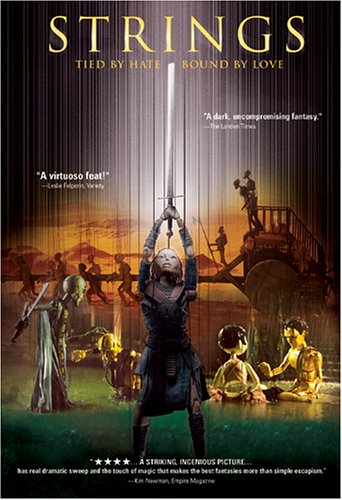
Strings: A Marionette Drama with Tangential Connections to Hamlet

Strings. Dir. Anders Rønnow Klarlund. Perf. James McAvoy, Catherine McCormack, Julian Glover, Derek Jacobi, Ian Hart, Claire Skinner, David Harewood, and Samantha Bond. 2004. DVD. Fox Lorber, 2005.

Many years ago, I chanced on a reference to Strings: it claimed that the film was a version of Hamlet. Having finally had a chance to watch the film, I concede that there are some Hamletesque tangents in the film, but, overall, the Shakespeare allusions are minimal. Essentially, they amount to the basic narrative: The King is dead, and the son attempts to avenge his death while the uncle attempts to seize control of the kingdom. But there are innumerable differences, including the fact that this king took his own life (a fact that is concealed from his son in a plot to remove the son from the seat of power and to deprive him of life).

If you see this film, you should let it stand on its own merits without considering the Hamlet connection too deeply. After all, it's quite an innovative film! The film doesn't merely present marionettes presenting a drama; the entire world of the film is a marionette world, crafted to show what such a world would be like. For example, the city gates are designed so that the marionettes' strings are prevented from entering—if you keep the strings out, you keep the rest out.

And it's beautifully shot. Observe the dark, tragic opening of the film:


I suppose the easiest reference to make is Claudius' speech:
Bow, stubborn knees; and, heart with strings of steel,
Be soft as sinews of the newborn babe!
All may be well. (III.iii.69-71)
Note: According to the Wikipedia site, there's another Hamlet connection: the film is "a Danish-Swedish-Norwegian-British co-production." Denmark is, therefore, in both works. But there's more! Substituting "Polish" for "Swedish"—because Fortinbras leads his troops "Against some part of Poland" (IV.iv.12)—provides us with a description of Hamlet itself!

Links: The Film at IMDB. The Wikipedia entry on the film.

Click below to purchase the film from amazon.com
(and to support Bardfilm as you do so).

Bardfilm is normally written as one word, though it can also be found under a search for "Bard Film Blog." Bardfilm is a Shakespeare blog (admittedly, one of many Shakespeare blogs), and it is dedicated to commentary on films (Shakespeare movies, The Shakespeare Movie, Shakespeare on television, Shakespeare at the cinema), plays, and other matter related to Shakespeare (allusions to Shakespeare in pop culture, quotes from Shakespeare in popular culture, quotations that come from Shakespeare, et cetera).

Unless otherwise indicated, quotations from Shakespeare's works are from the following edition:
Shakespeare, William. The Riverside Shakespeare. 2nd ed. Gen. ed. G. Blakemore Evans. Boston: Houghton Mifflin, 1997.
All material original to this blog is copyrighted: Copyright 2008-2039 (and into perpetuity thereafter) by Keith Jones.

The very instant that I saw you did / My heart fly to your service; there resides, / To make me slave to it; and, for your sake, / Am I this patient [b]log-man.

—The Tempest