Friday, August 17, 2012

The Tempest in the Closing Ceremony

Spall, Timothy. "Be not afeard." By William Shakespeare. Closing Ceremony. Olympics, London, 2012. Dir. Kim Gavin. 12 August 2012.

A quotation from The Tempest figured largely in the Opening Ceremony of the 2012 Olympics (for which, q.v.). The same quotation made its way into the Closing Ceremony—this time read by Timothy Spall in the character and after the manner of Winston Churchill.

Other Shakespeare quotes were also part of the Ceremony—printed as newspaper headlines and copy as part of the stage set (see the image above and the two images below). There were also quotations from other British authors, which sometimes led to unintentionally humorous connections. In the image above, for example, Samuel Johnson's famous words on the City of London are prominent at the top of the stage:
When a man is tired of London, he is tired of life.
That's all well and good—but the most prominent quote at the bottom is from Hamlet—when he is feeling quite tired of life himself:
To be, or not to be: That is the question.
But that's really beside the point.

The Shakespearean centerpiece was, once again, Caliban's "Be not afeard" speech—out of Winston Churchill by way of Timothy Spall (a version from the BBC DVD first, followed by my first effort—a clip shot from a screen):


Leaving aside the argument over whether Kenneth Branagh or Timothy Spall gave a better delivery of the lines, what are your thoughts on this? How does it change Caliban's speech to have it delivered by Winston Churchill? Does it make it more problematic? Does it change the tenor of the dream? Does it bring World War II into it?

[Note: I'm sorry about that last sentence. I remember that I was distinctly told "Don't mention the war," but I forgot.]

Let me know your thoughts in the comments below—and feel free to mention any other Shakespeare quotes you spotted during the Closing Ceremony. I didn't watch too much of it myself. When I learned that Ringo wasn't going to make an appearance, the Ceremony lost some of its interest for me.

"Now is the winter of our discontent." —Richard III

"The Rest is Silence: What a Piece of Work is a Man." —Hamlet

Click below to purchase the London 2012 Olympics discs from amazon.com
(and to support Bardfilm as you do so).

Wednesday, August 15, 2012

Shakespeare in Clueless

Clueless. Dir. Amy Heckerling. Perf. Alicia Silverstone, Stacey Dash, Paul Rudd, and Brittany Murphy. 1995. DVD. Paramount , 2005.

Clueless is better known for its connections to Jane Austen than its Shakespeare references; however, one of the means it uses to convey the plot of Emma is Shakespeare.

I detected two Shakespeare allusions in my admittedly-hurried glance through the film, and they're the most telling for the way they contrast. In the first, the Cher Horowitz / Emma Woodhouse character rightly recognizes lines from Shakespeare's Sonnet 18 as "famous"—but doesn't attribute them to Shakespeare. By the time, much later in the film, that the second allusion comes along, Cher / Emma has grown—and the male lead starts to recognize something more in her thereby:


That Mel Gibson provides her with this ability to recognize what the character of Hamlet said or didn't say is immaterial—she has the knowledge, and she's able to employ it. And it's also a good sign that she attributes the quote to "that Polonius guy" instead of "that Ian Holm guy."

Links: The Film at IMDB.

Click below to purchase the film from amazon.com
(and to support Bardfilm as you do so).

Monday, August 13, 2012

Friends and Lady Macbeth

"The One with the Tiny T-Shirt." By Adam Chase. Perf. Jennifer Aniston, Courteney Cox, Lisa Kudrow, Matt LeBlanc, Matthew Perry, David Schwimmer, and James Michael Tyler. Dir. Terry Hughes. Friends. Season 3, episode 19. NBC. 27 March 1997. DVD. Warner Home Video, 2003.

The omnivorous Shakespeare Geek usually beats me to the punch in relaying information about forthcoming Shakespeare films and cultural references to Shakespeare—which is why you should all follow his blog as well as mine—and this is no exception. In fact, Shakespeare Geek's blog called my attention to this Shakespeare reference in Friends. His post, written in 2008, mentions a brief Shakespeare joke in the show; however, his post doesn't provide the context or a nifty video clip. I felt that it was up to me to do so.

In this clip, Joey is mad at an actress who is treating him as an inferior because of her training in drama. Searching for a way to explain how she thinks she's better than anyone else, Joey ends his sentence with a cliché that doesn't quite jive with the beginning of his sentence:


Chandler is quick to jump on the incongruity and to imagine a speculative actress who is actually named Sliced Bread (the caption on the image above should have capitalized "Bread" to stay with the joke)—one who made herself memorable as great by playing the role of Lady Macbeth. Once again, Shakespeare demonstrates his usefulness as a marker of cultural greatness—as does Shakespeare Geek.

Links: The Episode at IMDB.

Click below to purchase all the Friends you can stand from amazon.com
(and to support Bardfilm as you do so).

Saturday, August 11, 2012

Hamlet's Father's Ghost's Speech in Paramount's Star Trek's Troi's Revenge

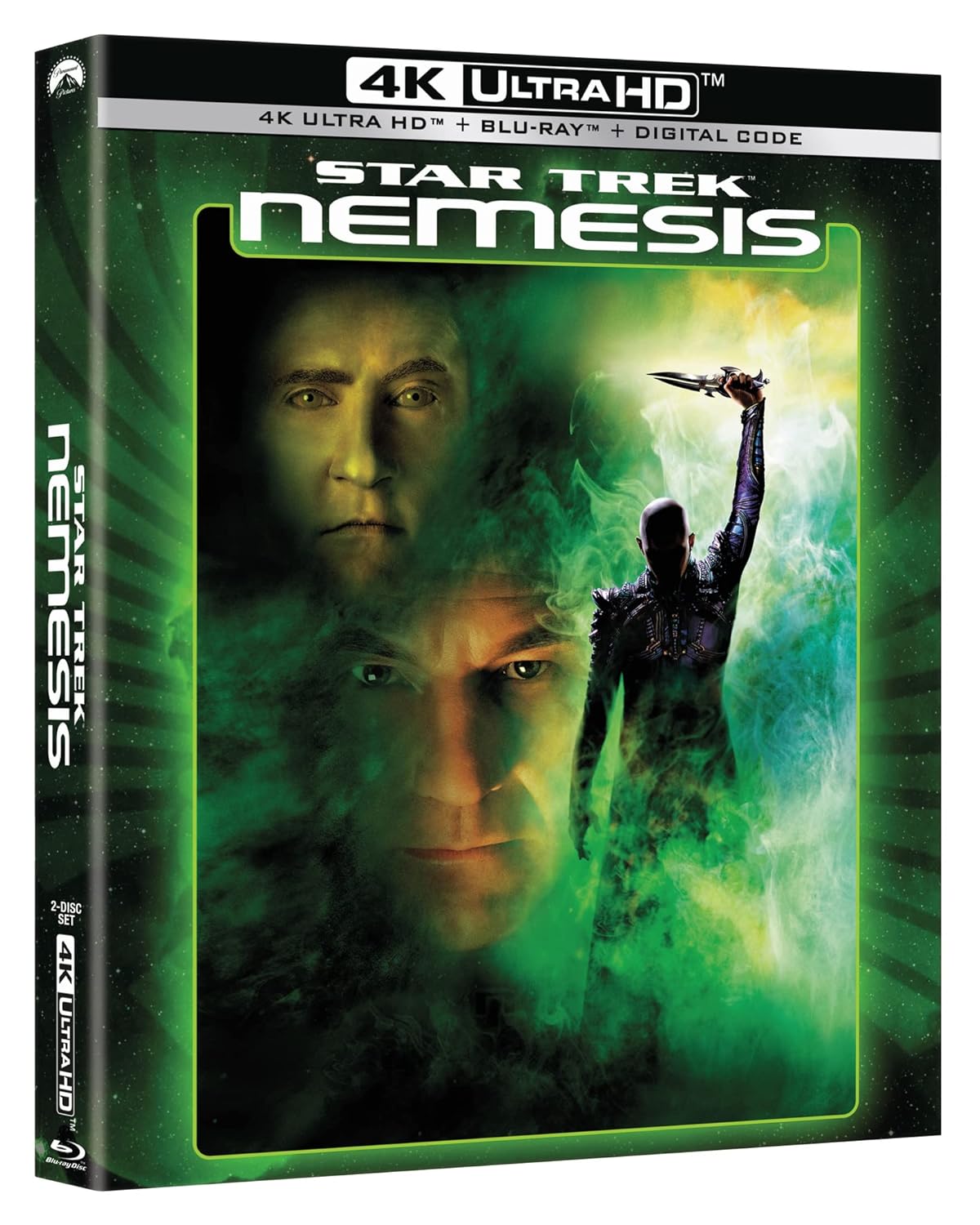
Star Trek: Nemesis [a.k.a. Star Trek X]. Dir. Stuart Baird. Perf. Patrick Stewart, Jonathan Frakes, LeVar Burton, Michael Dorn, Marina Sirtis, and Brent Spiner. 2002. DVD. Paramount, 2003.

In the worst of all the Star Trek films to date lies the final Shakespeare quotation of all the Star Trek films to date:
Remember me. (Hamlet, I.v.94)
The quotation had been used before—in an Original Series episode (for which, q.v.) and as the title of an entire Next Generation episode (for which, q.v.). In this film, it's used as a cry of revenge rather than (as in Shakespeare's play) a cry to revenge.

Deanna Troi has been psychically abused by the bad guys in this film; in this scene, she uses her empathic abilities to target the bad guys' cloaked ship:


And there you have it. Captain Picard's cry of "Fire at Will" is as likely to be a reference to Will Shakespeare as to Will Riker (in other words, not very likely), so the Shakespeare allusions in Star Trek stop at "Remember me." And that is, all in all, not a bad place for them to stop—even if the film itself is pretty bad.

Links: The Film at IMDB.

Click below to purchase the film from amazon.com
(and to support Bardfilm as you do so).

Quotation from King Lear in Star Trek V: The Final Frontier?

Star Trek V: The Final Frontier. Dir. William Shatner. Perf. William Shatner, Leonard Nimoy, DeForest Kelley, Nichelle Nichols, James Doohan, Walter Koenig, and George Takei. 1989. DVD. Paramount, 2005.

I'm not sure that much commentary is necessary here; the image says it all.

A Klingon character in Star Trek V: The Final Frontier utters a near-quotation from King Lear. In Shakespeare's play, the quotation has two additional words:
I am a very foolish fond old man. (V.vii.59)

Links: The Film at IMDB.

Click below to purchase the film from amazon.com
(and to support Bardfilm as you do so).

Friday, August 10, 2012

A Rare Allusion to Cymbeline in Star Trek

“Genesis.” By Brannon Braga. Perf. Patrick Stewart, Jonathan Frakes, LeVar Burton, Michael Dorn, Gates McFadden, Dwight Schultz, and Brent Spiner. Dir. Gates McFadden. Star Trek: The Next Generation. Season 7, episode 19. Syndicated television. 19 March 1994. DVD. Paramount, 2002.

I acknowledge that my previous two (at least) posts about Shakespeare in Star Trek may have been stretching it a bit, but we're back on solid ground here.

In this episode, the hypochondriac Barclay is worried that he may be suffering from a particularly Shakespearean illness: Cymbeline Blood Burn:


The skeptics among you may point out that the condition is spelled "Symbalene" in the captioning to the episode, and those same skeptics may point to the entry on Symbalene blood burn at Memory Alpha; however, those individuals may have overlooked two important points in their skepticism. First, the disease is likely named for this quote from Shakespeare's Cymbeline:
Thou basest thing, avoid! Hence, from my sight!
If after this command thou fraught the court
With thy unworthiness, thou diest: away!
Thou'rt poison to my blood. (I.i.125-28)
It's clear enough that a poison in the blood was enough to inspire the name of this condition, but the second point clinches it. Barclay had originally thought he was suffering from "Terellian Death Syndrome," which could be spelled "Tyrellian Death Syndrome" to indicate its connection to the character Tyrrel from Richard III. Tyrrel, as you know, is the one who dispatches the two princes in the Tower of London. If any Shakespeare character could be equated with a Death Syndrome, it's Tyrrel.

Links: The Episode at IMDB.

Click below to purchase the complete series from amazon.com
(and to support Bardfilm as you do so).

Thursday, August 9, 2012

"The fault is not in our Stars but in our Trek."

“Legacy.” By Joe Menosky. Perf. Patrick Stewart, Jonathan Frakes, LeVar Burton, Michael Dorn, Gates McFadden, and Brent Spiner. Dir. Robert Scheerer. Star Trek: The Next Generation. Season 4, episode 6. Syndicated television. 29 October 1990. DVD. Paramount, 2002.

In this clip, Captain Picard alludes to Cassius' speech tempting Brutus in Julius Caesar:
The fault, dear Brutus, is not in our stars,
But in ourselves, that we are underlings. (I.ii.140-41)

Links: The Episode at IMDB.

Click below to purchase the complete series from amazon.com
(and to support Bardfilm as you do so).
Wednesday, August 8, 2012

"Do you believe these . . ." allusions to Shakespeare in Star Trek?

“Yesterday's Enterprise.” By Ira Steven Behr. Perf. Patrick Stewart, Jonathan Frakes, LeVar Burton, Michael Dorn, Gates McFadden, and Brent Spiner. Dir. David Carson. Star Trek: The Next Generation. Season 3, episode 15. Syndicated television. 17 February 1990. DVD. Paramount, 2002.

The line I cite in this post is almost certainly not deliberately drawn from Shakespeare—but only almost certainly.

The episode contains this line: "Do you believe this . . . Guinan?"

Perhaps the connection is more between the way the line is delivered in a film version of Hamlet that I've seen very frequently, but I hear an echo of a line Polonius delivers to Ophelia: "Do you believe his . . . tenders, as you call them?" (I.iii.101).

I include both lines in the clip below. You be the judge:


Note: Polonius' quote above comes from Hamlet. Dir. Kevin Kline. Perf. Kevin Kline and Diane Venora. 1990. DVD. Image Entertainment, 1990.

Links: The Episode at IMDB.

Click below to purchase the complete series from amazon.com
(and to support Bardfilm as you do so).

Tuesday, August 7, 2012

A Few Final Fragments of Shakespeare in Star Trek: Data Quotes Sherlock Holmes Quoting Shakespeare

“Elementary, Dear Data.” By Brian Alan Lane. Perf. Patrick Stewart, Jonathan Frakes, LeVar Burton, Michael Dorn, Diana Muldaur, and Brent Spiner. Dir. Rob Bowman. Star Trek: The Next Generation. Season 2, episode 3. Syndicated television. 3 December 1988. DVD. Paramount, 2002.

Completing my collection of Shakespeare references in Star Trek (for which, q.v.) has proven more difficult than I thought it would be. This week, I'll be adding a few small moments that I overlooked—even though I wonder if some of them count.

For example, is it Shakespeare when the person being quoted is clearly Sherlock Holmes—even if Sherlock Holmes is quoting from Shakespeare? In this clip, Data has taken on the role of Holmes, and he concludes his deductions with "The game's afoot" (Henry V, III.i.32).


Data does extend Shakespeare's original contraction to "The game is afoot," but he doesn't extend "afoot" to "a foot," which would create an interesting image.

Links: The Episode at IMDB.

Click below to purchase the complete series from amazon.com
(and to support Bardfilm as you do so).

Tuesday, July 31, 2012

A New Musical Version of Merchant of Venice: Shylock Sings the Blues

Sokol, David. Lyrics. Shylock Sings the Blues. Music by Dennis Willmott. Perf. The Venetians. David-Sokol.com Productions, 2012. CD.

I get—or, rather, Bardfilm gets—a fair number of requests from people wanting their book, DVD, or other project reviewed or their Kickstarter project promoted. I'm often amenable, but I'm also often severely lacking in time. "Send it along," I say, "but I don't know when I'll get to it."

This is one project that I wish I had gotten to earlier. I'm a fan of Shakespeare, and I'm a fan of the blues, but I kept putting off listening to the CD Shylock Sings the Blues that David Sokol sent me.

I shouldn't have.

This CD is astonishing in its vision, its lyrics, and its music. The liner notes invite us to imagine a Merchant of Venice set in the gangster underworld of New Jersey in the 1950s. In it, we have a very sympathetic Shylock—one who doesn't desire revenge for the anti-Semitism he's faced as much as he desires to expose the other characters' hypocrisy. The songs roughly follow the plot of the play, taking us musically inside the minds of most of the main characters.

Honestly, I hope someone picks this album up and produces a full-scale Broadway musical out of it.

The music is well-performed, and the songs are well-sung. There's a rough edge to some of the numbers that is drawn from early blues performances. I hear a fair bit of Robert Johnson in the guitar work, and Etta James seems to be moving through the female vocals. And Big Bill Broonzy's sound is here, too. The music is great.

I also hear something of a song called "Dealin' with the Devil" as performed by James Cotton on the 1995 album Deep in the Blues, but more in terms of some of the themes of the album. One of the strongest pieces on the album is "The Devil Told Me." Not all the songs on the album are narrative in nature, but this one embodies Launcelot Gobbo's monologue about leaving Shylock's service. As such, it contains the anti-Semitism of Launcelot's speech (equating Shylock with the devil, for example) as well as Launcelot's hypocrisy (blaming Shylock for doing wrong while admitting his own wrongdoing).

I received permission to provide that track on this blog as a sample. I've done so by making it the soundtrack to part of the silent 1910 film version of Merchant (for which, q.v.). It seemed entirely appropriate to do so. That clip follows, and it is followed by the song's lyrics (taken from the album's website, but with slight alterations) and Launcelot's speech from Shakespeare's play.

The Devil Told Me

I had a conversation with the devil
It made a lot of sense
He visited me at my house and
that was no coincidence

I had to get out of the hole I was in
The devil said I could rely on him.

About the guy I work for
my conscience said I should stay
[That devil said I should just run away.]
And the angel told me
she said I should stay.

You tell her to shut her mouth
and go away


Yeah but doin’ the wrong thing can bring
so much guilt and shame

The person you wrong is
always the one you should blame
.

Run away from you
Run as if I flew
Gonna run away from you
Run as if I flew.

Take my advice or you’ll leave in a hearse.

I may be listenin’ to the devil but
What I runnin’ from is worse.

You guys make the money
and you guys got the fame
for all the world's problems
you guys got the blame.
You got greed and avarice
And world control
You got banks and TV and you
you got radio
You got media and expedia
and private jets abound
you got limos and Maseratis
and I take the bus to town.

Run away from you
Run as if I flew.

Oh my daddy told me
He said You will always be a slave.

I am telling you you don't have to behave.

Now I hate you and I love you
And I envy what you got
Your Caddy and your Lincoln
And your sunny beach spot.

You guys make all the money
and you pile it up around
You got the big old house
on the hillside of town.

Run away from you.
Run as if I flew.
Here's Launcelot Gobbo's speech:
Certainly my conscience will serve me to run from this Jew my master. The fiend is at mine elbow and tempts me, saying to me, “Gobbo, Launcelot Gobbo, good Launcelot,” or “Good Gobbo,” or “Good Launcelot Gobbo, use your legs, take the start, run away”. My conscience says “No; take heed, honest Launcelot; take heed, honest Gobbo,” or, as aforesaid, “honest Launcelot Gobbo; do not run; scorn running with thy heels.” Well, the most courageous fiend bids me pack: “Via!” says the fiend; “away!” says the fiend; “for the heavens, rouse up a brave mind,” says the fiend, “and run.” Well, my conscience, hanging about the neck of my heart, says very wisely to me “My honest friend Launcelot, being an honest man’s son,” or rather an honest woman’s son; for, indeed, my father did something smack, something grow to, he had a kind of taste; well, my conscience says, “Launcelot, budge not.” “Budge,” says the fiend. “Budge not,” says my conscience. “Conscience,” say I, “you counsel well;” “ Fiend,” say I, “you counsel well.” To be ruled by my conscience, I should stay with the Jew my master, who, God bless the mark, is a kind of devil; and, to run away from the Jew, I should be ruled by the fiend, who, saving your reverence, is the devil himself. Certainly the Jew is the very devil incarnal; and, in my conscience, my conscience is but a kind of hard conscience, to offer to counsel me to stay with the Jew. The fiend gives the more friendly counsel: I will run, fiend; my heels are at your command; I will run. (II.ii.1-32)
Do yourself a favor and buy this album. It is simply remarkable.

Film clip from Merchant of Venice. Dir. Gerolamo Lo Savio. Perf. Ermete Novelli, Francesca Bertini, and Olga Giannini Novelli. 1910. DVD. Image Entertainment, 2000.

Links: The Album's Official Website.

Another Review of the Album.

Yet Another Review of the Album.

Click below to purchase the album from amazon.com
(and to support Bardfilm as you do so).

Monday, July 30, 2012

The Tempest in the Opening Ceremony

Branagh, Kenneth. "Be not afeard." By William Shakespeare. Opening Ceremony. Olympics, London, 2012. Dir. Danny Boyle. 27 July 2012.

When you heard that the 2012 Olympic Games in London would be opened by the ringing of an enormous bell inscribed with a quotation from Shakespeare, each one of you had an idea of what it would be. Those who admire the equestrian events were hoping for "My kingdom for a horse" while soccer fans expected "You base football player," a quote from King Lear. I wished for "Your hands than mine are quicker for a fray, / My legs are longer though, to run away" from Midsummer Night's Dream—or even "[They] shall with speed to England" from Hamlet, but I thought it much more likely that the famous speech from Richard II would make the final cut:
This royal throne of kings, this scepter'd isle,
This earth of majesty, this seat of Mars,
This other Eden, demi-paradise,
. . . . . . . . . . . . . . . . . . . . . . . . .
This blessed plot, this earth, this realm, this England. (II.i.40-42, 50)
When I learned that it was from one of Caliban's speeches in The Tempest instead, I was a bit perplexed, especially considering the complicated ways in which Caliban's character has been read and the fact that the quote comes from a scene in which Caliban is urging the violent overthrow of Prospero. The line on the bell is short:
Be not afeard; the isle is full of noises. (III.ii.135)
As inscribed, it has no context—not even the context of its author's name. All the same, it carries a calming sense.

In the opening ceremony, Kenneth Branagh delivered the speech in its entirety, re-contextualizing it as a speech of promise. The opening ceremony itself took a historical approach—and one that wasn't always sentimentalized. The opening song was the hymn "Jerusalem," its lyrics by William Blake. That song mentions "England's mountains green" and its "pleasant pastures" as well as the "dark Satanic Mills" usually read as the devastation of the Industrial Revolution. And the opening ceremony reflected both the joys of an English country green and the humble sports played upon it and the smokestacks and greed wrought by the Industrial Revolution. But the conclusion of the song points toward the hope of the redemption of the land and a determination to reverse the damage done to it.

Branagh's delivery of the speech from The Tempest similarly recognizes the ills done by the isle while hoping for a reversal of those ills.

Update: The BBC has released a six-disc set of the London 2012 Olympic Games; I was able to put together the following clip from it. I've left the two other permutations of the clip below.


Some kind soul operating under the on-line name Mikeatle captured Branagh's delivery of the speech. It is embedded below; below it is my own clip of the speech—in case Mikeatle's disappears; below that is the full text of the speech:


Note: The clip immediately above has been edited to bring the ringing of the bell closer to the delivery of the speech. I've also removed the commentary and extended both the ringing of the bell and the applause after the speech.
Be not afeard; the isle is full of noises,
Sounds, and sweet airs, that give delight and hurt not.
Sometimes a thousand twangling instruments
Will hum about mine ears, and sometime voices,
That if I then had wak'd after long sleep,
Will make me sleep again, and then in dreaming,
The clouds methought would open and show riches
Ready to drop upon me, that when I wak'd,
I cried to dream again. (III.ii.135-43)
What do you think? Is this an overly-optimistic reading of the speech? Does this address the issues of postcolonialism raised by the play itself? Does Kenneth Branagh always deliver speeches from Shakespeare in the voice of Henry V and with a matching soundtrack?


No one can emote awe and childlike wonder better than Kenneth Branagh.


Click below to purchase the discs from amazon.com
(and to support Bardfilm as you do so).

Tuesday, June 26, 2012

Richard III in Twin Peaks

"Episode 18" [a.k.a. "Masked Ball"]. By Barry Pullman. Perf. Kyle MacLachlan, Michael Ontkean, and Mädchen Amick. Dir. Duwayne Dunham. Twin Peaks. Season 2, episode 18 [a.k.a Season 2, episode 11]. ABC. 15 December 1990. DVD. Paramount, 2007.

I don't imagine ever having the time to even watch—let alone comprehend—the cult classic television series Twin Peaks. Yet we find some Richard III there, too.

Since I don't fully understand what's going on . . . hold on—that was too mild. Let me start this paragraph over again.

Since I'm completely mystified by the show, I'll turn to a paragraph of summary provided by the Twin Peaks Episode Guide blog:
In his office, unshaven Ben Horne, looking as though he’d slept in his clothes, watches home movies of the groundbreaking of the Great Northern Hotel. “Now is the winter of our discontent made glorious summer by this son of York,” he recites as he approaches the screen to kiss his mother’s image.
And here's the clip:


And that's how Richard III week at Bardfilm comes to a close—not with a bang, but with a semi-confused "Huh?"

Have I missed any of your favorites? Let me know in the comments below—but you might also try these Richard III-related clips:
Spectacular Spider-Man
Black Adder
Family Guy 1
Family Guy 2
King Rikki 1
King Rikki 2
Looking for Richard
Richard (Loncraine / McKellen)

Links: The Episode at IMDB.

Click below to purchase the series from amazon.com
(and to support Bardfilm as you do so).

Monday, June 25, 2012

Richard III in Jesus of Montreal

Jesus of Montreal. Dir. Denys Arcand. Perf. Lothaire Bluteau, Catherine Wilkening, and Johanne-Marie Tremblay. 1989. DVD. Koch Lorber Films, 2004.

This quotation from Richard III may be more than just incidental—it certainly seems so—but I'm not familiar enough with the film to dig deeply into its significance.

But I can point out the connections between religion and theatre that the scene evokes. The film is about a theatre director who is hired to put on scenes from Christ's passion for a church pilgrimage of sorts. The unorthodox theology behind his presentation makes a number of people nervous and angry.

In the scene below, a character contemplates his own history. He presents theatre and religion as something of a dichotomy. He loved the theatre, but he felt that he had to pursue religion instead:


The rest of the film may, in part, be contemplating whether religion and theatre are irreconcilable entities. Perhaps it is even taking us back to the origins of the theatre in English—to the medieval mystery plays themselves.

Links: The Film at IMDB.

Click below to purchase the film from amazon.com
(and to support Bardfilm as you do so).

Friday, June 22, 2012

Richard III in The Wars of the Roses

King Richard III. Dir. Michael Bogdanov. Perf. Andrew Jarvis, Michael Pennington, Anne Penfold, June Watson, and Susanna Best. Wars of the Roses. 1990. DVD. Films for the Humanities & Sciences, 2005.

And now, in the category of terrific films that no reasonable person can reasonably afford, we have the series The Wars of the Roses, the English Shakespeare Company's astonishing production of both tetralogies. Yes, they filmed their series of plays that includes the plots of Richard II; Henry IV, Part One; Henry IV, Part II; Henry V; Henry VI, Part One; Henry VI, Part Two; Henry VI, Part Three; and Richard III. Amazing is too mild a word for it.

But it's also around $700 for the series, which is why you should have your library buy it for you (as I did).

Their Richard III opens with this excellent and humor-filled introduction to the cast. In under four minutes, they set the stage for the play, obliterating any confusion students, scholars, and general readers might face in encountering the play:


Links: The Series at IMDB.

Click to purchase
(or to have your library purchase)
the films from Films for the Humanities and Sciences.

Thursday, June 21, 2012

Richard III in Magnum, P. I.

“Case of the Red Faced Thespian.” By Donald P. Bellisario and Glen A. Larson. Perf. Tom Selleck, John Hillerman, and Roger E. Mosley. Dir. Ivan Dixon. Magnum, P. I. Season 4, episode 12. CBS. 19 January 1984. DVD. Universal Studios, 2006.

While Runaway Train lies nearer to the sublime on the continuum, this episode of Magnum, P. I. moves along the scale toward the ridiculous.

I know very little about the conventions of the show, but this episode centers on a character named Higgins who is struck on the head by a croquet ball just before a 1920s Theme Party begins. He imagines himself to be the great (albeit fictional) Shakespearean actor Sir Fearing Pangborn. [As a side note, does anyone know whether that name is parodying any actor in particular? Sir Herbert Beerbohm Tree? John Barrymore?] [Additional Note: See the comments below for the solid suggestion that the character actor Franklin Pangborn is the object of the mild parody.] Another character (T.C., for those in the know) is dressed as Paul Robeson—but he claims he's playing Paul Robeson playing Brutus Jones, so there's no additional Robeson-as-Othello material in this episode.

Here's a brief sample. Warning: It's quite silly, and impressional people should not be allowed to assume that Magnum's shirt-and-shorts combo is appropriate attire in the twenty-first century.


Links: The Episode at IMDB.

Click below to purchase the complete series from amazon.com
(and to support Bardfilm as you do so).

Bardfilm is normally written as one word, though it can also be found under a search for "Bard Film Blog." Bardfilm is a Shakespeare blog (admittedly, one of many Shakespeare blogs), and it is dedicated to commentary on films (Shakespeare movies, The Shakespeare Movie, Shakespeare on television, Shakespeare at the cinema), plays, and other matter related to Shakespeare (allusions to Shakespeare in pop culture, quotes from Shakespeare in popular culture, quotations that come from Shakespeare, et cetera).

Unless otherwise indicated, quotations from Shakespeare's works are from the following edition:
Shakespeare, William. The Riverside Shakespeare. 2nd ed. Gen. ed. G. Blakemore Evans. Boston: Houghton Mifflin, 1997.
All material original to this blog is copyrighted: Copyright 2008-2039 (and into perpetuity thereafter) by Keith Jones.

The very instant that I saw you did / My heart fly to your service; there resides, / To make me slave to it; and, for your sake, / Am I this patient [b]log-man.

—The Tempest