Monday, July 26, 2021

Shakespeare in Get Fuzzy

Conley, Darby. Dumbheart: A Get Fuzzy Collection. Kansas City: Andrews McMell, 2012.

We've covered a number of Shakespeare-related comics here at Bardfilm, but we have never ventured into the Get Fuzzy world.

It's a bit of a shame because there's some pretty good material there.

For example, the comic introduced a character called "Shakespug"—a dog (a pug, if it isn't clear) who spends a lot of his time quoting Shakespeare. 

Here are some samples with a bit of commentary from time to time.


Bucky is the main cat character in the comic, so it's clear that he would be upset by the introduction of any new character.


That one provides a nice variant! I'm glad that Shakespug is caught out in trying to pass off quotes from Every Man in His Humour as Shakespeare. And I'm even more amazed that Bucky (who is generally presented as not having the keenest of intellects) calls him out on it, recognizing a Ben Jonson quotation trying to pass itself off as a Shakespeare quote. 


There, again, we have a nice, more obscure direction. The quote (slightly misquoted) is from Two Gentlemen of Verona. It's not the place everyone would go.


Alas, I suppose even the greatest Shakespeare scholars can't always call to mind the most relevant quotations from Shakespeare at the exact moment when they would do the most good. I know it's happened to me—but let's be silent and not speak of that. 

Click below to purchase the book from amazon.com
(and to support Bardfilm as you do so).

Tuesday, July 20, 2021

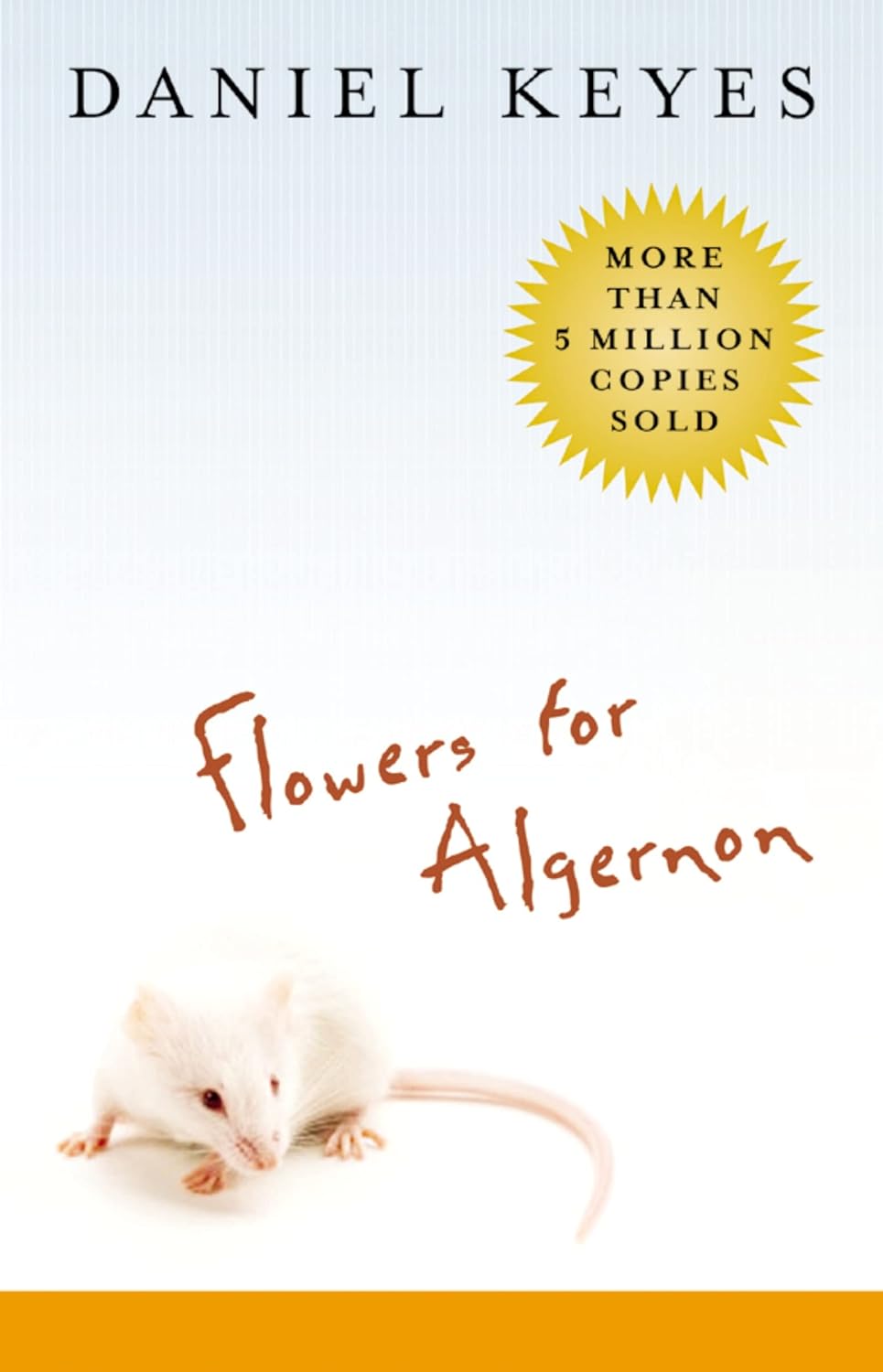
A Little Shakespeare in Flowers for Algernon

Keyes, Daniel. Flowers for Algernon. New York: Harcourt Brace, 1897.

The short story "Flowers for Algernon" was a memorable part of the general literature curriculum when I was growing up. Only recently did I learn that there was a novel telling the same story.

The story is about a mouse (Algernon) who has undergone an operation and has gained "super-genius" status. The same operation has been performed on our protagonist, whose intelligence had been below average.

Before you risk any spoilers, you can pause to read the short story.

Back?  All right.

The story, then, is about how the mouse starts to lose his intelligence just when the man is reaching the peak of his and what the man thinks when he realizes his intelligence is ephemeral. 

Somewhere in the middle of the novel, Charlie Gordon (the man) is exposed to college life, and he's fascinated by all the things people have to say. The section below shows the direction the conversation goes when Shakespeare comes into the picture:


The rest of the book is silent on what Charlie thinks about the argument, but it's interesting to note that this is one issue that fuels his intellectual hunger.

Click below to purchase the book from amazon.com
(and to support Bardfilm as you do so).

Friday, July 16, 2021

Book Note: Romeo and / or Juliet

North, Ryan. Romeo and / or Juliet. New York: 
Riverhead Books, 2016.
If you want one more layer of "chose your own," you can start by deciding whether you want Ryan North's To Be or Not To Be (for which, q.v.) or Romeo and / or Juliet. Either way, you'll be well served—though the latter is perhaps a bit more inviting in terms of graphics.

Like the Hamlet book, this one gives you the chance to choose roles—you can play / read as Romeo or as Juliet.

Here's a bit of the way that's established:


Click below to purchase the book from amazon.com
(and to support Bardfilm as you do so).

Thursday, July 15, 2021

Book Note: To Be or Not To Be

North, Ryan. To Be or Not To Be. N.p.: Breadpig, 2013.

I could have sworn I wrote about this book—one that started life as a Kickstarter project—much nearer its publication date, but my memory seems to be faulty.

Here we go, then!

This is a fascinating "Choose Your Own Adventure" version of Hamlet—with a ton of fascinating twists. To start, you choose whether you'd like to read it / play it as Hamlet, as Ophelia, or as Hamlet's Father's Ghost. From there, there must be hundreds of ways to go.

I find it to be a great book to noodle around on while waiting for appointments, commuting, or relaxing. You're never committing to reading all 700+ pages—just to following an interesting path.

Let me show you one possible path, starting with choosing Hamlet.


Note that it doesn't stop even after that last choice! Inventively, the storyline continues.

Grab a copy, relax, and make your way through Hamlet.

Click below to purchase the book from amazon.com
(and to support Bardfilm as you do so).

Wednesday, July 7, 2021

Knowledge of Shakespeare Helps Solve Mysteries

Marsh, Ngaio. Surfeit of Lampreys [a.k.a. Death of a Peer]. New York: Felony & Mayhem Press, 2013.

If you needed another reason to brush up your Shakespeare (not that you do—Cole Porter helped us realize that), remember that a good knowledge of Shakespeare can help you solve the mysteries typical to detective fiction.

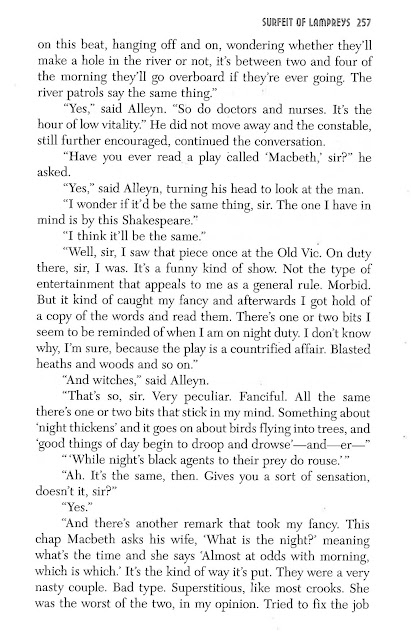
Here's an example from a Ngaio Marsh novel that I recently finished.

First, we get the play's relevance established:


Then we get the secondary character whose casual comments lead the detective to the solution:


I won't give you the solution, of course, but, if you're well up on your Macbeth, you know it already. And if you aren't, now's the time.

Click below to purchase the book from amazon.com
(and to support Bardfilm as you do so).

Friday, July 2, 2021

The Complete Shakespeare: Where it All Began for Bardfilm

Shakespeare, William.
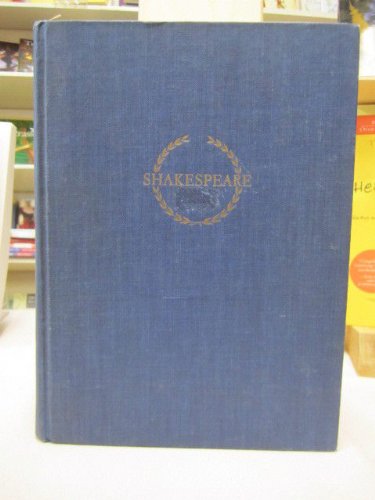
The Complete Plays and Poems of William Shakespeare. Ed. William Allan Neilson and Charles Jarvis Hill. Cambridge: Houghton Mifflin Company (The Riverside Press Cambridge), 1942.

The New Cambridge Edition of the Complete Works of William Shakespeare was the place where it all began.

I don't mean that this was my first experience with Shakespeare. That has been lost to the ages (though I make a stab at some of the earliest encounters here).

I mean that this was the first time I fell head-over-heels, leave-everything-behind, I've-found-it-at-last, I'll-never-forget-you in love with the complete works of Shakespeare.

Thinking reading Shakespeare might prove beneficial to me, I bought the volume for ten dollars at a used bookstore in St. Louis. And I read it, literally, from cover to cover.

Indeed, that was probably the last time I read straight through the sonnets (pictured below).


I found various and sundry people who were willing to read it through out loud with me, and that was a revolution. I distinctly remember my first genuine, conscious encounter with III.i of Hamlet (pictured below):


What marvels were there!

And I read through every play.  Indeed, that was probably the last time I read straight through Henry VIII.

You may note the absence of any annotations on the images above. Yes, that goes for the whole text. At that point, I considered the physical text somewhat sacrosanct, so I did not underline anything or write any question marks or exclamation points or questions or arguments in the margins or on the footnotes. Most of my other editions of Shakespeare plays—complete or individual—have all of that and more. But this was where it all started, and I'm glad it's still there, unmarked, though faded and fraying. I'm still particularly fond of this volume, and I think I shall always be so.

Click below to purchase the book from amazon.com
(and to support Bardfilm as you do so).

Tuesday, June 29, 2021

Book Note: Her Infinite Variety: Stories of Shakespeare and the Women he Loved

Berkman, Pamela Rafael. Her Infinite Variety: Stories of Shakespeare and the Women he Loved. New York: Scribner Paperback Fiction, 2001.

This is one of those books that hung around for a while until I felt guilty enough to read it. It's a collection of imaginative short stories about the women in Shakespeare's life—Anne, Judith, the Dark Lady, et cetera. And it includes short stories about the fictional women in Shakespeare's life—Ophelia, Titania, and others.

The stories vary quite a bit. Some are remarkably tedious while others have sparks of genuine interest.

I gravitated toward the stories about characters. For example, here's Titania's story, in which we learn that her fairy powers and her hatred of the "falling in love with a donkey" plot point combine to bring a very particular curse on Shakespeare's head:


The Ophelia story also has some interest:


There you have it. Some points of interest are to be found here, but the volume won't become a mainstay in my Modern Shakespearean Fiction class.

Click below to purchase the Book from amazon.com
(and to support Bardfilm as you do so).

Wednesday, June 2, 2021

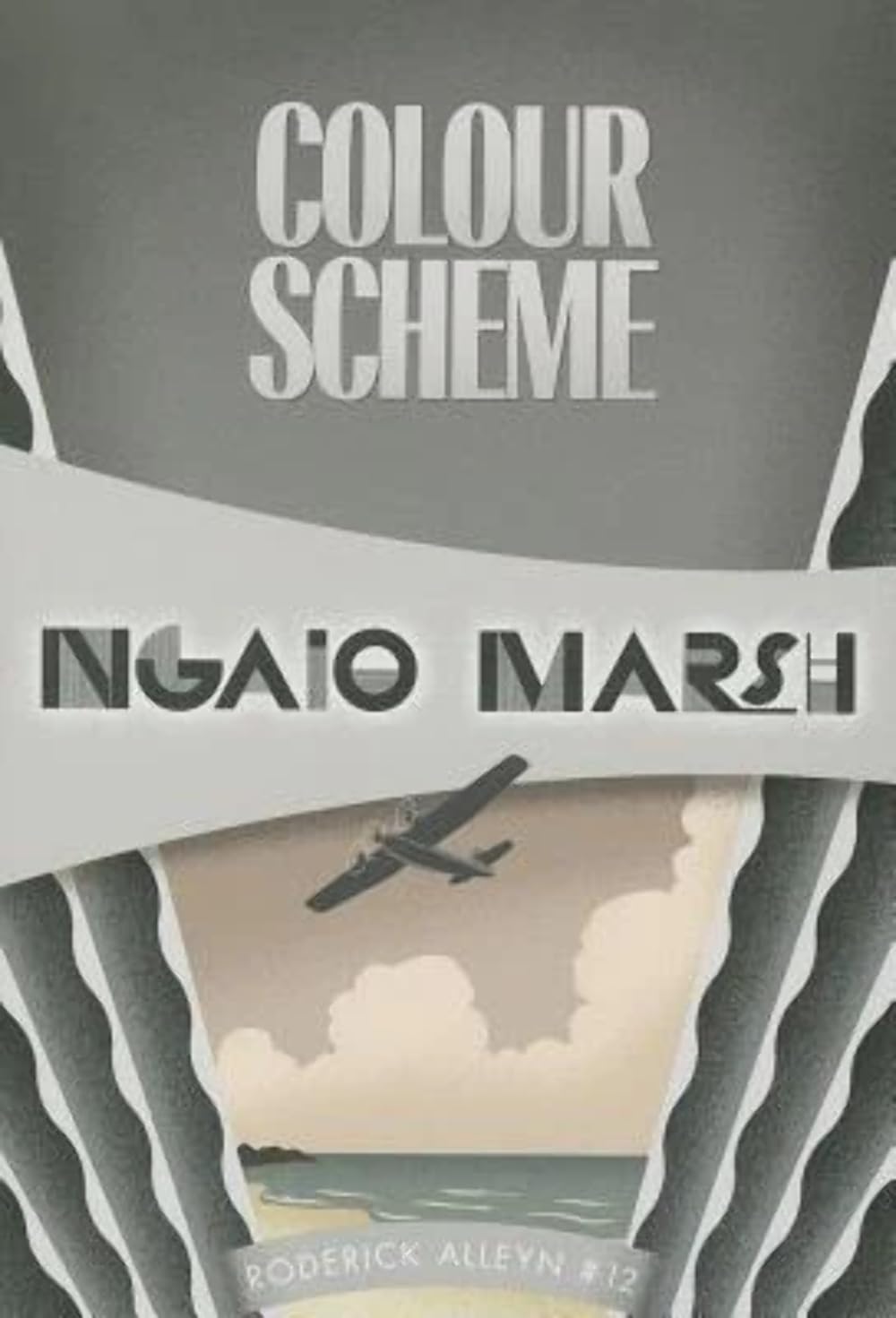
Book Note: Colour Scheme

Marsh, Ngaio. Color Scheme. New York: Felony & Mayhem Press, 1971.
I've been trying to read through the complete works of Ngaio Marsh in chronological order, and it's a fun project. Here at Bardfilm, you may have encountered Death at the Dolphin (for which, q.v.) and / or Light Thickens (for which, q.v.). Those are both novels set around specific Shakespeare or Shakespeare-related productions.

But, as with Agatha Christie and Dorothy L. Sayers, Shakespeare allusions or Shakespearean actors are never very far out of the picture.

In Color Scheme, a 1943 novel set in New Zealand, a retired (but not retiring—see what I did there?) Shakespearean actor goes to a hot springs resort to attempt to cure his gammy leg. While there, he (naturally) speaks some speeches trippingly on the tongue. One of the first of these is the Agincourt speech—in this case, spoken to impress a female admirer at the springs. 

The Henry V is important (a key plot point hinges on it—but there's a mistake there somewhere), so stick around. But I want to give you that first scene nearly in full—the characters have a wide-ranging discussion about Shakespeare (it starts about halfway down page 135 below):


All very interesting and good—particularly the line about Charley's Aunt to close the scene.

But then there's a murder. And the alibi of one of the suspects depends on when he was at a performance of "Speeches from Shakespeare" delivered by our retired actor friend Gaunt. Here's how that gets set up (page 260):


So they got back in time to hear the part early on in the performance where Gaunt delivers the St. Crispin's Day speech. And, as something of a side note, if you check OED definition B.3 for "dugout, adj. and n.," you get this: "3. A person of out-dated appearance or ideas; spec. a superannuated officer, etc., recalled for temporary military service. slang." Very good. But then we get this on page 289:


I believe the popular expression is "Wait . . . what?"

The time difference between the two speeches is clearly important, as we learn on page 290:


But there it is again. It suggests a difference between the Agincourt speech and the Crispin speech. But those are the same speech! "Once more into the blasted breeches, pals" comes from what is often called "The Speech Before Harfleur," which comes much earlier in the play but six minutes later in the performance of Shakespeare speeches.

It's clear what they mean, and it doesn't really make any difference to the alibi. But I wonder how the mistake made its way into the final version of the novel—if this is the final version of the novel. I was reading from a 1971 edition. My next step will be to try to track down an earlier and a later printing to see if it's just this edition that got them mixed up or if they were mixed up from the get-go.

Click below to purchase the book from amazon.com
(and to support Bardfilm as you do so).

Wednesday, May 19, 2021

Ophélia (1962)

Ophélia
. Dir. Claude Chabrol. Perf. Alida Valli, Claude Cerval, and André Jocelyn. 1962. DVD. Gaumont, 2012. Blu-Ray. Olive Films, 2017.

Disappointed with the 2018 film entitled Ophelia (for which, q.v.), I decided to search back in time (and on my shelves) to see if the 1962 French film Ophélia might have more to offer.

It does, but it does not center its story on Ophelia's narrative.

Let me walk you through the experience of the film in case you're not able to track it down and watch it for yourself.

We start with an establishing shot of a funeral. The coffin is outside, and everyone is gathered around it. Then, after a brief shot of the corpse, we get a POV shot from inside the coffin of all the mourners. The lid blocks that shot; then we cut to the coffin being taken into a chapel of some sort. After everyone enters, the camera is left outside, and the doors close, providing a blackout.

Roll opening credits. 

After about ninety seconds, we fade back on the doors, which open. Dozens of very clearly very happy people then walk toward and past the camera. The last to exit the chapel is a solitary figure—one of the distressed mourners we saw from the perspective of the camera in the opening sequence.

In this brilliant way, we experience just how short a time it is (or seems—nay, I know not "seems") for Hamlet between the funeral and the marriage.

We then get a brief scene that I'll provide. It's worthy of something done by Henri, the Exitential Cat (for example, this one—Henri 4: L'Haunting). But I digress. Here's the clip from Ophélia I have in mind:


As we continue our stroll through this film, we learn that our protagonist's name is Yvan Lesurf and that his uncle, Adrien, has married his mother, Claudia. "A-ha!" we think. "We anticipate an interesting role-reversal trick."

After we see several instances of Yvan behaving erratically, we meet Lucie, his girlfriend. We also learn that his uncle—whom he sometimes calls "father," just as he sometimes calls his mother "aunt"—is worried for his life because of a threatening strike at the factory he now owns.

On another day, Yvan wanders into town and sees the townsfolk excited about the new film that is now showing at the local theatre: Laurence Olivier's Hamlet!

Up to this point, we've been tracking the plot of Hamlet, and we've been assuming that we're watching a straight derivative version of the play. But we haven't been! The plot has just been coincidental. And, just as we realize that, Yvan realizes it. And he figures that what worked for Hamlet will work for him. Here's how he thinks it through and presents it to his friend François:


Thus, we find ourselves in something more like the "mirror movie" category of derivative—as propounded by Kenneth Rothwell (for which, q.v.).

At this point, Yvan starts calling Lucie "Ophelia," despite her insistence that she's Lucie. She thinks he's going crazy, thinking of her as Ophelia and himself as Hamlet—and everyone else in analogous positions.

Not much later, we are presented with a very amusing movie-within-a-play-within-a-movie (of sorts) and . . . well, you'll have to track down the rest on your own! But I will say that it's both interesting and probably not exactly what you're thinking.

Well, make that definitely not exactly what you're thinking. And, okay, I'll give you the play-within-the-play scene to make up for that cliffhanger:


Links: The Film at IMDB. Note: IMDB gives the year as 1963, but both formats I have list 1962 as the year.

Click below to purchase the film, in one format or another, from amazon.com
(and to support Bardfilm as you do so).

 (DVD) 

(Blu-ray)

Note: In this case (and currently), the Blu-ray is much less expensive than the DVD. It also has subtitles in English as well as French, which might be important to some viewers.

Bonus Image! Yvan checks out what's playing at the local cineplex:


Bonus Video! But it's really just the first part of the first video above:

Friday, May 14, 2021

Ophelia (2018)

Ophelia
. Dir. Claire McCarthy. Perf. Daisy Ridley, Mia Quiney, Calum O'Rourke. 2018. DVD. 
Shout! Factory, 2019.
Based on the book by Lisa Klein (for which, q.v.), the 2018 film Ophelia has a fair bit of interest—up to a point.  And then it all falls apart.

The opening is pretty promising. We get, à la Olivier, some narration. Over a shot of Ophelia floating and then sinking in the brook, Ophelia herself tells us that her story has been told many times by many people, but now it's her chance to tell it herself:


The scene also gives us the musical theme that will run through the entire film—a setting of the poem in Hamlet's letter to Ophelia: "Doubt thou the stars are fire, / Doubt that the sun doth move, / Doubt truth to be a liar, / But never doubt I love" (II.ii.116-19).  

The next scene involves the ten-year-old (ish) Ophelia and her entrée into court. The young Queen Gertrude takes a liking to her, makes her one of her maids-in-waiting, and protects her from the jealous mocking and cruel treatment the other maids-in-waiting deal out. We get some interesting information about Gertrude's backstory, and the relationship between these two—the only two female characters in Shakespeare's play—starts to develop some interest and depth.

The scene with Laertes' departure and Polonius' challenge to Ophelia also shows some interesting family dynamics:


I like the paraphrasing and paring down of Polonius' advice to his son. Additionally, the relationship between Polonius and Ophelia when they talk about Hamlet seems more playful than controlling (though, clearly, it's both).

And the nunnery scene is also interesting, though also somewhat unbelievable. Ophelia uses the opportunity to pass along a warning to Hamlet. Please note that there will be spoilers in this clip and in the rest of this post.


So. Yes. I'm sorry for the spoilers, but they will help indicate how what might be interesting and deep and significant is abandoned in favor of the ludicrous. With one perfectly good play to develop into a derivative, this film decides it isn't enough. We get some Macbeth—Ophelia visits the three witches (conflated into one). And then we get some Romeo and Juliet. We learn that, in her younger days, the witch took the same potion Juliet took to avoid being burned at the stake. And, in this Hamlet derivative, Ophelia and Hamlet have gone off to a Friar to be secretly married.

If you keep watching from that point, the plot just gets more and more convoluted and confusing. If you make it to the duel scene, be prepared to laugh heartily. And if you get to the end, you'll see that the advertising tag line for the film, "Vengeance is Hers," is the exact opposite of the conclusion.

In short, the first third is really interesting, the second third is weird, and the final third is laughable. It's interesting to watch, but it could have been so much better.

There's another film entitled Ophélia—a French film from 1962—that I intend to try next. Let's see if that's  a better way to hear her story.

Links: The Film at IMDB.

Click below to purchase the film from amazon.com
(and to support Bardfilm as you do so).
Thursday, May 13, 2021

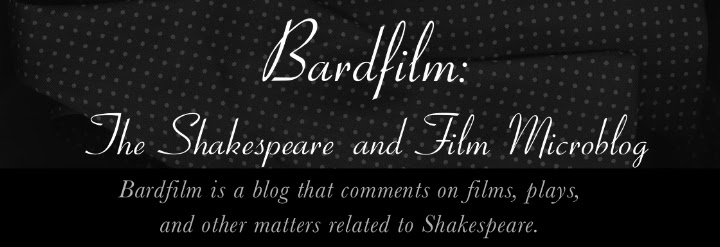
Book Note: Maurice Evans' G. I. Production of Hamlet

Evans, Maurice. Maurice Evans' G. I. Production of Hamlet by William Shakespeare: Acting Edition. Pref. Maurice Evans. Illus. Frederick Stover. Garden City: Doubleday & Company, 1947.

A discussion of the Macbeth that Salvador Dali illustrated (for which, q.v.) reminded me of another slightly rare Shakespeare book that I happen to have.

Essentially, this book is a performance edition of Hamlet based on a wartime production (in Hawaii, in 1944) and a subsequent performance on Broadway. Maurice Evans' introduction recounts the decisions he and the production cast made in putting the play on for members of the military. It includes revelations about costuming, editing, and conceptualizing the play for that particular audience.

For a sample, I'm providing the title page (with facing portrait of Maurice Evans), a sample of the detailed stage directions from the opening lines of the play, and an image that will give you a sense of the costumes.


Click below to purchase the book from amazon.com
(and to support Bardfilm as you do so).

Bardfilm is normally written as one word, though it can also be found under a search for "Bard Film Blog." Bardfilm is a Shakespeare blog (admittedly, one of many Shakespeare blogs), and it is dedicated to commentary on films (Shakespeare movies, The Shakespeare Movie, Shakespeare on television, Shakespeare at the cinema), plays, and other matter related to Shakespeare (allusions to Shakespeare in pop culture, quotes from Shakespeare in popular culture, quotations that come from Shakespeare, et cetera).

Unless otherwise indicated, quotations from Shakespeare's works are from the following edition:
Shakespeare, William. The Riverside Shakespeare. 2nd ed. Gen. ed. G. Blakemore Evans. Boston: Houghton Mifflin, 1997.
All material original to this blog is copyrighted: Copyright 2008-2039 (and into perpetuity thereafter) by Keith Jones.

The very instant that I saw you did / My heart fly to your service; there resides, / To make me slave to it; and, for your sake, / Am I this patient [b]log-man.

—The Tempest