Friday, July 13, 2018

All's Well at the Great River Shakespeare Festival (and Midsummer Night's Dream, too)

All's Well that Ends Well. Dir. Rick Barbour. Perf. Caroline Amos, Michael Fitzpatrick, Benjamin Boucvalt, Leah Gabriel, Anique Clements, Christopher Gerson, Jonathan Contreras, Alex Givens, Zach Curtis, Melissa Maxwell, Jonathan Gillard Daly, and Christopher Peltier. Great River Shakespeare Festival. Winona, Minnesota. 2018. 

A Midsummer Night's Dream. Dir. Beth Gardiner. Perf. Benjamin Boucvalt, Silas Sellnow, Andrew Carlson, Anna Sundberg, Anique Clements, Zach Curtis, Antonio Duke, and Leah Gabriel. Great River Shakespeare Festival. Winona, Minnesota. 2018. 

First, the title of this post sums it up cleverly enough. The Great River Shakespeare Festival is putting on All's Well that Ends Well, and the Great River Shakespeare Festival is serving up its usual fare of tremendously thoughtful, terrifically acted Shakespeare plays. This is their fifteenth year of doing so, so that isn't too surprising.

Second, I got to the shows earlier in the season this year than in years past, which gives me more time to promote the productions more specifically. You have until August 5 to make it to Winona, Minnesota (a gorgeous two-hour drive from the Twin Cities) to see these marvelous plays.

Let me tell you briefly what struck me in of each of the Shakespeare plays on tap this year.

All's Well that Ends Well

This is one of Shakespeare's "problem plays," and it has traditionally been harder to find this in production than other, less difficult plays. Indeed, the Great River's production is the first live production I've seen.

One of the reasons it's denoted as a problem play is that its ending tends to be less satisfying than others of Shakespeare's comedies. And one of the main reasons for that is the character of Bertram, who seems priggish, spoiled, and whiny through the first four acts—and then proves to be a liar and (more or less) a scoundrel in Act V. And he's our male romantic lead!

And that can make Helena, our female romantic lead, either extremely naïve or extremely persistent and forgiving.

This production went with the latter.  Indeed, the entire production is geared toward forgiveness, reconciliation, and grace. Halfway through the play, we get fabulously-constructed stagings like this, with Helena in the foreground and a silhouette of Bertram (looking somewhat Hamiltonesque) in the background:


Toward the end of the play, the two have moved to a level of equality and reconciliation, as seen in the image below:


Spoiler alert: The focus on forgiveness is so strong that the last five minutes or so of the show are largely taken up with Bertram kneeling before every individual he's wronged and silently asking for their forgiveness or absolution. It took (perhaps) a bit too long to accomplish, but it made that element of the production clear.

With the big-picture ideas out of the way, we can move to a few bullet points about the production:

  • Parolles was played to great effect. It took just a little while for the audience to get his character and to understand that we're meant to laugh at his cowardice (a bit like we laugh at Falstaff). Once we caught on to that, he became a figure of true comic relief—one we looked forward to seeing.
  • Many of Lavatch's lines were cut and replaced with whole Shakespeare sonnets (occasionally slightly modified to connect to the play). I need to re-read the play to form a clearer opinion about that decision . . . but it worked on the stage—probably primarily because the role was played so brilliantly by Jonathan Daly, who returned to the Festival this year to universal delight.
  • The bed trick was fairly convincingly portrayed. Bertram meets with Diana, who blindfolds him before she is replaced by Helena. 
  • Lighting, costuming, and staging were all interestingly and brilliantly done.

Theatre is often about the personal experience, and my own gave me a perspective that I shall try to keep in mind in the future. I had never seen a live production of this play, and I haven't read it for over a decade. I remembered the broad strokes of the plot, but very few of the details. And it took me a while until I became attuned to Shakespeare's words and could follow the plot and the speeches with greater comprehension. I want to remember that feeling—I imagine it's how many of my students feel when they come to a Shakespeare play.

Go see All's Well at the Great River Shakespeare Festival. They make the play very enjoyable, and I trust that your experience with the play will end well.

A Midsummer Night's Dream

This production was a quick and delightful romp through Athens and its surrounding forest. Just eight actors—Just. Eight. Actors.—double and triple up to play all the roles.

There isn't a lot of heavy thought to take home from this show—and that's fine. If All's Well can be a problem comedy, this is a Dream from which all problems have taken to their heels and run away.

  • The plot of the Indian child has been excised from this version. That simplifies things, but it also muddles the motivation of the feud between Titania and Oberon. I need to think more about that, but I don't think that cut served the play well.
  • Titania's interest in Bottom is . . . well, it's a bit more on the PG-13 side than is the case with most productions.  She's not just doting on him . . . we get some Sonnet 129 "lust in action" from her.
  • This production's Puck is on the taller, solider, older, more majestic side. Most Pucks are on the spry, elfin side, ready to turn handsprings on stage to do Oberon's bidding. This Puck uses magic rather than physicality to accomplish Oberon's tasks. It gave him an ageless feel—like he's been around far longer than Oberon and serves him because that's more interesting than taking responsibility to make decisions on his own.

Again, go see the play—it's well worth seeing and offers a great deal of hilarity—particularly when the Rude Mechanicals put on their play.

Links:  The Great River Shakespeare Festival. An album of photos from All's Well.


Bonus Image: Parolles (played by the inimitable—seriously, he can't ben imitabled —Christopher Gerson) & Lavatch (played, in his triumphant and much-ancipated return to the festival, by Jonathan Daly)

Wednesday, June 27, 2018

Book Note: Malvolio's Revenge

Masson, Sophie. Malvolio's Revenge. New York: Ember, 2012.

The last book I read by Sophie Masson was The Madman of Venice (for which, q.v.). Indeed, I once taught it in a course I developed called "Modern Shakespearean Fiction."

I ran across this one in an essay for the most recent Shakespeare Association of America Convention. From the title, I thought it might be a sequel to Twelfth Night, and it does have some elements of that, but it's more of a mirror novel, but with a twist.

The story involves a touring troupe of actors putting on a play entitled Malvolio's Revenge. They end up in New Orleans. The year is 1910. There's much witchcraft, mystery, and intrigue.

Because of the mystery and intrigue, I don't want to say too much about the plot—spoilers, you know. But I'll provide a few sample pages—particularly geared toward the plot of the play-within-the-novel.

The first gives us the troupe's first sight of a Louisiana manor house called . . . yes, you can probably guess it . . . Illyria:


Later, we learn a bit more about the play:


I thought the book had a good sense of setting and tone, and the plot is intriguing. We don't get as much of the play-within-the-novel as I'd like—I'd like to learn more of the vision of the afterlife of Twelfth Night that the novel plays with.

Click below to purchase the book from amazon.com
(and to support Bardfilm as you do so).

Tuesday, June 12, 2018

Shakespeare in The Flintstones

"Curtain Call at Bedrock." By George O'Hanlon. Perf. Alan Reed, Jean Vander Pyl, and Mel Blanc. Dir. Joseph Barbera and William Hanna. The Flintstones. Season 6, episode 20. ABC. 18 February 1966. DVD. WarnerBrothers, 2012.

In an episode of The Flintstones close to the end of its run, our Bedrock buddies put on their production of a Shakespeare play.

In its usual style, the name has been altered to fit the paleo setting. Thus, we have Romeorock and Juliettestone as the play.

The plot involves Fred Flintstone objecting to playing the lead role of Romeorock—even though he knows all the lines and is adequate in putting passion into them. At least, he's more adequate than Barney Rubble, who is tagged to play the role.

Barney keeps forgetting his lines. And when he does deliver them, he does so very monotonously. The controversial intervention of the Great Gazoo solves the former, but it can't do anything about the latter.

I've compiled some clips to give you a sense of the episode, which had a surprising number of lines from Shakespeare in it (and one reference to public speaking majors):


To avoid spoilers, I'm not showing you anything from the actual performance at the end of the episode—you'll have to seek that out for yourself (though the image that heads this post may give you a clue as to how it works out).

There's a Season five episode (episode 11, for those keeping score) titled "Dino and Juliet," but I suspect that its use of Shakespeare is much more generic.

Links: The Episode at IMDB.

Click below to purchase the complete run of the show from amazon.com
(and to support Bardfilm as you do so).

Monday, June 11, 2018

Book Note: Kino & Teresa

Lujan, James. Kino and Teresa: A Play in Two Acts set in New Mexico in the Years after the Pueblo Revolt of 1680, after the Spanish Re-Conquest of 1692, Based on Shakespeare's The Tragedy of Romeo and Juliet. Lexington: Native Voices, 2005. Post-Production Draft.

At the 2018 Shakespeare Association of America convention, I learned about Kino and Teresa, a Native-American play that retells the story of Romeo and Juliet.

I don't know much about the period 1680 to 1692 in New Mexico. I know John Dryden's Absalom and Achitophel was published in 1681, but that's not exactly relevant here.

The play is set in a Spanish town with two groups of Pueblo peoples: those who are living peaceably in the town (though they are subject to racist attitudes) and those who are living outside the town and who are suspected of plotting against the Spaniards.

The play stays very close to Shakespeare's original—sometimes seeming to proceed almost speech-for-speech.

I'll give you two samples (click on the images to enlarge them). Here's one from early in the play. It's setting things up . . . and then working into the opening "Do you bite your thumb at us?" exchange:


And, since I know you're going to ask, here's how the balcony scene plays itself out:


Bypassing the "wherefore" conundrum, we get "O, Kino, Kino! Why have you come into my life, Kino?"

The play provides an intriguing setting for its retelling of Romeo and Juliet, but it may stay a bit too close to the original to provide a depth of commentary on the cultures involved in that setting. But I'd love to see it in production—that might bring the cultural elements to the foreground.

Click below to purchase the book from amazon.com
(and to support Bardfilm as you do so).

Thursday, May 31, 2018

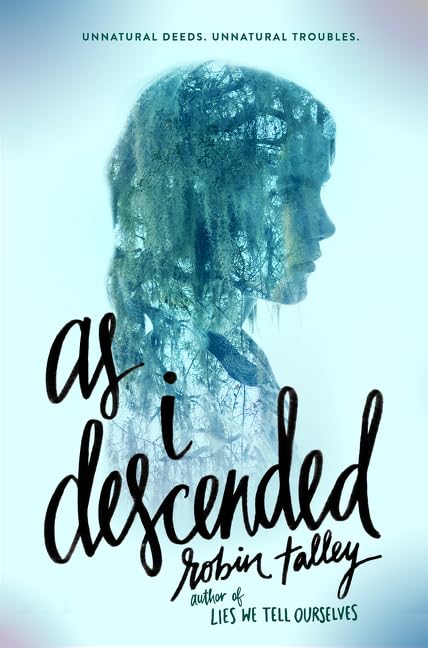
Book Note: As I Descended

Talley, Robin. As I Descended. New York: HarperTeen, 2016.

As I Descended is a young adult novel that is derivative of Macbeth. Its title comes from a question Macbeth asks not long after the murder of Duncan.

This version of the plot is set in an upper-crust boarding school with a history of ghosts and supernatural activity. Indeed, our Macbeth analogue is tempted into action when a Ouija board says "Usted conseguirá lo que más desea" (20)—you will have what you most desire.

The novel generally follows the plot of the play, but the characters have been changed along with the setting.  Our Macbeth and Lady Macbeth are Maria and Lily, a lesbian couple. Duncan is Delilah, the top student and soccer player. The Kingdom of Scotland is the college scholarship for which they're competing.

All in all, it's a compelling read, but it does take agency away from the characters and give it to a myriad of ghosts, figures from folklore, and other supernatural creepy things. Some sample pages follow.  Note: The extracts below are not appropriate for all readers.

The first encounter with the supernatural elements in the novel:


Maria starts to realize that the spirits are telling the truth:


Lily persuades Maria to put drugs in Delilah's glass so that she'll test positive on the upcoming drug test and lose her chance at playing on the soccer team or winning the scholarship:


Click below to purchase the book from amazon.com
(and to support Bardfilm as you do so).

Wednesday, May 30, 2018

Book Note: Exit, Pursued by a Bear

Johnson, E. K. Exit, Pursued by a Bear. New York: Speak, 2017.

In Exit, Pursued by a Bear, we're off to cheerleading camp for a Winter's Tale retelling—for the first part of the book.

Hermione and Leo have been a couple, but he's starting to become jealous—and not just of her and other guys. He's also jealous of her ideas and her cheerleading performance.

But things suddenly change.

Then, during a fireside camp activity, Hermione is administered a "date rape" drug and is raped. She wakes up in the hospital, uncertain of what happened or who did it. The rest of the novel addresses the aftermath—including determining who was responsible and how he did it.

The novel deals with those deep issues in a sophisticated way, not pulling any punches with the serious nature of the crime and its consequences.

It's not exactly my cup of tea, and it does deviate from Shakespeare's plot after following it for a while, but it's an interesting novel that opens doors for conversation.

Here's an extract from relatively early in the novel so you can get a feel for it.


Click below to purchase the book from amazon.com
(and to support Bardfilm as you do so).

Tuesday, May 29, 2018

Book Note: New Boy

Chevalier, Tracy. New Boy. London: Hogarth Shakespeare, 2017.

Hang on tight, everyone, this may take a while. This will be a roundabout way of talking about Tracy Chevalier's New Boy, but it's one way of getting my point across.

Have you heard the music of Alison Krauss? She's astonishing. She's won twenty-seven Grammy awards—twenty-seven!—and she's recorded tons of amazing music. She's even released an album with Robert Plant of Led Zeppelin fame.

I trust you're following me so far. We have an amazing performer who is known for an incredible singing voice.

Have you heard her sing "Ghost in this House"?

Let's all take a quick listen:


Listen to that astonishing voice. It has an unbelievable clarity to it. Listen to the "up" and the "down" in the lines "I don't keep this place up; / I just keep the lights down." You can slice that note anywhere you want and you'll get exactly the same segment—it's beyond comprehension. It's like a giant salami of sound, cured to perfection.

So . . . amazing performing . . . incredible voice.

But what she's singing is little more than drivel. The melody is great; the voice is superb. But the lyrics leave an enormous amount to be desired. I listen to the song entirely because of the voice.

Note: For a better marriage of voice, melody, and lyrics, listen to Alison Krauss sing the Beatles' "I will."  

Another Note: I have the same complaint—as seemingly-unthinkable as it might be—about Adele. She needs to cover more Dylan, sing more gospel numbers, or do the Cole Porter Songbook. Put that voice to better use, Adele, than singing codswallop like "Rumor Has It." 

I told you that to tell you this.

Tracy Chevalier's New Boy is very well-written, has an excellent concept involving race, and presents a number of intriguing voices.

But it just doesn't work.

The primary reason for that is its setting. The plot of Othello is played out in the grade-school classroom. That's a place for jealousies and rivalries, of course, but the idea of Dee "going with" Casper behind Osei's back lacks gravitas, to put it mildly. I suppose a handkerchief is a light enough object, so the idea of a strawberry pencil case replacing it isn't too far off. But the rest of the plot does not work in the setting, however well-written it might be.

Here are a few sample pages, starting with Dee's first lie to Osei.


Ian (our Iago analogue) tempts Osei in this section:


Finally, Osei lashes out at Dee:


Again, the book is well-written and interesting, but, all in all, it doesn't succeed.

Click below to purchase the book from amazon.com
(and to support Bardfilm as you do so).


Bonus: Alison Krauss singing "I Will":

Tuesday, May 22, 2018

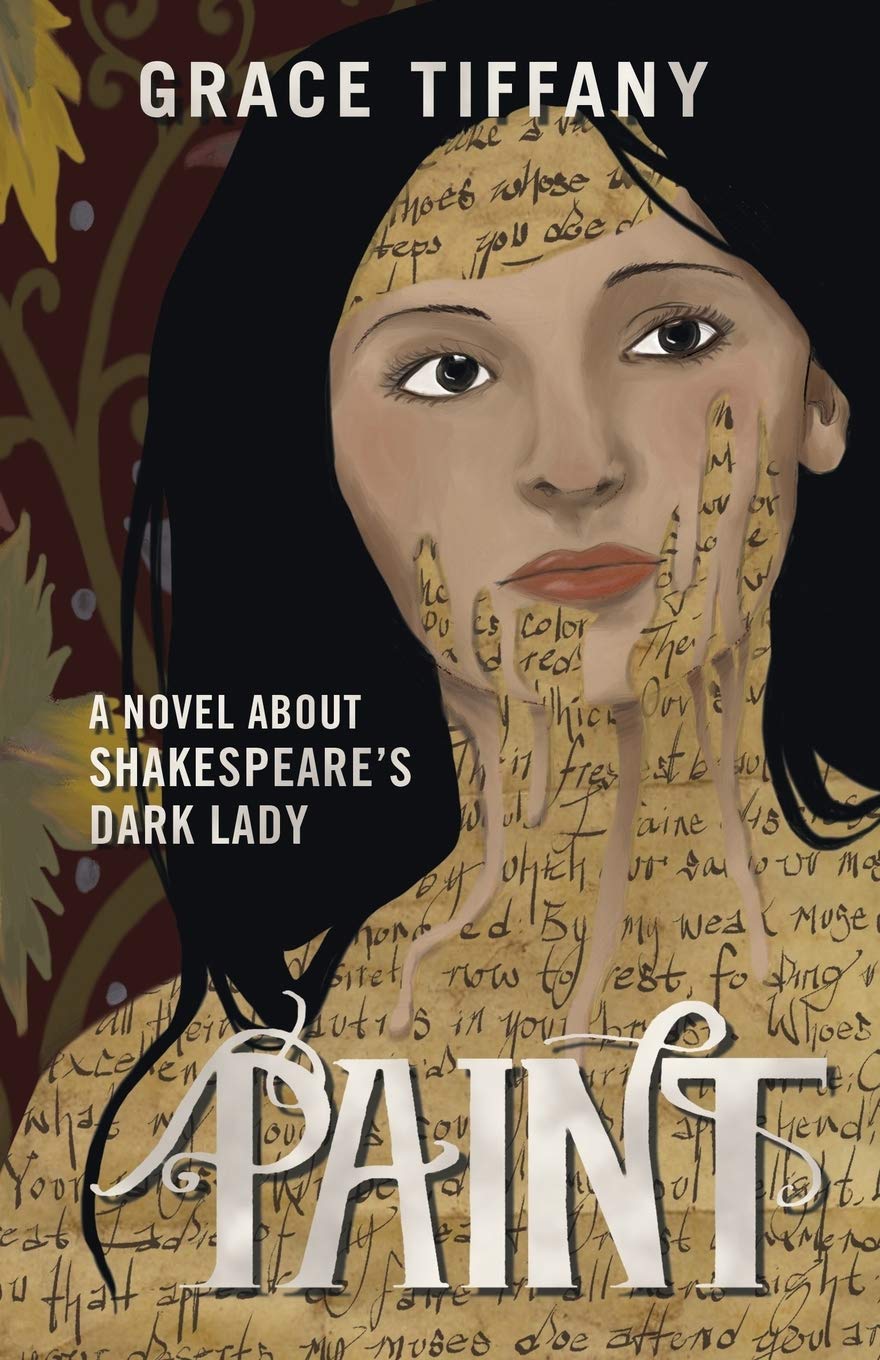
Book Note: Paint

Tiffany, Grace. Paint. Tempe: Bagwyn, 2013.

Grace Tiffany has written a number of historical / biographical novels about Shakespeare. Witness her Will: A Novel (for which, q.v.) and her Shakespeare had a Daughter (for which, q.v.).

In Paint, she takes on the mystery of the sonnets, telling the story of Emilia Lanier, the woman some people name as the Dark Lady of the Sonnets.

Frankly, I'm more interested in Shakespeare in Star Trek than in theories about the Dark Lady—though they do sometimes overlap (for which, q.v.). But this novel is well-written and fairly interesting.

I'll just give you a quick sample from the first third of the novel and let you decide if it's your cup of tea or not.


Click below to purchase the book from amazon.com
(and to support Bardfilm as you do so).

Tuesday, May 15, 2018

Book Note: The Shakespeare Stories

Matthews, Andrew. The Shakespeare Stories. Illus. Tony Ross. Croydon: Orchard Books, 2015.

This delightful collection of sixteen Shakespeare plays retold for early readers has only recently come to my attention.

These are more than fabulous introductions to the plots of the plays. Each one has a brief essay at the end that opens up some of the questions raised by the play in question.

And they're illustrated by Tony Ross, who is deeply influenced by Quentin Blake (who illustrated many of the Roald Dahl books). I find the illustrations to fit the plots and their retellings perfectly.

Let me show you what I mean—and, just so you know, the books are available individually as well as in the box set pictured here, so if you just need the Hamlet, you can get it.

Speaking of Hamlet, here's The Shakespeare Stories' take on it:

Matthews, Andrew. Hamlet: A Shakespeare Story. Illus. Tony Ross. Croydon: Orchard Books, 2015.

I'm very fond of the Hamlet for its illustrations and its clarity of plot presentation, but it does reveal one critique I have of all the stories: it needs more Shakespeare! I know that they're designed for early readers, but Shakespeare has many passages that are clear and comprehensible, and working those in would provide a terrific foundation for kids reading the plays later. couldn't they work in "to be or not to be" in the section that provides Hamlet's POV during the big soliloquy?

But let me give you a substantial portion of this retelling of the play. Each retelling has a brief dramatis personae, so we'll start with that, and then we'll get Hamlet's most famous soliloquy and some interaction with Ophelia.


Matthews, Andrew. The Tempest: A Shakespeare Story. Illus. Tony Ross. Croydon: Orchard Books, 2015.

We can turn to The Tempest quickly—for two main reasons. First, I like the way Caliban is presented. He's a monster, but a sympathetic rather than a scary one. Second, the second spread below shows that the books do incorporate quotations from Shakespeare—but not as part of the retelling . . . just as interludes or epigraphs.


Matthews, Andrew. Twelfth Night: A Shakespeare Story. Illus. Tony Ross. Croydon: Orchard Books, 2015.

I wanted to provide a sample of the short essays as well, so here is the one for Twelfth Night, which I thought was just right for opening questions about the play—getting readers to start thinking about what they've just encountered in a retelling and preparing them for what they may encounter in a future, fuller version of the play.


All in all, these are highly recommended additions to family libraries, school libraries, and personal libraries. And they make fantastic gifts from Shakespearean aunts and uncles to potential Shakespearean nieces and nephews.

Click below to purchase the books from amazon.com
(and to support Bardfilm as you do so).


Monday, May 7, 2018

Book Note: Queen Lear

Conley, Ellen Alexander. Queen Lear. N.p.: N.p. 2013.

It's another self-published Shakespeare novel!

This time, I'm not reading it all the way through. I read the opening, skimmed a bit, found it to be not too compelling and too full of easy profanities, and sent it back to the library.

But I'll also call your attention to it so you can either grab it (if it's your cup of tea) or avoid it (if it isn't).

Letty Lear is a real estate mogul who divides her empire between her three kids (and their kids). Then things become complicated, though the plot from there on doesn't closely follow Shakespeare's.

In any case, here are the first few pages—with some censored words.


Click below to purchase the book from amazon.com
(and to support Bardfilm as you do so).

Friday, May 4, 2018

Book Note: Peril at End House

Christie, Agatha. Peril at End House. New York: Bantam, 1988.

I'm sure Dame Agatha Christie was asked—far more often than she liked—where she got the ideas for her novels.

I think I can answer where she got one of the ideas in Peril at End House, a novel from the early 1930s.

Actually, it's Hercule Poirot's idea, but I imagine Dame Agatha had something to do with it.

I'll tell you the plot point and then provide the text to support it.

In the novel, several attempts have been made on the life of Mademoiselle Nick Buckley. After the last, Hercule Poirot has put her in a private hospital with strict instructions that she should see no one but him and Hastings and that she should eat no outside food. Unwisely, she eats a chocolate that she thought was sent by Poirot himself and becomes very—but not dangerously—ill.

That's when Poirot has the idea. See if you can figure out where he may have gotten the idea. It starts about halfway down page 142 below (click on the images to enlarge them):


Where could he have thought of such a thing?

I'll just provide you with a quick speech from Friar Francis in Much Ado About Nothing:
                                            Pause awhile,
And let my counsel sway you in this case.
Your daughter here the princes left for dead:
Let her awhile be secretly kept in,
And publish it that she is dead indeed. (IV.i.200-04)
Poirot's motives are a little different—he wants to smoke out the attempted murderer—but the plot is the same!

I'll let you read the novel to determine whether the end is more like Much Ado's or Romeo and Juliet's.

Click below to purchase the book from amazon.com
(and to support Bardfilm as you do so).

Bardfilm is normally written as one word, though it can also be found under a search for "Bard Film Blog." Bardfilm is a Shakespeare blog (admittedly, one of many Shakespeare blogs), and it is dedicated to commentary on films (Shakespeare movies, The Shakespeare Movie, Shakespeare on television, Shakespeare at the cinema), plays, and other matter related to Shakespeare (allusions to Shakespeare in pop culture, quotes from Shakespeare in popular culture, quotations that come from Shakespeare, et cetera).

Unless otherwise indicated, quotations from Shakespeare's works are from the following edition:
Shakespeare, William. The Riverside Shakespeare. 2nd ed. Gen. ed. G. Blakemore Evans. Boston: Houghton Mifflin, 1997.
All material original to this blog is copyrighted: Copyright 2008-2039 (and into perpetuity thereafter) by Keith Jones.

The very instant that I saw you did / My heart fly to your service; there resides, / To make me slave to it; and, for your sake, / Am I this patient [b]log-man.

—The Tempest