Wednesday, January 31, 2018

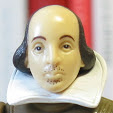
Shakespeare's Appearance in The Lego Movie

The Lego Movie. Dir. Phil Lord, Christopher Miller. Perf. Jorma Taccone, Chris Pratt, Will Ferrell, and Elizabeth Banks. 2014. DVD. WarnerBrothers, 2014.

Although Bardfilm tries to be completely cutting edge, right on the spot as Shakespeare-related developments occur, we do occasionally have lapses.

Sometimes the lapses are as long as four years.

It's been four years since I saw The Lego Movie in theaters, and I remember wanting to call our collective attention to William Shakespeare's appearance in the film. Then it took time for the DVD to be released and for the library to buy it and for me to remember just where exactly Shakespeare appeared in the film.

But we're all ready now! I've put together one clip with each of the three appearances William Shakespeare makes in The Lego Movie. The first is his only line in the film:  "Rubbish." Shakespeare himself only uses the word twice (not counting "Ay, there's the rub[bish]" from Hamlet's soliloquy. In Julius Caesar, Cassius says, "what trash is Rome, / What rubbish and what offal, when it serves / For the base matter to illuminate / So vile a thing as Caesar!" (I.iii.113-16). In Richard II, the Duchess of York asks Edmund of Langley to pick up his tale from where he left off—where "rude misgovern'd hands from windows' tops / Threw dust and rubbish on King Richard's head" (6-7).

Shakespeare's second appearance is when he flies into battle to save the day.

And, at his final appearance, he does the popular dance known as "The Worm."  Here you go—and apologies for the four-year delay.


Links: The Film at IMDB.

Click below to purchase the film from amazon.com
(and to support Bardfilm as you do so).

Tuesday, January 30, 2018

Julius Caesar Makes its Way into Anthropoid

Anthropoid. Dir. Sean Ellis. Perf. Jamie Dornan, Cillian Murphy, and Brian Caspe. 2016. DVD. Universal Studios Home Entertainment, 2016.

Although I hate to say so, sometimes the Shakespeare in a film seems a bit tangential.

That's the case with its appearance in Anthropoid, a film about Operation Anthropoid, the joint British / Czechoslovakian operation to assassinate Reinhard Heydrich, the Nazi who oversaw the elimination of a great part of the Czech resistance to Hitler and Nazi Germany's expansion.

That, of course, is a much bigger issue than a line from Julius Caesar.

Still, the quote is used effectively, though ambivalently. In one scene, a character asks if those who have attempted the assassination were serious in their declaration that they would commit suicide with signs declaring that they were responsible (in an attempt to reduce Nazi retaliation upon the Czech people). When one of the assassins says, "Maybe," he response with this line: "Cowards die many times before their death, / The valiant never taste of death but once" (II.ii.32-33).

Is that meant to say that such a death would be cowardly or valiant? It's ambitious.

[Caution: Some (probably predictable) spoilers follow.]

Later, just before the assassins kill themselves to prevent themselves from falling into the hands of the Nazis, we see a copy of Julius Caesar float past them.

Here's a clip that includes both scenes:


It's an effective use of Shakespeare, whichever way you read the use of the quotation.

Note: It took an embarrassingly long time, but I finally realized that the film and the play the quote is from are both about assassination and the unexpected ramifications of what might be seen as a reasonably-straightforward assassination. There's greater depth than I first realized in that element.

Links: The Film at IMDB.


Click below to purchase the film from amazon.com
(and to support Bardfilm as you do so).

Monday, January 29, 2018

Czech Hamlet Rock Opera

Ledecký, Janek. Hamlet: The Rock Opera. CD. BMG, 2000.

When I bought this, I was under the impression that it was a DVD, and I crossed my fingers for English subtitles. When it arrived, it was a two-CD set—the soundtrack of a Czech Rock Opera version of Hamlet. It had lyrics, but no English translation of them.

Still, the music is fascinating . . . even though the meaning is mostly a closed book (closed set of liner notes?) to me.

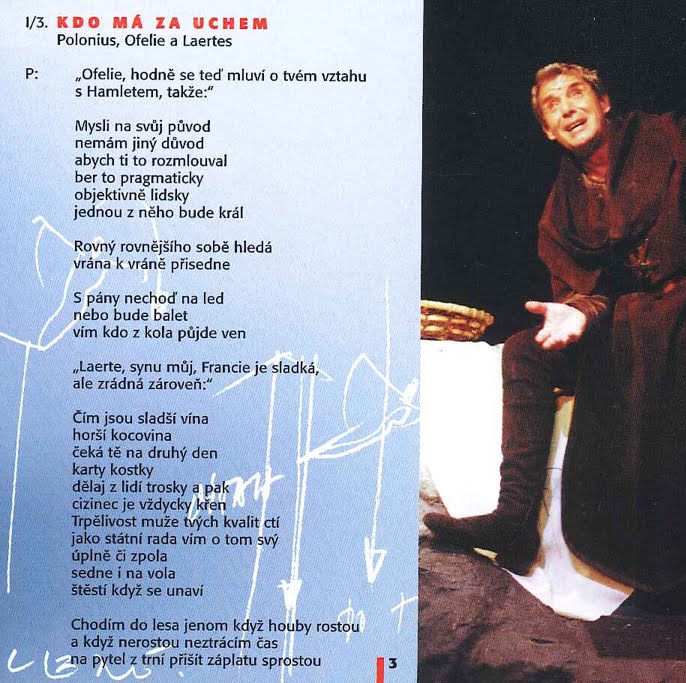
I say "mostly" because I prevailed upon a friend who knows Czech to translate "Kdo Má Za Uchem," one of Polonius' big numbers. First, here's the translation (along with the Czech lyrics sheet):
Ofelia, there is a lot of talk about that relationship of yours with Hamlet, so: 
Think of your origins
I don't have another reason
to be talking you out of it
take it pragmatically
objectively, really
one day he will be a king

Birds of a feather flock together
one best find an equal to himself [Note: This doesn't translate very well—it's a saying—that somewhat has to do with the birds saying]

Don't go on thin ice with the lords
or else you will have to ballet
I know who will lose their place in the dance first

Laertes, my son, France is sweet
but full of betrayal at the same time

The sweeter the wines
the worse the hangover
awaits you the following day
card games and dice
make wrecks out of people
once a foreigner/stranger, always a horseradish
Patience may appreciate your qualities
like the State Council would—I know what I am talking about
all the way or halfway
happiness will sit
even on a bull when it gets tired


I only go to the woods when the mushrooms grow
and when they don't, I don't waste time
I don't fix a bag made of thorns by sewing on a stupid patch


Choir: Blood is no water
that's really too bad
but even that blood is for sale
skip what you can't buy
you'll save yourself the loss
in your own interest
it's different to be digging a hole
let the other try what a fall is

the one that's dirty
will be the last one to laugh
he keeps an arrow as backup

Destiny's horse is tickled in the weak spots
may the one who doesn't want to be better be worse off

that's all I got . . .
And now, here's the song. As always with this blog, I have to provide a video clip with any audio I want to share, and I usually try to make them related in some way. In this clip, the video is from Hamlet Goes Business (for which, q.v.). In any case, the video isn't what's interesting—the music is. Listen:


Now, to add to your knowledge and experience, let me tell you about a website I found when doing a bit of research for this post. It tells something about the history of the rock opera, and it lets us know that the author is currently working on a rock opera version of Othello entitled Iago.

The site also contains some English-language versions of the songs (not, alas, the one I've provided above), including "All My Life I'm Diggin' Graves," which is what you would expect if you cast Leon Redbone as the First Gravedigger. Try that out at this URL (click on the song title to get it to play).

Clearly, we need to advocate for an English-language release of this work.

Note: Shakespeare Geek almost immediately called our attention to this English-language rock opera version of Hamlet. Watch it here, but note that it isn't the same as the one I've been writing about.

Additional Note: Shakespeare Geek almost immediately thereafter called our attention to this Korean-language musical version of Hamlet. 

Links: The Website that Talks about the Rock Opera.

Friday, January 26, 2018

Lady Macbeth . . . or is she?

Lady Macbeth. Dir. William Oldroyd. Perf. Florence Pugh, Cosmo Jarvis, and Paul Hilton. 2016. DVD. Lionsgate, 2017.

In his great Shakespeare on film classification system (for which, q.v.), Kenneth Rothwell mentions films that are "parasitical" of Shakespeare. I think this film goes in that category.

I spotted this film, and thought we might be treated to a retelling of Macbeth from Lady Macbeth's perspective.

The quote on the cover should have tipped me off: "Imagine Alfred Hitchcock directing Wuthering Heights."

The story is very sparsely told—as if it were an Ernest Hemingway screenplay—with lots of lengthy scenes with no dialogue, as in the image above. It's the story of a woman who is disgusted with her distant and unloving husband, takes a lover from among his workers, and then (sorry if this is a spoiler) kills a bunch of people to try to cover up the affair and to keep her lover.

At first, I thought the writers were just grabbing the name Lady Macbeth to give the main character a sense of coldness and murderousness (even though Lady Macbeth in Shakespeare's play never participates in any actual violence). Then I realized that the film is a derivative version of Nikolai Leskov's Lady Macbeth of Mtsensk, which Dmitri Shostakovich famously made into an opera (Леди Макбет Мценского уезда, variously translated as Lady Macbeth of Mtsensk or Lady Macbeth of the Mtsensk District). The film Siberian Lady Macbeth, directed by Andrzej Wajda, was also based on the work.

The film, therefore, has a longer history than I realized.

But it also doesn't really have any connection to Shakespeare.  Sorry.

Links: The Film at IMDB.

Click below to purchase the film from amazon.com
(and to support Bardfilm as you do so).

Thursday, January 25, 2018

"Making Love" in Shakespeare's Day: A Quick Note on I.i.107 of Midsummer Night's Dream

Shakespeare, William. A Midsummer Night's Dream. Ed. Harold F. Brooks. Arden Shakespeare. London: Methuen, 1979.

A speech in Act I, scene i of Midsummer Night’s Dream often misleads modern readers. In that scene, we’re just learning that Lysander and Demetrius are both in love with Hermia, and then Lysander tells us this interesting bit of information:
Lysander
Demetrius, I’ll avouch it to his head,

Made love to Nedar’s daughter, Helena,

And won her soul; and she, sweet lady, dotes,
Devoutly dotes, dotes in idolatry,
Upon this spotted and inconstant man. (I.i.108-12)
The potentially-misleading phrase is in line 109. What does Lysander mean when he says that Demetrius “made love” to Helena?

He doesn’t mean what the phrase now euphemistically means: to sleep with (or, more embarrassingly but less euphemistically, to have sex with). He does mean what the phrase used to mean: to woo.

How do we know which meaning Lysander has in mind? The OED will help us immensely here.

Midsummer Night’s Dream was written around 1595. To figure out what Lysander’s talking about, we need to see how the phrase “make love” was used at that time.

When we look up “love” in the OED, we find “to make love” defined as a phrase (def. P3 a). Starting in 1567, the phrase meant “To pay amorous attention; to court, woo.” The OED gives several examples of the phrase used in that way, including Shakespeare’s use of the quote in this very speech.

Next, the OED, noting that the origin of this meaning of the phrase comes from the U.S., provides this definition of the phrase in def. P3 b: “To engage in sexual intercourse, esp. considered as an act of love.” The first use of the phrase in that sense appears in 1927.

Therefore, when Shakespeare has Lysander say that Demetrius “made love” to Helena, it means that Demetrius wooed or courted Helena.

Since the meaning has changed over time, it’s very easy to be misled by that phrase into thinking something more happened between Demetrius and Helena than actually happened, and that can give readers a mistaken impression about both characters.

The OED is a marvelous tool for helping us avoid misinterpretation (or, as the OED might put it, misacceptation, misprision, or wresting). Use it wisely and well and frequently!

Click below to purchase the play from amazon.com
(and to support Bardfilm as you do so).

Wednesday, January 24, 2018

Globe-alization: Around the World in Shakespeare Plays

kj. "Shelfspeare One and Shelfspeare Two." Personal Photographs. January 2018.

Each of the two images to the right is a photograph I took in a bookstore.

The question for you is this: Which photograph was taken in a bookstore in Vietnam—Ho Chi Minh City (Saigon), to be exact—and which was taken in a bookstore in the Twin Cities—St. Paul, Minnesota, to be exact?

I've been to Vietnam four times:  twice around sixteen years ago, once about two years ago, and just now. As a casual observer, I've noticed the way globalization has changed at least consumer goods available in the major cities.

Can we call it "The Oreo Factor"? Although I wasn't particularly searching for them, Oreo cookies were not readily available—I didn't see a single one. But when I traveled again, about two years later, I found a few packs of Oreos here and there--in convenience stores geared toward visitors to Vietnam. During my last two trips, I saw Oreos everywhere--even in smaller stores off the beaten path.

The same may be true of Shakespeare. Again, I wasn't looking for Shakespeare during my trips in the early 2000s, but I spotted some during my 2016 trip, and I spotted even more in 2018 (including a number of volumes in the "No Fear Shakespeare" series. And my own purpose in traveling in 2016 and 2018 was to bring more Shakespeare along with me.

I find that to be encouraging. But these volumes are in English, and I'm wondering how much Shakespeare in translation has made its way to Vietnam. Amazon lists two modern translations—Macbeth and Vua Lear—and the only review of one of them is highly disparaging.

I have learned that it's relatively common for graduate students in literature and some undergraduates to read Shakespeare in English as part of their coursework, and familiarity with the plays seems to be increasing (again, from my limited experience and exposure).

I'll be thinking and writing about this and other related matters this semester. Stay tuned. And contemplate the Oreo Factor.

p.s. The photo on the left is from a bookstore in Vietnam; the other is from one in the United States.

Friday, December 15, 2017

Musical Version of Bottom's Dream

"Bottom Dreamed a Dream." Pyramus! Unproduced Off-Broadway Musical.

Most years, I write a song that will help students review the material in my Shakespeare course.

Past hits include Bob Dylan singing the plot of Measure for Measure (for which, q.v.).

The current piece is one I put together last year—and then ran out of time to record. Students had to be satisfied with a live version.

But now we can all enjoy (?) this piece. Imagine, if you will, a new musical based on the play-within-the-play of Midsummer Night's Dream. It's called Pyramus! And this is just one of its many show-stopping numbers.


Note: In case the video above fails to embed properly, I'm attaching a blog-native version here.

Tuesday, November 21, 2017

Calvin, Hobbes, and Hamlet

Watterson, Bill. "Blecchhh." The Complete Calvin and Hobbes. 3 vols. Vol. 3: 1992-1995.  Kansas City: Andrews McMeel Publishing, 2005. 6 March 1994. 308.

With everything that's going on, I seem to be averaging one post a month.

Since that's the case, I might as well leave November in the very capable hands of Bill Watterson.

Watterson offers up a serving of Hamlet's soliloquy—in one of the most daring adaptations yet seen.

In his version, Hamlet's too, too solid / sullied / sallied flesh seems to have melted away entirely, leaving a bemoaning residue on the plate.

Let's tune in to see what happens (click on the image below to enlarge it).


Bonus image for those who have scrolled down this far.

Click below to purchase the set from amazon.com
(and to support Bardfilm as you do so).

Thursday, September 28, 2017

Shakespeare in passing in The Avengers

The Avengers. Dir. Joss Whedon. Perf. Robert Downey, Jr., Chris Evans, Scarlett Johansson, and Chris Hemsworth. 2012. Blu-Ray.  Walt Disney Video, 2012.

Sometimes, it's the briefest allusions that help make the film.

Surely, you'll agree that, without the lines in the clip below, The Avengers would not be as aesthetically pleasing—though it probably would be as popular—as it is.

It also lets us know that Joss Whedon is unlikely to forget about Shakespeare.

And it lets us know what Robert Downey, Jr. has been up to since he played Rivers in the Ian McKellen / Loncraine Richard III.


No one's fooled by Downey's attempt at fake Shakespeare ("Doth mother know you weareth her drapes?")—we know he knows the real Shakespeare and how to deliver his lines. 

The dismissive "tourist" at the end is just the icing on the cake.

And I'm not sure, but I think I can make out a diagram of the Globe Theatre on the helmet display—just for a second.

Links: The Film at IMDB.

Click below to purchase the film from amazon.com
(and to support Bardfilm as you do so).

Monday, September 4, 2017

Book Note: Too Too Solid Flesh

O'Donohoe, Nick. Too Too Solid Flesh. Seattle, Wizards of the Coast, 1989.

This is another of the books that I tackled so that you can run far away from it into the end zone.

I kept trying this book on and off throughout the summer. It took a long time because there were always books that were better, more gripping, and more attuned to the Shakespeare vibe I hope for in a work of modern Shakespearean fiction.

Too Too Solid Flesh takes us to a future in which all the acting is done by androids—and most of the audience appears to be androids as well.

There's also a murder. Someone high up in the echelons of those who program . . .

You know what, never mind. It doesn't matter, and I didn't pay that close attention.

We have an android Hamlet and an android Horatio (only he's actually a human disguised as an android to investigate the murder).

Here are the only two pages I thought interesting enough to pass along. At one point, they conjure up android (or possibly hologram) Humphrey Bogart and Ingrid Bergman—just to have a chat with them.


Later, Shakespeare himself shows up. Well, an android version of him does. Here's what happens when he does:


As you can see, there's just not much here. Steer clear.

Click below to purchase the book 
(despite those last two words of warning)
from amazon.com
(and to support Bardfilm as you do so).
Tuesday, August 29, 2017

Book Note: Something Wicked

Hart, Carolyn G. Something Wicked. New York: Bantam, 1988.

And sometimes I just read them so you don't have to.

I don't remember quite how I found out about this book, but I requested it from my library and decided to give it a try.

You shouldn't bother.

In the book, a rag-tag band of actors is putting on a production of Arsenic and Old Lace, but someone is sabotaging the production.

Enter Scooby-Doo and friends.

Actually, that part didn't happen, but it was a close thing. I felt that the Mystery Machine was going to pull up at any moment.

And there's not much Shakespeare in it at all.

I went in thinking that one of the productions the company was going to put on would be by Shakespeare. Instead, we get a very dramatic moment where an actor quotes from the Scottish play in the middle of a rehearsal. I'll give you that scene:


That's very early in the novel—pages 26 and 27—and that's about all the Shakespeare we get for the rest of the generic murder mystery.

Click below to purchase the book from amazon.com
(and to support Bardfilm as you do so).

Friday, August 11, 2017

Book Note: The Labrador Pact

Haig, Matt. The Labrador Pact. New York: Viking, 2004.

Matt Haig's The Dead Father's Club (for which, q.v.) revisited Shakespeare's Hamlet, and I enjoyed it quite a lot. When my students told me that he had written another book—this one grappling with 1 and 2 Henry IV, I was intrigued.

Having read the book, I'll admit to being a bit disappointed. My complaint is the same as always: Not enough Shakespeare! I thought the novel might retell the plays—or, if not the plays, at least elements in them.

Instead, the novel is a clever account of a dog named Prince, who, in an attempt to care for his family, ends us breaking the Labrador Pact, the most sacred rule of that particular breed of dogs:  Duty over all.

The opposing breed is the Springer spaniel, whose motto is "Pleasure not duty."

In terms of Shakespeare allusions, the boy of the house is named Hal; another character is called Simon Hotspur. There's also a foul-mouthed bully of a dog whose name is Lear. And the mother of the family is called Kate, but I don't see the relevance of that choice.

The main Shakespearean part is, I suppose, the relationship between Prince, our Labrador protagonist, and Falstaff, the fun-loving dog of a woman who has recently moved in to the neighborhood. The pages below provide the first time Adam, the father of the family and Prince's master, and Emily, the new woman, meet. It's also Prince and Falstaff encounter each other.


The long and short is that there's not much Shakespeare here—apart from names and personality traits. As a side note, be aware that this is not a young adult novel—the foul-mouthed Rottweiler is only one aspect that may be inappropriate for younger readers.

Click below to purchase the book from amazon.com
(and to support Bardfilm as you do so).

Thursday, July 27, 2017

Richard III at the Great River Shakespeare Festival

Richard III. Dir. Doug Scholz-Carlson. Perf. Caroline Amos, Benjamin Boucvalt, Christopher Gerson, Alex Givens, Stephanie Lambourn, Katie LeSuer, Melissa Maxwell, Duncan McIntyre, Christopher Peltier, Silas Sellnow, Jason Michael Spelbring, Emma Bucknam, and Adeline Matthees. Great River Shakespeare Festival. Winona, Minnesota. 2017. 

This year's Richard III was one of the best plays I've seen at the Great River Shakespeare Festival—and you know that I've seen a lot of great plays there over the years.

Unfortunately, there's not a lot of season left to see the show—and there's not a lot of time in my schedule to tell you everything you should know about the production. This post, therefore, will have to consist of a few highlights or points of note.

Lighting

First, the lighting was superb. Take a look at the image above. That's from the opening of the second half. The brightly-lit spheres on sticks are wire skull-like structures that were gradually added to the back of the playing space and donned with hats whenever characters died in the course of the play. Later, they were brought forward to represent the ghosts cursing Richard to "Despair and Die" and Richmond to have victory. The silhouette is Richard, replete with forearm crutches, creeping creepily forward like some kind of bottled spider. The screen at the back changed color and had horizontal lighting effects that were extraordinarily effective. Below is another shot to show the change in lighting:


Set

That image can lead us to talk about the set design. R. Eric Stone has done a marvelous job keeping the staging simple but having it hold significance and weight. The branches on the left of the image could swing like a door. I think both it and the screen of vertical branches at the back (which could be raised and lowered) are a visual representation of a speech given by Richard in 1 Henry VI—one that is often imported into productions of Richard III (though not, interestingly enough, this one):
And I—like one lost in a thorny wood,
That rents the thorns, and is rent with the thorns,
Seeking a way, and straying from the way;
Not knowing how to find the open air,
But toiling desperately to find it out⎯
Torment myself to catch the English crown;
And from that torment I will free myself,
Or hew my way out with a bloody axe. (3 Henry VI, III.ii.174-81)
It was beautifully done.

Text

The GRSF takes the text of Shakespeare seriously, and this play was no exception. We got the entirety of Act I, scene iv—the two murderers meeting Clarance—played for its full comic effect. At first, it made the audience uneasy, but then they started to roll with the comic, clownish, almost slapstick characters . . . which made their sudden and dramatic murder of Clarence all the more unnerving. We also got the Three Citizens discussing the affairs of state, which is usually cut. Since these were not excised, the production had a roundedness others sometimes lack.

Humor

Related to the above, the play retained its remarkable and macabre humor. The production had a lot of fun with Richard and his play, both on and off stage. For example, here's a video they produced about Richard's intended rise to the throne:


They also supplied this program note—a genealogical table with Richard's notes and to-do list included:


There's a lot of good fun there.

And Then There's Richard

Christopher Gerson's Richard is mesmerizing. He's funny, engaging, charismatic, and utterly repulsive and horrifying. 

He uses arm crutches, making me think of Anthony Sher's portrayal, described in his The Year of the King (for which, q.v.). As a result, he spends nearly the entire play at a seventy- to eighty-five-degree angle. And he uses it effectively. Here's an image that shows the general angle well:


And here's an image that shows him using that angle to get in, in this case, Elizabeth's face:


It's threatening and unsettling, intimate and horrific in equal measures. I loved it. And it also gives him both the suggestion of a bunch-backed toad and a bottled spider—creeping along the outskirts of the stage and suddenly pouncing at various characters.

Gerson's range is delightful. He's pathetic and romantic, furious and insane, and conflicted and confident. This image is from his "I am not in the vein," delivered to Buckingham:


If you didn't know that you don't want to be Buckingham before, you know it then. Even Buckingham knows it then!

Gerson pointed out to me that Richard seldom speaks in straight blank verse after his encounter with Elizabeth in IV.iv. He used that to play Richard's deterioration through the end of the play. The night I watched, the audience seemed to be generally complicitous with Richard in the jocular, humorous opening scenes. But by the time the verse starts to break down, they had turned against him.

And the Rest

The rest of the cast was also tremendous. Margaret was vindictive and great. Anne was regretful and great. Stanley was awkward and great. Buckingham was conspiratorial and great. Clarence was fearful and guilt-ridden and great. I wish I had time and space to detail the way this show gave every role—each one would stand up to close scrutiny.

The Play as a Whole

The production had great unity, passion, and force. The Great River Shakespeare Festival has, once again, provided exceptional theatre to its audiences.

Links:  The Great River Shakespeare Festival. An album of photos from the show.


Wednesday, July 26, 2017

A Masterful Comedy of Errors at the Great River Shakespeare Festival

Comedy of Errors. Dir. Melissa Rain Anderson. Perf. Alex Givens, Maya Jackson, Stephanie Lambourn, Katie LeSuer, Melissa Maxwell, Duncan McIntyre, Chris Mixon, Christopher Peltier, Silas Sellnow, Jason Michael Spelbring, and James Queen. Great River Shakespeare Festival. Winona, Minnesota. 2016. 

The Great River Shakespeare Festival provided a fast-paced, farcical Comedy of Errors this season. It differed greatly from the 2010 production (for which, q.v.), which was presented more seriously. This show was all about the ridiculous, the ludicrous, and the farce.

The setting is something of a mix of 1920s flapper parties, Chicago-style underworld, and vaudeville. Before the show, we were treated to a piano, string bass, and vocal trio who were singing sultry songs that seemed to have the theme of magic: "Witchcraft," "I Put a Spell on you," "(You Give me) Fever"—perhaps included for its references to Romeo and Juliet ("Thou givest me fever . . . Fever, yea, I burn, forsooth"), and others.

The characters were straight out of the commedia delle'arte tradition. The two Dromios are prefect clowns, with ridiculous outfits—complete with enormous shoes. Their clowning was perfectly timed and impressively physical. Their confusion at, wonder about, and childlike admiration of the chaos unfolding around them was hilarious, and they worked very well with their respective Antipholuses (Antipholii?). The speech about the kitchen wench Nell was particularly stunning in that regard. Tarah Gerson as Dromio of Syracuse delivered the line "She is spherical" with a kind of overwhelmed awe that brought the image of the off-stage Nell before us all and made her a figure of majesty and amazement.

We also have the henpecked husband, the shrewish wife, the lovelorn sister all filling their places in the play—which doesn't mean they stay there. Shakespeare provides depth and roundedness even to characters that might otherwise be merely stock characters, and the actors play the roles with a healthy sense of that three-dimentionality.

The Great River Shakespeare Festival never fails to please—and it does so at the highest level, with the highest level of professionalism and production values.

And I'm off to see what they're going to do with Richard III . . .

Links: The Great River Shakespeare Festival. An album of photos from the show.


Monday, July 10, 2017

Will on TNT

“The Play's the Thing.” Perf. Laurie Davidson, Olivia DeJonge, and Reid Anderson. Dir. Shekhar Kapur. Will. Season 1, episode 1. TNT. 10 July 2017.

The much-touted Will—early promotions alluded it it as Shakespeare with Sex, Drugs, and Rock 'n' Roll—debuts tonight on TNT. But if you can't wait, you can watch it right here, right now. Note: You can watch the first of the two episodes that will debut tonight; you'll have to watch the other live.

I've been watching it in bits and pieces since early this morning. Without risking spoilers, here are some things the show made me think about.

Although the beginning seems to be the usual country-lad-comes-to-the-big-city narrative (one that's a bit heavy on crypto-Catholic plots), it still has some interest. First, there's more color in this than in most 1590s London recreations. And that first vision of London is accompanied by The Clash's "London Calling," a very effective choice for setting the stage.

A Sampling of the Colours of London in the 1590s

We also have a street urchin who offers to guide the Country Bumpkin Will around the city. He seems very much like a Puck figure.

The show gives us some lines from Edward III, a play by Thomas Kyd (with, quite conceivably, some help from Shakespeare) that was first published in 1596. Shakespeare declaims the lines to Burbage Senior's daughter:
So, John of France . . .
Had you done at first as now you do,
How many civil towns had stood untouched
That now are turned to ragged heaps of stones!
How many people's lives mightst thou have saved
That are untimely sunk into their graves!
We get some "upstart crow" and some "Shakeshaft," and, in a scene reminiscent of Shakespeare in Love, we get a scene where Burbage promises the audience a new play by Christopher Marlowe entitled Tamburlane's Ghost. We get Kit Marlowe, spy, searching for secret Catholics. And we get a poetry slam between Shakespeare and (I'm pretty sure) Greene.

There's also a scene where an actor keeps asking "What am I holding the mirror up to?" that becomes both comic and touching.

Will on Stage

The main artistic critique I have may just be in the nature of a first episode of a series: things wrap up too tidily. The poetry slam is won pretty handily; a play that is about to fail is rescued very neatly.

Additionally, historical accuracy is sacrificed for the sake of the drama. But it isn't as if Shakespeare didn't do that himself—constantly and continually!

All in all, it's an interesting show, well worth watching (though readers should note the rating). Give it a try tonight . . . or at the link above.

Note: More episodes have become available, and I'm less sanguine about the show. It's a very dark show, with an unseemly emphasis on torture. It also presents Kit Marlowe as increasingly weird and psychotic. Also, despite a good bit of Midsummer Night's Dream in a later episode, there's not enough Shakespeare!

Links: The Show at IMDB. A review by the New York Times. The show at TNT.


Bardfilm is normally written as one word, though it can also be found under a search for "Bard Film Blog." Bardfilm is a Shakespeare blog (admittedly, one of many Shakespeare blogs), and it is dedicated to commentary on films (Shakespeare movies, The Shakespeare Movie, Shakespeare on television, Shakespeare at the cinema), plays, and other matter related to Shakespeare (allusions to Shakespeare in pop culture, quotes from Shakespeare in popular culture, quotations that come from Shakespeare, et cetera).

Unless otherwise indicated, quotations from Shakespeare's works are from the following edition:
Shakespeare, William. The Riverside Shakespeare. 2nd ed. Gen. ed. G. Blakemore Evans. Boston: Houghton Mifflin, 1997.
All material original to this blog is copyrighted: Copyright 2008-2039 (and into perpetuity thereafter) by Keith Jones.

The very instant that I saw you did / My heart fly to your service; there resides, / To make me slave to it; and, for your sake, / Am I this patient [b]log-man.

—The Tempest