Thursday, August 18, 2016

Romeo, Juliet, Lenny, and the Squigtones

"Suds to Stardom." By Buz Kohan. Perf. Penny Marshall, Cindy Williams, David L. Lander, and Michael McKean. Dir. James Burrows. Laverne & Shirley. Season 1, episode 14. ABC. 11 May 1976. DVD. Paramount, 2014.

I learned about this, like so many things, from Shakespeare Geek.

The quirky Lenny and Squiggy (who often accompany the almost equally quirky Laverne and Shirley) participate in an audition for the Shotz Brewery talent show.

The song they've put together is called "Star-Crossed." The lyrics later make the connection to Shakespeare's Romeo and Juliet explicit:
I live on the north side. She lives on the west.
The west is the worst side: the north is the best.
Her mudda's a drunk; her fadda's a punk.
But I know (yes, I know) that our love (yes, I know) could be real.

But we're star-crossed.
We're like Romeo & Juliet.
Star-crossed—she just dont belong in my social set.

But I know (yes, I know) that someday (someday)
The Lord will look our way, and we'll be free.

We meet in the shadows and wish on a star.
We kiss in a phone booth or under a car.
Our friends put us down. They say we're a clown!
But it hurts (yes, it hurts). Yes, it hurts (yes, it hurts) in my heart . . .

That we're star-crossed.
We're like lollipops and caviar.
Star-crossed—so we'll drive up to the reservoir.

Even though (even though) it's a sin (it's a sin),
We'll throw each other in, and we'll be free.
It may be a big tangential, but there's still some interest there. The narrative has more elements of West Side Story than Romeo and Juliet, and I'm curious about the socio-economic placement of the Juliet analogue.

It's also just quite a lot of fun. Observe:


You'll be happy to note that this was (for Lenny) just the beginning.  Lenny really did go on to make it big, changing his name from Leonard "Lenny" Kosnowski to David St. Hubbins when he joined Spinal Tap.

Star-Crossed!

Links: The Episode at IMDB.

Click below to purchase the entire run of the show from amazon.com
(and to support Bardfilm as you do so).

Wednesday, August 17, 2016

Book Note: Hamlet had an Uncle

Cabell, Branch. Hamlet had an Uncle. New York: Farrar & Rinehart, 1940.

Shakespeare took a narrative already told and raised it to the level of sublimity. Branch Cabell takes a sublimely-told narrative and lowers it far past the level of mediocrity to the utterly dull and uninspired.

This is the kind of book I used to think of when I thought Shakespeare-inspired fiction. It reminds me somewhat of the ineptitude of The Best House in Stratford (for which, q.v.).

The story is meant to be historical fiction telling the original narrative from Claudius' point of view. Claudius is caught in Gertrude's bed by Hamlet, Sr., who threatens to kill Claudius but who is stabbed in the back by Claudius as he turns to berate Gertrude.

It should be possible to tell a narrative that begins that way in an exciting, thrilling way. As it is, the most thrilling points are the chapter headings. I'll provide some of those for your amusement—and also a sample of the plodding prose (if you can take it).

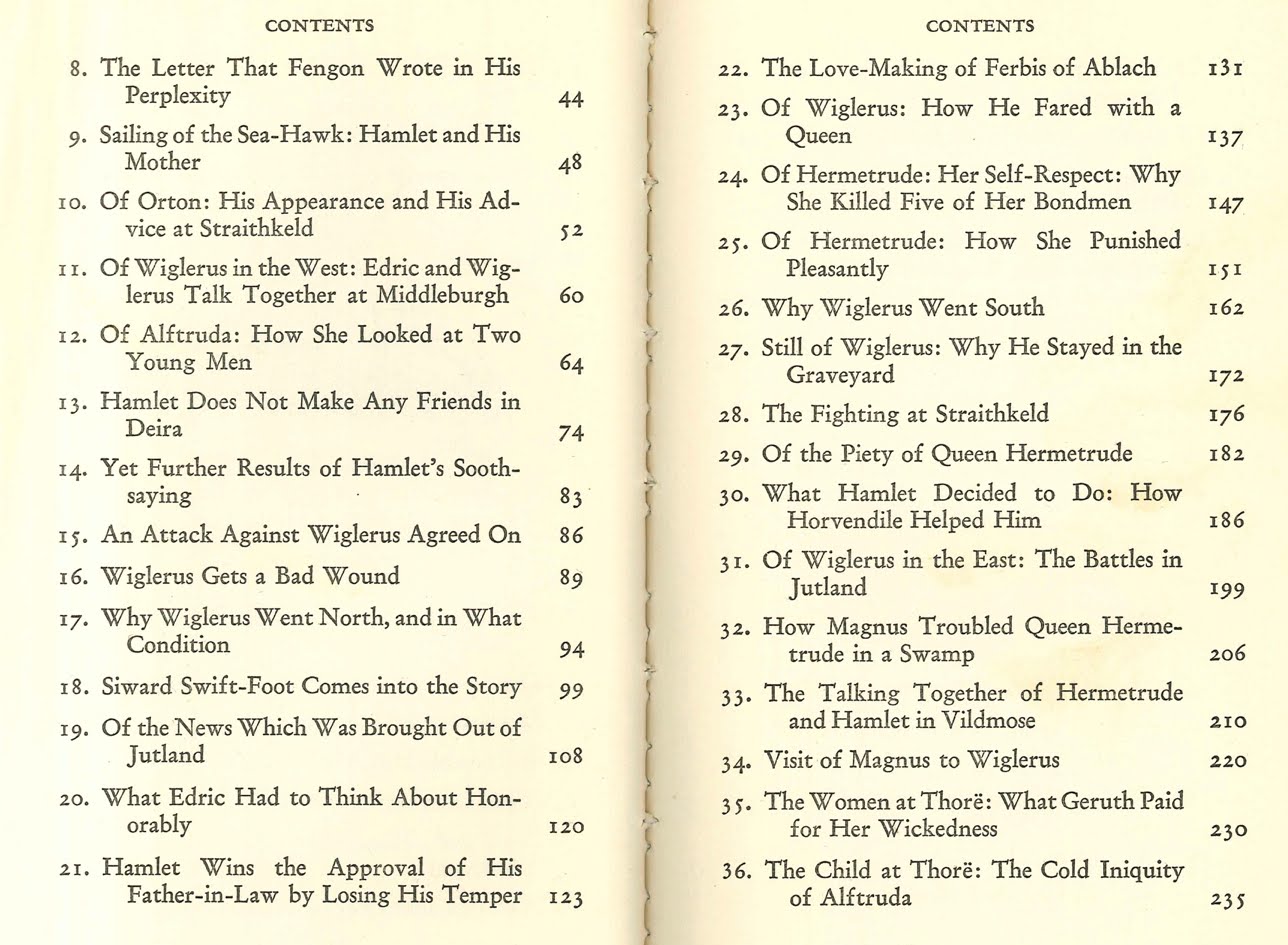
The contents. Try "Wiglerus Gets a Bad Wound" for fun and excitement:


A slice of Chapter Four: "Of Hamlet: How he Troubled People."


The colophon. I take this to be the moral of this retelling of Hamlet. Could this be what Hamlet should teach us, too?


Give this one a miss. Even John Updike's Gertrude and Claudius (for which, q.v.) is better than this.

Click below to purchase the book from amazon.com
(and to support Bardfilm as you do so).

Tuesday, August 16, 2016

Book Note: Ruled Britannia

Turtledove, Harry. Ruled Britannia. New York: NAL, 2002.

Speaking of alternate history—and we were speaking of alternate history, weren't we? With alternate history, it's so hard to tell. In any case, let's speak of alternate history now.

I spotted Ruled Brittana on a list of Shakespeare-related fiction somewhere; in the interests of keeping up with the current Shakespearean fiction scene—well, of keeping within a couple of decades of the current Shakespearean fiction scene—I decided to give it a try. I requested it from my local library, and it arrived within a few days.

When I saw the size of the book and its cover, a gnawing, growing skepticism about it seemed to grip me. But, as Shakespeare said, "Never judge a book by its cover," so I (eventually) cracked the cover.

The first few pages absolutely sucked me in. The storyline became instantly compelling, and the characters soon followed suit.

The book imagines that the Spanish Armada succeeded in its 1588 invasion plans. England has become a Catholic nation, ruled by Philip II. After roughly a decade of this rule, an undercover group of English nationals is preparing to overthrown Spanish rule and put Queen Elizabeth I back on the throne.

And they need to recruit William Shakespeare to their cause. He's asked to write a play about Boudicca, one that will enflame English spirits to revolt against their Spanish, Catholic overlords. He's simultaneously working on a play called Philip II, which the Spanish want to use to celebrate their king upon his death (which is imminent).

Another playwright haunts the theatres of London. He admires Shakespeare, but he's working on his own craft—in Spanish. It's FĂ©lix Lope de Vega y Carpio, the great Spanish poet and playwright.

I'm very taken with the novel. The characters are fascinating—especially Shakespeare (perhaps, though not necessarily, of course), Will Kemp (who is hilariously ribald and laughs in the faces of—well, everyone), and Richard Burbage.

I don't want to give you very many spoilers—have the fun of reading this novel for yourself!—but I will give a few sample pages.

Lope de Vega's opinion of Shakespeare:


Samples of Shakespeare's work in progress (lifted, but adapted, from Titus Andronicus and other locations):


Finally, a constable named Walter Strawberry, who's humor lies in malapropism and a dogged search for the truth (ring any bells?):


The book is very cleverly put together. The spy plot and the battle scenes are terrific, and the scenes at the Globe are quite compelling. Numerous allusions and quotations from Shakespeare abound in the common speech of the characters (in fact, that's the only quibble I have with the book—those lines become a bit too much and threaten to distract from the narrative).

Don't let the size or the cover sway you. Try this intriguing novel.

Click below to purchase the book from amazon.com
(and to support Bardfilm as you do so).

Monday, August 15, 2016

Hamlet with Vegetables (a.k.a. The VeggieTales Hamlet)

"Omelet." By Phil Fischer. Perf. Jimmy Gourd; Archibald Asparagus; Phillipe and Jean-Claude, The French Peas; Scooter Carrot; Mr. Lunt; Larry; and Junior Asparagus. Additional Perf. Mike Nawrocki, Lisa Vischer, Jim Poole. Lyle the Kindly Viking. VeggieTales. 2001. DVD. Big Idea, 2012.

Recently, I noticed a gap in the blog. I've frequently shown a brief segment of a VeggieTales episode during my "Mystery Shakespearean Derivative" day in my Shakespeare and Film class. I teach at a small Christian liberal arts college, and many of my students grew up on the show. They appreciate taking a new look at the show—and at Hamlet at the same time.

I thought I had written about the episode here, but I have never done so. Perhaps that's because I like to keep the Mysterious Shakespearean Derivatives a mystery. But I'll take the chance.

In Lyle, the Kindly Viking, Archibald Asparagus (who is usually a bit snooty anyway) is attempting to raise the tone of the show by incorporating things with greater cultural value. Thus, Hamlet. The VeggieTales production provides some fairly-good adaptations of lines from the play that you'll likely recognize.

Here's part of the segment (in keeping with Bardfilm's Fair Use Policy, I'm not providing the clip in its entirety). Enjoy!


I like to think that the last two lines indicate a desire on the part of the characters to explore Shakespeare's play itself rather than this adaptation. Either way, they are funny.

Links: The Wikipedia Article on the Episode.

Click below to purchase the film from amazon.com
(and to support Bardfilm as you do so).

Friday, August 12, 2016

The Tempest—Now with Puppets!

The Tempest. Dir. Conrad Bishop. Perf. Anthony Shaw Abate, Jessica Bauman, Conrad Bishop, Jan Freifeld, Benjamin Stowe. Produced by The Independent Eye in collaboration with Sonoma County Repertory Theater, Sebastopol, California.  Premiered Sept. 18, 2009, at Sonoma County Repertory Theater. DVD. The Independent Eye, 2009.

This is another post that I've owed an attentive reader for some time.

Back in 2009, a group of actors put on a production of The Tempest using puppets.

Don't think The Muppet Show. Think nearly life-size puppets without strings.

I found the show very compelling.  The image above is of the Propero puppet, but you can make out the performer carrying it. At strategic moments throughout the film, he puts the puppet aside to carry on acting on his own—but he's the only one (as far as I noticed) to do so.

I'm providing two scenes for you to get the feel of the production. Here's a good segment of Miranda and Prospero talking at the beginning; it segues into an exchange between Ariel and Prospero:


And here's the entirety of Act II, scene ii—where Caliban takes cover and Stephano and  Trinculo try to join him. It's played for humor, but the language is still given a great deal of priority:


The film version of the stage production is exceedingly enjoyable. It works for the Shakespeare scholar, but I think it would also work for introducing neophytes to the play.

Links: The Film at the Independent Eye.

Click below to purchase the film from the Independent Eye.

Purchase Link

Thursday, August 11, 2016

Book Note: Courting Cate (and Other Amish Shakespearean Fiction)

Gould, Leslie. Courting Cate. Minneapolis: Bethany House, 2012.
———. Adoring Addie. Minneapolis: Bethany House, 2013.
———. Minding Molly. Minneapolis: Bethany House, 2014.
———. Becoming Bea. Minneapolis: Bethany House, 2014.

I can't remember quite where or when I heard that there were retellings of Shakespeare set amongst the Amish, but I eventually tracked them down.

This genre isn't my cup of tea, so take that into consideration. And the publisher was very rude, picky, and stingy about supplying review copies, so put that in, too. Finally, consider that I've only read twenty-five percent of the books I have.

With a caveat like that, you can probably tell that I wasn't thrilled by this book. I'm intrigued by the idea, and the writing is competent, but I'm not convinced that we learn much about either the Amish or Shakespeare by reading this kind of book.

The one I read was Courting Cate. It's meant to be a retelling of The Taming of the Shrew, and it follows the plot roughly, and that's intriguing. But the way the characters are drawn and the way the plot is carried forward remains problematic. For example, Cate's shrewishness seems to be embodied merely in reading too much, being a bit standoffish to some cousins who teased her when she was young, and burning biscuits.

Note: Some spoilers will follow.

I'm also not convinced by the romantic developments in the novel. Cate has to marry before her younger sister can marry (as in Shakespeare's play). Cate finds out that her cousins are paying Pete to court her (as in 10 Things I Hate About You). Our Katherine analogue enters into a marriage of convenience with our Petruchio analogue (Pete) because her sister is pregnant; if her sister doesn't get married (and fast), it will bring shame to her Dat, who has raised them both since their mother died a few days after her sister's birth. Cate then moves away to live with her in-laws, who are rude and mean (mostly). When she comes back home for her sister's wedding, she sees that her sister isn't pregnant after all. It turns out her sister never did anything that would cause her to get pregnant, but she didn't read the books Cate gave her to read on the subject, so she thought she was pregnant when she wasn't.

Fortunately, Cate's fallen in love with Pete by then—his sleeping on the floor in a sleeping bag and working hard at her in-laws gradually caused her to fall for him—so everything works out all right. But that plot device seemed a bit cheap and frustrating.

But the writing isn't terrible, and there's some character development that makes sense—so I'm a bit torn. Of course, the writing does occasionally head toward the ridiculous, as in this example:

It wasn't my father; it was Pete. My heart fluttered at the sight of him. He smelled fresh, like the cold spring air mixed with the scent of goat's milk soap, and wore a clean shirt and nicer pants than the ones he'd had on the other times I'd seen him, but they weren't anywhere close to new. (67)

When the couple went to New York City and overheard some actors saying, "Kiss me, Kate," I had hopes for some metafictional contemplation of the way Shakespeare's story matched that of the couple in the novel—but we're left to do that on our own. Still, there's something self-aware in the passage:


On the next page, we get something that could be developed much more fully—but it's a nice start:


And the idea of finding something of our stories in Shakespeare's is caught up toward the end of the book as well. Here, things are starting to work out—but there's still some room to go:


For a character whose "shrewishness" is defined by her excessive reading and excessive trips to the bookmobile, it's surprising that she's never read any Shakespeare—but what would she have done if she had?

If the idea of Amish Shakespeare fiction sounds good to you, try it—and the three others Leslie Gould as written. The writing is good, and they're fairly well-crafted. And they play with the plots of Romeo and Juliet (Adoring Addie), Midsummer Night's Dream (Minding Molly), and Much Ado About Nothing (Becoming Bea).


Click below to purchase one—or more!—of the books from amazon.com
(and to support Bardfilm as you do so).


Wednesday, August 10, 2016

Book Note: Something Rotten

Fforde, Jasper. Something Rotten. New York: Viking, 2004.

Something Rotten is a confusing, fascinating, odd, genre-bending, bizarre, deep, shallow, adventurous, and thoroughly-enjoyable novel. If you can imagine something halfway between Terry Pratchett (for which, q.v.) and Douglas Adams (for which, q.v.), you've probably found something that is not entirely unlike Jasper Fforde.
Our protagonist, who is named Thursday Next, works keeping the world of fiction as it ought to be. Making sure that things from the genre of Greek Myth don't end up in the genre of American Western. That's a sly joke on the rest of the novel, which mixes, in a very metafictional way, all sorts of genres, from spy novel to alternate history to fantasy to sports novel to time travel and much in between.

Include Shakespeare in that mix. Indeed (as you may have guessed), that's why I read it.

In Something Rotten, Hamlet has left the fictional world of his play to see what people think of him in the non-fictional world of the rest of this book. Moreover (and meanwhile), the English government in the novel is working on an anti-Dane campaign—fearmongering to reassure its own re-election.

But it would take all day to try to trace even the merest outline of the plot. Instead, I'll give you a sample from early on. You'll meet Hamlet, you'll get a taste of the plot, and you'll even imbibe a bit of literary criticism. All that in two pages! If that doesn't encourage you to try this book, I'm not sure what will.


Note: I forgot to mention that the novel ends on a cliffhanger, so you'll want to have the next in the series—it's called First Among Sequels, if you're keeping score—handy when you get near the end.

Click below to purchase the book from amazon.com
(and to support Bardfilm as you do so).

Tuesday, August 9, 2016

Nicol Williamson's Hamlet

Hamlet. Dir. Tony Richardson. Perf. Nicol Williamson, Judy Parfitt, Anthony Hopkins, Marianne Faithfull, and Mark Dignam. 1969. DVD. SPE, 2012.

A few people have told me that their very favorite film version of Hamlet was Nicol Williamson's. I know him primarily from the BBC Macbeth (for which, q.v.), but I've heard that his 1969 stage version of Hamlet rivaled Gielgud's, Barrymore's, and Burton's.  I've also heard that he was rather difficult to deal with when he was in the New York production of I Hate Hamlet (for the play, but not that particular production, q.v.; for that particular production, cf. this article from the New Yorker).

Intrigued by the number of people who count this version as their favorite (and usually count it there by a large margin), I watched it.

I'm not sure I see the brilliant acting that others see.

The production is good, but I just don't see where it rises even to the top of the vengeance of Hamlet films that are out there—much less far above others.

The film has some interesting points—notably how much of it is filmed in bed. Some of John and Yoko's late-'60s influence may be there, but there's also some intentionally.  I was struck by the sequence from Polonius' reporting and reading of Hamlet's letters through "To be or not to be" and on to the nunnery scene. Gertrude and Claudius (played by Antony Hopkins) receive Polonius' news in bed; Hamlet delivers the soliloquy in bed; he affronts Ophelia in a kind of hammock.

Two clips will serve as examples here. The first shows Polonius reporting his news. Hopkins delivers his lines well—but without ever pausing before their delivery. As a consequence, the scene seems rushed and Claudius seems (giving the intention of the actor and director the benefit of the doubt) to give very little consideration to anything. Without the benefit of the doubt, it seems like students reading through the text in class--just trying to get through it:


The second clip gives us the nunnery scene. Some interesting camera work toward the end is worth noting, and the performance itself is fine, but I don't see the insanely good Hamlet others rave about:


What are your thoughts? Give me a defense of Williamson in the comments and I'll reconsider!

Links: The Film at IMDB.

Click below to purchase the film from amazon.com
(and to support Bardfilm as you do so).

Monday, August 8, 2016

Chimes at Midnight

Chimes at Midnight. Dir. Orson Welles. Perf. Orson Welles, Jeanne Moreau, John Gielgud, and Margaret Rutherford. 1967. Blu-ray. Criterion Collection, 2016.

This post is mainly to anticipate the Criterion Blu-ray release of Chimes at Midnight. It will come out at the end of this month.

The film richly deserves the full Criterion treatment. Indeed, I think this is the film that will push me into buying a Blu-ray player.

What I have for you is not from the delicately remastered print to come; it's from an old videocassette that I happened across in a book sale somewhere. Watch it so that you can rejoice that the good people of Criterion have made it better.

The film combines elements from 1 and 2 Henry IV into an amazingly insightful set of character studies and deep reading.

The clip I've excerpted is from the scene in Eastcheap where first Falstaff and then Hal imaginatively enact an exchange between Hal and his father the king.


That should give you a sense of how great this film can be. And now . . . prepare yourselves for the power of the Criterion edition.

Note: Here's a new version of the image that begins this post. Observe the Blu-Ray difference!


Links: The Film at IMDB.

Click below to purchase the film from amazon.com
(and to support Bardfilm as you do so).

Friday, August 5, 2016

3 Henry VI in The Naked Truth

The Naked Truth [a.k.a. Your Past is Showing]. Dir. Mario Zampi. Perf. Terry-Thomas, Peter Sellers, Peggy Mount. 1957. DVD. MGM, 2005.

I've owed this post to an attentive reader for some time now, and I apologize for the delay.

The 1957 film The Naked Truth is a very good example of the madcap yet thoughtful British comedies of the 1950s and 1960s. With Terry-Thomas and Peter Sellers, how could there not be a great deal of fun and insanity?

The plot involves a clever blackmailer who develops an ingenious scheme that leaves him virtually untouchable. But his victims start separately plotting to murder him; eventually, they form a coalition to rid the world of this blot.

The Shakespeare comes in toward the beginning. The Peter Sellers character starts to contemplate murdering his blackmailer, and he quotes from Richard's speech in 3 Henry VI.


That's extracted from a speech about midway through 3 Henry VI when Richard (of Richard III fame) reveals his plan to make his way to the English Crown by removing all those who stand in the succession before him:
Why, I can smile, and murther whiles I smile,
And cry “Content” to that which grieves my heart,
And wet my cheeks with artificial tears,
And frame my face to all occasions.
I’ll drown more sailors than the mermaid shall;
I’ll slay more gazers than the basilisk,
I’ll play the orator as well as Nestor,
Deceive more slily than Ulysses could,
And like a Sinon, take another Troy.
I can add colors to the chameleon,
Change shapes with Proteus for advantages,
And set the murderous Machevil to school.
Can I do this, and cannot get a crown?
Tut, were it farther off, I’ll pluck it down. (III.ii.172-95)
The plan then gives Peter Sellers leave to put on all sorts of crazy costumes and to try out all the access of which he is capable (and he's capable of much). I was particularly struck by his Irish revolutionary—but you'll have to track down the film yourself to see that!

As a final note, remember that we've seen Peter Sellers in a Richard III role before—with the Beatles!

Links: The Film at IMDB.

Click below to purchase the film from amazon.com
(and to support Bardfilm as you do so).

Thursday, August 4, 2016

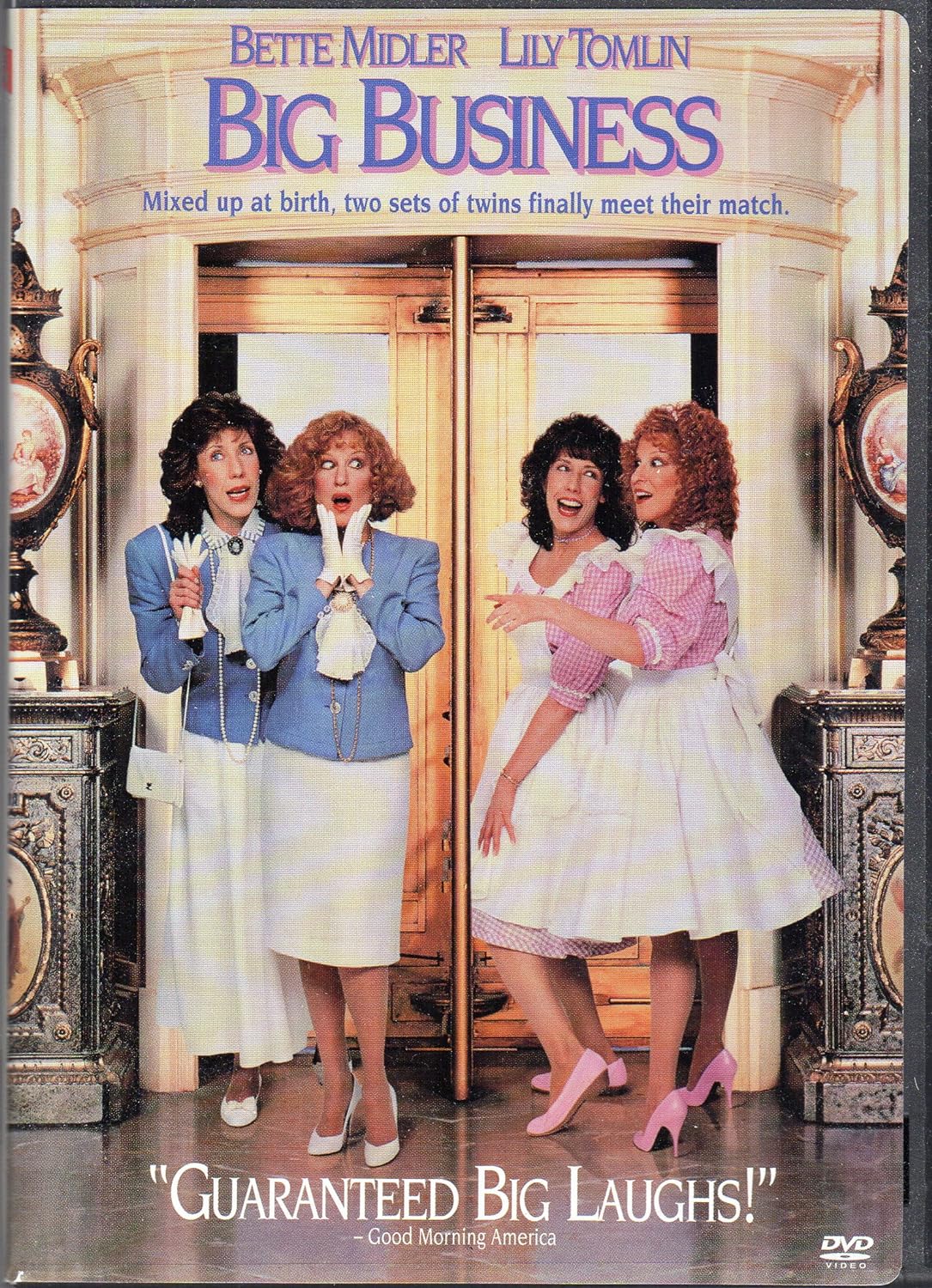
Big Business: A Comedy of Errors Derivative?

Big Business. Dir. Jim Abrahams. Perf. Bette Midler, Lily Tomlin, and Fred Ward. 1988. DVD. Buena Vista Home Entertainment / Mill Creek, 2002.

While we're on the subject of The Comedy of Errors, let me tell you about another film that I had been meaning to see for some time. Someone, somewhere told me that Big Business, the 1988 Bette Midler / Lily Tomlin film, was a derivative version of Shakespeare's Comedy of Errors. I put it down with a question mark.

After watching the film, I still have the question mark there. The film involves two sets of identical twins—that's certain. But the farce that develops is quite different than Shakespeare's. In this film, the twins are mixed up soon after birth—one of the "city folks" twins is switched with one of the "country folks" twins. That out-of-place twin always longs for her birth environment.

As the plot unfolds, we learn that the city sisters are involved in trying to sell the country sisters' furniture business.  The country sisters journey to the city to try to thwart the sale. And one of the sisters from the city doesn't like the idea of the sale; one of the sisters from the country is fine with the sale.

There's plenty of confusion and fun, but it doesn't really pick up on the themes or much of the plot of Comedy of Errors.

The clip below shows one of the film's opening scenes, explaining the double names.  It then goes on to show "the big reveal"—where all the twins learn that they have twins and that they were mixed up soon after birth.


It's a fine comedy with some Shakespearean elements, but it's not really a retelling of Comedy of Errors.

Links: The Film at IMDB.

Click below to purchase the film from amazon.com
(and to support Bardfilm as you do so).

Wednesday, August 3, 2016

Angoor: A Bollywood Comedy of Errors

Angoor. Dir. Gulzar. Perf. Sanjeev Kumar, Moushumi Chatterjee, and Deven Verma. 1982. DVD. N.s., n.d.

This film has been on my "to watch" shelf for an extremely long time. At first, I had a copy without any subtitles. It was interesting, but I was as lost as a bloodhound with a cold. Finally, I tracked down a DVD with English subtitles, but it took me a while to cycle around to Comedy of Errors again.

It was worth the wait—at least marginally so. The film follows the plot of Shakespeare's play fairly closely, but with some modernizations and some differences in character development. One of the Antipholuses (Antiphonlii?), for example, is a devotee of paperback detective stories. When he arrives in town, he's automatically suspicious of everyone and everything because his head has been filled with gangs and double agents and so on. An additional modernization involves the suspected use of drugs. Whenever a master doesn't recognize a servant (or vice versa), the mistaken one is accused of using hashish. In one elongated scene, the set of Dromio and Antipholus from out of town feed the wives of the other set some eggplant fries laced with hashish.

I was hoping too see more particular engagement or transmigration into the local culture. Still, the local setting worked well—and the plot of the play generally carries the day.

The clip below shows the opening frames of the film—where the film foregrounds its indebtedness to Shakespeare—and then a bit of the confusion of mistaken identities in this setting. It closes as the film closes—with a return to the portrait of Shakespeare. Enjoy!


Links: The Film at IMDB.

Click below to purchase the film from amazon.com
(and to support Bardfilm as you do so).

Tuesday, August 2, 2016

Black Butler Performs Hamlet

"Sono Shitsuji, KĹŤgyĹŤ" [a.k.a. "His Butler, Performer"; a.k.a. "His Butler, On Stage"]. By Mari Okada. Perf. Brina Palencia, Monica Rial, J. Michael Tatum, Daisuke Ono, Maaya Sakamoto, Jun Fukuyama, Yukari Tamura, and Koji Yusa. Dir. Toshiya Shinohara. Black Butler. Season 1, episode 25. Original Video Animation (OVA). DVD. Funimation Productions, 2012.

Anime is one of an enormous number of things that I can appreciate but not understand. I think that I would be able to dig in to its complexity and the rules of the genre and appreciate it even more thereby, but I think I would have to devote considerable time and effort to doing so, and time is not one of the things I have freely at my disposal.

Even with my limited appreciation and even more limited understanding, I can tell that Black Butler is on the high end for anime. I've only watched one episode, but considerable complexity and character development is readily apparent in just that one. And, unlike the Shakespeare in Aa! Megamisama! (for which, q.v.), the Shakespeare in this episode seems to be carefully and intentionally crafted.

In the episode "His Butler, Performer," actors who were to put on a charity performance of Hamlet for a group of orphans are delayed, but, as we've been instructed, the show must go on! Drawing from their limited resources, the show's regulars put on the show. I've complied (and streamlined) the performance of Hamlet in the clip below.


The butler's musing "I don't know that children can quite understand Hamlet" is proven false (even though it did take dancing seaweed to get there.

At the end of that clip, it appears that the show (in both senses) is over. But there's something of an epilogue after the closing credits showing how everyone reflects on their Hamlet:


That gives us a good sense of the larger issues that are at stake in the show as a whole. It convinces me that an investment of time in Black Butler would be well worthwhile. Somehow, I'll just need to track down the time required! 


Links: The Wikipedia Article on the Series.

Click below to purchase the film from amazon.com
(and to support Bardfilm as you do so).

Bardfilm is normally written as one word, though it can also be found under a search for "Bard Film Blog." Bardfilm is a Shakespeare blog (admittedly, one of many Shakespeare blogs), and it is dedicated to commentary on films (Shakespeare movies, The Shakespeare Movie, Shakespeare on television, Shakespeare at the cinema), plays, and other matter related to Shakespeare (allusions to Shakespeare in pop culture, quotes from Shakespeare in popular culture, quotations that come from Shakespeare, et cetera).

Unless otherwise indicated, quotations from Shakespeare's works are from the following edition:
Shakespeare, William. The Riverside Shakespeare. 2nd ed. Gen. ed. G. Blakemore Evans. Boston: Houghton Mifflin, 1997.
All material original to this blog is copyrighted: Copyright 2008-2039 (and into perpetuity thereafter) by Keith Jones.

The very instant that I saw you did / My heart fly to your service; there resides, / To make me slave to it; and, for your sake, / Am I this patient [b]log-man.

—The Tempest