Saturday, February 28, 2009

Shakespeare in Jazz

“Shakespeare: Drama’s DNA.” Perf. Richard Eyre, Peter Brook, and Judy Dench. Dir. Roger Parsons. Changing Stages. Episode 1. BBC. 5 November 2000. Videocassette. Films for the Humanities, 2001.

As readers of Bardfilm know, we at Bardfilm try to document all the materials we use. Only occasionally do we find ourselves unable to provide full bibliographic information about the films and books we mention here.

However, we sometimes have to throw up our collective arms (that's an image for you) and acknowledge that we do not know the source and cannot track it down.

This is the case for a brief musical interlude that is at the end of the documentary mentioned above. As that volume ends, a delightful jazz number swells over the credits—credits that do not credit the author or performer of the song. Googling the lyrics, often a productive way of finding what others have said about them, produced nothing. To the best of my knowledge and belief, this is the only site that contains the lyrics to the song (which must, for the time being, rest both anonymous and untitled).

First, here's the song (with a slideshow of Shakespeare images provided by Bardfilm); the lyrics follow.


And here are the lyrics:
To be or not to be: That's the point, of course.
Lead on, Macduff. The Game's afoot. My Kingdom for a horse.
Once more into the breach, my friends—into the breach once more!
All the world's a stage, my friend: let slip the dogs of war.
If music be the food of love . . .
And here's an appeal: If any of you can provide information about this song, please do so in the comments below! Thank you very much!

Oh—the image above ought to have its own bibliographic entry! It's from I'm Not There, a film about Bob Dylan—one which has a very brief Shakespeare-related exchange (which is almost entirely encapsulated in the image above). In the film, Dylan makes this claim: "I dig Shakespeare." Here's the bibliographic reference:

I'm Not There. Dir. Todd Haynes. Perf. Cate Blanchett, Ben Whishaw, Christian Bale, Richard Gere, Marcus Carl Franklin, Heath Ledger, Kris Kristofferson, and Richie Havens. 2007. DVD. Ufa / DVD, 2008.

Links: I'm Not There at IMDB.

Click below to purchase I'm Not There from amazon.com
(and to support Bardfilm as you do so).

Friday, February 27, 2009

Meryl Streep as Katherine; Raul Julia as Petruchio

Kiss me, Petruchio. Dir. Christopher Dixon. Perf. Meryl Streep and Raul Julia. 1981. Videocassette. Films, Inc., 1983.
This film is another one that falls into the "you-never-know-what-you'll-find-in-the-videocassette-section-of-your-library category." This film is more of a documentary than anything else, but it has a few scenes from the show itself. I'm particularly fond of the over-the-top entrance of Katherine, showing her stomping on the flowers just for the sheer meanness of it.

The documentary also has a few clips of the actors attempting to articulate the vision of love they find in The Taming of the Shrew—rather successfully, as a matter of fact.

Notes: Raul Julia played Kalibanos in Paul Mazursky's Tempest. Meryl Streep is—well, she's Meryl Streep, and she's amazing, both in her acting and in her explication of the play. This production of the play was for the New York Shakespeare Festival in 1981.


Note: A total of four clips of this production are available on this blog: The First Clip, The Second Clip, The Third Clip, and The Fourth Clip.
Links: The Film at IMDB.

The Uses of Empire / The Uses of Shakespeare

“Shakespeare: Drama’s DNA.” Perf. Richard Eyre, Peter Brook, and Judy Dench. Dir. Roger Parsons. Changing Stages. Episode 1. BBC. 5 November 2000. Videocassette. Films for the Humanities, 2001.
Much modern criticism of The Tempest is post-colonial in nature. This clip demonstrates something of an a-colonial (as opposed to a pre-colonial or post-colonial) use of Shakespeare.

I know it's brief, but it shows a bit of the uses to which the British Empire put Shakespeare.

Please note that Henry V is the play in question—not The Tempest (but note, too, that the announcer begins with a quote from that play in his introduction):


Thursday, February 26, 2009

Efrem "Prospero" Zimbalist, Jr.?

The Tempest. Dir. William Woodman. Perf. Efrem Zimbalist, Jr., William Hootkins, and Duane Black. 1983. Videocassette. Century Home Video, 1983.

While we're in a tempestuous frame of mind, we might consider the performance of Prospero that Efrem Zimbalist, Jr. gave us. The name itself is quite weighty. It sounds like a big-time, old-school studio executive with a cigar to match his temper and an ego bigger than both put together.

The performance is not quite as weighty as that sounds, but it is better than what you might expect from a big-time, old-school studio executive with a cigar to match his temper and an ego bigger than both put together.

[Note: Efrem Zimbalist, Jr. was not a big-time, old-school studio executive with a cigar to match his temper and an ego bigger than both put together. Neither was Efrem Zimbalist, Sr. The later (who was the former, chronologically speaking) was an extremely famous concert violinist; the fomer (who came later) made his big break as Dandy Jim Buckley in Maverick in the 1950s.]

In any case, you can see for yourself and judge for yourself by watching the following clip:


Links: The Film at IMDB.

Click below to purchase the film from amazon.com
(and to support Bardfilm as you do so).

Roddy "Ariel" McDowall?

The Tempest. Dir. George Schaefer. Perf. Maurice Evans, Richard Burton, Roddy McDowall, Tom Poston, Liam Redmond, and Lee Remick. 1960. Videocassette. Films for the Humanities, 1983.

Roddy McDowall has been in just about everything, so we probably shouldn't be surprised to find him playing Ariel opposite Richard Burton's Caliban in the 1960 made-for-TV production of The Tempest.

McDowall's Ariel looks like a cross between the Sewer Urchin (from the animated version of The Tick—in one episode of which, Roddy McDowall played a villain named "The Breadmaster," by the way), an echidna, and . . . um . . . Roddy McDowall.

Yes, it's a little hard to imagine.  Fortunately, you can let us on your imaginary forces work.  Think, when we talk of Roddy McDowall as Ariel, that you see him in the clip below, singing "Where the bee sucks, there suck I" with occasional slapstick orchestral punctuation:


Links: The Film at IMDB.

Click below to purchase the film from amazon.com
(and to support Bardfilm as you do so).

Wednesday, February 25, 2009

Richard "Caliban" Burton?

The Tempest. Dir. George Schaefer. Perf. Maurice Evans, Richard Burton, Roddy McDowall, Tom Poston, Liam Redmond, and Lee Remick. 1960. Videocassette. Films for the Humanities, 1983.

I have been studying The Tempest this semester; this led to my discovery of Richard Burton as Caliban in a 1960 made-for-TV (Hallmark Hall of Fame) production of the play. It certainly isn't great, but it isn't always terrible, either.

Burton's Caliban looks like a cross between Aquaman after a late evening and Charlie the Tuna (mascot of the Chicken-of-the-Sea brand of canned tuna fish—Starkist) after meeting up with some rough, angry dolphins.

But the voice—that amazing voice. That's surely something!


Links: The Film at IMDB.

Click below to purchase the film from amazon.com
(and to support Bardfilm as you do so).

Tuesday, February 24, 2009

Shakespeare Author Cards

Jones, Keith. Shakespeare Author Cards. © 2009
If you grew up playing the classic "Authors" card game, you'll love this modernized, Shakespearean version! And it's offered free, courtesy of Bardfilm in honor of our first anniversary (appropriately, the paper anniversary).

Here's how to get the cards ready:
  1. Click on each image below (to enlarge them), then save them to your computer.
  2. Print them out (ideally, on card stock). I've even included an image to place on the reverse side of the cards.

  3. Cut the printed sheets into a set of fifty-two Shakespeare-related cards! [See below for instructions on how to play the game.]

Now you're ready to start playing the game! Here are the game instructions. Ideally, you should have more than two players, but you can get by with just two—especially if you're using this as a parent-child bonding game.
  1. Deal seven cards to each player. Place the remaining cards face down in the middle of the table.

  2. The player to the left of the dealer may ask any other player for a card that matches one that she holds in her hands. For example, if she has the Queen of Hearts (Henry the Fourth, Part Two), she may say, "Do you have Richard the Second, a play from Shakespeare's Second Tetralogy?"

  3. If that player has the card, he must give it to her, and she may ask any player (including the one who had Richard II) for another card. If that payer does not have the card, she must draw from the pile.

  4. Play passes to the next player, who may ask any player for a card matching one in his hand.

  5. When a player gets all four works in a given category, she places them face up on the table in front of her, saying, for example, "The Second Tetralogy is complete!"

  6. The player with the most sets at the end of the game wins! He or she then gets to choose which Shakespeare film to watch that night.
We hope you enjoy this game enormously. Good luck!

Sunday, February 22, 2009

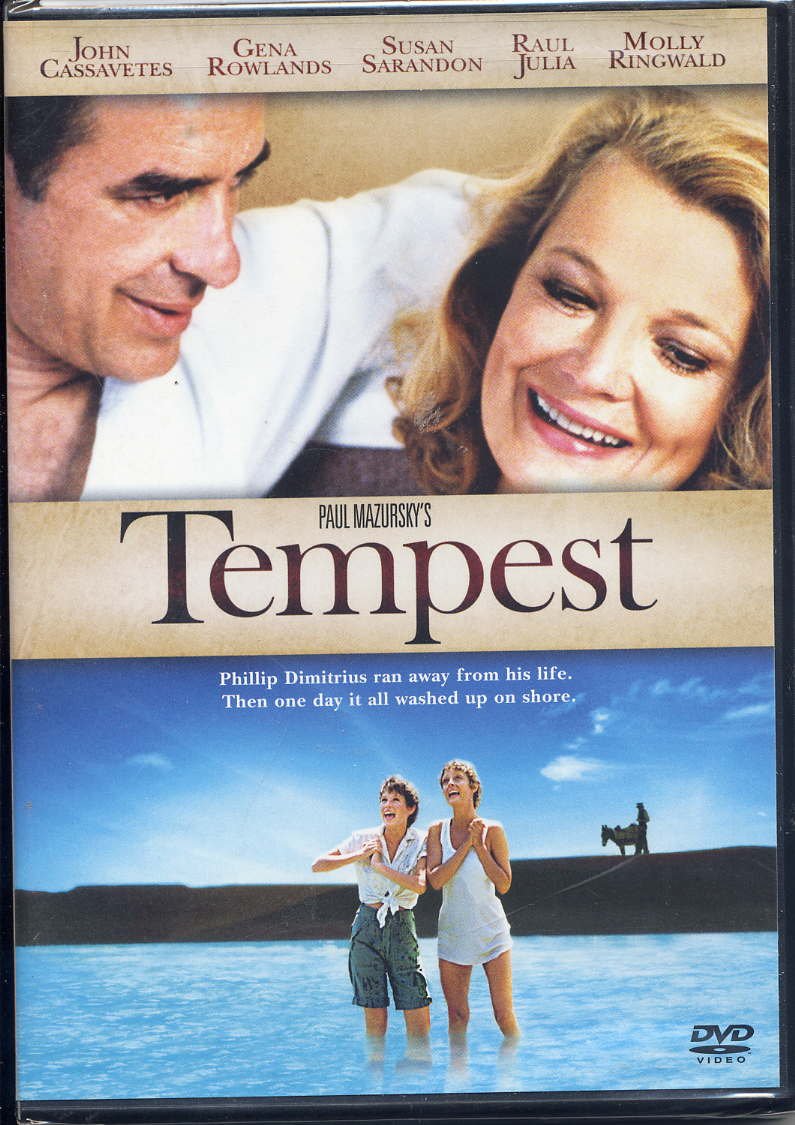
Mazursky's Tempest

Tempest. Dir. Paul Mazursky. Perf. John Cassavetes, Gena Rowlands, Susan Sarandon, Raul Julia, and Molly Ringwald. 1982. DVD. Sony Pictures, 2007.

This may be one of the mircoest posts in this microblog, but here it is. In Mazursky's Tempest (part of which I'm using in my Shakespeare and Film class to show the degrees of Shakespearean derivatives), the characters mention the possibility of a new musical:  "It's a cross between Chorus Line and Macbeth."

The film itself is a good derivative, playing with the plot and abandoning Shakespeare's language.  "Show me the magic," says the Prospero analogue as he summons up a storm—toward the end of the film rather than the beginning.

It also introduces Molly Ringwald, who plays the Miranda analogue!

Links: The Film at IMDB.

Click below to purchase the film from amazon.com
(and to support Bardfilm as you do so).

Saturday, February 21, 2009

Avant-Garde Meditation on The Tempest

Le Tempestaire [The Tempest]. Avant-Garde: Experimental Cinema of the 1920s and 1930s. Dir. Jean Epstein. 1947. DVD. Kino, 2005.

In this version of The Tempest, a young woman is worried about her young man, who has gone out to sea. In her fear over the possibility of a tempest, she seeks out one of the ancient "Tempest Masters" who can prevent the storm.

It's not enormously faithful to the play, but it seems to play with the idea of the play—and with the power to control (in this case, to reverse or to prevent) storms at sea. The most visually-pleasing part is the waves running in reverse:


Links: The Film at IMDB.

Click below to purchase the film from amazon.com
(and to support Bardfilm as you do so).

Wednesday, February 18, 2009

"Now is the winter of your discontent!"

“And the Weiner is . . .” By Mike Barker and Matt Weitzman. Perf. Seth MacFarlane and Alex Borstein. Dir. Bert Ring. Family Guy. Season 3, episode 5. FOX. 8 August 2001. DVD. Twentieth Century Fox, 2003.

Today is the first anniversary of Bardfilm! One year ago, Bardfilm's quest began with an overly-humble post about The Banquet (for which, q.v.). To celebrate, here's an extremely-brief (in keeping with the "Micro" portion of this sometimes-unaptly-classified "Microblog") Shakespeare allusion from Family Guy. 

[Note: The clip contains something that might be considered a minor expletive. If your children (or your parents) are looking over your shoulder and you're concerned, you have been warned. Oh—there's also a violent attack with a snow bazooka. Just so you know.]


Links: The Episode at Wikipedia.

Click below to purchase the complete show from amazon.com
(and to support Bardfilm as you do so).

Tuesday, February 17, 2009

Sonnets in Ten Things I Hate About You

Ten Things I Hate About You. Dir. Gil Junger. Perf. Julia Stiles and Heath Ledger. 1999. DVD. Walt Disney Video, 1999.

Although I was enchanted by Ten Things I Hate About You when i first encountered it, I soon became disenchanted. Now, with a gap of a few years, I'm re-enchanted. Perhaps the reason was that I didn't care overly much for The Taming of the Shrew, the play on which this derivative is based (at least at its beginning). But I've grown to understand more about the play by teaching the play (which often happens), and I like the film more as a result.

The thing I appreciated most about the film this time around was the way in which its placing nearly everyone in the film into a stereotype brings out the way in which Shakespeare's Taming of the Shrew plays with stereotypes. Padua, like Padua High, is filled with easily-labeled stereotypes—which are (for the most part) broken in the course of the play.

This time around, I noticed the use of sonnets—possibly because I've been writing about sonnets on Bardfilm recently. In the clip below, the teacher presents the first four lines of Sonnet 141 ("In faith, I do not love thee with mine eyes") preparatory to giving his students an assignment. Kat (played by Julia Stiles) usually gives the teacher a hard time—that's why he responds as he does. The clip then segues to the completion of the assignment—after Heath Ledger's underhandedness (which he now regrets) has come to light. The poem (which seems to list thirteen things the narrator hates about the addressee) seems to be the source for the film's title:


Bonus! The two poems in question:

Sonnet 141 (Derivative Version)

I hate the way you talk to me,
And the way you cut your hair.
I hate the way you drive my car.
I hate it when you stare.
I hate your big dumb combat boots,
And the way you read my mind.
I hate you so much it makes me sick.
(It even makes me rhyme.)
I hate the way you’re always right.
I hate it when you lie.
I hate it when you make me laugh—
Even worse when you make me cry.
I hate it when you’re not around, and the fact that you didn’t call.
But mostly I hate the way I don’t hate you—not even close, not even a little bit, not even at all.

Sonnet 141

In faith, I do not love thee with mine eyes,
For they in thee a thousand errors note;
But 'tis my heart that loves what they despise,
Who in despite of view is pleased to dote;
Nor are mine ears with thy tongue's tune delighted,
Nor tender feeling, to base touches prone,
Nor taste, nor smell, desire to be invited
To any sensual feast with thee alone:
But my five wits nor my five senses can
Dissuade one foolish heart from serving thee,
Who leaves unsway'd the likeness of a man,
Thy proud heart's slave and vassal wretch to be:
Only my plague thus far I count my gain,
That she that makes me sin awards me pain.


Links: The Film at IMDB.

Click below to purchase the film from amazon.com
(and to support Bardfilm as you do so).

Monday, February 16, 2009

Speaking of Sonnets . . . My So-Called Life and Sonnet 130

“Self-Esteem.” By Winnie Holzman. Perf. Bess Armstrong, Wilson Cruz, and Claire Danes. Dir. Michael Engler. My So-Called Life. Season 1, episode 12. ABC. 17 November 1994. DVD. Bmg Special Product, 2002.

In considering the way in which a Shakespeare sonnet is brought in to emphasize and contemplate themes in an already-Shakespearean plot in the Shakespeare Retold's Much Ado About Nothing reminded me of similar uses of sonnets in other settings.

One episode of My So-Called Life brings Sonnet 130 ("My mistress' eyes are nothing like the sun") to bear on its plot structures in this way. I don't pretend to know the intricacies of the Jordan / Brian / Angela love triangle. But it it clear in the clip that the two men realize and recognize something about the woman that they have been idealizing. And the teacher realizes that class discussion has gone rather well today, thank you very much!


As a bonus, here is the sonnet in question and the dialogue that follows its reading:
Sonnet 130
My mistress' eyes are nothing like the sun;
Coral is far more red than her lips' red;
If snow be white, why then her breasts are dun;
If hairs be wires, black wires grow on her head.
I have seen roses damask'd, red and white,
But no such roses see I in her cheeks;
And in some perfumes is there more delight
Than in the breath that from my mistress reeks.
I love to hear her speak, yet well I know
That music hath a far more pleasing sound;
I grant I never saw a goddess go;
My mistress, when she walks, treads on the ground:
And yet, by heaven, I think my love as rare
As any she belied with false compare.


Mr. Katimski: What kind of girl is Shakespeare describing here? Is . . is she the most beautiful girl?

Brian: No.

Mr. Katimski: Is she a goddess? Mmm? Physically perfect? The kind of girl who stops traffic when she walks down the street?

Brian [with a slight chuckle]: No.

Mr. Katimski: So he's not in love with her?

Jordan [barely audible]: Yeah. [Then louder:] He is.

Mr. Katimski: Well, and why is that? Why is he in love with her? What is it? What is it? What is it about her?

Brian: She's not just a fantasy. She's got . . . like . . . flaws. She's real.

Mr. Katimski: Thank you.


Links: The Episode at IMDB.

Click below to purchase the show from amazon.com
(and to support Bardfilm as you do so).

Saturday, February 14, 2009

Shakespeare Retold and Sonnet 116

Much Ado About Nothing. Shakespeare Retold. Dir. Brian Percival. Perf. Sarah Parish, Damian Lewis, and Billie Piper. 2005. DVD. BBC, 2007.

The BBC, in their remarkable derivative version of Much Ado About Nothing, cleverly work Shakespeare's Sonnet 116 into a scene between the Beatrice analogue and the Benedick analogue. At first, I thought it was just a way to create some romantic tension between the two. Each of them has been told that the other is madly in love with them; each of them has started to fall madly in love with the other; but no one says anything about that. Instead, they read a sonnet together.

But the more I think about it, the more clever it gets. First, it stands in for the exchange of sonnets that the characters in Shakespeare's play make later in the play. Second, it gives the characters the chance to talk seriously on a serious (but non-threatening) topic, and that enables them to appear far more mature than they have to that point in the film. Even during the course of the scene itself (see below), the characters both seem to mature.

Third (and possibly the most interesting), the sonnet ("Let me not to the marriage of true minds / Admit impediments") picks up on a word used several times in the play itself—Don John says, "Any bar, any cross, any impediment will be medicinable to me" as he plots his evil course," and the Ceremony of Matrimony (see the 1552 version below) is echoed in the Friar's "If either of you know any inward impediment why you should not be conjoined, charge you, on your souls, to utter it." And the word "impediment" is merely a verbalization of the issue of impediment on which the play (and the film) constantly ring changes. For marriages to take place at the end of the play or the film, impediments need to be removed. And, as the wording suggests, that includes "inward" impediments in addition to the usual outward impediments (unsupportive fathers, friends, monetary situations, et cetera) that are the stock-in-trade of this kind of comedy.

But it's Valentine's Day! Let's just take a look at the lovely and romantic scene itself:


And, as a bonus, here's the full text of the sonnet and a bit of the marriage ceremony:
Sonnet CXVI

Let me not to the marriage of true minds
Admit impediments. Love is not love
Which alters when it alteration finds,
Or bends with the remover to remove:
O no! it is an ever-fixéd mark
That looks on tempests and is never shaken;
It is the star to every wandering bark,
Whose worth's unknown, although his height be taken.
Love's not Time's fool, though rosy lips and cheeks
Within his bending sickle's compass come:
Love alters not with his brief hours and weeks,
But bears it out even to the edge of doom.
If this be error and upon me proved,
I never writ, nor no man ever loved.
The Ceremony of Matrimony from the 1552 Prayer Book:
I require and charge you (as you wil aunswere at the dreadful day of judgment, when the secretes of al hearts shalbe disclosed) that if either of you doe knowe any impediment, why ye may not be lawfully joyned together in Matrimonie, that ye confesse it. For be ye wel assured, that so many as be coupled together otherwyse then god's word doth allowe, are not joyned together by god, neither is there Matrimonye lawfull.

Links: The Film at IMDB.

Click below to purchase the entire Shakespeare Retold set
(of which this is only one out of four films)
from amazon.com
(and to support Bardfilm as you do so).

Friday, February 13, 2009

Shakespeare Retold (Retold)

Much Ado About Nothing. Shakespeare Retold. Dir. Brian Percival. Perf. Sarah Parish, Damian Lewis, and Billie Piper. 2005. DVD. BBC, 2007.

Note: This is a reposting of a very early blog entry. Actually, it's nearly a year old. Back then, I was publishing the blog through iWeb and forwarding those pages directly to the blogspot blog, so the formatting was often quite odd. Anyway, I just watched the film with my Shakespeare and Film students; therefore, I'm thinking about these issues; therefore, I wanted to repost them in a more readable format.

Note: Before reading this post, go watch the Shakespeare Retold version of Much Ado About Nothing. That adaptation changes Shakespeare’s plot substantially, and you really should see it to believe it . . . not read about it here. Thanks!

Our class had a lively discussion about the way the Shakespeare Retold series ended its Much Ado About Nothing. Part of the debate was over whether the play offers some hope—or, at least, some ambiguity—for Claude and Hero to get back together. Here’s a transcript (as best I could reproduce it) of the last conversation between the two of them that the film allows us to overhear:
Hero: What? Get married? To you? Never in a million years.

Claude: OK, maybe not in the short term. But . . . sometime in the future perhaps? Just say I can hope, Hero, please. Please.

[She looks at him, tosses her head, and stares at the horizon. Cut to the two of them in long shot walking toward us on the beach.]
Later, as Benedick and Beatrice are getting married, Hero gives Claude a look (see below). Is that look sufficiently charged with ambiguity to enable us to think that they will be getting married later on? Or is it just, as one student put it, “the bridesmaid look” that is nice but doesn’t mean much?

More on this topic later. It’s too interesting to leave like this! (Which may be just what Claude was thinking about Hero at this moment!)


Note:  As Ophelia sings, "Tomorrow is St. Valentine's day / All in  the morning betimes."  Come back for Bardfilm's Valentine's day post!

Links: The Film at IMDB.

Click below to purchase the entire Shakespeare Retold set
(of which this is only one out of four films)
 from amazon.com
(and to support Bardfilm as you do so).

Thursday, February 12, 2009

Peter Brook's 1971 King Lear

King Lear. Dir. Peter Brook. Perf. Paul Scofield, Anne-Lise Gabold, Ian Hogg, Cyril Cusack, Susan Engel, and Tom Fleming. 1971. DVD [PAL, Region 2 Format]. Uca, 2005.

“Shakespeare: Drama’s DNA.” Perf. Richard Eyre, Peter Brook, and Judy Dench. Dir. Roger Parsons. Changing Stages. Episode 1. BBC. 5 November 2000. Videocassette. Films for the Humanities, 2001.

Peter Brook's film version of King Lear hasn't been released in DVD in American markets. But I discovered a small segment on the videocassette that presented a short clip of Peter Brook's 1970 stage production of Midsummer Night's Dream.  It's starting to become something like Rare-and-Interesting-Clips-of-Shakespeare-Productions Week at Bardfilm!


Links: The Film at IMDB.

Click below to purchase the film
(assuming you have access to a Region 2 DVD player)
 from amazon.com
(and to support Bardfilm as you do so).

Bardfilm is normally written as one word, though it can also be found under a search for "Bard Film Blog." Bardfilm is a Shakespeare blog (admittedly, one of many Shakespeare blogs), and it is dedicated to commentary on films (Shakespeare movies, The Shakespeare Movie, Shakespeare on television, Shakespeare at the cinema), plays, and other matter related to Shakespeare (allusions to Shakespeare in pop culture, quotes from Shakespeare in popular culture, quotations that come from Shakespeare, et cetera).

Unless otherwise indicated, quotations from Shakespeare's works are from the following edition:
Shakespeare, William. The Riverside Shakespeare. 2nd ed. Gen. ed. G. Blakemore Evans. Boston: Houghton Mifflin, 1997.
All material original to this blog is copyrighted: Copyright 2008-2039 (and into perpetuity thereafter) by Keith Jones.

The very instant that I saw you did / My heart fly to your service; there resides, / To make me slave to it; and, for your sake, / Am I this patient [b]log-man.

—The Tempest