As my Grandmother Jones used to say, I told you that to tell you this.
Late in Season Three, we're presented with a two-part episode that begins (quite promisingly, from Bardfilm's point of view) with some Shakespeare. That's not too unusual, and, since the episode aired on the day after Shakespeare's 431st birthday, quite fitting. But I was disappointed and unsatisfied. After all, it seems like mere filler to show the ongoing quasi-antagonistic relationship between Garak (a Cardassian who might or might not be a spy) and Doctor Bashir, a member of the Federation (which has, at this point, a queasy peace with the Cardassians). Here's all the Shakespeare we get in the episode:
Not much there, right? That could have been a conversation about Ernest Hemingway or Emily Dickinson or Erma Bombeck, couldn't it?
After a fashion, that's accurate. But we get a deep payoff toward the end of the second episode of this two-parter, and it's exactly what Star Trek, at its best, does with Shakespeare.
Note: From this point forward, spoilers abound.
The plot of “Improbable Cause," the first episode, involves Odo, Deep Space Nine's Constable (a.k.a. Chief Security Officer) investigating an explosion at Garak's shop. [Side note: Garak has been exiled from Cardassia for mysterious reasons and has set up shop as a tailor on Deep Space Nine—which is, in itself, somewhat suspicious.] Odo suspects Garak of having blown up his shop himself, but it's also possible that he's been the victim of an attempted assassination. When the two of them learn that many former members of the Obsidian Order, a secret police force of sorts, have recently been killed, they set off to find Enabran Tain, who was very high up in the Order—and responsible for Garak's exile.
Garak and Odo find Enabran Tain, who was, indeed, responsible for eliminating many of his former colleagues and underlings in the Obsidian Order. In doing so, he was setting the stage for a political and military power play. Because Garak betrayed him in the past, Tain doesn't trust that Garak's interests and his own (which he equates to those of Cardassia) coincide. However, he offers Garak a chance to join him. Even though doing so works directly against the Federation, Garak does so.
The second episode is entitled "The Die is Cast," and its plot increases the intrigue. In fact, it gets very complicated indeed. Essentially, the Cardassians and the Romulans, historic enemies of the Federation, have joined forces to do battle with the Founders (a.k.a. the Dominion, a.k.a. [sort of] the Jem'Hadar), brand-new enemies. And Garak has cast his lot (or "die," I suppose) with Enabran Tain and Cardassia.
But that's where Julius Caesar comes back. It's themes of trust and betrayal have actually been running subtly throughout the entire two-parter. In the clip below, we find out that it's all been a trap for the Cardassians and the Romulans. We join in the middle of a very one-sided battle:
Although Garak wasn't the mastermind behind the trap (and hasn't betrayed Enabran Tain in that way), he has been working to protect Odo—you can see him sneaking off to save Odo in the last moments of the clip.
What seemed to be a tangental and throwaway use of Shakespeare turns out to be the underlying structural element of the entire two-part narrative! When we go back to the first minute of the first episode with the second episode in mind, Garak's "I knew Brutus was going to kill Caesar in the first act" makes us consider whether we should have known that Garak would betray Enabran Tain from the beginning of the two-parter. That's the use Star Trek can make of Shakespeare if it puts its mind to it.
Which brings me to Star Trek: The Next Conversation. In order to belong to their prestigious "Admirals' Club," a listener must post a five-star review somewhere where it's likely to be seen. And I've decided I'd like to be a member of that club.
Star Trek: The Next Conversation is a five-star podcast. Matt Mira and Andrew Secunda, its hosts, have taken listeners through the entirety of Star Trek: The Next Generation, which Matt had watched—and watched deeply—many, many times while Andrew had seen few (if any) episodes before the podcast began. The podcast is currently making its way through Star Trek: Deep Space Nine. The thrilling experience of seeing Star Trek in all its forms through their eyes cannot be duplicated elsewhere, especially given the devoted listener contributions (the creation of theme songs and other hilarious material by fans of the show), the many "inside baseball" insights from two television writers, and odd-but-enjoyable segments like the strangely-compelling "Frank Sinatra? Come on!" bit where Matt and Andy recount what the Chairman of the Board was doing on the release date of many episodes.
If there's one part of this otherwise-flawless podcast that could be improved, it is the hosts' engagement with the Shakespeare offered by
Star Trek. It's almost as if they haven't read carefully through
Bardfilm's vast collection of Shakespeare references in
Star Trek found in the post
Shakespeare and Star Trek Complete or discovered that my work compiling those references has earned me the nickname "Chairman of the Bard." On occasion, the Shakespeare is incidental to
Star Trek. But in the case of “Improbable Cause” and “The Die is Cast," understanding the Shakespeare is integral to appreciating the episodes. In their most recent episode, for example,
Star Trek: The Next Conversation gave “Improbable Cause” fewer than a full ten Andies (their rating system)—in part because they felt the opening sequence had nothing to do with the rest of the story. I hope that their next episode will re-consider that rating now that the second episode of the two-parter has make the Shakespeare reference intensely relevant to the show as a whole. Paying greater attention to the Shakespeare will make this five-star podcast even more rich and strange (see what I did there?—that's a quote from
The Tempest).
An Evil Prospero Analogue Quotes from The Tempest in Star Trek: Deep Space Nine
“Our Man Bashir.” By Ronald D. Moore. Perf. Avery Brooks, Rene Auberjonois, Alexander Siddig, Terry Farrell, Colm Meaney, Nana Visitor, Andrew Robinson, Carlos Lacamara, Joseph Ruskin, Darwyn Carson, Julianna McCarthy, and Paul Dooley. Dir. Avery Brooks. Star Trek: Deep Space Nine. Season 4, episode 9. Syndicated television. 27 November 1995. DVD. Paramount Pictures Home Entertainment, 2021.
Inspired by the podcast
Star Trek: The Next Conversation, I've been re-watching
Star Trek: Deep Space Nine, this time with an eye more peeled for Shakespeare.
At this point, I'm well ahead of the podcast, but I'll be certain to call their attention to the Shakespeare in "Our Man Bashir."
Unfortunately, there's not much Shakespeare here. In this episode, something (imagine that) has gone wrong with the holosuite. I won't trouble you with the details, but Dr. Bashir is playing (essentially) James Bond, Kira is the Russian femme fatal, and Captain Sisko is the evil villain.
The Shakespeare comes in when the evil villain reveals his dastardly plot:
For those of you who aren't terribly fond of Prospero, this can be taken as an interpretation of his twisted vision of his power over the island (even though he appropriates Miranda's line for his idea of the future). Through science (rather than magic), he'll have complete authority over the vastly-geographically-reduced brave new world.
To provide much-needed additional depth to what is otherwise a pretty disappointing episode, we're given a biblical allusion as well: The evil genius is named Dr. Noah.
Beyond that, there's not much positive to say about the episode. But the allusions to Shakespeare and the Bible do raise the overall tone somewhat.
Five Words from Macbeth in an Episode of Deep Space Nine
“Sons of Mogh.” By Ronald D. Moore. Perf. Tony Todd and Michael Dorn. Dir. David Livingson. Star Trek: Deep Space Nine. Season 4, episode 14. Syndicated television. 12 February 1996. DVD. Paramount Pictures Home Entertainment, 2021.
With the Shakespeare Radar™ turned on, I've been re-watching
Star Trek: Deep Space Nine.
But I freely admit that it may be too sensitive. Are these five words, unquestionably found in Macbeth in this exact sequence, deliberately and purposefully quoted? Or is it mere coincidence? [Note: All right. I admit it. In the play, two of the words are contracted, so it's technically four words in the play and a five-word misquotation in the episode.]
Perhaps you will agree to be the judge:
In Act III, Lady Macbeth says, "Things without all remedy / Should be without regard: What's done, is done" (III.ii.11–12). Here, Worf gives us a very close paraphrase.
Unfortunately, I can't find any genuine connection between the plot of the episode and the plot of Shakespeare's play. We don't even get the variant "What's done cannot be undone" (V.I.68) that Lady Macbeth utters when she's sleepwalking.
But I'll keep watching, hoping to find any further (and deeper) connections between Shakespeare and Star Trek.
"I wish your Enterprise to-day may thrive." —Julius Caesar, III.i.13
 Star Trek: Generations [a.k.a. Star Trek VII]. Dir. David Carson. Perf. William Shatner, Leonard Nimoy, DeForest Kelley, Nichelle Nichols, James Doohan, Walter Koenig, George Takei, Patrick Stewart, Jonathan Frakes, LeVar Burton, Michael Dorn, Brent Spiner, Billy Campbell, Alan Ruck, Whoopi Goldberg, and Malcolm McDowell. 1994. DVD. Paramount, 2004.
With the image above, Bardfilm wraps up its survey of Shakespeare in
Star Trek. Combing through the wreckage of
The Enterprise, Captain Picard is delighted to find his
Complete Works of Shakespeare intact.
It's not a bad image for what
Star Trek, in all its permutations, has done with Shakespeare. The show has quoted Shakespeare, decontextualized Shakespeare, alluded to Shakespeare, borrowed from Shakespeare, and done many other things with Shakespeare, but Shakespeare comes out intact.
The overarching interest in these uses of Shakespeare in a pop culture icon like
Star Trek is that they are both engaged in the same project. Shakespeare takes real human beings and puts them in situations that enable us (and them) to study and to learn about the human condition—its behavior, its faults, its depravity, its redemption. Although the circumstances may be unlike any that we are likely to experience (I'm not, for example, in line to the Throne of Scotland, however much I'd like to be), we—through Shakespeare's characters—learn
by experience about our own guilt and sin as we see Macbeth's guilt and sin played out on stage. As we learn about our own need for redemption, we also discover means for working out that redemption. I hope I'll never be as hypocritical as
Measure for Measure's Angelo, for example, but I can certainly learn about mercy and redemption by watching him through that play.
Star Trek also puts human beings (and Betazoids and Romulans and Sheliak and Vulcans and Tholians and Klingons and others too numerous to mention here) into situations that show us (and them) something about humanity writ large.
Star Trek, being what it is, has a less-Calvinistic (I'm just starting work on a paper I've been commissioned to write on Shakespeare and John Calvin—more on that as time progresses) position on human nature than does Shakespeare, but its characters are still seeking redemption for humanity.
There you have it.
Star Trek, seeking to understand the human condition, turns to Shakespeare to aid it in its own—um—enterprise.
Hamlet's Father's Ghost's Speech in Paramount's Star Trek's Troi's Revenge
 Star Trek: Nemesis [a.k.a. Star Trek X]. Dir. Stuart Baird. Perf. Patrick Stewart, Jonathan Frakes, LeVar Burton, Michael Dorn, Marina Sirtis, and Brent Spiner. 2002. DVD. Paramount, 2003.
In the worst of all the
Star Trek films to date lies the final Shakespeare quotation of all the
Star Trek films to date:
Remember me. (Hamlet, I.v.94)
The quotation had been used before—in an Original Series episode (for which,
q.v.) and as the title of an entire
Next Generation episode (for which,
q.v.). In this film, it's used as a cry
of revenge rather than (as in Shakespeare's play) a cry
to revenge.
Deanna Troi has been psychically abused by the bad guys in this film; in this scene, she uses her empathic abilities to target the bad guys' cloaked ship:
And there you have it. Captain Picard's cry of "Fire at Will" is as likely to be a reference to Will Shakespeare as to Will Riker (in other words, not very likely), so the Shakespeare allusions in
Star Trek stop at "Remember me." And that is, all in all, not a bad place for them to stop—even if the film itself is pretty bad.
Shakespeare in Star Trek: Beyond Star Trek: Beyond. Dir. Justin Lin. Perf. Chris Pine, Zachary Quinto, and Karl Urban. 2016. DVD. Paramount, 2016.
Just when you think you've assembled
every single Shakespeare reference, allusion, and quote in all of canonical Star Trek, they release a new film with a new quote.
This time, it's quite a good one, though it is obscure.
First, the scene. Reboot Spock has been injured. Reboot Kirk is worried. Reboot McCoy has found some ancient medical equipment that he hopes will help.
The word
hope is the cue for Reboot Spock to quote some Shakespeare:
The quote Reboot Spock chooses is one Measure for Measure's Claudio delivers while he is under sentence of death: "The miserable have no other medicine / But only hope" (III.i.2-3). If Reboot Spock had had the strength, he doubtless would have concluded the line: "I have hope to live, and am prepar'd to die" (III.i.4).
Reboot Bones is nonplussed, but only for a moment. Either he recognizes the quote or he figures that Reboot Spock is more likely to quote Shakespeare than . . . say . . . Dryden.
I'd like to read more into the quote than the surface connection of hope and medicine. In the film, Reboot Spock and Reboot Uhura have decided not to pursue a romantic relationship; Claudio and Juliet have had the decision not to pursue a romantic relationship thrust upon them. Claudio without Juliet is as miserable as Reboot Spock without Reboot Uhura.
Naturally.
Star Trek: Picard and The Tempest
“Et in Arcadia Ego, Part 2.” By Michael Chabon. Perf. Patrick Stewart and Brent Spiner. Dir. Akiva Goldsman. Star Trek: Picard. Season 1, episode 10. Paramount+. 26 March 2020. DVD. Paramount Pictures Home Entertainment, 2023.
It's been some time since I had anything to add to my "Shakespeare and
Star Trek Complete" post (for which,
q.v.). And that post, in all honestly, is "complete" for
Star Trek: The Original Season and
Star Trek: The Next Generation while only venturing occasionally into other
Star Trek universes (e.g.,
Star Trek: The Animated Series,
Star Trek: Enterprise, and the reboot films).
But I've finally found the time to watch Star Trek: Picard and to find the Shakespeare therein.
I'm afraid Picard is pretty awful in most respects, but you can learn more about that from other sources. Here, we'll talk about the Shakespeare—which you may think is pretty awful, too.
Note: Spoilers are approaching at high warp.
In the final episode of Season 1, the show awkwardly wraps up. Picard has died (but don't worry—his consciousness has been placed in an android body . . . the very thing we've been warned not to do in "The Schizoid Man" and elsewhere in the Star Trek universe), and Data (who likewise died near the end of Star Trek: Nemesis) has been restored—but only in a simulation, not in a physical body of any sort (but don't worry—Dr. Noonien Soong has a previously-unmentioned biological son who looks just like Data). Data wishes to end his existence since that's the only thing that is certain about human beings (except when it isn't), and he wishes to have a fully human experience.
As Data's simulation shuts down, Picard provides narration in the way of a speech from
The Tempest:
Anyone who would say "Spoilers are approaching at high warp" should be careful about calling anything corny, so I'll avoid doing that. Instead, I'll comment on the insight that we're offered. Here's what Picard says before the Tempest quote:
Looking at the human race, with all its violence and corruption and willful ignorance, he could still see kindness, the immense curiosity and greatness of spirit. And he wanted, more than anything else, to be a part of that . . . to be a part of . . . the human family.
He's talking, of course, about Data. But he could easily be talking about Shakespeare—at least in the first part. The second part could be changed for Shakespeare to "he wanted to show us the human family."
With that in mind, perhaps there's less corniness in Prospero's words and Picard's (and Picard's) use of them:
We are such stuff
As dreams are made on, and our little life
Is rounded with a sleep. (The Tempest, IV.i.156–58)
Star Trek: Picard and Macbeth
“Penance.” By Akiva Goldsman, Terry Matalas, and Christopher Monfette. Perf. Patrick Stewart and John de Lancie. Dir. Doug Aarniokoski. Star Trek: Picard. Season 2, episode 2. Paramount+. 10 March 2022. DVD. Paramount Pictures Home Entertainment, 2023.
Shakespeare doesn't appear often in
Star Trek: Picard, but we just have to take what we can get.
In this episode, Q returns for yet another test—either of humanity in general or of Picard specifically. When he starts to allude to his plan (in his usual ambiguous manner), Q suggests that Picard is guilty of something and that his guilt is akin to Macbeth's. For Q, the answer to Macbeth's query "Will all great Neptune's ocean wash this blood / Clean from my hand?" is decidedly in the negative:
I've noted that Star Trek: Picard is, in general, all kinds of terrible, and Season Two seems to be the worst of the three. That applies to its use of Shakespeare. Instead of carrying this allusion forward, making oblique or direct reference to it during the rest of the season and wrapping the season up with some great Shakespeare-related insight, this is it.
Perhaps there will be something in Season Three that provides more Shakespeare. We can but hope.
Star Trek: Picard and Julius Caesar
“The Last Generation.” By Terry Matalas. Perf. LeVar Burton, Michael Dorn, Jonathan Frakes, Gates McFadden, Marina SirtisPatrick Stewart, and Brent Spiner. Dir. Terry Matalas. Star Trek: Picard. Season 3, episode 10. Paramount+. 20 April 2023. DVD. Paramount Pictures Home Entertainment, 2023.
We conclude our search for Shakespeare in
Star Trek: Picard with the very last scene from the very last episode.
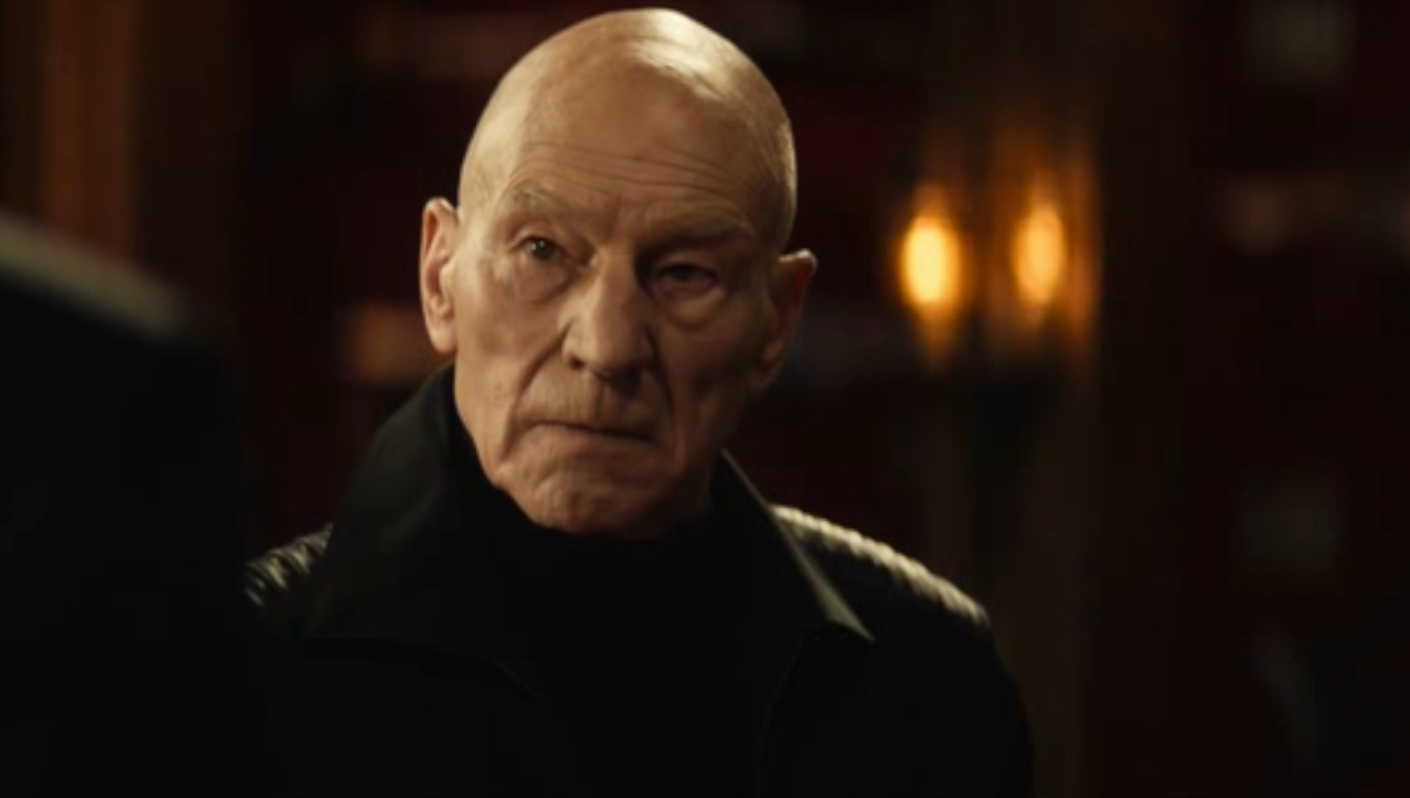
Spoiler Alert: Everything gets wrapped up quite neatly in Season Three (which is probably the best of the not-so-great show), and a toast is requested. Admiral Jean-Luc Picard obliges with a speech from
Julius Caesar:
The speech is taken from the second (and duller) half of the play. Julius Caesar has been assassinated, Mark Anthony has gathered his troops, Brutus and his forces are fighting for their survival, and Caesar's ghost has not yet appeared to Brutus to utter his foreboding prophecy. Brutus speaks to Cassius:
There is a tide in the affairs of men,
Which[,] taken at the flood, leads on to fortune;
Omitted, all the voyage of their life
Is bound in shallows and in miseries.
On such a full sea are we now afloat,
And we must take the current when it serves,
Or lose our ventures. (IV.iii.218–24)
The speech is appropriate, but it might have been more appropriate at any of a dozen other points in the season—points where a brave and daring decision actually needed to be made. Here, it seems to suggest that not taking the flood means heading off to bed after a long day (and a long season of battles and betrayal) and taking the flood means playing a few rounds of poker.
The line that immediately precedes the famous speech is "We, at the height, are ready to decline" (IV.iii.217). It's part of Brutus' overarching argument: Our army is only going to get weaker from here, so we must strike while we're at our strongest. It's hard for me not to apply that to, at the very least, Season One of Star Trek: Picard . . . or, rather, to the last season of Star Trek: The Next Generation. Then, the stories with these characters were at their height; Seasons One and Two of Star Trek: Picard show everything in decline.
But we also get Will Riker's anti-climactic addition to the speech: "We're grateful to have ridden the tide with you." It's a nice sentiment, but it takes the speech from a heroic determination to face the future come what may to a nostalgic reflection on the past when they were "at their height."
Still, Season Three catches the potential of the show more than the other two seasons. And it's great to hear noted Shakespearean actor Patrick Stewart (who, I suspect, had something to do with the inclusion of Shakespeare here) wrap things up with a strong performance of a strong speech from Shakespeare.
 Hamlet. Dir. Catherine Hardwicke. Perf. Emile Hirsch. Overture, 2011.


.png)



.png)
.png)
.png)
.png)
.png)
.png)


.png)