Wednesday, November 30, 2016

Excellent Shakespeare Exhibit at the Newberry Library in Chicago

Creating Shakespeare. Shakespeare 400 Chicago. Sponsored by Rosemary J. Schnell, Exelon, the Elizabeth F. Cheney Foundation, the Paul M. Angell Family Foundation, and Paul C. Gignilliat. The Newberry. Chicago. 23 September 2016-31 December 2016.

I was privileged to be able to see the Creating Shakespeare exhibit at the Newberry a few weeks ago. Two huge exhibition halls are filled with remarkable Shakespeare-related material. Once side is devoted to telling the story of how Shakespeare became Shakespeare; the other concentrates on what happened to Shakespeare when he got to the United States of America.

You only have a month left to see this exhibit—and I only have a few minutes to tell you about it (before I plunge back into the grading that was the reason I didn't tell you about this immediately after I went to the Newberry).

Let me give you some of the highlights—and you can get there to see the rest for yourself.

First, it's free. That is, in itself, pretty astonishing, considering what you'll find there. But when you actually consider what you'll find there, you'll be even more amazed at that fact.

There are quartos and folios aplenty. True, some of the folios are second and third folios, but there is at least one first folio in the exhibit. There's also a quarto of Much Ado About Nothing—printed in 1600—and . . . are you ready for this?

They currently have the first folio of Hamlet (printed in 1603). That's right. Q1 of Hamlet. The bad quarto. The quarto so bad it's good. One of only two extant first quartos known. It's there. Right there. It's the first time it's travelled across the Atlantic, finding itself within a stone's throw of the only other Q1 of Hamlet in existence. Well, that assumes you can throw a stone from downtown Chicago to San Marino, but they're much closer than they've been in a long time. It was a thrill to see it, and utterly amazing that the Newberry convinced the British Library to let them borrow it (along with many other things).

They have some early examples of the "book of the play"—handwritten copies of the play for the propter to use during a particular production of the play.

They have some early diaries related to Shakespeare performance.

There are postage stamps and songs ("Caliban's Jig," anyone?), modern artistic printings of the plays, a copy of a poem written by James Boswell during the Shakespeare Jubilee of 1769, and a vast array of Shakespeare miscellanea.

In the "Shakespeare in America" section, an array of early advertisements featuring Shakespeare were on display. I wasn't allowed to take pictures, but the Newberry kindly supplied me with some images of the ads. One of them heads this page: it details how Libby, McNeill, & Libby's Cooked Corned Beef will help us have men about us who are fat.

Since I'm from St. Louis, I have to include this advertisement from Anheuser-Busch. Note: Bardfilm does not thereby condone the drinking of alcoholic beverages or of this particular brand of alcoholic beverage.


I find that fascinating, though I'm not sure why they claim that Shakespeare's "favorite eating place in London was the celebrated Falcon tavern." Perhaps the Mermaid didn't serve Budweiser.

We're also shown how "The gravedigger with his meal of canned meat pauses at his task and listens" while "Hamlet moralizes o'er the death of Yorick." He seems to be about to eat the best ox tongues—making us wonder why the can isn't printed with the line "That skull had a tongue in it once."


And a joke on whether wherefore means where or why is never out of place:


There was talk of Shakespeare and film in the exhibit, but only one video clip on display—but that one was a rare doozy! Ruth Page, the famous ballet dancer, put together modern dance choreography to provide the sense of three Shakespeare heroines in what might be called interpretative dance. The Newberry has provided a bit of that on YouTube (see below), but you'll have to get to the exhibit to see the full thing:


All of this—and a series of tremendously informative charts, labels, and explanations—like the one below, which takes us on a tour of Shakespeare in America:


The long and the short is that this exhibit is not to be missed. Get there before time (and 2016) runs out! 

Links: The Exhibition at the Newberry.

Wednesday, November 16, 2016

Benedict Cumberbatch as Hamlet

Hamlet. Dir. Robin Lough. Perf. Benedict Cumberbatch, Sian Brooke, Leo Bill, Ciarán Hinds, Anastasia Hille, Kobna Holdbrook-Smith, Jim Norton, Karl Johnson, Matthew Steer, Rudi Dharmalingam, and Ruairi Monaghan. 2015. Simulcast. National Theatre Live, 15 October 2016 and 15 November 2016.

I wish I had a lot more time at my disposal to tease out my thoughts on this production more fully. While we're at it, I wish that a DVD release of this film were coming soon.

Instead, I have a backlog of rough drafts to get back to students . . . and I'm not sure that the National Theatre Live is prioritizing getting its holdings out on DVD.

Therefore, I'd just like to get a few thoughts out there–and please feel free to join the conversation.

Benedict Cumberbatch was quite a marvelous Hamlet. His Hamlet is intelligent and immature, capricious and calculating, lucid and incomprehensible. He delivers the lines exceedingly well—having just thought of them, he delivers them to us. His is a very in-the-moment Hamlet, and that brings out a great deal in the play.

The production itself made a lot of interesting choices—many of which succeed admirably and many of which fall flat.

The overarching impression I took away from the play was that its stagecraft was marvelous. The production's greatest strength, in fact, is not Cumberbatch but the stagecraft. It was tight and fast and meticulous and gigantic.

The acting of the rest of the cast was very uneven. Indeed, I learned that a truly remarkable Hamlet can't make a production successful overall. It enabled me to realize that one of the great things about the Kevin Kline Hamlet is that every single person in the cast is at the very top of the game.

Those generalizations arise out of these specific points:
  • The opening is intriguing. We skip the usual opening with the soldiers' (and Horatio) viewing of the ghost, but we get the lines. Hamlet is listening to an LP of Nat King Cole (a theme that comes back periodically through the film) when he hears a noise. "Who's there?" he cries.
    "Nay, answer me," he demands. A bit later, Horatio enters and they have an exchange about Horatio coming back from Wittenberg (but not a conversation about any ghosts that might be in the offing). The effect of this is to give us a Hamlet that is almost exclusively from Hamlet's perspective.
  • During a couple of soliloquies, this Hamletcentric theme is developed; the rest of the cast goes into slow motion while Hamlet tells us his thoughts. It was an effective device, not overused.
  • The ghost was quite tremendous. He sounded a lot like Lawrence Olivier—the same catches in his voice from time to time. The actor doubled as the gravedigger, and gave us a marvelously funny performance there.
  • Claudius and Gertrude were not very good. Indeed, I was quite struck with Claudius' one-level ranting at one particular point in the play. Hamlet had just said to the players, "suit the action to the word, the word to the action" and "O, there be players that I have seen play, and heard others praise, and that highly, not to speak it profanely, that, neither having the accent of Christians nor the gait of Christian, pagan, nor man, have so strutted and bellowed that I have thought some of nature's journeymen had made men and not made them well, they imitated humanity so abominably." Enter Claudius who does just that.
  • We don't get to know Ophelia too well—I think primarily because the play centers on Hamlet's perspective.
  • Horatio is played as an outsider—something of a hipster, I suppose.  At one point, he comes in complaining about people buying commemorative plates with Claudius' picture on them (while obviously having bought one himself.  I guess he bought his ironically, so that makes it okay.
  • Polonius and Ophelia have no sympathy. I wondered why she would be upset at the death of someone so distant—but it made me wonder if she was upset because she felt such relief and freedom at her father's death—and if guilt from that was part of what drove her mad.
  • The text was modernized here and there, and some lines were simply added to it. When they did that, they did try to make the lines iambic. Some modernization made sense, but others did not. Why would Gertrude need to say "cast thy nightly color off" instead of "nighted color"? And, in all my years of teaching Hamlet, I've never had a student ask, "What do they mean by 'jump at this dead hour?'" Does it need changing to "just at this dead hour" for clarity?
  • Ophelia starts to write a note to Hamlet in the middle of the nunnery scene. Great choice—but there was no follow-through. I was hoping Hamlet or Claudius would chance upon the note and know that Ophelia is either more (in the first case) or less (in the second) to be trusted.
  • Hamlet's madness was played as a person trying to act like a comedy would think lunatic would act. Cumberbatch played it well, but it wasn't a subtle choice, and I'm not sure it worked.
  • Ophelia's madness scenes contained snatches from dialogue in the rest of the play (as well as some of the traditional songs). That worked marvelously well.
  • The part after intermission was generally very bad. The palace had been filled with charred bits of wood and other rubble—knee-deep or higher in some places—without much preparation. It was a neat idea, but it didn't organically fit the rest of the vision of the production. Additionally, that part was extremely rushed and didn't always make a lot of sense. Claudius suddenly says, "Do not drink, Gertrude" after Hamlet chases Laertes down and stabs him back. She's choosing that moment to have a quick nip of wine?
  • Speaking of wine, we do not have a Claudius who drinks very much. We do have a Hamlet who's often polishing off a goblet of wine. It's a nice touch—his complaints about "We'll teach you to drink deep" are then transferred from his own problem to Claudius'.
  • "To be or not to be" is placed extremely early. I think that's a good choice. We're not building up to it and preparing to judge it by the others that we have heard. It seems more spontaneous and straightforward. I think they followed Q1's placement of the speech there.
All in all, the production gives us lots to think about. But if I owned a DVD (which I will—if you release it, O National Theatre Live—and please do), it would not become my stand-by full Hamlet for students to watch in their entirety. Cumberbatch is brilliant, but he can't hold up the production on his own.


Links: The Film at IMDB.

Tuesday, October 18, 2016

Subtle Shakespeare in Star Trek II: The Wrath of Kahn

Star Trek II: The Wrath of Kahn. Dir. Nicholas Meyer. Perf. William Shatner, Leonard Nimoy, DeForest Kelley, Nichelle Nichols, James Doohan, George Takei, Walter Koenig, and Ricardo Montalbán.  1982. DVD. Paramount, 2009.

Star Trek II: The Wrath of Kahn never made it to my post "Shakespeare and Star Trek Complete" (for which, q.v.)—perhaps because the reference was visual rather than auditory or perhaps because the references to Moby Dick and Paradise Lost overshadow it.

Today is the anniversary of the 1851 publication of the English edition of Moby-Dick (titled The Whale). And plenteous references to Melville's novel can be found in the Star Trek universe. But I'm always interested in the Shakespeare.

The Shakespeare in Wrath of Kahn is found in the image above. Among the expected volumes—Inferno, Paradise Lost / Paradise Regained (in one convenient volume), Moby Dick, Paradise Lost (in one large volume) the Bible, and Statute Regulating [the Something Something], we find King Lear.

The film itself doesn't offer much in the way of plot elements drawn from King Lear—the vengeful hunt by Kahn for the white whale of Kirk is uppermost.  But imagine what great quotes Kahn could have hurled at Kirk had he spent more time with that volume of King Lear and less with Moby-Dick:
The bow is bent and drawn, Kirk!

Now, Kirk, stand up for bastards! [Would Kahn have known about Kirk's illegitimate son?]

These late eclipses in the sun and moon portend no good to us.

I will have such revenges on you, Kirk,
That all the world shall . . . I will do such things—
What they are, yet I know not: but they shall be
The terrors of the earth!
For best effect, read all of those in Ricardo Montalbán's unique accent.

Links: The Film at IMDB.

Click below to purchase the film from amazon.com
(and to support Bardfilm as you do so).

Monday, August 29, 2016

Book Note: Desdemona by Tony Morrison

Morrison, Toni. Desdemona. Lyrics by Rokia Traoré. London: Oberon Books, 2012.

This play (perhaps verse drama would be a better description) by Tony Morrison recently came to my attention.

In my Literary Studies class, we study Rita Dove's Darker Face of the Earth. Her verse drama retells Sophocles' Oedipus Rex, recasting it in the antebellum South.

Toni Morrison's play doesn't retell or recast the story of Othello. Largely, it gives the impression of the characters meeting in the afterlife to discuss the events of the play.

That leads to some interesting discussions—for example, Desdemona's mother has a brief exchange with Othello's mother.

But Desdemona herself is the main voice we hear.

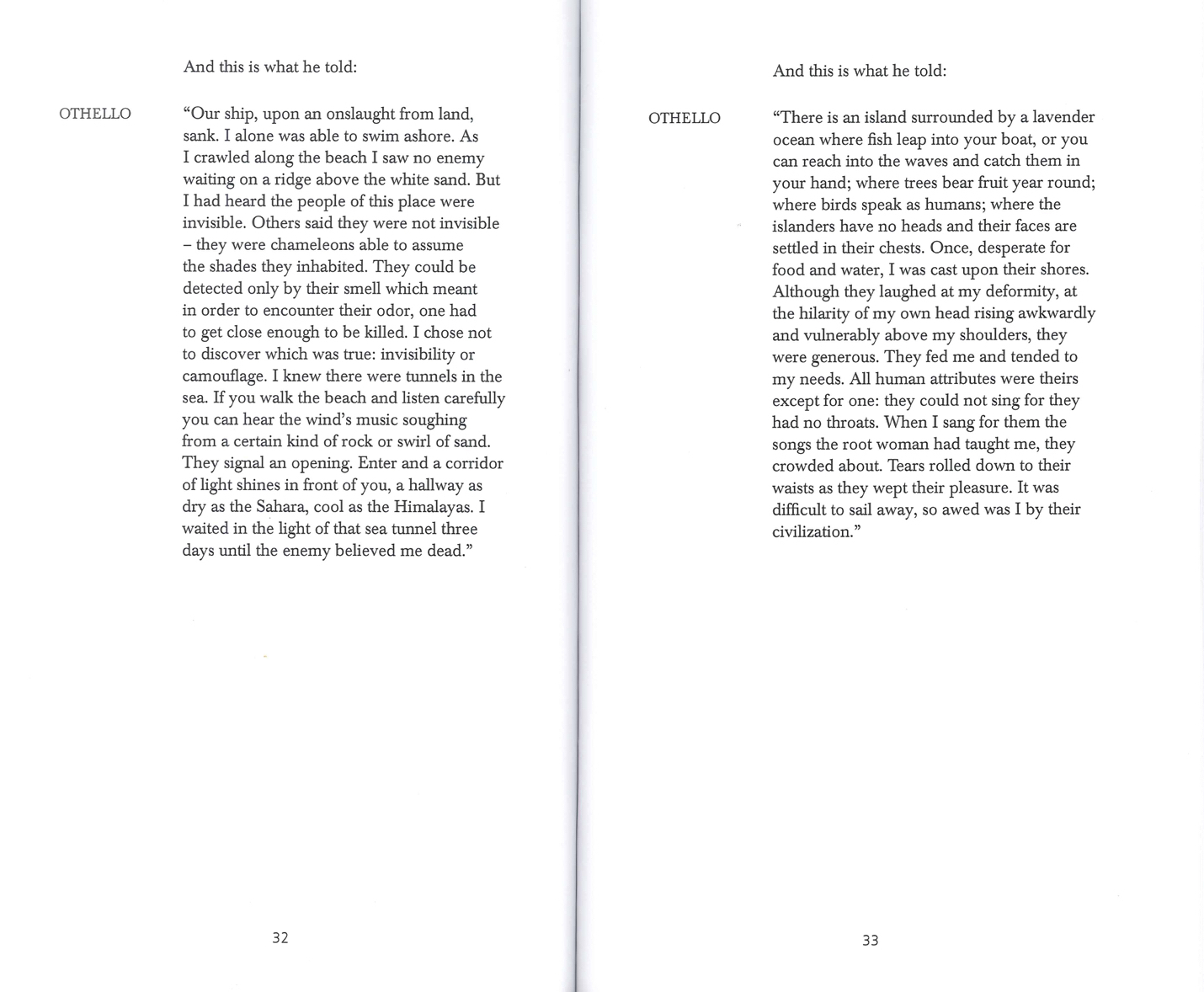
She reports on the stories Othello told to woo here (here's a brief sample—there are more stories related in the middle of the play):


I find that intriguing—but even more fascinating was the use Morrison finds for Barbary. Readers of Othello may recall that, near the end of the play (and therefore—spoiler alert!—near the end of her life), Desdemona recalls a maid her mother used to have:
My mother had a maid call'd Barbary;
She was in love, and he she loved proved mad
And did forsake her: she had a song of "Willow,"
An old thing 'twas, but it express'd her fortune,
And she died singing it. That song to-night
Will not go from my mind; I have much to do,
But to go hang my head all at one side
And sing it like poor Barbary. (IV.iii.27-33)
The moment is thrilling and moving and complicated—Iago had early alluded to Othello as "a Barbary horse" (I.i.111-12)—"Barbary" meaning "Arab" (according to M. R. Ridley's Arden edition) or "The Saracen countries along the north coast of Africa" (according to the OED in def. II.4.a).

Barbary and Desdemona meet in this play, and the sensitive and touching memory is undermined by Barbary's declaration "We shared nothing" and her accusation "you don't even know my name."  I'm including that scene in its entirety:


I find that to be a marvelous riff on that part of the play.

All of these scenes are interspersed with songs written by Rokia Traoré. They provide a different and poetic, lyric voice to many of the characters.

The work is short, but the doors it opens lead to long corridors.

Click below to purchase the book from amazon.com
(and to support Bardfilm as you do so).


Wednesday, August 24, 2016

Book Note: Vinegar Girl

Tyler, Anne. Vinegar Girl: The Taming of the Shrew Retold. London: Hogarth Shakespeare, 2016.

My criteria for a novel that retells the plot of a Shakespeare play include (1) its ability to tell us something about the play that we hadn't noticed, seen, or thought deeply about and (2) its status as a novel in its own right.

Those two criteria sometimes fight with each other. If the work becomes too much its own thing, it may not have that much to say about the play (cf. Tempestuous). If it doesn't become much of its own thing, it may not tell us anything about the play (cf. John Marsden's Hamlet).

When the Hogarth Shakespeare Series was announced, I was expectedly thrilled. When great novelists take on Shakespeare plays, the result will surely be excellent, inventive, inspiring. It will also be useful in my Modern Shakespearean Fiction class.

The Gap of Time was the first, but it proved to be pretty disappointing (for which, q.v.).

And I'm afraid I have to say something of the same for Anne Tyler's Vinegar Girl. I had even higher expectations for this, having enjoyed some of Tyler's novels in the past. And I did start to enjoy it and find some depth in it after about a hundred pages.

The plot involves a scientist father who is largely absent, a daughter whose shrewishness is largely a tell-it-like-it-is attitude, a much younger sister who is falling for her high school Spanish tutor, and a lab assistant from Russia whose visa is about to expire and who therefore needs to marry an American as soon as possible.

I appreciate the inventiveness of that last plot element. Perhaps it helps to explain why a woman would marry a man quickly while still not particularly caring for him. The sample below gives a taste of that part of the relationship:


The one part of the novel that called our attention back to the play itself for realization, reconsideration, and reflection comes at the very end of the novel. Note: This is something of a spoiler. Here's how things wrap up:


Overall, the novel doesn't fit my criteria. But the attempted translation of Katherine's "I am ashamed that women are so simple" speech does have considerable interest in it—enough to provoke some good discussion both of it and of Shakespeare's original.

So let's start some! What's your impression of Anne Tyler's version of the speech? Is it a fair modernized version of the speech? Does it radicalize the speech or return it to largely-conservative territory? Give us your thoughts in the comments below.

Click below to purchase the book from amazon.com
(and to support Bardfilm as you do so).

Tuesday, August 23, 2016

Book Note: William Shakespeare: Scenes from the Life of the World's Greatest Author

Manning, Mick, and Brita Granström. William Shakespeare: Scenes from the Life of the World's Greatest Author. London: Frances Lincoln Children's Books, 2015.

I chanced upon this book at my local library—and it just goes to show that a trip to the local library is very seldom wasted.

This recent children's book provides an invaluable survey of Shakespeare's biography in an engaging yet highly informative way. Not only do we glance at Shakespeare's history and culture, we get a number of very large spreads with careful (albeit brief) summaries of the plays.

I'm providing a couple of the spreads as examples. Click on them to engage them.

First, we have the "Lost Years." There's speculation here, but it's presented as speculation rather than fact. It seems a bit heavy on the "Shakeshaft" theory (see the sidebar in blue), but it does present a balanced position on that idea:


Second, here's a two-page spread on Henry V that gives us the plot of the play—together with some speeches and some audience annotation.


Finally, a small quibble (that is, I'm afraid, an uphill battle) with part of the text. In a section about Shakespeare's theatre (one that nicely re-tells the story of the parts of The Theatre being used to build The Globe), the book tells us that The Theatre—built in 1576—was "the first purpose-built theatre" in England. Although there's not absolute scholarly agreement on the subject, many scholars consider the Red Lion (in use from 1567) to be the first purpose-built theatre in England. But they do get the bear baiting (and good old Harry Hunks) right:


The books is pretty terrific, and I'm certainly going to add it to my library. I highly recommend it for libraries—public and private—as a tremendous introduction to Shakespeare's life, times, and works.

Click below to purchase the book from amazon.com
(and to support Bardfilm as you do so).


Monday, August 22, 2016

Book Note: Still Time

Hegland, Jean. Still Time. New York: Arcade Publishing, 2015. 

You may have noticed that Shakespeare Geek has provided a good review of this book. I just want to add a bit to it and do what I can to increase the novel's visibility.

Still Time isn't a derivative version of any Shakespeare play, but it contains multitudes. The main character is a retired Shakespeare scholar who has recently been admitted to a nursing home. He's suffering from Alzheimer's disease or dementia. He struggles to remember his daughter, and he keeps insisting that he's meant to be heading home before nightfall. He recalls bits of his career from time to time—and bits of Shakespeare. Those seem to stick deeper than some other elements, but even those are occasionally hard to grasp for him.

As you can imagine, that's a tough story to tell. What impressed me most was the deep and convincing way in which the story is told. This isn't a tearjerker—though it's likely to make you cry. This isn't a simple narrative—though it's clear. This isn't a story about recovery from loss—though it provides thoughts on that subject.

I also felt like I might be reading my future in the novel. That makes it harder, of course, but it also makes it genuine.

I often talk to my students about writing with depth and significance. This complicated novel provides just that—without providing an easy moral at the end. 

Click below to purchase the book from amazon.com
(and to support Bardfilm as you do so).

Friday, August 19, 2016

Book Note: "The Merchant of Stratford"

Ramirez, Frank. "The Merchant of Stratford." Isaac Asimov's Science Fiction Magazine 3.7 (July 1979): 125-33. Rpt. in Laughing Space: Funny Science Fiction Chuckled Over by Isaac Asimov and J. O. Jeppson. Ed. Isaac Asimov and J. O. Jeppson. Boston: Houghton Mifflin, 1982. 293-300.

It took a while to track this one down, but I managed it (with a little help from the magic of Inter-Library Loan).

Most of us have (I daresay) wished for a time machine so that we could travel back in time to Shakespeare's day. This short story imagines just such an event.

Or, I should say, events.

The story imagines what would happen if nearly everyone who wanted to visit Shakespeare in a time machine did so. It's told from the perspective of the first time traveller in history. He arrives toward the end of Shakespeare's life, cautiously and carefully approaching the great man so as not to shock him.

Instead, he's the one who's shocked. Shakespeare has been plagued by time travellers since his youth. Once time travel was possible, everybody and their second cousin wanted to visit him.

It's great fun, but I won't give any spoilers on the plot. I will, however, provide an interesting moment from the middle of the story. It turns out Shakespeare is a Science Fiction fanatic—and he makes something of a case for treating SF as literature. After all, he argues, his own work wasn't considered literature in its day.


Track the story down—it's worth the search. It will probably make its way into my "Short Packet o' Short Shakespeare Adaptations" in my Modern Shakespearean Fiction class next semester.

Click below to purchase the book that contains the short story from amazon.com
(and to support Bardfilm as you do so).

Thursday, August 18, 2016

Romeo, Juliet, Lenny, and the Squigtones

"Suds to Stardom." By Buz Kohan. Perf. Penny Marshall, Cindy Williams, David L. Lander, and Michael McKean. Dir. James Burrows. Laverne & Shirley. Season 1, episode 14. ABC. 11 May 1976. DVD. Paramount, 2014.

I learned about this, like so many things, from Shakespeare Geek.

The quirky Lenny and Squiggy (who often accompany the almost equally quirky Laverne and Shirley) participate in an audition for the Shotz Brewery talent show.

The song they've put together is called "Star-Crossed." The lyrics later make the connection to Shakespeare's Romeo and Juliet explicit:
I live on the north side. She lives on the west.
The west is the worst side: the north is the best.
Her mudda's a drunk; her fadda's a punk.
But I know (yes, I know) that our love (yes, I know) could be real.

But we're star-crossed.
We're like Romeo & Juliet.
Star-crossed—she just dont belong in my social set.

But I know (yes, I know) that someday (someday)
The Lord will look our way, and we'll be free.

We meet in the shadows and wish on a star.
We kiss in a phone booth or under a car.
Our friends put us down. They say we're a clown!
But it hurts (yes, it hurts). Yes, it hurts (yes, it hurts) in my heart . . .

That we're star-crossed.
We're like lollipops and caviar.
Star-crossed—so we'll drive up to the reservoir.

Even though (even though) it's a sin (it's a sin),
We'll throw each other in, and we'll be free.
It may be a big tangential, but there's still some interest there. The narrative has more elements of West Side Story than Romeo and Juliet, and I'm curious about the socio-economic placement of the Juliet analogue.

It's also just quite a lot of fun. Observe:


You'll be happy to note that this was (for Lenny) just the beginning.  Lenny really did go on to make it big, changing his name from Leonard "Lenny" Kosnowski to David St. Hubbins when he joined Spinal Tap.

Star-Crossed!

Links: The Episode at IMDB.

Click below to purchase the entire run of the show from amazon.com
(and to support Bardfilm as you do so).

Wednesday, August 17, 2016

Book Note: Hamlet had an Uncle

Cabell, Branch. Hamlet had an Uncle. New York: Farrar & Rinehart, 1940.

Shakespeare took a narrative already told and raised it to the level of sublimity. Branch Cabell takes a sublimely-told narrative and lowers it far past the level of mediocrity to the utterly dull and uninspired.

This is the kind of book I used to think of when I thought Shakespeare-inspired fiction. It reminds me somewhat of the ineptitude of The Best House in Stratford (for which, q.v.).

The story is meant to be historical fiction telling the original narrative from Claudius' point of view. Claudius is caught in Gertrude's bed by Hamlet, Sr., who threatens to kill Claudius but who is stabbed in the back by Claudius as he turns to berate Gertrude.

It should be possible to tell a narrative that begins that way in an exciting, thrilling way. As it is, the most thrilling points are the chapter headings. I'll provide some of those for your amusement—and also a sample of the plodding prose (if you can take it).

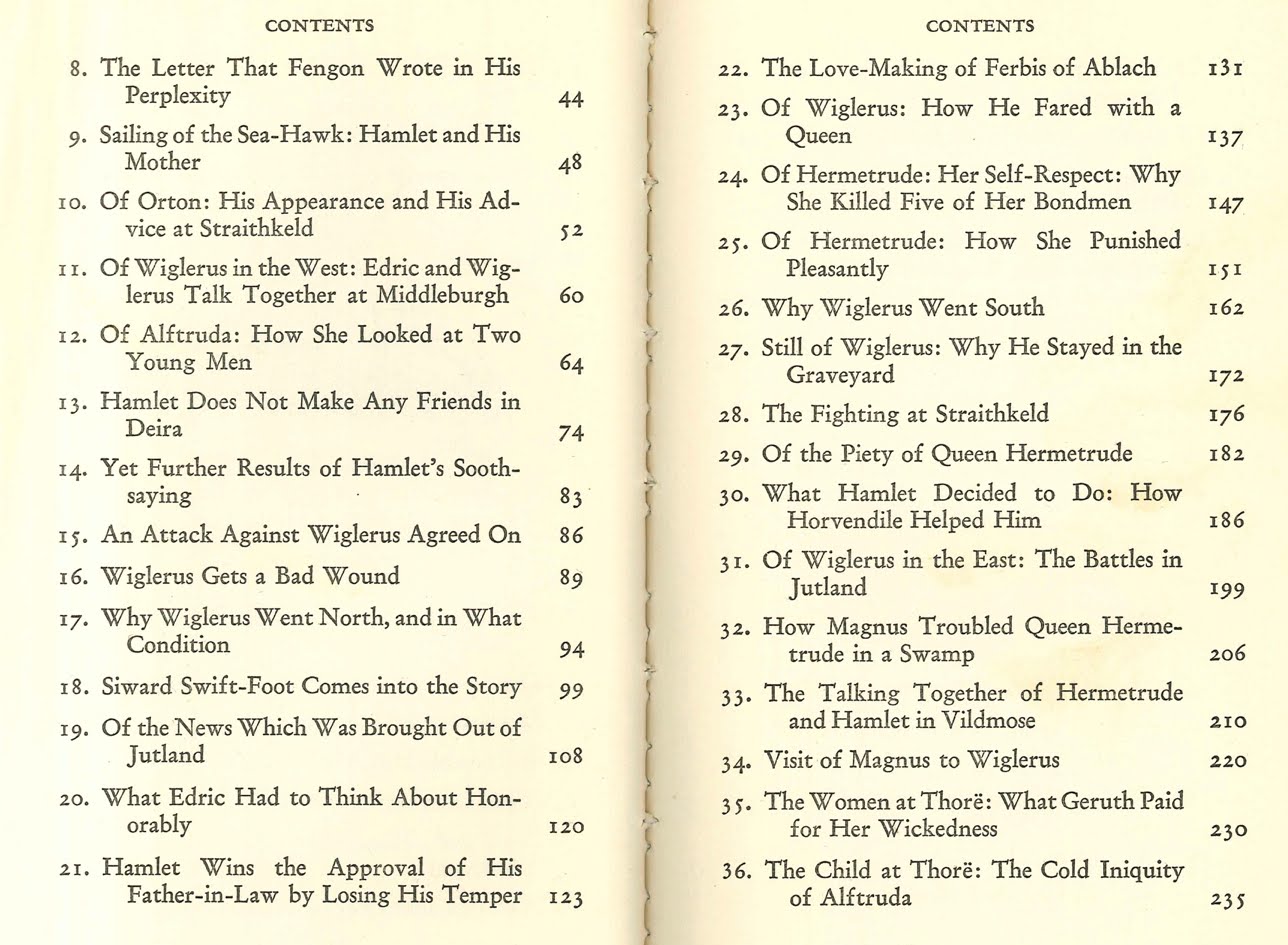
The contents. Try "Wiglerus Gets a Bad Wound" for fun and excitement:


A slice of Chapter Four: "Of Hamlet: How he Troubled People."


The colophon. I take this to be the moral of this retelling of Hamlet. Could this be what Hamlet should teach us, too?


Give this one a miss. Even John Updike's Gertrude and Claudius (for which, q.v.) is better than this.

Click below to purchase the book from amazon.com
(and to support Bardfilm as you do so).

Tuesday, August 16, 2016

Book Note: Ruled Britannia

Turtledove, Harry. Ruled Britannia. New York: NAL, 2002.

Speaking of alternate history—and we were speaking of alternate history, weren't we? With alternate history, it's so hard to tell. In any case, let's speak of alternate history now.

I spotted Ruled Brittana on a list of Shakespeare-related fiction somewhere; in the interests of keeping up with the current Shakespearean fiction scene—well, of keeping within a couple of decades of the current Shakespearean fiction scene—I decided to give it a try. I requested it from my local library, and it arrived within a few days.

When I saw the size of the book and its cover, a gnawing, growing skepticism about it seemed to grip me. But, as Shakespeare said, "Never judge a book by its cover," so I (eventually) cracked the cover.

The first few pages absolutely sucked me in. The storyline became instantly compelling, and the characters soon followed suit.

The book imagines that the Spanish Armada succeeded in its 1588 invasion plans. England has become a Catholic nation, ruled by Philip II. After roughly a decade of this rule, an undercover group of English nationals is preparing to overthrown Spanish rule and put Queen Elizabeth I back on the throne.

And they need to recruit William Shakespeare to their cause. He's asked to write a play about Boudicca, one that will enflame English spirits to revolt against their Spanish, Catholic overlords. He's simultaneously working on a play called Philip II, which the Spanish want to use to celebrate their king upon his death (which is imminent).

Another playwright haunts the theatres of London. He admires Shakespeare, but he's working on his own craft—in Spanish. It's Félix Lope de Vega y Carpio, the great Spanish poet and playwright.

I'm very taken with the novel. The characters are fascinating—especially Shakespeare (perhaps, though not necessarily, of course), Will Kemp (who is hilariously ribald and laughs in the faces of—well, everyone), and Richard Burbage.

I don't want to give you very many spoilers—have the fun of reading this novel for yourself!—but I will give a few sample pages.

Lope de Vega's opinion of Shakespeare:


Samples of Shakespeare's work in progress (lifted, but adapted, from Titus Andronicus and other locations):


Finally, a constable named Walter Strawberry, who's humor lies in malapropism and a dogged search for the truth (ring any bells?):


The book is very cleverly put together. The spy plot and the battle scenes are terrific, and the scenes at the Globe are quite compelling. Numerous allusions and quotations from Shakespeare abound in the common speech of the characters (in fact, that's the only quibble I have with the book—those lines become a bit too much and threaten to distract from the narrative).

Don't let the size or the cover sway you. Try this intriguing novel.

Click below to purchase the book from amazon.com
(and to support Bardfilm as you do so).

Monday, August 15, 2016

Hamlet with Vegetables (a.k.a. The VeggieTales Hamlet)

"Omelet." By Phil Fischer. Perf. Jimmy Gourd; Archibald Asparagus; Phillipe and Jean-Claude, The French Peas; Scooter Carrot; Mr. Lunt; Larry; and Junior Asparagus. Additional Perf. Mike Nawrocki, Lisa Vischer, Jim Poole. Lyle the Kindly Viking. VeggieTales. 2001. DVD. Big Idea, 2012.

Recently, I noticed a gap in the blog. I've frequently shown a brief segment of a VeggieTales episode during my "Mystery Shakespearean Derivative" day in my Shakespeare and Film class. I teach at a small Christian liberal arts college, and many of my students grew up on the show. They appreciate taking a new look at the show—and at Hamlet at the same time.

I thought I had written about the episode here, but I have never done so. Perhaps that's because I like to keep the Mysterious Shakespearean Derivatives a mystery. But I'll take the chance.

In Lyle, the Kindly Viking, Archibald Asparagus (who is usually a bit snooty anyway) is attempting to raise the tone of the show by incorporating things with greater cultural value. Thus, Hamlet. The VeggieTales production provides some fairly-good adaptations of lines from the play that you'll likely recognize.

Here's part of the segment (in keeping with Bardfilm's Fair Use Policy, I'm not providing the clip in its entirety). Enjoy!


I like to think that the last two lines indicate a desire on the part of the characters to explore Shakespeare's play itself rather than this adaptation. Either way, they are funny.

Links: The Wikipedia Article on the Episode.

Click below to purchase the film from amazon.com
(and to support Bardfilm as you do so).

Friday, August 12, 2016

The Tempest—Now with Puppets!

The Tempest. Dir. Conrad Bishop. Perf. Anthony Shaw Abate, Jessica Bauman, Conrad Bishop, Jan Freifeld, Benjamin Stowe. Produced by The Independent Eye in collaboration with Sonoma County Repertory Theater, Sebastopol, California.  Premiered Sept. 18, 2009, at Sonoma County Repertory Theater. DVD. The Independent Eye, 2009.

This is another post that I've owed an attentive reader for some time.

Back in 2009, a group of actors put on a production of The Tempest using puppets.

Don't think The Muppet Show. Think nearly life-size puppets without strings.

I found the show very compelling.  The image above is of the Propero puppet, but you can make out the performer carrying it. At strategic moments throughout the film, he puts the puppet aside to carry on acting on his own—but he's the only one (as far as I noticed) to do so.

I'm providing two scenes for you to get the feel of the production. Here's a good segment of Miranda and Prospero talking at the beginning; it segues into an exchange between Ariel and Prospero:


And here's the entirety of Act II, scene ii—where Caliban takes cover and Stephano and  Trinculo try to join him. It's played for humor, but the language is still given a great deal of priority:


The film version of the stage production is exceedingly enjoyable. It works for the Shakespeare scholar, but I think it would also work for introducing neophytes to the play.

Links: The Film at the Independent Eye.

Click below to purchase the film from the Independent Eye.

Purchase Link
Bardfilm is normally written as one word, though it can also be found under a search for "Bard Film Blog." Bardfilm is a Shakespeare blog (admittedly, one of many Shakespeare blogs), and it is dedicated to commentary on films (Shakespeare movies, The Shakespeare Movie, Shakespeare on television, Shakespeare at the cinema), plays, and other matter related to Shakespeare (allusions to Shakespeare in pop culture, quotes from Shakespeare in popular culture, quotations that come from Shakespeare, et cetera).

Unless otherwise indicated, quotations from Shakespeare's works are from the following edition:
Shakespeare, William. The Riverside Shakespeare. 2nd ed. Gen. ed. G. Blakemore Evans. Boston: Houghton Mifflin, 1997.
All material original to this blog is copyrighted: Copyright 2008-2039 (and into perpetuity thereafter) by Keith Jones.

The very instant that I saw you did / My heart fly to your service; there resides, / To make me slave to it; and, for your sake, / Am I this patient [b]log-man.

—The Tempest