Wednesday, June 18, 2014

A Touch of Julius Caesar in Aladdin

Aladdin. Dir. Ron Clements and John Musker. Perf. Scott Weinger, Robin Williams, and Linda Larkin. 1992. DVD. Walt Disney Video, 2004.

I've just finished directing a production of Julius Caesar for a group of fourth to eighth graders, and it was a marvelous experience. One of the things I love most is the use the students put to Shakespeare:

"Yon Cassius has a lean and hungry look—pass him the mashed potatoes!"

"Let slip the dogs of war—but remember to bring a bag to clean up after them!"

Recently, two of the students pointed out that there's a tiny bit of Julius Caesar in the Disney film Aladdin. As a particular bonus, the clip has a guest appearance by another Disney character: one with not one but two Shakespearean names. I'm talking about Sebastian the Crab, whose familiar name comes from The Tempest (as does the name of The Little Mermaid's Little Mermaid—Ariel) but whose full name—Horatio Thelonius Ignatius Crustaceus Sebastian— has a little bit of Hamlet thrown in.

Here's a brief clip of the Genie pondering how to make Aladdin a prince and quoting from Shakespeare as he does so:


Note: Aladdin also has a character with a name from Shakespeare. Any guesses? It would be a good question for your next trivia quiz . . .

The parrot—the evil henchparrot for the evil Jafar— is named Iago.

Links: The Film at IMDB.

Click below to purchase the film from amazon.com
(and to support Bardfilm as you do so).

Friday, June 13, 2014

Shakespeare Festival St. Louis Presents 1 Henry IV, 2 Henry IV, and Henry V

1 Henry IV and 2 Henry IV. Dir. Tim Ocel. Henry V. Dir. Bruce Longworth. Perf. Jim Butz, Anderson Matthews, Gary Glasgow, Joneal Joplin, Tony DeBruno, Michael James Reed, Jerry Vogel, Alex Miller, Reginald Pierre, Andrew Michael Neiman, Charles Pasternak, Chauncy Thomas, Antonio Rodriguez, Drew Battles, James Hesse, Dakota Mackey-McGee, Kari Ely, Kelley Weber, Eric Dean White, Mason Conrad, Michael Williams, and Dan Haller. Shakespeare Festival St. Louis. St. Louis, Missouri. 2014.

I've wanted to see a Shakespeare Festival St. Louis production for many years, but I'm not usually in St. Louis when they're putting on shows—which is a genuine shame, as I've heard marvelous things about their take on the plays.

I tried to go last night, and I managed to be able to take in a lot of the surrounding and supporting material of the play—but the rain became increasingly torrential, and I, drenched and cold, left at 7:00. The show eventually went on, but it started around 8:40, and I couldn't (alas) have made it that long.

But I urge anyone in the St. Louis area to try it out. It's free, it's outside (which is normally quite pleasant), and you can bring your own chairs or blankets and have a picnic while you watch the show. Additionally, there are lots of fun things to occupy you as you await the beginning of the show. At 6:30, for example, a group of high school students did a twenty-minute version of the play. I was impressed by its use of the text of the play (rather than paraphrase) for most of the story; the actors also did an impressive job. There's also a jester wandering around the crowd (last night, he was having fun imagining that various people in the audience were weasels and exploring the implications of their weaselhood) and "The Wheel of Will," which allows audience members to spin a wheel. Whatever it lands on (sonnet, tragic speech, et cetera), the actors have to do.

You can also take a look at the plot summary of Henry V in the image below (click to enlarge it).


I've also heard that Jim Butz is a really astonishing actor. Some have said that his Hamlet was the best they've ever seen, and the reviews point to his doing a marvelous Henry V as well. In short, go and see it if you possibly can!

Links: The Official Web Site for Shakespeare Festival St. Louis.

Wednesday, June 11, 2014

Does Percy Jackson Like Shakespeare?

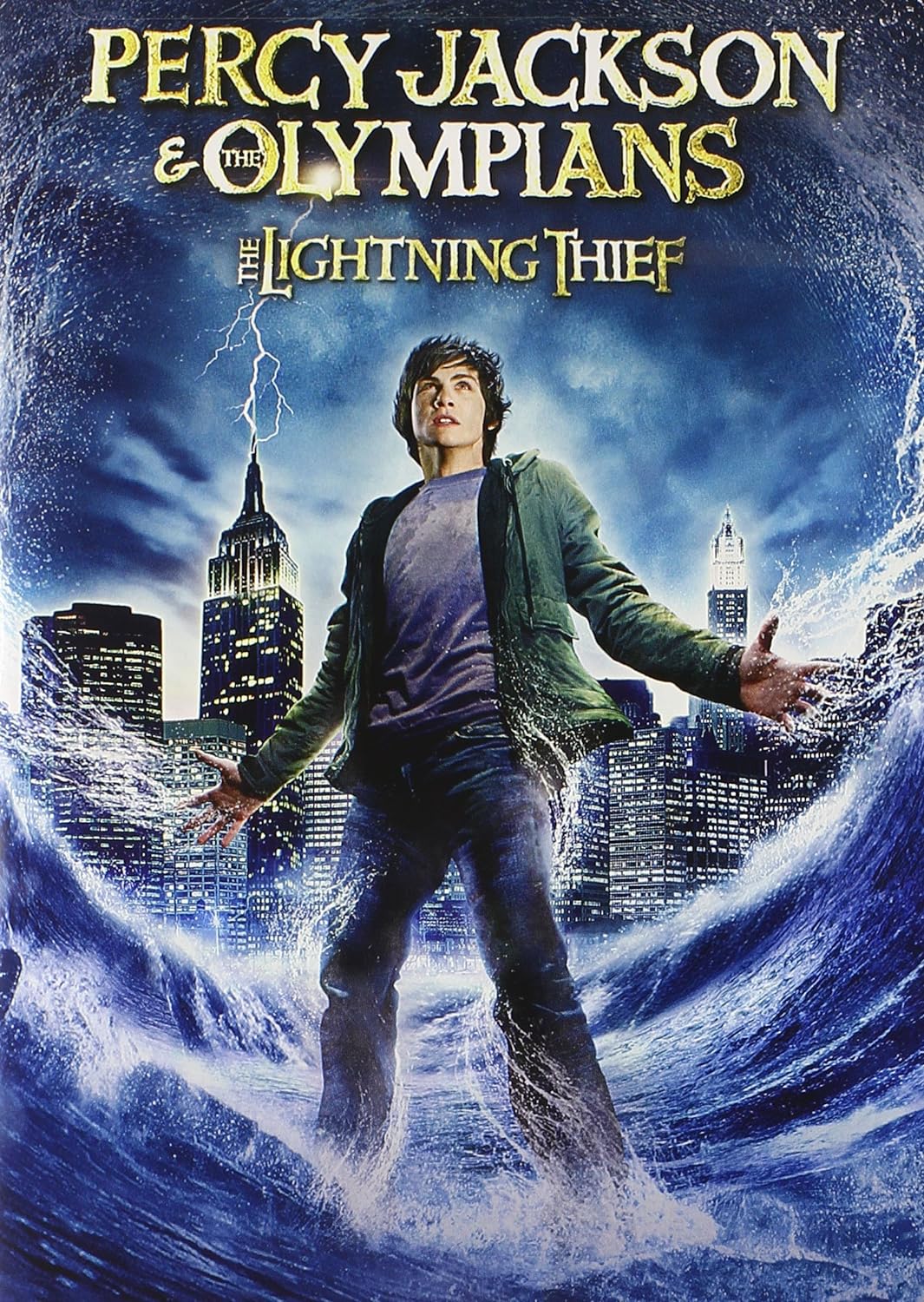
Percy Jackson & the Olympians: The Lightning Thief. Dir. Chris Columbus. Perf. Logan Lerman, Kevin McKidd, Steve Coogan . 2010. DVD. Twentieth-Century Fox, 2010.

The short answer is "No," but I think a longer answer is a bit more interesting.

The Percy Jackson books and films tell the story of a son of Poseidon in the modern age who eventually discovers his parentage and, thereby, his semi-divine powers.

Early in the film, he appears to be an ordinary high school student (if there is such a thing as an ordinary high school student), struggling through life and a substitute English teacher's class (she later turns out to be an evil, horrible monster—a more literal evil, horrible monster than the stereotypical substitute teacher). At this point, she's not being evil or horrible.  She's presenting some Shakespeare to the class:
I understand a fury in your words,
But not [your] words. (IV.ii.35-36)
Note: I'm away from the office and all its marvelous books, but I have been able to do enough scholarly research on the internet to determine that Q1 of the play (1622) has "But not the words" rather than "your words" as the closing line. The First Folio (1623) omits the line entirely. It looks like the substitute teacher made an intentional or unintentional mistake in transcribing the lines to the board.

She asks the class if anyone can explain the quote and deliberately calls on Percy (even though other students have raised their hands). A point-of-view shot establishes that the letters don't stand still long enough for Percy to read them. At first, I thought that it was an intriguing way to portray dyslexia—and, after a fashion, it is. We later learn that Percy's brain is hard-wired to read ancient Greek—he can read the writing on the Greek sculptures in the museum without any trouble.

Beyond that, it's intriguing that the quote fits the plot. Percy can understand the general tenor of what he reads, but he's not able to make out the words themselves. Further, the word "fury," with its connections to the myths of ancient Greece, has an appropriate flavor.

Here's the scene in question:


In short, Percy Jackson doesn't seem to like Shakespeare—but it's because he's hard-wired for ancient Greek. Perhaps they should try Timon of Athens or even Midsummer Night's Dream for him instead!

Links: The Film at IMDB.

Click below to purchase the film from amazon.com
(and to support Bardfilm as you do so).

Wednesday, May 21, 2014

Uhura and Chekov in Antony and Cleopatra?

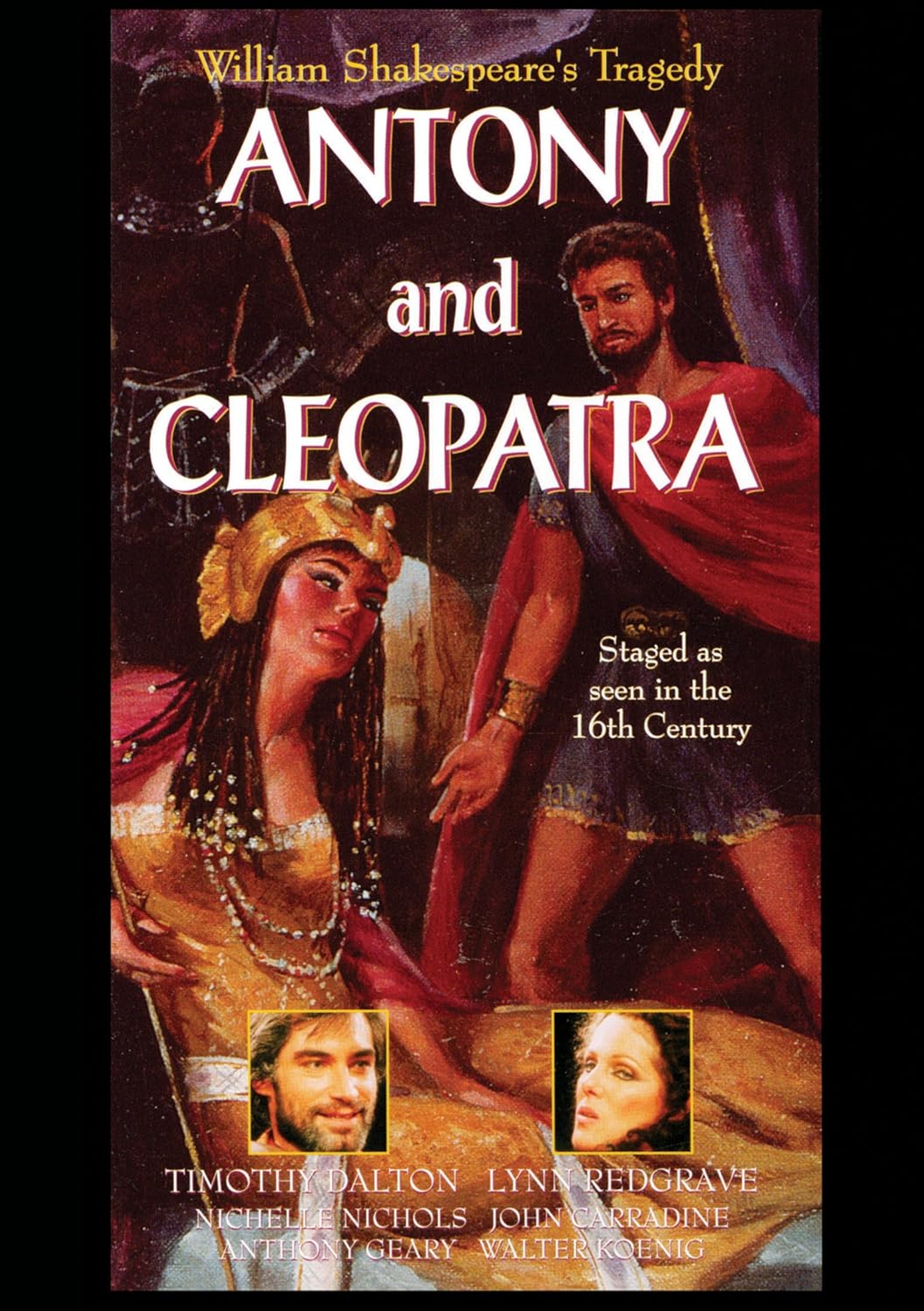
Anthony and Cleopatra. Dir. Lawrence Carra. Perf. James Avery, Sharon Barr, Michael Billington, Timothy Dalton, Lynn Redgrave, John Carradine,  Walter Koenig, and Nichelle Nichols. 1983. DVD. Bard Productions / Century Home Video, 2012.

The claim "Shakespeare is ubiquitous in the Star Trek universe(s)" can be readily established by my "Shakespeare and Star Trek Complete collection (for which, q.v.). But what about actors from Star Trek who went on to play roles in Shakespeare productions? Yes, I mean besides William Shatner and his Julius Caesar rap (for which, q.v.).

Walter Koenig, who played Checkov, and Nichelle Nichols, who played Uhura, performed in a 1983 television production of Antony and Cleopatra. Here, I must apologize if the title of this post turns out to have been disingenuous. They didn't play the title characters; those roles were left to Timothy Dalton and Lynn Redgrave. Nichols played Charmian, and Koenig was Pompey.

Here's Act I, scene ii, which gives us Charmian at her most playful—though Nichols does give some depth to the character:


I've let the scene run to Cleopatra's entrance so that you can get a glimpse of her and also so that you can see the effect of the interesting "Hush, here comes Antony" . . . "Not he, the queen" (I.ii.79) exchange.

The other scene is Act II, scene i. Despite a small miscue (he jumps on one of his lines too early), Koenig does a fair job with the part and the lines:


The one critique I have is that he seems to be doing Pompey with a slight Russian accent. I suppose old habits die hard.

Links: The Film at IMDB.

Click below to purchase the film from amazon.com
(and to support Bardfilm as you do so).

Wednesday, May 14, 2014

Three Days of Hamlet: A Documentary

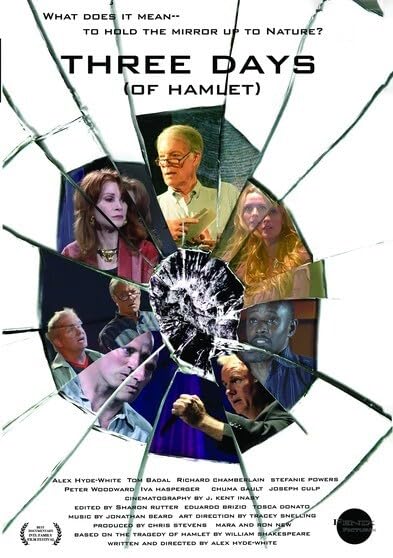
Three Days of Hamlet. Dir. Alex Hyde-White. Perf. Alex Hyde-White, Tom Badal, Richard Chamberlain, Iva Hasperger, Stefanie Powers,Chuma Hunter-Gault, and Peter Woodward. 2012. DVD. Fenix Pictures, 2013.

Three Days of Hamlet is a documentary about putting a production of Hamlet together in three days. The most intriguing part of this honestly not-too-intriguing film has to do with the father / son relationship—both in the play and between the director (and the Hamlet) and his father.

Alex Hyde-White, perhaps best known for his role as James Morse in Pretty Woman, is the son of Wilfrid Hyde-White, whom I know best as Pickering in the 1964 film version of My Fair Lady. A fair bit of the documentary contemplates their relationship and the complicated ways in which the appearance of the ghost of Hamlet, Sr. affects Hamlet, Jr.

Some psychological contemplation is clearly underway—to the point where we might see this entire production as Alex's way of proving something to Wilfrid about acting . . . or his life . . . or his desire to pass the torch of the acting profession to his son . . . or . . . something.

The production-within-the-documentary has some occasionally slight interest, but it seems mostly ordinary. The actors read their scripts,which I don't mind, especially given that they have three days to mount the production. But the overall effect is to distance them from the material itself and from their audience. There are also a surprising number of slightly-misread lines:  "Get thy ways to a nunnery," "No, not by this hand," "These foils have all the strength?" et cetera. I'm not quite sure what to do with that, other than to note that it reveals a lack of attention to the text.

The following clip will give you a good sense of the flavor of the documentary:


Links: The Film at IMDB.

Click below to purchase the film from amazon.com
(and to support Bardfilm as you do so).

Tuesday, May 13, 2014

An Early FoxTrot with Shakespearean Overtones

Amend, Bill. The Best of FoxTrot. Andrews McMeel: Kansas City, 2010.

I've always adored FoxTrot. Bill Amend does marvelous things with the genre and provides intriguing insights into all sort of issues.

But I like it best when it has some Shakespeare.

Is anyone surprised?

Despite being from an early period, this comic has some marvelous things to recommend it. Look at the marvelous foreshortening of Antony in the panel above. Yes, it does look a bit like a boot scrubber, but look over that to get at the emotion that's captured there. The third panel below has something of the same intensity. Perhaps Mr. Amend was watching films by Orson Welles when drawing this comic.

In any case, click on the image below to enlarge it—and to enjoy it!


Click below to purchase the book from amazon.com
(and to support Bardfilm as you do so).

Friday, May 2, 2014

Motocrossed: A Twelfth Night Derivative that Predates She's the Man

Motocrossed . Dir. Steve Boyum. Perf. Alana Austin, Trever O'Brien, Riley Smith. 2001. Videocassette. Walt Disney Video, 2002.

I hate a good challenge. So, when Shakespeare Geek pondered out loud on Twitter whether the 2001 Disney film Motocrossed was a derivative version of Twelfth Night, I was annoyed. I knew I would have to find out. It's only available on VHS (and it's very expensive at that), so I had to track down a library that had a copy, obtain it through Inter-Library Loan, digitalize it, and find time to watch it.

Fortunately, it turned out to be, indeed, a derivative version of Twelfth Night—five years before She's the Man came on the scene. In fact, according to IMDB, the film's working title was The Twelfth Lap, which makes a more direct connection to Shakespeare's play.

Unfortunately, it's not terrific (though it's also not terrible). It fits in the genre of "Saturday Afternoon Feel-Good Movie." When Andy Carson is injured, Andi Carson, his twin, enters the race pretending to be her brother. Hijinks ensue.

The gender mix-up is handled intriguingly, but not with very much bite. Andi turns out to have an affinity with the female sex, and another racer (Dean) admires that ability in him; they start hanging out, Dean trying to get Andi to help him develop a relationship with Faryn. She tries her best, but she's falling for Dean and thinks that Faryn isn't at all for Dean. Faryn, of course, falls for Andi, thinking she's Andy.

Here's a representative clip:


Links: The Film at IMDB.

Click below to purchase the film from amazon.com
(and to support Bardfilm as you do so).

Wednesday, April 2, 2014

Celebrate Shakespeare's 450th Birthday with a Forty-Five-Second Film Festival Contest

"Shakespeare 450th Birthday 45-second Film Festival Contest." St. Paul Pioneer Press. Due by noon on 21 April 2014.

This seems like a good deal of fun as well as something that might encourage some interesting, creative approaches to Shakespeare.

The St. Paul Pioneer Press is sponsoring a context ("Brush up your Shakespeare; Start Filming him Now" seems to be one of the tag lines). They're calling for films that are forty-five seconds or shorter that have something to do with Shakespeare:

"We'll consider anything, no matter how wondrous strange. Want to do a hip-hop version of Sonnet 18? A highly condensed version of Romeo and Juliet with an all-cat cast? Henry V’s band of brothers speech in Klingon? Lay on, Macduff."

I'm embedding the official promotional video below. Watch it—and then make something to submit. I know I will!


Update: Actually, I never got around to submitting. But others did. You can find all the films here. And the winner? This was the winner. Enjoy!


Links: Information about the Contest.

Monday, March 31, 2014

Cockatoo Paraphrases Hamlet in Rio 2

Rio 2. Dir. Carlos Saldanha. Perf. Anne Hathaway, Leslie Mann, Rodrigo Santoro, Jemaine Clement, and Kristin Chenoweth. 2014. Twentieth Century Fox / Blue Sky Studios.

In between discussions of The Tempest and its many interesting problems (for which, q.v.), Shakespeare Geek offhandedly mentioned that the trailer for Rio 2 alludes to and gives credit to Shakespeare.

I couldn't resist tracking it down and passing it along. In the brief clip below, a cockatoo with feathers (?) that resemble a ruff adapts a quotation from Hamlet. The line is part of Hamlet's encouragement to the players in the play-within-the-play to get back to business: "The croaking raven doth bellow for revenge" (III.ii.254). Enjoy!


Links: The Film at IMDB.  The full trailer.

Click below to purchase the film from amazon.com
(and to support Bardfilm as you do so).
Friday, March 28, 2014

An Odd Approach to Romeo and Juliet in Orange County

Orange County. Dir. Jake Kasdan. Perf. Colin Hanks, Jack Black, Schuyler Fisk, John Lithgow, Lily Tomlin, George Murdock, Mike White, Chevy Chase, Kevin Kline, and Ben Stiller. 2002. DVD. Warner Bros., 2009.

Orange County is an odd little film about a surfer who finds a book in the sand one day—one written by a professor of creative writing (I infer) at Stanford University. It turns his life around, and he desires nothing more than to become a writer. For him, that involves getting into Stanford.

The one scene that's directly related to Shakespeare takes place in his classroom. A quote above the white board there reads "Is not this something more than fantasy?" I imagine the quote is meant to inspire enthusiasm in the subject matter, but the fact that it's Bernardo's line to the skeptical Horatio taken completely out of context pleases me greatly.

The scene ends up being something of a parody of teachers who use film versions of Shakespeare plays to teach Shakespeare—but that's all right. I can take it. Observe:

“Some great movies are based on his plays: Hamlet, West Side Story, Talented Mr. Ripley, Waterworld, Gladiator, Chocolat . . ."

Well, maybe I can't take it, but I can see how some people might find that amusing.

The rest of the film is devoted to zany antics geared toward getting our protagonist into Stanford (his guidance counsellor sent in the wrong transcript, so he was declined). Finally, he meets the writer who wrote the book he found in the sand . . . and it turns out to be Kevin Kline. I can't help but see that as an allusion to his role as teacher in The Emperor's Club (for which, q.v.).

Links: The Film at IMDB.

Click below to purchase the film from amazon.com
(and to support Bardfilm as you do so).

Thursday, March 27, 2014

Book Note: Romeo and Juliet in Asterix

Uderzo, Albert. Asterix and the Great Divide [Les Grand Fossee]. Trans. Anthea Bell and Derek Hockridge. London: Orion Books, 2001.

I have fifteen quick minutes before I need to depart for class.

That may be just enough time to mention the spin Asterix takes on Romeo and Juliet.

I found this while doing a search for something else entirely in my local library. Serendipity is often quite welcome.

The plot of the Asterix stories is always generally the same. There is, in the books, one village in Gaul that has never been conquered by the Romans. The stories are filled with bad puns and battles agains the Romans. I started reading them in French (that's where I learned my bad French puns), but I turned to English when availability of the French editions started to diminish.

In this book, a different village is divided (you can see the trench that runs through the village in the sample below). But—are you surprised?—a boy from one side of the village is in love with a girl from the other side.

The image below is where most of the Shakespeare makes its way in to the story. Click on it to enlarge it, and enjoy this re-creation of the balcony scene.


Links: The Official Web Site for Asterix.

Click below to purchase the book from amazon.com
(and to support Bardfilm as you do so).
Friday, March 14, 2014

Book Note: Tower of the Five Orders

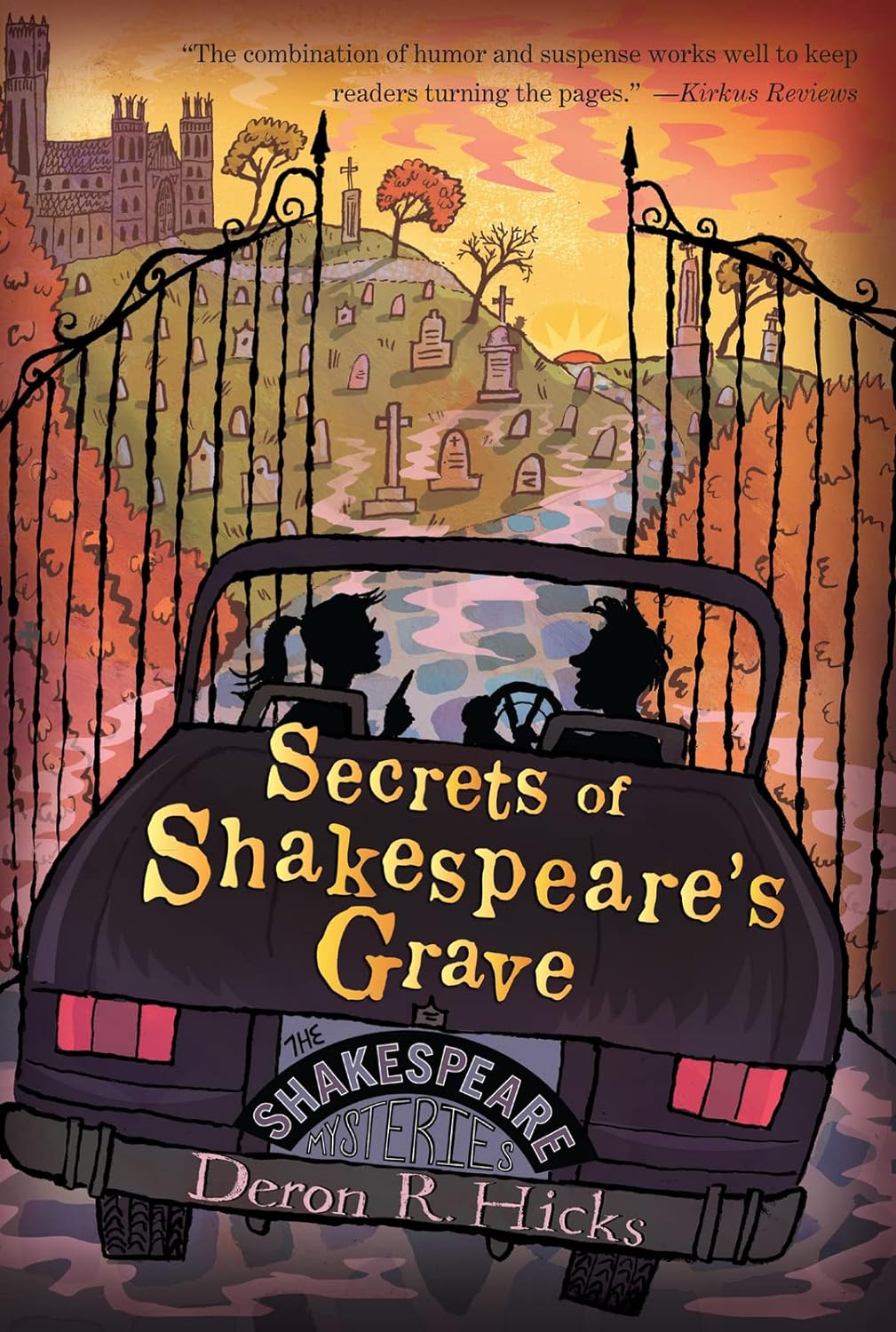
Hicks, Deron R. Tower of the Five Orders . Boston: Houghton Mifflin Harcourt, 2013.

I just finished reading the second book in the Shakespeare Mysteries series. For Secrets of Shakespeare's Grave, the first book in the series, click here.

I enjoyed the book very much—though I did spend a considerable portion of the middle of the book chanting "Please don't be a Marlovian Conspiracy Theory book. Please don't be a Marlovian Conspiracy Theory book."

It turns out that it isn't. At least, it isn't yet. Another cliffhanger at the end makes us wonder where the next book will take us, but it does seem that Shakespeare's authorship of his own works is fully secured by the end of the novel.

As with the previous novel, I really can't tell you much about the story without spoiling it. But I will just say that it's a terrific adventure story, complete with life-threating suspense and a few truly villainous villains. Read it.

Links: The Series' Official Website.

Click below to purchase the books from amazon.com
(and to support Bardfilm as you do so).


Thursday, March 13, 2014

Benedict Cumberbatch as Rosencrantz in Rosencrantz and Guildenstern are Dead

Rosencrantz and Guildenstern are Dead. Perf. Kobna Holdbrook-Smith and Benedict Cumberbatch. Selection from National Theatre: 50 Years on Stage. Dir. Nicholas Hytner. Olivier Theatre. 2 November 2013.

The National Theatre recently celebrated its fifty years of existence with a stage performance and documentary that's currently available for streaming in full at PBS's website.

The section that is likely to catch everyone's eye is Benedict Cumberbatch.  He who plays Sherlock in the new BBC Sherlock series and Khan in Star Trek: Into Darkness plays Rosencrantz in the "dead in a box" sequence from the middle of Act II of Rosencrantz and Guildenstern are Dead, Tom Stoppard's first play on the stage of the National Theatre. Here's the scene in question:


That is, of course, great—and Kobna Holdbrook-Smith does a magnificent job as Guildenstern. But the entire show has some fascinating clips from the archives that I can't wait to enjoy.

Book Note: The Truth About William Shakespeare: Fact, Fiction, and Modern Biographies

Ellis, David. The Truth About William Shakespeare: Fact, Fiction, and Modern Biographies. Edinburgh: Edinburgh University Press, 2012.

David Ellis' The Truth About William Shakespeare: Fact, Fiction, and Modern Biographies is a thoroughly enjoyable and certainly necessary critique of the modern biography of Shakespeare. In a careful and scholarly way, Ellis comments on the persistent drift from the certain to the speculative—and then to the speculative-but-expressed-as-certainy—that characterizes the modern Shakespeare biography. It's a tendency I noted in a post on the documentary In Search of Shakespeare, and it became most evident to me in Stephen Greenblatt's Will in the World (mentioned in the same post).

Ellis is meticulous in analyzing the anecdotes and assumptions that have made their way into every aspect of biographies of the bard in chapters that take us chronologically through Shakespeare's life. His chapter "How to make bricks without straw" comments on the ways biographies of Shakespeare—if they are to be written at all—must depend largely on speculation. Subsequent chapters then detail the speculation in different categories:  "Forebears," "The female line and Catholicism," "Boyhood and youth," "Marriage," "The theatre," et cetera.

Let me give you an example of Ellis' modus operandi. First quoting from Katherine Duncan-Jones, who says, "as a member of Leicester's Men for some time between 1584 and 1586, Shakespeare would have quickly shown his versatility both in writing and performing. He would have been a natural choice to supply one of the gaps left by Knell's death in June 1587" (61, Ellis' emphasis), Ellis goes on to critique the disappearance of the conditional.
What is so effective here is again that "would have" has the mere appearance of the conditional; bu that is more interesting from the point of view of biographical method is how, when Duncan-Jones later reverts to the question of Shakespeare and the Queen's Men, any hint of that conditional (previously event in all the words I have italicised) has disappeared. Only a little later, for example, she speculates about the work Shakespeare would have done for the Queen's Men "while he was a full-time member of the company in the later 1580s." Her treatment of the issue is only one example among hundreds, in her work and those of the other biographers, of how what might have been is gradually converted into what was. (60)
Ellis primarily considers Duncan-Jones' Ungentle Shakespeare, Stephen Greenblatt's Will in the World, Peter Ackroyd's Shakespeare: The Biography, Jonathan Bate's The Genius of Shakespeare and Soul of the Age, René Weis' Shakespeare Revealed, and James Shapiro's 1599, but he comments on dozens of others.

The book is great, offering a welcome bit of common sense and a much-needed reminder to exercise sound scholarship when making claims about the life of the Bard.

Click below to purchase the book from amazon.com
(and to support Bardfilm as you do so).

Wednesday, March 12, 2014

Book Note: Grace Tiffany's Will: A Novel

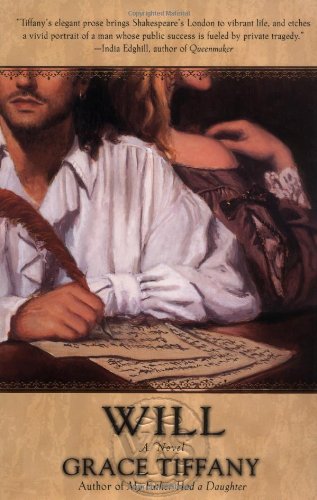
Tiffany, Grace. Will: A Novel. New York: Berkley, 2004.

No real surprises await in Grace Tiffany's Will: A Novel, but it's a pleasant read nonetheless. Indeed, without Grace Tiffany's old use of language, the book would fall rather flat.

The novel is a fictional biography of Shakespeare, filling in all the missing pieces—not the least of which is Shakespeare's point of view on things like his wife, his son's death, and his desire to act and write for the London stage. And, since Grace Tiffany is a well-respected Shakespeare scholar in her own right, the novel has (with a few exceptions) a good sense of the contemporary history.

One of the exceptions is having one of Shakespeare's daughters end up disguising herself as a boy and coming to London to try to take her place on the stage. I can't quite place where I've encountered that idea before, but I know another fictional piece or two has toyed with the idea. It's not quite as common as having Elizabeth I attend a performance at the Globe, but it carries the same weight of impossibility—mixed with the interest of the impossible becoming possible.

There's also a wonderfully unlikely scene where Will Shakespeare and Ben Jonson steal a skull from London bridge—the skull of Edward Arden, as it turns out—to play the role of Yorick.

Better than those moments are the points where Shakespeare reflects on his art. In the section below, Shakespeare separates himself and his own views from his characters and their views:
Mayhap I think the thing the rebel says. Mayhap I do not. He says it, not I. And they hang him. Do I think it right that they hang him? Who may guess? It is not I who speaks, but the play, and the play is poetry, and poetry is many sided. . . . I say only that there is safety in poetry's doubleness. (179-80)
Although we have license to be skeptical of the ways Tiffany fills in the gaps of Shakespeare's biography, this novel is compelling.

Click below to purchase the book from amazon.com
(and to support Bardfilm as you do so).

Bardfilm is normally written as one word, though it can also be found under a search for "Bard Film Blog." Bardfilm is a Shakespeare blog (admittedly, one of many Shakespeare blogs), and it is dedicated to commentary on films (Shakespeare movies, The Shakespeare Movie, Shakespeare on television, Shakespeare at the cinema), plays, and other matter related to Shakespeare (allusions to Shakespeare in pop culture, quotes from Shakespeare in popular culture, quotations that come from Shakespeare, et cetera).

Unless otherwise indicated, quotations from Shakespeare's works are from the following edition:
Shakespeare, William. The Riverside Shakespeare. 2nd ed. Gen. ed. G. Blakemore Evans. Boston: Houghton Mifflin, 1997.
All material original to this blog is copyrighted: Copyright 2008-2039 (and into perpetuity thereafter) by Keith Jones.

The very instant that I saw you did / My heart fly to your service; there resides, / To make me slave to it; and, for your sake, / Am I this patient [b]log-man.

—The Tempest