Monday, August 31, 2009

But you don't have to take my word on the McKellen King Lear

King Lear. Dir. Trevor Nunn and Chris Hunt. Perf. Sir Ian McKellen, Sylvester McCoy, Romola Garai, William Gaunt, Frances Barber, and Monica Dolan. 2008. PBS, 2009.

My word, for what it's worth, is that it's a magnificent production, astonishingly acted and inventively directed. But the reason you don't have to trust me on this is that the film is now available for free viewing! Simply head to this PBS site and dig in!

In preparation for the school year, I recently purchased the DVD; while we're on the subject, let me offer a few comments that will serve as a micro-review of the film.

The production is beautiful rendered on DVD. I've written before about the privilege of seeing this cast perform this play at the Guthrie Theatre. Indescribable.

This video is nearly as good as being there. Certainly, it's the next best thing. The images in this post don't do justice to the clarity and detail of the video. You can see the seams of the costumes, for heaven's sake!

In addition to the stunningly effervescent acting—especially of Sir Ian McKellen and former Doctor (of Doctor Who fame) Sylvester McCoy, the decisions of the director are exceptionally interesting. There are moments that are too horrible to bear. And I suppose that's the point.

Trevor Nunn pays a considerable amount of attention to the relationship between the play's gods and the play's people. One way he does so comes near the very end of the play. Upon learning that Cordelia and Lear's lives are in jeopardy, Albany and Edgar desperately send Edmund's sword (the token of reprieve) in an attempt to stop the planned execution. The instant after the Gentleman departs, Albany says, "The gods defend them" (the text reads "The gods defend her" at V.iii.254; this change focuses our attention on the pair instead of on Cordelia alone) and each member of the entire company raises arms in supplication:


After only a few beats, Lear enters with his devastating line: "Howl, howl, howl, howl! O, you are men of stones" (V.iii.255). It's as horrific as you can imagine. And it's capped off with another line composed completely of monosyllables (Shakespeare is seldom high-falutingly verbose when he has his characters speak of the deepest emotions)—one of the most tragic lines in all of Shakespeare:
I know when one is dead and when one lives. (V.iii.258)
At the very end, the image of raising hands is presented again as the final speech (given, as in F, to Edgar in this production—not to Albany, as in Q) is delivered in voiceover. Edgar raises his hands and, in a gesture eloquent of despair, drops them uselessly to his sides.

It's terrible. And marvelous. But, as I said before (paraphrasing Levar Burton's Reading Rainbow phrase), you don't have to take my word for it! Watch it yourself! Enjoy!

Click below to purchase the film from amazon.com
(and to support Bardfilm as you do so).

Tuesday, August 25, 2009

The Nine Words Most Likely to Anger King James

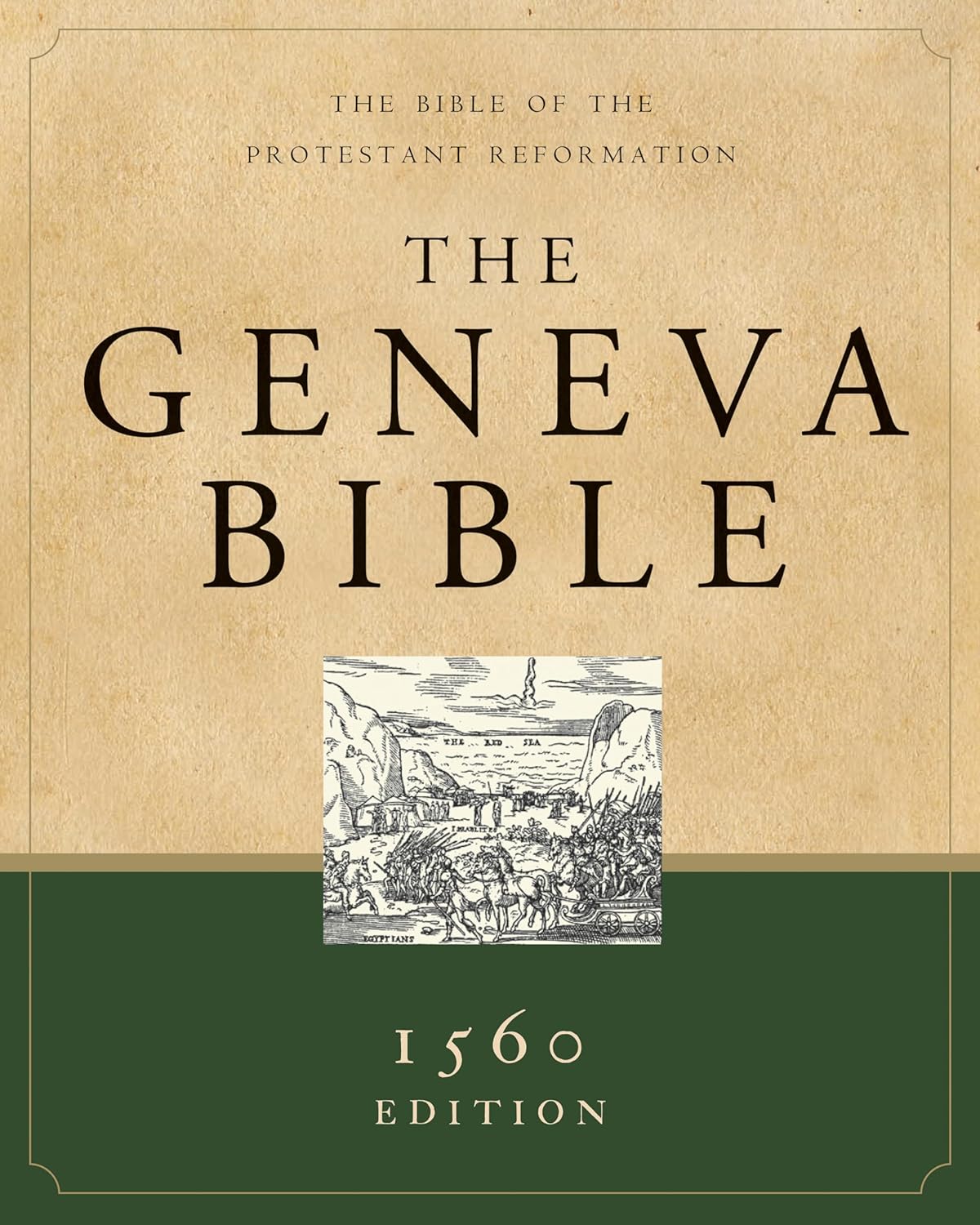
The Geneva Bible: A Facsimile of the 1560 Edition. Peabody, Massachusetts: Hendrickson, 2007.

In the few minutes between printing hundreds of pages of opening-day handouts and delivering them, I thought I'd try to squeeze in a micropost on King James' attitude toward the Geneva Bible.

He hated it.

He even hated it more than he hated all other English translations of the Bible—and that's saying something. That hatred was one of the reasons he was open to the suggestions of the committee to produce a new translation in English—the translation that would later be know as the King James Version.

In particular, he hated the marginal note on Genesis 1:19. Here it is:


Their disobedience herein was lawful, but their dissembling evil.

That first part got James' goat as much as a pack of unfiltered Lucky Strikes would have (he hated tobacco, too). To think that any disobedience to a lawful monarch could be itself lawful was anathema epitomized! And that's even considering that obeying "The King of Egypt" here is to commit horrific atrocities.

To get a sense of how objectionable—indeed, how seditious—King James found such a statement, listen to his adresss to the Parliament on 21 March 1609:
Kings are justly called gods, for that they exercise a manner or resemblance of divine power upon earth: for if you will consider the attributes to God, you shall see how they agree in the person of a king. God hath power to create or destroy, make or unmake, at his pleasure, to give life or send death, to judge all and to be judged nor accountable to none; to raise low things and to make high things low at his pleasure, and to God are both souls and body due. And the like power have kings: they make and unmake their subjects, they have power of raising and casting down, of life and of death, judges over all their subjects and in all causes and yet accountable to none but God only.
Now that's monarchal power! James' subjects seem to have managed this authority (even as they managed under Elizabeth I and Henry VIII—who believed every word in that speech but didn't feel the need to say such things as blatantly as James did), but things changed dramatically under Charles I. Perhaps you recall the outcome of Charles' attempts to rule with such an iron fist wrapped in a concrete glove?

Click below to purchase the 1560 facimile of the Geneva Bible from amazon.com
(and to support Bardfilm as you do so).

Tuesday, August 18, 2009

Macbeth:Duncan::Hazael:Ben-hadad?

The Geneva Bible: A Facsimile of the 1560 Edition. Peabody, Massachusetts: Hendrickson, 2007.

Shakespeare's England was soaked in the Bible, and the enormous number of biblical allusions squeezed into Shakespeare's plays indicates how like a sponge Shakespeare's mind was (in a good way).

I've been doing a lot of work on Shakespeare and Calvin this summer, and I've also been reading through the Bible. That happy conjunction led to my noticing something in 2 Kings 8:7-15 that might have some bearing on Macbeth. And the recent arrival of a facsimile of the 1560 Geneva Bible (one of the main contenders for the title of "the version of the Bible Shakespeare probably used most") forms another happy conjunction—all the happier because of the astonishingly-low price Amazon.com is currently asking for the immense and remarkable volume! (See below for purchasing information.)

In the passage (quoted in full below), Ben-hadad, the King of Syria (the 1560 Geneva Bible reads "the King of Arám"), is sick, and he sends Hazael to ask the prophet Elisha whether he'll recover. Elisha says, "Oh, he'll recover all right. But he's also doomed to die." Then Elisha stares at Hazael until Hazael gets really uncomfortable. And then Elisha starts to weep. Eventually, he reveals that Hazael will become King of Syria and that he will serve as an instrument of God's chastisement of the people of Israel in that position. Hazael reports back to Ben-hadad the good news about Ben-hadad's recovery—and smothers Ben-hadad the next day.

The entire narrative strikes me as remarkably Macbethesque—not in the way Elisha might be compared to the Weird Sisters (Elisha's motivations are clearly different than the witches—he speaks the truth sorrowfully about the sovereignty of God while they seem to revel in the chaos they seem to hope will result), but in the similar ways in which Hazael and Macbeth respond to the truth presented to them.

Neither man is told that he will kill the King—yet the messengers seem to know that murder is a temptation for each man. Each man acts to hasten a prophecy he believes to be true, and each man becomes King as a result of his own actions.

Of course, the primary difference is that there's no Lady Hazael in the passage at hand. But when Hazael says, "Is this a damp bed cloth I see before me, the hem toward my hand?" it's pretty much a dead giveaway that Shakespeare had this passage in mind when he composed Macbeth.

Actually, allusions to scripture in Shakespeare (as opposed to biblical references in Shakespeare) are never as cut-and-dried as that. But I'm still pondering, in light of Shakespeare and Calvin, what to make of Macbeth and Hazael.

And I'm also wondering about Elisha's response. Is there some equivocation in his answer? Basically, he is asked whether the King will die of his illness, and his answer is "No, he won't die of the illnesss—nudge, nudge, wink, wink." He doesn't encourage Hazael, but he shows Hazael that he knows Hazael's heart.

Finally, I'm thrilled to possess the 1560 Geneva Bible! Not so long ago, its price put it out of the reach of all but large research libraries. Now it can sit on my desk to be consulted at will (especially thanks to the book allowance my college gives me every year) at any time of the day or night.

Especially interesting are the marginalia. I've included an example above—one in which we're told that, "Vnder pretence to refresh or ease him, he styfled him with this cloth." It gives a certain dramatic motivation or stage direction to the text that I find immensely appealing.

In a similar way, the Geneva Bible glosses Elisha's comment about the recovery of Ben-hadad: "Meaning that he should recover of this disease: but he knewe that this messenger Hazaél should slaie him to obtaine the kingdome."

These are only preliminary thoughts. But they at least point toward the remarkable presence of the Bible in Shakespeare. And they point toward a remarkable edition of a remarkable translation of the Bible.

Click below to purchase the 1560 facimile of the Geneva Bible from amazon.com
(and to support Bardfilm as you do so).


Here is 2 Kings 8:7-15 from the English Stadard Version:
Now Elisha came to Damascus. Ben-hadad the king of Syria was sick. And when it was told him, “The man of God has come here,” the king said to Hazael, “Take a present with you and go to meet the man of God, and inquire of the LORD through him, saying, ‘Shall I recover from this sickness?’” So Hazael went to meet him, and took a present with him, all kinds of goods of Damascus, forty camel loads. When he came and stood before him, he said, “Your son Ben-hadad king of Syria has sent me to you, saying, ‘Shall I recover from this sickness?’” And Elisha said to him, “Go, say to him, ‘You shall certainly recover,’ but the LORD has shown me that he shall certainly die.” And he fixed his gaze and stared at him, until he was embarrassed. And the man of God wept. And Hazael said, “Why does my lord weep?” He answered, “Because I know the evil that you will do to the people of Israel. You will set on fire their fortresses, and you will kill their young men with the sword and dash in pieces their little ones and rip open their pregnant women.” And Hazael said, “What is your servant, who is but a dog, that he should do this great thing?” Elisha answered, “The LORD has shown me that you are to be king over Syria.” Then he departed from Elisha and came to his master, who said to him, “What did Elisha say to you?” And he answered, “He told me that you would certainly recover.” But the next day he took the bed cloth and dipped it in water and spread it over his face, till he died. And Hazael became king in his place.

Thursday, July 30, 2009

Never Saw Never Say Macbeth

Never Say Macbeth. Dir. Christopher J. Prouty. Perf. Tammy Caplan, John Combs, and Scott Conte. 2007. Vanguard Cinema, 2008.

I have never seen this film, but I intend to, even though it doesn't look like the best derivative ever made. The primary reason to see it is that it's available for free viewing until August 3!

Another reason for seeing it is that it's about the Macbeth Curse—and that's always good for laughs. At least, if Slings & Arrows is any indication, it is.

Try it out, and, if you get there before I do, let me know something about it.

Update: It's now available on DVD. See below.   

Note: I have now seen it! Read about it here.

Links: The Film at IMDB.


Friday, July 24, 2009

Shakespeare and Michael Jackson

The Wiz. Dir. Sidney Lumet. Perf. Diana Ross, Michael Jackson, Nipsey Russell, Ted Ross, Mabel King, Lena Horne, and Richard Pryor. 1978. DVD. Universal Studios, 2008.

Posting to Bardfilm has become something of a treat reserved for the brief time between finishing one of the summer's projects and starting another. I've reached such a point, so I can pass along the connection between Michael Jackson and Shakespeare.

No, it doesn't have anything to do with the millions of fans who quoted Romeo, saying "O, that I were a glove upon that hand" (Romeo and Juliet, II.ii.24). Nor is it about Michael Jackson being the Shakespeare of his age (though both were gifted performers and both died in their early fifties).

Instead, it's Michael Jackson (as the Scarecrow in The Wiz) quoting from Henry IV, Part II:

Uneasy lies the head that wears a crown. (2 Henry IV, III.i.31)
There you have it! Now on to the next project!

Links: The Film at IMDB.

Click below to purchase the film from amazon.com
(and to support Bardfilm as you do so).

Wednesday, July 22, 2009

The Great River Shakespeare Festival: Six Performances in Search of an Audience

Love's Labour's Lost. Dir. Paul Mason Barnes. Perf. Doug Scholz-Carlson, Chris Mixon, Andrew Carlson, Brian Frederick, Christopher Gerson, Evan Fuller, Tarah Flanagan, Shanara Gabrielle, Katy Mazzola, Nikki Rodenburg, Michael Fitzpatrick, David Rudi Utter, Eva Balastrieri, Jeremy van Meter, Jonathan Gillard Daly, David Coral, Nick Demeris, Katie Bowler, Moira Marek, Duncan Halleck, Theo Morgan, Ceci Bernard, Chris Bernard, and Mitchell Essar. Great River Shakespeare Festival. Winona, Minnesota. 2009.
And I'm certain that they'll find the audience they seek.

There are only six performances left in this year's Great River Shakespeare Festival. Therefore, though innumerable other projects have been pressing on my time, I really ought to take a bit of time to add my last comments on the productions and encourage you to see them.

Two Particularly Memorable Moments in Love's Labour's Lost:

The play opens with the entire ensemble singing "In the Good Old Summertime." The remarkable thing about this decision is that the director used it as something like a dumb show of the entire play. It wasn't an easy way to introduce us to the characters—in fact, only two are named—instead, it gave us a flavor of what was to come.

Even more astonishing was Chris Gerson's delivery of Don Armado's last lines—the lines that close the play. On the page, they seem straightforward:
The words of Mercury are harsh after the songs of Apollo. You that way: we this way. (V.ii.918-19)
In other words, the ladies need to exit back to France; the men need to exit to their own destinations. Or, in other other words, the upper-class men and women need to exit one way and the characters from the subplot need to exit in another way.

Instead of these possible readings, Gerson makes them into something of an epilogue—like at the end of A Midsummer Night's Dream or As You Like It. The audience is being told which way it must go while the actors must head backstage to change out of their costumes and take off their makeup. The actors have done their work; it's now up to the audience to do its work—whatever that may be. Remarkable. Brilliant.

I have a few other points in my notes that I wish I could develop at greater length. But I can't. The first is the use of the supernumeraries—especially as they observe (as a kind of on-stage audience) the actions of the other characters. The second is the technical aplomb demonstrated in the production's stagecraft and lighting. For example, a photographer takes a photo with old-fashioned flash powder. Perfectly simultaneously (which is the extremely difficult part), the lights suddenly swell and there was a small auditory sound. Well done, whoever arranged that! The third point is that the company managed to avoid the tendency of "Guthrie asides"—additions to the text that become fairly annoying if overdone. Frequently (but not always), the characters cried "Olé!" at the mention of Don Adriano de Armado's name. But they varied it enough and didn't do it every single time—and that made it much more palatable.
The Tempest. Dir. Alec Wild. Perf. Eva Balistrieri, Andrew Carlson, David Coral, Nick Demeris, Jonathan Gillard Daly, Michael Fitzpatrick, Tarah Flanagan, Brian David Frederick, Evan Fuller, Shanara Gabrielle, Christopher Gerson, Kate Mazzola, Chris Mixon, Doug Scholz-Carlson, Nicole Rodenburg, David Rudi Utter, Jeremy van Meter, and Tessa Wild. Great River Shakespeare Festival. Winona, Minnesota. 2009.

A few of the marvels of The Tempest:

The GRSF's production of The Tempest was less straightforward than its Love's Labour's Lost, offering a welcome variety to the festival. The play itself gives its audience more to think about, and that was reflected in this production.

An enormous amount of work must have gone into the production. Behind the main performance area (which included a number of moveable parts on an enormous circular track), an entire orchestra (it seemed) of flautists, percussionists, players-upon-crystal-goblets, and others provided the "Sounds and sweet airs that give delight and hurt not" for which the isle is so justly famous.

Caliban was played by Chris "Gollum" Gerson, and he did a remarkable job of presenting the director's view of the character—though I'm not certain I agree with it entirely. His Caliban crouched and crawled, simpered and served throughout the production. The main reason this was effective wasn't clear until the last scene. When Caliban says, "I'll be wise hereafter / And seek for grace," he almost stands almost upright—but not quite.

Tarah Flanagan's Ariel sat on top of a huge column made of metal struts. From there, she commanded a myriad of Ariels on the surface of the stage. Her delivery of the lines—especially those related to her desire for freedom from Prospero's service—was exquisite.

John Daly's Prospero was on the angry side—which was a really interesting choice. The best part of that is when he forgives all those who have wronged him. As Daly delivers the lines, it's almost like he's saying, "I forgive you—take that!" He's heaping burning coals on his enemies' heads, and that's cathartic for him and for his enemies and for his audience.

Naturally, more could be said. But you'll just have to go see one of the six remaining performances yourself. And you should.
Links: The Great River Shakespeare Festival.

Sunday, July 12, 2009

Full House. Standing Ovation. The Great River Shakespeare Festival.

Love's Labour's Lost. Dir. Paul Mason Barnes. Perf. Doug Scholz-Carlson, Chris Mixon, Andrew Carlson, Brian Frederick, Christopher Gerson, Evan Fuller, Tarah Flanagan, Shanara Gabrielle, Katy Mazzola, Nikki Rodenburg, Michael Fitzpatrick, David Rudi Utter, Eva Balastrieri, Jeremy van Meter, Jonathan Gillard Daly, David Coral, Nick Demeris, Katie Bowler, Moira Marek, Duncan Halleck, Theo Morgan, Ceci Bernard, Chris Bernard, and Mitchell Essar. Great River Shakespeare Festival. Winona, Minnesota. 2009.
The current season’s production of Love’s Labour’s Lost at the Great River Shakespeare Festival is remarkable. The play, one of Shakespeare’s early comedies, must be incredibly difficult to direct. Its humor depends heavily on real and phony Latin, parodies of Elizabethan rhetorical devices, and dancing Muscovites. Unless you’re into those things—I naïvely thought—you’ll miss an awful lot of the play.

Paul Barnes’ production is extremely easy to enjoy, to laugh at, to ponder, and to be moved by—and that effect must have been astonishingly difficult to produce, however easy it may look. Yesterday afternoon’s performance was sold out (we were very fortunate to have tickets), and the crowd gave the troupe a standing ovation.

In a half an hour, we’re off to see the Great River Shakespeare Festival’s Tempest, so I’ll need to elaborate more on the festival and the production later.

But I have time for some well-deserved compliments before I need to leave.

One of the most amazing things about this festival is its engagement with the community of Winona. Winona is a ridiculously-delightful town that has warmly embraced the festival—and the festival has responded by engaging with the community to a degree that I haven’t heard about in other festivals.

One of the most amazing things about this production is its ability to navigate between the uproariously-funny lines and those lines that must be taken absolutely seriously.

Chris Mixon’s Berowne has a huge percentage of the play’s lines, yet he delivers them with a freshness and sincerity that is almost overwhelming. I’ll say more about the production's use of the play’s references to Cupid later, but when he delivers these lines, we get the sense that there’s genuine regret behind his flippant comment:
Go to; it is a plague
That Cupid will impose for my neglect
Of his almighty dreadful little might.
Chris Gerson’s Don Adriano de Armado—a character who is usually played for mockery alone—brings us the extraordinary humor of the lines most of the time. However, when the lines become serious (as, again, they do surrounding the workings of Cupid), he brings them across with all the depth they deserve.

I’m singling out these two only in the interests of time. This company is entirely professional, and each actor gives a stunning performance.

Additional details to follow. In the meantime, why wait? Come to the Great River Shakespeare Festival immediately!

Links: The Great River Shakespeare Festival.

Saturday, July 4, 2009

Hamlet and A Game of Chess

Hamlet. Dir. Laurence Olivier. Perf. Laurence Olivier, Jean Simmons, Basil Sydney, Eileen Herlie, Norman Wooland, Felix Aylmer, and Terence Morgan. 1948. DVD. Criterion, 2000.
The rule of infinite regress is only one reason to have many different versions of Hamlet. Another is the rule of chess.

I hope the title of this post hasn't misled anyone into thinking I'm writing about Thomas Middleton's A Game at Chess (a play you should all read when you get a chance). Instead, I'm thinking about the ways the rules of chess are like the rules of producing any version—film or stage or personal reading—of Hamlet.

Do you all know the rules of chess? Do you all know the rules of baseball? Do you know the plot of Hamlet? Those questions pry into your knowledge on an abstract level.

How many of you remember game seven of the 1987 World Series? On the bleak and horrible day on which that game was played—October 25, 1987—the St. Louis Cardinals suffered defeat at the hands of the Minnesota Twins. Can you recall Game Six of the 1985 World Series? It was October 26, 1985. Kansas City. A bleak and weary town. An umpire called a Kansas City player safe. As a result, some argue, the Cardinals lost the game that would have secured the championship. How many of you remember the 1987 match in Brussels between Ljubomir Ljubojevic and Garry Kasparov? How many remember the 1948 Hamlet with Lawrence Olivier? The questions in this paragraph are about specific applications of the abstractions in the previous paragraph.

All these different games have extensive similarities. There are general rules (the rules of baseball, the rules of chess, the text of Hamlet) and specific application of (or failure to apply) those rules (the 1985 World Series, the 1987 Ljubojevic / Kasparov match, the 1948 film version of Hamlet). Moreover, the specific games may or may not be remembered—and some may be best forgotten. But the abstraction of “The Game” continues and is enduringly interesting.

Twenty opening moves are possible for white in a game of chess; and black may respond with any one of twenty moves. After three or four moves, the number of possible moves increases somewhat. After eight or nine moves, the number increases enormously—but, as pieces are removed from the board or become trapped, the number rapidly decreases. The end of the game is determined, ideally, by checkmate, although other endings are possible. I cannot calculate the number of possible chess games—mathematically or otherwise—but I estimate it to be infinity minus three. The virtually-unlimited possibilities—within (and this is most vital) a rigid structure—ensures continual fascination.

When a reader, teacher, student, or director approaches the text of Hamlet, the same concept applies. Seemingly-small decisions like which text to use, how much of the plot to reveal, who to cast in a given role, and how to have that actor play that role have a cumulative effect. Moreover, each small decision has an effect on every other element of the play. In the highest levels of competitive chess, the opening ten moves may seem perfunctory. Yet those small moves are determining the tenor of the entire game. In reading Hamlet or in directing a stage or film version of the play, the decisions readers and directors make about each character, though similarly incremental, determine the nature of every other character in the play.

For example, here are three of the characters in the play and some of the ways in which incremental changes to the characters around them change our understanding of each one's own character:
Ophelia. The more overbearing her father is, the stronger we must imagine her to be if she rebels against him in any way. Further, her eventual madness may be predicated on harsh treatment by her father if he is overbearing. Or her madness may be motivated by her guilt at her complicity or her guilt at not doing all her father asks. Or it may be motivated by genuine concern for her father.

Hamlet. The more evil Polonius is, the less we blame him for Polonius’ death. Indeed, the more terrible Poloinius is, the more we may view his death as deserved. But if Polonius is more of a comic figure, it makes Hamlet’s action more misguided.

Claudius. The more power-hungry Polonius is, the more he may influence the King. The more the King is influenced, the weaker he is. And the weaker he is, the sneakier we imagine the murder to be. Of course, the weaker Claudius is, the weaker Hamlet himself must be not to act against such a weakling. Directors must achieve a delicate balance in this and other interpretative decisions.
That's just an opening gambit—call it the Rosencrantz and Guildenstern Gambit, if you like—on an important issue. This idea has extensive implications for staging, reading, and watching productions of Hamlet. I'm currently interested in portrayals of Shakespeare in Vietnam. Some would argue that these incremental changes eventually become large enough that Hamlet is no longer what is being portrayed. Instead (they argue), the Shakespeare has been lost. I disagree, preferring to see the interest and significance in the ways different cultures make sense out of characters, speeches, and plots that westerners have also made sense out of—in different ways.

I'll return to this issue later. Re-reading Laura Bonannan's "Shakespeare in the Bush"—a popular article on relating the plot of Hamlet to a homestead of the Tiv people in Nigeria—has given me a great deal of food for thought (beginning with the pejorative-sounding title of the article). The article is extremely interesting—although it strikes me as somewhat contrived and somewhat naïve. But you'll hear more on that later!

Note: The Olivier Hamlet is used as an example here because I've had this image of the back of Hamlet's head for a year now and haven't done a thing with it! Links: The Film at IMDB.

Click below to purchase the film from amazon.com
(and to support Bardfilm as you do so).

Monday, June 29, 2009

Infinite Regress Hamlet

Hamlet. Dir. Catherine Hardwicke. Perf. Emile Hirsch. Overture, 2011.
A new film version of Hamlet, one staring Emile Hirsch, is about to be in production. It isn't due for release until 2011, so we'll need to hold back any enthusiasm we have for a while so that we don't use it all up too far in advance.

The film will (if all goes according to the current plan) be set in an east-coast college (here's to Shakespeare adaptations that are not set in high school!) whose President has been murdered.

Although Bardfilm's policy on film versions of Hamlet is "the more the better—and, if they're good, that's better yet," I know that the question of whether we need another film version of the play has been bandied about. And there are many answers.

One that I've been thinking about recently comes from the play itself. Near his death, Hamlet says this to Horatio:
If thou didst ever hold me in thy heart
Absent thee from felicity awhile,
And in this harsh world draw thy breath in pain,
To tell my story. (V.ii.346-49)
When the first Hamlet told the first Horatio that, he started the progress of infinite regress. Horatio has to turn around and start us off at the beginning of the play again. Near the end of that play, the Hamlet Horatio is telling us about tells the Horatio Horatio is telling us about to tell his story; that Horatio starts us over at the beginning—and so on. We're caught in an infinite number of Horatios telling us about an infinite number of Hamlets.

I suppose it's better than an infinite number of monkeys banging on an infinite number of typewriters. Or at least, it's quieter.

Links: The Film at IMDB.

Sunday, June 28, 2009

Undead Again with Rosencrantz and Guildenstern

Rosencrantz & Guildenstern are Undead. Dir. Jordan Galland. Perf. Jake Hoffman and Devon Aoki. 2008. C Plus Pictures, 2008.
Every now and then, news of the film Rosencrantz and Guildenstern are Undead comes up. I've been waiting with bated breath (a phrase from Merchant of Venice—did you know that?) for its theatrical release for about two years.

While waiting, though, I've been immensely entertained by the "Shakespiracy" videos they've created. They are spot on in their parody of both conspiracy theories in general and bad Shakespeare scholarship in particular. Combined with a reasonable-sounding narrator, the result can be devastatingly funny. Observe:

Saturday, June 27, 2009

Quick Reminder—and a Sonnet Competition

Love's Labour's Lost. Dir. Paul Mason Barnes. Perf. Doug Scholz-Carlson, Chris Mixon, Andrew Carlson, Brian Frederick, Christopher Gerson, Evan Fuller, Tarah Flanagan, Shanara Gabrielle, Katy Mazzola, Nikki Rodenburg, Michael Fitzpatrick, David Rudi Utter, Eva Balastrieri, Jeremy van Meter, Jonathan Gillard Daly, David Coral, Nick Demeris, Katie Bowler, Moira Marek, Duncan Halleck, Theo Morgan, Ceci Bernard, Chris Bernard, and Mitchell Essar. Great River Shakespeare Festival. Winona, Minnesota. 2009.
The Tempest. Dir. Alec Wild. Perf. Eva Balistrieri, Andrew Carlson, David Coral, Nick Demeris, Jonathan Gillard Daly, Michael Fitzpatrick, Tarah Flanagan, Brian David Frederick, Evan Fuller, Shanara Gabrielle, Christopher Gerson, Kate Mazzola, Chris Mixon, Doug Scholz-Carlson, Nicole Rodenburg, David Rudi Utter, Jeremy van Meter, and Tessa Wild. Great River Shakespeare Festival. Winona, Minnesota. 2009.

Yesterday was the opening night for the Great River Shakespeare Festival in Winona, Minnesota. I haven't yet seen the shows (but I shall—and a write-up will follow), but, knowing the company, some of the actors, and the director, I'm confident that these are productions that you must not miss.

Further, they're having a sonnet competition! Brush up on your iambic pentameter and submit something.

But, more importantly, get your tickets and see some delightful Shakespeare!

Sunday, June 14, 2009

Last-Minute Shakespearean Father's Day Gift Ideas

With just a week to go before Father's Day, you're waiting anxiously (I'm sure) for the books and DVDs and diamond-studded power tools that you ordered Dear Old Dad to arrive.

But what if shipping is delayed? What if they packed the wrong book? What if the DVD is in PAL-2 format, unplayable where Dear Old Dad lives?

Don't worry! Here are three quick and easy gift ideas for your father:
  1. A Shakespeare Mask. Print one of the portraits of Shakespeare (I've used the image from the First Folio—see image above) on heavy card stock. Cut around the head and cut holes for the eyes (trying not to think of Gloucester as you do so). Tape this to a stick or ruler. Voilá!

  2. A Shakespeare Play. Dad would love to see you—and other members of your family, if you can rope them in—put on a shortened version of one of his favorite plays. How about the opening of King Lear—you know, where he asks his daughters which one loves him most?

  3. Shakespeare Author Cards. This game is marvelous fun for the whole family, but dads are particularly partial to it. Click on the URL and follow the directions.
There you have it! Soon your dad will be saying (if you are female) this:
I have a daughter--have while she is mine--
Who, in her duty and obedience, mark,
Hath given me this! And I love it. Thanks! (Hamlet, II.ii.119-121)

Saturday, June 13, 2009

"Well, well, thou hast a careful father, child." —Romeo and Juliet

King Lear. Dir. Trevor Nunn and Chris Hunt. Perf. Sir Ian McKellen, Sylvester McCoy, Romola Garai, William Gaunt, Frances Barber, and Monica Dolan. 2008. PBS, 2009.

[Note: Something has gone wrong with this post. In other words, Technical Difficulties; Please Stand By.]

Several Shakespeare DVDs have been released recently—just in time for Father's Day! Be a careful child to your careful father and choose the perfect gift: Shakespeare.

Of them, the most vital is Ian McKellen's Lear (directed by Trevor Nunn). What better gift could you give (or receive) for Father's Day? Kick back with Dear Old Dad to learn about fatherhood from the master of the English language with a superb actor in the lead role. Doctor Who fans will appreciate the fact that the Fool is played by a former Doctor (Sylvester McCoy).


Edward II was written by Christopher Marlowe—but if you would like to follow the conspiracy theorists and believe that Marlowe (before he became Marlowe) was really Sir Philip Sidney, who did not die fighting in the low countries, but, instead, became a spy for Elizabeth I, changed his name to Kit Marlowe, faked the death of Marlowe in a pub brawl, became both William Shakespeare and Thomas Dekker, and, eventually, successfully disguised himself as King James I, demoting the real monarch to stable boy, third class, then this play becomes more Shakespearean. In any case, a much younger Ian McKellen plays Edward II in the newly-released DVD of the 1970 production.


For the acting father (I mean, the father who acts), try this marvelous (yet expensive) series:


Alternately, try Judy Dench's Titania in this 1968 production of A Midsummer Night's Dream:


I asked our library to by An Age of Kings about two months ago, and I'm looking forward to reviewing it once it gets processed into the system.


Finally, it would be lovely to watch a number of thirty-minute animated version of Shakespeare plays with your dad and / or your children. This is what you need to do that:


Click below to purchase the films from amazon.com
(and to support Bardfilm as you do so).


Thursday, June 11, 2009

"Why speaks my father so ungently?"

Coville, Bruce. William Shakespeare's Hamlet. Illus. Leonid Gore. New York: Dial, 2004.

The answer to the question above ("Why speaks my father so ungently?"—taken from The Tempest, I.ii.445) may be that you neglected to consider carefully your Father's Day gift for him!

For Shakespeare-interested fathers of younger children, consider the remarkable adaptations of Shakespeare plays by Bruce Coville. Well-illustrated and retaining some of Shakespeare's language, these books are sure to intrigue children (and fathers) of all ages!

Click below to purchase
one or all of Bruce Cogville's Shakespeare adaptations
from amazon.com
(and to support Bardfilm as you do so).


Wednesday, June 10, 2009

Whew!

“The Next Doctor.” By Russell T. Davies. Perf. David Tennant, David Morrissey, Dervla Kirwan, and Velile Tshabalala. Dir. Andy Goddard. Doctor Who. 2008 Christmas Special. BBC Wales. 25 December 2008.
Finishing the complete guide to Shakespeare and Star Trek (for which, q.v.) was a hard and time-consuming task. Thank goodness it's over. Now we can move on to other, non-science-fiction related incarnations of Shakespeare in film.

We'll start with a brief glimpse from the new series of Doctor Who episodes!

It's pretty much "Doctor Who Views a Cyberman PowerPoint Presentation in the 1800s." There are a few images of Shakespeare and of the Globe stored in the Cybermen's thumb drives, and the Doctor views them.

It's not "The Shakespeare Code" (for which, q.v.), but it's something Shakespeare-related! Perhaps the Cybermen, having read up on "The Shakespeare Code," knew that they had to get some quality Shakespeare research done. It points toward the truism "The more Shakespeare you know, the better off you are."


Links: The Episode at IMDB.
Bardfilm is normally written as one word, though it can also be found under a search for "Bard Film Blog." Bardfilm is a Shakespeare blog (admittedly, one of many Shakespeare blogs), and it is dedicated to commentary on films (Shakespeare movies, The Shakespeare Movie, Shakespeare on television, Shakespeare at the cinema), plays, and other matter related to Shakespeare (allusions to Shakespeare in pop culture, quotes from Shakespeare in popular culture, quotations that come from Shakespeare, et cetera).

Unless otherwise indicated, quotations from Shakespeare's works are from the following edition:
Shakespeare, William. The Riverside Shakespeare. 2nd ed. Gen. ed. G. Blakemore Evans. Boston: Houghton Mifflin, 1997.
All material original to this blog is copyrighted: Copyright 2008-2039 (and into perpetuity thereafter) by Keith Jones.

The very instant that I saw you did / My heart fly to your service; there resides, / To make me slave to it; and, for your sake, / Am I this patient [b]log-man.

—The Tempest