Tuesday, October 21, 2008

Silent Merchant in Silent Venice

Merchant of Venice [Il Mercante di Venezia]. Dir. Gerolamo Lo Savio. Perf. Ermete Novelli, Francesca Bertini, and Olga Giannini Novelli. 1910. Silent Shakespeare. DVD. Image Entertainment, 2000.

This 1910 Merchant of Venice, made in Italy, is beautiful. Each frame has been painstakingly (at least, I assume it was more painstaking than slap-dash) colorized, often with amusing effects.

I've edited the twelve-minute original down to about five and a half minutes, and I've added a soundtrack from The Klezmer Conservatory Band (to buy their amazing, astonishing album, see below). Enjoy the color, enjoy the acting, and enjoy the fact that it ends (in both my edited version and in the original) right after the courtroom scene.


Links: The Film at IMDB.

Click below to purchase the film from amazon.com
(and to support Bardfilm as you do so).

Monday, October 20, 2008

If Silence be the Food of Love . . .

Twelfth Night. Dir. Charles Kent. Perf. Florence Turner, Charles Kent, Julia Swayne Gordon, and Tefft Johnson. Vitagraph Company of America. 1910. Silent Shakespeare. DVD. Image Entertainment, 2000.

Silence, as we all know too well, is the perfectest herald of joy (at least according to Claudio in Act II, scene i of Much Ado About Nothing). So I thought that the week of silents at Bardfilm could continue—at least for the present. Besides, we haven't yet gotten to some of the lengthier comedies!

For example, here's a version of Twelfth Night. At five minutes and twenty-five seconds, it's shorter than the original, which runs about a minute per night of the play (i.e., twelve minutes), but it contains all the essentials, including a shipwreck (note the lovely wrecked ship in the background when Sebastian is saved), a falsified letter to Marvolio, and marriages for (almost) everybody!

Due to circumstances beyond our control, this clip is temporarily (or permanently) unavailable.

Thank you for your understanding.

—The Management

Links: The Film at IMDB.

Click below to purchase the film from amazon.com
(and to support Bardfilm as you do so).

Sunday, October 19, 2008

The Dawn of Shakespearean Cinema

King John. Dir. William Kennedy-Laurie Dickson and Walter Pfeffer Dando. Perf. Sir Herbert Beerbohm Tree, Dora Senior, F. M. Paget, and James Fisher. British Mutoscope and Biograph Company. 1899. DVD. Image Entertainment, 2000.

What Shakespeare play would you guess the earliest filmmakers would think to put on film? Perhaps a comprehensible tragedy like Romeo and Juliet? Or a relatively-straightforward comedy like Midsummer Night's Dream?

Well, I won't keep you in suspense. It was King John. It's the deathbed scene. It lasts about a minute and a half. It's not terribly interesting. But it is the earliest extant extract of Shakespeare on film—it was made in 1899:  a hundred and nine years ago!—and that makes it, of necessary, both significant and fascinating! Here it is, in its entirety:

Click below to purchase the film
(and many other early silent Shakespeare films)
 from amazon.com
(and to support Bardfilm as you do so).

Saturday, October 18, 2008

Early Twentieth-Century Shrew Taming

The Taming of the Shrew. Dir. D. W. Grifffith. Perf. Florence Lawrence and Arthur V. Johnson. 1908.

Wehr, Katy. “’Til Your Heart Comes Around Again.” The Smell of Rain. CD Baby, 2005.

This version of The Taming of the Shrew (which I've written about before) is only eleven minutes long. It's a bit difficult to get a great deal of subtlety into an eleven-minute Shrew, even with words! Essentially, the film sticks with slapstick and spanking and leaves it at that.


The music is from the Katy Wehr album listed above. I hope she doesn't mind the cognitive dissonance created by the combination of the haunting music and the slapstick on screen!

Links: The Film at IMDB.

Friday, October 17, 2008

A Christmas Macbeth

Macbeth. Prod. American Mutoscope and Biograph Company. 1905. American Mutoscope and Biograph Company, 1905.

Christmas traditions in 1905, particularly in Scotland, were different than they are today. One thing they loved to do was to dress up as characters from Macbeth and duel, often recording the experience in the newly-developed silent film technology. Observe:

Thursday, October 16, 2008

Christmas is Coming, so Let me have Men about me that are Fat

Cajus Julius Caesar. Dir. Enrico Guazzoni. Perf. Amleto Novelli, Giovanna Terribili Gonzalès, Pina Menichelli, Ruffo Geri, Ignazio Lupi, Irene Mattadra, Bruto Castellani, Augusto Mastripietri, Sigira Geri, Orlando Ricci, Carlo Duse, and Lea Orlandi. 1914. Palatino / Cines. 1914.

The Advent season is approaching, and Christmas will follow soon after. With that in mind, take a look at this silent Italian version of Julius Caesar. It demonstrates the dangers of turning aside wassailers. An old-fashioned wassail can quickly turn to riot if the participants' demands for figgy pudding are not quickly met.

My favorite part is section of the lyrics that goes with the image above: "Let these jolly wassailers in!" they cry!

The film itself is remarkable, and not just for the wonderful names I've included above. The scope and size are impressive.

Wednesday, October 15, 2008

Eleven Years Later, Another Silent Othello

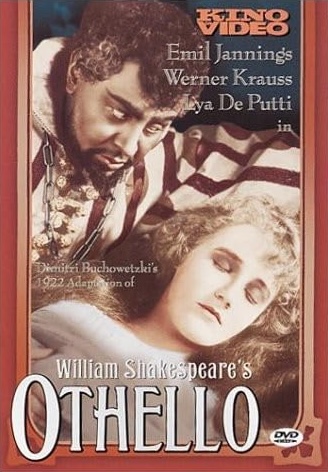
Othello. Dir. Dimitri Buchowetzki. Perf. Emil Jannings and Werner Krauss. 1922. DVD. Keno Video, 2002.

The advanced special effects of this film enable us to see, with Othello, Desdemona and Cassio embracing. I'm not so sure about the Pierrot costume—it seems to have more of a comic than a tragic effect.


Links: The Film at IMDB.

Click below to purchase the film from amazon.com
(and to support Bardfilm as you do so).

Tuesday, October 14, 2008

Desdemona

Desdemona [a.k.a. Up with the Curtain (For Åabent Tæppe)]. Dir. August Blom. Perf. Valdemar Psilander, Thyra Reimann, Nicolai Brechline, Henry Knudsen, Svend Bille, and Julie Henriksen. 1911. Nordisk, 1911.

Kenneth S. Rothwell suggests that there are seven kinds of Shakespearean Derivatives. This very early silent film falls into his classification of "Mirror movie." In this kind, the characters in the film put on a Shakespeare play, and the plots of the play-within-the-film and the film interact.

In this Danish film of 1911, a jealous actor playing Othello strangles his actor-wife on stage.

Monday, October 13, 2008

A Week of Silents at Bardfilm

Richard III. Dir. James Keane. Perf. Frederick Warde, Robert Gomp, Albert Gardner, and Violet Stuart. 1912. DVD. Kino, 2001.

Gnarls Barkley. “Feng Shui.” St. Elsewhere. Warner Music, 2006.

I've been collecting rare clips of silent versions of Shakespeare plays for a while now, and I've gathered enough to have a week of Silents. [At some point, I will also have a week of silence at Bardfilm, but that's for the future.]

I've posted on Silent Shakespeare before (cf. posts on Hamlet, The Tempest, and King Lear). This week, we'll look at shorter, rarer clips, most of which are found on the DVD listed above and below: the Kino release of the 1912 Richard III.

Although there's always dispute about these matters, it seems that the earliest extant American feature film is this version of Richard III. Staring Frederick Warde, the film runs about an hour. One interesting thing about the the film is the Frederick Warde (in the photograph above) used to tour with the film, reciting monologues and offering commentary on the film as it ran. With Warde around, it wasn't exactly silent Silent Shakespeare; unfortunately, all we have left is the silent film. It would be marvelous to have a recording of Warde to go along with it, but the survival of the film is miracle enough.

Here's a montage from the film—with a nifty soundtrack by Gnarls Barkely:


Links: The Film at IMDB.

Click below to purchase the film
and /or the album containing the song on the soundtrack
from amazon.com
(and to support Bardfilm as you do so).

Sunday, October 12, 2008

Today: "Blow, Winds, and Crack Your Cheeks"—Slings and Arrows Style

“That Way Madness Lies.” By Susan Coyne. Dir. Peter Wellington. Perf. Martha Burns, Paul Gross, Don McKellar, Mark McKinney, Oliver Dennis, Susan Coyne, Stephen Ouimette, Catherine Fitch, and William Hutt. Slings and Arrows. Season 3, episode 2. Movie Central: Canada. 7 August 2006. DVD. Acorn Media, 2006-2007.

Briefly, one version of the "Blow, winds, and crack your cheeks" speech from King Lear appears below.  This time, Lear is accompanied by The Storm-a-Tron 3000 (or something)—the latest in storm technology for dramatic productions. More on this later, but the words and the actors should be able to convey the sense of the storm more than all the special effects in the world. Take a look:

[Note: One obscenity has been silenced—but, because you can still tell it was there, I thought you should know about it in advance.]


Next week will be a week of Silents at Bardfilm. Not a week of silence, note: a week of Silents.
Links: Episode List at IMDB.

Click below to purchase the series from amazon.com
(and to support Bardfilm as you do so).

Saturday, October 11, 2008

Slings and Arrows: Third Season, Opening Song

“That Way Madness Lies.” By Susan Coyne. Dir. Peter Wellington. Perf. Martha Burns, Paul Gross, Don McKellar, Mark McKinney, Oliver Dennis, Susan Coyne, Stephen Ouimette, Catherine Fitch, and William Hutt. Slings and Arrows. Season 3, episode 2. Movie Central: Canada. 7 August 2006. DVD. Acorn Media, 2006-2007.

King Lear, offering a remarkable amount of small moments of comic relief, is still so overwhelmingly tragic that we seek, in our own responses to it, to find humor. One place where this is found is, once again, in Slings and Arrows.

The third season, as you know, deals with King Lear. The opening song gives us a comic version of the plot. Here's that song, followed by its lyrics (for your convenience).


The lyrics follow:
When life takes its toll, and fate treats you bad . . .
You used to be king, and now you've been had . . .
Alone with your fool, you think you'll go mad—
It's nice to take a walk in the rain.

A stomp through a storm is what I'd advise,
When people you trust tell nothing but lies,
And kidnap your friend and gouge out his eyes—
It's nice to take a walk in the rain.

You say your daughters are evil plotters?
A pitter-patter shower will keep you sane.
When all has been said, and all have been slain,
It's good to take a walk in the rain (for several hours);
Helps to have a howl in the rain (without your clothes on)—
Nice to take a walk in the rain!

Links: Episode List at IMDB.

Click below to purchase the series from amazon.com
(and to support Bardfilm as you do so).

Friday, October 10, 2008

A Little Ado Before the Weekend

Much Ado About Nothing. Shakespeare Retold. Dir. Brian Percival. Perf. Sarah Parish, Damian Lewis, and Billie Piper. 2005. DVD. BBC, 2007.

A considerable amount of time has passed since I last wrote on the BBC's Shakespeare Retold —or, at least, since I wrote about their derivative versions of Shakespeare's plays. Their version of Much Ado About Nothing is at the very top of the tree.

Since I've been teaching King Lear—which has comic relief, but not of a very comic or a very relieving nature—I've been feeling the need for a break.

This clip is from the beginning of the BBC's production of Much Ado. And, I suppose, it doesn't exactly offer a spoiler, though it does offer an interesting take on the backstory in Shakespeare's play. It's brilliant, actually. And it has chosen its soundtrack brilliantly. Well, take a look, and I'll offer some commentary below.


Shakespeare offers a simmilar backstory to the relationship between Beatrice and Benedick, but keeps it offstage and lets us infer it from the text. The BBC decides to start with that backstory. Although it leaves a bit less to our imaginations, it is still enormously effective.

Links: The Film at IMDB.

Click below to purchase the film from amazon.com
(and to support Bardfilm as you do so).

Thursday, October 9, 2008

Johnson, Shakespeare, and Gloucester

Johnson, Samuel. Preface to Shakespeare. New York: Kessinger Publishing, 2004.

In his Preface to Shakespeare, Samuel Johnson wrote this about King Lear
The Tragedy of Lear is deservedly celebrated among the dramas of Shakespeare. There is perhaps no play which keeps the attention so strongly fixed; which so much agitates our passions and interests our curiosity. The artful involutions of distinct interests, the striking opposition of contrary characters, the sudden changes of fortune, and the quick succession of events, fill the mind with a perpetual tumult of indignation, pity, and hope. There is no scene which does not contribute to the aggravation of the distress or conduct of the action, and scarce a line which does not conduce to the progress of the scene. So powerful is the current of the poet’s imagination, that the mind, which once ventures within it, is hurried irresistibly along.
Oh, certainly. I hope that that happens when my students read the play, though one can easily become too bogged down in the footnotes to be pulled along quite as irresistibly as all that.

There's also the question of "scarce a line." Even with the high praise above, the blinding of Gloucester is a stumbling block, for Johnson as for others:
But I am not able to apologise with equal plausibility for the extrusion of Gloucester’s eyes, which seems an act too horrid to be endured in dramatick exhibition, and such as must always compel the mind to relieve its distress by incredulity. Yet let it be remembered that our authour well knew what would please the audience for which he wrote.
I suppose, with all the bear-baiting and seelèd doves of the Renaissance, this might be considered "pleasant" for an audience. But I would rather use the phrase "knew what would have a decided effect on his audience" than "knew what would please the audience." The reported death of Cornwall is more apt to "please" than the blinding of Gloucester.


Wednesday, October 8, 2008

WWSPST?: What Would Sir Philip Sidney Think?

Shakespeare: A Day at the Globe. By William Furstenberg. Prod. William Furstenberg. Videocassette. Guidance Associates, 1990.
Sidney, Sir Philip. The Defense of Poesy. Sir Philip Sidney. Ed. Katherine Duncan-Jones. Oxford: Oxford University Press, 1994. 101-42.

While cleaning up the office yesterday, I put in a videocassette I had checked out at random from our school library to see if it would be of any use. It appears to be dated 1990 (though it's hard to make out the Roman numerals on the closing screen); it also appears to be a videocassette of a film strip / LP combo available at some point for classroom use.

It turned out to be mildly interesting and not at all useful.

Except that it had the following slides accompanying excerpts from Sir Philip Sidney's Defense of Poesy. In the quotations, Sidney (who died in 1586—unless you follow the conspiracy theorists who arugue that he just went into hiding, only to re-emerge in the character of Christopher Marlowe (who went into hiding in 1593, only to re-emerge in the character of William Shakespeare)—and who was unable to see any one of Shakespeare's plays—unless, of course, he wrote them all himself) is objecting to the theatre of his day and its violation of the Unities:


I wonder what Sidney would have thought about (1) any one of Shakespeare's plays and (2) any film version of any one of Shakespeare's plays. Would he have been horrified, or would he have modified his views after seeing what a director like Branagh could do with a script?

Click below to purchase the book from amazon.com
(and to support Bardfilm as you do so).

Tuesday, October 7, 2008

Stand up! Stand up!

King Lear. Dir. Brian Blessed. Perf. Brian Blessed, Hildegard Neil, Jason Riddington, and Phillippa Peak. 1999. DVD. Storm Bird, 2006.

At the request of a reader / viewer, I'm posting a portion of Jason Riddington's Edmund from the Brian Blessed Lear. I'm delighted to do so, because I always hear the speech as a rousing, Saint-Crispin's-Day-esque speech that rallies its audience to a fever pitch—even though it's in favor of the bad guys. Most actors seem skittish with the speech, most so with the "Now, gods, stand up for bastards" conclusion.

Riddington doesn't mind giving the speech some of its full grandeur:


I'm not entirely satisfied with this version—I'd love to have the soundtrack from Kenneth Branagh's Henry V playing in the background, swelling and rolling and moving us to cheer for Edmund during this speech.

Links: The Film at IMDB.

Click below to purchase the film from amazon.com
(and to support Bardfilm as you do so).

Bardfilm is normally written as one word, though it can also be found under a search for "Bard Film Blog." Bardfilm is a Shakespeare blog (admittedly, one of many Shakespeare blogs), and it is dedicated to commentary on films (Shakespeare movies, The Shakespeare Movie, Shakespeare on television, Shakespeare at the cinema), plays, and other matter related to Shakespeare (allusions to Shakespeare in pop culture, quotes from Shakespeare in popular culture, quotations that come from Shakespeare, et cetera).

Unless otherwise indicated, quotations from Shakespeare's works are from the following edition:
Shakespeare, William. The Riverside Shakespeare. 2nd ed. Gen. ed. G. Blakemore Evans. Boston: Houghton Mifflin, 1997.
All material original to this blog is copyrighted: Copyright 2008-2039 (and into perpetuity thereafter) by Keith Jones.

The very instant that I saw you did / My heart fly to your service; there resides, / To make me slave to it; and, for your sake, / Am I this patient [b]log-man.

—The Tempest